“Thy dawn, O master of the world, thy dawn….”: ON HER MAJESTY’S SECRET SERVICE AT 50 (a repost)

Fifty years ago today, on December 18, 1969, the sixth James Bond movie opened. Its initial reception was mixed, partly because the Bond mania of the 60s was simmering down, and partly because it was the first time that Sean Connery had not starred as Agent 007, in favor of complete unknown newcomer George Lazenby. While I didn’t see the movie until an ABC telecast sometime in the early 80s, I liked it from that very first viewing and it very quickly shot up my personal rankings until by the time I was fifteen or sixteen I was willing to crown it as my favorite Bond movie of all time. And while certain opinions that we have in our youth shift as we learn and grow, some do not…and for me, this is one of the opinions that stuck. To this day, almost 19 movies later, OHMSS has never been equaled.


I wrote the following essay almost nine years ago and repost it here without a single word changed, except to fix a broken link.


Sometimes I change my mind about movies. Sometimes I don’t. Some movies meant a lot to me, years ago, but have dropped away to the point that I’ve forgotten about them. Other movies, though, have stayed with me forever. One of those is On Her Majesty’s Secret Service, the sixth James Bond film, which I have regarded since I was a teenager as the best Bond film ever made. In fact, I consider it one of my favorite films of all time, in any genre.

My long examination of the film, with lots of screencaps, after the page break.


Released in 1969, OHMSS came out when the Bond-mania of the 1960s was starting to wane. Films like Goldfinger and Thunderball had been enormous hits, but now, Sean Connery had left the role of Bond and a complete unknown named George Lazenby was cast as his replacement. All this is well known, and over the years, Lazenby’s performance in OHMSS has been reliably controversial. To this day, there are Bond fans who loathe his performance, and to this day, there are fans who not only think he did a fine job, but that he really doesn’t stand in Sean Connery’s shadow at all. (I am in the latter camp.)

Narratively speaking, OHMSS is one of the strongest films in the series. Its script, by Richard Maibaum, is outstanding, with lots of wit and fine dialogue that rarely seems as far-fetched as Bond dialogue can sometimes get. The story, though, does present problems for people who are interested in continuity.

The problem comes from the fact that Eon Productions (the producers of the Bond series) did not adapt the Ian Fleming novels to the screen in the order that they were written. The first Bond film is Dr. No; the first novel is Casino Royale. The Bond films of the 1960s, excepting Goldfinger, all feature Bond squaring off against the minions of SPECTRE, culminating in You Only Live Twice when he finally meets Ernst Stavro Blofeld face to face. However, in the novels, it’s in OHMSS that Bond meets Blofeld. The problem then is why Bond and Blofeld don’t recognize each other in the OHMSS film when they come face to face. There are lots of possible fictional explanations for this, and the original idea was to have Bond undergoing plastic surgery to explain his new resemblance to George Lazenby. The producers chose not to do this…and yet, in the next film, Diamonds are Forever, they would use the plastic surgery idea to explain why Blofeld in that film now looks like Charles Gray. (Without, of course, explaining why it is that Bond now no longer looks like George Lazenby but like Sean Connery again.)

In watching OHMSS recently, I came to realize that the Bond films that are the best tend to be the ones that most deviate from the standard Bond “formula”. That certainly holds true with OHMSS. The film starts with Bond, already on assignment in Portugal. But, as M notes in the film’s very first scene, no one with MI6 has any idea where Bond is, and his current assignment is becoming politically problematic: “Number 10 is making ugly noises about Operation Bedlam.” Operation Bedlam, we later learn, is the search for Blofeld, who is presumably on the run following his failed scheme in You Only Live Twice. So already Bond is on thin ice with his superiors; he is failing at an assignment; he’s been on a single assignment for two years.

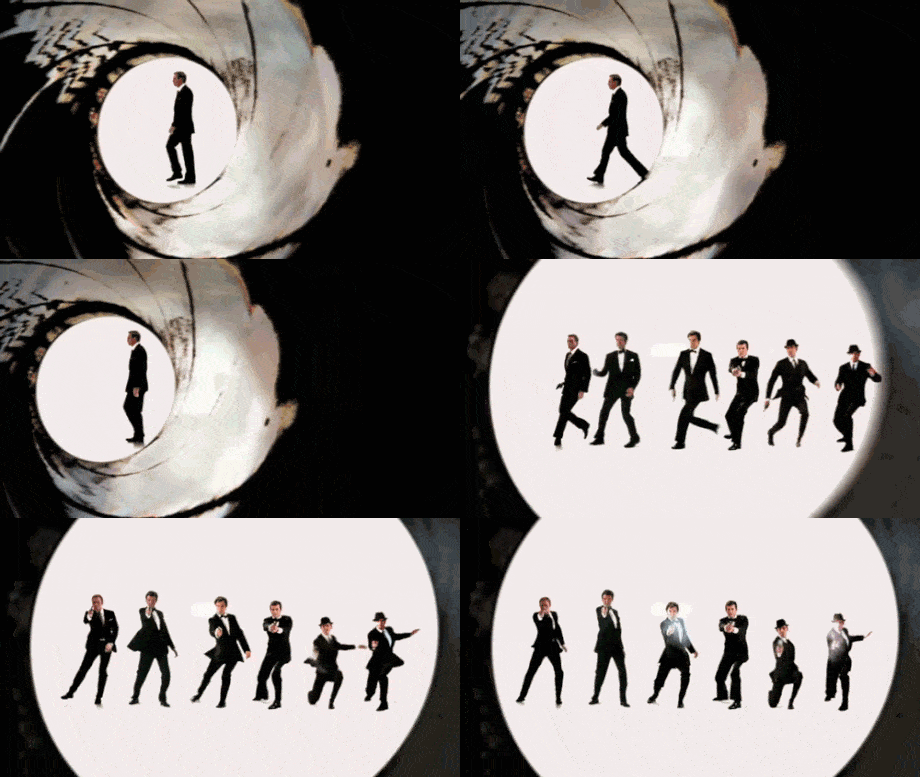
That last is important, because time is a recurring motif all through the film. Bond’s relationship with time is a constant underlying theme, made explicit in Maurice Binder’s typically-brilliant opening titles sequence. Clocks and hourglasses figure prominently in the title sequence. Now, timers and clocks are a constant trope of spy fiction and thriller films, what with heroes defusing bombs or whatnot as the digital timer ticks off the last few seconds before disaster is to strike. But there is something different about time in OHMSS: even as Bond is up against the same kinds of time constraints that he’s always faced before, we get a real sense that he’s weary of the whole thing and desires a different kind of relationship with time.

So Bond is in Portugal, driving along, when a woman in a red car passes him on a lonely seaside road. Bond, of course, gives chase, and comes to a beach where the woman parks her car and goes down to the water, where she starts to wade out. Bond spies her through the telescopic sight of his rifle, and it’s thus that we get our first close-up of Contessa Teresa di Vicenzo, better known as Tracy.
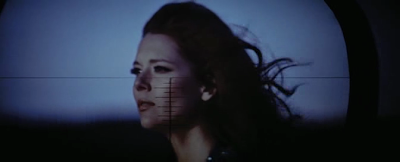

Tracy – played by Diana Rigg – already looks sad and lost in this shot, as Bond watches her wander into the water. He quickly realizes that she intends to let the tide carry her out; he is watching a suicide attempt, so he intercedes, bringing her back in from the water and introducing himself – “Good morning! My name’s Bond. James Bond.” Here we see Lazenby’s face for the first time; up until now, the film has teased us with shots of his head from behind, closeups of his lips as he lights a cigarette, and the like.
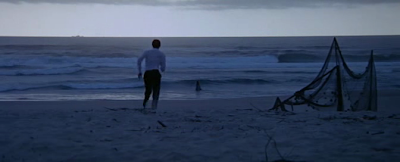

Two goons show up here, to take Tracy away. Of course, Bond has no idea who this girl is, or who her two “protectors” are, but the goons apparently intend to kill Bond, so there’s a fight. It’s a pretty kinetic fight, and all of the fights in OHMSS are pretty kinetic – and with good reason, as director Peter Hunt has literally sped them up in the editing room. I’m not sure why he chose to do this – some fans speculate that Lazenby was an awful screen fighter, and the sped-up fights are a ploy to conceal this – but it doesn’t matter. This is another facet of OHMSS that can divide fans. Some are distracted by the quickened fight scenes; others – myself included – simply accept it as a stylistic choice in a film that has a lot of style going for it.

Anyhow, Bond dispatches the goons, but the girl has already fled, jumping back in her car and driving away. Bond is left alone on the beach, holding her shoe, whereupon he breaks the fourth wall to tell us, “This never happened to the other fellow.” Cut to opening title sequence.

When we return, Bond is still in Portugal, and checks into a hotel, where he notices a red Cougar parked outside that he is informed belongs to a lady. He takes his room, and looks down on the pool, whereupon there’s a wonderful transition shot from day to night as this shot…
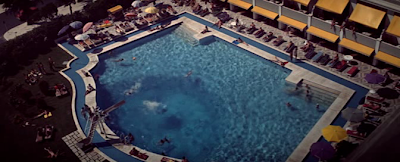

…fades into this one, while a slow tune for jazz flute plays in the background.


I love that second shot; the pool seems deserted but the reversed “Casino” logo is disrupted by ripples a couple of times. This isn’t the kind of shot one typically sees in a Bond film.

Over the next twenty minutes or so, the film’s story continues to unfold slowly, and in a way that seemingly has absolutely nothing to do with spy intrigue. Bond goes to the casino to play baccarat (the traditional card game of the Bond films, until Casino Royale replaced it with poker). An elegantly-dressed woman enters the game, places a huge bet, and promptly loses – but she has no money. Bond recognizes her: she is the woman whom he saved on the beach the night before. Detecting her streak of self-destructive behavior, Bond bails her out for twenty thousand francs and then has a brief conversation with her over champagne, where she is quite blunt about how she is to repay her debt to him: she gives him her room number and says, “I hope it’ll be worth it.” She is cool and businesslike; when Bond calls her “Contessa Teresa”, she replies, “Teresa was a saint. I’m known as Tracy.”
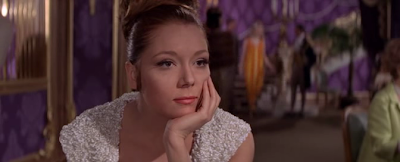

Bond is already intrigued by this woman who is proving somewhat resistant to his charms, by her mysterious background, and by the fact that she has goons following her around. One attacks him when he enters her room; after dispatching the goon, Bond figures that the tryst isn’t happening and goes back to his room, which is where she’s waiting. She pulls his own gun on him, but now he is having none of this: he demands to know who the men following her are, and when she claims ignorance, he slaps her and says, “I can be much more persuasive, Contessa.” Ahhh, the freewheeling sexism of the early Bond films – not a quality of the Bond series that I’ve missed, but it’s worth noting that Tracy proves equal to the moment, lifting her gaze to fiercely meet Bond’s as she says, “Whatever else I may be, I’m not a liar.”
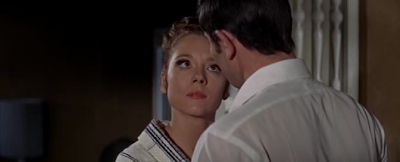

Here, at this moment, is when the film score gives us the first hint that this girl is different, because this is where we first hear the film’s love theme. After some more discussion during which Tracy still resists Bond’s efforts to figure out who she is and why she is acting the way she is (“The only thing you need know about me, Mr. Bond, is that I pay my debts”), Bond and Tracy do, in fact, sleep together, but when he awakes the next morning, he finds that she is gone not just from his room but from the hotel entirely…but not before leaving two chips for ten thousand francs in his bedstand. “Paid in full,” Bond notes – and we never learn just how she came up with that money.

Here, Bond is again greeted by the goons following Tracy, who have him at gunpoint (with his own gun – Bond was a bit careless in not noticing that it was missing). The goons take him on a long drive to a shipping company headquarters, where Bond meets the man behind these guys. Is he a villain? Maybe, at first glance – he is Marc-ange Draco, the head of a crime syndicate called the Union Corse – but more relevant, he is Tracy’s father. It is he who fills in some of the blanks, telling the story of Tracy’s birth and her sad life which has led her to behave self-destructively. Draco’s big idea, though, is that Tracy’s need can be filled by…a man. A man like Bond. This, too, is eerily sexist, and Bond seems to see through this whole notion, refusing Draco’s offer of a dowry of one million pounds in gold.
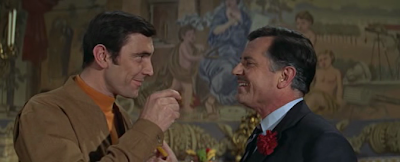

But here, about a half hour into the movie, is when the film finally steers its course back into the espionage arena, because Bond senses an opportunity here. He knows that Draco, as head of a huge crime syndicate, may well have information on the whereabouts of Ernst Stavro Blofeld; he implies to Draco that while he won’t take Draco’s money, he might consider marrying Tracy if Draco tells him where Blofeld is. Draco, for his part, says “If I did know [where Blofeld is], I would not tell Her Majesty’s secret service. But I might tell my future son-in-law.” Bond gets his first break in the case in years, returns to London to report to M on what he’s learned…and the formula reversals continue.

M takes Bond off the case without even hearing his new lead. “You’ve had two years to run him down,” M points out. “The license to kill is useless unless one can set up a target.”

Bond has been chasing Blofeld for two years, and the little bit we’ve seen of that chase has taken its time unfolding – but M has just decided that Bond is out of time, and Bond angrily decides that he’s had enough of the whole thing and decides to resign. He dictates his resignation letter to Moneypenny and goes to clean out his desk (allowing a few brief glimpses of gadgets from Bond-films past), before M calls him back to accept his request. Bond thinks he’s out of a job, but Moneypenny has changed the letter to a request for two weeks’ leave, so Bond heads out again…this time to return to Draco to get his information. Bond has been freed of his time constraint for finding Blofeld, since there really can’t be any doubt that he intends to continue the chase.

(In a charming bit, M expresses his gratitude to Moneypenny for changing Bond’s resignation letter as well, saying “What would I do without you, Miss Moneypenny? Thank you!”)

The film’s relaxed pace continues, as Bond returns to Portugal to meet with Draco at his country estate. Tracy is there as well, and is disgusted to find Bond there; she clearly regards him as just another in a long line of men who have come along who were interested in one thing alone from her. Funny thing is, we know Bond’s history, and this might well not be off the mark – only Tracy is, for the first time, different for Bond. Tracy susses out the crappy deal between Draco and Bond (“No woman would waste this excellent champagne discussing a business deal unless she herself happened to be part of the arrangement”), and basically forces her father to give Bond the information he wants without going through with the whole marriage idea. Draco relents, telling Bond that there may be a connection between Blofeld and a lawyer in Bern, Switzerland; then Tracy gets up from the table and storms away after saying, “And now Mr. Bond need have no further interest in me.”

Bond, however, disagrees, and goes after her. Meeting her by her car, he finds that Tracy is in tears. Why? I suppose it’s because she’s sick of this kind of thing. She doesn’t want to be someone’s prize or payment, and she doesn’t want to pay her own debts anymore, either. When Bond catches up to her, though, he does something interesting: he doesn’t crack wise, or make it obvious that his next goal is to make love to her. In the first real gesture of intimacy we have ever really seen from James Bond, he brushes the tears from her cheeks, and then takes Tracy into his arms.
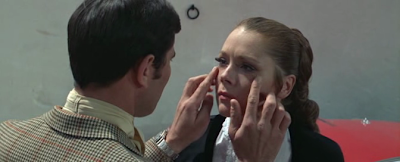

Our slow pacing continues, as what comes next is an honest-to-goodness love montage, complete with love song (“We Have All the Time In the World”, sung by Louis Armstrong), which at first might seem terribly out of place in a James Bond film, but which works here, because the film has taken its time in setting it up. We’re only vaguely aware that Bond is on the job at all; the whole first third of the film is given to him meeting this strange, wounded woman and finding himself under her spell. The title of the song used makes it all clear that Bond has finally found a woman with whom he wishes to relate outside of his job, because as a spy “on Her Majesty’s secret service”, Bond never has all the time in the world. His world is a world of ticking time bombs, of stopping villains before it’s too late, of passing moments of physical pleasure that must be set aside quickly so that he can move on to the next threat. Now, he’s getting his first hint of a world where one doesn’t have to worry about time.

The film never states it outright, and I have no idea if George Lazenby intended it (aside from the one scene, later in the film, where the subject sort of comes up), but his portrayal of Bond really does seem to convey a certain feeling of weariness about the whole business. Lazenby’s Bond is competent, skilled, brave, and witty – but he also seems just a bit tired of it all. It’s in little touches, really – would a Bond who is really invested in things fail to notice that his gun wasn’t where he’d left it? If he’s on assignment, would he really be heading out for a round of golf? It’s not that Bond is “phoning it in”, not at all, but it’s as if the thought is starting to form in the back of his mind that maybe, just maybe, he doesn’t want to be 007 for his entire life.

As the montage ends, though, Bond is back in the world of spying and being up against time. He has to infiltrate the office of a lawyer named Gumbold and search for any connection he can find to Blofeld, while Gumbold is off at lunch. For a simple office break-in, this scene is surprisingly tense, because of the time limit. Gumbold emerges from his office and walks down the hall, curtly informing the desk attendant that “I’ll be back in an hour.” Gumbold’s shoes click on the marble floor of the office building with such precision (we’re in Switzerland, after all) that it sounds like the ticking of a clock. Bond arrives, and goes to work, using the only real gadget in the movie: a safe-cracker that also comes with a built-in photocopier. This is hoisted up to the balcony of Gumbold’s office from the construction site next door – Bond has a man there – and then Bond has to simply wait for the machine to do its job. Meanwhile, John Barry’s suspenseful music churns in the background, first slowly and then picking up steam as the hour ticks past. You can watch the entire scene here; it’s like a thriller-within-a-thriller. I love the bit where Bond settles in, looking bored while he waits for the safe cracker to do its thing; it’s also hilarious the way Bond finds Gumbold’s issue of Playboy, tucked into a newspaper.

Of course, Bond finds something: letters from a “Count de Bleuchamp”, who is apparently seeking to establish himself as reigning Count of the Bleuchamp family. Bond takes this information to M – visiting him at his home – and indicates that “Bleuchamp” is the French form of “Blofeld”. The reversal here is interesting: Bond is briefing M, not the other way around.

What unfolds next is more in traditional keeping with Bond films, as the intrigue takes over as Bond, posing as an expert in heraldry and genealogy, heads to Switzerland to find out if this “Bleuchamp” is Blofeld or not. Of course, he is, with the whole works: a new scheme involving his posing as a doctor who cures allergies, the young women who are his patients (but who are really unwitting pawns of his, via mind control), and a fortress perched atop a Swiss Alp.
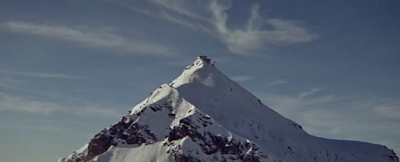

Of course, what commands Bond’s attention almost immediately is Blofeld’s allergy patients:


There’s a funny scene where Bond is trying to seduce one of the girls at the moment the mind-control stuff in her room starts up: swirling red lights, odd music, and Blofeld’s voice coming over the loudspeaker to address this girl who is mortally afraid of…chickens. Bond’s expression of “WTF?!” is perfect as we hear Blofeld’s voice intoning things like “You love chickens. You love their feathers.”
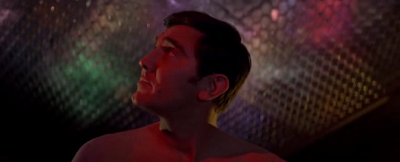

Even so, all of this continues to unfold quite slowly, and the film actually is free of action entirely from the fight in Tracy’s hotel room fifteen minutes into the picture until Bond’s capture by Blofeld over an hour in. OHMSS allows its story to unfold, and the slackening of the pace makes it all the more tense later on when Bond finds himself once again battling the clock. There is a fine scene, after Bond has been found out by Blofeld, where Bond must escape from the gear room of the cable cars that provide the only access to the mountain hideaway; then Bond lurks about as Blofeld’s “allergy patients” – beautiful girls, all of them – are given their final hypnotic briefing on how things will go now. The girls are each given an atomizer, theoretically filled with perfume, but which are actually filled with a toxin that, according to Blofeld, will cause widespread infertility in crops and livestock. The girls will be hypnotically instructed as to when to release the toxin.

Now, Bond is up against the clock, and makes his escape from Piz Gloria (the mountain hideaway), on skis. It’s surprising to note that, aside from a couple of brief fistfights, this is the first action set piece since the teaser sequence, and it comes well over an hour into what was for years the longest of all the Bond films. (Casino Royale was actually longer.) The ski chase in OHMSS is, for me, still the best ski chase ever filmed for a Bond movie (subsequent skiing scenes would appear in The Spy Who Loved Me, For Your Eyes Only, A View to a Kill, and The World Is Not Enough). It relies fairly heavily on rear projection during the closeups, but the entire sequence is edited together wonderfully, with the main theme from the film making its first reappearance since the title sequence.
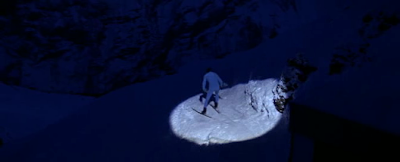

What’s great about the ski chase is that Bond has to work for it. So many Bond chases in other films make it look easy for him, but here, Bond is constantly having to re-escape. At one point, he loses one ski; at another, he has to lie in wait for his pursuers to come upon him, which results in a couple of fights atop a thousand-foot-high cliff. Bond makes it down the mountain, to the charming Swiss village in the valley where there’s all manner of Christmas celebration and ice skating and happy people all over the place…and yet, the bad guys are there too, and Bond can’t get away. This is all pretty fascinating: many times in the series, we see Bond evade pursuers by putting a big crowd of people between them and himself. Here, though, it doesn’t work, and we become aware, through a series of quick cuts from the crowd to the pursuers to Bond back to the crowd and back again, that Bond is really, genuinely afraid. It’s not often at all in the 007 movies that we get to see Bond feel fear.
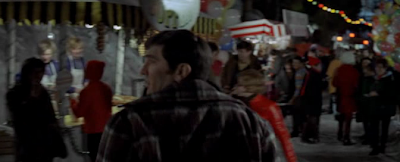
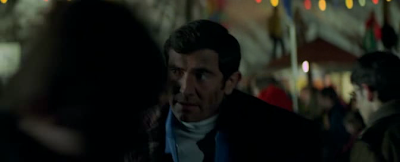
And, in keeping with the film’s reversal of quite a few formulas, Bond doesn’t escape on his own. He is rescued, by an unlikely heroine:


Tracy is there. She’s followed Bond to Switzerland, based on information from her father, and now she’s found him. She gets Bond out of that village, albeit not without being seen by the bad guys, who again give chase. With Tracy driving, Bond is the passenger in a high speed chase that takes us into a demolition derby.
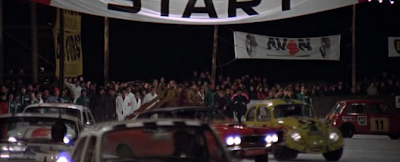

And after that, they drive away, straight into a snowstorm that forces them to take shelter in someone’s barn. This scene is the emotional heart of the film, because Bond and Tracy don’t just do what Bond and any other girl would do when trapped in a barn during a snowstorm. They actually talk first, and they talk about something: their relationship with each other. Bond can’t tell her what really went on up at Piz Gloria, because he’s still an agent; Tracy says that they’ll just have to keep doing things the way they are. “Tracy, an agent shouldn’t be concerned with anyone but himself,” Bond says…and the way George Lazenby delivers the line makes absolutely clear that as true as it may be, Bond is sick of it. “I’ll find something else to do,” he says. This is as startling an admission as you’ll hear from James Bond. Tracy asks if he’s sure, and he is: “I love you, and I know I’ll never find another girl like you.” And thus does James Bond get engaged.
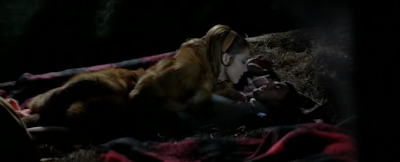
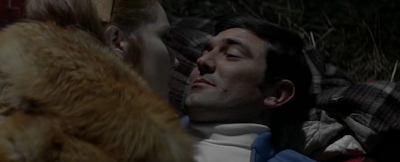
This scene is the scene in the film; if this scene doesn’t work, pretty much the entire film is sunk, because the entire subtext of the film is that James Bond is tired, he’s vulnerable, and he wants to do something else. Lazenby sells this scene so well that it’s almost heartbreaking, and as I’ve said for years, I defy any of Lazenby’s detractors to claim in seriousness that Sean Connery would have done this scene any better. (Frankly, as much as I love Sean Connery, I’m not sure he wouldn’t have done this seen worse. In his Bond films, he never presents a single hint of genuine vulnerability in his portrayal of 007. Which isn’t to say that Connery couldn’t do “vulnerable”, because clearly in his acting career we see that he could, but in playing Bond, he didn’t, and I’m not sure he would have done so here.)

The next morning, Blofeld and lackeys arrive at the barn, only to find that Bond and Tracy have already left, and are skiing away. There’s another ski chase – this one taking place by day instead of night – and again, it’s a close affair that ends when Blofeld uses a flare to set off an avalanche. Thus he captures Tracy, but assumes that Bond is dead (“A grave deep enough to prevent even 007 from escaping!”). Of course, Bond isn’t dead, but he is despondent that he has failed: Blofeld’s plan is alive, and the woman he loves is now his prisoner.
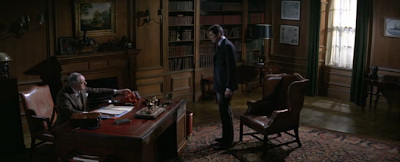

Back in London, Bond paces in M’s office as M is notified by his superiors that the United Nations plans to give Blofeld what he wants: a full pardon for all crimes as head of SPECTRE and full recognition of his title as “Count de Bleuchamp”. M seems oddly accepting of this, while Bond is thinking that if they can get to Piz Gloria before Blofeld’s deadline, they can destroy his center of communications and thus keep him from ever being able to psychologically order his patients all over the world to release his toxin. M refuses to go along with it, assuming that all Bond wants to do is save Tracy: “This department is not concerned with your personal problems.” Bond retorts, “This department owes her a debt. She saved my life.” Bond still fails to persuade M to allow an attack on Piz Gloria, so Bond organizes one anyway…using Draco and his men.

This brings us to the film’s final action setpiece, the aerial attack led by Bond and Draco in helicopters against Blofeld’s headquarters. As the choppers approach, Draco has to convince the Swiss authorities that they are a Red Cross flight. As Blofeld and his men listen in on the radio transmissions, Tracy recognizes her father’s voice, realizes that the game is afoot, and starts using her feminine whiles to appeal to Blofeld, thus keeping him distracted and not realizing that he’s about to be attacked until the guns start shooting.

From here out, it’s pretty standard Bond film set-piece fare: explosions and gunfire, close fights, and so on. Bond slides on his stomach across the ice of a curling board, dispatching lots of bad guys in the process; meanwhile, Tracy has to fend off several goons on her own, further establishing her credentials as Bond’s genuine equal. At no point in the film, really, is Tracy ever a helpless damsel in distress, screaming “James!” as Bond tries to rescue her; instead, a number of times she rescues him. Anyhow, Draco’s men rout Blofeld’s, and plant explosives to destroy Piz Gloria. Bond manages to find Blofeld’s map of where his “angels of death” are all located, and is taking photos of the locations when Blofeld fires on him and then runs away. Bond gives chase, leading to a bobsled chase with Bond trying to catch Blofeld as Piz Gloria explodes behind him.

The chase ends with Blofeld being snagged by the neck in a tree; apparently Bond assumes that Blofeld is dead, which is ironic because that is the same mistake that Blofeld (and others) are always making about Bond, and this time it will have disastrous consequences. Meanwhile, Bond goes off to live happily ever after: we see him purchasing Tracy’s wedding ring, and then putting it on her finger and wiping away her tears of happiness in a reprise of his gesture from the bullfight. Bond says his goodbyes to M and Q; he gives Draco back the one million pound dowry (“Her price is above rubies…or even, your million pounds!”, and then, after tossing his hat one last time to a crying Moneypenny, drives off into his new life with his bride.


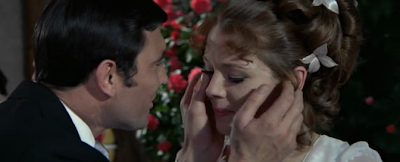
It’s about here that I usually start to lose it, when watching this movie. There are lots of movies with sad endings, and I count among them many of my favorite movies. This one, as well. But when I stop and think on it a moment, On Her Majesty’s Secret Service is unique among movies with sad endings in that every time I watch the film, I desperately want the ending to not be sad. Just…this…once.

What happens is this: Bond pulls over on the side of a road that’s overlooking the sea, so he can pull some of the flowers off the car. He and Tracy enjoy some playful newlywed banter. Another car comes along…and it’s driven by Blofeld. In the backseat is Irma Bunt, his chief lackey; and in her hands is a machine gun. She sprays Bond’s car with bullets as he speeds past.
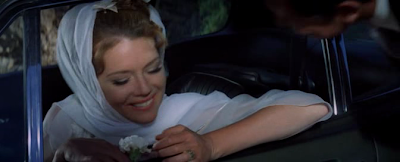

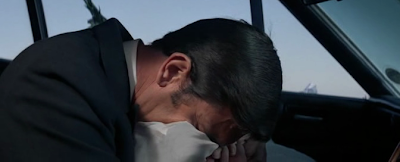
“It’s Blofeld!” Bond shouts, as he jumps back into the car. “It’s Blo–” he starts to say to Tracy, when he looks at her…and sees the single bullet wound in her forehead. Tracy is dead. Her body slumps into his lap as a policeman pulls up alongside on a motorcycle. Bond looks up at the policeman, and with the dazed calm of a person whose brain hasn’t yet caught up to what’s just happened, he says, “It’s all right, really, she’s just having a rest. We’ll be moving on soon…there’s no hurry, you see, we have all the time in the world.” Here Lazenby’s voice cracks as he leans down over her, kisses her forehead, and then buries his head as he begins to sob. John Barry’s instrumental arrangement of “We Have All the Time in the World” plays through these last few seconds. The music is heartbreaking, and reaches its final chord as we fade to the film’s final shot: the bullet hole in the windshield of James Bond’s Aston Martin.
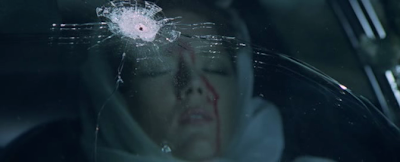
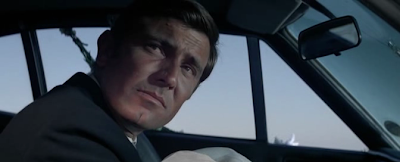
Then, as the credits roll, the “James Bond Theme” smashes in, obliterating the mood from the beautiful melody of “We Have All…”. I’ve heard film music fans over the years argue that this is a mistake on the part of the filmmakers, and that the film should have used “We Have All…” as the end title, but I don’t agree – because it fits perfectly with the themes of the film. Time, Bond’s weariness as a secret agent, all of it is brutally illustrated by the drastic musical switch in moods at the end of OHMSS. As soon as the Bond theme starts, it is as if Bond is being told, “No, you don’t have all the time in the world. That was it. That was all the time you got…and now, like it or not, you’re back in the only world you’ve ever known.” Time is the relentless enemy of us all, and not even James Bond can stand in its way. No one has all the time in the world.

I don’t think it’s anything peculiar to John Barry’s arrangement of the Bond theme in this picture, as opposed to just the connotation of hearing that theme after what’s just happened, but I don’t think you’ll find another instance in the entire Bond series of the James Bond Theme sounding so bitter, so cold. The Bond Theme is a cultural icon, after nearly fifty years of these movies, that musically symbolizes thrills and coolness, but at the end of OHMSS, it’s anything but cool or thrilling. It’s angry, it’s sullen, and it’s unwelcome. We don’t want to hear it…and yet, the film forces it upon us, as it has forced cold, unblinking loneliness upon James Bond, at the moment when he thought himself to be free of it all.

I’ve occasionally wondered what might have been, had George Lazenby stuck around as Bond. I’m genuinely unsure, really. I think his performance in OHMSS is terribly underrated, and that he would have been just fine had he continued in the role. But also, the Bond films were about to undergo a significant transition into campy scripts and gonzo plots. Connery returned for the next one, Diamonds are Forever, in which Blofeld is again the villain – but that film doesn’t make a single mention of the fact that Blofeld killed Bond’s wife, and Bond never even seems angry with Blofeld, just mildly disgusted as he is with any villain. And then Connery would leave, to have the role go to Roger Moore, who would then be saddled with the silliest scripts of all the Bonds (and yet, Moore, too, had his moments when he made Bond cold and ruthless, moments that are often forgotten or overlooked by people who tar the Moore era with the cloth of camp). It’s interesting, though, that Moore’s best Bond film, For Your Eyes Only, opens with Bond visiting Tracy’s grave.

And now that James Bond has been rebooted with Casino Royale and continued with Quantum of Solace, what to make of it all? Will they just go for straight-up remakes of some of the earlier films? Will Daniel Craig’s Bond have to fall in love with a new Tracy, all over again? Who knows…but it doesn’t matter, really. We’ve already got On Her Majesty’s Secret Service. Even if we don’t have all the time in the world.

ADDENDUM, 12/18/2019: Obviously since I’ve written this there have been two more Daniel Craig Bond films, SKYFALL and SPECTRE, both of which I enjoy greatly and both of which have enormous charms. Neither is OHMSS, of course, but those two films do continue the Craig era’s willingness to openly explore the emotional life of James Bond, with SPECTRE containing specific elements that do seem to call back to the 1969 film. I eagerly await the arrival of NO TIME TO DIE in 2020 to see where Daniel Craig’s 007 ends up.
Share This Post

Nobody Did It Better: Thank You, Sir Roger Moore

Sir Roger Moore has died.

I’ve loved all the James Bonds, to be honest. My favorite is George Lazenby, but I appreciate each and every actor who has played the part. There is a special place in my heart for Roger Moore, though, because he was my first Bond, and you don’t forget your first. That initial Bond experience for me was Moonraker in 1979, and I’ve been a James Bond fan ever since.

Here’s Moore as I first saw him:


Oddly, Moore’s first film as Bond is the Bond film I like the least — in fact, I dislike Live and Let Die so much that to this day I do not own a copy of it, and I don’t think I ever have. This isn’t Moore’s fault, though. He’s actually very good in the movie, and my distaste for it is based on other complaints. Moore’s reputation as Bond is unfortunately skewed: many see him more as a comic figure, when the Bond films had a lot more broadly comedic moments than in the Connery (or Lazenby) years. (Witness Jaws flapping his arms after his ripcord breaks in the clip above.) It always struck me as unfair to blame Moore for faults in the writing of the scripts, to be honest, and the Bond films of the 70s were all written with that kind of broad comedy that often bordered on outright slapstick. This started with Sean Connery’s last turn in the role, Diamonds are Forever, and didn’t end until 1981’s For Your Eyes Only toned things down significantly. That film and its successor, Octopussy, are two of my absolute favorites, and I even have a soft spot for the troublesome A View to a Kill, which starts trending to over-the-top comedy again.

Witness this clip from For Your Eyes Only, when Moore’s Bond gets the drop on a vicious hit-man who has been dogging him throughout the film:


That is as lethal a moment as anything that Connery’s Bond ever did, and it’s worth noting that no matter who plays him, James Bond is rarely that cold. But Moore could play it.

Moore’s Bond was an enormous part of my geek childhood, and I wouldn’t be a Bond fan if not for his work. So thank you, Sir Roger Moore, for your wonderful work, and I hope there are some wonderful ladies and nifty Q gadgets awaiting you!

Share This Post

Thoughts on a Matter of Extreme Importance and Relevance

After listening to one of my regular podcasts recently, I realized that there exists a deeply important topic about which most people seem to be deeply confused. As I have a good deal of understanding pertaining to this particular issue, I have decided to use space in my blog in an attempt to clarify things, so that discussion of this deeply important subject can move forward, freed of misconceptions and the errors that those misconceptions can create. These are matters of deep import, and my blog is a wasted opportunity if I do not use it to help the world in its ongoing grapples with this issue.

I speak, of course, of the plot of Octopussy.

The podcast in question was the James Bonding cast, of which I have written before. Octopussy is actually one of my favorite in the series of films featuring the adventures of British secret agent James Bond (code-number, 007). It’s not the first James Bond movie I ever saw – that was Moonraker – but Octopussy was the first one I ever went to see by myself, when I was twelve years old. One shouldn’t discount that: it’s generally my view that what one is into when one is twelve is likely what one is into for much of the rest of life. And that’s not a bad thing.

So, if you remember Octopussy, it’s likely as the one with the ridiculous name, the one where James Bond dresses up as a clown at the end, the one where Bond flies a tiny jet plane in the pre-credit sequence, et cetera. If you remember the plot at all, you likely recall that there’s a Russian general with a plot to detonate an atomic bomb on a military base, and that somehow the story involves Faberge eggs. It is, admittedly, not the easiest plot in the world to follow.

But having listened to the James Bonding guys struggle to explain things, I realized first that the story isn’t that hard to put together, and second, that enough is enough. Let’s get this over with, shall we?

After the opening credits end, we’re in East Berlin (remember, this was 1983), and there’s a clown on the run from two identical twins who are expert at throwing knives. The clown is no slouch, very nearly pulling off the escape before getting a knife in his back and falling into a river. This clown staggers to the British embassy, where he tumbles through a glass door as he dies. Something rolls across the floor to the feet of the Ambassador: a Faberge egg.

Next, Bond is briefed in London. It turns out that someone is auctioning Faberge eggs and other rare Russian treasures, someone unknown and shadowy. MI6 has no idea why, but they suspect that the Russians are raising money for use in intelligence work. The reason this is all relevant to MI6 in the first place? The reason some shenanigans in the jewelry market is on their radar at all? Because the egg in the clown’s hand is a forgery of an egg that’s about to be auctioned, and because the dead clown is actually Agent 009.

Meanwhile, a Soviet general named Orlov is trying to sell the Soviet High Command (or whatever they call it) on his plan to steamroll Western Europe, but they are having none of it, with General Gogol (a recurring character in Bond movies in that period) pointing out that the West will respond to a Soviet invasion by nuking the Soviet Union. So here’s Orlov’s problem: he wants to overrun the West without risking nuclear reprisal.

Next comes a pretty odd scene: Orlov is called to the bowels of the Kremlin Art Repository, which looks like the Soviet equivalent of the giant warehouse into which the US government stashed the Ark of the Covenant in 1936. There’s a guy down here working on forging jewelry pieces, and also there is one of our knife-wielding twins. The jewelry guy, named Lenkin, informs Orlov that his superiors have announced an unscheduled inventory of the Repository holdings, and that the fake egg has been lost. Orlov says that “their man in London” will have to get the original egg back. So here’s the first plot point: these characters are replacing treasures from the Kremlin Art Repository with fakes and auctioning the originals in the West.

Now, one might wonder how long such a plot can go on. Sooner or later, someone is going to do an inventory and discover that a lot of priceless art objects in the Kremlin Art Repository are actually fakes, and they will find that the actual items have been auctioned off to Western collectors. So what could possibly be the point of all this? As M later asks Bond, “Why would General Orlov participate in a jewelry caper?” Bond replies that the jewelry is merely “the tip of the tentacle”, and it really is. The key here is that General Orlov doesn’t give a shit about the jewelry.

We’ll come back to that. In London, Bond goes to the auction and antagonizes the eventual buyer, an Afghan man named Kamal Khan (played, in nice 1980s whitewashing, by Frenchman Louis Jourdan), buy forcing up the price and, we later learn, actually switching the real egg for the fake one. Bond knows that he was at no risk of winning the auction: Khan had to make the purchase, but Bond doesn’t know why. Off he goes to New Delhi to find out why.

And what does Bond find out in India? Well, among other things, he learns that Orlov and Khan are working together. Orlov shows up at Khan’s palace with a cask filled with jewelry, and he overhears the men talking about something to do with the town of Karlmarxstadt in East Germany. Bond also learns that there’s a connection of some sort between Kamal Khan and a mysterious leader of a women’s cult named “Octopussy”. He learns that her cult is a front for a crime organization, albeit a fairly small-potatoes one, whose activities include using her circus’s travels throughout Europe for…wait for it…jewelry smuggling!

So, by the time Bond arrives in East Germany, he knows that Octopussy is smuggling the jewelry, with Kamal Khan acting as the “middle man”. Orlov gives the jewelry to Khan, who has it duplicated “according to Lenkin’s specifications”. Then Khan keeps the genuine jewelry, while Orlov returns the fakes to the Kremlin. Octopussy then smuggles the jewelry into the West; there, Khan sells it and, presumably, keeps the money. Or so it seems.

But remember what we established above: Orlov doesn’t give a shit about the jewelry. He has a huge doublecross in mind. He’s arranging this shipment of jewelry, well enough, but the only reason he’s participating in the jewelry caper is to give him a way of smuggling his real goal into the West: an atomic bomb. As the train is setting out, Orlov’s men switch the cask full of jewelry for a cask loaded with the bomb. The idea is that when the bomb detonates, on a US Air Force Base in West Germany, everyone will assume that it was an accidental detonation of an American bomb. This will enable Europe to demand that all nuclear weapons be removed from their countries, allowing Orlov to send his armies into Western Europe without fear of nuclear retaliation.

Octopussy is to die in the blast, because you always sacrifice your co-conspirators, if you can. She has no idea at all of the bomb plot, remember. As for Kamal Khan? He stands to make a ton of money, and Orlov will be, as he says with his dying words, “a hero of the Soviet Union.”

I always loved this plot, to be honest. It’s complex, like any good spy thriller plot should be, and it employs the conspiratorial activities of people who each want different things. It’s just plausible enough, by Bond film standards, to be a bit scary as Bond’s race against time in the film’s last act plays out. There’s some real edge-of-the-seat stuff that goes on in that last part of the film as Bond races to get to the bomb before it goes off, and the scene in the train car between Bond and Orlov is as good a Bond-confronts-villain scene as there is. It’s the only time Bond and Orlov are on screen together, and those who think Roger Moore a lesser actor should watch this scene again. Bond, having realized that Orlov plans to detonate a bomb on a USAF base, says, “What happens when the US retaliates?” Steven Berkoff as Orlov, who has been wildly overacting through the entire movie (to this day, my sister brings up his goofy enunciation of the word Czechoslovakia – “Czech-o-slo-VAKIA!!!”), goes understated right here to look at Bond, smirk slightly, and simply say, “Against whom?”

I love that scene.

I’m not sure why the James Bonding guys apparently had such a hard time following all this. Admittedly, there isn’t really any scene at which all the dots are connected, so it’s easy to lose sight of how the jewelry-smuggling caper fits into the larger, “Tilt the geopolitical scales” scheme. But the connective tissue is there, and when one is trying to piece together a complex plot, I find that the best way to figure it all out is to first keep in mind what the villain, or villains, are trying to achieve. What does the bad guy want? That should inform all the things that happen. In the case of Octopussy, you have two outright villains and a villain/ally who are all working together but who all want different things.

So, when one of the James Bonding guests asks how they expect to get away with switching real jewels for fake ones (or something like that), the answer is: They don’t care. That’s not the objective. By the time the fake jewelry is discovered, the world will have bigger fish to fry, the real jewelry will either be sold or in Kamal Khan’s collection.

Thus concludes our lesson. Tune in next week when I either propose a comprehensive plan for solving global warming, or post pictures of the cats and the dog!

Share This Post

Ranking the Bond Songs!

You know what this blog needs? More lists of things ranked in reverse order of how much I like them! So here is a ranking of all the James Bond theme songs.

Before I start, a brief proviso: by “theme song”, I mean, “song that plays over the film’s opening credits”. This is necessary because there are some places where the particular movie’s most memorable song plays at some other point, and in some latter cases, the films have multiple songs. So that’s my definition of “theme song” for this post, and even that definition will have an exception or two along the way.

Why do this? Well, as I noted in a post a while back, I’ve been listening to a podcast about the Bond films, so this lore is often fresh to mind in some way. I remember an LP album I had when I was a kid that had all the Bond theme songs on it, up to For Your Eyes Only, if memory serves. I played the hell out of that album, which I got when I had only seen a few of the Bond films at all; thus I came to know some of the songs before I saw the films. I found “Under the Mango Tree” from Dr. No particularly baffling and un-Bondlike, but…well, anyway, let’s get started! I’m going in reverse order here, and as in all such lists, I find that my bottom group and my top group are pretty well set, and everything in the middle is changeable.

23. Quantum of Solace (Jack White and Alicia Keys)

This is just a nothingburger of a song. It goes nowhere, it does nothing. Listening to it is outright unpleasant. I can’t say much more than that about it. It actually opens promisingly, with a bass line that calls back to the opening guitar smash of the previous film’s song, Casino Royale, but the vocal lines are awful and there is no real melody at all. I was glad when the opening credits were done running when I saw this movie.


22. Die Another Day (Madonna)

I gave some thought to whether this song or Quantum was my least favorite, and this one wound up not quite dead last because the song’s disjointed nature actually does mesh fairly well with the disjointed nature of the film’s credits sequence, which depicts a captured James Bond being held captive and tortured for more than a year. I can accept the song’s nature on that basis, but still, it too is just plain unpleasant to hear.


21. Goldeneye (Tina Turner)

As I look over the list of all the Bonds, it appears that Pierce Brosnan really didn’t fare well in the theme song department. This song suffers in a number of ways, first by not being very tuneful (I’ve seen the film any number of times and I can barely summon up the melody in my head), not memorable in the lyrics department, and it’s written in such a way that it really doesn’t do much justice to Tina Turner’s voice. I’m not the world’s biggest Turner fan, but I don’t think this song does her any favors.


20. Dr. No (special case)

This feels slightly unfair, since the very first Bond movie underscores about half of the credits sequence with nothing other than the James Bond Theme in its original incarnation. That’s pretty cool. But eventually the Bond theme fades out, and it’s replaced with some calypso-sounding percussion (again, not bad), but then a very bizarre calypso rendition of “Three Blind Mice”. This ends up referring to the three blind assassins who start the plot off in the first scene, but then these fellows are never seen again and the whole “Three Blind Mice” thing ends up just seeming weird. The whole effect is pretty disjointed.


19. Moonraker (Shirley Bassey)

Bassey did three Bond themes, and here’s the last. She sings it gorgeously, so the problem here is the song itself. It’s a very slow, ponderous ballad that just slides by without leaving much impression at all. The Bond films did a string of slow songs for themes in the late 70s and early 80s, only two of which really worked. This isn’t one of those. It’s telling that they recorded a faster, kind-of discofied, version for the film’s end credits.


18. The Living Daylights (a-ha)

Lots of people always assume that the producers were trying to capitalize on a-ha’s short-lived MTV popularity here, but it’s worth remembering that the Bond films are made by Europeans, and a-ha was a much bigger deal over there. They actually had a long career in Europe which you’d never know about if your view of the music world never extends beyond the American top-40 list. This song is OK, but it’s not especially memorable, it’s not even the most memorable actual song from the film, and John Barry didn’t like it all that much, so he didn’t make a lot of use of it in his score.


17. Tomorrow Never Dies (Sheryl Crow)

Another instance of the producers grabbing a contemporary popular name for the song, this one is again an OK tune, but again it’s not especially memorable and it doesn’t fit the rest of the movie. The problem here is that composer David Arnold drew a lot of melodic inspiration from the other song in the movie, by kd lang, which was supposed to be the main title song in the first place but ended up getting bumped to the end credits. It does fit the TRON-esque credits sequence, but that’s about it.


16. The Man With the Golden Gun (Lulu)

I have a soft spot for this song because it’s so goofy in the lyrics department (“Love is required/whenever he’s hired/he comes just before the kill!”), and because John Barry did a lot of neat things in the actual score using this song as inspiration – some terrific action writing, for instance. The song’s got a good beat to it, but ultimately it just feels like it’s trying too hard. It feels almost like a parody of a Bond theme song.


15. A View to a Kill (Duran Duran)

After Golden Gun, we’d go ten years before another up-tempo Bond theme. This song just reeks 80s pop to me, which isn’t a bad thing. It’s a fun listen and the melody pops up in the score, which listening to the song the first time isn’t something you’d initially think possible. I mainly rank it down this far because the lyrics make absolutely zero sense. Seriously. You could sing a Sarah Palin speech to this tune and have as coherent a set of lytics.


14. You Only Live Twice (Nancy Sinatra)

It’s gorgeous and lush and Nancy Sinatra has a wonderful voice. The problem is that it might be too lush, at times feeling repetitive. This song comes after the Bond films have been ratcheting things up in the song department, and though I like it a lot, it’s not my favorite thing in the world.


13. Octopussy (Rita Coolidge)

Another in the string of slow ballads that dominated the Bond series right around the time I was starting to cultivate my 007 fandom. Notably, one of the few times the song doesn’t use the film’s title in any way, which I suppose was the right decision to make, since I doubt anyone really felt like taking on the challenge of using “Octopussy” in the song. It’s a nice ballad and I like it, particularly the little guitar licks toward the end, and I love Coolidge’s husky voice. But for Bond, the song may be just a bit too nice.


12. Licence to Kill (Gladys Knight)

This is a weird song. I like it a lot, actually, and like the movie itself, I think it’s terribly underrated. The song goes on a bit too long, but I dig the way Knight really sinks her teeth into it. It’s a good Bond-type of ballad, even if it tries to rip off Goldfinger a bit with those big opening chords.


11. Goldfinger (Shirley Bassey)

Yes, Goldfinger doesn’t even make my top ten. I know, I know – it’s the most iconic of all the Bond theme songs, but iconic or no, I simply don’t like it all that much. It’s good, but like the movie, I think too much is made of it.


10. From Russia With Love (John Barry)

Unusual case here. FRWL has an honest-to-goodness song, with a singer and everything (a fellow named Matt Munro), and it’s really quite good. It starts off almost sounding like a lounge song, but it gets bigger and bigger and at the end it’s pretty dramatic. Problem is, it’s only heard during the movie’s end credits. For the opening credits, we simply have a John Barry instrumental arrangement of the same song, as the credits are projected over the undulating features of a belly dancer. That arrangement is pretty awesome, though, starting with very fast and staccato chords in the brass. The arrangement really sets the tune for some action and adventure in an exotic locale. That instrumental is terrific stuff, and would later be quoted by David Arnold in his score to Tomorrow Never Dies.


9. Diamonds Are Forever (Shirley Bassey)

My favorite of the Shirley Bassey songs. This ballad is haunting and evocatively scored, with that wonderfully mysterious open and some nifty 70s synth stuff in the middle. John Barry even gets in some of his trademark staccato brass stingers in the midst of this lush bit of mysterious romanticism. I love this song. Too bad the movie doesn’t rise to its level. (Or anywhere near it, really.)


8. The World Is Not Enough (Garbage)

This is one of those Bond movies that no one much talks about, which is a shame because it’s loaded with good ideas and good performances and is pretty much done in by the ridiculous inclusion of Denise Richards as a complete nothingburger of a character. This song is really quite good, too, in my opinion. I don’t know anything about the band Garbage other than this song, but this is just a terrific Bond song. David Arnold does some Barry-esque things with the sound (brass stingers, again), the chorus is ear-wormy as hell, and the overall sound is one of exotic mystery. This is a deeply underrated gem of a Bond song.


7. For Your Eyes Only (Sheena Easton)

Here’s some Bond trivia for you, next time you’re in a bar and you need a James Bond fact to stump people: What’s the only Bond film in which the theme song’s singer appears in the titles sequence? That’s right, it’s FYEO! Cool, huh? Yup, Sheena Easton is right there on screen, belting out this early 80s ballad. And it’s a good one, with some exotic sounds from the synths, and lyrics of the oft-used “lonely woman singing to the secret agent who has come to save her” genre. This is a terrific song.


6. Casino Royale (Chris Cornell)

The Daniel Craig reboot era begins with the blood-soaked gunbarrel animation giving way to this hard-driving rock song. It’s really a nicely-crafted film sequence, in which Craig’s Bond appears in two separate black-and-white sequences, one of which is muted and quiet, the other of which is harsh and loud and garish – and then this song kicks in with driving opening chords and explosions of color as the titles begin. As for the song itself, I like it a lot. It’s got a very ear-wormy aspect to it, and it sounds like a new version of Bond while still being Bond.


5. Live and Let Die (Paul McCartney and Wings)

Once upon a time I hated this song, but over the years it has relentlessly climbed up my list. It’s a very different kind of Bond song, really – John Barry was not involved in this film, and so the sound of the music is quite different. LALD starts right off with Paul McCartney singing, and then we get those wonderful smashing chords when he reaches the words “Live and let die”. I had a problem for years with the fact that probably half the song is instrumental, but all that stuff works. To this day, though, I can’t quite get behind the weird funky middle section (“What does it matter to ya? When you got a job to do, you gotta do it well!”), because it’s just so weird and out of place. It’s very McCartney-esque, as sticking mismatched sequences into the middle of songs is something he likes to do, but I still don’t care for that tiny bit. Still, this song is terrific. Not enough to redeem the movie, though, which is by far my least favorite Bond movie ever.


4. Thunderball (Tom Jones)

Oh, this wonderful, weird, gonzo song! Listening to it, you can just hear the producers telling John Barry, “We need a song even bigger than Goldfinger!” So out comes this strange number, in which Tom Jones sings ever-so-lovingly of the world’s most narcissistic and misogynist asshole. Seriously, listen to the lyrics and imagine what it would be like, to be in the company of a guy like that. But Jones sells it, doesn’t he? Just don’t ask what it means to “STRIKE [bum bum bum bum BUM] like THUN-DER-BALLLLLL.” (For added fun, listen to Jones’s voice as he holds that last high note and imagine the colors his face turned before he finally collapsed into unconsciousness.) This song is like the movie: bloated, over-the-top, and huge. It makes the most liberal quotes from the James Bond Theme itself, and…I just love it to pieces.


3. The Spy Who Loved Me (Carly Simon)

The song is titled “Nobody Does It Better”, and it’s just an outstanding song – so good that it’s probably been overplayed through the years, and it’s a staple of many a karaoke bar. The film’s music score is a regrettable mishmash of disco-sounding crud, but this song is outstanding, quite easily the best of Roger Moore’s films. Just the way Carly Simon sings it is amazing: in the first verse she sounds small and hesitant, backed by little more than a piano, but then she gets to “Baby, you’re the best”, and as she sustains the word “best”, her voice seems to double in size, and it keeps growing and growing throughout the song. I’m not the biggest fan of the movie, but this song is fantastic.


2. Skyfall (Adele)

Adele may be the first person to ever do a Bond song where I thought, “I’d like her to do more of them.” This is the Bondiest of the Craig songs, with its lush sound, its big vocals by a big-voiced singer, and even its way of making almost-coherent lyrics out of a made-up word (“Skyfall”). It’s a wonderful song, and it even goes so far as to suggest the film’s somewhat downbeat ending in its constant references to the sky falling and tumbling and such. I really like it.


1. On Her Majesty’s Secret Service (John Barry)

I suppose this is no surprise, coming from me, is it? I make no apologies. This movie’s opening titles sequence is scored not with a vocal song but with a driving instrumental by John Barry that doubles as the film’s main action-sequence music. It begins with Barry-esque staccato stingers in the brass, and then there’s a driving downward pounding motif my bass synths before the main melody kicks in with an amazing rhythm in the background. It’s the perfect music for the film’s ski-chase sequences, and it musically suggests speed and danger as well as anything Barry every wrote for a Bond film. I’ve always been amazed that the producers made no attempt to convey the film’s “Bond-ness” through the use of a song, but rather just gave the job to John Barry, who then delivered perfectly. No piece of music, other than the James Bond Theme itself, screams “007!” to me so well as this one, which is why I put it at the top of the list.


(At some point I’ll look into some other songs and musical oddities from the Bond films.)

Share This Post

Responding to Bonding

A while back, Michael May started an exploration of James Bond, by going back to Bond’s literary roots. In the inaugural post, Michael mentioned a couple of Bond-related podcasts, one of which I’ve been listening to semi-regularly for the last few months. It’s James Bonding, and it has two comedy writers, Matt Gourley and Matt Mira (the “two Matts”), discussing the films one at a time, with guest commentary from people they know. I’ve found listening to this podcast to be an interesting distillation of everything about geek-discussion and geek-debate: sometimes it’s a blast, other times it’s totally maddening. There are times when I find myself laughing uproariously, almost to tears, and other times when I start screaming my rage-filled disagreement. Huh…after writing that, I’m starting to think that maybe it’s a bad idea for me to listen to this podcast while driving.

Listening to a podcast that focuses on any particular geek-obsession is a dangerous game. For one thing, they can’t respond, because they’re not there. So there’s no way for you to express your disagreement other than commenting on the site, or e-mailing, or Tweeting, or…writing a blog post. If you’ve ever sat by in forced silence while someone gets things WRONG!!! about your favorite thing, whether they’re genuinely wrong or they just have the totally WRONG!!! opinion, then you know the frustration. Likewise, there are times when I want them to focus on one aspect or another of the movie-in-question, be it something I really like about the film or seriously hate about it, and if the two Matts either don’t bring it up or gloss over it, the shouting starts anew. That’s just the way it is!

Also, I always have to remind myself that they’re producing a podcast and not, say, a DVD commentary. A lot of times they end up discussing earlier parts of the film in pretty gory detail, and then when it comes time to break down the ending, they mainly fly through it and then close up shop. Often times, though, the ending warrants more discussion than it gets, which I always find frustrating.

And then there’s just the plain fact that these are two people who aren’t me and who don’t always think like me, which is annoying in itself!

So yeah, listening to the James Bonding podcast is frustrating, annoying, angering…and a lot of fun. For the most part. But what’s the point of a blog if I can’t take after someone else’s opinions? So in this post I’m going to do just that, by responding to a few points they make about each film, as if I myself was a guest. Fun wow!

First off, by way of format, the way they’re approaching the films is interesting in itself. They aren’t going in strict chronological order of release; they’re alternating each week, with the odd weeks starting at Dr No and progressing forward, and with the even weeks starting at the other end, with Skyfall, and progressing backward. In the introductory installment (Episode zero), they talked through the roster of films in that way and determined that the podcast will conclude with a long series of installments on the Roger Moore era, ending with For Your Eyes Only. It’s an interesting approach, and as I write this, they have just arrived at Live and Let Die, having moved through all the Connery films (and the Lazenby one), and just finished with the Pierce Brosnan era, so that only Timothy Dalton remains.

As I note, they always have a guest or two on the show, and they always start by inquiring of their guests as to their personal relationship with James Bond. They’ve done a great job of getting a wide variety of such; they’ve had folks on who are so steeped in Bond that they have actually worked on DVD releases of the films, and they had a couple of women on who knew nothing about Bond at all, with the rest of the guests being somewhere in the middle. So it seems to me I should offer the same background info. How did I come to James Bond? Well, unlike a lot of the guests (the ones who are familiar with Bond, anyway), I didn’t come to love Bond through my father. No, it was via my mother that I discovered Agent 007.

I was born in 1971 (the year of Diamonds are Forever), but I didn’t discover Bond until 1979, when I saw teevee commercials for a movie called Moonraker. The commercials screamed out, “Bond is Back!”, but I had no idea who Bond was or what he was back from. All I knew was that this movie took place in space. There were laser guns and spaceships. For eight-year-old Star Wars fan me, this was all it took to sell me on this movie, so my mother – who apparently knew her James Bond – took me to see it. I still remember my initial confusion as the movie started – what’s with the white dots going across the screen? Who is this guy who just shot the camera, and what’s the red stuff…oh wait, that’s blood…wait, is this a space movie or what?

Moonraker doesn’t get to space until its third act, which might have bothered me, but I found the stuff leading up to that enough fun that it didn’t bug me much, and when we did get to space, well, that shit was just cool. I loved the movie, and that’s where my love of Bond started. Over the next bunch of years I would see all the remaining films, but in those days, the only way to see the Bond films was to wait for them to show up on the ABC network; they would air one every couple of months, in no set order, either. Plus, they were heavily edited, and when we moved to WNY in 1981, our reception of ABC was awful until we got cable, three or four years later. My first viewings of the Bond films were hardly ideal.

The next Bond film after Moonraker was For Your Eyes Only, which for some reason only played in the Olean, NY theaters for two weeks or so, so we missed that one. (As much as I love a lot of the movies with which I grew up, there’s no getting around the fact that the theaters in which I saw most of them all sucked. Olean’s theaters were terrible.) When Octopussy came out in 1983, though, it began my as-yet-unbroken string of having seen every single Bond film since in the theater. I’ve just consulted the list of all the Bond films, and it turns out that not until last year’s Skyfall did I reach a point where I have seen the majority of the films in the theater. Wow. (And what I wouldn’t give to see On Her Majesty’s Secret Service in a good theater!)

Along the way, at some point I read probably half of the Ian Fleming novels. I also collected the film score albums, and I also owned a James Bond trivia book at one point (I miss that book and wonder whatever happened to it), along with a couple other Bond “encyclopedia” type books. I’m not a hard core Bond fan, but I’m no slouch, either. I know my Bond lore, so it would seem that the James Bonding podcast is made for me!

However, with a series of films like this, it’s always the case that you meet other fans just as devoted whose opinions are entirely different, and that’s certainly the case with the Two Matts of James Bonding. Thus, in this post, I air my thoughts on the podcast in somewhat random order.

:: First off, this just bugs the living hell out of me, so out it comes. I’m not a huge fan of tests of geek purity. I don’t believe, much, in challenging fellow fans to tests of trivia to prove their worth. No matter what your particular geek obsession is, there is always someone out there who knows more about it. This kind of thing gets downright obnoxious: someone claims to be a comics fan and professes a preference for a certain superhero, and then some obnoxious douche sets out to prove that this person’s knowledge is not sufficiently encyclopedic about that one character to warrant that person being taken seriously at all.

But…well, for me, there are certain base things someone should know. I don’t care if someone claims to be a Star Trek fan but can’t name all the episodes of TNG, or never bothered watching past season three of Voyager or any of Enterprise at all. [Yeah, that’s me.] But if I ask a self-professed Star Trek fan to tell me the Enterprise‘s registry number, they’d better be able to come up with “NCC-1701”. They don’t need to be able to tell me what specific year any given Star Trek episode takes place in, but they at least should know that classic Trek takes place in the 23rd century and the TNG era in the 24th.

Likewise, a Star Wars fan need not know what species Yoda is, but if they can’t name the planet on which we meet Yoda, that’s a problem for future conversation. A comics fan doesn’t need to be able to name every single mutant who has ever been a member of the X-Men, but they should know that the X-Men is a team of superheroes who are mutants.

So it really, really, really bugs me when on two different occasions, the Two Matts of James Bonding can’t get right what SPECTRE stands for. In one installment, they actually Google it; in another they say it from memory, and get it wrong. This just irritates the hell out of me. True, a casual fan who likes the Bond movies because they’re fun action movies may not know it, but these aren’t casual fans. These are two guys hosting a Bond-related podcast. One of them had a Bond-themed birthday party when he turned a round number. They can recite the roster of films in order of release, with the years, but they can’t come up with “Special Executive for Counterintelligence, Terrorism, Revenge, and Extortion”. I’m sorry, but if you’re hosting a podcast based on your James Bond fandom, you need to have that in your memory bank.

:: It is refreshing to encounter Bond fans who don’t automatically take the view, which has become almost a pop-culture shibboleth, that Sean Connery was the definitive James Bond and everyone else since Connery has worked in his shadow. I’ve never believed this for one second, and when I heard the Two Matts both basically admit that Roger Moore is their favorite, I found that somewhat refreshing. However, I was subsequently a bit let down when they advanced a notion that you hear all the time these days, but which has never made a great deal of sense to me: that “favorite” does not equal “best”. Why the hell shouldn’t it? Why do we have to always hedge our bets with that weird idea? Why not just go ahead and argue that what you like is best, and that you like it because you think it’s the best? “Best” and “favorite” are different words, but they’re still just words that we use to express opinions. I often find that the “favorite versus best” distinction is a way of trying to deflect criticism.

Both Matts, when they eventually get around to ranking all the Bond actors, say that their rankings of “favorite” Bonds and “best” Bonds are different lists, which strikes me as really silly. I expect they do this so they can still put Connery at the top of a list, which is what pop culture seems to have decided that we should all be doing. I, of course, reject this.

:: So what’s my list of “best” Bonds? Here it is:

George Lazenby
Daniel Craig
Roger Moore
Timothy Dalton
Sean Connery
Pierce Brosnan

Now, breaking this down just a tad: yes, Lazenby only did one movie. And yes, there are a few times – fewer than most admit, though – when Lazenby’s status as a guy who has never acted before shows. But the fact remains that the movie he did is not just my favorite Bond movie, but one of my favorite movies of all time. It’s the most emotional of all the Bonds (only Casino Royale and Skyfall come close in sheer emotional heft), and in the scenes that carry the emotion, Lazenby nails the role. In Lazenby, we see an emotional Bond, a fearful Bond, a loving Bond, an angry Bond, a weary Bond. So I make no apology at all for liking Lazenby most of all and being sad that he didn’t continue in the role (although that means he would have been around for a really bad series of scripts).

:: That said, the Two Matts are also careful to point out that criticism that sounds harsh often sounds more negative than it really is, because the only context in which the criticism can be taken is the context of James Bond. When I rank Pierce Brosnan at the bottom of my list, it’s because I see his run of films as being the most faulty – and yet, I still enjoy watching them, for the most part. I don’t hate the Brosnan era, by any means, and I like him very much as Bond. I think he really got screwed by scripts that each had issues. Roger Moore started out the same way, but his films got a lot better toward the end.

:: Talk about differing opinions: both Matts express a good deal of fondness for Live and Let Die, which is by far my least favorite Bond movie. It’s the one I’ve rewatched the least, and I’m not sure I’ve ever owned a copy, even back in the VHS days of keeping copies of movies I taped off ABC. LaLD does have some good stuff in it – Yaphet Kotto is fantastic – and I like Roger Moore, but what’s bad in LaLD is so bad that it renders the rest of the movie nearly unwatchable. I quite literally hate that movie, and I won’t even let it play if I randomly find it on teevee.

:: Going back to Lazenby and OHMSS for a moment: several times, the Matts say that they would love to see OHMSS with Connery in the lead instead of Lazenby. This is odd, because they also indicate their view that in Thunderball and You Only Live Twice, the two films before OHMSS, Connery looked more and more bored by the whole thing. Plus, when they do the OHMSS installment, they openly state something that I’ve said for years to people who have wished for Connery in that film: they’re not sure he could have really sold Bond-in-love. Lazenby could, and did, and for that alone I’m willing to overlook a handful of wooden line-readings that mostly occur early on in the movie. Ultimately, the Two Matts (and their guest commentator on that installment) don’t really offer any real specific critiques of Lazenby, just general statements that he doesn’t have enough charisma or something. That’s not terribly convincing.

:: Missing plot details seems to happen a lot, too. Sticking with OHMSS, they wonder why Bond would follow that strange girl to the hotel at the beginning of the movie – not noticing that he didn’t follow her, but pulled into the hotel and only then recognized the distinctive car there as being the one from the odd encounter the night before.

:: The installment features guest commentators each time out, which can be a lot of fun…or not so much, depending on the commentators and their views on Bond. This is actually one of the better aspects of the series, because it always lends a fresh viewpoint to the show, and the Two Matts are careful to pick a variety of guests, some of whom are well-schooled in Bond and some of whom are less so. There are men and women featured, which is good; there was one woman who is staggeringly in love with Casino Royale, and then there was a pair of women who absolutely HATED Goldfinger, mainly because of its wild sexism. The podcast doesn’t just take the same approach and viewpoint each time out, which I appreciate.

:: On the topic of the Goldfinger installment, which got some flack from the show’s fans…that installment is a hard listen, because the two women who guested were really turned off by the movie, so much so that the installment pretty much stayed on that one topic the entire time they were talking about the film. (There’s a long stretch in the last half when they just ditch Bond for what seems like twenty minutes and talk about bartending and alcoholic drinks.) I’m of the view that you can’t really talk about Bond today without coming to some kind of grips with the sexism of the series – particularly that of the first bunch of films, and maybe even all of them – but it was still frustrating to hear Goldfinger discussed pretty much only in those terms, because, well, there’s an awful lot wrong with Goldfinger apart from the sexism. They barely touch on the fact that for most of that entire movie James Bond is almost entirely irrelevant to the action, or how a lot of the movie makes absolutely no sense (why does Goldfinger bother spelling out his plan to the criminals, since he’s killing them anyway?). I know, this puts me dangerously close to “You’re not using YOUR forum to talk about what I want you to talk about!” territory, but it was a thought that occurred to me. However, I stand by my view that you have to talk about sexism in Bond at some point, if you have any honesty at all.

:: That said, if you want to talk about sexism, racism, and other “Western exceptionalism” tropes, the movie to do it is probably You Only Live Twice. I watched that recently and there are parts of it that are downright painful.

:: The two women who hated Goldfinger actually returned, for an appearance with one of the Matts at a “James Bonding” panel discussion at some convention. The idea was for them to watch Casino Royale, and see if their opinions of James Bond changed with a more modern film whose racial and sexual mores aren’t firmly rooted in the 1950s. (Yes, Goldfinger came out in 1964, but it was very faithful to the book, which Fleming wrote in the 50s.) This has mixed results. The more outspoke of the two, a woman named Alie, rails on how ugly she thinks Daniel Craig is; they both fail to pick up pretty obvious plot points (Bond hasn’t earned his Double-O stripes at the beginning); Alie says that she didn’t really like the parkour chase because she didn’t know why Bond was chasing the guy; she refers to the scene where Bond comforts Vesper in the shower (when Vesper is almost in shock after witnessing some Bondian violence and brutality) as “the rape-shower scene”. And then, it comes out that she didn’t even watch the entire movie. That is, to me, kind of insulting, and while it’s perfectly OK to not like James Bond, or even hate him, I find it bizarre to bring someone to a podcast who hates the concept the entire podcast is built around. She even says, “This is like you hand me a plate of the best tomatoes on earth, and I hate tomatoes, so I won’t get it.” I’m thinking, “Why even go on the thing, then?” Again I’m reminded of people who hated the first two Star Wars prequels and yet still dragged themselves to see Episode III opening weekend. Plus, I generally find it a major turn-off to listen to or read commentary on movies by people who completely miss basic plot details.

:: Since I listened to this one most recently: they weren’t generally too pleased with Licence to Kill, the second of Timothy Dalton’s Bond movies. That bugged me, because this one has always been one of my favorites in the series! The criticism seems to mainly fall into the idea that LTK is too heavily influenced by the action movies of the day, such as Die Hard. I’m not sure that’s fair, since Die Hard came out the year before this movie, and I doubt had started to be an influence so early on. In fact, it’s likely that LTK was already in production, at least in the pre-production phase, when Die Hard came out. They also mention Miami Vice as an influence, but I’m not sure about that, either – that show’s feel was really not terribly evident in LTK, other than the subject matter of Latin American drug running, which was more of a heavy concern at the time of the film’s production.

I like LTK a lot because it does send James Bond off the grid a bit. It breaks formula in a lot of pleasing ways, and it does so in ways that often nudge you just a bit to remind you what the formula is. So you have James Bond on his way to stand up at Felix Leiter’s wedding, to be told that he can only accompany Felix to capture Franz Sanchez “as an observer”; you have Bond’s briefing scene with M replaced by M chewing his ass out and trying to get him to snap back to reality (only to be spurned). Q goes into the field, in what is probably a high point for Q fans in the series (I’m a Q fan, so, yay!), and you have Bond not really all that concerned with investigating a bad guy or figuring out what he’s up to. Bond doesn’t even have a plan, really – he’s just reacting to what he finds, and yet, he proves enormously resourceful, figuring out how to ingratiate himself with Sanchez and get him to kill his own allies.

The Two Matts accuse LTK of being “multiple movies”, which doesn’t strike me as fair, because the movie isn’t about a single through-line. They claim to be confused as to why a couple of “ninjas” show up at one point, but their presence is explained in the very next scene (they’re working for Hong Kong’s version of the DEA, and at this time, Hong Kong was still a British protectorate, so technically, this guy and Bond are working for the same people), and it makes perfect sense. (Also, there’s the whole thing about “ninja” being an all-purpose term for “Asian martial arts practitioner” that’s a bit troubling, but we’ll leave that for now.) The complaint seems to be that there’s this drug dealer, but then there are these “ninjas”, and then there’s some plot involving stolen Stinger missiles – the movie can’t make up its mind what it wants to be about! But that’s the wrong way to read this movie. What we have here is a Bond film with a villain who has no big scheme. Sanchez isn’t planning his own version of Auric Goldfinger’s “Operation Grand Slam”, or Max Zorin’s “Main Strike”, or Orlov’s plot to get the West to disarm Europe by detonating an A-bomb on an American Air Force base. Sanchez just wants to be the most powerful drug kingpin in Latin America, and his only plan for those missiles is to use them to make terrorist threats in order to keep American law enforcement off his back. That’s it. James Bond is injecting himself into a world that has nothing to do with the usual stuff that generally concerns him, and it makes perfect sense that he’s going to encounter a bunch of different folks along the way, each with their own goals and things they’re trying to accomplish. I like that there’s a certain slightly-disjointed quality to LTK. It works for the story being told.

It also kinda bugs me that the Two Matts didn’t comment on the wonderful character moment Q has when he uses one of his own gadgets and then, after having berated Bond in movie after movie for never returning his equipment in one piece, just tosses it aside into some weeds and walks away. I’m sure they noticed, but they didn’t mention it! Gahhh!!!

The other complaint is that Licence To Kill is somehow an homage to everything that was popular in movies at that time. You had to have a drug lord movie! You had a fight in a roadhouse, because of Roadhouse! This is all pretty silly. First of all, Roadhouse came out the same year, so it’s pretty odd to suggest that the bar fight has any basis in the Swayze movie (which is, by the way, one of the worst things ever). But to rip on Licence for its origins in the cultural trends of its time is deeply odd, since the Bond movies had been doing that for years. Star Wars bursts on the scene? Bond goes to space in Moonraker! Reagan and Thatcher come along and get everybody fired up for the Cold War again? Look! Cold-war subtext galore in For Your Eyes Only and Octopussy! Computers start becoming a big thing? Silicon Valley in A View to a Kill! Russia in Afghanistan? The Living Daylights! And it kept going after Dalton, too: the Soviet Union has fallen apart and left lots of dangerous shit behind? Step right up, GoldenEye! Media moguls become a thing? Tomorrow Never Dies! And so on and so on. This entire line of complaint makes very little sense to me, as it can be applied to probably over half the Bond films ever made, once the films stopped trying to be faithful to the novels from which they took their titles..

:: Let’s see, what else? Well, one of the Matts really doesn’t care for Pierce Brosnan as Bond. That’s certainly justifiable, although it’s hard to tell if he really has issues with Brosnan or if he just notices things that he doesn’t like about Brosnan because Brosnan’s films are so all-over-the-map. Those four movies – Goldeneye, Tomorrow Never Dies, The World Is Not Enough, and Die Another Day – probably encapsulate the most schizophrenic run of movies in the entire series. Each film has some good things in it, but each film also has some gobstoppingly awful things going on as well. Goldeneye makes out the best in their view, and I agree; in fact, the only awful thing about that movie is Eric Serra’s terrible electronica score. The next three films are really tough to figure, and I notice that the Two Matts never quite notice that Purvis and Wade, the two screenwriters behind those films (with some help along the way), seem to often have some really great ideas but always fall short in the execution.

TND gives us a villain clearly made for the 1990s, an odd blend of Ted Turner and Bill Gates, but it sends him wildly over the top. Additionally, the movie takes an interesting idea – what if Bond has to reunite with a former lover? – and pretty much does very little of anything with the notion, in favor of the first Bond film to really go whole-hog into the “Big Action Movie” style. My take on TND has always been that it’s a movie I enjoy as an action movie, but as a Bond movie, it suffers. It takes a real “blunt force” approach, when the first time Bond meets the bad guy, he basically walks in and says, “I’m a spy and I know that you had that boat sunk and I’m gonna stop you.” Erk.

And then there’s TWINE, which is a movie that, like LaLD, has a lot of great stuff in it along with some awful stuff. Again, a great idea – what if The Girl is also The Villain? – is bungled, because the producers either didn’t have the courage of their convictions or because they didn’t realize how good an idea that was, so we ended up with Denise Richards as The Single Worst Bond Girl Ever Ever Ever (And Don’t Even Try Citing Tanya Roberts Because I’ll Take Her Any Day And Twice On Sundays Over Denise Richards). That, and this movie’s pacing is all over the map.

The less said about Die Another Day, the better – although there, too, a great idea is wasted. Here, the idea is, what if Bond is damaged or rendered untrustworthy, so that he has to work his way back into MI6’s good graces while some villain or other carries out a master plan? That’s a great idea, but the movie buggered it to hell, which is a shame, because that very idea was later done spectacularly well – in the fourth Mission: Impossible movie. (For the record, I love love love the Mission: Impossible series and pray that they keep making them. I even love the one that JJ Abrams directed from the script by Orci&Kurtzman, whom I usually hate as writers.)

:: The topic of pacing comes up a lot, and generally they seem to agree that the films are too slow and take too long. Sometimes that might be the case, but not always, and while I chafe enormously at the notion that OHMSS should have been half-an-hour shorter, I agree strongly that Thunderball‘s pacing blows. The movie takes forever to get going, and then it gets going for an hour or so, and then it screeches to a halt again with something like half-an-hour still to go.

:: I agree with one of the Two Matts (I think it’s Matt Mira): In the Craig films, they are all calling M “Mum”. Apparently this is a matter of some contention, though.

:: One awesome thing they do on this podcast is dig up alternate versions of the theme songs, of which there are far more than I ever realized. This type of thing is really fascinating! Since John Barry (and, later, David Arnold) often worked the melodies of the theme songs into the filmscores themselves, it’s interesting to note how much different Bond would sound if different songs had been used.

:: They opine that Quantum of Solace works a lot better if viewed immediately after Casino Royale. I’ll have to try that. I remember liking QoS more than most, although I, too, found that director’s work in the action sequences abysmal.

I think that just about covers all of my thoughts thus far on the James Bonding podcast. I’ll probably have more as new installments appear, but production on the podcast has drastically slowed (apparently due to work requirements on the participants), and as of this writing, there’s only one installment I haven’t heard yet, and I think this post is long enough without hearing me respond to their take on The Man With the Golden Gun. I’m still generally new to the whole podcast thing, and I find that it takes me a while to get through podcasts, because I generally listen to them when I’m driving, and my local drives aren’t very long (ten minutes to work, roughly). I drive longer on weekends, on my way to do shopping and run errands, so that’s when the bulk of my podcast listening gets done. I certainly can’t listen to podcasts while I write – that way, madness lies!

Share This Post

“Let the sky fall….”


A little Tgiving afterdinner entertainment....

On Thanksgiving Day, The Wife and I have a relatively new tradition of going to see a movie together after dinner (and sending The Daughter off packing with my parents). We’ve done this six of the last seven Thanksgivings, and on three of those, we’ve been lucky enough to see a James Bond movie. So…what of Skyfall?
It’s very, very good. Here are some spoiler-free observations (with more extensive, and heavily spoilerish, observations after the page break):

:: Daniel Craig continues to own the role a little more, each time out. He gives lots of little windows into the soul of James Bond, sometimes with barely perceptible shifts in facial expression. He also does all the little, tiny things that make Bond Bond, and not some run-of-the-mill action hero. The best of these (which you’ve seen if you’ve seen the trailers) comes when he makes a pretty dramatic entrance into a train (the back part of the car he’s entering is falling away behind him, and thank GOD that the trailer didn’t show why the train car is falling away, because that’s one of the movie’s better eye-pops), and before resuming his pursuit of a bad guy, he pauses ever-so-briefly to straighten the cuff of his dress shirt.

:: If you’ve been waiting for years for a Bond movie that is great visually as well as in the script department, this is the one. Skyfall is a gorgeous film, just amazing to look at. There is color everywhere, always wonderfully used (a shot where M stands over the caskets of slain agents is particularly effective, with stark gray and black everywhere constrasting with the crimson stripes of the Union Jack), and…well, I just had a wonderful time looking at this movie.

:: Remember the awful, nearly-impossible-to-follow action sequences in Quantum of Solace? Remember the quick cuts from close-up to close-up with no establishing shots? Remember seeing entire action sequences when you had no idea what was going on until the sequence was over and you got to see who was still standing? Well…you can forget about those. Director Sam Mendes shoots his action scenes so well that it was a revelation. This is a subset of the item above, actually; I never thought that a James Bond movie could look this good. And that’s not to say that the Bond films haven’t looked good before! But this one? Wow. There’s one fight scene, between Bond and an assassin, fairly early on that had my jaw on the floor, so wonderful was the way Mendes composed the shot. Bond on one side, the assassin on the other, fighting in silhouette in front of the shifting display of an enormous LED display screen. And no cuts at all: the only thing Mendes does with his camera in that sequence is a slow close-up. The movie is loaded with sequences that just look amazing.

:: I need to save my observations about the script for the spoiler section, I think, but…the dialogue is great, and this movie does something that’s been hinted at before, but never attempted so openly: it delves into Bond as a character, looking at him personally. More on that in the spoiler sections. This is also a very emotional Bond film — the most so since my beloved On Her Majesty’s Secret Service.

:: The cast is fantastic. Not a single weak link. Javier Bardem and Ralph Fiennes are as great as always. Judi Dench is a rock. Albert Finney in a Bond movie? More, please! And Naomie Harris in a small role (with a delightful revelation at the end) was a treat. And…that young guy who plays the new Q. Liked him a lot.

:: Judging by the rate at which my admiration for Adele has grown over the last year or so (starting a year ago at a level of “Hey, who is this ‘Adele’ person I’ve heard tell about?”), in another year I’ll be covering the walls of my bedroom with posters of Adele and writing “Kelly Loves Adele” on the cover of all my notebooks. I’m just sayin’. I love the song, and I love Adele’s voice. She’s amazing.

:: I’ve seen a few reviews that aren’t terribly enthusiastic about Thomas Newman’s score for Skyfall. David Arnold has been the Bond composer for the last five movies, starting with Tomorrow Never Dies, and he’s done a generally excellent job, but Sam Mendes has a strong working relationship with Newman, so along came Newman for the ride. I thought Newman did a fine job, working the Bond theme and the Skyfall song into the score in nice ways, and he did a lot with chord progressions that strongly suggest the classic John Barry ‘Bond sound’. I like the score a lot.

:: I thought this movie was just terrific. I don’t have perspective yet to put it into any kind of ranking in my personal Bond pantheon, but I can really see it ranking highly. For me, Skyfall is in OHMSS territory.

OK, now the spoilers, below the break. Read at your own risk, if you haven’t seen the film.

As I was driving home and thinking about the movie, I realized that Skyfall, while seeming to be a standalone film after Quantum of Solace’s direct sequel to Casino Royale, is really the concluding film in a trilogy that reboots Bond from the ground up. It’s generally thought that CR was the ‘reboot’ film — that’s where we saw Bond earn his Double-0 stripes — but that’s all that one did. QoS continued that story, working Bond through the personal issues from that mission, and now comes Skyfall, which completes the job by filling in the rest of the classic tropes in a modernized way. Put it this way: in the film’s very last scene, as a longtime Bond fan, I actually gave a not-entirely-silent inner cheer when I saw Bond pass through a certain doorway with a certain leather-cushioned door.

In Skyfall, we have a Bond who is no longer learning the ropes as far as the physicality of his job goes. And we no longer have a Bond who is emotionally wounded after having suffered a kind of betrayal at the hands of a woman with whom he had fallen in love. This is the beginning of the ruthless Bond, the Bond who is always competent and always calm and almost always able to figure out a way to regain the upper hand, no matter how thoroughly he may seem to have been defeated. It takes him some time to get there, however: in the film’s pre-credits sequence, Bond is pursuing an enemy agent who has taken possession of a computer drive containing all the names and aliases of all the MI6 agents undercover throughout the world, and in the course of grappling with the guy on top of a train, his partner — a female agent named Eve, whose last name we’ll learn later on — get a line on a shot to take out the bad guy. But she can’t get a clean shot, a shot that hits the enemy and misses Bond, so M orders her to take the shot anyway. And she hits Bond, knocking from the train and off the bridge and into the water.

This action of M’s forms the emotional basis of the entire movie, because it’s at the heart of Bond’s emotional journey in Skyfall. James Bond works in a business where ruthlessness and lack of emotional attachment are the basis of everything, and yet, Bond has never been portrayed — on screen, at least — as quite the ruthless killer that his world seems to assume he is supposed to be. He just isn’t. He’s very careful and very guarded, but he does allow emotions and concerns for people to factor into his decision making, even if he doesn’t call a great deal of attention to it and even if he seems committed to a lifetime of real loneliness. Still, Bond can’t help but see M’s ordering of the shot as something of a betrayal — or does he? The script never really makes it clear exactly how he sees M’s order, which is one of the script’s strengths, because it turns out that our villain this time is another former MI6 agent against whom M gave a similar order, and whose opinion of that is a lot less generous — possibly — than Bond’s. Will he see things in Silva (Javier Bardem)’s way? Probably not, since we all know that James Bond is a hero. But how strongly will he resist Silva’s appeals to his emotions at being betrayed? Will some part of him turn out to be just a bit sympathetic? And will that lead, in a moment of distress, to a moment of hesitation?

The idea here seems to be that you take an established character, make us think we know where his moral boundaries are, and then push him right up to those boundaries. Silva, obviously, has crossed them. What will Bond do, even in the face of certain disaster at MI6? This is a circumstance that the Bond films have never much plumbed before. Bond has disagreed with M before, and even outright disobeyed M (or someone holding the office of M), but Bond has never had his loyalty to M tested in anything remotely like what happens in Skyfall. And that, it ultimately turns out, is because M is more than Bond’s commander, Bond’s superior. M is Bond’s true parental figure. This is brought home in startling fashion in the film’s final act, when, seeking an advantage in familiar ground, Bond takes M to his ancestral home in Scotland. And here we get the first real acknowledgement in the history of the Bond film franchise of Bond’s origins.

Yes, it was mentioned briefly in GoldenEye, and in fact, that earlier film delved a bit into the nature of James Bond as eternal loner. In that film he admitted to the girl (Natalya) that he had to stay alone because his loneliness is what keeps him alive. Also in that film, our villain — rogue double-0 agent Alec Travelyan, in another sense an agent perverted by a perceived betrayal, that one by Bond himself — also reminded Bond of his status as an orphan, referring to the climbing accident that killed Bond’s parents. I wondered a bit, watching Skyfall, if a conscious decision to take the questions posed by GoldenEye even farther was made by the writers of the present film. But then, doing so opens up questions to how much of a ‘reboot’ this current incarnation of James Bond really is, especially since the film brings back the most iconic of Bond film gadgets, the Aston Martin from Goldfinger. So, was Daniel Craig the Goldfinger Bond? Was someone else? Was there a Goldfinger Bond at all? Who knows? People who like continuity are, as a rule, vexed by the Bond films. But it’s not hard to look for continuity here.

Another interesting choice that Skyfall makes is to put James Bond into a more contemporary context by updating the world in which he lives, and by drawing connections between the world of Bond and the ‘real’ world. There’s little doubt that the Bond films have much of the time been a world of fantasy, what with the gadgets and the wonderful locations. (One of my problems with Goldfinger, which I’ve never liked nearly as much as everyone else, is simply that a James Bond movie should never prominently feature a KFC in the establishing shots of any of its locations.) Also, the Bond films have not generally dealt very strongly with geopolitical realities. Years ago I got into an argument on a Usenet group with someone who had opined strongly against ‘the stereotypical view of Russians taken in James Bond movies of the 1960s’. My problem was simply that there was no stereotypical view of Rusians taken in James Bond movies of the 1960s, because only one of the six Bond films of the 1960s dealt with any kind of Cold War subtext as a primary plot point at all (From Russia With Love), and in that one, the subtext was of espionage as more a game than anything else. It wasn’t really until the 1980s, with For Your Eyes Only, that the Cold War became a significant backdrop in the James Bond mythos, and even then, it wasn’t much of a “Bond versus the Russians” thing at all, except in FYEO. In Octopussy it was a rogue Soviet general who wanted to trigger a war all by himself; in The Living Daylights, it was another rogue Russian military officer who was basically trying to make a pile of money for himself.

Licence to Kill would go into the drug war, and then when GoldenEye appeared, part of the plot dealt with the fragmenting of the Soviet Union after the fall of Communism. But even so, for the most part, the Bond films have always been about really rich and evil businessmen with nefarious schemes, only occasionally inspired by any degree of contemporary events. Topical Bond is dated Bond, to a large extent, and the Bonds that are the most timeless tend to be the ones that manage to tell their stories in such a way that they aren’t grounded in hyper-specificity of era (with the exception of stuff you can’t avoid, like cars and hairstyles). While earlier films would nod in the direction of the Cold War, things didn’t start getting pretty specific until GoldenEye. One key indicator was a line of dialog that M had in that film: “Unlike the Americans, we don’t like to get our bad news from CNN.”

And that’s precisely how Bond finds out that it’s time for him to re-engage with the MI6 world, after he’s been off ‘enjoying death’ for a time, as he puts it: he’s in a crappy beach bar someplace, and CNN comes on with reports of the bombing of MI6 headquarters. More than that, though, Skyfall explicitly explores the role of MI6 in the larger world of geopolitics. M is called to testify before Parliament, where she is basically forced to defend her agency’s actions and her general approach to intelligence and thwarting threats to Britain and the world. M gives an impassioned speech in which (before quoting Tennyson, huzzah!) she indicates that we now live in a world where enemies aren’t nations and you can’t tell who the combatants are by looking at a map. This is true, and it’s pretty daring on the part of the screenwriters to go that route, seeing as how, as I’ve already noted, that’s always been the case for Bond anyway. Bond is never going up against some country on a map; it’s always super-rich businessmen with nefarious plots.

(I have to admit that the older I get and the more awful, and completely legal, shenanigans I see large companies and businesses commit, I wonder more and more why SPECTRE ever bothered with crime in the first place.)

So: Skyfall performs the somewhat amazing trick of taking a character who has always squared off against rogue elements and makes him contemporary and relevant again by making it clear that we need him precisely because of rogue elements. That’s pretty nifty, and it works wonderfully. The ‘then-versus-now’ subtext also applies to Q-branch, which is now cast as a group of superhackers as opposed to a bunch of tinkerers coming up with nifty gadgetry. The only real innovation this time out is a gun that imprints to Bond’s palm print, and for those paying attention, we’ve already seen one of those, in Licence to Kill. The new Q rather snottily says something like “What were you expecting, an exploding pen?” But the tables get turned on him pretty quickly, and in the end, Bond relies heavily on precisely the kind of old-school gadget that used to rule the day, in the form of that great old Aston Martin. (How it got there, where it came from — all that is cheerfully ignored by the movie, leaving forever open the question of whether or not we’re to believe Bond is the same guy who’s been working for MI6 for fifty years now.)

One can’t discuss a Bond film at any length without discussing the villain, so now we have to talk about Mr. Silva, played by Javier Bardem. He was a British agent — the film doesn’t indicate that he was a Double-0 — who was sold out by M in order to get a larger objective done. Somehow he’s survived, and now he’s waging a personal war against M directly, hacking into her computer so that the phrase Think on your sins appears onscreen just before every thing he does. I found Silva to be a very effective villain, because his motivation is personal and, if not justifiable, it’s at least understandable. I can look at Silva, consider where he’s coming from, and say, “Yeah, I can see how that might drive a fellow to murderous rage.” Those are the scariest villains, the ones whose evil has just a hint of righteousness behind it.

Bond villains are often a homoerotic bunch, but Skyfall really amps that up, to the point where Silva really seems to be coming onto Bond. One might say that the “Bond meets the villain” scene constitutes a mini-genre of its own in these movies, and this one might well become one of the more iconic ones, as it is shot in close-up and Silva runs his hand across Bond’s body in spots that we’re unaccustomed to seeing another man touch. I’m not sure what all that was about — perhaps Silva is testing Bond’s limits, or playing on him to see if he can crack into Bond’s outer shell and create some discomfort, or perhaps he’s genuinely seeing if Bond reciprocates at all. The moment passes and isn’t much commented on again, but it does linger in the mind, as the film’s larger implication seems to be that there’s not a whole lot separating Bond and his unshakeable sense of duty from Silva, whose sense of duty has been not shaken but broken.

I also like that the newer breed of Bond adventures seems skewed more to villains who are personally involved, not just from a standpoint of motivation, but also in the execution of their schemes. Silva has his remote fortress where he meets Bond for the first time, yes, but he also is willing to come out of it, to get down and dirty with his plan. In fact, his plan requires him to do so. He’s not just sitting in some control room, issuing menacing commands to underlings whom he later on punishes for failure; no, Silva is willing — insistent, even — on being his own trigger man. What I liked most is that there’s no real final confrontation between Bond and Silva; instead, Bond has to get there in the proverbial nick of time. But the cat-and-mouse game between the two has already been foreshadowed by one of the creepier villain monologues in a Bond movie, in which Silva describes how he once took care of a rat infestation problem on an island. Bond and Silva are the last rats, he says, and the symbolism is telling.

Most telling, though, is that although Silva doesn’t get to enjoy it — he actually wins. His goal is to kill M…and he does. That’s a pretty startling thing to happen in a Bond movie, and I’m pretty sure that this is the first Bond film where the villain actually achieves his goal. Yes, Blofeld killed Tracy at the end of OHMSS, but that was revenge, not his main goal, and Tracy wasn’t the target, anyway. But there’s no real sugarcoating the fact that Silva, in a real way, wins. Now yes, Bond kills him, and that’s necessary as Silva would be entirely too dangerous a person to allow to live at the end. But striking back at M is his only goal in Skyfall, and he accomplishes it, as Judi Dench’s M passes away in Bond’s arms in what’s definitely the single saddest moment in a Bond movie since 007 cradled Tracy’s body…also in his arms. And that brings me to Skyfall and what I think its its main theme, Bond and parental figures.

M is very clearly a parental figure in this movie. You get this almost immediately, in the first minutes, when Bond is talking to M via his cellphone ear-piece, and he calls her ‘mum’. So does everyone else in talking to her, but it really stands out when Bond calls her that. And later on, when Silva is talking to Bond about M’s betrayal, he says, “Mummy has been very bad.” The betrayal isn’t just betrayal. It’s not the betrayal of a friend. It’s probably the very worst kind: parental betrayal, which is worst because it’s so inconceivable. Does Bond see M as a surrogate mother? The film doesn’t come right out and say this, but it’s hard not to draw that conclusion. We know that Bond’s parents died when he was a boy, and M indicates at one point that orphans are often recruited for agents. And at the end, when Bond must take M someplace safe — it’s to his ancestral home, the Skyfall estate in Scotland, where his parents are buried and where we meet the one person (a groundskeeper) in the history of the Bond films who ever knew Bond as anything other than James Bond 007.

So when M dies, it’s with all this parental subtext, and she dies in his arms (other women have died there, all of them lovers), and she does so in the very chapel outside which his parents are buried, while they are illuminated by the fires of the burning estate where he grew up. Of course, MI6 must go on, so a new M is appointed — the Defense Ministry official (played by the invariably wonderful Ralph Fiennes, who I’m sure will be a very fine M indeed) with whom M had sparred throughout the film, but who has also been established as not being entirely adversarial in his relationship with M and Bond. Skeptical, yes. But not adversarial. And in the film’s last scene, when Bond enters the new M’s office — with that iconic leather-cushioned door — there’s a real sense that we’re there now. This is Bond. It’s time to start saving the world, and in the words of the apocryphal Q from Never Say Never Again, have some ‘gratuitous sex and violence’.

M has always been Bond’s superior, but it’s only in the Daniel Craig films that we’ve seen something more than that. Very rare hints have come as to any kind of life M ever had outside of MI6, or even outside that office of his, and those tended to come during the Bernard Lee era (Lee played M from Dr. No to Moonraker, but died as For Your Eyes Only was heading into production). In From Russia With Love, Bond is heard on audio tape about to discuss a time when he and M were in Tokyo, but M stops the tape before Bond can go on with the embarrassing anecdote. In On Her Majesty’s Secret Service, Bond goes to visit M at his home, and interrupts him as he is in the process of maintaining his butterfly collection. Aside from that, though, the only real emotional connection we’ve ever seen between Bond and M are M’s stern supervision of Bond, coupled with his eternal confidence in Bond’s abilities. Not until the Craig films did we get a notion of Bond as M’s protege, and M as Bond’s mentor. M as a parental figure. Daniel Craig and Judi Dench create the relationship wonderfully, and in fact, Craig and Dench have more chemistry together than many Bond actors did with their respective “Bond girls” in various movies. (One thing I hold against Goldfinger is what I see as a complete lack of chemistry between Sean Connery and Honor Blackman. That, and the fact that the film’s story makes zero sense.)

It must be a strange thing, to be an agent; you have to maintain emotional distance, but then along comes a film like Skyfall that demonstrates the clear impossibility of that. Humans aren’t robots, and if we try to make them so, the results can be disastrous. What makes Bond Bond, the film seems to be saying, isn’t the sum total of the scores on all his various tests. It’s something else. That, ultimately, is what propels Skyfall to lofty heights of the best Bond films, because the best Bonds are the ones that treat Bond as a character, and this one gets that right more than most.

So, where does James Bond go from here? I don’t know, but I’m excited to find out. Hopefully it doesn’t take four years to get there, as Skyfall was delayed by financial problems at the studio level. And hopefully, wherever Bond goes from here, he does it at least half so well — because that would still be a hell of a movie.

Share This Post

John Barry 1933-2011

John Barry, one of the most distinctive film composers of all time, has died.

Barry could often, for me, be a “hit or miss” kind of composer, but when he hit — which in my experience was more often than not — oh man, did he hit. He’s probably best known for his work on the James Bond series, but Barry had a very long career of composing. He had a seemingly inexhaustible ability to come up with lush, gorgeous melodies, and he had an approach to film scoring that was all his own (and which, sadly, fell out of favor in the 1990s).

I could probably come up with dozens of examples of Barry’s music, but I don’t have time this morning (I’m writing this before work, because I don’t want to go all day without acknowledging his passing), so here are just a few.

Farewell, Mr. Barry.

Share This Post