Avada….

And, just like that, Harry Potter is over.

I’d like to think that we’re not done with him, actually. JK Rowling is still on the young side, and she should have many years ahead of her. I wouldn’t mind at all if, maybe ten years from now, she decides to take up the pen again and let us in on what happens now. Maybe Hogwarts: The Next Generation. I posed this question on Facebook a bit ago, and one person said, “What’s wrong with having a story finished?” And I’m thinking, Was this Harry’s only story? The kid’s only in his 40s when the first story ends!

But anyway, about the movie of Deathly Hallows, or more specifically, part II of the movie of Deathly Hallows. I don’t think that a single bad film was made out of the entire lot of the Potter films — Chamber of Secrets comes closest, and even it is quite entertaining and watchable, even if it doesn’t really do a single thing to expand on the cinematic Potterverse from Sorceror’s Stone — and this one is, like all the others, quite fine indeed. No, it’s not perfect; none of them are. But they get a lot right in this one – just about everything they need to get right, actually.

It’s an odd thing, how the Harry Potter franchise has ended twice. First the books were all out, but the arrival of that final book – even though it finished the story and told us all that happened – didn’t really have that feeling of ending, precisely because we knew, at the time, that there were still three movies (which turned out to be four, what with the split of Deathly Hallows in two) to come. And sure enough, the real feeling of an ending, of an era closing, of Harry Potter now joining the ranks of things that are complete is here now, with this final movie.

When I discovered Harry Potter, there were just two books, but Prisoner of Azkaban came out shortly thereafter. This was in 1998 or 1999 or so. The movies didn’t start coming out until 2001. At the time I was skeptical that the filmmakers would be able to make all the books with primarily the same cast; I figured at least one of the major characters would have to be recast at some point in the line, but as it happened, the only one that had to be recast was Dumbledore, and that was because Richard Harris passed away after Chamber of Secrets.

I actually don’t have a great deal to say about Deathly Hallows part two — just some random notes, really. I thought it a wonderful close to the series in general.

:: I’m hard-pressed to think of a single weak link in the entire cast of this entire series of movies. I particularly admire Michael Gambon’s work as Albus Dumbledore, though. I’ve read some critiques of his interpretation of Dumbledore, but what he’s always managed to capture for me is the sense of distance that surrounds the character. In the books, even though Dumbledore often comes off as a kindly old man, there is always the hint of many things going on underneath his surface and that he has thoughts which are forever off-limits to Harry and friends. There’s an air of mystery that always surrounds Dumbledore that Gambon very ably captures. It would have been too easy for Gambon to play Dumbledore as “Gandalf the Second”, but to his credit, he never did.

:: Maggie Smith has been in great need of a real moment in these films, ever since the first one. And boy howdy, did she get one.

:: If ever they needed a partial reason to muddle with the script a bit and deviate from the books, the first ten minutes or so was probably it. Part One of Deathly Hallows ended on a perfect break point, but it left a less-than-enthralling starting point for Part Two. The plot gets boiling quickly enough, but there’s a bit of talking at the beginning that keeps the pacing down a bit.

:: Our Big Three – Daniel Radcliffe, Rupert Grint, and Emma Watson – have really grown well over the course of these films. They’ve developed finely as actors, and the series frankly would not work at all if they hadn’t. Grint and Watson shine as they come together finally as a couple, and Radcliffe? He just takes over. He really does. His Harry Potter in this movie (and in the previous half) is finally coming of age as a Wizard, and Radcliffe nails that portrayal, right down to his sad but serene acceptance that he must go to what he thinks is his own death.

:: I love Ralph Fiennes as Voldemort. I really do. Until now he has played Voldemort in a quietly menacing way, but then, when his victory seems utterly at hand, he begins to mug and preen and gloat and allow his overconfidence to show. It’s really quite superb, and I think Voldemort will be remembered well in the annals of movie villains.

:: And then there’s Alan Rickman, who finally gets his payoff as Severus Snape. He’s just a great, great actor. He truly is. His resignation when he knows that death is less than a minute away, and his willingness to at last show emotions to Harry Potter that he has kept tightly in control for all these years, is terribly heartbreaking. “Take them,” he says, referring to his own tears; and, of course, his last reminder to Harry that he has his mother’s eyes. The only thing missing – and it’s more JK Rowling’s problem than anyone’s with the film – is insight into just how Snape was able to keep hold of himself during all the years he had to do awful things on little more assurance than Dumbledore’s faith in him.

:: OK, the very last battle between Harry and Voldemort? I can’t quite make up my mind about it. It’s filmed wonderfully, but it’s done very differently in the book, where Harry and Voldemort circle each other, talking, before the final bit of magic comes. Harry’s explanation as to why the Elder Wand won’t kill him no matter who commands it to? In the book, Harry says that to Voldemort before the end, and it creates terrific suspense: Is Harry right, or is he wrong? In the movie, though, we don’t learn this until afterwards, and to me it felt like the wrong time to do it. Even if David Yates was going to save the explanation for afterwards, there still should have been a line for Harry, something like “The Elder Wand will never kill me, Tom Riddle. And you’re too blind and twisted to figure out why.”

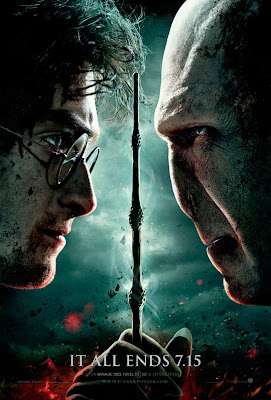
I also loved how, in the book, that final confrontation comes as everyone – the entire cast that isn’t dead by that point – is gathered round to watch. Everyone sees what happens, everyone hears it. In the movie, Harry and Voldemort have their final moment alone, unwitnessed by everyone (except Ron and Hermione). But then, I loved Harry’s “Let’s finish this as we started – together!” before he grabs Voldemort and jumps off the tower. And I loved how Voldemort’s demise was depicted – no sudden flash of death, but his screaming as his body suddenly and slowly fragmented into ash that fluttered away in the breeze. It was a very striking moment. The problem was that there wasn’t enough build-up to it, so when Voldemort started to disintegrate, I was thinking, “Wait, that’s it? Harry beat him already?” At the very least, those last two dueling spells should have been shouted out, as they were in the book, with Voldemort’s Avada kedavra meeting Harry’s Expelliarmus head-on.

So on one hand, it bugged me that Harry never explained to Voldemort just why the Elder Wand wouldn’t work for him. But on the other, how great is it that Hermione asked Harry why the Elder Wand didnt’ work for Voldemort? The most important bit of magical knowledge in the entire series comes down to something Harry knew and figured out, something that no one else did. He’s come along way from having to ask Hermione to explain things. Harry won’t be looking to Hermione to explain the pronunciation of “Leviosa” anymore, that’s for sure.

:: But then, I am glad that Yates and company didn’t include the Hogwarts ghost who flew around right after the battle in the book, chanting “Voldy’s gone moldy, so let’s have some fun!” That may have worked in the book, but it would have been an awful thing in the movie.

:: The film’s overall look is fantastic, and I love how in the epilogue, the washed-out colors are gone and we’re back to the bright palette of the first film. It’s a key visual way in which the film shows us that the rightful order has been restored. I still think that a nice touch would have been to have Dudley Dursley show up on Platform 9.75, with his own muggle-born wizard kid in tow, but that’s Rowling’s fault, not the filmmakers. Oh well.

So…that’s it for Harry Potter, I suppose. I do find it kind of saddening, but that’s the great thing about stories, isn’t it? They’re always writing more. And hey! So am I.

(But really, Ms. Rowling? You need to start writing something, if you hadn’t already.)
Share This Post

You disappoint me, Mr. Quint.

I’ve been enjoying the “Behind the Scenes Pic of the Day” feature over at AICN for quite a while now, even if it’s curated by ‘Quint’, who is my least favorite of the regular AICN commentators. I think that Quint tends to be full of crap and tends to get on top of his hobbyhorses and ride them for broke. A good example of the former? In today’s Behind the Scenes pic, which comes from Dr. No, Quint reveals what he thinks to be the three best Bond movies: Dr. No, From Russia with Love, and Thunderball.

One of those titles I can see. The other two? No way in hell.

Cool Behind the Scenes pic, though.

Share This Post

Notes on the PopStuff

Some thoughts on a bit of pop culture stuff of late:

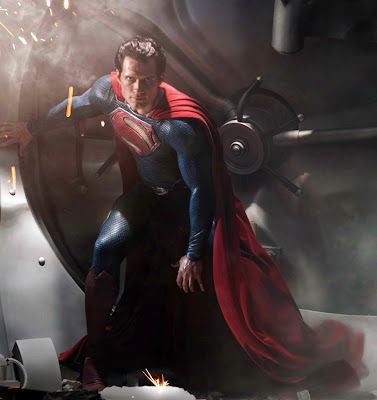
:: Here is actor Henry Cavill as Superman in the new movie about Superman, titled…Man of Steel.

In all honesty, I’m just not very thrilled with this. He looks OK, himself, although I wonder why the “Superman Curl” is missing from the middle of his forehead. The costume, however, bugs me. Proportionally it looks fine, but I hate that texture. I wonder why Hollywood decided that superhero costumes need to not look like cloth anymore; this looks like it was sewn from the material they use to make basketballs. I’m also not thrilled with the washed-out colors. I hope the film doesn’t look like this.

:: A sequel to Cosmos is on the way, apparently. I’m kind of glad to hear this, but any such project will be missing one key element: the poetical prose of Carl Sagan. The new show will be “hosted” by PBS science show mainstay Neil deGrasse Tyson. I hope this is done well, and doesn’t pander at all.

Of course, there has already been a sequel to Cosmos, at least in print: Sagan’s own book Pale Blue Dot. (I excerpted this book once, here.)

:: Oh my God, they’ve killed Sean Bean!

You bastards!

Share This Post

Brightest day, darkest night, yada yada yada….

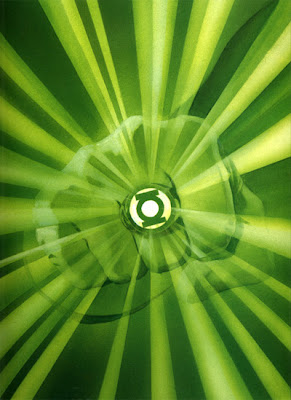
I saw Green Lantern a while back, and I’ve been struggling since then to figure out how to write about it. I liked the movie, quite a bit. I grant some of its flaws, but for the life of me, I can’t justify the enormous piling-on of the critics who have ripped the film and given it an awful reputation. That, plus what I understand to be lackluster box office, seems to cast doubt on any hopes that Green Lantern might be the start of a franchise. Maybe DVD sales will help, but in this era of slackening DVD sales – well, I’d be surprised if the next time we see Green Lantern on the big screen will likely be a reboot that happens later rather than sooner.

Green Lantern just isn’t a bad film. It simply isn’t. Not one of its flaws is sufficient to sink it as an enjoyable experience, and I think that a lot of the harping on those flaws is downright unfair. One common complaint – too much CG! — has really become, in my view, a crutch complaint that everybody levels against everything nowadays in the movies.

But the thing is…Green Lantern is a frustrating film, because I’ve rarely seen a movie that makes so clear the ways it could have been a truly outstanding film in its genre. On the one hand, it’s a fun movie. On the other, it’s a maddening one.

I came to Green Lantern fairly virginal as far as the character goes. I knew very little about him aside from the bare bones of his origin: a hotshot pilot named Hal Jordan comes across a crashed alien spaceship, whose purple-skinned pilot hands him his green ring and the green lantern that powers the ring. In this way, Jordan becomes a Green Lantern – a member of an intergalactic police force, who uses his ring’s power to fight evil. I did read some recent comics — mostly stuff by Geoff Johns — as preparation for the movie. Some of it, I liked. Some of it (lookin’ at you, Blackest Night), I thought was just over-the-top, histrionic nonsense. But anyway….

Green Lantern casts Ryan Reynolds as Hal Jordan, and it’s a fine performance. The character isn’t really anything we haven’t seen a lot of times before; he’s the talented but uncommitted screw-up who is given power far exceeding his apparent level of maturity and who must learn to see within himself whatever the “ring” saw. Yes, that’s a tried-and-true formula, but that’s because when done well, it really works. In Green Lantern, it does work, but not as well as it should. Why?

Well, for one thing, the film keeps taking its focus off Hal Jordan for other things. There’s a lengthy intro that tells us a lot of stuff about who the Green Lanterns are and what they do and why they do it. It’s kind of interesting, but…it’s too early for it. There’s a reason why, in Star Wars, we’re more than a half hour into the movie before the words “Jedi Knight” are ever uttered. The movie has to set up its enormous cosmic threat, a beastie called Parallax. Now, I liked the way Parallax was depicted, but I kept thinking throughout the movie that we really needed a tighter focus on Hal Jordan the whole way through.

And there’s the other problem: Parallax isn’t the only villainous force in play here; there’s a whole other villain too. A scientist is somehow infected with the “Yellow” power of fear, and becomes the initial threat that Jordan must face before Parallax finally comes to call on Earth. And here is part of my general problem with superhero movies these days: they’re all origins, all the time.

I don’t mind origin stories for superheroes; in fact, we need them, so we know who they are and why they can do the things they do and why they do them in the first place. Problems arise when, in addition to a superhero’s origin story, we also have to endure a long origin story for the villain, too. That happens here. It happens in the Spiderman movies. It’s going to happen again in the new Spiderman movie, the one that’s a reboot that will apparently treat us all to seeing Peter Parker bitten by the damn spider again.

The best superhero movies I’ve seen — Superman, the Christopher Nolan Batman films, Iron Man – don’t really bother with the origins of the villains, because they don’t really need to. We can spend time delving into Superman’s origin properly because we’re not also having to learn all about how Lex Luthor became, well, Lex Luthor. Ditto The Dark Knight — we know who Batman is, and all we need know about the Joker is that he’s a lunatic. Now, the first two Spiderman movies were still well-made, but in each case, we still had to watch long origin stories for the supervillains. And in Spiderman 3, there were two of them.

I was looking forward to Green Lantern because of the hero’s space opera nature, but it turns out that Green Lantern might have really been something special if it had omitted much of the space opera and left that for the potential sequel. I did groove on all the space stuff, but I can’t help thinking that what the movie really needed to do was tighten the focus on Hal Jordan, give him more heroic things to do, and have him square off against not quite so cosmic a villain.

Random thoughts:

:: If the Lanterns can fly through space by themselves, why does Abin Sur have a spaceship at all?

:: Why can Parallax slap aside a dozen Lanterns in one scene, and then get taken to the mat by Hal Jordan?

:: The final fight is over too soon, anyway. Jordan should have been battered and bloody well before he got to his “In brightest day….” recitation. (Which was a great moment, by the way.)

:: I loved the fact that a little mask isn’t enough to conceal Jordan’s identity from those who know him. I also loved how he tried using the Christian Bale Batman-raspy voice.

:: Some folks have complained that Sinestro’s taking of the yellow ring, during the credits, isn’t set up in the movie. See, coming at this from a non-GL fan perspective, I thought that Sinestro’s presence in the movie did nothing but set this up. It’s the only reason he’s in the movie at all. So the film is actually giving us three origin stories!

:: I loved the look of the film. It’s not nearly as ‘green’ as the commercials and posters suggest. I also didn’t find the CGI poorly done at all. But then, these kinds of complaints seem to me to usually spring from people who have an overly strong attachment to Harryhausen stop-motion stuff.

:: Having heard the score now in context of the film…it’s still a bad film score.

So there it is. I hope there’s another movie, but I’m not optimistic. But I liked this one.

Share This Post

We could quibble all day on who shot first….

I’ve been waffling on whether or not to write this post, as part of it involves blogging about work, which I’m not generally thrilled to do, but I don’t think that the relevant work details are especially sensitive, so here goes.

A few weeks back, the fine folks at Cultural Compulsive Disorder (one of my favorite pop-culture blogs, by the way) decided that it would be cool to show all six Star Wars movies in their favorite bar. They were going to make a thing out of this — they put up flyers, and so on. Come to the bar, buy drinks or snacks or whatever, and watch Star Wars for free.

Unfortunately — but, I think, fairly predictably — Lucasfilm caught wind of this and issued a cease-and-desist letter. Now, they got their details wrong, thinking that this was to be a charged-admission event, but still, the writing was on the wall: No public screening of Star Wars without permission. Naturally, this didn’t go over well with the CCD guys, although they are complying.

Cal (of Canadian Cave fame) commented on this, and I left the following comment (slightly revised) in response.

Firstly, there’s an awful lot of blasting of Lucas personally here and on CCD. I suspect that Lucas in all likelihood personally knows absolutely nothing about this whole affair, and that this is the work of a legal department and nothing else. And the fact is, this isn’t an abnormal thing to happen. It may suck, but it’s not unheard-of or out of the blue.

Here’s a true story. I work at a big grocery store, as you may know, which is part of a pretty large chain in the Northeast US. A couple of years ago, someone at corporate thought it would be cool to have “Movie Nights” on Fridays in our cafe’s. We’d show a movie in the cafe, something “family friendly”, the idea being that parents would bring their kids to watch the movie and maybe buy a meal or two to eat in the cafe. I’m not sure how it’s worked out in terms of increasing sales, but it’s worked fairly well at least as far as getting people to come watch the movies.

Some stores show their movies on a large flatscreen teevee, but the fellow who was store manager at the time had a “Go big or go home” type of philosophy, so at his command, we went all out. We bought a commercial corn popper. Two dozen bean-bag chairs to be put out for kids to use. A large carpet to roll out (our cafe’s floor is quarry tile). And for screening? We installed a 16′ by 9′ screen, a ceiling-mounted projector, and a home-theater sound system with five surround speakers and a subwoofer. (I got to install all that, along with the help of another guy. It was actually a really fun project to do.) Attendance at our movie nights has been hit-or-miss (we do one or two a month, packing ’em in sometimes and not so much other times), but for quality of the set-up, we’re top-notch.

But about six months ago, we got a letter from the MPAA. They weren’t telling us to stop, but they were notifying us that since we (the company, not my store specifically) were screening movies for more than 25 people at once, this constituted a “public screening”, and thus, we had to pay for the privelege. So now, the company must pay some money to the MPAA every time one of our stores has a movie night. It’s not a huge amount — our company can easily afford it — but still, those are the rules. Oh, and there was one other rule: No screening of Disney movies is allowed. Period. And that includes Pixar, unfortunately. Disney, apparently, said “No free screenings of our films.”

None of this is meant to be a defense of Lucasfilm’s reaction, but, unfortunately, that’s the lay of the land, and has been for quite some time. In all honesty, I do think that the fine folks at CCD should, when dreaming this idea up, have contacted Lucasfilm first to ask permission to have a free screening of the movies in a bar. Those disclaimers at the beginning of every movie on home video since the early days of VHS — “This film is licensed for private viewing only” — are easily dismissed, but legal departments of production companies take them seriously.

I obviously have no idea if Lucasfilm would have OK’d a free screening of Star Wars in a bar or not. I’ve seen screenings of the films advertised occasionally around town, though, so I would think they’d be at least somewhat open to the idea. Again, I don’t know — but I do know that this sort of thing is part of the whole copyright landscape these days, and that organizers of such events are best advised to proceed with caution and get permissions.

Share This Post

War Horse

Steven Spielberg has a movie coming out this winter that I didn’t even know existed until just this morning. Here’s the trailer for War Horse:

This screams out “Movie that will have me crying like a little girl at the end”.

(It also strikes me as odd that, when I watched the trailer on YouTube, it was preceded by an advertisement that is…a trailer for another movie. I have to watch a trailer before get to watch a trailer? Really?)

Share This Post

“A pirate’s life for me!”

Pirates of the Caribbean: On Stranger Tides is, to hear most folks tell it, not a very good movie at all. Most reaction I’ve seen has ranged from tepid to outright negative, but then, I’ve seen very little reaction to this movie from people who didn’t hate Dead Man’s Chest and At World’s End. I’ve almost got the impression that folks are teeing off on On Stranger Tides because they didn’t get enough chance to talk about how much they hated those two films as well, but never mind that.

I thought On Stranger Tides was terrific. I enjoyed the living hell out of it, and I’ve been trying to figure out why my reaction to the film is so different from everyone else’s. I suppose a big part of it is simply that I love these characters sufficiently that I’m more willing to go where they take me than others. I further suppose it’s partly because I don’t really see these movies as telling any kind of ongoing story, and certainly not the ongoing story of Jack Sp–Captain Jack Sparrow. I don’t think that Jack Sparrow has an ongoing story.

This is contra, for example, Michael May, whose thoughts I deeply respect, but who was disappointed in the film:

The movie is very silly and cartoony, but that might have been forgivable had it actually done what it was supposed to do: continue the story of Captain Jack Sparrow. When last we left Jack, he’d become a kinder pirate and we do see that reflected in On Stranger Tides. But that’s what he grew into in the last trilogy. For his story to be worth continuing, he needs to go somewhere new.

The journey promised by At World’s End is Jack’s quest for immortality. He died in Dead Man’s Chest and was terrified of repeating the experience. It drove everything he did in At World’s End and made sense of his quest for the Fountain of Youth. But as Stranger Tides opens, Jack’s pretty much given up the quest and has to be pulled back into it. There’s no personal urgency to his finding it. Instead, he fills a role much like he did in the original trilogy: running around making things more interesting for the characters who actually have story arcs.

See…I’m not sure that’s right. I don’t think that Jack was terrified of death (beyond a normal sense of self-preservation). What’s always motivated Jack has never been immortality; if he wanted that, he could have pocketed a coin from the Aztec treasure at the end of Curse of the Black Pearl and enjoyed his immortality that way. Of course, the movie established that that kind of immortality sucked, but then, he was hip to try to take Davy Jones’s place as Captain of the Flying Dutchman. Why was this? He’d be immortal, right?

But he didn’t want to be Captain of the Dutchman because he wanted to be immortal. He wanted to be Captain of the Dutchman because what always motivate Jack was freedom, and he defines freedom as being the Captain of a ship. Jack wasn’t trying to avoid death in DMC and AWE, so much as he was trying to avoid being pressed into Davy Jones’s servitude. He owed Jones a century of servitude; if he wanted long life, he could have simply taken Jones up on the offer. After all, a hundred years is unheard of for someone in Jack’s line of work, right? So why didn’t he just do that?

Because Jack wanted to be free, and that meant being Captain and having a ship.

There’s a moment in AWE that illustrates this. Jack indicates to Will Turner that he wants to stab Jones’s heart and become Captain of the Dutchman, to which Will responds, “But then you have to do the job, Jack. You have to ferry the dead, or you become like Jones.” Jack’s response is less than enthusiastic, so even that isn’t ideal, because even though he’d be Captain, he still wouldn’t be free. Jack is all about total freedom. Of course, at the end of AWE, he is willing to do the deed anyway, because it’s the only way he’ll ever be free of Davy Jones…until he realizes he must do something selfless and let Will Turner stab the heart.

Jack certainly does fear death to some degree, but when he realizes that there’s no other alternative, he embraces it head on: he puts his hat back on, says “Hello, beastie!”, and charges the Kraken. That’s interesting to me, as is the scene in AWE when he is clearly sad that the Kraken is dead. Jack Sparrow is sensibly scared of death. But he’s terrified at the prospect of living a life without freedom, living on someone’s terms other than his own.

So, then, is Jack really planning to go after the Fountain of Youth at the end of At World’s End? Maybe, maybe not. I’m not sure it really matters. What matters is that he already figures that Captain Barbossa is going to ditch him again. Is he going after the Fountain, or is he only keeping the charts as future leverage? We don’t really find out, but in On Stranger Tides, Jack isn’t really motivated by a desire to find the Fountain at all, except as a way of getting himself away from the current batch of miscreants who have literally shanghai’d him into their service. Jack finds himself in servitude aboard the Queen Anne’s Revenge, which is once again an intolerable situation – so he immediately begins to plan a mutiny.

As On Stranger Tides ends, Jack is once again without a ship and planning on how to get one. Some have complained about this, but I rather like it. I’m coming to see Captain Jack Sparrow not as a character whom I need to see growing and changing all the time; I see him more as a character whose situations simply don’t allow for him to grow much at all. I see him in similar light to James Bond. Aside from a very few films, James Bond doesn’t grow or change much at all in the course of the series, and that’s fine because no one expects him to, and when he finally does, the result is extremely notable. I like the usual trajectory for Jack Sparrow: he’s cleverer by far than the people around him, but he’s still somehow always watching his ship sailing away without him, or being dragged to the bottom of the sea by a Kraken, or being shrunk down so it can fit inside a bottle. I’m just not sure that I want to see Jack Sparrow changing; I’m not sure that I need to learn in great detail about what motivates him. I don’t think he’s that kind of character, any more than James Bond is, or, to take another recent pop-culture Jack, 24‘s Jack Bauer. Now there‘s a guy who is in similar circumstances to Jack Sparrow: he can never escape his lot in life, and he’s constantly being dragged into adventures that maybe he’d just as soon not have. Of course, Bauer’s a lot more morose about it than Sparrow.

Another similar character is Brad Pitt’s Tristan Ludlow, from Legends of the Fall; Tristan doesn’t change much at all over the years of his story, either, and at film’s end, our narrator describes him as “the rock that everyone broke themselves against”. That’s Jack Sparrow.

So, on its own, how is On Stranger Tides? I, personally, loved it. I found it full of good old swashbuckling fun, and I loved that it didn’t take itself nearly as seriously as its immediate two predecessor films did (as much as I loved those). The way the film gradually pulls us into its story was terrific – there’s an impostor in London, claiming to be Captain Jack Sparrow and recruiting sailors. Obviously Jack is intrigued by this and investigates, in the course of freeing his first mate Mr. Gibbs from the gallows and escaping the King’s men and finding himself in audience with the King himself and escaping the King’s men again. As is typical, Jack does all this with varying degrees of success. Soon he’s in a race against other pirates, the King’s royal navy, and the Spaniards for the Fountain of Youth – which Jack isn’t that enthusiastic about seeking out to begin with.

The film’s major weakness is a subplot involving a captive Catholic priest on board Blackbeard’s ship, and his love story with a mermaid who is captured because it turns out that in order to take advantage of the Fountain of Youth, one needs a freshly-shed mermaid’s tear. I loved that little detail, but the film is so stuffed full of other things going on that the priest is only along to save the mermaid at the end. His character is pretty expendable, and he really could have been set aside; maybe Jack could set the mermaid free, thus showing us his usually-hidden selfless side. I also liked that the mermaids are really quite strange sea creatures, but aside from a single set-piece, they really don’t amount to much in the film. I’d have liked to have seen more of them.

And then there’s Angelica Malon, played by Penelope Cruz. She’s an old flame of Jack’s, who has turned to piracy for reasons of her own. As underdrawn as the Catholic priest is as a character, Angelica is perfectly pitched. She’s almost a female Jack Sparrow, trustworthy at times and untrustworthy at others, and strongly motivated. The film leaves her fate wide open, and I do hope that she features again in the adventures of Jack Sparrow.

A couple other random notes about On Stranger Tides:

:: The score isn’t as good as AWE, but it does add Spanish guitar to the proceedings, which is a nice touch. I’ve grown to really like the music for these films, which show that you don’t need to take a Korngoldian approach to scoring a pirate movie.

:: The Pirates films are all beautifully photographed, and this one’s no different. Rob Marshall takes over directing responsibilities for Gore Verbinski this time out, and he did a pretty good job, especially in the action sequences. I’ve come to really appreciate directors who are able to shoot action in such a way that you can tell what’s going on. Verbinski was very good in that way, and Marshall keeps that going.

:: If the Black Pearl was sunk in battle, I really hope that sailors Pintel and Ragetti either survived or weren’t on board. (Those are the short bald guy and the tall thin one-eyed guy from the first three films. The piratical C-3PO and R2-D2, in other words.)

:: Nowhere in On Stranger Tides does anyone mention rum; nor does Jack ever inquire as to why the rum is always gone.

:: I don’t really care that the Pirates films cheerfully do whatever they want with the geography and geology of the Caribbean.

:: I wonder what seafaring bits of lore will be mined for the next Pirates movie? Maybe Jack Sparrow can have an encounter with a giant white whale. I suppose he could find Atlantis, or maybe the lost Templar fleet. Who knows?

(By the way, I can’t recommend highly enough Michael May’s thoughts on Curse of the Black Pearl, Dead Man’s Chest, and At World’s End. Those are terrific posts, on the subject of character development in the first three PotC films. He has interesting thoughts as to who the main character of that trilogy is, and I’m inclined to agree with him.)

Share This Post

So-and-so wants to be friends.

I watched The Social Network a month or so ago, and going into it, I had high hopes. I used to count myself among Aaron Sorkin’s biggest fans, but he started to disappoint me midway through the third season of The West Wing (and after rewatching Season Three recently, I’m even clearer in that conviction — post to come at some point), I found Studio 60 on the Sunset Strip ultimately disappointing, and Charlie Wilson’s War didn’t really impress me a whole lot, either. But when the reviews for The Social Network were almost unanimously raving, I hoped that Sorkin had recaptured some of his earlier mojo. Alas…I was entertained, but ultimately, again I was not terribly impressed. I wonder if I’m over Sorkin completely.

I don’t have much to say about the story of The Social Network. Nor do I have much to say about the characters, because I’m starting to wonder if Aaron Sorkin has lost his ability to create characters with their own distinct voices. Or, putting it slightly differently, I’m wondering if he ever really had the ability to create characters with different voices, and instead relied on actors to give their characters voice. My problem is that everybody in this movie sounds the same – and they all sound the same as other characters in other Aaron Sorkin movies and teevee shows. It’s frustrating for me, wanting to like each new Sorkin project, and only end up hearing the same tropes he brings to every bit of dialog.

What do I mean? Things like: characters speaking in sentences that are longer than sentences found in nature. Conversations that loop back and forth, in which characters will refer back to things said earlier in the conversation using the exact same wording. The only affirmative response to any question being “Yeah.” One character will be stuck on a certain part of whatever project it is they’re working on, and then in the middle of a conversation on a completely unrelated topic, another character will just happen to say something that leads the first one to the breakthrough on the problem they’re stuck on. Sharp debates on issues will be somehow won by one side or the other, often without the benefit of an actual argument being made. Supremely arrogant characters will defend their arrogance on various grounds. Someone will say something along the lines of “X isn’t going to happen because of Y. X is going to happen because of Z.”

I was trying to cut the movie some slack along the way, trying to get involved, but the Sorkinisms just kept coming and kept coming and kept coming, until I finally had to admit that I just couldn’t get involved at all. The one that finally ejected me from the movie was during one of the court deposition scenes. The lawyer is following a line of questioning that Zuckerberg planned to cheat his onetime partner out of ownership of Facebook out of jealousy, and Zuckerberg fires back thusly:

Ma’am, I know you’ve done your homework, and so you know that money isn’t a big part of my life, but at the moment I could buy Mt. Auburn Street, take the Phoenix Club, and turn it into my ping-pong room.

This is supposed to make Mark Zuckerberg look confident and dismissive of the entire proceeding under which he is being sued for ownership of Facebook, but hearing that, all I could think of was another court deposition scene, almost identical in tone, from the Sorkin-scripted movie Malice, in which Alec Baldwin delivers his noted “You ask me if I have a God complex? I am God.” speech.

Ultimately, I just didn’t care about the people in this movie as I was watching it. I just didn’t. The creation of Facebook is probably one of the most important cultural events of the 2000s, but The Social Network, for all its long and circular speeches and its whiplash dialog, just didn’t make the behind-the-scenes story all that interesting to me. Nobody in this movie is sympathetic; nobody in this movie was anyone I really cared to know anything about. In Aaron Sorkin’s best work — The West Wing, The American President, A Few Good Men — there are characters to care about. In the things he’s done that didn’t impress me — Studio 60, The Social Network — all there is are people who say lots of neat-sounding things but whose problems don’t involve me one whit.

The film’s first scene has a girl telling Mark Zuckerberg that he’s an asshole, and that is ultimately the problem with the movie. Everybody in it is an asshole. And an asshole with lots of great speeches to give is still, in the end, an asshole.

Share This Post

Oh, James Newton Howard, NO!!!

I’m listening to James Newton Howard’s score to Green Lantern, and…well, I really hope that the rest of the movie rises above the music Howard has written for it.

Howard is one of the more respected composers active today — quite a few of the “Goldsmith was God” freaks at FilmScoreMonthly, for instance, seem to view Howard as Goldsmith’s heir apparent. But not on the basis of Green Lantern. Boy howdy, this score is awful.

Like many scores nowadays, this is a blend of orchestral and techno elements. I have no problem with this at all. What I do have a problem with is how depressingly conventional this score is. There is literally nothing distinctive about it. There is no sense of epic scope, to suggest Green Lantern’s blend of space opera and superhero genre. The action music could be slotted into nearly any action sequence in any film of the last twenty years; the “wonder” music for when Hal Jordan first flies as one of the Green Lanterns sounds like any other “wonder” music out there.

And worst of all, there is virtually no melody to be found here. None. There are some motifs that I heard several times, but nothing that ever develops into anything of substance. I recall when superhero flicks had themes. John Williams wrote one of the most famous ones of all time for Superman. Danny Elfman did a fine theme for Batman. Jerry Goldsmith wrote a good theme for Supergirl (it’s virtually unknown these days because, like most Goldsmith scores, it accompanied an absolute dog of a movie).

But these days? There are no big melodies, no big themes, just subdued motifs that you have to study the score to find and which aren’t remotely memorable when you do.

God, what a crashing disappointment. James Newton Howard can do so much better than this. He has done so much better than this. I truly, deeply hope that melody can make a triumphant return to film music one day soon. Michael Giacchino can’t do it all by himself.

Share This Post