

Apparently there’s a grassroots movement afoot to get the Muppets brought in to host the Oscars. I endorse this without reservation, because it would be awesome.
Mr. Williams
Check out this list of Top Ten John Williams filmscores, which actually picks some very interesting scores, including a couple from Williams’s very early career. I haven’t even heard all of them! There are two here that are completely new to me.
The list’s writer, Matt Zoller Seitz, does make a couple of minor errors along the way, but in his defense, only a true film music geek would catch them. (Ahem.) In discussing Superman, he says this:
Williams revamped this score in “Superman II” and “Superman III.” Alexander Courage (“Star Trek: The Original Series) stepped in for “Superman IV” but based his work around Williams’ familiar themes.
This is actually incorrect; Williams had nothing to do with Superman II or III; instead, in a cost-cutting move, the producers had a composer named Ken Thorne come in and provide scores based substantially on Williams’s themes from the first film. (With a much smaller orchestra, also, which is why the score to Superman II sounds, well, really bad in my ears.) Thorne would get to do some more original work for III.
And then, in praising Williams’s score to Star Wars Episode III: Revenge of the Sith, Seitz says:
Greater still is the moment where Anakin becomes a hero (and the Sith lord Palpatine’s latest catch) by piloting the emperor’s crumbling starship back to Coruscant. Williams superimposes “Duel of the Fates” — the prequel cue that expresses the tension between the dark and light sides of the Force — over the optimistic “The Force Theme,” which we associate with Luke in chapters IV-VI; this cue foreshadows both Anakin’s moral failure in the second half of “Sith” and his belated redemption in the “Return of the Jedi.”
What’s wrong here is that the music in question was actually written for The Phantom Menace, and was re-used for this scene in Sith. There are several places in Attack of the Clones and in Sith where music is tracked in from TPM (and come to that, there are a couple places in Return of the Jedi which use tracked-in music from The Empire Strikes Back).
But those are mere quibbles. Check Seitz’s list out — it’s a good selection of Williams, and it doesn’t always stick to the obvious stuff.
Share This Post
“Be he ne’er so vile, this day shall gentle his condition”
Truth, Justice, and the American Way!
This is totally sick, and utterly hilarious: How Superman II should have ended. This will appeal to those who never liked how Superman is able to erase Lois Lane’s memory by somehow “magically” kissing her.
Share This Post
YARRRR!!!
Yippee ki-yay….


I didn’t want to see Die Hard when it first came out.
Mostly it had to do with a strong distaste I had for Bruce Willis, whom at the time I only knew of via Moonlighting, which was a show that I just could not stand. Even with one episode ending with a fantastic pie fight, I just never warmed to that show, and I saw Willis as a crappy actor whose only facial expression was a goofy smirk. So I didn’t see Die Hard for a year or two, not until home video, when my sister rented it and forced me to watch it. Yeah. Damn her!
Initially I wasn’t thrilled. I mean, our very first glimpse of Bruce Willis in the movie has him on that jet liner, smirking away the same smirk that bugged the hell out of me on Moonlighting. But the movie soon won me over. Took about, oh, ten minutes.
The first Die Hard is one of the best-made films I can think of. It is just competent, from beginning to end. We get the blanks filled in very quickly: why John McClane is estranged from his wife, and we realize that it’s not really for the best of reasons, which he himself seems almost willing to admit to himself – note the way he scolds himself after he and Holly have yet another iteration of the same old argument. And there’s a skyscraper that is nearly deserted and is still under construction. All that’s important.
Anyway, the plot was startlingly original at the time, wasn’t it? I don’t think it would even get green-lit today, but back then – terrorists take control of a skyscraper, with an off-duty cop on the loose in the building? Wow, what a plot. Such a simple little hook, but the film is a lot more complex than that. We don’t get standard-issue terrorists; we get a guy named Hans who has a very definite plot in mind, and it’s a lot more devious than just taking hostages and demanding that prisoners in Israel get released.
Hans is, of course, played by Alan Rickman, in one of the great performances of villainy of all time. Hans Gruber is fiercely observant, ruthless, calm under pressure, and deeply intelligent. Very little phases him, and he thinks very quickly as he works to fit every single mishap into the plan. He also has a sense of humor – a violent and twisted sense of humor, but a sense of humor nonetheless – and he is willing to show his frustration at times with the knowledge that his minions just aren’t as smart as he is.
What also stands out for me is that Hans Gruber isn’t a killing machine. Lots of action movies in the post-Die Hard era really seem to want to establish their villain’s evil by having him do quite a bit of gratuitous killing, but sometimes all that killing can really make a movie a downer. A good example is the Gary Oldman character in Air Force One – he’s already taken the airplane and killed someone just to show he’s serious, but there’s a truly awful scene in which he counts to ten before killing a woman. This made it hard to cheer Oldman’s later demise – it was just a feeling of, “Oh, finally.” Hans Gruber, however, personally kills only two people: Mr Takagi, the obligatory “kill to show he’s serious”, and then Ellis, who puts himself in harm’s way, anyhow.
What makes Die Hard really work is that hero and villain really are just about as smart as the other. Hans, of course, must underestimate John McClane, but it’s such a tiny underestimation, based more on his own stereotypical hangups on Americans than anything he knows about McClane. Die Hard is a good action film because its action sequences are thrillingly staged and magnificently filmed, but it’s a great movie because of the handle it has on its characters.
And then, a few years later, the sequel arrived. This one I did see in the theater, and I was thrilled to do so. I’d seen a teaser trailer months earlier, that had John McClane running through another industrial-looking subbasement or some such thing, with plumbing and electrical piping and conduit everywhere, at which point he says, “How can the same stuff happen to the same guy twice?!” That trailer indicated that this time, the setting is an airport. Bring on Die Hard 2: Die Harder. (Even though “Die Harder” never appears onscreen.)
Die Hard 2 isn’t as good as the first film, but it’s still plenty good. What’s nice is that it doesn’t try to tell the same type of story as the first film, so there’s no “lock McClane in a tight spot with a different bunch of terrorists” thing. This time, our terrorists take control of Dulles Airport in Washington, DC in order to rescue a Central American military leader who is being flown to Washington to stand trial for drug charges, or something like that. Unfortunately, the movie damages itself by inventing a fictitious country for our General to hail from, but that’s not that big a deal.
McClane is at the airport on a snowy day to pick up Holly, who is flying in on another flight, when the terrorists strike, shutting everything down and keeping planes in the air, circling as weather worsens. It’s a nice new way of creating tension, also factoring in that the planes will be running out of fuel.
Die Hard 2 takes longer to get started, really – there’s a lot, toward the beginning, that has McClane doing his own investigative stuff after he notices a couple of guys handing each other packages under a table. It’s a while before the action really kicks in, this time really putting the airport setting through the paces. Our villain this time is a guy named Colonel Stuart, played by William Sadler (better known as Heywood from The Shawshank Redemption). He’s suitably cold and ruthless and also intelligent, but he’s not nearly as charismatic as Hans Gruber.
If Die Hard didn’t give us gratuitous killing by Hans, this film more than makes up for it. There’s a scene where, to make his intentions plain, he deliberately causes a 747 with 200+ people aboard to crash. And the movie underscores the point by showing us, just before the crash, the flight attendants comforting the passengers minutes before their fiery deaths. The scene is really numbing, it’s so awful. (It’s also implausible, as there is no way a plane with no fuel left explodes into that large a fireball.) And it’s almost not worth mentioning that, through no fault of the film’s, the realities of America after 9-11-01 do cast a pall over it.
There are quite a few twists and turns, mainly involving who’s a villain and who’s not, and some filler involving Holly being on the same plane as the nitwit reporter from the first movie. There are also more stupid cops, with Dennis Franz now playing a well-meaning but inept Italian-American version of the first movie’s Deputy Chief Dwayne T. Robinson. Die Hard 2 doesn’t work quite as well as the first film, but it’s still an above-average action flick.
And then there’s Die Hard With a Vengeance, the third one. This one is really a mixed bag.
There’s a lot that I like about it. In fact, there’s a lot that I like a lot about it. Our villain this time is played by Jeremy Irons, and he turns out to be Hans Gruber’s brother. He’s got his very own scheme, but part of it involves torturing John McClane by making him do weird things and solve puzzles that any kid who ever owned a book of brainteasers will remember. If McClane fails to do what he’s told, though, Simon – the Irons character – will detonate a very big explosive somewhere. This all culminates with a threat against one of New York City’s public schools, while Simon and his small army of cohorts stage an extremely impressive bank robbery.
Plot-wise, Die Hard WAV is really very well constructed (for the most part). Everything happens for a reason, and nothing is wasted in terms of the machinations of the story. Some of the puzzles and tasks set for McClane are truly diabolical, including one that seems virtually impossible – until McClane realizes that it was virtually impossible, and that therefore it was set up to be virtually impossible.
McClane is also given a sidekick this time: a Harlem shop owner named Zeus, played by Samuel L. Jackson, who ends up involved when he gets in the middle of Simon’s first assigned task for McClane (to walk ten blocks in Harlem wearing a giant sign that declares a personal distaste for black people). I love the interplay between these two guys, even if it’s nothing we haven’t seen before a lot of times – two guys who hate each other have to work together or a criminal does something very bad. Zeus is also really smart, but he has zero experience, so it’s fun watching McClane try to keep him from screwing everything up or getting killed, even as he has to admit how much he needs the guy around.
One other thing I really loved about Die Hard WAV is that it dispenses with the stupid other cops of the first two movies. This time, McClane’s fellow cops are also smart, competent, and toward the end, heroic. This movie really does away with the idiots, and it’s a very wise decision.
What’s not so wise, however, is what’s done to John McClane himself. This is what really bugs me about this film. In the first two, McClane was a family man who had some struggles but who put things back together; but by this time around, while he’s still intelligent and skilled and quick with the funny wisecracks, he’s also estranged again and something of a drunk. He’s back with the NYPD, although he’s on suspension, so we get the obligatory bit where his Captain slaps his badge on the desk and McClane says, “Am I a cop again now?” I hated that aspect of things. If they wanted to set the movie in New York, I can think up a dozen ways to get McClane there off the top of my head without making him a jerk who has ditched his family. It ends up feeling like some kind of alternate universe John McClane, instead of the real thing.
The movie’s climax is also something of a disappointment, when it arrives. Die Hard WAV is a very exciting film that peters out before the end, unfortunately enough; it almost feels as though the writers couldn’t figure out how to end the movie, so they just tacked on an ending and called it good. But still, on balance, I do like the film quite a bit.
I never saw that fourth one, so there is where my opinionation on the Die Hard flicks must stand….
Share This Post

Is the space opera over when the fat alien lady sings?


MD Jackson links this IO9 piece by Charlie Jane Anders about the fact that space opera has all but disappeared from filmed entertainment these days. It’s really a shame, I think, and I hate to think its partly reflective of a general slackening of interest in space, but I think there’s something to that.
Two depressing facts became apparent the other day: 1) NASA is so desperate to get people excited about space travel, they were willing to consider collaborating on the horror mockumentary Apollo 18. 2) The fall 2011 season is the first time there’s been no TV show, on any network, featuring people on spaceships, since probably the mid-1980s.What’s happened to us? We haven’t just lost our space shuttle program, we’ve lost our zest for space adventure altogether, at least in TV and movies. How can we get our love for space opera back?
How do we get it back? I have no idea, unfortunately. This is because I’m just not sure where the love of space opera initially came from. Space opera was a staple in science fiction well before rocket launches became commonplace, but did space opera as a serious going concern in mass entertainment really exist much before Star Trek or Star Wars? I’m not sure they did. I’m just glad that space opera continues to be big in SF books.
I suspect a number of factors, not the least of which is our fairly lame space program right now. But manned space travel isn’t going to stop, and if private outfits like the SpaceShipX people or that crazy Virgin guy who likes to spend huge amounts of money on stuff (like spaceships) make headway, I think we may see a resurgence of interest. I remember that line in Apollo 13: “You guys have made going to the Moon about as exciting as a trip to Pittsburgh.”
Now, I actually like Pittsburgh and taking trips there, but that’s beside the point. One big reason that the space program hasn’t done much for firing imaginations over the last batch of years is that the ships haven’t been going anyplace new. The spaceships keep going to Low Earth Orbit, and the pictures they send back all look the same. The planet’s always the same size, the astronauts floating in zero-grav look the same, it’s all the same. Anything new is coming from the robots. Which is fine…it’s great, actually…but every time a robot goes someplace new and sends back gigabytes upon gigabytes of fascinating information, it can’t help but psychologically pose the question, “Why do we need spaceships at all?”
And without any real reason for people to be there, there’s no real reason to tell stories about them, is there?
Another part of the problem is that imaginative storytelling in filmed entertainment seems to be the exclusive province of Fantasy these days, which again is fine, but for every fantasy flick that gets made and becomes a hit, that’s a SF movie that’s not getting made. Even the resurgence of interest in Star Wars, over the course of the Prequel trilogy, wasn’t enough to lead to a Space Opera rebirth in film, because (a) reaction to the Prequels was mixed and (b) folks are starting to see Star Wars as mainly fantasy, anyway.
It seems to me that there is also the Hollywood “copycat” syndrome to blame for all of this. Starting in the late 1990s, the Harry Potter books exploded onto the scene, which then, in 2001, showed up as successful movies. At the same time, The Lord of the Rings arrived onscreen, and the success of both these high quality franchises really primed the fantasy pump. At the same time, the superhero movie became big doings, with Spiderman finally reaching the big screen and Batman returning. I think a part of space opera’s fade in Hollywood is partly just because some other stuff came along.
Will space opera come back in a big way? Maybe, maybe not. I don’t think it’ll ever be gone forever, though, from filmed entertainment. And there’s a big bright side here, as well: we know that Hollywood is increasingly unwilling to come up with ideas of its own. Well, when they do want to tackle space opera again, they will find a lot of space opera books waiting to be optioned and turned into movies. What will goose Hollywood into getting back in the space opera mood, however? That, unfortunately, is something I’m not sure of. It might take a space opera equivalent of Harry Potter to do it. Therefore, someone needs to write that. I wonder who might be crazy enough to give that mission a whirl….
Anyway, I don’t have any major answers here…but the article is interesting. Check it out, those of you with any passing interest in SF in general or space opera in particular.
Share This Post

“No fate but what we make”
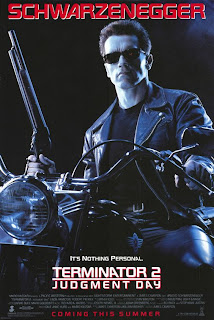

I hadn’t watched Terminator 2: Judgment Day in quite a long time, so I picked it up from the library and gave it a whirl. I’ve only seen the first two Terminator flicks, but I’ve long counted them among my favorite sci-fi action thrillers, and watching T2 again does nothing to make me think otherwise. This is, simply, a very finely made film.
I discovered a “Special Edition” on the DVD, which I assumed included extra footage. I’m always a sucker for those kinds of things, so that’s the version I watched. The additional footage is, altogether, under ten minutes of total screentime. None of it is really essential, but for the most part, the new footage does add some texture and character moments to the movie.
Here are some random thoughts on Terminator 2:
:: I’ve always wished that the film’s publicity campaign had not been so overt about Robert Patrick’s T-1000 being the main villain. I remember zero effort being made during the film’s original release to conceal this, which is a shame, because the film is clearly constructed to keep you guessing during the first half hour or so. We know that two individuals have been sent back in time, one to kill John Connor and another to protect him. Having seen the original, we’d naturally expect that the one that looks like Arnold Schwarzenegger is the one trying to kill John, so it would come as a surprise when, in the mall scene where the two meet, it turns out that the Schwarzenegger Terminator is actually here to protect John this time.
No such luck, though; the publicity campaign had the T-1000 as the bad guy and the Terminator as the good guy this time out. Oh well.
:: Additional scenes that work well include a reveal that Sarah Connor has been having her “nuclear holocaust” dream repeatedly, at the asylum. We see the dream, right up to the blast, and Connor tells the psychiatrist that the dream is the same every night. This implies that later on in the film, when we see the nuclear holocaust itself, it’s also the first time that Sarah Connor is seeing it. Pretty powerful. (This is still one of the most effective “nuclear destruction” sequences ever filmed.)
:: There’s another scene where John and Sarah remove the brain chip from the Terminator, and Sarah goes to smash it with a mallet, but John stops her, saying, “If I’m growing up to be a great military leader, then maybe you should listen to my ideas once in a while”. The extended bits flesh out the troubled relationship John has had with his mother.
:: That said, there’s a goofy scene that has John trying to teach the Terminator to smile. This probably should have remained in someone’s archives.
:: T2 originally had a more upbeat ending, with Sarah Connor sitting on a park bench in Washington while John went off to Congress, or something like that. I’m glad that the special edition doesn’t restore that ending, choosing instead to keep the ambiguous and haunting final scene of Sarah’s narration over the footage of a highway at night speeding by.
:: I’m of mixed mind on Brad Fidel’s music. On the one hand, the main theme is pretty iconic and mechanical-sounding. And the growling motif that we hear every time the T-1000 shows up is great stuff. But a lot of the underscore, especially in the action sequences, is just adequate.
:: Boy, is Dr. Dyson’s family in for a rough time, huh? Their husband and father is dead, and he’s involved in a plot to destroy Cyberdyne Systems. Ouch.
:: T2 is a great example of why pacing and length are not always dependent qualities. T2 is not a short movie — it’s around two-and-a-half hours — but it is so well paced and so well constructed that there really aren’t any spots where it feels as though it’s lagging. James Cameron really is one of the best at keeping things going, even over a fairly long haul.
I guess the next thing to do would be to watch Terminator 3, but…I don’t know. Anybody seen it? Is it worth the time?
Share This Post

“Dead or alive, you’re coming with me.”
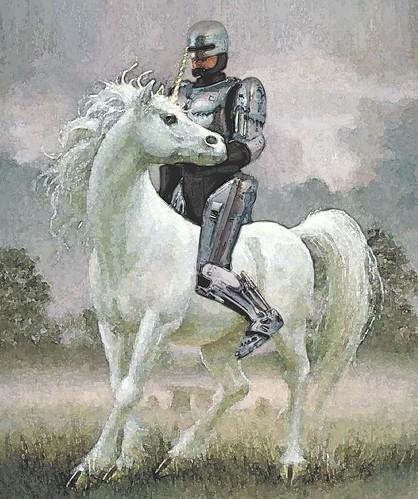
I swear, I have no idea why Robocop is riding a unicorn. No idea at all. But anyway:
Funny story about the first time I saw Robocop: I watched it on VHS with my parents because a coworker of my father’s told him how good it was. I found that highly amusing, because from what I knew of Robocop, I knew that my father was exceedingly unlikely to enjoy it much at all. I have never known my father to have the least inclination toward science fiction in any way, and he’s not terribly big on violence. And back then, I seem to recall he didn’t much care for use of the word ‘F***’ in his movies. Robocop had three strikes against it, going in, and no, it didn’t recover. Not his cup of tea at all. But I liked it.
The movie was a staple of our action-movie watching in college, but since then, I hadn’t watched Robocop in a really long time (I don’t honestly know if I’ve ever watched it in its entirety, uncut, since college), until the other day I saw it streaming on Netflix, so I decided to watch a little bit of it. Which turned into the whole thing. Go figure. Only problem was that I was doing this on a whim and I’d already had an afternoon snack, so I didn’t make popcorn. And really, Robocop is one of the popcorniest movies ever made.
So I’ve always liked Robocop. The sequel was meh, but the original has always been a good flick. However, in my head I’ve always kind of viewed Robocop as a prep film for some of the better stuff director Paul Verhoeven would do later on — Total Recall, Starship Troopers. I remember Robocop being perfectly good, but not extraordinary. Turns out that Robocop is a lot better than I recall.
The story is, I assume, familiar to anyone who is still reading this post. At some point in the future, things in Detroit have become so bad that the police force has been privatized by a company called OCP, which is looking for new, technological approaches to law enforcement. The first such approach involves big robots called ED-209’s, which turn out to be a bit…overzealous. (During a demonstration at a board meeting, the ED-209 machine-guns a young executive to death, leading the CEO to do a facepalm as this young fellow’s corpse is oozing blood from a hundred bullet holes all over the boardroom floor.) Enter another young up-and-coming executive, who wants to show up the guy whose pet project just splattered some guy’s guts all over the board room. His notion is to turn a cop who has been fatally wounded into a robotic police officer.
He almost immediately gets his wish, when our hero, Officer Murphy (Peter Weller), is brutally shot a number of times by a very bad man named Boddicker (Kurtwood Smith) and then left for dead. Murphy is somehow ‘saved’ by doctors, but when he ‘awakens’, he has been turned into a robot. Robocop.
Now, why they need a human for this is never really explained, since the idea is basically the same as ED-209 – turn police work over to a robot. Presumably ‘Robocop’ is better because of the addition of human instincts and thought patterns, but without memories, which have been wiped clean. Nothing of Murphy remains inside Robocop.
Except, well, turns out that quite of Murphy actually is knocking around in there, and as the rest of the movie goes on, Robocop tries to put together who he really is all the while trying to capture the bad guys, who have powerful allies in OCP itself. Much mayhem ensues, with Verhoeven establishing his reputation in this movie as a fairly creative director of gore-filled action.
I was struck this time, after not having seen the movie in so long, by the pacing. In the first place, Robocop just doesn’t waste any time at all. We meet Murphy in the first five minutes, and he’s been fatally mutilated and wounded about ten minutes later after an action sequence. We’re told almost nothing about him – he has a wife and kid, he started twirling his pistol before holstering it because his son saw a guy do it on teevee – and yet, the film somehow is able to make us think we know more about him than we do. Since we know so very little about Murphy, Robocop’s frustration as he tries to recover his memories is all the more engaging. It’s a brilliant device, and in a lesser movie, there would be about fifteen minutes of stuff letting us “get to know” Murphy before his killing. We don’t really feel a sense of loss until Robocop himself feels a sense of loss.
The pacing also keeps the film focused on events and actions, and only in passing mentions the various moral issues behind its story. Verhoeven’s suspicions of corporate capitalism are clear, but there are no big speeches about it in Robocop, just rapid-fire angry conversations between rival executives. (“Who cares if it works? Military contracts! Selling spare parts for twenty years!”) The Robocop seems cool in itself, and it’s chilling in retrospect that no one ever questions the morality of a project that is just waiting for some poor cop to get killed in the line…and worse than that is the fact that OCP has maneuvered cops around in order to ensure that one of them will get killed in the line, sooner rather than later. Risks and personality assessments are cited as methods for determining where to put the cops who may die, but again, in keeping with the film generally keeping us in the dark with respect to Murphy, we are not told exactly what it is about Murphy that makes OCP determine that he’s likely to get killed in his new assignment.
In terms of design, Robocop himself is iconic, with his helmet that conceals everything except his jaw. I always find this a bit interesting – why not just cover his entire face? Of course, it’s because we need some reason to still see him as a human being, and for most of the time he’s onscreen, that jaw is it. He doesn’t do much of anything else with his mouth except speak, leaving Robocop to show his growing frustration mainly through body language, such as when he is exploring his old house and experiencing bits of old memory and puts his fist through the teevee screen realtor.
We do get to look at Robocop without his helmet late in the film, and it’s not the prettiest sight, but that’s when we really know that Murphy-the-person really is inside there, and he hasn’t been entirely erased. There’s a moment prior to that, though, that hints that this is the case. It’s blink-and-you-miss-it stuff: when the bad guy sics ED-209 on him, Robocop’s visor is broken in a couple of places, and Verhoeven throws in a couple of quick closeups of his fear-filled eyes. It’s enormously effective, and it really cements Robocop as a character in this movie, as opposed to…well, whatever he’d be otherwise. A prop, perhaps.
Robocop‘s prognostications of the future are mainly hit-or-miss. The world of the “clean future” is one of antiseptic concrete; wood and metal are mainly used to depict Old Detroit, the run-down place where chaos still reigns. There are newscasts which give a bit of “future news”, telling us a bit of what’s going on in the world. I’m not sure why they bothered; none of this really adds much to the film, except for the bits that deal specifically with Detroit, and in any case, the prognostications seem to take the various strifes of the 1980s and project them forward forty years or so. Thus we have wars in South Africa and Central America.
I also am of mixed mind on how the movie ends: Robocop dispatches the main bad guy, there are about two lines of dialogue, and then, smash cut to credits. I always find the ending vaguely unsatisfying – but then, I’m not entirely sure how to better wrap things up. The film certainly leaves open a lot to be explored in possible sequels, particularly, Robocop’s explorations of whether he’s a person or not. It’s too bad only one relatively lackluster sequel was made.
Basil Poledouris’s score is a highly-regarded piece of SF-action film music, and deservedly so; it’s appropriately futuristic sounding without being otherworldly. I realized that the main theme, the Robocop theme, isn’t heard until we’ve first met Robocop and he’s gone out onto the street to do cop stuff. Of course, that main theme is one of the great earworms of film music history. Just try watching this movie and then not end up humming that tune for days.
It’s too bad that Robocop didn’t lead to anything more than what it already is, but one good film is more than a lot of franchises get, right?
Share This Post
Geekin’
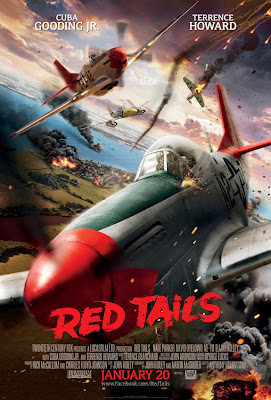
Just a few pop-cultural items knockin’ round my head….
:: I love this poster, for the upcoming film Red Tails, which tells the story of the Tuskegee Airmen and is backed by executive producer George Lucas:

Of course, I look at that poster and I see that Lucas is only the executive producer. He’s not the actual producer, nor did he write the screenplay or the story on which the film is based, nor did he direct the movie. But anyone want to lay odds on whose name gets mentioned exclusively if the film flops?
:: I think that the existence of this is frakking hysterical:

Why? Well, if you know anything about Norman’s somewhat infamous series of sci-fi novels set on the world of Gor, you can imagine just what his sexual recommendations are like (i.e., great if you’re a man and you’re into dominance, not so much if you’re, well, not).
:: I really am starting to get an appreciation for cosplay.

She’s makin’ it up as she goes along, folks!
