Of goats and the men who gaze intently in their direction

Thanksgiving Day is a really nice day to go to a movie. We’ve seen both Casino Royale and Quantum of Solace on T-giving in the last few years; this year, The Wife really wanted to see a movie, but there wasn’t anything playing that I was really jazzed about. (Couldn’t James Cameron have finished Avatar a few weeks earlier?) So, we settled on The Men Who Stare At Goats. It wasn’t a great movie, by any means; in fact, it was a little frustrating, because it’s fairly easy to see how they could have really elevated this material. But it’s a slick, well-made, well-acted, and pretty funny little film. We enjoyed it.

I don’t want to spoil too much about the story, but it interweaves flashbacks with “present day” stuff about a secret unit in the Army whose soldiers are trained in paranormal activities, like remote viewing, trying to pass through walls, and killing things simply by staring at them really intensely. (One of the test victims is a goat; hence the title.) Ewan McGregor is a reporter who gets turned on to this Army unit by a veteran; he files it away for future reference until he ends up in Kuwait in those hazy days post-Iraq War (or rather, during the War but post-“Mission Accomplished”), when he falls in with George Clooney, who is an actual member of the unit and who is on a mission to…well, that’s never really made clear, and frankly, it’s not that important anyway.

As McGregor journeys with Clooney across the Iraqi desert, Clooney fills him in on the history of the shadowy unit he serves. They call themselves “Jedi Knights”, which is an in-joke that goes all the way through the movie and really wears out its welcome. In all honesty, I have no idea why the writers decided to call them “Jedi”, because aside from that, there is no reference to Star Wars in the film, so the “Jedi” thing ends up being an odd kind of shorthand joke that we only laugh at because it sounds like we’re supposed to laugh at it. (It doesn’t really help the joke out to have Ewan McGregor say, “What’s a Jedi?”)

The film flashes by pretty quickly, and ultimately it’s a light and fluffy piece of entertainment. I do wish the script had pushed the material farther; there’s a lot of gold to be mined from the involvement of various world governments, including our own, in paranormal research and the attempted development of psi-weaponry during the Cold War era. The Men Who Stare at Goats is a perfectly fun little movie that seems to suggest, around its outlines, a much better movie to be made someday from similar material.

Share This Post

Rats, Robots and Retirees, oh my!

I know, I know – Pixar Studios has yet to make a bad movie, and their least effort is merely really good. I know. But after finding their work amazing as everybody else did for several years, I’ve been disappointed by their last two films, WALL-E and Up. And yet, both of these films seem to generally receive almost unanimously high praise. Odd. In each case, though, I was entranced by the early part of the film and let down by the latter part. Each film left me with the odd sense that the filmmakers just didn’t have the total confidence they needed to keep following the threads of their stories in the directions they wanted to go, so each film, after a remarkable start, settles into something a lot more familiar and a lot more routine. Neither film seemed as good to me, as strong, as the previous films in the Pixar canon – Ratatouille, The Incredibles, and my favorite Pixar film to date, Finding Nemo.

(Yes, I omit Cars from that pantheon — I like that movie more than most, but I do have to concede its problems, especially in the area that we fantasy lovers call “worldbuilding”. As finely done as Cars is, it’s often just a bit too hard to really buy into the world of the movie. Hard enough to accept that these sentient cars live in a landscape that is so clearly human in its design – I constantly found myself wondering things like “Why would cars build hotels that look like hotels?” and “In a world where the dominant lifeform is the car, what possible purpose do tractors serve?”. Even more damaging, though, were the automobile-related physical landmarks in the film, like big rock ridges shaped like radiators and tail-fins. Things like that really kept me, at least in part, outside the film for most of the time. And still, it’s a really likable and watchable movie.)

So: Ratatouille, which I watched in its entirety for the first time just a few weeks ago. I’d already seen lots of it, perhaps eighty percent of it, in bits and pieces on nights when The Daughter watched it. I loved this film a great deal, when I finally watched it from beginning to end. Its strengths are the same as all of the great Pixar films: character and story, of course, but I also think that the best Pixar films also achieve something visually that most, if not all, of the other animation studios only scratch at: visual beauty. Ratatouille is a gorgeous film. Setting the film in Paris, the animators imbue every frame with a glowing appearance, befitting Remy (our rat hero) and his view of Paris as ultimate land of culinary dreams come true. Even in the scenes set in dark places, the film has “pockets” of light, such as the rooms, and the tableaus within, that Remy briefly looks down upon as he runs through the floorboards and plumbing ducts of the great city.

More than that, Ratatouille, as a film, has the courage of its convictions as it plays out. This is important, and it’s a big reason why I was somewhat unsatisfied by Wall-E and Up.

In the first case, we have the story of the “little trash robot that could”. I’ve got to be honest: the first half of that movie is utterly engrossing, and it’s all the more engrossing because it all plays out without dialog to explain things along the way. All we hear are ambient sounds as Wall-E does his daily routine in his world (which is our world, after we’ve piled it so high with garbage that we’ve literally abandoned it). Onto his world arrives another robot, this one clearly feminine and far more advanced than Wall-E, and there’s a very gentle kind of thing that goes on in the movie next as the two robots get to know each other. Or, rather, as Wall-E tries to get to know Eve, who at first doesn’t seem terribly interested in Wall-E at all.

Eventually the movie brings us back to the world of humans, which is roughly where I felt the film deflate a bit. A lot of the film’s magic seems to go away when the humans are around. The notion is that we’ve become so technologically advanced that we need literally do nothing for ourselves, so we’ve all become a very fat and sedentary species. In fact, the greatest human accomplishment depicted in the movie is when one particular human actually stands up. The old “dangers of technological reliance” chestnut is a very old SF plot; we’ve seen it many times before and will doubtless see it many more times to come. In Wall-E it’s just OK, but to be honest, every time our attention in the movie is directed to the humans, I found myself thinking, within seconds, “Can we get back to the two robots?”

I think it’s because the scenes between Wall-E and Eve are so good that the other stuff ends up feeling perfunctory, and I started to suspect that maybe the Pixar folks just couldn’t bring themselves to do what I wish they’d have done: made the two robots and their love story the entire movie, with no human presence at all. At no point did I wonder where the humans were or if they’d ever come back to Earth; I didn’t need to know how the terraforming of our own home planet would come to pass. All I wanted to see was the interaction of the trash robot and the sleek explorer robot.

The scene where Wall-E and Eve “dance” in space is one of the most magical things I’ve ever seen in a movie, but that scene almost seems to max out the movie’s magic quotient.

That brings me to Up. Again, I felt let down by Pixar about halfway through the film, when for no reason I can discern, they took a captivating narrative that had been casting an irresistible spell over me and went instead in a much more conventional direction.

Up begins with a sequence that has been lauded by nearly everyone I’ve heard comment on the film. We meet our hero, Carl Frederickson, as a young boy who is obsessed with the exploratory adventures of one of those Charles Lindbergh-types who used to go around the world, into the unexplored places of our planet, and come back with thrilling tales of wonderment, until he too disappeared. Carl meets a girl with the same obsession, Ellie, and over the next few minutes the film takes us through Carl and Ellie’s life together – as childhood friends, then sweethearts, then husband and wife. The film depicts, with little or no dialog, the day they move into their house, the day they lose their baby, the days they spend quietly together while still nursing thoughts of adventure in their minds, and finally, Ellie’s fatal illness. By the time we get to the meat of the story, Carl is an old and somewhat bitter widower.

The sleepy street he lives on has become Development Hell, and the developers want him to move so they can finish their big skyscraper or something like that. They seem to finally get the upper hand on him, forcing him to abandon his house (and, by extension, his life with Ellie) and move to an old folks’ home – but Carl ties thousands of helium-filled balloons to his chimney, lifting the house free from its foundations. Thus does he set his sights on South America, where he hopes the find the almost mythical locale that eluded the disappeared adventurer from his youth. It’s just Carl and his house, floating southward beneath a giant bunch of balloons. Carl settles himself into his favorite armchair for the journey, when there’s a knock at his door. It turns out that when the house had broken free of its moorings, a local boy scout named Russell, who needs to get that last badge to complete his training for whatever the next level up happens to be, was on his porch about to knock the door when the house took flight. The film is now a tale of an unlikely friendship that is slow to develop as Carl must start to set aside some of his bitterness, now that this kid who is young and earnest but prone to screwing up is along for the ride.

All of this is wonderful stuff. Really, it is; the way the film doesn’t shy from some of the darker aspects of life and the whimsical manner of Carl’s escape from his old life in precisely an effort to grab the last bit of his old life he has left to him struck me as reminiscent of a Roald Dahl story. Don’t like where you are? Then float away to somewhere else in your own house using a bunch of balloons! That’s a totally Roald Dahl-ish kind of story to tell. Likewise, the friendship between an old man and an awkward young kid put me in mind of another favorite kid-lit author of mine, John Bellairs. I loved the movie pretty much up until the inevitable moment when it’s finally revealed what became of the adventurer whose exploits Carl and Ellie had worshiped as children.

To be fair, I didn’t hate what ensued from that point in the movie. The talking dogs are pretty funny, after all. And the film’s use of flight as a motif seemed to be a nice homage to the work of Hayao Miyazaki. The problem I had is that until we meet the old adventurer in his old zeppelin, everything in the movie seems new and fresh, while everything that happens after that just seemed routine. All of the film’s magic and whimsy disappears as it becomes another race-against-time, chase-the-bad-guy-before-he-can-do-something-awful kind of flick. It greatly disappointed me that a movie as astonishingly good in its first half, so full of imagination and spirit, has an ending that involves fisticuffs and heroes dangling precariously above terrifying heights while the villain cackles. If only the filmmakers had had enough imagination to give Up a conclusion that didn’t let the first half of their film down so far.

I’m not down on Pixar per se, but I must admit that their recent films haven’t thrilled me as much as they have many others. I’m rooting for them to return to form. Perhaps they’ll surprise me with Toy Story 3, a sequel which just doesn’t strike me as particularly necessary. We’ll see. As I said, Pixar has yet to make a bad film.

Share This Post

“We’re the only ones who know! The only ones!”

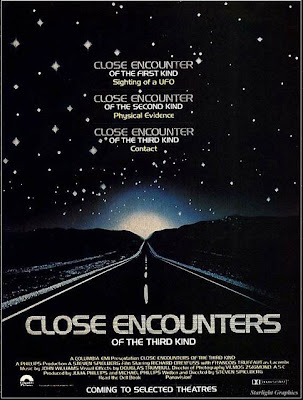
After the Buffalo Bills managed to lose at home to the Cleveland Browns by a score of 6-3, despite holding the Browns to just two completed passes on the day, I decided that I was done watching them for the year and instead instituted a little tradition for The Daughter and I (since The Wife works on Sundays) called “Instead of the Buffalo Bills Theater”. What this basically means is that instead of the Bills game, we watch a movie instead. It’s a lot more fun than watching boring, badly-played football by a team that’s probably not going to be here anymore pretty soon anyway. So, one film we recently watched was an old favorite of mine that I hadn’t seen in a long time, it turns out: Steven Spielberg’s UFO classic Close Encounters of the Third Kind.

Describing the plot probably isn’t necessary, but maybe it is – the movie is over thirty years old, after all. Its opening scenes establish, via subtitle, that the events we’re watching take place in the “Present Day”, although the illusion is harder and harder to maintain, the farther out we get from 1970s-era cars, hairstyles, and architecture. Still, we open rather mysteriously as a bunch of government operatives arrive at a crappy little town – or maybe it’s not even a town – in the middle of a desert in Mexico. Why is this group, led by a Frenchman, here? To investigate just why a group of fighter planes that disappeared in 1945 have shown up there, with no trace of the pilots. (It’s the famous Flight 19, which disappeared without a trace while on patrol over the Caribbean.) A local, an old man who looks as poor as his surroundings, tells the investigators that “The Sun came out last night”, and that it sang to him. He is mysteriously sunburned.

This is the first of a series of very odd events that take place, all around the world: a ship turns up in the middle of the Gobi desert, the entire population of a city in India is singing a series of tones given to them from the sky, series of numbers are broadcast to a radio telescope that seem to be the latitude and longitude for Devil’s Tower, Wyoming. As all this goes on, with the shadowy government people investigating it (just who they are and who they answer to is never really explained, although at one point they’re seen to be driving around in vehicles marked “UN”), two people in Indiana are drawn in via psychological “messages” given to them (and many others, apparently). Electrician Roy Neary is out investigating a power outage when he truck stalls and is flown over by a UFO; single mother Jillian Guiler is awoken to find that her son Barry has run off into the woods after all of his toys have turned on. Both Roy and Jillian become more and more obsessive over time as the visions being implanted in their brains become stronger and stronger. Both of them are put through harrowing experiences: Roy loses his job and his family becomes more and more estranged by his increasingly crazy behavior, with the final straw being when he decides to build an enormous Devil’s Tower sculpture in his own living room, while little Barry, Jillian’s son, is actually abducted by the aliens in what is one of the more harrowing sequences Spielberg has ever directed. (To this day, the scene of Barry’s abduction is scarier to me than anything M. Night Shyamalan has done.)

Eventually Roy and Jillian learn, along with others, that they are actually being called by the aliens, although they don’t know who the aliens are, to Devil’s Tower for the arrival of the Mother Ship, even though they’re still not sure what’s going on and may well be heading into their deaths. (The Devil’s Tower region has been cleared of all people via the news of a train derailment that has spilled thousands of gallons of toxic gas into the air in those parts – or so the government has reported. It turns out that there was no toxic gas and that the livestock in the region was knocked out by the use of a sleep aerosol. One wonders how they’ll explain this once everything’s done – “Our bad, your cows were asleep, but everything’s OK, come on home now” – but one also suspects that once the explanation for just why Devil’s Tower and everything around it had to be cleared out gets made public, the apologies for the sleep gas will be the least important thing going on. I’d love to know what happens after CE3K, but more on that a bit later.

So the mother ship arrives, and turns out to be benign. Everything going on has simply been the aliens’ way of saying “Hello”, and in the end, all the people they’ve “abducted” are returned, including the pilots of Flight 19, little Barry Guiler (who is genuinely sad to see the aliens go), and a bunch of others. But before the aliens leave again, they take someone with them again, this time voluntarily: they choose Roy Neary. His selection and boarding of the ship, as John Williams’s magnificent score quotes “When You Wish Upon a Star”, is the film’s emotional high-water point. The ship leaves, and the credits roll.

I’d be fascinated, though, to know what happens the day after. What happens? I’d assume they can’t keep all this a secret, and that word of the First Contact will get out. So what then? What would the world be like once we know, for all time, that we’re not alone? The film makes no suggestions thereof; neither does the later film Contact, which is content to allow many to believe that the first contact didn’t even happen. And not just the world in general, but what would it be like, being Roy Neary’s wife and learning of what became of him? Learning that he wasn’t crazy, and that it was all part of a plan by these aliens? Her actions (getting increasingly upset with Roy before finally concluding that he’s literally gone crazy and become dangerous enough that she leaves him, taking the kids with her) are entirely reasonable, and while it is to Spielberg’s credit that he doesn’t present her actions as unreasonable, we are left to wonder what it will be like for her to learn that no, Roy wasn’t crazy after all.

Spielberg grew up in a broken household himself, and it is something of a recurrent theme in a lot of his early movies. The family in ET is a broken home; even in Raiders of the Lost Ark, Indiana Jones is shown to be estranged from his father figure, Abner Ravenwood, and is later shown in Last Crusade to be somewhat estranged from his actual father. I read somewhere that Spielberg has admitted that if he were to make CE3K today, he wouldn’t just have Roy Neary go off with the aliens without so much as a farewell to his family or something similar. And yet, Neary’s actions themselves, as presented in the film, aren’t unreasonable either. He doesn’t have the chance to explain anything to his family, because he doesn’t understand any of it, and by the time he does understand it, the time to leave is upon him, if he wishes to take it. On this one level, then, the film’s resolution somehow seems both wrong and right at the same time. It’s an odd thing, really, and only as we watch the film do we realize that we have no real idea at all of what the aliens were about in the first place. Spielberg makes no attempt to explain any of this. Where are they from? Where are they going? When do they plan to bring Roy back? Do they plan to bring Roy back? We never learn one answer to any of these questions, and the reason seems more practical than anything else: the film just doesn’t have room for the answers. There’s no point at which it would make sense for anything to be explained. That fascinates me.

Technically, the film still looks wonderful, even now that it’s more than thirty years old. There are only a few moments that genuinely appear dated – a shot of Ronnie Neary in her “sensible shoes”, a shot of the old-school dashboard radio in Roy Neary’s electricians’ truck – but everything looks natural enough, so it’s generally easy to get into the spell of the film. The effects are amazing, crowned by the mothership, whose arrival is one of the most stunning special effects sequences ever filmed. Now, I’m not one to wax poetic about the model-making era of movie effects or to decry the way things look now that it’s all done with computers, but that doesn’t mean I’m not often amazed by the artistry involved in the great effects spectacles of the past. This is one of them.

CE3K is one of those films that doesn’t get enough recognition for how influential it is. There’s a great deal in its production design, its approach to atmosphere, and even its music that would show up in later efforts like The X-Files and other conspiracy or horror shows and films of the 90s and 2000s. I always take note, of course, of John Williams’s score, which makes heavy use of atonal dissonances throughout but which also gradually moves toward a tonal climax toward the end, and of course, there is the masterful way Williams incorporates the aliens’ musical communication motif into the tableau of his scoring at film’s end. (If ever I start my own Geek version of the Freemasons, our secret handshake will incorporate the musical hand signals from CE3K. Anybody can make the Vulcan salute from Star Trek, but how many people know the hand signals from Close Encounters?)

Remember: this means something. This is important.

Share This Post

50 films from the Aughts

The other day in Sentential Links I linked two different bloggers who made a list thusly:

This list means nothing, except to me. It’s a list of 50 movies that gave me pleasure over the past decade. I can say without reservation that I would watch any of these again. Would I say that all of them are great films, however great films are supposed to be defined? Probably not. But that’s nothing you need to worry about. Because it’s my list.

So, here’s my list of such films. Some of these I’ve written about before, and I briefly considered digging back to find their respective posts, but in some cases I’ve written about these films multiple times and I really don’t feel like doing all that work. Sorry for that, but there is a search function on this blog if you’re interested! These are in no particular order, just the order in which I think of them whilst writing this post. (I usually italicize film titles in my posts, but since this is literally a list of titles, I’m eschewing the italics for now.)

1. Star Wars Episode II: Attack of the Clones
2. Star Wars Episode III: Revenge of the Sith
3. The Lord of the Rings (all three films)
4. Harry Potter and the Prisoner of Azkaban
5. Love, Actually
6. Catch Me If You Can
7. Finding Nemo
8. Spirited Away
9. Sunshine
10. Kingdom of Heaven
11. Almost Famous
12. Elizabethtown
13. 3:10 to Yuma
14. Anchorman
15. Blades of Glory
16. My Big Fat Greek Wedding
17. Casino Royale
18. Eternal Sunshine of the Spotless Mind
19. Batman Begins
20. Cast Away
21. The Emperor’s New Groove
22. Spiderman 2
23. Monsters, Inc
24. Millennium Actress
25. Chicago
26. The Count of Monte Cristo
27. Possession
28. Road to Perdition
29. Whale Rider
30. Across the Universe
31. Pirates of the Caribbean: The Curse of the Black Pearl
32. Pirates of the Caribbean: Dead Man’s Chest
33. Pirates of the Caribbean: At World’s End
34. X2: X-Men United
35. Before Sunset
36. Finding Neverland
37. The Incredibles
38. Sky Captain and the World of Tomorrow
39. The 40-year Old Virgin
40. Little Miss Sunshine
41. Serenity
42. Brokeback Mountain
43. Tristan and Isolde
44. Nanny McPhee
45. A Prairie Home Companion
46. The Simpsons Movie
47. Stardust
48. Juno
49. Atonement
50. Star Trek

Anyone else? (If you do this, probably best to quote the paragraph reproduced above and link back to the original blogger.)

Share This Post

Animatorium

SamuraiFrog comments on Entertainment Weekly‘s list of the 20 Greatest Animated Movies, and I figure I’ll do the same thing. EW is pretty good for generating lists for bloggers to talk about, after all.

20. Ghost in the Shell

Haven’t seen it.

19. Waltz with Bashir

Nor this one. I’m not off to a good start here….

18. Pinocchio

Only #18? This is really one of the greats: it’s Exhibit A for the existence of the seriously dark side of the Disney of old.

17. Kiki’s Delivery Service

I love Kiki, but it’s simply not as good as My Neighbor Totoro, and it’s nowhere near as good as Laputa or Princess Mononoke. I suspect this one’s cited on the basis of accessibility: it’s the kind of anime people can watch if they don’t want to deal with all that weird Japanese stuff.

16. South Park: Bigger, Longer & Uncut

Haven’t seen it. I’ve never been able to figure out if I like South Park or not.

15. The Iron Giant

Why the hell is this so low? Probably because it still isn’t that well known.

14. Akira

Haven’t seen this either, although I should.

13. Chicken Run

Huh. I’d forgotten about this movie, although it’s really pretty terrific.

12. The Triplets of Belleville

Geez…haven’t seen it.

11. Dumbo

Hmmmm. I like Dumbo. I like it a lot. But I’m not sure I like it more than Pinocchio, and I sure as hell don’t like it more than Snow White.

10. Coraline

OK, doing this list was a bad idea. Haven’t seen it. I liked the book. Although I’m not sure the movie’s been around long enough to warrant this kind of reverence.

9. Bambi

I was just thinking about Bambi today, while listening to guys at work talking about their success or lack thereof in their hunting exploits. (Hunting season just opened up.) It’s one of my favorite of all Disney movies, and it’s certainly deserving of this list.

8. Toy Story 2

Really, really good movie. I love its resonance — every adult I know remembers some long-lost toy they wish they hadn’t dumped in a box somewhere — and I love the little digs it makes at the collecting hobby world, the little pop culture references (especially to Star Wars), and…well, everything.

7. The Incredibles

If Pixar had to do a sequel for their next one, I’d rather see an Incredibles II than Toy Story 3. It’s a terrific superhero movie, and it’s so sure about itself. The sequence where Mr. Incredible is sitting at the computer console, scrolling past the history of the bad guy’s development of his evil robots, is utterly chilling.

6. Beauty and the Beast

This should be higher. It’s a great, great film, full of magic and brilliant characters and outstanding songs and music. Yeah, it’s too low.

5. Persepolis

Haven’t seen it. But I assume it’s roughly as good as the book, and since the book is brilliant….

4. The Lion King

I’m sorry, but I have to call foul here. The Lion King just isn’t this good. It’s very entertaining and fun and all, but I’ve never seen it as the classic everyone else seems to think it is. I can name probably a dozen Disney films that I think are better than this. It’s not a bad movie, but there’s no way it’s the supreme Disney achievement.

3. Up

WAY too soon to be on a list like this. I just saw it last week and will post more about it later on, but I loved about two-thirds of it. Roughly until it set aside its magic and wonder in favor of another villain who needs to be defeated.

2. Spirited Away

This movie isn’t high enough. It’s just so, so, so brilliant.

1. WALL-E

Have I ever blogged about this movie? I’m of mixed mind on it, and generally, I view it as I do The Lion King: a generally good movie with some wonderful parts (WALL-E and Eve’s “dance” in space is as amazing a piece of imagination as I’ve seen in a film) but also some parts that left me cold. To be honest, I felt a lot of the air of the film go out when the humans showed up. It almost felt to me as if the filmmakers didn’t quite have the courage of their convictions and had to have something conventional happen sometime. (The same problem afflicted Up.) I wouldn’t have this movie this high up, and I in fact might not even have it on the list.

What other movies do I miss from this list? Well, there’s not room for everything and I’m not about to re-write the whole thing, but…Fantasia. Snow White. (That one’s omission is just weird.) Finding Nemo (still my favorite Pixar film). Princess Mononoke. The Emperor’s New Groove. (Yes, I’m serious. It remains the only Disney film that’s ever come close to channeling the spirit of Chuck Jones.)

Share This Post

“Your conscience is sensitive, Dan. I don’t think it’s my favorite part of you.”

I’ve always enjoyed Westerns, for the most part. I’ve been trying to think of a Western that I actively disliked, and I’ve been unsuccessful; the best I can do is find Westerns that aren’t my cup of tea, like The Searchers and the ‘spaghetti Westerns’ of Sergio Leone. But every Western I’ve ever watched has been, at least, admirable or entertaining on some level.

Most recently I watched 3:10 to Yuma, the 2007 remake of a 1957 film of the same name. What struck me about this film is the way it is not a “deconstruction” kind of Western; it’s not a Western that feels the need to make statements either about the genre itself (Unforgiven) or different statements about the West (Dances With Wolves). 3:10 to Yuma is nothing more than an archetypal blood-and-guts Western, with good ranchers who are down on their luck, bad guys who are very good with their six-shooters, towns where the marshals are openly corrupt when they need to be, tense evenings around the campfire, ill-advised ventures into Indian territory, stagecoach robberies, and all the rest.

Russell Crowe is Ben Wade, the leader of a gang of criminals who are extremely brutal in their crimes -but interesting, Wade himself isn’t shown to be especially brutal himself. His underlings, though, are very brutal, chief among them his second-in-command, the possibly psychotic Charlie Prince. Just once in the film is the question raised of how bad a man must Wade be to actually lead these guys.

On the other side of the moral ledger, we have Christian Bale as rancher Dan Evans, who is just about as down on his luck as he can be. His ranch is desperately close to foreclosure, the railroad company is itching to take his land, the water to his ranch has been diverted, his older son thinks he’s a failure, and he’s trying to do the best he can despite the fact that he lost a leg in the Civil War. Evans meets Wade by chance early on, and then again a short while later, when Wade is captured. However, Wade’s gang is still at large and will clearly do whatever they need to do to get him back, so a dangerous mission is undertaken to take Wade to the town of Contention, where they will put him on the train that departs at 3:10 pm for Yuma, and the prison there. The 3:10 to Yuma. Dan, our rancher hero, is good with a rifle, and volunteers to go, for $200. They set out, and it’s a race against time and a group of violent bandits.

What’s interesting about this particular race against time is that it’s almost an anti-race against time. Most races against time are of the “Do X before Y happens or else”. Here, the goal isn’t to do something in an allotted span of time but to get something done at a very specific time, even though that specific time is a little ways off and there are all kinds of obstacles between. It’s a combination, really, of a race against time and a dread-filled wait for a moment where we all know all hell will break loose. These two relations to time come into play over the course of the film, creating very different kinds of tension in very different places.

This is, simply, a very good film. Its performances are all first-rate, and the chemistry between Christian Bale and Russell Crowe is outstanding. The supporting cast is superb across the board, most notably Ben Foster as Charlie Prince, a man whose devotion to Wade is never explained, or even speculated upon, but is yet somehow suggested. The conversations in the film, especially those between Evens and Wade, all feel quite real and almost unscripted, as both men feel each other out and stake out their own moral claims on what is going on.

That’s what impresses me so much about the film: the fact that it so clearly understands the notion that even villains see themselves as the heroes of their own story. Ben Wade acts, throughout the film, in accordance with a very real moral code, and we, somewhat like others in the film, admire him for that, even as we acknowledge that his moral code is not a good one. But it is a code, and we know that, for all his murder and robbery, Ben Wade is actually more moral than some of the men who capture him.

3:10 to Yuma is a terrific film. Highly recommended.

Share This Post

Everyone here is highly gruntled.

SamuraiFrog on The Office so far this season:

Last week’s episode of The Office was the best this season. I liked the wedding episode, but the “mafia” episode was a real dud. There were a lot of people out there screaming about shark-jumping, which I thought was premature. Besides, you can’t even claim a show jumped the shark at a certain point until at least a half-season has gone by: the phrase is about the overall effect, not immediate bitching about something that pissed you off. There’s a new phrase for that: “nuking the fridge.” That’s when you idiotically whine about how a series that features Nazis being melted by the power of God, a man surviving a fall from a plane in a raft, a guy having his heart ripped out of his chest and continuing to live, and a man simply walking off a gunshot wound after drinking from the Holy Grail is suddenly unrealistic because a guy survives a nuclear blast inside of a lead-lined refrigerator.

OK, them’s fightin’ words! Well, not really, but I do disagree with some of this, so here are my points of contention with My Right Honorable Friend.

While I haven’t opined that The Office has engaged in shark-jumping, I’ve wondered if it might be getting close to doing so, because for me, the show’s best moments — and there have been so, so many — have all been grounded in a strong sense of believability. We’ve all known bosses who are like Michael Scott: amiable, and even good at their original position, but utterly inept at management and who only succeed by virtue of the good people they have under them. We’ve all known managers who stay employed almost inexplicably: “How can the higher-ups not see this stuff going on?!” Michael is that boss, and The Office has followed the tried-and-true comedy strategy of taking something very familiar and simply dialing up the intensity just enough to allow for absurdity.

The problem, for me, is that the absurdity has usually been still believable on some level. The least successful episodes have all involved incidents in which Michael, or someone else, did something that I’m pretty confident would get them fired in nearly any real-life workplace. I remember a few seasons back when the Scranton office got flooded with the just-relocated members of the now-closed Stanford branch, and Michael outed one of the new people as a felon and humiliated another who was extremely fat. Or the episode where Michael “outed” Oscar as gay. Those episodes left bad tastes in my mouth, because things just wouldn’t return to normal after incidents like that, unless we’re talking about a very poorly run company indeed.

My problem this year is that so far it feels like the air of plausibility around The Office is feeling strained. Michael and Jim as co-managers? I’ve never seen any kind of co-manager scenario, except in a couple of cases where one manager was being transferred out but his “effective” date at the new place wasn’t for a week or two. Long-term co-managers? I don’t see how any workplace would try this.

Likewise, Jim and Pam in the same office. I have never heard of a workplace where this is allowed: a person allowed to work in an office where their spouse is their direct superior. This has already reared its ugly head on the show, in an episode where Michael and Jim had to decide which employees got raises and which didn’t. That kind of thing is a giant can of worms, and each week it goes on, I find it hurts the believability of the show.

My biggest problem with the show’s direction right now, though, isn’t about plausibility but about character. Dwight Schrute is one of the show’s signature creations, but so far this year, especially with the promotion of Jim, I fear that the writers are going too far with Dwight. They’re perilously close to making him not a very odd and paranoid character, but an outright malevolent one. I found the sadistic glee Dwight showed in bugging Jim’s office almost out-of-character.

However, I could still be wrong. It could be that the writers are setting up some storylines here. I hope so.

(On SamuraiFrog’s “nuking the fridge” comment, I do object there on the grounds that with the exception of the liferaft-from-the-airplane thing, the Indiana Jones moments he cites are all instances of something literally magical happening in the movies. Sure, I can accept the power of God melting the Nazis, because that’s the power of God. Sure, I can accept a sacrificial victim still living after his heart’s been plucked out, because that’s the power of the evil sorcerer-priest. Ditto the Hole Grail. There is no magic at work in the fridge-nuking, which is why that scene doesn’t work. It’s the same with the airplane jump: there’s nothing magical going on there, so all we have to go on in terms of plausibility is our own experience. Suspension of disbelief is a hard thing to get a handle on, sometimes.)

Share This Post

60-B!

From time to time, when reading a negative review of a movie I’ll see the film described as a “mess”, and often times I’m unsure of what a “mess” is, in terms of a movie. The instance that stands out in my memory is Pirates of the Caribbean: At World’s End. When I was looking for reactions to that movie, I think nearly every article or blog post I read about it called it a “mess”, which I found odd because I didn’t find the movie messy at all.

But now, having re-watched the Cameron Crowe flick Elizabethtown, I understand better what it is to call a movie a mess, because, well, Elizabethtown is one. It’s an amiable mess, to be sure. It’s not the kind of mess a dog makes on the new carpet; it’s the kind of mess that covers the desk of the dotty teacher we all had in school, the one we liked anyway despite his dottiness. (It was a guy teacher for me; yours might have been a woman. Doesn’t matter.) Elizabethtown is a mess. But I really liked it anyway.

Orlando Bloom plays a guy named Drew who works, as the film opens, for an athletic wear company in Portland, Oregon. (It’s not Nike, but as Nike is located in a Portland suburb, it’s pretty clear that we’re talking about Nike here.) Drew is being whisked to the corporate HQ by company helicopter so he can meet with the billionaire CEO (played by Alec Baldwin) so he can be fired. Why is this shoe designer for a hugely successful company getting fired personally by the CEO? Because his latest shoe design is a failure of epic proportions. He’s designed a shoe that has been touted as the Biggest Thing EVER, only to see it universally loathed. The opening scenes show entire semis full of these shoes being returned to the HQ’s warehouse. Drew has just committed Epic FAIL which will cost his company nearly a billion dollars. Oops. (The film doesn’t dwell on the shoe itself much, but we do get to see it a few times, and yes, it looks ridiculous, like the shoe Prince Namor of Atlantis would put on if he was going to go for a jog.)

After this staggering and extremely public failure, Drew is feeling a tad suicidal – but just a tad – until he gets the call, later that night, that his father has passed away, back in the family hometown of Elizabethtown, Kentucky. Off Drew goes to return to the home he hasn’t seen in years. On the plane, he meets a flight attendant named Claire (Kirsten Dunst), who comes off as just this side of being a crazy stalker. She talks to him, gives him directions to his hometown, follows him into the terminal so she can shout the directions to him through a crowd (“Remember: Route 60-B!”). Drew gets home, and then we have the usual kind of thing in one of those stories where the city-kid returns to his small-town roots. There are folks who aren’t aware that California and Oregon aren’t the same place, there’s the cousin in his 30s who is still at heart a teenager who wants to get the band back together, there’s the doting older woman who takes one look at Our Hero and concludes that he hasn’t eaten anything since 2003.

One night Drew is feeling lonely and calls everyone he knows, only to get through to no one; and then he dials the number given him by Claire, the almost-crazy flight attendant, who just happens to be off duty and can drive up to hang out with him.

Elizabethtown is a movie that just can’t seem to decide what movie it wants to be, and that’s how it’s a mess. It feels not so much made a cobbled together out of various ideas. It’s as if Cameron Crowe literally couldn’t decide what story he wanted to tell, so he just said the hell with it and told all of them. Hence the result: a film that is so amiable and clearly heartfelt that I can’t dislike it, but still just doesn’t get into my heart the way Crowe’s better films — Say Anything, Jerry Maguire, Almost Famous — do. Elizabethtown has the crashing of a wedding, long conversations by phone, stand-up comedy at a wake, “Freebird” at the same wake, a fire alarm at that same wake, and in the end, a road-trip across the country in which Drew drives places as prescribed for him by Claire, cueing up specific songs on specific CDs as he passes specific points on the trip.

I remember a review by Jeff Simon (of The Buffalo News) of this film, in which he wrote that the film is basically a mix tape. That’s a very good metaphor for the movie, in the way its individual parts all seem disconnected and unrelated except for the larger connecting theme of how it all relates to Drew and his various troubles. Elizabethtown is an unfocused film that lurches from one thing to another, and yet it does so in incredibly likable fashion. Maybe that’s the way that the movie is a metaphor for life itself? I dunno…but the movie is a mess, and still, I liked it a lot.

Share This Post

Trekkin’

A couple of Star Trek related notes:

:: Ron Moore confirms what many have suspected over the years: that the technobabble on Star Trek: The Next Generation was just made up, fill-in-the-blanks type stuff.

“It became the solution to so many plot lines and so many stories,” Moore said. “It was so mechanical that we had science consultants who would just come up with the words for us and we’d just write ‘tech’ in the script. You know, Picard would say ‘Commander La Forge, tech the tech to the warp drive.’ I’m serious. If you look at those scripts, you’ll see that.”

This comes as absolutely no surprise, obviously. The over-reliance on technobabble has always been what keeps me from ranking TNG as high as The Original Series or Deep Space Nine, both of which had much greater emphasis on their characters. TNG was at its best when it used character to its advantage, but so often it felt as if the producers just didn’t trust their characters and their cast to carry the weight fully, which is why we ended up with so many episodes where a problem is discovered, we investigate the problem for a while, and then wait until the last ten minutes when Data or Wesley would come up with the pulse or beam or blast of some kind of particle that would fix the problem with the space-time continuum.

:: That said, I was recently discussing Star Trek ’09 (which is how I now refer to the recent movie, which I discussed some months ago) with a friend at work, who was baffled as to why I had such a hard time buying into the events of the movie when I would cheerfully swallow the idea of, say, the Genesis Device. I thought that a fair question: why did I have such a hard time with the notion of a drop of “red matter” creating a black hole in the middle of a planet, while I would accept the idea of a torpedo the size of a refrigerator converting a dead planet into one with a nice biosphere?

Well, I don’t know, really. Part of it is probably how the ideas are treated. The Genesis Device is constantly referred to as an “experiment” in Trek II and shown as an outright failure in Trek III, for one thing. For another, though, the Genesis Device didn’t come on the heels of a long list of Star Trek doomsday devices, substances, and elements. The Genesis device was a new item, but now, with Trek ’09, I’ve heard a lot more along the way. Trilithium, which can halt the nuclear reactions in a star. The Tox Uthat, which does the same thing. There are many more in that vein. It gets harder and harder for Star Trek to come up with threats like these.

It also hurts the cause of the “Red Matter” when the film in question is chock-full of all manner of SF whoppers. I’ve generally found that I’ll accept something that is clearly bollocks as long as it’s not literally bollocks. That’s another part of why I can accept the Genesis Device: my brain accepts it as a fully fictional item, and I’m fine. But Trek ’09 gives us things like black holes taking one back in time, supernovas that threaten to destroy the entire galaxy, and so on. By the time we get to an explanation of “red matter”, Trek ’09 has, for me, worn out its quota of scientific-implausibility forgiveness.

:: A tiny detail also glared out at me upon re-watching the movie. At one point, Kirk, and the rest of our heroes, are at Starfleet Academy, where he decides to take the Kobayashi Maru test for the third time. In a scene with McCoy, he says he’s taking it “tomorrow”. That night, though, he’s making out with a green-skinned cadet who happens to be Nyota Uhura’s roommate. Uhura comes in and describes a distress call she’s just intercepted from the Klingons, in which an entire Klingon armada has been destroyed by a Romulan ship. OK.

Cut to the next morning, when Kirk is beating the Kobayashi Maru test after reprogramming it. This causes scandal, so there is a full tribunal of, it appears, all of the Starfleet cadets in Kirk’s class. As the tribunal goes on, a distress call from Vulcan comes through, causing Starfleet to mobilize its fleet. Off everyone goes to their ships, with cadets first being assigned to various vessels, then flying to them by shuttle. Some legerdemain on McCoy’s part gets Kirk on board the Enterprise, and after some more stuff surrounding the launch, Kirk listens to the ship’s briefing on what’s happening and realizes that Vulcan is under attack. He races to the bridge to tell Captain Pike what he’s learned…citing the attack on the Klingon fleet as evidence. So far so good…except that he says that the attack happened last night.

Wait a minute.

So, all of the above has happened in one day. Kirk’s reprogramming of the Kobayashi Maru test, his taking of the test, the suspicion and investigation of his possible cheating, the mobilization of Starfleet and the launch of an entire fleet whose crews haven’t even been assigned yet. Yeah, I have trouble with that.

:: I’ve decided that, at long last, I believe the entire Kobayashi Maru test to be complete BS.

We’ve seen the Kobayashi Maru test twice now: in Star Trek II: The Wrath of Khan, and in Star Trek ’09. The idea seems pretty simple: it puts a cadet into a situation from which there is no possibility of a “win”, and thereby tests what the cadets do in a “no-win” situation.

The scenario depicted in both instances is the same: a distress call is received from a damaged ship, the Kobayashi Maru, in the Neutral Zone. It’s illegal to enter the Zone and is seen by Klingons as an act of war, so the cadets have a hard choice: respect the Neutral Zone and allow the Kobayashi Maru to die, or embark on a rescue mission. Both films establish, through dialog, that rescue is impossible, so then the choice becomes fight-or-flee. So the possible resolutions seem to be these: attempt no rescue, attempt a rescue but abandon it as soon as the shooting starts, and attempt a rescue and go down in flames with the ship. Hence the “no-win” scenario.

In Wrath of Khan, Admiral Kirk tells Saavik that the Kobayashi Maru test is a “test of character”, presumably to see how cadets deal with the “no-win scenario”. It’s “facing death”, Kirk says: “How we deal with death is at least as important as how we deal with life”. And later on, when Saavik learns that Kirk actually cheated to beat the test, she replies: “Then you never have faced that situation. Faced death.” I’ve always found that line extremely odd. Kirk hasn’t “faced death”? The guy who stood and watched as Edith Keeler died, who had to kill his own best friend (Gary Mitchell), and so on and so forth? He never “faced death” because he cheated his way out of a fake test? Right.

In Trek ’09, we have the afore-mentioned tribunal after Kirk cheats. Spock tells Kirk that he has failed to grasp the point of the test: it is to ensure that cadets in command situations have “experience fear” and dealt with it in a command situation.

So, the Kobayashi Maru test is, basically, a device to make cadets “face death” and “experience fear”. But the problem is this: by its very nature, the Kobayashi Maru test can do neither of those things.

If you’re a Starfleet cadet taking the Kobayashi Maru test, the problem is this: you know you’re taking a test. How can you “experience fear” or “face death” in any kind of meaningful way when you know that you are not on the bridge of a starship but in a simulator on the planet Earth? You are not facing death when you know that you’re not actually ordering a starship into the Neutral Zone to rescue a ship that doesn’t exist, and you can not be filled with fear — other than the typical kinds of academic fear, such as what will my fellow cadets think of me when I fail this again or how embarrassing will the post-test talk with the professors be — when you know that you’re not facing any kind of real situation.

Basically, the Kobayashi Maru test by its very nature can reveal nothing meaningful about those who take it. It’s an interesting diversion and nothing more. (And really, the only reason they came up with it in the first place was so that Trek II could fake us out at the beginning, since everybody knew that Spock was going to die at the end of the flick — I know that when I saw the movie as a ten-year-old kid, I saw Spock “perish” as the bridge burned after the Klingon attack, and I thought, “Wait, they killed him in the first five minutes?!”)

Interestingly, this kind of test was actually handled in much more convincing fashion in an early episode of The Next Generation, called “Coming of Age”. In this episode, Wesley Crusher is undergoing testing to see if he makes it into Starfleet Academy yet. It’s all typical academic stuff, although there’s something called a “Psych Test”, which is tailored to each student individually based on their psychological profile. The day comes for Wesley’s, and he goes into the room where he’s to take it, whereupon he hears a distant explosion. Getting up and leaving to investigate, he finds that a laboratory down the hall has erupted into fire, endangering two scientists. The room is about to be sealed, and Wesley can only get one guy out himself, so he makes his choice and drags the one guy he can out before the room is sealed, killing the other scientist.

Of course, the whole explosion was the test, and both scientists are fine. The test for Wesley was to see if he could, in a desperate situation, make the kind of decision that cost someone their life (since his father had died years before when another officer had made a similar decision). But what made it effective was that at no point during the test did Wesley ever realize that this was the test itself. The Kobayashi Maru test isn’t like that at all; especially not in Trek ’09, when the cadet in the Captain’s chair can actually see the professors watching him, in the overhead galleries.

:: Finally, I hope the next movie reveals that Gaila, Uhura’s green-skinned roommate, wasn’t killed in the incredibly-short Battle of Vulcan. I found her both hot and cute. For a green-skinned Orion girl.

OK, I’m done geeking out for now.

Share This Post