I’ve always maintained that this is a great film, and seeing it for the first time in over a decade, I have to contend that this is still a great film. Seeing it as an adult, maybe I like it for different reasons than I did when I was a kid, but it’s still as involving and enjoyable at 33 as it was when I was 8.
I still feel that Karate Kid is a great movie, despite some of the 80s kitsch sentiment that has unfortunately accrued around it.
Edward is so abusive, and Bella is so needy to be abused, it makes it impossible to feel sympathy or even like for either of these two self-absorbed assholes. What all of the little girls and unfulfilled women in their 40s creaming their pants over vampire boy don’t seem to get is that living with Edward is like living with an alcoholic–only worse, because it’s an alcoholic who keeps reminding you constantly that he could kill you at any moment, and in fact wants to, but is trying really hard to control himself. He belittles you so that your heart melts at the smallest compliment, he makes your decisions for you, and tells you it’s dangerous for you to be near him while making sure never to leave you alone for even a moment. As my wife said this morning: “This is like what a date rapist does so that, when he rapes you, you blame yourself instead of him.”
Amen, brother. The whole “fake-sex in the woods” was, for me, the straw that broke the book in two.
Noting the arrest in Switzerland of director Roman Polanski, I must say that I hope this means that he will, at long last, be able to soon bring to an end his thirty-plus year ordeal and find closure. Because, you know, fugitive pedophiles deserve closure, too.
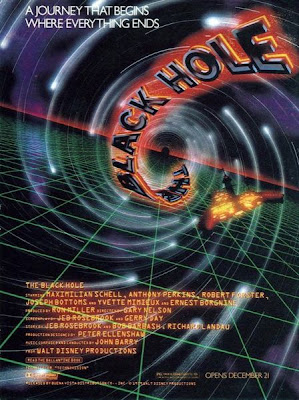
Hey, remember the movie The Black Hole? I ran across a clip of it on YouTube the other day, and I’ve been thinking a bit about it. Maybe I should track down a DVD at some point. (Spoilers here, but the movie’s 30 years old, so….)
The fine folks at Disney made The Black Hole in 1979. It was their entry in the “Hey, the kids do sure like that Star Wars, so we needs ourselves a space movie too!” sweepstakes that resulted in lots of space opera stuff, some of it not bad (Battlestar Galactica), some of it campy but fun (Battle Beyond the Stars), some of it weird (Moonraker), and, naturally, some of it downright awful (Starcrash). So in 1979, along came The Black Hole, which flopped at the box office. I suspect that word-of-mouth wasn’t that great, and maybe by then the whole space-flick thing was getting a little tiring anyway and besides everybody knew that the real thing, in the form of The Empire Strikes Back, was less than a year away.
But The Black Hole isn’t bad. Neither is it all that good. It’s solidly in the middle, occasionally approaching “good”, and then veering back toward “bad”, but never setting itself up at either pole. So ultimately it’s a pretty vexing movie — was it a good movie inside a bad one, or a bad movie inside a good one?
Our story: a small spaceship, the Palomino, is in deep space when it starts on its journey back to Earth. On the way it comes across a black hole, and perched on the edge of the hole is an immense spaceship which turns out to be the USS Cygnus, which was reported lost years before. Here’s the Cygnus, which is one of the most beautifully-constructed movie spaceships ever:
Investigating, they discover the Cygnus in the command of Dr. Hans Reinhardt, who operates his ship with the aid of a crew of humanoid drones, a squadron of security robots, and one very nasty robot named “Maximilian”. Here’s Maximilian:
Pretty menacing, eh? Especially as he doesn’t walk but rather floats around in the air and is equipped with a buzz-saw weapon which he uses on one unfortunate character later on (who tries to defend himself with a thick folder stuffed with papers — self defense FAIL).
Anyhow, it quickly becomes apparent that Reinhardt is crazy and planning to fly his ship into the black hole. In keeping with movie crazies of all stripes, Reinhardt refuses to let the crew of the Palomino leave, so now there’s a race against time: can our heroes escape before the crazy guy and his crazy robot take them on a journey into certain death?
It’s actually a kind of nifty plot, and watching the movie, I always get the impression that the Disney folks, in looking for a way to cash in on the post-Star Wars SF craze, looked for any script they could find, optioned this one, and then, well, Disney-fied it up a bit. There’s some serious stuff in this movie, lots of beautiful production design, and even a number of moments of genuine “sensawunda”. Here, for example, is the bridge of the Cygnus:
Seriously, that’s a gorgeous bridge, isn’t it? And nothing at all like the bridges or cockpits of big spaceships in movies to that point, where there’s a screen or window at the front and everybody’s facing it.
But then, along comes the Disney “We gotta make this for kids too!” stuff. Enter our heroic robot, VINCENT, whose design just screams out, “We need an R2-D2, only cuter!”:
And later on, after we’ve gotten used to VINCENT, we meet an earlier model, who is called in the film — I kid you not — “Old BOB”:
Old Bob is voiced by Slim Pickens. Can’t have a movie without an old-timer to tell the heroes what’s really goin’ on, I guess. (VINCENT and BOB are acronyms, of course, but I’m too lazy to Google what they stand for.) And our heroes end up in a firefight at one point with some very goofy looking security robots:
Well, Imperial stormtroopers they ain’t, although I did like their double-barreled blasters.
So, do they escape? Well, yes — and no. They get free of Reinhardt, by stealing his personal ship (or something like that), but it turns out that it, too, is programmed to go through the black hole, so in they go, after the Cygnus has already been destroyed. This is all well and good, of course; the black hole itself is the film’s gun on the mantelpiece, and we’ve got to see it go off, right? This brings us to the film’s final scenes, in which we see not just what happens to our heroes as they go through the black hole, but also, in one of the oddest sequences to ever appear in anything with the Disney imprint, what became of Reinhardt and Maximilian:
Imagine what that felt like for a nine-year-old kid sitting in a theater! Evil genius and murderous robot somehow fuse together in some kind of sexual-looking event, and then end up presiding over Hell? Huh-whuh?!
Ultimately, The Black Hole is too slow-paced to be really exciting; its camp elements undermine the more successful moments of mystery and impending doom; its mysteries make the camp stuff all the more irritating. But still, it’s kind of a fun flick to watch — especially if you can arrange to be drunk when those last six minutes arrive.
Some time ago a reader asked me to recommend a list of filmscores that represent a good place to start with exploring the wonderful world of film music. I’ve been kicking that request around for a long time, and I’m finally going to attempt an answer.
The problem is that film music is a very large field, despite that it looks, at the outset, to be fairly small. But consider: films have been around for around a century, and films have had music pretty much the entire time. The world of film music runs the gamut from composers who knew some of the great masters to composers who started their careers in rock bands. Erich Wolfgang Korngold knew Mahler and Strauss; Danny Elfman was in Oingo Boingo. Both are beloved in film music circles, often times by the same fans. There is film music written in the dense German Romantic tradition; there is film music written in the Impressionistic tradition; there is film music written in the atonal tradition; there is film music written in the neo-Romantic tradition; there is film music that draws heavily on jazz or other ethnic musical traditions.
Clearly, then, it would be impossible to distill all of film music down to a single list of ten carefully-chosen scores, and that’s not what I’m after here. This list is just a starting point: what I’d recommend to a musically curious person who said, “Hey, what’s film music all about, anyway?” This is in no way intended to be a Top Ten Film Scores of All Time, although there isn’t a score here that I don’t include among my very favorites.
(These are in no special order, by the way. I’m writing them as they come to me.)
1. Vertigo, Bernard Herrmann.
Herrmann is considered one of the greatest of all film composers, and with very good reason. His body of work comprises dramatic music of the highest order. He was especially good at composing music that could sum up, very succinctly, the emotional fabric of a film. Herrmann was Alfred Hitchcock’s composer of choice for most of his films. His most famous bit of music is probably the “slashing strings” figure from Psycho, but I choose Vertigo because it’s more subtly suggestive of unhealthy and obsessive love. It is lush and sumptuous music that nevertheless fills the listener with a sense of disquiet. This is psychological music of the first order.
2. Casablanca, Max Steiner.
Steiner was one of the foremost composers of what film music fans tend to refer to as the “Golden Age”. Why was it golden? Well, in those days, musical literacy was a lot more common than it is now, so the directors and producers could be assumed to know something about music, which meant that they would understand what their composers were talking about, and be more inclined to listen to what they had to say. The idea of a director needling a composer because his score did not reflect the temp-score closely enough would have been laughable. Composers were treated as important members of the film-making team, and the music was generally taken more seriously. (Of course, I also think that the appellation “Golden Age” reflects a certain degree of taste on the part of many listeners of film music, a matter of stylistic preference. Much film music of this period was orchestrally dense in the Germanic symphonic tradition.) Casablanca gives us a perfect example of a filmmaker being able to call on musical literacy that is no longer assumed to be essential to a good education: in the famous scene where Victor Laszlo, incensed that the Germans are raucously singing their German anthems, commands the band at Rick’s to play La Marseillaise. Producer Hal Wallis instructed Max Steiner to score this scene for full orchestra, rather than use the scoring for the band onscreen, in order to make the moment that much more iconic. How right he was.
As for Steiner’s score to Casablanca, it’s a fascinating listen not just because it’s a fine, fine score in its own right, but because Steiner is able to create an emotionally and dramatically engaging score mainly using two melodic ideas that aren’t his own: La Marseillaise, and the song “As Time Goes By”. Steiner employs a lot of minor-key quotes from the French anthem, suggesting that Casablanca is full of French people who can’t be free, and of course, “As Time Goes By” is the film’s love theme.
Casablanca‘s score yields yet another of the great anecdotes of luck or fortune that led to the film being as good as it is. Steiner, professional as he was, hated “As Time Goes By”, and lobbied hard to have the song tossed aside in favor of something original that he would write. Steiner very nearly got his way, but this would have required re-shooting several scenes, because the song is actually referred to by title in the film’s dialogue. Those reshoots were impossible, however, because by this time, Ingrid Bergman had already moved on to her next role and cut her hair very short for whatever that film was. So “As Time Goes By” stayed.
Anyway, Casablanca is valuable to a first-time listener because it’s so easy to trace the melodies through it, from beginning to end.
3. Chinatown, by Jerry Goldsmith.
Noir scores of the 40s and 50s tended to be full-orchestra affairs. As fine as they often were, they also tended to be just as lush and Romantic in their sound as a great many other scores of those eras. With Chinatown, however. Jerry Goldsmith wrote a score using a very small ensemble, and he spotted the film sparingly, allowing silence to do its work when it is the best tool used. Chinatown also employs some compositional styles that would have been used by the composers of the period in which Chinatown takes place – prepared piano, atonal effects, and a jazz-influenced main theme, heard during the opening credits played by a solo trumpet.
4. Ben Hur, by Miklos Rozsa.
If there’s a film music lover out there who doesn’t love at least one score to one of the old Biblical epics, I’ve yet to meet that person. The large-scale Biblical epics of the 50s and 60s tended to all boast fine scores, and in many cases, the scores outshine the films themselves by their quality. King of Kings, The Greatest Story Ever Told, The Robe — all films that aren’t seen much anymore at all, but their scores are beloved by film music fans of all ages. For my money, Rozsa’s Ben Hur score is the very best of this subgenre.
These films all tend to give adjectives like “lush” and “Romantic” a new meaning, and Ben Hur is no exception at all. It features a full-sized orchestra and chorus, and the score plays for well over half of the three-hour-plus film’s running time. It’s a thematically rich score as well, featuring many themes along its long journey, and it is by turns thrilling, moving, Romantic, and it is especially tinged with a strong spiritual tone, as Rozsa’s music is required to suggest the holiness of Christ in a film where Christ is a character who is never seen from the front and never heard to speak. Ben Hur is one of the greatest of all film scores, and it’s also one of the most accessible to those who are unfamiliar with film music listening in the first place.
5. The Godfather, by Nino Rota.
Here is a different kind of epic score for a different kind of epic. It is intimate and melodic, as befitting a film whose focus is on a single family and its deeds and misdeeds through several decades. If the score’s musical language seems somewhat limited, that is probably by design, as the film’s focus itself is intensely limited, with the story involving the Corleones through the years, without ever really acknowledging the outside world. Rota’s approach to scoring the film is to infuse each scene with a sense of nostalgia, musically suggesting us the sad passing of an age, even if that age is one of violence and crime and death.
6. The Magnificent Seven, by Elmer Bernstein.
This is, perhaps, the definitive score to a Western. Its sound reflects one of the most influential of twentieth century composers, Aaron Copland, with its thrilling rhythms suggestive of no other place on Earth than the Old West and Mexico, and with its theme, which is one of the most famous melodies ever written for a movie. Bernstein’s career spans the same time, almost exactly, as Jerry Goldsmith’s, and both composers came of age roughly at the tail end of the “Golden Age”. Both then were major composers of the “Silver Age” (which I take to start roughly in the mid-1970s and last until around the early 1990s, although good luck getting filmscore lovers to agree on what the “Silver Age” actually is). And both died just a few years ago, after being active nearly until the end of their lives. Bernstein was nominated for an Oscar just months before his death (for Far From Heaven).
7. Star Wars Episode IV: A New Hope, by John Williams.
Well, duh. But seriously, it’s one of the iconic filmscores of all time; it’s an outstanding example of a leitmotif-based filmscore; and it’s an orchestral masterpiece. Simple as that. (And no, it’s not “ripped off from Holst”.) Williams has been one of the major voices in film music for the last forty years, and in this score you hear why.
8. Apollo 13, by James Horner.
In the clip below, I link the actual scene instead of the isolated music for the reason that this clip, almost more than any other, illustrates just how the ebb and flow of a well-composed score can propel a film’s emotional climate along. This scene, without music, would just sit there on the screen, with certain shots lasting an absurdly long time and others feeling incredibly out of place. The music here starts out solemnly and builds a bit before ebbing back down, and in the seconds before the launch itself, you can hear the music rising and falling, undulating beneath the action, in much the same way that our breath quickens during those final seconds of the countdown before the triumph of the launch itself.
The score uses a Copland-esque sound as well, but in a different way from Bernstein in Magnificent Seven; Horner also supplements his orchestra with synthesizers in nice ways that don’t stand out horribly. (I don’t think Horner has ever been as good as he was in the mid-90s.)
9. Blade Runner, by Vangelis.
The film is considered by many (not by me, although I do kind of like it) to be a classic, and one of its most defining elements is its score, by Greek composer Vangelis. What’s primarily notable is that the score is almost entirely electronic (the only non-electronic thing that I can recall in it is the saxophone in its gorgeous love theme), and it’s on that basis that I cite the score here. The world of Blade Runner is one of the most visually amazing in all of film – the visual design has proven to be extremely influential ever since, in the world of science fiction cinema – and Vangelis produces a score that is a perfect counterpart to it. In the sequence below, the main titles and first few visuals from the film, note the way Vangelis chooses to musically depict the future cityscape we first look upon. At the very first glimpse, 2019 Los Angeles looks hellish and dystopian, but the Vangelis music works against that impression, with a synthesized “harp glissando” as the city fades into view, almost musically symbolizing the curtain going up; and note that rather than write grim and dystopic music (the kind of thing that seems to dominate techno music today), Vangelis’s music is primarily music of awe. In fact, it’s eerily beautiful.
Aside: in searching out that clip, I noticed something interesting. In the clip above, note the “big melody” that is heard at about the 2:58 mark, when we are looking across the city and we cut to the eye of someone looking out over that city. Now watch this clip of the famous “I’ve seen things” speech by Roy Batty at the end of the movie (particularly starting at about the 2:25 mark). It’s the same melody. Is Vangelis telling us that it was Batty’s eye we saw back at the beginning of the film, looking out over the city? Are we seeing some of the things that he has seen? This is the kind of thing that paying attention to film music can bring up.
10. Princess Mononoke, by Joe Hisaishi.
Here we have a great example of Japanese film music, as well as music for an animated film. Animated films can rely on their music to a much greater degree than live action, and this is as good an example as I’ve ever heard – in fact, for my money, Joe Hisaishi is writing some of the finest music for films anywhere today. Music for animated film can sometimes get overlooked, even by film music lovers, for many reasons. Many animated films use songs along the way, and many of the more recent ones are outright musicals, which tend to require different kinds of discussion than “regular” film scores. But musical storytelling is still musical storytelling, and Hisaishi is one of the best.
Pick those up, explore them, and you’re well on your way.
Rewatching movies I haven’t seen in years, or even decades now, is a sometimes-pleasurable thing to do. Why only sometimes? Because sometimes I find myself admiring a film anew or rediscovering why I liked it in the first place; other times, however, I find myself either finding that a film I liked once isn’t as good as I remember it, or that a film I didn’t like to begin with is still a film I don’t like.
Fame came out in 1980. I recall it being highly regarded at the time, although since it was an R movie, I didn’t get to see it. (Of course, I was nine and my interests were nowhere in the remote vacinity of a movie like Fame.) Later there was a teevee series that ran for several years based on the movie, but I didn’t get to watch the film itself until I caught it on teevee at some point in the late 80s. It might have even been on PBS, I’m not sure…but it was a heavily-edited version. How edited? Well, it turns out, now that I’ve finally seen the whole thing as it ran in the theaters, heavily edited. There are a number of characters in Fame – not all of them, but a few – who are incapable of uttering a sentence without using the F-word at least three times in the sentence, including one very angry rant early in the film from a girl who doesn’t get into the prestigious school.
Fame follows a group of students through their years at the High School for the Performing Arts in New York City. We meet them during the audition process, and then track their progress through each of their four years in this school, wherein they learn to hone their respective artistic crafts. We see musicians, dancers, and actors in their auditions. Some are more convincing than others, of course; some are clearly delusional in their attempt to get into this school. One girl is a prospective dancer; she brings a male friend along with her to be her dance partner through her audition. Even though he’s just along for the ride, the male friend ends up impressing the judges more than the girl, who is rejected and walks out of the school and back to her regular life with a stream of profane invective. Another girl is auditioning to be an actress; at first glance her audition looks to be a disaster (her scene is someone waiting for an elevator) but when next we see her, she’s attending class.
We focus in, of course, on a few of these students more than others. The guy who was only a dance partner but ended up in the school is the “kid with the massive chip on his shoulder” who runs afoul of a stern teacher who won’t let him slack off one bit. There are the two acting students who are apparently very talented while also being very insecure, as well as the very talented singer and musician and would-be comedian who are very talented but who hide their insecurities well.
As the movie goes on, we basically follow these kids through their trials and tribulations mainly through small vignettes. We are invited to compare and contrast their behaviors as they grow, and to see them blossom in some cases and retreat into their shells in others. Each character is a fascinating person; there isn’t a single uninteresting character in this film. If anything, the film leaves me wanting to spend more time with these kids, and there is the ever-present desire to learn what became of all these kids after they graduate. (There is a cautionary tale there, in the way a graduating senior upon whom our heroes look in awe when they are freshmen turns out to be waiting tables three years later when our heroes are seniors.)
Fame is also a musical. The songs are decent enough; the most famous is the title number, with vocals by Irene Cara. The closing number, “I Sing the Body Electric”, is also a fine song. In truth, though, I had a bit of trouble with the musical nature of the film. Maybe it’s that the first number doesn’t come until about twenty minutes into the film, but for some reason, the film’s realism works against the musical numbers. The film attempts to ground the numbers in the realistic setting, but somehow they still end up feeling false in a way. I like the movie’s songs, but the film ends up being a musical that just doesn’t feel like a musical.
My larger quibble with the film is that I just didn’t think it was long enough. The movie creates an amazing world, within the walls of that school, and it populates that world with characters who are fascinating. I wanted to spend more time with them, to see more of their struggles and more of their conflicts and more of their successes and their failures. Maybe the fault here is that the film has too many characters, and thus to get them all in has to short-change them a bit, but I’m not sure that’s the case as I can’t decide for the life of me that, if that’s the case, which character I would cut from the film. But I didn’t see enough of the tense relationship between the black dance student and the gruff English teacher; I didn’t see enough of the young electronic musician and the cab-driver father who dotes on him; I didn’t see enough of the red-haired young gay actor. What we see of these people is great stuff! I wanted to see more of it, to such a degree that I must consider it a fault that I didn’t.
What I would not do is exactly what the film was wise enough to not do: we are given no hint at all as to the lives of these characters after they graduate and pursue their individual crafts. There is no American Graffiti-type summation that tells us who went on to be a successful writer, and who went on to be a career insurance salesman, and who got killed in a war. Fame leaves that entirely up to us.
So, after gushing about Fame, what’s the other movie that I re-watched recently? Well, I’ve never been a fan of the Alien franchise. I didn’t care for the first film, I didn’t care for the second, the third is crap on a stick, and on that basis I never bothered watching the fourth. But for some reason, I decided to give the original Alien another shot. And I still don’t like it.
Alien always gets props for being a classic of the horror genre, but I just don’t know. Boiled down, it’s just “horrible thing jumps out from the dark”, set in space. There are horror stories – movies, books, what have you – that retain their effectiveness on repeat explorations. Now, the specific “creep moments” may lose some effectiveness when you know what happens and who survives and who doesn’t and how those who don’t meet their fate, but the really great horror stories still manage to horrify on deeper levels, with psychological insights and that sort of thing. The final scene in The Silence of the Lambs can no longer put me on the edge of my seat, even when we see Buffalo Bill’s hand reaching for Agent Starling through the night vision glasses, because I know how that turns out. But I can still be disturbed by the film’s delving into a harrowing world of human psychosis.
Not so with Alien, where I continue to find that the movie’s set pieces lose their effectiveness completely when I know what happens, and where I find all the stuff in between the set pieces largely uninteresting filler. And that’s a shame, because the film’s production design really is awfully good. Nostromo looks like an actual place, which is essential. But so what? As has been my impression for years, Alien remains a monster movie that doesn’t have much to say about the monster, or what it means to be a monster, or how we should react to monsters, or anything else. The characters in Alien are not all that interesting, save for the two “grunts” who keep griping about their pay scale. In terms of interesting characters, the sequel Aliens is much better (and I end up disliking that movie for other reasons entirely).
The first time I saw Alien, I’ll admit that it was pretty gripping and scary. But each time thereafter — well, not so much. I’ve drawn this analogy before, but a friend once told me about the odd experience she had about a funny amusement park mishap she experienced once while riding a roller-coaster that takes place inside a building with all the lights off, in order to make a run-of-the-mill coaster more terrifying. I don’t recall if it was “Space Mountain” or someplace else, but she said that something went awry – maybe a power outage – just as her car was being pulled onto the track. The emergency lights came on, revealing the entire structure of the ride, and revealing it to be what it was all along: a humdrum coaster in a building. I find watching Alien now to be basically like riding “Space Mountain” with all of the lights turned on: when I know what’s going to happen, it’s a very humdrum movie.
Warner Bros. has closed a rights deal to remake the 1981 “Excalibur,” with Bryan Singer producing and developing the picture as a potential directing vehicle.
Deal comes as Singer gets serious about making the New Line-Legendary co-production “Jack the Giant Killer” his next directing effort, according to sources.
WB and Legendary Pictures have labored for months to pull together the rights to the film, which Singer will produce with Julie Yorn. Polly Johnsen, who was Polly Cohen when she was the WB exec who presided over the Singer-directed WB/Legendary collaboration “Superman Returns,” will also be a producer.
What catches me here isn’t the notion of remaking Excalibur so much as this: according to this, Warner Bros. has spent months and, by obvious extension, lots of money to acquire the remake rights to Excalibur. But Excalibur was based on material that has been in the public domain literally for centuries! This is what I don’t get. If Warner Bros. wanted to do a King Arthur movie, they could have simply hired a writer and said, “Write us a draft of a script based on the Arthurian legends.” But Hollywood suits don’t think like that, do they? They don’t think in terms of getting a project done, they think in terms of properties to be acquired. Which means that where they could make any movie they want based on Le Morte d’Arthur, they’d much rather spend orders of magnitude more money to acquire rights to a thirty-year old movie.
The mind reels.
(And really, why remake Excalibur anyway? The original is really about as good an Arthurian movie as I think can probably be made, given the non-cinematic nature of the source material. If the suits are that keen on hopping on the filmed-fantasy bandwagon, there are lots of unmade properties out there. This makes no sense.)
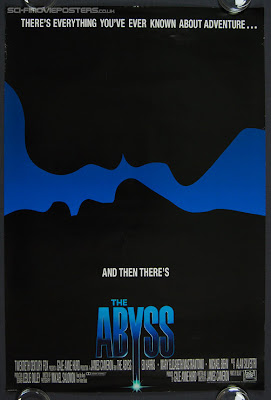
I’ve written on The Abyss before, but I just watched it again a little while ago, and if anything, I love it even more. This is one of those movies that gets better each time I watch it. I genuinely believe it’s an underrated classic, overshadowed by the films in James Cameron’s oeuvre that bracket it: Aliens (which I don’t like) and Terminator 2: Judgment Day (which I consider classic).
For those who haven’t seen The Abyss: it’s set in the late 80s, before the end of the Cold War. A US nuclear submarine is cruising near an extremely deep trench in the Caribbean (the titular “abyss”), when it’s buzzed by some kind of underwater phenomenon that travels extremely quickly with astonishing maneuverability, and which interferes with whatever electrical systems it comes near. Is it some kind of Soviet weapon? Or something else? They don’t find out, and the sub is caught in the turbulent wake of the “bogey” just as its electrical systems all go haywire, meaning that the sub can’t avoid crashing into the walls of the trench. The sub goes down, eventually coming to rest a couple of thousand feet down, flooding and killing all the sailors on board, but not before they can launch their log buoy.
So a recovery mission is launched. The problem is that the Navy can’t get its recovery equipment and vessels into the region before the hurricane that’s on its way will get there, so they recruit the crew of an experimental undersea oil drilling platform, “DeepCore”, (referred to throughout the film as “the rig”) to do the job of inspecting the sunken sub. A team of Marines are sent down to the rig to help, and of course, the Marines don’t get along terribly well with the oil workers who populate the rig; and the Marines are accompanied by the rig’s designer, the alpha-female Lindsay Briggman, who happens to be the estranged wife of the rig’s foreman, Virgil “Bud” Briggman. Hilarity ensues as the hurricane on the ocean surface results in great damage to the rig under the sea, as Bud and Lindsay battle one another, as the Marines execute their own orders without telling anybody else, and as the commander of this bunch of Marines starts to show signs of underwater psychosis. Add to that a race against time as the rig is cut off without its replenishing oxygen supply, the strange underwater bogeys that may or may not be aliens, and the nuclear menace when the Marines’ secret orders turn out to involve removing a warhead from the sunken sub.
(You know, I’m not sure they’re Marines. Navy SEAL’s, perhaps? I don’t recall. Yeesh. And I just watched the movie.)
Anyhow, I’ve never understood why this movie doesn’t have a better reputation than it does. Not that its reputation is bad, mind you; my general sense is that it’s well-regarded, but it wasn’t really embraced by the general public. One reason is probably the theatrical cut of the film, in which the role of the undersea aliens is a bit reduced, and in which one of Cameron’s main subplots, the Cold War tensions being exacerbated by the rescue operation in waters very near Cuba, was completely cut from the movie.
That’s not entirely a bad thing, since while I do think the Director’s Cut is better than the theatrical cut, it’s not across the board better. The problem is that James Cameron has never, not once, been a filmmaker who counts subtlety among his bag of tricks, so the Cold War stuff is driven home hard, hard, hard. We see news reports highlighting the events between the US and the Soviet Union, which is all well and good, except that Cameron also throws in some odd “Joe Citizen” interviews in which supposed people on the street say things like “Geez, the Russians love their kids too, so why are we doing all this?” This stuff doesn’t work very well, and more on some other problems with the Cold War subplot in a bit.
What really works with this movie – really, really works – is the creation of a complete setting that is totally believable, filled with details that feel totally plausible. To my knowledge, there’s nothing at all like Deepcore anywhere in existence, but the movie has extensively thought out what such an undersea drilling rig would be like and what life would be like for the men and women working there, with the result that the setting works. That’s worldbuilding, in the best sense of the word. Everything looks real, like it has a purpose. Everything clanks and clunks like metal on metal; the ceilings and walls are covered with pipes that constantly drip water in various places; the place is cold and dark and dank, and yet the people who work there consider it home, and they live in the place with an eerie acceptance of the awesome pressure of water all around them. There’s also a keen sense of family among the cast: the crew of the Deepcore rig really do seem to have been working together for a number of years. They know the same songs, they share the same in-jokes, and they speak to each other in the kind of shorthand that only people who have worked in close quarters for a long time can do.
The film draws much of its tension from the claustrophobic settings of the rig, which are made even more claustrophobic by the fact that they’re a mile underwater. There is also palpable sense of fear, both fear of the unknown and fear of the possible nuclear disaster unfolding. There are a number of very finely-done action sequences, foremost among these being a chase sequence involving two submersibles. And the movie also features one of the more creative riffs on the “defuse a bomb by cutting the correct wire” meme I’ve seen.
The music is by Alan Silvestri. It’s mostly a serviceable score that doesn’t really call attention to itself, but like most Silvestri scores, it’s got some nice ideas and fine moments.
What don’t I like about the movie? Well, the ending always feels like a small let-down. In the Director’s Cut, the entire last act ends up feeling not unlike The Day the Earth Stood Still. It’s mostly effective, but again, Cameron’s lack of subtlety actually harms things a bit, when he chooses to drive home the film’s anti-nuke message with all the delicacy of a brick thrown through a plate glass window. Still, I’m always deeply touched by the aliens’ final reason for not causing the seas to wipe the Earth clean of the human menace. (And, to be frank, the visuals in the film’s very last scene always look fake to me. I wish they’d have found a better way to shoot some of what happens at the very end.)
Tiny quibbles, though. I watch The Abyss once every year or two and it always feels fresh and exciting to me. It’s a terrific movie that should have a higher reputation than it does. I consider it a modern SF classic.
EXTRA NOTES: I’d never seen the poster art above until I Googled about a bit for an image to use for this post. I like that image, a lot — the blackness surrounding the deep blue of the dark water, forming the profiles of the man and woman. Cool poster! Image taken from here.
I popped over to the FSM message boards just to see what was going on, and someone posted this slice of nostalgia:
How cool is that! I assume that the Charlie Brown movie is Race For Your Life, Charlie Brown, which I see was released less than two weeks after Star Wars in 1977. I’ve never seen that one, but still — that’s a pretty impressive slate at the theater, isn’t it?
The first real indication I had as a kid that geek culture could be a lonely thing was when the movie TRON came out. I thought TRON was amazing; I loved it. I was just starting to become a minor-league computer nerd, and at the time, computers weren’t nearly as omnipresent as they are now. To use a computer I’d go with my father to the college, where we’d use terminals hooked up to the mainframe; there I’d dink around and play Colossal Cave and experiment with programming in BASIC and whatnot. Computers in public schools, though? This was rare — very rare, actually. As in, the purchase of a single computer for a single classroom would be taken up at a school board meeting. There were kids in my class who were years away from ever even touching a computer. Strange times, those.
So when TRON came along, I remember being the only kid in my grade who actually saw the thing. This befuddled me for a while: after all, every kid saw Star Wars! Every kid saw Raiders of the Lost Ark! Every kid saw ET, and Star Trek, and whatever else there was. But TRON? Nope. Nobody saw that one. Oddly enough, the other kids who were only vaguely aware of the existence of the movie were certainly aware of the video game. On the rare occasion when I’d get to go into an arcade (my parents weren’t wild about giving me fistfuls of quarters to go into those dark dens of video temptation, for some reason), I’d watch some kid play TRON:
KID: I’m gonna do the lightcycles next! That’s my favorite part of the game!
ME: Yeah. That part of the movie is so cool! (I don’t remember what the slang was back then — “rad”, maybe? Or did “rad” come along later?)
KID:: Movie? Oh yeah, this game’s from a movie. Huh.
And so it would go.
Cut to now, though: TRON‘s reputation has improved over the years. It’s remembered by many a geek now as a seminal event, and it’s not even a bad movie, either — a bit awkward in places, and in a couple of others it’s hilariously dated, but still, TRON still tickles the strings my geek heart:
So now, they’re doing a sequel: TRON Legacy. Right now I’m kind of excited about this, especially on the basis of a pretty amazing trailer that’s making the rounds of the Interweb right now. Yeah, trailers rarely reflect the quality of a movie, but…well, WOW. (Video embedding is disabled, so click over to see it.) Wow, those lightcycles have sure come a long way since 1982…and I love the visual homage to the Pod Race from The Phantom Menace that’s in there.
What am I hoping for? Well…the original was nifty and computer-esque without being full of dark, dank and cynical expression like The Matrix. I hope for that, at least. And I want lots of lightcycles and Recognizers and program identity discs and all that jazz. I can’t wait!