“DANCING! Everything else is bullshit!”

It’s always fun to take trips down memory lane and investigate the objects of our nostalgia, isn’t it? Once in a great while we’ll look into something we deeply loved when we were young and find that it’s every bit as good as we remember it; much more frequently we find that the thing we loved is actually complete crap, and a kind of jaded disappointment sets in as we wonder how we could have ever been so naive as to think the item in question was any good at all.

But there’s a little-discussed third category, when we strongly suspect that the thing we loved back in the day is crap, and thus, when we find our suspicions confirmed, we’re not so much disappointed as rather elated in a strange way. I had one of these experiences last week, when I popped into my computer the DVD of a movie I hadn’t seen since I watched it at the tender age of eight in my own living room. The movie? A mostly-forgotten flick called Thank God It’s Friday.

How did I come to see this movie when I was eight? It was on HBO during the year when we actually subscribed to that service, the year we lived in Elkins, WV. I was in second grade. HBO was kind of cool — a channel with uncut movies! What could have been cooler than that? I vaguely remember being ordered out of the living room when my parents wanted to watch an R-rated movie on HBO, but I could be misremembering events. I don’t really remember how many movies I saw on that channel — the only ones that stand out are Buck Rogers in the 25th Century (I had an obsession about that flick and its later teevee show), The Poseidon Adventure, and Thank God It’s Friday.

So, what about this movie? Well, I noted some time ago that Saturday Night Fever has a camp reputation about it, mostly owing to the camp reputation that’s accrued around everything from the disco era these days. SNF‘s reputation, though, is unfair; the movie is cynical, bleak, and brilliant. People who haven’t seen SNF mock its dance moves and the disco clothes. The movie they should be mocking is Thank God It’s Friday, because this movie really portrays the reality that most people think of when thinking of the disco era: bad clothes, bad dance moves, drunken and drugged-out sexual escapades carried out on smoky dance floors under the eye of a hyperkinetic deejay.

TGIF is one of the campiest movies ever made. I’m reasonably confident in that statement, even though my sample size of movies seen is nowhere big enough to make that statement definitive. Seriously, this is one silly movie. Not one minute of it deserves to be taken seriously. However, I don’t hold that against the movie, because I don’t think that the movie takes itself seriously for one minute.

What is TGIF about? It’s one night, a Friday night (obviously), in the life of a Los Angeles disco. Into this disco wanders a motley cast of characters, whose misadventures on and around the dance floor we follow for the duration of the flick. There is the pair of underage girls who are breaking curfew in hopes of winning the disco’s dance contest. There is the Wonder-bread guy whose Wonder-bread wife wants to be more than Wonder-bread, and thus drags her accountant husband to the disco. There’s the naughty girl who drags her nice friend to the disco in hopes of finding her a man, and there’s the naughty boy who drags his nice friend to the disco in hopes of scoring with the ladies. (No points for guessing who the nice girl ends up with at the end of the movie.) There’s the full-of-himself disco owner (played by Jeff Goldblum), who pursues a married woman on a bet. There’s the deejay who is under pressure because The Commodores are coming for a live performance that may make or break his career as a radio deejay — but the guy bringing the equipment for the Commodores is nowhere to be found. And there’s the young lady singer who is desperate for her big break and thinks that this disco may be it. Oh, and don’t forget The Leatherman, the guy in leather who never stops dancing for one minute and works his catchphrase (which I’ve appropriated as the title of this post) into every conversation.

Thank God It’s Friday is goofy. It’s stupid. It’s clicheed. Yes, it depicts all of the bad aspects of the disco culture with none of those aspects’ bad effects. (Which is, by the way, why SNF is such a great film.) It just isn’t a good movie, by any conceivable standard.

Except that…geez, I had fun watching it again. I laughed at it, I laughed with it, I just plain laughed. And the music? Yeah, it’s disco — but really, not everything about disco was awful, and one of my favorite songs ever springs from the movie: “Last Dance” by Donna Summer (for which it won an Oscar, believe it or not).

This post is not a ringing recommendation that anybody watch this movie. But…watch this movie! You may find it so bad you love it.

Share This Post

Sunday Burst of Weirdness Linkage

I don’t have much by way of weirdness for this week, but I do have some linkage to offload at clearance prices, so here we go!

:: The “Cultural Anniversary” thing is gearing up for the 40th Anniversary of the Apollo 11 moon landing, but there’s a mildly-less-important 30th anniversary today, an anniversary that marked a major shift in pop culture history. Thirty years have passed since Disco Demolition Night.

:: One of the niche sports you don’t hear much about at all, even at Olympic time, is kayaking. You certainly never hear about Extreme Kayaking. To that end, here’s an article about Extreme Kayaking. What is extreme kayaking? It’s doing things like kayaking over waterfalls — some up to 100 feet in height. (To envision a 100-foot waterfall, the American Falls at Niagara vary between 70 and 100 feet from brink to the pile of rocks at the bottom. The Horseshoe Falls, by comparison, are more than 170 feet high.) I used to do a bit of kayaking, in my youth, but I never came near to being proficient enough to run any kind of waterfall, and the largest waterfall I ever saw that people would occasionally run was the Ohiopyle Falls on the Youghiogheny River in Pennsylvania. Those falls tower at eighteen feet in height, and even at that, I remember looking at them and wondering how on Earth any paddler could run them. Running a fall that’s half the height of Niagara? The mind reels!

(This also reminds me that I have an unfinished short story about a pair of kayakers that I should finish one of these days, just as soon as I figure out how to end it.)

:: James Wolcott surveys one implication of the proliferation of digital media: that our media will become more and more private.

In the same car is another, older woman—do men not read anymore? (Seinfeld’s Jerry, defensively: “I read.” Elaine: “Books, Jerry”)—holding up a Kindle at an angle to catch the light. Unless you were an elf camped on her shoulder, what she was reading was hoarded from view, an anonymous block of pixels on a screen, making it impossible to identify its content and to surmise the state of her inner being, erotic proclivities, and intellectual caliber. She might be reading Alice Munro, patron saint of short-story writers, or some James Patterson sack of chicken feed—how dare she disguise her download from our prying eyes! And reading an e-book on an iPhone, that’s truly unsporting. It goes the other way as well. How can I impress strangers with the gem-like flame of my literary passion if it’s a digital slate I’m carrying around, trying not to get it all thumbprinty?

I love it when people notice the cover of a book I’m reading and either comment on it or ask about it; likewise, I tend to be one of those people who will crane my neck to see what someone nearby is reading, on the off chance that it’s something I know well and love. “Oh my!” I’d say. “Isn’t that Locke Lamora a scream?” Or something like that. Oh well.

:: I’ve been meaning to link this for a few weeks but keep forgetting. The annual Bulwer-Lytton contest happened recently, honoring bad writing in the name of Edward Bulwer-Lytton, a writer once prized but who is now seen as the poster child for overly purple prose. Jess Nevins makes the case that Bulwer-Lytton’s negative legacy is unfair, and he makes his case pretty convincingly. (Not that I’d know, having never read Bulwer-Lytton.)

:: Huzzah! I finally managed to break through and win an installment of Becca’s weekly movie quotes/pics quiz.

Of course, my win this week wasn’t so much a function of me knowing more than her other readers, but my being in the right place at the right time. Her quizzes operate on a “who answers right first wins” plan, so if you happen to get there an hour after the quiz has been posted, you’re almost certain to join the party after all the queries have been answered. This time, though, I was first. Yay, me! (One time I got there when no one else had commented, but in the course of typing in my responses in her comments thread, someone else managed to type faster than me and get their answer in first. Aieee!!! But this time I was first, fair and square.

:: I don’t know anything about the Green Lantern, so do any of my readers have an opinion on Ryan Reynolds as Green Lantern? I’ve only seen Reynolds in one thing — the romantic comedy Definitely Maybe, in which I liked him while not finding him especially charismatic — so I have no real opinion here.

:: Lard! Whiskey! Sexy! (I may have linked this before, but as I did not delete the bookmark if I did, here it is again.)

And with that I should be able to clean out my bookmarks a bit.

Share This Post

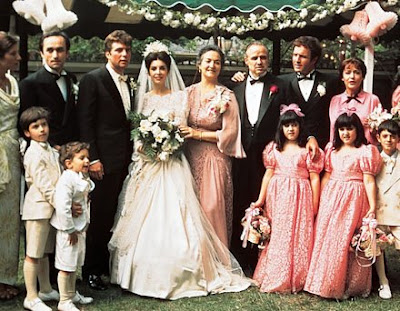
“Leave the gun. Grab the canoli.”

I figured, a while ago, that it was high time I eliminated a particularly large gap in my movie watching career. I’ve long indicated that stories about the Mob and organized crime in general aren’t my cup of tea, to the point where I refuse to see Goodfellas as the rightful Best Picture of 1990. Sorry, Scorsese fans, but I will always love Dances With Wolves more. But, while I have little interest in watching stuff like The Sopranos, I decided that I should at least venture to see the most celebrated film ever made in this genre. So it was that I watched The Godfather, at long last.

Now, I’ve seen bits and pieces of The Godfather over the years, many and many of the bits and pieces. It turned out that when all those bits and pieces were added up, I had, in fact, seen most of the movie’s important parts; the overall plot came as no surprise to me at all, except in a few spots where I finally got to put together the story mechanics behind some very famous scenes. I wasn’t going into the movie with any kind of chip on my shoulder, mind you; I expected The Godfather to be a very good movie. But wow, what a movie. That’s about all I have to say about it, really, in terms of overall appraisal. The Godfather is just an awfully good film. So, some random observations:

:: You know you’re watching a special movie when you’re unaware, or only occasionally aware, of the passage of time. The opening scene, at the wedding of Don Corleone’s daughter, seems over pretty quickly, and yet it’s about half an hour long. And yet, look how much of the movie is set up in that scene! It’s really pretty amazing. Virtually everything is foreshadowed in that half an hour, and it’s foreshadowed so artfully that we don’t even realize we’re being foreshadowed, most of the time. (And when we do realize it, the eventual payoff – such as the “service” that Bonaserra is eventually called upon to perform – is surprising in itself.)

:: Passage of time in the movie itself, within the story, is hard to get a handle on, and it seems as though the events of the Corleone family and their enemies don’t occupy any real relationship to the world around them. It is unclear as to how many years go by in the course of the film; Michael Corleone is back from Sicily for a minute or two of film time and it turns out that a year has gone by. Don Corleone himself goes from elder with lots of vitality to ancient patriarch before our eyes.

:: The passage of time thing brings up a larger point, that the world the film depicts – the world of the Sicilian mob in New York – is a totally insular one, isn’t it? There’s almost no depiction of any connection to the doings of the outside world, except as they relate to the criminal activities of the Corleones. It’s also interesting to see that law enforcement plays almost no role in this movie. There’s a dirty cop who isn’t around very long, and during the wedding that opens the film some FBI agents are taking down the license plate numbers of those in attendance, but that’s about it, isn’t it?

:: I wish I hadn’t known about the decapitation of the race horse before it happened; I’ll bet that was a shocking moment to audiences back when this film came out. Instead, I’m kind of saying to myself: “Hey! That’s the horse whose head gets chopped off to make a point to this arrogant prick!”

:: It’s interesting to me that “Luca Brasi” has become a pretty well-known character name in pop culture these days, for a character in a three-hour movie who has very little actual screen time. Luca Brasi isn’t around very much at all, is he?

:: The only part of the movie that lagged, in terms of pacing, was the part set in Sicily. It just wasn’t terribly interesting, although it did establish the root of Michael Corleone’s later ruthlessness.

:: My favorite line of dialogue in the movie is “Leave the gun. Grab the canoli.”

I will watch the sequels at some point.

Share This Post

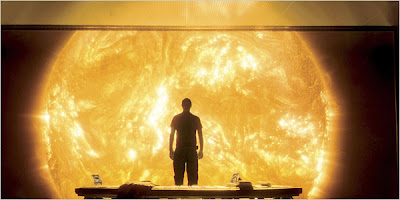
“Eight astronauts strapped to the back of a bomb. My bomb.”

A friend of mine sent me a copy of a science fiction movie from a couple of years ago called Sunshine, which I’d never heard of before. And it’s really a very good film.

The plot isn’t terribly complex: at some indeterminate point in the future, the Sun is “going out”, but some physicist figures out how to make a kind of “solar bomb” that can restart the Sun. A ship is sent to deliver this bomb into the Sun, but that expedition fails for unknown reasons, so a second expedition is sent. Shortly into the movie, the ship – called Icarus II, for obvious reasons, with the first ship, the failed one, being Icarus I — passes beyond a spot beyond which they can send no more messages back to Earth. From that moment on they are alone, and from that moment on, things start going awry.

First off, this is a movie that knows how to handle an implausible Maguffin. If a Star Trek; The Next Generation episode had a star going out and the crew trying to “restart” it, we’d be treated to at least one scene, if not more, in which lots of folderol about subatomic particles and space-time continua and the like would be bandied about in hopes of making it all sound as though it’s not what it is: pure BS. Instead, this movie gives the whole “dying Sun” thing exactly as much explanation as I give here in this post. The movie doesn’t care about the plausibility of the premise or how it could be glossed over; an opening monologue establishes the situation in four or five sentences, and then we’re on board the Icarus II.

This movie falls into that most reliably involving of genres: the “diverse group of people have to get something done by a certain time or absolute disaster will unfold, and meanwhile, everything that could possibly go wrong does” tale. Will the crew have enough oxygen for a return trip? Will the ship suffer damage in a meteor storm? Will the bomb even work? Will they succumb to whatever mysterious fate awaited the Icarus I? Will they manage to keep their psyches in check? The answers to at least a few of those questions are “No”, which is what makes for a gripping movie.

The film takes its time in getting moving, introducing us to its characters and creating some real sense of wonder in a few terrific scenes, such as one man’s desire to look upon the brightest sunlight he can, and another when the entire crew gathers before an immense viewscreen to watch a transit across the solar surface of the planet Mercury. When the tension starts to increase, it does so slowly at first, and then things get worse faster and faster, as the ship gets closer and closer to the sun. There are many excellent character moments — most of the characters in the film are memorable people, refreshingly enough — and the various moral dilemmas they all end up facing all seem quite real. Visually, the film is extremely well done; the effects aren’t terribly complex, but they don’t need to be and despite the film’s plot involving the sun going out, everything the movie shows us feels plausible enough. You really get the feeling that if we build a big ship for an expedition to the Sun at some point, that’s what the ship is going to look like.

The movie starts out slowly, and builds up its tension until it’s one of the more effective SF thrillers I’ve seen. There is a gradual shift in tone in the film — I don’t want to say too much, but eventually there’s a killer on the loose — but it all worked for me, very well. This movie drew me in and did so quickly.

The performances are all terrific; the cast is necessarily small, and fortunately there is excellent chemistry amongst them, which is an essential ingredient for a film as tightly focused as this one. The only actor I recognized by name was Michelle Yeoh as one of the crewmembers, although I was impressed by Rose Byrne (who, when I looked her up, turns out to be the actress who played Dorme in Star Wars Episode II: Attack of the Clones, a performance of a bit part that I praised a short time ago) and Cillian Murphy as “Capa”, an actor whose looks remind me eerily of Judson Scott. (Holy crap, Judson Scott is about to be 57 years old! How did that happen!)

I recommend Sunshine highly. I found it a deeply satisfying SF film.

Share This Post

Opening hailing frequencies, Captain

UPDATED below.

Seldom have I been more conflicted over a movie than I am over Star Trek. I mean, wow, am I of two minds on this movie. It’s as if the film has managed to split me right down the middle, which calls for something I haven’t done in a while on this blog: a full-on geek-out of epic proportions. Beware SPOILERS! I hold nothing back.

I loved watching it. Absolutely loved watching it. I don’t remember a more enjoyable piece of pure entertainment than Star Trek. Maybe the first Pirates of the Caribbean movie. As a piece of pure moviemaking, Star Trek is just about as good as it gets. Seriously. The cast is all wonderful, the direction outstanding, the editing is spot-on – there are maybe two or three minutes in the whole movie where the pacing flags a little, and those moments are over just as you notice that the moment in question is running a bit on the long side.

How about that casting? Chris Pine and Zachary Quinto are the most important players here, obviously, as James T. Kirk and Spock. Both are superb. What’s so impressive is that neither man tries to ape their forebears, William Shatner and Leonard Nimoy, instead choosing to create the characters as written for them, and yet also capturing the essence of the characters we all know so well. Karl Urban’s Leonard McCoy is just terrific; most commenters seem to think he’s just giving an eerily accurate impersonation of DeForrest Kelley, but I don’t think that’s quite fair. His McCoy is acid-tongued and emotional, and he gets to zip off the iconic “I’m a doctor, not a ____” line as well as make an angry reference to Spock as a “green blooded ____”, but surely that’s the essence of McCoy, not just of DeForrest Kelley. The remaining bridge crew is all superbly cast, even if there are a few too many riffs on Chekov’s thick Russian accent. (And of course, we all know that Chekov wasn’t on the Enterprise from the launch of Kirk’s captaincy, either. But more on continuity and canon later.)

Eric Bana as Nero, the Romulan villain, is OK, I guess. He doesn’t get much to do except look really angry and revenge-driven. He’s not an interesting villain, actually. Better is Bruce Greenwood as Captain Christopher Pike, who is presented as a father-figure to Captain Kirk. He has a ton of screen presence and charisma, which is exactly what that part needs; if Kirk’s going to grow into that, we need to see an example first.

Yup, this is how to make a movie, all right. Problem is, I’m not sure it’s how to write one. As great a time as I had watching it, I fear that Star Trek is kind of like the M. Night Shyamalan film Signs: the more you think about it afterwards, the less good it looks. (And nobody gets to say “But it’s a movie, you’re not supposed to think about it!” Nonsense.)

Plotwise, storywise, and to some extent characterwise, Star Trek is kind of disappointing in some regards, disappointing in others, and downright annoying in still others. The problem is that relatively few of the developments in Star Trek‘s story make sense. Some are contrived, others are just full of that good old fantasy element of SF, “handwavium”. Now, it’s true that virtually all SF relies to a certain extent on handwavium, but Star Trek positively drips with it.

While I noted above that there are virtually no boring moments in Star Trek, there are plenty of moments that made me think, “Hey, wait a minute.” Taking just one, Spock’s marooning of Kirk on the ice planet: first, doesn’t that seem a bit Draconian? Doesn’t the Enterprise have a brig he can lock Kirk up in? Second, how lucky is it that Kirk is marooned a mile or two from a crappy ice cave where Spock Prime (as he’s called in the movie’s credits) is hanging out, conveniently located to explain the whole plot? And then, how lucky is it that both of these fellows are marooned a mile or two farther away from the crappy outpost where Montgomery Scott is cooling his heels? This whole sequenced bugged the living hell out of me. In fact, Spock Prime’s presence irritated me. But more on that later on, as well.

I recall reading some positive reviews that cited the movie’s ability to avoid Next Generation-like reliance on technobabble to make its impossible stuff happen, but does it, really? A beach-ball sized glob of “red matter” is used, one drop at a time, to create black holes in the center of planets, thus destroying them? A drill that cuts holes to planetary cores? Temporal rifts? All of this is technobabbly, handwavium BS. Again, nothing against handwavium, but Trek has always made some attempt to make its nonsensical stuff seem believable. Sometimes that’s a case of “show, don’t tell” – note that in Wrath of Khan, no discussion at all is given to how the Genesis Device actually works; it just does. And I’d accept the handwavium here, if there wasn’t a lot of other complete nonsense going on that was avoidable. Spock refers to a single supernova that threatens to “destroy the entire Galaxy”. How the hell is one supernova going to do that? The blast wave of the nova, even if powerful enough to destroy a galaxy, would take centuries upon centuries, literally thousands of years, to traverse the entire Milky Way. This was complete nonsense that jolted me out of the movie. Ditto the way Spock is able to stand there on Hoth Delta Vega and watch as Vulcan is destroyed. There’s no way those two planets are that close. They would have to be orders of magnitude closer together than Earth and Mars. This, too, was complete nonsense that jolted me out of the movie. In fact, in terms of plausibility, this is the second-worst thing I’ve ever seen in a Star Trek movie. (The worst is Soren’s missile in Generations, the one that flies from the planet surface to the star in about eight seconds, leaving a contrail as it goes.) And then there’s the whole “going through a black hole takes you back in time” nonsense. This isn’t even close.

Other things bothered me about the movie, as well. For all the stuff early in the movie about James T. Kirk being a screwup and a delinquent, he undergoes a massive shift when he gets on board the Enterprise: suddenly he’s uber-competent and right about everything. There’s no real sense of growth to Kirk in this movie; one minute he’s the screwup with potential and the next he’s displaying “command fitness” out the wazoo. What lessons, really, does Kirk learn in this movie? He really doesn’t learn any, which is unfortunate. Everybody else learns from him, but he’s presented at the beginning of the movie as needing to learn the most.

I also didn’t like the Kobayashi Maru test. I’d like Kirk to have acted the part more, instead of just lazily goofing his way through a test that he knew he’d win. I’d have liked it if it had been the way he originally described it in TWoK: “I reprogrammed the simulation so it was possible to rescue the ship.” (My emphasis.) Instead, he simply reprograms it so he will rescue the ship. That was disappointing.

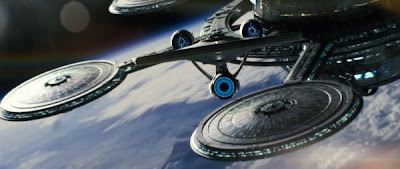
In terms of the film’s general look and appearance: I didn’t dislike the new Enterprise as much as I thought I would, honestly. I’m not big on how the rear ends of the warp nacelles light up when the ship is going to warp; the nacelles aren’t thrusters, after all. (I know they’re dumping all of the previously established canon as far as events in the series, but surely they’re not summarily dumping everything, right? The fictional idea behind warp drive still has to be the same, or else the creators here are just being dishonest.) The bridge is still too bright, too Apple Computer like, and the front viewscreen is no longer a viewscreen, but an actual window, apparently. (And there’s one shot in the movie that seemed to me to indicate that the bridge is now at the bottom of the saucer section! I could be wrong here – the shot was over in seconds – but if I’m right, that’s a huge change, and not one I much like. Why would a new timeline lead to a completely new design of starships? Did anyone else see this shot?)

And that brings me to the time travel stuff. I’ve had mixed feelings about this, ever since the film’s writers started giving interviews in which they indicated that they’re not resetting the Trek continuity to zero but rather kicking off a new timeline in which nothing has changed. The implication is that all the “standard”, or “canonical”, adventures of Kirk and company are still happening, to the Kirk and company in that timeline, where now we’re going to be following the adventures of Kirk and company in this timeline. This is, of course, pure handwavium, of the “have our cake and eat it too” variety. That’s all well and good for the writers, but is that really what happens in Star Trek?

Consider the chain of events. Apparently, in “Trek Prime”, Nero gets all pissed off and takes a mining ship after Spock’s attempt to save the galaxy from the exploding supernova destroys Romulus. But they end up going through the black hole and back in time (ouch). Pretty soon, Nero commits an act that changes history: he attacks the Kelvin, causing George Kirk to die heroically instead of living to raise his son. Now, everything is different. History has been changed.

Freezing the action right there: a few of the very best episodes of Trek ever made involve the changing of history. Most famous is “The City on the Edge of Forever”, in which Dr. McCoy, driven mad by an accidental overdose of some drug, jumps through the Guardian of Forever and winds up in 1930s New York, where he somehow prevents Edith Keeler from dying. Keeler goes on to found a peace movement that keeps the US out of WWII, allowing Germany to take over the world because they develop the atom bomb first. Also, just about every list of the best episodes of The Next Generation I’ve ever seen cites “Yesterday’s Enterprise”, in which the Enterprise-C gets thrown forward in time before it can accomplish what it needs to accomplish, again changing history (this time resulting in a Federation at war with the Klingon Empire). Both times, it’s taken for granted that history must be restored.

Other Trek time travel adventures include Assignment: Earth, in which the Enterprise travels back to 1968 and very nearly ends up a party to changing history again, and “Tomorrow is Yesterday”, when the Enterprise accidentally ends up in 1967 Earth and is seen by an Air Force pilot, whom they then beam aboard the ship and then realize have to beam back without his knowledge of having been there, lest history be changed. The best of the TNG movies, First Contact, has the Borg going back in time to take over Earth in the 21st century and preventing the Federation from ever existing; Captain Picard and the Enterprise-D have to fix history.

So, returning to the current Star Trek: Spock ends up with Nero back in time, and soon realizes that Nero has changed history. With all of that precedent in Trek lore for restoring the proper timeline, what does Spock do?

Nothing. And consider, he’s got his own ship, he knows how to travel in time (he calculated the equations for the time travel to get some humpback whales once), and failing time traveling in his own ship, Spock knows of an uncharted planet where resides a device called the Guardian of Forever. He could try to set things right…and doesn’t. He just accepts the “new timeline”, and at the end of the movie, is seen going off with the rest of the surviving 10,000 Vulcans who are left in the galaxy to re-establish their culture.

I’m sorry, but what the hell is that?!

Seriously, here, WTF? Why would Spock just blithely accept his fate in the “new timeline”? This makes no sense whatsoever. It would have been poetic, maybe, if Spock had tried, but failed, to set things right; maybe that could have ultimately been how Spock finally dies for keeps, and in all the “Hey, we gotta fix what we screwed up in time traveling!” stories ever made, I only remember one in which the time traveler doesn’t get it exactly right. And that’s a segment from one of the “Treehouse of Horror” episodes of The Simpsons. They could have had Spock being unsuccessful in restoring history, and realizing at the end that history is just going to go on now, in its rewritten state; that would have been poignant and gutsy.

Instead, we get this: Spock acting in very un-Spockish way, and some stuff about new timelines co-existing with old timelines from the creators. However, nobody in the movie indicates that the old timeline is still intact and just a dimension or two over to the left, so as far as they’re concerned, this is the way things are gonna be. All of that leaves me to believe that the writers’ babblings in the press about co-existing timelines was just as bunch of made-up nonsense to mollify the fans, who are annoyed at the prospect of a Jim Kirk who will never meet Edith Keeler.

Here’s my problem with that whole “co-existing timelines” thing: it renders the old stories irrelevant. Suddenly there turns out to be a lot less at stake than there might have been otherwise. Why should Kirk allow Edith to die, if he knows that there’s another timeline out there somewhere in which she does die, so why not just save her and have her love? Everything just becomes a bunch of dull counterfactuals. That’s what bothers me about the concept of a reboot – or rather, this particular concept of a reboot.

On reboots in general: they’re not all comparable. People like to justify this Trek reboot by citing Battlestar Galactica, the Batman movies, or the James Bond films. None of those comparisons hold, though. The original BSG lasted just nineteen episodes, so there’s really not much to cheapen by the existence of a reboot. Batman had four movies before the reboot with Batman Begins, and comics movies are a special case, anyway, since the movies exist outside the continuity of the comics in the first place. That leaves Bond – but the whole notion of James Bond being the same guy in Die Another Day and Dr. No is just silly on its face, so this isn’t the same kind of thing. It’s the reality of what exists right now, but the logic just doesn’t hold up.

Another note about canons and continuity: even if I grant that we’re in a new timeline now that starts with the destruction of the Kelvin, there’s still a remaining fact that the producers didn’t seem to realize: you still have to respect the established canon to that point. Which means that you have to deal with certain realities of Star Trek canon: Kirk has an older brother named Sam, who doesn’t appear to exist in the movie. You know who else has an older brother? Spock. So where is Sybok? And so on.

I also didn’t care for some of the depiction of the Vulcans in the movie. For a race devoted to logic and the suppression of emotion, they sure are a goofy bunch, as shown in Star Trek. A culture that advanced only manages to get 10,000 people off the planet? And the response of the “Elders”, whose job it is to keep the culture alive, to the imminent threat of planetary catastrophe is to go hide in a cave? And I’m sorry, but Sarek should never openly admit to loving Amanda. We know that he loves her, and that he shows it in the best Vulcan way, but to say “I married her because I loved her” just stood out as a staggeringly un-Vulcan thing to say. There’s no way Mark Lenard would have stood for that line! And McCoy refers to his divorce, but does his daughter Joanna exist in this timeline?

Other random observations and things:

:: We all know that James T. Kirk is a womanizer, but I didn’t much like how this movie depicts him as having an eye for anything that has the attributes of being a female and having a pulse. This can be chalked up to his being more of a delinquent slacker in this movie than Kirk Prime, but still, it got a bit annoying.

:: I like Michael Giacchino’s score a lot, although I would have liked to hear more of the classic Alexander Courage Trek Fanfare. At times the score called out for it, and it wasn’t there.

:: Why on Earth does Leonard Nimoy give the “Space, the final frontier” speech at the end? By the logic of the film, we should be hearing Chris Pine’s voice there. That made no sense.

:: I just loved the design of the end credits, with all of those nifty alien worlds and stuff. It looked like updated versions of the kinds of planets you used to see on the covers of cheap SF paperback novels.

:: So Nokia is going to survive the next 200+ years as a company? Really?

:: I had no problem with the relationship between Spock and Uhura. That’s fine with me.

:: It probably would have made the cast overstuffed a bit, but I would have liked to see Chris Chapel and Janice Rand in there somewhere.

:: Lots of people are wondering where Nero disappears to for twenty years. My assumption is that his nifty, bad-ass mining ship took some serious damage when it got rammed by the Kelvin, and making repairs to a ship from the future when the technology doesn’t exist probably takes a while. Twenty years? Well…the movie asks us to swallow the notion that a bit of “red matter” the size of a marble can destroy a planet, so why not?

:: But as for Nero’s ship — I didn’t get the design. What are all those appendages for? And why is the “flight deck” filled with ankle-deep water? A ship from the 2300’s doesn’t have floor-drains and plumbing?

:: I’m sorry, but I hated that they were building the Enterprise on Earth’s surface…and there goes another bit of continuity, too. Remember, in TOS, the Enterprise was not a new ship when Kirk took command; the events of “The Cage” are specifically indicated in “The Menagerie” to have taken place thirteen years earlier. That would mean that technically, the Enterprise should already be cruising around under Captain Pike’s command when young Kirk is joyriding in the hot-rod. I know, we’re in a new timeline, but there are limits to what I’m willing to accept as having been changed here. Enterprise should not be virtually out-of-the-box new when Kirk takes over the center seat.

:: The moment where Sulu screws up going to warp speed echoes a similar moment in an old Trek tie-in novel by Vonda McIntyre, called Enterprise: The First Adventure. That novel is a telling of the “Trek Prime” first voyage of the Enterprise under Jim Kirk’s command, and in fact, it’s actually a decent novel, well worth checking out. Kirk’s assignment to the Enterprise is what ultimately causes his break-up with Carol Marcus, and soon he’s getting to know a new crew. Anyway, there’s a moment at the beginning where the Enterprise is leaving spacedock, and Sulu messes up, causing the ship to lurch or something like that.

:: So, what’s next for Trek? The sequel has already been greenlit by Paramount, so I assume in two or three years we’ll be queuing up for Star Trek II…again. JJ Abrams has observed that the Enterprise crew could always meet Khan Noonian Singh again…for the first time, again. Or something like that. I personally don’t want that; nor do I want to see Borg again. Surely we can actually get a new adventure? Actually see some exploring of strange new worlds and new life and new civilizations? You know, going places boldly? In fact, it might be nice to have an exciting SF Star Trek adventure that never has the ship firing phasers or torpedoes. But if we have to bring back old Original Series characters for updating, how about some of the others? How about Klingon commanders Kang and Koloth? How about Harcourt Fenton Mudd? But really: how about a new adventure? Continually revisiting old characters is still fan-service for the Trekkers, and even they probably get tired of the same old thing every time out. (Of course, it’s to be noted that the least successful previous Trek flicks are the ones that tried to show something new instead of posing sequels or follow-ups to previous stories: TMP, The Final Frontier, and Insurrection. But then, I actually like those movies more than most, so….)

Well, anyway, Star Trek is a movie that bugged me, vexed me, annoyed me…and also entertained the crap out of me. Weird. JJ Abrams is a good director. I’m not much impressed by his writing, but his directing is spot on. (I know, he didn’t write Trek. I’m referring to past scripts of his.) I’ll be getting the DVD, you’d better believe it. All complaints aside, the movie did manage to hit my “explodey spaceshippy space opera goodness” sweet spot. Good on them for that much!

(Other blogger reviews I enjoyed were Jason Bennion, here and here; Snell; and Torie Atkinson.)

UPDATE: OK, I expected one, and I got it: a snooty comment from someone saying “You think too much. It’s just a movie.” Well, if I want to take that attitude into a movie, I’ll go see whatever Michael Bay’s got coming out. I expect more from Star Trek, and I didn’t get it here. Yes, it’s a wildly fun movie to watch. No, it doesn’t make any damn sense. The best Star Trek stories are the ones that are entertaining and manage to make sense; this movie got half the equation right. That’s my position, and I’ll think about it as much as I want.

Share This Post

Sabrina

You would think that I, having nursed a terrible crush on Audrey Hepburn for years and having admired Humphrey Bogart for even longer, would have seen the original Sabrina by now. And, until a few weeks ago, you would have been wrong. But now you’d be right, because I finally watched the movie a while back. Take that, Big Hole in my Movie Watching Resume!

Anyhow, I did see the remake of Sabrina when it came out years ago, the one with Harrison Ford as Linus, Julia Ormond as Sabrina, and Greg Kinnear as David. The basic story was not altered much at all for the remake, as I remember it: Sabrina (Ms. Hepburn) is a young girl, on the cusp of womanhood, who is about to leave for schooling overseas. Her father is the chauffeur for the Larrabee family, and she harbors an enormous crush on David (William Holden), the young playboy whose dalliances are constantly being covered for by his stiff, business-driven, older brother Linus (Humphrey Bogart). When she returns from Paris, Sabrina has blossomed into a gorgeous young woman indeed, so much so that she finally does catch David’s eye – but by this time, David has become engaged to the daughter of another very rich family with whom the Larrabee company desperately wants to do business, so his attraction to Sabrina is less than convenient. So Linus takes it upon himself to woo Sabrina himself, just to divert her attention until the deal can be completed.

Of course, anybody who’s ever seen a romantic comedy knows what’s going to happen next: Linus really does fall for Sabrina, and she really does fall for him, and it seems that all might end well when Sabrina naturally learns that Linus’s courtship was originally a ruse of sorts. It’s all very typical romantic comedy stuff, although I suppose this kind of thing was much fresher in the 1950s when the original Sabrina was made.

Nonetheless, the movie is totally charming. I haven’t seen William Holden in much else, but his portrayal here of a spoiled, carefree rich playboy is spot on; he smiles and laughs his way through the movie. His character is less important, naturally, than Hepburn’s and Bogart’s. Fortunately, the movie has Audrey Hepburn and Humphrey Bogart.

Bogart is a bit older here than he was in Casablanca, and at first he seems an unlikely romantic lead in Sabrina – but that’s exactly the point. He’s playing a man who has no use at all for romance being forced by circumstance to behave as though he does, and Bogart conveys this so effortlessly that I was tempted to think that this was the real Bogart…but he was an actor, so it probably wasn’t. He’s not an older version of Rick Blaine; Linus Larrabee is someone totally different. Although Linus, like Rick, is alone by choice, he’s not really alone out of cynicism but because his world simply doesn’t allow for anything but loneliness. However, there are flashes that buried beneath the surface of this boring businessman is a man with some passions, and as the film progresses, Sabrina manages to awaken those passions before Linus even realizes that it’s happening.

Sabrina is also, at times, wickedly funny, weaving moments of farce into the story effortlessly. This movie manages to convince us that, sure, a guy could totally forget that he’d stuck a pair of champagne flutes into his back pocket and thus sit on them, getting pieces of glass embedded in his backside.

In terms of specific comparisons between the original Sabrina and the Harrison Ford remake, all I can really remember is the very last scene of each. In the remake, Ford’s Linus goes to Paris to find Sabrina, and then he has a speech of some sort in which he declares his love (“Save me, Sabrina-fair; you’re the only one who can.”). It wasn’t a particularly effective moment, in all honesty. Much more effective is the way the original ends: with Sabrina sitting down on the deck of the ship that’s taking her to Paris, and Linus coming around the corner, walking jauntily as he approaches her. They hug, and then “The End”, with not a single word said. Why it is that remakes so often feel the need to have their characters say things that the people in the original didn’t have to say at all has always been beyond me.

Share This Post

“You only have one life to live. So make it chicken shit, or chicken salad!”

I’m not sure if I’ve ever held forth on the movie Cousins before in this space, but I recently watched it again and wanted to flesh out my thoughts on it a bit.

Cousins is a remake of a French movie that I’ve never seen. It came out in 1988 or 1989, somewhere in there, so by this time it’s full of the kinds of fashions we like to laugh at nowadays. (Mullets and big hair, chiefly. I actually like the big hair, but the mullets, not so much.) It’s directed, very well, by Joel Schumacher, a guy who isn’t on anybody’s list of great directors but whom I think tend to produce well-made films (from a technical standpoint).

In the movie, Ted Danson plays Larry, a dance teacher who is married to Tish (Sean Young, who never looked more beautiful). Isabella Rossellini plays Maria, who is married to Tom (William Petersen, ten years before he started following the evidence). In the opening scene, Larry’s Uncle Phil marries Maria’s mother, so Larry and Maria become cousins of some sort. They also meet in the reception hall after the reception has ended, because neither is sure where their respective spouses have disappeared to. Well, it turns out Tom and Tish have been doing the dirty (Tom turns out to be quite the philanderer), and after Larry and Maria realize this, they decide to pretend to be having their own affair in order to get back at them. It’s a little joke…except they end up becoming close friends and then falling in love with one another. Hilarity ensues.

Of course, this is a remake of a French movie, so it all gets more complicated than that. Uncle Phil dies of a heart attack after being married for a couple of weeks, and then Larry’s father Vince (Lloyd Bridges, who has most of the film’s best lines) shows up and starts to woo Maria’s mother. More hilarity ensues.

It’s hard to honestly appraise a movie like this, since one must acknowledge that a state of affairs anywhere remotely resembling this one would result in all manner of emotional trauma for all concerned. (The movie does address, in passing, the effects of all this on Maria and Tom’s daughter.) But the movie itself is awfully well-made, with chemistry positively dripping between virtually every couple it shows us, so I end up looking past a lot of that. Of course Danson and Rossellini have great chemistry; the movie wouldn’t work at all if they didn’t. But so do Danson and Young, and so do Rossellini and Petersen, and so do Young and Petersen. Heck, in a couple of scenes, even Danson and Petersen have good chemistry (although as rivals). It’s also to the film’s credit that its characters do bad things without being bad people. Even Petersen’s Tom, the “cheating husband”, is a fairly low-grade jerk who is genuinely hurt when he realizes that he’s losing his wife. “Are you in love with him?” he asks; “If I am I’ll get over it,” she replies. “Yeah,” he says, in return. “We were in love once, and we got over it.” (It is kind of unfair the way the movie’s finale leaves Tom in a limbo state; we get some idea that Tish will be just fine, but Tom’s just tossed aside.)

Of course, this is a romantic comedy, so one must also judge it by if it makes one laugh, and it certainly makes me laugh. The Lloyd Bridges character has zinger after zinger (“At my age, you don’t want to get too close to an open grave”, “I’d rather have a case of the clap than a case of that wine.”), and there’s a hilarious scene set inside a wedding theme park where one of the cherubs is shown smoking behind a bush.

And the score is wonderful. Angelo Badalamenti writes a very French-sounding score (apropos, obviously), bound by two main themes: a love theme in waltz time (heard in a big way when Larry and Maria run away on Larry’s motorcycle), and a simpler, beautiful theme for Maria. In a very nice touch, Maria’s theme turns up throughout the film as diagetic music, played by street musicians as Larry and Maria wander by. The movie is also great looking, filmed in Vancouver, with lots of sweeping shots of that city’s environs. Cousins is wonderful froth, if that’s what you’re looking for.

Share This Post

Thirty Fantasy Movies

SamuraiFrog did this last week, and I just have to follow suit. That being the case, here are my thirty favorite fantasy movies.

One caveat: I’m taking a more inclusive stance on what constitutes “fantasy” here, to basically include any kind of non-SF story in which supernatural stuff happens. For those who think that “fantasy” means armored Princes going to war on horseback using magical swords against evil wizards, well, you need to broaden your views!

The list is in no particular order, except for the final two, which really do constitute my top two.

Ghostbusters

So, why start here? Why not? It’s funny and it’s got ghosts. It’s full of wildly funny visual jokery, and some of it can slip by without notice; for instance, the StayPuft Marshmallow Man gets a huge laugh when he shows up, but what’s great is that he actually changes facial expressions: his grin turns mean when he’s stepping on people, and when he’s clinging to the edge of the building, watching helplessly as our heroes cross the streams (even though “it would be bad”), he has this comical expression of anger and fear. On a Marshmallow Man. I love that. This movie also features one of my favorite throwaway lines of all time: “Listen! Do you smell something?”

Willy Wonka and the Chocolate Factory

Now, I do like the recent Tim Burton version of this story, but it’s the old one that’s the enduring classic, and with good reason. I remember watching it when I was just a kid, and then I didn’t see it again until I was in college. Usually that is a formula for serious disappointment; nostalgia, as someone once wrote (I can’t remember who), is usually happiest when not fully investigated. But Willy Wonka sucked me right back in when I was twenty. To this day it’s the best thing Gene Wilder ever did. I love the way he takes over the film as soon as he shows up, and the casual malevolence and benevolence he is able to portray, often from one line of dialogue to the next.

The Exorcist

A lot of people I know don’t find this movie particularly scary, but I thought it enormously effective, and it accomplished its scares without resorting to things going bump in the night or evil slashers hiding behind curtains or any of the usual horror movie tropes. Instead, the movie takes place in brightly lit rooms where everyone can be seen, and it still got under my skin when I saw it. (I do consider horror to be part of fantasy.)

Back to the Future

Am I wrong to think of this as fantasy? Maybe. Maybe it’s science fiction. I’m not really sure. It depends on the definition, and as everyone knows, there’s just no good definition separating SF from fantasy. So I include BttF here because the BS behind its story is such cheerfully made-up BS. Sure, they dress it up a bit with some technobabble, but I’m calling it fantasy. So there it is.

Who Framed Roger Rabbit?

Now this is most definitely fantasy, and one of the most engaging movies of the 1980s. The sheer amount of craft in melding the animation and the live acting is amazing, but the movie’s script is just so perfect, always taking its material seriously but managing to evoke its madcap world of cartoons and people living together with extremely subtle winks to the audience. It’s a wildly funny and inventive fantasy.

TRON

Is it actually SF? No, I don’t think so. I think it’s pure fantasy, and another grand example of a movie creating its own world. Fantasy all the way.

The Princess Bride

Is it fantasy? Or parody of fantasy? I think it straddles the line like no other movie ever has. This movie kids because it loves.

Stardust

This movie died a quick death at the box office, and I don’t know why; I found it charming and fun.

The Green Mile

I may be cheating a bit here, since I haven’t seen the whole movie in one go, but I’ve seen all of its bits and pieces enough times in various telecasts that it all adds up to the whole thing. That said, this is, well, The Shawshank Redemption with some added supernatural elements.

(Warning — that’s the last scene of the film.)

The Adventures of Buckaroo Banzai Across the Eighth Dimension

This is another one that straddles the SF-Fantasy line. Maybe it’s actually SF, but I’m not sure; all of its Sfnal content is completely made up out of whole cloth. It’s a wickedly funny movie, too, full of sly and twisted humor that’s my cup of tea in such things. Lots of great lines, including another of my all-time favorites, “Whoa, don’t tug on that! You never know what it might be attached to.”

Pirates of the Caribbean

I’m listing all three of them here, because I genuinely love them all, even if the last one could have used one more pass through the rewrite stage.

Ben Hur

By far my favorite Biblical epic. Am I on blasphemous ground in calling it a fantasy? I guess one day I’ll find out. But I really love this movie (and I’m due to watch it again, come to that).

Raiders of the Lost Ark

‘Nuff said.

Merlin

The only movie on this list that was made for teevee. I don’t get the sense that it’s very well liked or remembered, but I find it a lively romp, telling the story of Merlin’s life as it intersects with the Arthurian story. It tends to be a bit episodic and disjointed, but I still think it’s a fun movie.

Interview with the Vampire

I thought Tom Cruise was just fine as Lestat. This is one of those movies that gets better on repeat viewings, I’ve found.

The Wizard of Oz

This movie is almost clicheed at this point, but it’s really a finely crafted fantasy. (Although frankly, I’ve often wondered what happens after the movie’s end – isn’t Toto still doomed?)

Krull

It’s not that great a movie, but it’s an ambitious piece of 1980s adventure movie making, it has a terrific score by James Horner, and as fantasy set-pieces go, surely the fire-mares sequence is one of the best.

Excalibur

It may seem odd, at first glance, that no indisputably great film has been made out of the King Arthur legends, but when one considers the Matter of Britain as a whole, the obstacles it poses to filmmakers become obvious. The Arthur “legend” is actually a giant collection of legends, and any telling of the story in a movie form is going to leave large amounts of stuff out. And if you really do it proper, Arthur himself will disappear for large periods of time while we follow other knights around. So, for now, Excalibur is as good as it gets, as far as Arthurian films are concerned. It’s a beautifully made movie, even if the tone is generally cool.

Peter Pan

I’ve long maintained that this is my favorite Disney animated film, and I’ve not changed my mind yet.

Pinocchio

You know what? This is not only fantasy, but in a lot of ways it’s straight-up horror. The whole Pleasure Island part of the movie is downright scary, especially when Lampwick starts his own transformation. Most people think of Jiminy Cricket warbling “When You Wish Upon a Star”, but that’s only the tiniest portion of this movie.

The Emperor’s New Groove

I never tire of giving this flick some love. It’s by far the zaniest thing ever to come out of Disney; it’s so zany and madcap and hilarious, in fact, that I almost think they were channeling the spirit of Chuck Jones when they made it. General opinion seems to be that Disney’s animated offerings after, say, Pocahontas were poor, but I’ve never believed that, and this movie stands with anything they ever did.

Aladdin

Rounding out the Disney portion of this list. This movie just barely edges out Beauty and the Beast, which is probably actually a better movie, maybe. But this one’s a sentimental favorite of mine, because in college The Girlfriend (now The Wife) and I saw it in theaters together four times.

My Neighbor Totoro

Now the Hayao Miyazaki portion of the program. Miyazaki is so good at making magic a part of his worlds, as normal as wind or trains or trees or whatever. He doesn’t give long explanations of anything; he just shows us his magical stuff and we accept it. The masterstroke here is how not only are we seeing the magical world of the Totoros, but they are seeing what is to them the magical world of us. How many other movies show big magical creatures taking enormous delight in the sound a raindrop makes when it hits an umbrella?

Kiki’s Delivery Service

Such a simple, low-key movie, telling the story of a young witch who has to use her powers to…deliver packages and find her own self-confidence. That’s it. No evil wizards to defeat, no threats to the world to thwart, just a girl at an awkward age trying to figure things out. And one of the most beautiful fictional cities ever in a movie. I’d love to live in that town!

Spiderman II

Spidey’s my favorite superhero, and I like all of the movies, but the first and third ones have problems that bug me a bit about them, where the second one is just about as good as it can be.

Superman

To this day, my favorite superhero movie ever. It does, admittedly, come a bit close to derailing courtesy of some of the slapstick stuff with Otis and Miss Tessmacher, but even with the “Turning back the world” thing, it just works on all levels for me.

Spirited Away

Many think that this is Hayao Miyazaki’s best film. I think it’s his second best.

Princess Mononoke

This is Hayao Miyazaki’s best film.

The Lord of the Rings

The whole thing.

Star Wars

Either A New Hope, or all six. Take your pick.

And there they are!

Share This Post

Permission to come aboard?

Well, now I officially want to see the damned new Star Trek movie. I still have my misgivings and I’ll probably bitch up a storm about it afterwards, but I genuinely want to see it in the theater now.

Over at AICN, there’s all kinds of coverage of last night’s surprise premiere in Austin, TX. What happened was this: the audience there was supposed to see a preview chunk of footage from the new movie, which would then be followed by a screening of a restored, pristine print of Star Trek II: The Wrath of Khan. Well, instead, they showed ten minutes of Khan and then pretended to have a projection problem, during which Leonard Nimoy came out and asked the audience, “Wouldn’t you rather see the new movie?” Audience goes nuts, and the new flick is screened.

Now that’s the way to do it, huh?

As for the new movie, here’s an interesting and non-spoiler review that is positive, but not gushingly so. But I still want to see the movie…not so much because of Trek, but because, I think, it’s four years since Revenge of the Sith. I need a good dose of big screen space opera, and Trek seems to be the only game in town.

Share This Post

Makin’ it up as he goes

A few months ago, after some waffling on my part, I decided that it would be OK to introduce The Daughter to the adventures of Indiana Jones. I wasn’t sure if she was ready for Temple of Doom yet, with its high levels of violence and gore, but I figured that she’s nine, and so was I when Raiders of the Lost Ark came out, and when I saw Raiders I hadn’t been prepared by having seen things like the Lord of the Rings movies, so one night we sat down to watch Raiders. Watching her react to that movie was as fun a Family Movie Night as I can recall.

The Daughter’s reactions to Raiders mirrored my own reactions, at least the ones I can recall, almost exactly. It was uncanny. At times she was on the edge of her seat, literally, quivering with the certainty that Indy was about to die horribly, starting with inside the Hovitos temple when Satipo has run off with the idol and Indy’s trying to climb out of the pit as the stone door descends, and again later when it looks certain as hell that Toht is about to use that poker to scar Marion for life. She laughed uproariously when Indy shot the Impressive Swordsman, and she tensed up later on when Toht’s chain-link torture implement turns out to be a coat hanger. She cheered Indy’s victory in the Desert Chase, and went “Ewwwwww!” when the Nazis’ faces started melting.

Next, of course, came Temple of Doom, which I waffled on allowing The Daughter to watch since it’s quite a bit darker and quite a lot more violent than Raiders. Of course, she loved the banquet scene, and she squirmed a lot during the bug scene; The Daughter is petrified of bugs in general, so this was highly effective. The rest of the movie she didn’t find all that scary, oddly enough. Hmmmm. (I did not let her see the plucking of the sacrificial victim’s heart, however. I skipped past that.) As always, I found Temple to be better than its reputation holds. Sure, Willie Scott gets to be too much at times, but it’s a fun movie.

Last up was Last Crusade, which remains the least of the three. Did so much of it have to be played for laughs? Did Marcus Brody, who had been implied in Raiders to be what Indy will become when he’s older, have to be turned into a complete buffoon? Was there really a purpose in having Indy seduce Elsa early in the movie, when he’s never been a seducer in the prior movies, other than to set up the fact that Indy and Henry Sr. both slept with the same woman? In fact, was there any purpose to having them sleep with the same woman at all? The chemistry between Harrison Ford and Sean Connery covers a lot of sins in Last Crusade, but wow, this should have been a better movie than it is.

Of course, watching the original three Indy Jones movies brought us to the most recent one. So. Indiana Jones and the Kingdom of the Crystal Skull. We finally got around to seeing it. My basic reaction through a lot of it was to wonder why on Earth so many people seem to think it’s crap on a stick, and then to see in certain places just why so many people seem to think it’s crap on a stick. Now, I don’t think it’s crap on a stick – it’s neither crap nor on a stick – but I can see where things in it would bug certain people with certain hangups about movies like this. Reflecting after the movie was over, one thought kept coming back to my head: “Wow, this would have been really something if they’d been able to get in just one more rewrite of the script.” There’s a lot of stuff in the movie that’s right, most of it, actually. But there are a few clunker moments and things that are left underdeveloped. By way of a food analogy: have you ever got a pizza from your favorite pizza place that, for some unknown reason, wasn’t quite baked all the way through? So while the whole thing’s generally satisfactory, there are bites of it that are doughy and underdone? That’s what I felt like watching Crystal Skull.

The movie takes place in 1957, when Indiana Jones is nineteen years older than the last time we saw him, in Last Crusade. His brown hair is now gray, he’s not quite as trim, his face is rounder, and his voice has a permanent rasp to it. But he’s still game for an adventure or two, and as the movie begins, he’s been dragged by force into this one. The opening scene tracks a convoy of military trucks across the Nevada desert as they arrive at a secret government base, which turns out to be, naturally, Area 51. The military convoy turns out to be Russians, and when Indy turns up, it’s not as a separate adventurer or anything like that. No, the Russians drag him out of the trunk of one of their cars. They’ve kidnapped him, because there’s a warehouse in Area 51 that contains a crate they’re looking for. (Actually, that warehouse contains lots of crates. Thousands of ’em, containing, we’re told, all of the darkest secrets of the US government. We get a glimpse a bit later of one of those crates, after it’s been broken open by accident during Indy’s escape; the crate contains what appears to be a chest made of golden wood topped with a pair of angels…but never mind that, the Russians want the crate that’s so magnetic it attracts gunpowder when Indy tosses it in the air.)

It turns out that these Russians, led by a female officer named Spalko, are looking for a crystal skull that, when taken to a mythical lost city in the Amazonian jungle called Akator, will somehow yield the ability to read minds the world over. The Russians will know American military secrets as soon as they’re conceived, irrevocably tilting the balance of the Cold War. That outcome, obviously, would be bad. Unfortunately, the film doesn’t do nearly enough to play up this angle, and the Cold War subtext of the film which is actually nicely drawn in the first half of the movie pretty much disappears in the second. That’s problem Number One.

The interesting development is that after escaping the Russians, Dr. Jones is branded a “person of interest” by the FBI because he “helped” the Communists get what they wanted, and he’s fired from his teaching job, and for a short while he’s followed by the US government. This could have led to some really interesting and fun complications; the only thing that’s more stressful for a hero than having to overcome the bad guys is having to overcome the bad guys while convincing the rest of the good guys that he’s really a good guy. (The current season of 24 has been milking this particular device for all it’s worth.) Unfortunately, this aspect of the plot drops out of sight soon after. That’s a shame.

So, Indy, having been fired, is contacted by a young man who goes by the name “Mutt”. Mutt’s got a whole bunch of chip on the shoulder attitude, but he needs Indy’s help, having been sent by his mother to get Indy’s help. Oddly, Indy doesn’t strongly follow up on the question of who this kid’s mother might be, but we learn later on exactly who she is: Marion Ravenwood, the original love of Indy’s life. Well, from there, it doesn’t take much to figure out that Mutt is Indy’s son as well. It turns out that Indy left Marion at the altar. Oops…and somehow, the producers of Crystal Skull failed to do the obvious and have Marion do the same thing she did the previous time she came into contact with Indiana Jones after a long period away from him: belt him across the jaw. No matter, though; the chemistry between Harrison Ford and Karen Allen is as strong as ever, and watching these two characters interact is one of the film’s finest pleasures. It’s too bad that Marion doesn’t have much to do in the film’s climax; she ends up just standing there a lot.

As long as I’m talking about the film’s climax, well…yes, the movie deals with aliens (or “interdimensional beings”), that are basically the exact alien that’s dominated the UFO culture ever since 1947. A lot of people didn’t like that an Indiana Jones film strayed so far away from the mystical-religious fantasy of the first three films in favor of sci-fi in Crystal Skull, but I’m not convinced, because I don’t think that’s what they did. In sending Dr. Jones into the Mayan milieu, it’s perfectly logical to bring aliens into the story, as many UFO researchers have done over the years, in suggesting that the Mayans were the beneficiaries of alien technology and that aliens played some part in that culture’s shockingly quick descent. Moreover, there is a lot of strong religious subtext underpinning much of UFO culture; you can’t miss it if you read into it, and so, one can definitely argue that in Crystal Skull, Indy still is very much working on mystical-religious stuff. Anyone complaining that this movie is Indiana Jones meets The X-Files must have missed all of the strong religious and spiritual content in The X-Files.

For that matter, a lot of UFO culture springs not just from mysticism but also from Cold War paranoia, which the film was trying to tie itself into. It wasn’t totally successful on this point, actually; the Cold War subtext is lost halfway through the movie, which is a shame. (For one thing, Raiders and Last Crusade didn’t lose track of their World War II subtexts.) It’s a shame that Indy’s quest, which should also have been a quest to clear his own name, was allowed to lose so much of that emotional urgency.

My other random complaints about Crystal Skull? Here they are, mixed in with some stuff I liked, because I actually liked the movie quite a bit:

:: I can accept the bit with Indy surviving the nuke blast by hiding in a lead-lined refrigerator. I’m fine with that, really. What I didn’t like so much was that the fridge got violently blasted something like several miles from its starting point. Now that I had a hard time swallowing. I would have liked this better if Indy had opened the fridge, pushed away a lot of wreckage of the house, and found himself standing in the middle of a bunch of radiation-suited guys who had come to inspect the results of the blast. I’m willing to accept a lot, but this pushed me just a wee bit.

:: Nice bit of scripting: we’re set in 1957, and Spalko tells Indy that they need his help finding the crate he had worked on ten years earlier. That would be 1947, which is when the first post-war UFO sightings happened.

:: Another nice bit of scripting: the twist on the classroom scene, which starts off the way the classroom scenes started in the earlier movies, but then whirls about with Indy’s firing. I loved that he’s still assigning Michaelson to his students; that’s exactly the kind of detail the movie had in spades for fans like me.

:: The next scene, in Indy’s house, was nicely done. I like that they didn’t turn the Dean into a mean jerk; he resigned in protest of Indy’s firing, and he’s there as Indy remembers his father and Marcus Brody. That Dean has a good line: “I think we’re both at that age when life stops giving us things, and starts taking things away.”

:: That brings me to the movie’s handling of Indy’s advancing age. I think the film handled this all very well. Some allusions are made to what Indy’s been up to since Last Crusade (he was an actual spy at some point, it appears), and Indy doesn’t spend the whole film complaining about things he can’t do anymore, but neither does he act in a way inconsistent with the fact that he’s now a 60-something action hero. He treats Mutt as a wise elder would, but he’s never condescending toward him.

:: Complaint time: the character Mac, who we first meet in the film’s opening, is a partner of Indy’s, until he’s revealed as a traitor five minutes later. In all honesty, this should have been that character’s last appearance. He keeps popping up throughout the movie, finally earning Indy’s trust again before betraying him again, and eventually dying because he can’t let the treasure go when the Temple is collapsing. After the first betrayal, he only clogs up the screen and takes attention away from characters we’re actually invested in. Mac should have gone away after the first scene.

:: Well-developed villains really aren’t the strong point of the Indiana Jones movies, but this one really shortchanges Colonel Spalko. We learn exactly nothing about her, except that she really wants the power of knowledge. That’s too bad, because I loved Cate Blanchett’s performance.

:: Who are the weirdly-made up warriors who are guarding Akator and the Temple earlier in the movie? We’re never told. They just pop up out of nowhere, twice in the movie. Huh?

:: I’ve read some commentary about the movie, although not a lot, prior to seeing it, and of the people I read (reviewers and bloggers alike), nobody gave away the visual punchline of the scene where Indy and Marion are caught in quicksand. (Well, not really quicksand, as Indy helpfully explains while they’re sinking.) Thanks, folks! Had I known what was coming I wouldn’t have laughed nearly as hard.

:: I do recall some people complaining about Mutt doing a Tarzan yell when he’s swinging on the vines, but I didn’t hear it – did they eliminate the yell for the DVD? Anyway, I’d have been fine with it, really, even though people complain about George Lucas having Chewbacca do a Tarzan yell in two different Star Wars movies. It shouldn’t have happened in Star Wars, but I have no great difficulty with it here; I’d simply assume that Mutt has spent some time as a kid in the movie theater watching Johnny Weismuller doing his thing as Tarzan.

:: The climax doesn’t work as well as it should, because there’s never that moment that came in the first three Indy films where the villain is undone because he (or she) has failed to understand something that Indy is only just now figuring out. (Don’t look at the stuff coming out of the Ark; don’t use the Sankara Stones in a way that Shiva wouldn’t have liked; at the Last Supper, Jesus would have been drinking out of a crappy tin cup.) So Spalko’s final demise isn’t really explained. I didn’t need Indy doing something, per se, but there’s no real explanation offered as to what befalls Spalko. It’s easy to figure out, but we shouldn’t have to put those pieces together. Indy could have shouted something like “Colonel, look at the size of that skull! Do you really think your brain is going to be able to handle what that brain knows? Much less thirteen of them?”

:: The wedding. Look, hasn’t poor Temple of Doom been rehabilitated enough yet that we don’t have to keep pretending that it never happened? It’s actually a pretty good film on its own, so if we’re going to have lots of little reminders of Indy’s prior adventures, can’t we acknowledge that one? Here’s how it should have happened. Hey, as Blogistan’s official script doctor for George Lucas, you can indulge me!

Just before the wedding, when the guy is stenciling Indy’s name on the door as the new Dean:

INDY: I can probably still get them to rehire you.

OLD DEAN: No, I’m looking forward to retirement, actually. Maybe write a book, or even go out into the field. If you can do it–

INDY: The field’s not what it used to be, old friend.

OLD DEAN: What is?

Indy finishes tying his bow tie.

INDY: Well, here we go!

A messenger enters, holding out a telegram.

MESSENGER: Dr. Jones? Telegram, sir!

INDY: Thanks. (looks at telegram) Shanghai?

OLD DEAN: You have an old friend in Shanghai, don’t you?

INDY: And a few enemies. (reads) “Dr. Jones: Regret unable to attend ceremony but I have found the lost tomb of Genghis Khan. Would appreciate your help. All the best, Short Round.”

He looks at the Old Dean, with that familiar Indiana Jones gleam in his eye….

OLD DEAN: Now, now, old friend, you’ve already broken this promise to Marion once. You’re not doing it again.

INDY: I guess you’re right.

He heads off to the chapel, but not before tucking the telegram in his pocket.

Then, later on after the wedding, as Indy and Marion are heading back up the aisle:

INDY: I know I promised you a honeymoon in Paris, but you know where it’s supposed to be beautiful this time of year? Shanghai.

MARION: Shanghai.

INDY: Yeah.

MARION: My father took me to Shanghai once. He was looking for the lost tomb of Genghis Khan.

INDY: Funny you should mention that…wait a second, I forgot something.

And that’s when he’d go back and grab the hat from Mutt.

:: I like that as soon as Indy learns that Mutt’s his son, he starts calling him “Junior”.

:: Maybe it’s that I live near Niagara Falls and am thus highly aware of the fact that going over it in any kind of open craft is certain death, but the waterfall scene bugged me even more than the refrigerator.

:: I chuckled when Indy said “I’ve got a bad feeling about this.”

OK, I think I’ve gone on long enough. Yes, it was a fun movie. Yes, it could have been a remarkable adventure film, with just a bit more work done on the script. I kind of wonder if the writers’ strike of a year ago played a part – maybe they wanted to take another pass at the script, but the strike came up and that meant that if they waited it out and then did their rewrite, the schedules of Spielberg, Lucas and Ford would have been another five years from converging. I wonder if the strike forced them into going into production with a script that wasn’t totally to their liking. But I could be wrong.

Anyway, like I said, Indiana Jones and the Crystal Skull is roughly 85 percent of a terrific movie.

Share This Post