

Makin’ it up as he goes

Last week when I wrote my list of 100 Things That Bug Me, I included as item #32 that when the new Indiana Jones movie comes out, the criticism focused on it will credit anything good in the movie to Spielberg or Harrison Ford or the screenwriter or whomever, while anything bad in the movie will be all George Lucas’s fault. The narrative about Lucas seems to be settling that whenever he manages to turn out something good, it’s invariably the result of some kind of alchemical reaction resulting from the happy circumstance of the talent he’s put together for that particular project, because it’s been clearly established that Lucas himself, left to his own devices, produces naught but Certified Crap On A Stick. And wouldn’t you know it, but I found a precursor in a post by Lance Mannion.

It seems that Lance watched Raiders of the Lost Ark with his family the other night, and while he still likes the movie as a whole, he doesn’t care for the film’s climax, what with the Ark of the Covenant unleashing the Power of God to melt the faces of the Nazis and make Belloq’s head literally explode. If he doesn’t like the ending, that’s his prerogative, obviously, but look where he places the blame:

It’s funny how that George Lucas, having originally conceived of the Indiana Jones movies as being full of the occult and the spook-tacular, had to have all that wedged into each movie, as if he looked at each of Spielberg’s first edits and said, “Where’s all the scary mystical stuff, Steven? Go back and put some in, ok?”

“Wedged into each movie”? When I saw Raiders as a kid, I thought the whole opening of the film was deliciously creepy; it didn’t feel “wedged” in there at all.

Lance also backs his point by appealing to John Williams as a gigantic factor in the success of Star Wars, saying:

A third if not half of the original Star Wars’ contagious joyfulness came from Williams’ score. A lesser composer and Star Wars might easily have been a one-shot, a cult favorite, kept alive by repeated late night showings on the Sci-fi channel back when the superimposed cartoon aliens commented on every film.

Ouch. There you have the standard thinking on George Lucas: it’s always to someone else’s credit when something of his is good. Now it’s John Williams keeping Star Wars out of MST3K oblivion. Not that I don’t revere the score to Star Wars, because I do, but let’s be realistic: there are lots of movies with great scores that have nevertheless sunk into obscurity. I don’t think a score has ever saved a movie, no matter what the Jerry Goldsmith freaks at the FSM board will tell you. (The Final Conflict has a great score. It’s still a piece of crap of a movie.)

This kind of thinking happens all the time. I have a friend at work who seems to loathe George Lucas, and like all such sufferers of Lucas Derangement Syndrome, he loves to toss Howard the Duck into the conversation whenever Lucas’s name comes up. And he won’t be dissuaded by the obvious point that Lucas neither wrote, directed, scored, nor starred in Howard the Duck: “Hey, he produced it! That means he’s responsible for the whole thing!” Well, OK, but if we’re going to go by that logic, then I think it’s probably time we all let Michael Bay off the hook for Pearl Harbor, Steven Spielberg for 1941, Eddie Murphy for The Golden Child, Joel Schumacher and George Clooney for Batman and Robin, and…well, you get the idea. Now, there is something to be said for magic happening when certain creative teams get together, but this is by no means a sure thing. Not every Astaire-and-Rogers musical is a gem; Fierce Creatures is an entertaining comedy, but despite sharing the same four leads, it’s no Fish Called Wanda.

But to return to Raiders of the Lost Ark, I’ve never had a problem with the ending. Lance and his commenters seem to think that the ending doesn’t fit the movie that precedes it, but of course it does! The early briefing scene, when Indy and Marcus Brody are explaining the Ark of the Covenant to the two Army guys who seem to never have attended Sunday School, has Indy opening his Bible to an engraving of the Ark blasting its enemies with “Lightning, fire, or the Power of God or something”; Marcus points out “The Bible speaks of the Ark leveling mountains and laying waste to entire regions. An army which carries the Ark before it is invincible.” It’s set up very early on that the object the Nazis are looking for contains within it the very power of God, and it’s referenced again in the hold of the cargo ship when the Ark burns the swastika right off the crate, so at the end, when it’s the Power of God which strikes them all down, it comes as no surprise. Nor, really, does the grisly nature of God’s punishment toward those who touch his Ark seem inappropriate to anyone who has read any of the Old Testament at all. This is an instrument of the God who turned Lot’s wife into salt because she looked back at where she’d come from. So yeah, melting the Nazis? I can see Old Testament Jehovah doing that.

What doesn’t quite add up is Indy’s sudden realization that he and Marion will be safe as long as they shut their eyes and refuse to look openly on the power of the Ark. How did he know? Was it pure intuition? We don’t know. In the novelization, there’s a line from that old wise man Indy and Sallah visit for the translation of the writing on the Headpiece; the line seems to be prefaced in the movie, when he says “This is a warning, not to disturb the Ark of the Covenant.” In the movie that’s all he says, but in the book he adds something like “He who would open the Ark and look on its contents will surely die”, reading from the Headpiece. So at the end, it’s that bit of wisdom that Indy suddenly remembers. That would have made the ending of Raiders make a little more sense.

I’m not sure how Lance would have Raiders end, but the Ark is the gun on the mantelpiece, and it’s got to go off in Act Three. And since we’re dealing with not just any gun, but God‘s gun, it’s got to go off something fierce. What else would have done? One final big action set piece? Without the Ark ever being opened? That would have just been silly.

(And here’s a thought: we all know that the Ark is locked away by the US Government by the “bureaucratic fools” Indy rants about at the end. But is that the right way to look at this? I imagine that Indy had to signal for a rescue from that island in the Mediterranean; assuming they’re picked up by an American ship, they’d find a man, a woman, a golden box, and…a whole bunch of dead Nazis who have been slain in spectacularly nasty fashion. Upon returning to the US, these Army guys (one of whom is played by William Hootkins, who was the first Rebel pilot to die above the Death Star in Star Wars) learn all this, and now they’ve got a dilemma: Now that they have the Ark, what the hell do they do with it? If it’s that powerful and indiscriminate in meting out punishment, then they can’t very well use it in any meaningful sense; and they can’t put it back where it was found, now that the Nazis know where Tanis and the Well of Souls are. So, they take the last option that makes any sense: they seal it away themselves, someplace secret and safe. Makes sense to me, and Indy’s “bureaucratic fools” are actually doing the only responsible thing they can. How about that?)

One thing I really like about Indiana Jones and the Last Crusade is that Indy is never really questing after the Holy Grail because he really wants it, whereas the younger Indy in Raiders wanted the Ark all along. At first, in Last Crusade, Indy is searching for his father; he only ends up going after the Grail because everybody else is, and he doesn’t want it falling into Nazi hands. He’s able to use some of the wisdom he gained in his quest for the Ark in his search for the Grail: when he realizes, for instance, how to get past the whirling blades by kneeling before God, but even moreso when he shows the insight that the Grail would not be a beautiful golden chalice encrusted with jewels, but rather a worn and dented and beat-up old cup befitting a King who showed up to claim his kingdom by riding on a donkey. That’s one really good thing about Last Crusade, a movie which otherwise has quite a few problems.

Lance also seems reticent to watch Temple of Doom again. Frankly, I’ve come full circle on Temple; when it first came out I loved it owing to its constant action, but then I liked it less when I decided I didn’t much like Willie Scott or Short Round. But even later after that, I decided that Willie and Shorty weren’t quite as annoying as all that, and I really liked the film’s set pieces and exploration of a whole different milieu. And I think it’s cool that Indiana Jones’s adventures establish as real the power of Jehovah, of Christ, and of the Gods of the Hindu pantheon. Of course, Temple is a lot more gory than Raiders and Last Crusade; in fact, if memory serves, it was Temple that was largely responsible for the creation of the PG-13 rating in the first place.
Share This Post

Whacking. I’m hell at whacking.

Sheila waxes poetic on one of my favorite movies, Witness. (Yeah, I didn’t rank it highly enough.) Here’s Sheila:

Let’s look at how delicately things are set up in this film – so much so that you don’t notice them. John Book has recovered (somewhat) from his wound and Samuel Lapp takes him on a tour of the farm. He shows him the well. (“It goes … it makes … it goes …” so cute) He shows him the silo and tells him how it works. He shows him the trap door. All of this will become crucial in the final scenes, as John Book sneaks around, trying to evade the murderers. But what becomes clear, beautifully, in subsequent viewings – is that it is SAMUEL who showed Book the way. It is SAMUEL who, innocently, gave John Book the tools for survival in those crucial end moments. And so the title of the film takes on even more meaning, more depth. WITNESS. “What’s up there?” asks John Book. “Corn,” answers Samuel. Notice the grace and simplicity of how that information is imparted. You might not even notice it. A lesser film would have just had John Book figuring out how the silo worked while he was under the gun (which is how so many thrillers operate – they ARE their plots. That’s it.) … but in Witness we are introduced, via Samuel, to “the way things work”. And he’s excited to show John Book around and to show him the well and also to show him how much he knows. It isn’t until later that we realize what Samuel Lapp has done, in that innocent tour.

She’s absolutely right. The exposition there is handled so well. Problems can often arise with this kind of thing, in movies like this; they’ve got to get that gun onto the mantle in Act One so it can go off in Act Three, but so many times, the filmmakers go overboard, making it blindingly obvious that they’re setting up something for later. This quiet scene between Samuel and Book, where Sam’s just showing Book around the farm, helps us get our bearings, and we never realize that we’re being set up for the climax.

Done wrong, this sort of scene-setting stands out like a sore thumb. A perfect example is in James Cameron’s Aliens, where we have that early scene where the one female Marine is demonstrating the robotic forklift-you-can-wear thing: there’s never one iota of doubt that Ripley will be putting that thing on and using it as a weapon by film’s end. That’s just badly done. Of course, Cameron would later get it right in Titanic, where he knew that he would have to make clear to the audience what exactly was going on at each stage of the ship’s sinking, but he also know that he couldn’t stop the tension of Rose and Jack’s harrowing exploits in the ship’s water-filled lower decks to explain it all, so he gives us the computer simulation of the sinking early in the movie. We never have to stop the action so Jack can tell Rose something like “See, the ship is going down by the head, so the stern’s going to rise up. I just hope the ship’s hull can withstand that pressure, because if it can’t, the ship will break in two!” Likewise, in Witness, we’re spared John Book talking to himself (us), saying things like “This is a silo! I’ll bet there’s corn up there!”

Sheila’s post also gives an appreciation for Harrison Ford’s work in Witness, a performance that Ford has never since come close to equaling. His work in this film is as good an example of character creation as I’ve ever seen. There’s not one moment in the film where Ford in the slightest way echoes something he did as Han Solo or Indiana Jones. His performance is full of tiny little touches, moments it’s so easy to miss, that add up to John Book being a real person, and not just a guy on a screen. I commented over there as follows (fixing my own typos):

Every time I watch this film I get a little more sad that this appears to be the last time Harrison Ford really used his talent to great effect. His performance is full of so many little details. I love how, after Eli interrupts his dancing with Rachel, he heartbreakingly wipes the sweat of his forehead on his shoulder. I love how the first time he’s handed a glass of lemonade (by Rachel) he downs the whole thing in one gulp, but the next time (by Hochleitner) he takes a single small sip and hands it back. I love how at the end, after he’s beaten the bad guys and all the cops are there on the farm, he’s standing there, leaning exhaustedly against a police car, having a much needed cigarette, when we haven’t seen him smoke at all in the whole film to that point.

I think that a good test for people I meet is to see if they give me a knowing smile when I tell them to “Be careful out among them English.”

Of course, I could go on. I love the bashful smile that Rachel gives John Book when they’re in the workshop and Book’s working on fixing the birdhouse he’d earlier driven into. She’s smiled at him politely before, usually with her lips, but this is different; she shows her teeth here in a full smile that’s at once more revealing and yet more shy than she’s been to that point. I think that’s when she first starts realizing her attraction to Book, because of the line that accompanies that smile, a very simple observation on her part: “You know carpentry.” In that moment I think that Book stops being something alien to her, some being almost literally from another world she can never know. I think that’s where it starts. Witness really is full of tiny moments of magic that you don’t even realize are there until you think about them.

On another tangent, a recent thread over at FSM included speculation on the relative lack of eroticism in the scores of John Williams. While only a couple of readers make the obvious point that John Williams really hasn’t scored any movies much at all that would call for an erotic kind of tone, others bring up as an example of a “sexy” score Jerry Goldsmith’s Basic Instinct. Now, that is a terrific thriller score, but I’m not sure how sexy it is. Basic Instinct, for all its kinky subject matter, just isn’t sexy to me. In the whole of that film, with all its nudity and violent sex and infamous shots of Sharon Stone’s privates, there is nothing at all that is nearly as erotic and beautiful and sexy as in Witness when John Book and Rachel Lapp dance in the barn to a golden oldie, with no clothing being removed at all.

(One of my favorite bits of trivia about Witness is that the barn dance was filmed during daylight in the middle of summer. Since it had to be night, the crew basically draped tarps over every entrance to the barn, thus creating the necessary darkness, but also making it really really hot in there; hence the sweating that only highlights the emotion of the moment.)

For me, just about the only flaw in Witness is the film’s score, by Maurice Jarre. It was the mid-80s, and at the time Jarre was into heavy synthesizer use, and this score is just about entirely on synth, if not entirely outright. Some of the atmospheric music early on works nicely, but it’s all mostly long chords that set a tone, and of course, the barn-raising scene is a wonderfully scored sequence. (When watching it, there’s a bit early on where John Book introduces himself to a new group of Amish men he hasn’t met before. The first one whose hand he shakes, the one in the light green shirt? That’s a young Viggo Mortensen, there, fifteen years before he’d take up his role as Aragorn son of Arathorn, King of Gondor.) The score’s “suspense” material is all fairly routine and a bit repetitive; none of the music hurts the film, but I’ve always thought that the film would have been better served with a more strong touch of melody, excepting that great barn raising set piece. (Speaking of which, “Building the Barn” is done brilliantly by full orchestra on the Jarre compilation album The Emotion and the Strength. You can listen to a different recording of that orchestral arrangement here. On a more personal note, this bit of music reminds me strongly of one of my favorite days of my recent years.)

Anyway, you all be careful, out among them English.

Share This Post

Cut-rate parasites

In the comments to my final post in my Top 100 movies list, an anonymous reader objects to my statement, regarding Casablanca, that Letters of Transit signed by General de Gaulle wouldn’t hold much weight in Vichy France, or a Vichy-governed territory like Morocco:

In Cssablanca, the letters of transit were signed by Vichy General Weygand, not Free French General de Gaulle. Listen to the soundtrack carefully.

Well, I’ve just listened to the soundtrack carefully, and I have to say, I still hear Peter Lorre saying “General de Gaulle”, not “General Weygand”. Now, both names will sound somewhat similar in the proper French pronunciation, but not exactly alike, and after replaying that sequence about eight times, I’m still hearing a distinct ‘D’ sound from Lorre (the ‘de’ in ‘de Gaulle’), as opposed to a ‘W’ for ‘Weygand’. This is a bit more tenuous, but I also don’t see Lorre’s lips moving in a way that suggests a ‘W’. The lips don’t need to move at all from the last syllable of ‘General’ to ‘de’, where they would have to purse slightly to form the ‘W’ sound in moving from ‘General’ to ‘Weygand’. I don’t see his lips move at all, which also suggests to me that he’s really saying ‘de Gaulle’.

Searching out the film’s shooting script isn’t terribly helpful, since the film’s script wasn’t even finished when the film started shooting and hasty rewrites were the order of the day, right up until the shooting of the final scene. I will note that Casablanca‘s Wikipedia entry indicates that Lorre says ‘de Gaulle’ and is subtitled in English on the DVD in the same way, while the French DVD subtitles say ‘Weygand’. (I haven’t checked this.) Also, the book Casablanca: Behind the Scenes indicates that the line references de Gaulle and makes no mention at all of Weygand.

So, absent more conclusive evidence, I’m sticking with my original hearing of the line. But hey, why take my word for it? You be the judge! Here’s the scene from the movie; the specific line of dialogue in question comes at about the 1:45 mark.

Next week, we’ll discuss whether or not Mark Hamill accidentally shouts “Carrie!” at the end of A New Hope. (Personally, I’ve always heard his shout as a meld of “Hey!” and “Yeah!”. But we can hash that apart another time. Yay, obsessive movie geekery!)

Share This Post

Thoughts on the Oscars

I’ve seen almost none of the movies nominated for anything tonight (Pirates: At World’s End and Ratatouille are it, I think), but I’m enjoying Jon Stewart’s hosting, and those faux-montages (“Oscar Salutes Binoculars and Periscopes”) were totally hilarious. That is all.

Share This Post

Movies: I like ’em

Here are some reactions to movies I’ve seen lately, either in theaters or in the friendly confines of Casa Jaquandor via the miracle of DeeVeeDee. I don’t shy away from spoilers, so if I discuss a title you want to remain unspoiled, scroll past it, please.

:: As part of The Daughter’s Christmas present, we took her to see Enchanted. I’m not sure if this movie was the result of a re-commitment to quality at Disney, or the unexpected resurfacing of the kind of quirky humor that marked the occasional Disney effort like The Emperor’s New Groove, but we all found this film totally, utterly delightful. It’s sort of like Shrek in that it riffs on the various tropes of all the classic animated films of yesteryear, but it differs from the Shreks of the world in that it treats its tropes with some reverence, choosing to play with those tropes, as opposed to making fun of them.

The story is pretty straightforward: through the machinations of your standard Evil Witch Queen, our beautiful Princess (who communicates through peppy song with the animal denizens of her woodland home) is transported to the Real World, where she continues to interact with the world in the only way she knows how, by bursting into song and by being so peppy and happy that most people around her start to think she’s crazy. She meets a single father and his only-child daughter and quickly becomes an integral part of their lives. Meanwhile her Handsome Prince comes to our world as well, trying to find her, and eventually the Evil Witch Queen shows up too, for one of those final confrontations that involves the threat of plummeting from a great height.

Nothing at all happens in this movie that will come as any kind of surprise to anyone who’s seen a classic Disney flick or two, but that’s not the point, is it? The pleasure comes not from surprises, but in watching a man of our cynical world enter the typical plotline of an animated movie, such as his reaction to the Princess’s ability to summon the animals of the real world to help her clean his apartment, or his constant mortification when she reacts to every emotional moment with a song (“You’re not gonna sing again, are you?”) The movie sets the tone right from the very beginning, when in classic Disney fashion, the first shot is of a large storybook opening to the first page of our tale.

Of course, a movie like this can also only succeed on the strength of its songs, and the team of Alan Menken and Steven Schwarz makes it all happen nicely, especially with the wonderful Central Park showstopper, “That’s How You Know”.

A funny thing happened when we saw Enchanted, by the way: as you might expect, the theater was full of families with children, merrily watching the show. Well, a minute or two into the live action portion of the movie, a woman comes into the theater and sits down at the end of our row, five or six seats down from me. There she sits through this happy, peppy Disney flick for about fifteen minutes before she leans over to me and says, “Is this Enchanted?” When I said yes, she got up, saying, “I thought I was in the wrong theater.” I don’t know what movie she’d meant to see. Maybe the current Saw sequel? Who knows? I just found it funny that it took her that long to figure out that she wasn’t seeing the movie she’d meant to see.

:: Way back in 1982, my mother took me to my first-ever R-rated movie, Blade Runner. This was on the basis of my youthful fascination with all things Harrison Ford. I didn’t get the movie, at all; I sort of understood the plot (“OK, Ford’s a cop of some sort, and he has to round up these evil androids called “replicants” who are on the loose. Gotcha.”), but for the life of me I didn’t get the whole setting or mood of the film. My experiences with science fiction to that point had involved Star Wars, Star Trek, and a few books by Arthur C. Clarke and Isaac Asimov. I was not prepared for the murky dystopia of Blade Runner, and I really didn’t get the notion that Los Angeles in 2019 would look like how I’d always envisioned Tokyo. But for the most part, I didn’t really get into the story all that much.

I didn’t watch Blade Runner again until college, when again I had gained a bit of appreciation for the film’s production design, but again, the story left me a bit cold. The characters just weren’t that interesting to me, and I still couldn’t get all that emotionally involved in the story. I saw the movie a couple of times during the 1990s, with mostly the same results, but I hadn’t seen it in probably ten years before a couple of weeks ago, when I watched Blade Runner: The Final Cut.

I’m warming up to the movie a bit more, but it’s still something of a tough nut for me to crack. I’ve watched and read more noir since the last time I watched it, so I understand the film’s tropes more than ever before, but still, I’m damned if I don’t find it hard to really like Blade Runner still, rather than merely admiring it. I think it comes down to Rick Deckard, about whom we learn almost nothing in the course of the film. Everybody else has something of an explanatory backstory, motivations that are clear and easily understood, but I have almost no idea what drives Deckard. Maybe this is what drives the continual debate in fan circles as to whether Deckard is a replicant or not, but for me, it just makes it hard to care about him, one way or the other.

Anyway, Blade Runner is still an amazing movie to watch and to listen to (Vangelis’s best film score). I just wish it had a more involving story.

:: Saturday Night Fever tends to get made fun of more often than not these days; it’s always seen less as the coming-of-age story of a troubled young man than as “that disco movie”, which is a shame. I’d only seen it once before, ten years or so ago, when it aired on TBS in a heavily sanitized version. Watching it in its original R-rated version for the first time, I was impressed at what a dark, grim, and cynical film it is. Disco is seen these days as a vaguely ridiculous detour that pop culture took for a few years there, a funny little thing that is seen as amusing for its camp value than anything else. It doesn’t help that many movies that featured disco sequences treated disco the same way; Saturday Night Fever is probably the only movie made during the brief heyday of disco that actually took disco seriously.

(OK, I know you’re all wondering: No, I’m not a fan of disco. But I find it hard to blow off disco completely, at the same time. It wasn’t all crap. Most of it, probably, and as a music genre, disco had virtually nowhere to go other than right back out the door it came in, but there’s still some vibrancy to be found in those throbbing beats and aggressive synths and sex-filled lyrics.)

John Travolta’s Tony Manero is quite the creation, and it’s a worthy reminder of what a potent force Travolta finds it in himself to be, every once in a while. Tony is at once insecure and utterly confident. The famous opening sequence of the film, with Tony strutting along the sidewalks of Brooklyn, displays the contrasts within Tony in just a few short minutes. He makes eyes at the ladies and struts as though he owns this town, and yet he’s carrying a gallon of paint. He stops to put a down payment on a new shirt, as opposed to buying it outright, and also stops for a couple of slices of pizza, which he then folds together and eats with one hand. And then he comes back into his workplace, the hardware store, via the back door so his waiting customer won’t see that he had to go to a place down the street to buy her the paint she wants.

Tony alternates between being likable and being loathsome. He and his friends are sexist, racist, and homophobic. They treat women as disposable objects, and yet Tony finds himself drawn for reasons he can’t even begin to explain to a woman he sees dancing one night. His friends are absolute jerks, and they draw Tony into some gang-type activity; they basically gang-rape the poor Donna Pescow character, whose biggest error is to be in love with Tony, and afterwards, Tony bluntly informs her that it’s her fault. One of his friends spends much of the movie agonizing over the fact that he has impregnated a girl in one of his back-seat-of-the-car escapades, but he’s not agonizing so much for what he’s done as for the fact that, as a “good” Catholic, he now has to marry her. In the end, he may or may not commit suicide. I like that the film leaves this point unclarified; as Tony tells the cop afterwards, “There are ways of killing yourself without killing yourself.”

What I liked most about Saturday Night Fever, ultimately, is its general lack of story. I’ve rarely seen a film that does what this one does: it enters a life, follows that life for a while, and then exits that life, without ever establishing some kind of lesson to be learned or even much indicating whether a lesson has been learned at all. Tony Manero has clearly grown a bit in the course of the film, but as the credits roll, it’s unclear as to where he goes from here or if he will continue to grow.

As for all the disco stuff, frankly, I found that once I was involved in the world of the movie, the disco stuff became just what’s it’s ever been: movie dancing.

(I’m told that Staying Alive, the sequel to Saturday Night Fever, is a ghastly movie, well and truly bad. I think I’ll be taking the word of those who say so.)

:: Finally, we have A Prairie Home Companion. I’ve been a casual, even occasional, fan of Garrison Keillor’s radio show for years, and I’ve been listening to it more often over the last year, ever since a shift in the scheduling of radio programs on Buffalo’s public radio stations has relieved the former situation that had Fiona Ritchie’s Thistle and Shamrock Celtic music show airing at the same time as Keillor’s PHC. I’ve long enjoyed Keillor’s brand of humor on that show, and I looked forward to the film on that basis. The conceit of the movie is that a major corporate entity of some sort has bought all the radio stations and the theater in which the show is performed, and the film presents the final airing of A Prairie Home Companion. Nevertheless, the show must go on, much as it always has, without maudlin retrospectives and the like.

That’s about all I knew of the movie before I watched it, although I quickly discovered some differences between the show in the movie and the show as it actually is. For one thing, one of the radio program’s recurring characters, private eye Guy Noir, is a flesh-and-blood character in the movie, who does security for the Prairie Home Companion tapings. As the performance begins, the show as depicted in the movie is pretty much what we all expect, although the camera slides in and out of the performance as it’s transpiring onstage and into and out of the lives of the people who work hard to put the show on in the first place. The main attraction here are the singing sisters, Rhonda and Yolanda, one of whom (I don’t recall which) is played by Meryl Streep and the other by Lily Tomlin. These two actresses have pretty wonderful chemistry together, and I hope they can get together onscreen again at some point. (I confess to not being the biggest Meryl Streep fan in the world, but here she’s just brilliant, and it turns out the she has a very good singing voice.)

Backstage films like this are a favorite genre of mine, and it occurs to me that this is kind of what I’d hoped Studio 60 on the Sunset Strip would be. The film is full of sly details about the production of a radio show: the way that performers hold off-the-air conversations right up until the very second they’re on the air, at which point they effortlessly slide into character, the way performers interact with one another despite the fact that their facial expressions cannot be seen by the vast majority of people hearing the show. At one point, as Rhonda and Yolanda begin a song together, the one played by Lily Tomlin covers her mike with her hand, turns to the band, and says, “Not so slow this time, you sons-on-bitches, or I’ll break your necks.” And best of all? None of the bandmates so much as twitches in response. The Prairie Home Companion radio program has been on for years, done each week by the same group of devoted performers, and the Prairie Home Companion movie, while using some of those performers, adds others with star casting – the afore-mentioned Streep and Tomlin, as well as Woody Harrelson and John C. Reilly. And the actors who are merely playing longtime PHC performers actually pull off the illusion. Lindsay Lohan is along for the ride as well,

If that was all there was to PHC, it would be a decently entertaining movie. But that’s not all there is to it: there’s a strong supernatural element as well, which seems a staggeringly odd thing to find in a film of a radio show, but there it is. Into the middle of the theater walks a blond woman in a white trenchcoat, and she turns out to be the former soul, now an angel, of a woman who died in a car crash when she failed to negotiate a curve because she’d been laughing at a joke she’d heard on the radio…on Prairie Home Companion. Her presence turns the film from a bittersweet tale of the end of a radio institution into a deeply touching meditation on the nature of death.

This film will, I think, linger for a while in my thoughts. I’ll consider it as I enjoy a slice of Beeboparebop Rhubarb Pie.

Share This Post

Drink up me hearties!

So in the last month we’ve finally caught up on our Johnny Depp swashbuckler viewing by watching the second and third Pirates of the Caribbean movies, Dead Man’s Chest and At World’s End. Prevailing opinion of these movies, so far as I can tell, is that each could have been an hour shorter, each is a mess with too much incomprehensible plot, each consists of a couple of large-scale action set pieces surrounded by boring scenes in which characters continually doublecross each other. In fact, the one word that seems common to nearly every review of these two movies I’ve read is “mess”. Ouch. They must really be bad, right?

Well, wouldn’t you know it: I love the two sequels, I found the plots of each fairly easy to follow, and I wasn’t in the least bit confused by all the apparent switching of loyalties. Go figure. These aren’t great movies, but they’re really very good, in my view. I can’t see why so many people hated them.

I don’t understand the critiques of the films from a story point of view, at least as far as the claims that there isn’t enough story to sustain the films and that the second movie is nothing more than set-up for the third. Well, DMC is designed to lead directly into AWE, so of course it’s a large set-up: it’s literally one-half of a story, with the other half contained in AWE. The PotC movies are less like, say, the Indiana Jones or James Bond films, each of which contains a single story that has no bearing on the next. They’re more like the Star Wars or Lord of the Rings movies, in which they are intended clearly to serve as parts of a larger whole. Since DMC is the first half of a story, to say that it’s set-up for the third movie is actually praise rather than complaint: the movie does its job well.

So what of that larger whole, anyway? I genuinely didn’t have much problem with it. Some stuff isn’t handled as well as it should be, but for the most part, I was never totally confused by the machinations of the story, even when characters start betraying one another and apparently switching sides. I say “apparently” because, for all the double-crossing that goes on, the actual motivations of the characters never changes, which is nice: they’re always acting toward the same goal. Will Turner’s actions are driven first by his desire to be free to marry Elizabeth, and then by his desire to free his father from Davy Jones’s servitude. Captain Jack Sparrow’s actions are always driven by his desire to be free, and by the fact that he defines his freedom in terms of having a ship such that he can always sail wherever he wishes. Now, it may be the case that the various motivations aren’t always cleared up right away, and sometimes when they really should be, but they’re there. Basically, I found that the characters stay true to themselves throughout, which is something I appreciate.

Taking the two films separately, I can certainly see how the plots can be seen as convoluted, but really, they aren’t that complicated after all. Jack’s actions at the beginning of DMC are explained soon enough: he became Captain through making a bargain with Davy Jones, who raised the Black Pearl from the ocean floor for Jack to command, with the proviso that after thirteen years of being Captain, Jack would owe Davy Jones one hundred years of servitude aboard the Flying Dutchman, a bargain Jack is clearly eager to circumvent; this he plans to do by capturing the Dead Man’s Chest, which contains the very heart of Davy Jones. Leverage. Captain Jack Sparrow is always all about leverage.

Meanwhile, Will Turner and Elizabeth Swann are to be married, but they are arrested for piracy instead by Lord Cutler Beckett, the new Big Cheese in the Caribbean. Will is offered freedom in exchange for retrieving Jack’s compass, which we later learn points in the direction of whatever one wants most; meanwhile, Elizabeth escapes and goes after Will, not understanding why he’s left without telling her where he was going.

What’s so confusing about this? Nothing that I can see, really, but the film does derail itself a bit with a lengthy set-piece that involves an escape from a tribe of cannibals. Maybe that bothers some viewers, but I didn’t have much difficulty with this either, as the whole sequence is nicely in keeping with the gonzo action sequences of the first film. (I particularly love the double-take both sets of pirate prisoners do when they realize that there’s really no reason for both groups to survive and escape to the Pearl.)

I don’t need to go into the plot details beyond that, but I note that it’s not all that hard to follow, and with one admittedly large exception, just about everything that happens actually gets explained at some point. Why do Jack Sparrow, Will Turner, and James Norrington all want the Dead Man’s Chest? Who is Tia Dalma, and why does she have the presumed-dead Captain Barbossa ready at hand? Why is she already apparently planning a voyage to World’s End, to save Jack Sparrow? Why is Lord Beckett trying to get Jack’s compass? Why is Davy Jones always playing emotionally-laden music on the organ in his quarters? What is the significance of his locket? All of this is explained, and within the dense and happily gonzo mythology the PotC writers have created, it all fits together pretty nicely. With the exception of a couple of action sequences, just about everything that happens in these movies actually leads on to the next thing. Fine by me. Sometimes the movies take their sweet time in explaining why one thing leads to the next thing, but that’s not the same thing as not explaining it at all.

I also loved how the afore-mentioned gonzo mythology of the film draws from all manner of sea lore, with great sea monsters, buried treasures, curses, a ghost ship called the Flying Dutchman, Davy Jones’s locker being a real place belonging to a very real Davy Jones, and so on. I loved the design of the creatures, from the skeletal cursed crew of the Black Pearl in the first movie to the men of the Dutchman, who are gradually becoming one with the sea and are thus taking on the appearance of all the creatures of the ocean. I loved how many of the minor moments of the first movie came into play in the later films: that one guy’s wooden eye, the way that Will gets Jack out of a prison cell, and so on. The visuals of these films are magnificent, with every ship seeming to move through real water with very real weight, and Gore Verbinski’s direction of the action sequences is extremely well-handled. In the final “Maelstrom” sequence of AWE, all hell is breaking loose, and yet Verbinski keeps everything clear to the point where the sequence is very easily followed. I never found any of the action sequences hard to follow, and it’s these kinds of sequences that are the hardest to get right.

So, what else? Most commentators I’ve read have mentioned that Orlando Bloom and Keira Knightley are barely adequate in the films, but I generally had little problem with them, so there’s that. As for the other actors, I loved all but one. We’ll get to that in a minute, but first the good: if they make more of these movies, focusing on Captain Jack Sparrow, I could watch Johnny Depp playing him forever. I nearly cheered at the end of DMC when Captain Barbossa was revealed to be very much alive; one great thing about AWE is the way Barbossa becomes one of our heroes, as opposed to one of our villains, and yet he remains the same character. He hasn’t had a change of heart; it’s the allegiances of everyone around him that have changed. That was great, and Geoffrey Rush could play Barbossa for life, as far as I’m concerned, as well.

The films also have a lot of fine dialogue, with lots of exchanges that gave me pleasure. This, between Jack Sparrow and Barbossa, when they are standing beside the body of the dead kraken, really stood out in my ear:

BARBOSSA: Still thinkin’ of running, Jack? Think you can outrun the world? You know the problem with being the last of anything, by and by there be none left at all.

JACK SPARROW: Sometimes things come back mate. We’re livin’ proof, you and me.

BARBOSSA: Aye, but that’s a gamble of long odds, ain’t it? There’s never a guarantee of comin’ back. But passin’ on, that’s dead certain.

JACK SPARROW: Summoning the brethren court then, is it?

BARBOSSA: It’s our only hope, lad.

JACK SPARROW: That’s a sad commentary in and of itself.

BARBOSSA: The world used to be a bigger place.

JACK SPARROW: World’s still the same. There’s just less in it.

“There’s just less in it.” What a great sentiment, and what a perfect line for Captain Jack Sparrow, a man who would rather live free in a world where he can die in the grasp of a vicious “beastie” like Davy Jones’s kraken than any other. Jack is mourning the monster who killed him. I loved that.

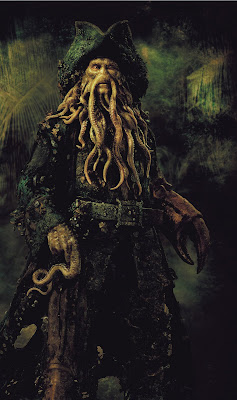
Another great bit of casting is Bill Nighy as Davy Jones. His face is obscured by the visual effects of the tentacles they give him, but he is still able to emote strongly with his eyes, and it’s clear that the facial expressions of his tentacled mug are models on the real expressions he made at the time, so much so that I found him totally believable as a character. His performance here is along the lines of Andy Serkis as Gollum in the Lord of the Rings films: even though we see almost nothing of the actual man, he gives a full-on performance through and through, as the man fearsome enough to make Captain Jack Sparrow afraid. And as long as I’m on the subject of Davy Jones, he’s really a great character, a man who has become somewhat twisted and refused to carry on his duties as Captain of the Dutchman in his bitterness over his doomed love for Calypso. The scene between him and her in the hold of the Pearl is a really good scene: he demands to know why she wasn’t there for him when she’d said she would be, and she replies, “It is my nature.” Isn’t that the truth? The beautiful sea has been betraying sailors ever since men first put boats into water. There’s quite a lot of insight in these films that slides right by, almost unnoticed.

So who, then, is the weak link in the cast whom I mention above? Sadly, it’s a big one, and it’s probably the biggest reason I think that the PotC sequels miss the mark of being potentially great adventure movies. It’s the guy who plays the main villain of the two films, Lord Cutler Beckett. I can’t remember the name of the actor, and that’s the problem: he’s as white-bread a villain as you’ll find, basically using two facial expressions and a British accent to establish his villainy. This is a person who aspires to ruling over all the seas of the world, and he is brazen enough to take command over Davy Jones himself, and he’s played by one of the blandest actors I’ve ever seen. He’s supposed to be the virtual equal of Captain Jack Sparrow, having been the man who branded the Captain a pirate, and yet, the actor is blown off the screen by Johnny Depp in their one big scene together. Heck, he’s even dominated on the screen by Orlando Bloom. For this part, an actor was needed who was at least equal to Johnny Depp, and this simply didn’t happen. A great adventure movie needs a great villain. This one could have had a great villain, but it didn’t. (Aside from Davy Jones.)

The failure of Lord Beckett isn’t just the actor’s fault, though; the script leaves him too blank. We learn that Beckett and Jack Sparrow have a history, but we learn nothing at all of what that history is. Jack points out that his compass won’t help Beckett because what Beckett most wants is Sparrow dead. This is an interesting little twist, but the obvious question — why does Beckett want Sparrow dead – is never answered. Beckett is more cypher than character, and it hurts the film.

Other problems with AWE are smaller, but real. The freeing of Calypso from her human bonds is a good scene – Captain Barbossa’s interpretation of what it means to “speak to a lover” is hysterical – but then there’s a very odd bit where Calypso suddenly becomes a fifty-foot giant before exploding into a million crabs. This was just silly.

Also faulty is the nature of the final battle. While it’s certainly true that we only really need to see a clash between the Black Pearl and the Flying Dutchman, since those are the two ships we’re actually invested in, this needed a bit more set-up, since the film has to this point been setting up a massive battle between the pirate fleet and the English. Even worse is that there was an obvious way to do this: by resorting to the Pirate Code of the Brethren. (“I call on the right of Single Combat by ship: one vessel from each fleet. The Pearl versus your flagship.” Which Beckett could then use to seize the upper hand by sending not his flagship, but the invincible Dutchman.) Truth is, as much as I loved watching these two films, they definitely could have used another run-through in the script-writing phase. A lot of necessary exposition in these movies comes at very odd times: it’s from the dead Governor Swann (whose demise really should have been shown onscreen, come to that) that we first hear the fateful words “The Dutchman must have a Captain”, and the explanation for Tia Dalma’s resurrection of Captain Barbossa goes by in a flash, even though it makes perfect and utter sense (he’s one of the Pirate Lords, and without him, she can never be freed from her human bonds as Calypso).

So the second and third PotC films are big, loud, exuberant films that feature many conflicting loyalties and actions on the part of their characters that are sometimes a bit hard to follow. But that’s not the same as saying that these films are a “mess”.

(I’ll say something in a later post about Hans Zimmer’s music for these films. Zimmer’s a troublesome figure in film music.)

Share This Post

Top Men

Indiana Jones, standing on some crates:

Who cares about crates? Well, remember the very last shot in Raiders of the Lost Ark…a warehouse full of crates…and what’s in one of those crates….

(via)

Share This Post

Top Ten Bond Females

So I was thinking of stealing a posting habit from Tosy and Cosh, and start doing Top Ten lists of random stuff, and the other night, as The Family Unit sat down to watch For Your Eyes Only, I figured I had the obvious starting list: my personal Top Ten Bond Girls. Well, lo and behold, it turns out that someone went and took a poll to determine who the Top and Bottom Ten Bond Girls happen to be, at least as far as British public opinion goes. I’ll give my own list below, but first, I must discuss the polling results, because they’re, well, really bad.

First, here are the lists, with the Worst Bond Girls first, followed by the Best Bond Girls.

(Wait a minute, actually, before I do that, let me renew my objection to the somewhat sexist term “Bond Girls”. I only use it here because the linked article already uses it, and it’s pretty much the accepted way of referring to these characters as a group.)

OK, the lists:

Worst Bond girls

1. Denise Richards as Dr Christmas Jones in “The World Is Not Enough”
2. Tanya Roberts as Stacey Sutton in “A View To A Kill”
3. Corrine Clery as Corinne Dufour in “Moonraker”
4. Maryam D’Abo as Kara Milovy in “The Living Daylights”
5. Karin Dor as Helga Brandt in “You Only Live Twice”
6. Britt Ekland as Mary Goodnight in “The Man With the Golden Gun”
7. Carey Lowell as Pam Bouvier in “License to Kill”
8. Lois Chiles as Holly Goodhead in “Moonraker”
9. Lynn-Holly Johnson as Lili Bahl in “For Your Eyes Only”
10. Maud Adams as Octopussy in, you guessed it, “Octopussy”

Best Bond girls

1.Ursula Andress as Honey Ryder in “Dr. No”
2. Honor Blackman as Pussy Galore in “Goldfinger”
3. Diana Rigg as Tracey Divicenzo in “On Her Majesty’s Secret Service”
4. Eva Green as Vesper Lynd in “Casino Royale”
5. Barbara Bach as Anya Amasova in “The Spy Who Loved Me”
6. Famke Janssen as Xenia Onatopp in “Goldeneye”
7. Michelle Yeoh as Wai Lin in “Tommorrow Never Dies”
8. Lotte Enya as Rosa Klebb in “From Russia With Love”
9. Jill St. John as Tiffany Case in “Diamonds Are Forever”
10. Carole Bouquet as Melina Havelock in “For Your Eyes Only”

Got all that? Well, where to begin?

First of all, we should probably establish just what a “Bond Girl” is, since by my personal reckoning, some of those listed aren’t “Bond Girls” at all. When I read these lists, I had to think to myself, “Hmmm, they seem to be pretty liberal in what they consider to be a Bond Girl”, which then led me to wonder what a Bond Girl really is. My personal definition, therefore, is as follows:

A Bond Girl is a female character with whom James Bond engages in the act of sexual congress who is either (1) on Bond’s side, (2) totally incidental to Bond’s mission, or (3) initially against Bond but comes to his side after the afore-mentioned act of sexual congress.

This definition automatically rules out several of the “Bond Girls” listed in the polls. Taking their “Worst Girls” list first, we can exclude Helga Brandt (You Only Live Twice), because she’s a villain and although Bond gets her to not kill him by using his manly charm, she doesn’t change her allegiance, and we can likewise toss aside Bibi Dahl (For Your Eyes Only), who is a notable female character in that not only does Bond not sleep with her, he actually refuses to do so, and quite vehemently, at that. Those two are not Bond Girls. (By the way, you’d think that whoever wrote this article could at least get the character names right. It’s Bibi Dahl, not Lili.)

As for the second list, GoldenEye‘s Xenia Onatopp is disqualified on two counts: first, she’s a villain who doesn’t change allegiance, and second, she doesn’t actually sleep with James Bond. (They engage in some kinky swimming pool foreplay before Bond grabs his gun and forces her to take him to the boss.) The same goes for From Russia With Love‘s Rosa Klebb, whose presence on this list is almost laughable: not only is she a villain through and through who never considers changing sides for one second, and not only does she not sleep with James Bond, it’s doubtful that Bond would ever even attempt to sleep with her because she’s and old, ugly, and frumpy woman, to be quite frank. (If you’re having trouble placing her, this should help.) The notion that Rosa Klebb can be thought of as a Bond Girl makes one wonder if the people putting the poll together just gathered a list of female characters who appear in Bond movies and called them all “Bond Girls”; if that’s the case, one rightly wonders why Miss Moneypenny doesn’t appear on the list. (Not that she should, since she’s not a Bond Girl either.)

And besides, the lists are just bad anyway, on other grounds. Ursula Andress is the best Bond Girl? Huh? Sure, that shot of her, bikini-clad as she emerges from the water, is a famous shot, but as a character, she’s of almost no interest at all, and Andress’s performance is pretty much monotoned throughout. Honor Blackman, second? Ahead of Diana Rigg? Really, folks, we need to get over the notion that Goldfinger is the best of the Bond movies. Pussy Galore’s got that name, of course, but again, she’s not a terribly interesting character and it doesn’t help that Blackman comes in third among the other potential Bond Girls in the very same film, in terms of plain physical beauty. (Both of the doomed Masterson sisters are prettier, and it’s a shame Tilly had to die, because she was potentially interesting.)

Likewise, I’ve always thought that Barbara Bach is a tad overrated as well in The Spy Who Loved Me. Her accent is unconvincing, and while the idea of Bond having a female counterpart in the KGB who’s as capable as he is could be interesting, the movie doesn’t really do much with this notion, making Anya a damsel-in-distress several times, including at the end of the movie. And Jill St. John’s Tiffany Case (Diamonds Are Forever)? Huh-whuh? Bond himself calls her a “stupid twit”, and that’s pretty much what she turns out to be.

Of course, the lists aren’t complete bollocks. Some Bond Girls fail on the basis of their performances (Honey Rider), while others fail because the characters aren’t well written (Stacy Sutton), and all this is opinion, anyway. It’s always struck me as unfair that Tanya Roberts gets pilloried for her character’s wailing (“James! Don’t leave me! James! James!”) and her failure to notice things like propeller-driven airships coming up behind her, when none of that was Roberts’s fault, unless she did some script-doctoring and didn’t receive screen credit for her work in that capacity. Likewise, Denise Richards can’t be blamed totally for her character’s lack of focus in the script to The World is Not Enough, but frankly, as an actress she’s blown right off the screen by Sophie Marceau (not a Bond Girl, because she’s a villain to the end).

So there are names I’d bump from the “Best” list, but what of the “Worst” list? Who would I bump there? Well, frankly, I’ve always liked Lois Chiles (Moonraker), Maud Adams (Octopussy), and Maryam d’Abo (The Living Daylights). They perform well, they’re beautiful, and the characters are nicely written. Chiles, I think, may be the most underrated of all “Bond Girls”; she’s the CIA female equivalent of Bond, as Anya Amasova was one film earlier in the KGB, but she doesn’t end up the damsel in distress, instead being an actual equal and partner in Bond’s heroics. Maud Adams and Maryam d’Abo also show a lot of spunk, with d’Abo particularly displaying nice character growth as she becomes more and more capable as the film goes on.

But anyway, time for what I meant to do in the first place: a list of the Top Ten Bond Girls.

1. Diana Rigg as Teresa di Vicenzo, On Her Majesty’s Secret Service.

2. Eva Green as Vesper Lynd, Casino Royale.

3. Carole Bouquet as Melina Havelock, For Your Eyes Only.

4. Lois Chiles as Holly Goodhead, Moonraker.

5. Claudine Auger as Domino Derval, Thunderball.

6. Jane Seymour as Solitaire, Live and Let Die.

7. Carey Lowell as Pam Bouvier, Licence to Kill.

8. Izabella Scorupco as Natalya Simonova, GoldenEye.

9. Maud Adams as Octopussy, Octopussy.

10. Maryam d’Abo as Kara Milovy, The Living Daylights.

And there you have it. No, I’m not doing a worst list.

Share This Post

Recent Movie Watching

One of my goals for 2008 is to catch up on movie watching. And not just recent stuff, either, but some of the “Old Greats” that I’ve never before seen, or only seen in part. I’m not setting a specific goal, but it’s just a general thing I want to do. I’ll be using resources like the AFI 100 lists, which even if they are certainly open to debate, they do boast some very good movies in their ranks. In the last couple of weeks I’ve watched two such films.

:: Even though I’d never seen The Philadelphia Story until just a couple of weeks ago, I knew its story well, because I’ve seen a number of times High Society, the musical version of the same story that was made fifteen or so years later. Wouldn’t you know it; going back to the source material (so to speak, since The Philadelphia Story is in turn based on a stage play), I find that the original is superior to the remake.

It’s not an entirely fair comparison, I suppose, since High Society is a musical while The Philadelphia Story is not; they’re not really the same types of pictures, even if the stories are the same right down to large swatches of dialog. High Society‘s songs are all quite good, and the film has a justification for its musical doings: CK Dexter Haven is, in HS, a jazz musician who has scheduled a jazz festival in his home town (Newport, RI) that just happens to coincide with the wedding of his spoiled brat of an ex-wife with whom he happens to still be in love. Hijinks ensue.

Contrasting in TPS is CK Dexter Haven as a rich guy who is enlisted by SPY Magazine to get two reporters into the wedding, on the basis that they are friends of Dexter Haven’s equally spoiled brat of an ex-wife’s brother Junius. Or something like that. Anyway, the basics are the same: CK Dexter Haven is still in love with Tracy Lord; Tracy’s marrying a stuffed shirt named George Kittridge; two reporters (Mike Connor and Liz Imbrie) from SPY are in attendance, even though they find the assignment distasteful, and Liz is in love with Mike, although he’s oblivious to her feelings and finds himself involved in shenanigans of sexual chemistry with Tracy. Hijinks ensue.

I find it interesting that while HS is watchable because it’s got good actors and good songs and the like (although I continue to be amazed that anyone ever thought Bing Crosby a suitable romantic lead), TPS is, with the same story and much of the same dialog, actually funny. I’m not entirely sure why, but I found myself laughing out loud at a lot of the hijinks in TPS, and I was struck by Cary Grant’s ability to be the near-perfect straight man. He’s funny just standing there, being stoic while all manner of hijinks ensue around him, and when he himself partakes in some foolery, it’s utterly hilarious; witness his impromptu “Pomp and Circumstance” when George stomps away at the end of the movie.

And of course, James Stewart and Katherine Hepburn are, well, they’re James Stewart and Katherine Hepburn. I tend to like Stewart more in movies like this, where he can be cynical and weary; for instance, when his boss the publisher guy asks Mike if he hates him, and Mike replies, “No, oh no. But I don’t like you very much.” It’s not a great line, by any means, but Stewart turns it into one, by showing that Mike is enough of a diplomat to not openly admit to hating his boss, but possessed of enough self-pride to not pretend otherwise, either.

I also think that the ending works better in TPS than in HS, mainly because HS really beats the viewer over the head with the fact that CK Dexter Haven is still in love with Tracy, while TPS never really comes out and states it but rather lets us grow to suspect it as we get to know him.

(And for sheer laughs, TPS gets the nod over HS by having young Diana, Tracy’s precocious little sister, rip off an exuberant rendition of “Lydia the Tattooed Lady”, a song so funny that I’d laugh no matter who sang it.)

:: So, what better to follow up a 1930s screwball comedy about romantic shenanigans in an upper class Eastern city than a cynical 1970s tragicomedy about a man committed to a mental hospital? Nothing, obviously, which is why I finally struck One Flew Over the Cuckoo’s Nest from my list of movies I should really have watched way before now.

What a great movie. Parts of it troubled me, parts of it made me laugh, parts of it saddened me. I guess that was the whole point. It never quite went in the direction I thought it was going in, and that makes me happy, even toward the end when the film took the tragic note that I’d really knew was coming the entire time.

I did find the film difficult going on occasion. I don’t know much about mental illness, but I do know that while it still probably isn’t taken seriously enough, it’s taken much more seriously now than it was even in the time One Flew Over is set (late 60s or early 70s, I assume). The attitude toward mental patients in the film seems to run from seeing them as children who can’t handle anything to people who are simply dangerous to themselves and others. I don’t know enough about the history of mental illness treatment to know how accurate a depiction of that period’s treatment of mental patients may be, but there’s certainly a rather disturbing and horrifying tone to it all. I don’t know if that feeling was there when the film first came out, but it’s certainly there now. Similarly, I’m not sure if I was supposed to feel this sense of impending doom during the fishing boat sequence, but I did. I was surprised when that doom didn’t happen at all.

This is why I had a hard time seeing Nurse Ratched as the malevolent villain she’s most often described as. I couldn’t decide if she was the cold authoritarian, or just a very serious person locked into the standard view of mental illness of her day. Certainly Louise Fletcher’s performance is a great one, worthy of the Oscar it won, but watching the movie now, in 2008, for the first time ever, I couldn’t truly see her as a villain. She’s an antagonist, certainly, but that’s not the same thing. She gets her way in the end in the brutal fashion of the day, but again, it’s hard not to see that situation playing out any other way, even if she’d been a perfectly nice lady the whole time, right up to McMurphy’s attempted strangling of her. The much more malevolent presence, for me, came from the orderlies underneath Nurse Ratched. I don’t know if this was intentionally done on the part of the director, but these orderlies, played by two black men, have the same hairstyles and the same mustaches, they wear the same uniforms of white shirts with black bowties, and they walk with the same muted swagger. They seemed like, for lack of a better term, stormtroopers. Certainly nothing in the film was, to me, more ominous, not even anything said or done by Nurse Ratched, than the orderly who decides that it’s time to get tough with McMurphy and puts a strap of hard leather over his knuckles in preparation to fight him.

McMurphy was doomed at that moment, of course, but even so, the Chief’s subsequent discovery of his lobotomy scars is one of the sadder moments I’ve seen in a film recently. McMurphy is literally reduced to the drooling existence he had earlier pantomimed after his electroshock therapy. This time it’s real, and McMurphy can no longer observe his greatest triumph: that he gave the Chief the wherewithal to free himself. I found the film playing out, in some of its particulars, almost like a Greek tragedy.

To praise the film’s acting is easy enough, but there it is. Most of what I’ve seen of Jack Nicholson has been released in more recent years, when he’s been JACK NICHOLSON, so to go back and see him when he was a young and vibrant force on the screen was a real treat. I kept noticing the one guy and thinking “Wow, he looks like a young Danny DeVito!”, and then when I watched the credits, I learned that it actually was a young Danny DeVito. And then, of course, there’s Christopher Lloyd, much younger than his Doc Brown days and much thinner and cleaner, and thus much more crazy looking, than his Reverend Jim of Taxi.

So: two movies down, and I loved both of them. Off to a good start, I think.

Share This Post

Stuff!

Some lazy linkage for a snowy Thursday evening:

:: Lynn Sislo hasn’t posted in several days. As she lives in Oklahoma, I assume that this is due to the ice storm they had in those parts. I hope she’s back online soon.

:: Do check out this wonderful article about visual injokes in Pixar’s movies. I love stuff like this.

:: I suppose I should start reading Terry Pratchett sometime soon. He has been diagnosed with Alzheimer’s.

:: When I become Supreme Ruler of Teh Universe, my first decree will be that all gas stations shall be one-way only, and that it will be illegal to swing your car into the opposite direction just because the one open pump is on the opposite side of your car as the gas cap. I am really tired of trying to figure out how to line up for a pump, when more often than not, the cars at the pumps will be facing me no matter which way I queue up.

:: Via Michael May I see that Joss Whedon’s not done with the Firefly universe, and will tell more stories there in the best medium for the job: comics. In fact, he’s apparently already done a comic of Firefly; I’ll have to track that down. It’s called Those Left Behind; the new one will be called Better Days. Cool. (Note to self: finish watching Firefly and then watch Serenity one of these days.)

Share This Post