I figured that Steve Martin had forever left behind the days of the white suit and King Tut…but apparently not.
This makes me really happy, for some goofy reason.

The official site of Kelly Sedinger: Reader, writer, photographer, and dreamer
Sorry I couldn’t come up with a more eloquent title for this post, but…well, sometimes you gotta go with the words that hit you. Therefore: Let there be dancing in the streets!
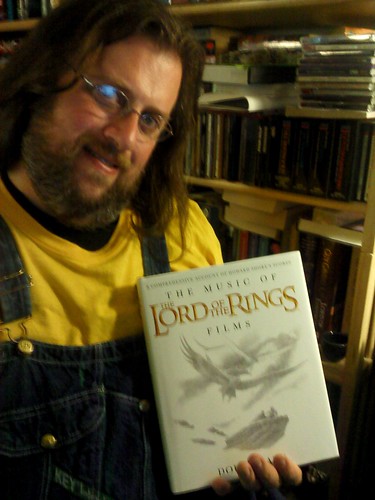
Yup, I won a copy of Doug Adams’s The Music of The Lord of the Rings, which makes me so utterly happy that…well, later there may be opening of beer and dancing once I am alone and no one can see.
The entry rules were simple: in addition to providing contact info, entrants had to identify their favorite bit of music from the films and describe why. Here’s what I wrote:
My favorite bit of music from the LOTR scores? That’s a nearly impossible requirement for me to fill, as I adore just about every single note in the trilogy, from start to end. But for the purposes of this contest, I’ll name the music that plays as Gandalf leads the Fellowship into the ruin of the subterranean Dwarvish city of Dwarrowdelf, in Moria. There’s just something so majestic and regal about the music in this scene: most of the Moria music is dark and forbidding, but in this one passage, Howard Shore conveys some of the optimism that the Dwarves must have felt as they started digging into Moria. The music builds and builds, and it feels like it’s about to open up into a huge melody — but that melody never comes, which is fitting since Moria never reached the heights that the Dwarves had hoped. Instead, the music turns dark again as Gimli finds Balin’s tomb. This moment in the score always makes
my spine chill a bit. (The film actually blunts the impact a bit by having Sam say “Now that’s an eye-opener and no mistake”. It’s a scene that needed no dialogue.)
Here’s the music I’m referring to. It’s the first 1:15 of this clip, and I shiver in awe every time I hear this passage. It’s so regal and sad and evocative of Tolkien’s world that is full to overflow with old things that are lost and nearly forgotten:
That music is Middle Earth.
Not George Lucas, but one of my other favorite Georges, with whom I share the birthday of September 26: George Gershwin. In his honor, here is the animation for Rhapsody in Blue, produced for the Disney film Fantasia 2000 (which seems to me a terribly underrated movie — there is some wonderful animation in that film). The opening narration here is dubbed into French, but once the music starts (at about the :50 mark), it doesn’t matter one whit. (It’s in two parts to account for YouTube’s duration limits.)
The style is inspired by the famous, oh-so-NYC caricatures of Al Hirschfeld (with, to my eye, a bit of the Eloise books as well).
My first high school band director, Bill Roosa, died over the weekend.
My feelings on Mr. Roosa were always somewhat conflicted. There was a pretty big dispute between him and my parents, regarding my older sister when she was in his band, with the end result being her quitting band in her senior year. I don’t recall the particulars, but my parents felt a certain loathing for Mr. Roosa that I’m not sure ever abated. And I’m not sure those feelings are unjustified.
But then, Mr. Roosa was for the most part completely OK with me. For a time he took a very active interest in my musical education, even taking time to give me individual trumpet lessons when I wasn’t even in his band yet (Mr. Roosa directed the Senior High Band; Jim Beach had the Jr. High group.) I can’t deny that he taught me a great deal; I can’t deny that he loved music; I can’t deny that he had a lot of impact on a lot of music students who came under his baton; and I can’t deny that he could be a first-class son-of-a-bitch. I think he might even be somewhat proud of that last. It wouldn’t surprise me if some people — a smallish number, but real nonetheless — attended his funeral just to make sure he was really dead.
Bill Roosa was a big man with a very deep and raspy voice. He was also loud and liked to command attention. The Senior Band at my high school had a somewhat glowing reputation when I was coming up through the ranks, but the program suffered a bit as I approached it. I never really understood why, but band membership dropped like a rock, and for a time, Mr. Roosa seemed almost apathetic about the whole thing. My guess is that he was a very “old school” kind of teacher at a time when his style of pedagogy was, to put it mildly, falling out of style. He was of the mind that it wasn’t the worst thing in the world if a teacher shoved a student around a bit and maybe even struck him in the course of administering discipline; that kind of thing wouldn’t last more than a day in schools nowadays. I think he felt a growing sense of frustration over his final years of teaching, and I think to a great degree a lot of what he felt was the fun of the job got sucked out of it. (To be clear, this is all guessing on my part.)
When I entered junior high school, the district had for years been run by the same tiny group of crusty white men who all retired right around the same time. I suspect that Mr. Roosa didn’t get along nearly as well with the subsequent administration, in part because he was an old-school type and they were not. (And, I should note, also probably in part because as far as I could tell, the new group of folks running the show were, quite frankly, complete pinheads.) Mr. Roosa’s teaching career came to an abrupt end during my senior year. He had already butted heads a few times with administrators, but a month or two into that year, something transpired that I never found out any details about, but Mr. Roosa started cashing in all of his sick days he’d accrued over the years (this was back when teachers could roll them over, and the more wily and healthy ones would bank them for years, to the point where they could call in sick for two months near the end of their careers), and then he simply stopped showing up for work entirely. The band just kind of twisted in space for most of the remainder of that year, led for a time by a substitute who was not a music teacher at all before finally being taken over in the spring by a twenty-three year old guy who had just graduated college. I’ve always wondered what the final straw was that caused Mr. Roosa to say “The hell with this.” No doubt he felt emboldened by the fact that his family was, at the time, making tons of money off their own small chain of video rental stores.
(The video store thing was kind of interesting — his stores were bought out seven or eight years later by Blockbuster. I asked him about that business once and he bluntly said, “There’s no future in this. Sometime in the next fifteen years they’ll be beaming movies right to your TV and you won’t be renting anything on a tape. But we’ll have made our money by then, so it’s fine.” And, aside from his timeframe being a bit on the short side, he was exactly right, wasn’t he? Now, a bit more than twenty years after I had that conversation with him, you can stream movies over the Interweb via your Wii.)
Mr. Roosa was utterly beloved by nearly every alumnus of his band that I ever met, and I always wondered what it might have been like to play in the band during the years when he wasn’t as disengaged as he was when I was under his baton. He did have his moments during my years, though. In my junior year, membership of the Senior Band had fallen to about thirty kids, which is terribly low — with a really healthy instrumental music program, the band should have had at least fifty kids. Mr. Roosa took what I’ve always thought was a pretty creative approach that year, accommodating the fact that his band was so small: he decided that the year’s focus would be on Civil War band music. Now, the bands of the Civil War era were terribly small, and the music of that era — predating the big marches of John Philip Sousa and Karl King — had a very raw feel to it, with nearly every piece being full of folk tunes and popular songs of the time. It was, to be honest, a terribly fascinating year of band music, deeply steeped in an era of music that to this day very few people know anything about.
The next year was my senior year, when the wheels finally came off. Shortly before that happened, though, I asked Mr. Roosa if we’d be doing Civil War music again, and he said “No, I’m kind of thinking of looking through some of those books of German military music we have laying about.” We had complete sets of German band books there — where they came from, I have no idea — and the idea of exploring another obscure world of esoteric band music was extremely appealing. Alas, that never came to be.
Mr. Roosa’s musical tastes tended to be very heavily skewed toward marches, which it must be said, sometimes got to be a little much. But he also loved the great band transcriptions of orchestral masterpieces that dominated concert band programs during the “glory years” of the American bands, around the turn of the 20th century. It’s because of Mr. Roosa, for example, that I love the light opera overtures of Franz Von Suppe, even though to this day I can’t hear the Jolly Robbers overture without remembering one particular explosive rehearsal when Mr. Roosa lost his temper over our continuing inability to get a particularly technical passage right. (Or the fact that the same overture begins with the trumpets sounding a high F, which is for various reasons pertaining to the physical and acoustic nature of the trumpet a very difficult note to hit dead on.) And it was during my freshman year in Mr. Roosa’s senior band that a piece landed on the program that had a very peculiar title: “March to the Scaffold”. Mr. Roosa introduced me to Hector Berlioz. For that alone he’ll have my eternal gratitude. It now occurs to me that he was already gone from teaching when I discovered my other great musical passion, Sergei Rachmaninov. I have no idea at all if Mr. Roosa liked the Russian Romantics.
Mr. Roosa was, as far as I knew, not terribly interested at all in new music. We played no modern music whatsoever. The music he chose might not have been terribly balanced, but what he chose was invariably good. I don’t recall hating a single piece we ever played. That’s something. His big passion, actually, was circus music, and he was very active in a national group of circus music afficionados called the “Windjammers”. When I was in eighth grade — and thus still in the Junior Band — he somehow arranged for the Senior Band’s spring concert to be nothing but circus music, an entire program of it, complete with introductions by a ringmaster and to be guest-conducted by a man named Merle Evans, who is one of the legendary figures in the music of the three-ring circus. I attended that concert, and I wish to this day that it had happened a year later so I could play in it.
He was also the type of person who liked to test students by, well, being a colossal jerk to them for a time. I myself landed on his shit list one year — I think it was my sophomore year, actually — and I stayed there for a solid month, during which he rode me hard at every opportunity. Every screw-up I made in rehearsal became a moment for him to stop the band and berate me, and I remember one time when I was rubbing my lips during a break in rehearsal (your lips can really start to hurt when you’re a brass player and you’re working hard), he spotted me doing it and launched into a tirade on how no real trumpet player would even admit to pain while playing. Funny thing is, after about a month of this, it stopped almost immediately, and from that moment on, Mr. Roosa never rode me again. He’d point out when I would screw up, obviously, but there was never that sense of maliciousness that had been there during my “Hell Month with Bill Roosa”. I don’t know if there is something I did to earn his respect or if he just got bored and figured it was time to let me out of the doghouse, but we were fine after that, and soon we’d be back to swapping funny stories about great musicians. (He knew a ton of these, and he could crack the best jokes that only musicians would get or find funny. One of them was when he was trying to pick another march for our concert program, and he said, “I’ve got an American march, a British march, a German march, a French march, and a Polish march. I’m not sure which one I should do.” Another kid, who was something of a wise-acre, said, “Hey, have you got any Hungarian marches?” Mr. Roosa didn’t bat an eye as he said, “Yeah, I’ve got a Hungarian march right here. It was written by a Czech.” OK, you had to be there, but to this day, I think that was funny.)
I don’t really know much of anything about what became of Mr. Roosa after he left teaching and after I graduated later that year. I know that his family formed some kind of real estate developing business that was somewhat successful; I also know that his son faced some sort of legal trouble, but what that was about, I have no idea. It’s not really important, anyway.
Finally, I often think of Mr. Roosa whenever the Olympics are taking place. In 1988, when the US Olympic teams performed poorly (especially at the Winter Games in Calgary), Mr. Roosa ranted several times during rehearsals about how discouraging he found the Olympics because they represented to him a fading of a work ethic in American youth. I wonder if he watched subsequent Olympics, when the US teams bounced right back, and ever thought to himself, “Maybe the kids are all right.”
In Mr. Roosa’s memory, here’s the Suppe overture that gave me nightmares in my sophomore year, “Jolly Robbers”. It’s the original orchestral version, but it’s all there. (The part that terrified us all starts at the 5:38 mark.)
And, since Mr. Roosa and I would talk a lot about Wagner, here is Siegried’s Funeral March.
Via Roger:
Rules: Create a non-objective list of your favorite albums of the last 20 years (anything released between 1990 and now), remember, this is your FAVORITES so, if Maroon 5’s Songs about Jane was your favorite album, that should be number 1, even if you feel Nevermind was a more influential album.
Sounds like fun, although I do quibble with the word “non-objective” up there. There is no such thing as an “objective” list of the Top X of anything, but that’s neither here nor there. So, my top albums from the last twenty years? Hmmmmm….
Well, what the hey. Here’s a list, in no particular order:
The Beatles Anthology (Probably cheating here, but it’s my list)
The Village Lanterne, Blackmore’s Night
Santiago, The Chieftains
The complete scores to The Lord of the Rings (all three)
Cleopatra, Alex North (the restoration by Varese Sarabande)
Hymns of the 49th Parallel, k.d. lang
Les Miserables: The Tenth Anniversary Concert from the Albert Hall
The three scores to the Star Wars prequels
Princess Mononoke, Spirited Away, and Ponyo, Joe Hisaishi
Supernatural, Carlos Santana
The Rising, Bruce Springsteen
Live from the Ends of the Earth, Dougie MacLean
Home, Dixie Chicks
Any of Sir Colin Davis’s live recordings of the music of Berlioz, with the London Symphony (particularly Les Troyens and Romeo et Juliette).
What are your favorite albums of the last twenty years?
Last Saturday night, The Wife and I attended another concert by the Buffalo Philharmonic Orchestra. This one, however, did not feature classical music; we actually attended a Pops concert. It was called “Classical Mystery Tour”, and it featured the BPO doing songs of the Beatles. I expected orchestral arrangements of Beatles songs, maybe a few singers along the way, and generally a “Beatles turned into classical music” kind of thing.
That’s not what happened, though. It turns out that “Classical Mystery Tour” is the name of a Beatles tribute band that tours around performing with symphony orchestras around the world. This I figured out when we entered the hall to take our seats and saw, at the front of the stage and in front of the orchestra, a rock-band type set-up. “Ooooh, there’s a band!”, I said. And after the BPO warmed things up with a concert overture that was pretty much exactly what I expected the concert to be — Beatles melodies arranged for orchestra — the band came out.
And you know what? They were pretty good. Very good, in fact.
It probably helped us that we were far enough up in the balcony that we could see that the four guys in the band had the general “look” down (four guys in dark suits and mop haircuts), but not their specific facial features that would make it obvious that hey, that dude on the left doesn’t look anything like Paul McCartney at all.
The group’s sound was excellent, for the most part. I liked that they sounded very similar to the Beatles, but they didn’t strive for sounding identical to the Beatles. They did a basic rundown of a lot of the Beatles’ greatest hits, and they used the Philharmonic to great effect, achieving sonic effects from the stage that the Beatles themselves only achieved in the studio.
It was a grand evening, even if I have to cry foul that “Live and Let Die” is not a Beatles song!
I haven’t been an active member of the film music fan community, either online or off, in quite some time, because for the most part I came to find that community mostly unpleasant, annoying, and generally filled with people I’d like to punch if I knew them in real life. I haven’t regretted this, but every so often — once a month, at most — I’ll drop by the FilmScoreMonthly message boards, just to see what’s new in film music, as in, new releases of hard-to-find music and the like.
I just dropped over yesterday, and I saw a thread therein that validated all of my negative opinions and gave me immense amusement as well.
It seems that Varese Sarabande (one of the biggest remaining labels in film music) indicated that an announcement was impending, regarding a new CD release of theirs. This is something record labels do a lot. They’ll say “On May 31 we’ll announce our Next Great Title!”, as a way of drumming up a bit of buzz. Well, the FSM folks — bless their hearts! — followed Varese’s bouncing ball and, with zero evidence to back them up in the slightest way, that Varese was about to release Alex North’s score to Spartacus.
Now, you have to understand something here: Spartacus is one of the last great Holy Grails of unreleased film music. There is an old CD of Spartacus out there, but it amounts to a miniscule portion of a long, epic score that has been for decades regarded as one of the finest scores ever written; and I think there are bootlegs floating around, but there has never been a release of the entire score in fine digital remastering. Spartacus really is a big deal to film music lovers, and its release would send that community into orgasm.
So the FSM thread goes on for page after page after page as people construct elaborate arguments for why the new release just has to be Spartacus. The logic is almost reminiscent of folks who pore through the Bible until they determine the exact date for Armageddon. Everybody is convinced it’s going to be Spartacus, except for one lone soul late in the thread who says, “Gee, do we even know that it’s going to be Spartacus?”
And guess what the release turns out to be?
An expanded edition of Michael Giacchino’s score to last year’s Star Trek.
So then some fans (not all) start bemoaning their crushing disappointment, with only a couple of persons pointing out, “Hey, nobody said you were getting Spartacus. You convinced yourself.” In among that, you get to see all kinds of folks saying things like “OK, Star Trek. Now I don’t have to spend $30!” Because that’s what often passes for interesting comment on these boards: someone announcing that they will, or will not, buy something.
One of many reasons I stopped hanging out with these folks. Who really cares who buys what???
American Idol for this year is over, at long, long last. Aside from a couple of too-rare bright spots, this season was generically disappointing from the start right up until the end, when — for the first time in my experience — Idol crowned the wrong person. And not just a little bit wrong, but staggeringly wrong.
Lee DeWyze was utterly, utterly inadequate, no matter how much the judges inexplicably adored him. He’s got a pleasant enough voice, and he can strum a guitar in relatively convincing fashion (although that’s about all he did with it), but he showed, time and time and time again throughout the show’s run, that he had zero real musicianship. He showed it when he failed completely to sell the song “Beautiful Day” in the finale; he showed it when he did an awful one-half of a duet with eventual runner-up Crystal Bowersox in “Falling Slowly”; he showed it in his jaw-droppingly awful rendition of “Hey Jude”; and worst of all was his wholesale slaughtering of Leonard Cohen’s “Hallelujah”, which he turned into a Queen-style arena rock anthem. There have only been a couple of times in all the seasons of Idol I’ve watched (all but the first) in which someone I really disliked made the finale (Diana DiGarmo and David Archuleta), but this was the first time that the person I really disliked actually won, and he did it despite near unanimous opinion that his performances on the Finale were seriously subpar.
What was odd was the judges’ reaction to Lee all year. Until the finale, Lee received zero criticism. None. He was slathered with praise every single week until the finale, when at long last he seemed to receive some mild critique. It’s true that the judges can’t eliminate or keep anyone around solely by virtue of their criticism, but they can certainly shape opinion, and Lee had them in his back pocket right to the end, even to the point where he’d give warbling performances in which he would literally sing wrong notes and start shouting the song as soon as he possibly could, and yet, no one would point it out; Randy Jackson, famous for using the word “pitchy” as much as “dawg”, would merely shout out things like “Oooooh, someone is in it to win it!” The judges’ devotion to Lee DeWyze was absolutely mystifying.
What about Crystal Bowersox, then? Well, it’s pretty obvious that I loved her. Absolutely loved her. Not everything she did was perfect; on “Movie Song Night”, she did some song from Caddyshack that nobody much remembers, for example. But she was such a smart, capable, intelligent performer. She thought her songs through in a way that Lee couldn’t even conceive. After Simon Cowell criticized her for the way she had performed a particular song, she was actually able to look at him and say, “Well, the lyrics say this, so I had to sing it in a way that made that meaning clear” or some such thing. That kind of musical intelligence is rare on Idol, which is tailor-made for vocalists like Lee DeWyze and Siobhan Magnus who approach a song as though it is a vocal jungle-gym.
Crystal also had tremendous stage presence, which Lee did not. During the Season Finale (the results show, not the individual performances), both Crystal and Lee showed up on stage occasionally to perform with various famed pop and rock artists. Crystal did a number with Alanis Morissette in which she held her own with the star, making the moment something special. A short while later Lee did a number with Chicago, and he couldn’t even stand out as a 20-something kid amongst a group of aging, has-been rockers. Lee just melted into the stage; Crystal looked like the stage was her home. And it was. That the Idol voters didn’t consider this is…well, it’s not very shocking, actually.
Crystal’s dominance over Lee in the final performances was so undeniable that not even Lee could deny it. At the very end of the show, just before the final fade-out, there they were on stage, Lee and Crystal, with Ryan Seacrest in between. The look on Lee’s face was the look of dismay on the face of any person who has been thoroughly beaten by a superior opponent.
So why, then, did Lee win? I’ve heard some theories:
Lee is more marketable, more current, more contemporary, more [insert intangible here] than Crystal.
I don’t buy this. First of all, I have no idea what’s “current” or “contemporary” and neither does anyone else. It’s all BS, really — Crystal stands in the tradition of Melissa Ethridge and Sheryl Crow, both of whom are still very much present on the music scene. Plus, Idol viewers aren’t record producers. It’s not their job to pick people who sell tons of albums, even though that’s the hope. Ruben Studdard, Fantasia Barrino, Taylor Hicks — all have had fine music careers since winning Idol, but none have lit the world on fire. But more importantly, none were “current” or “contemporary”.
Crystal doesn’t really need to win. She’s virtually guaranteed a great career.
I’m not so sure about this. Everyone loves to talk about the Idols who didn’t win and who went on to some kind of stardom — Clay Aiken, Jennifer Hudson (didn’t even make the finale), and Adam Lambert are prime examples here — but there are others who disappeared. Justin Guarini, Kat Stevens, that beat-boxing kid from a few years back: where are they? Nowhere that anybody knows. Some non-winners have had good careers. Many more have not.
Lee’s backstory is more compelling than Crystal’s.
Well, this is all opinion, I guess. I, for one, am more attuned to the single mother struggling to make it as a singer than the paint salesman trying to be a singer, but that’s just me.
A related theory:
America’s a pretty puritanical country, so a single mom isn’t going to win IDOL against a good-looking guy. Same was Adam Lambert lost.
Don’t know about this one. I hope it isn’t true, but I’m sure that for a few voters, it was.
Teenybopper girls robotexting their votes carried the day for Lee.
There may be something to this; I suspect it’s at least part of the reason Lee won. You can’t overestimate the sway held by the “cute” contestants, whether they can sing or not. It’s why Aaron Kelly and Tim Urban lasted so long, despite their relative lack of plausibility as Idols. I saw this theory advanced somewhere to explain the fact that men have won Idol four of the last five years (Taylor Hicks, David Cook, Kris Allen, and now Lee DeWyze). However, looking at who lost some of those years, the theory looks a little less convincing. There’s no way anybody’s going to look at David Cook and decide that he’s going to have the “teenybopper girl” vote sewn up when he’s up against David Archuleta, and Jordin Sparks beat out…that beatboxer kid who looked like he should command the “teenybopper girls” segment of the Idol electorate. I’m sure this is a factor, but a determining factor? Maybe not.
This illustrates the power of the judges to sway opinion, given how relentlessly positive they were about Lee.
This is, for me, the likely big factor here.
So anyway, Lee’s the winner and Crystal’s not. I predicted Lee to win the whole thing weeks ago, mainly because of the way the judges were pushing him so hard in their critiques. In fact, I predicted that Crystal wouldn’t even make the final, so I was partially wrong on that score. But this also demonstrates something else: that the judges’ critiques in the final don’t determine much at all. The judges treated Lee with reverential fervor all year until the final, when they gave him criticism that was mild at best while highly praising Crystal. It’s a far cry from two years ago, when in the final, the judges declared all three “rounds” for David Archuleta, who ended up losing by what was apparently a pretty sizable margin. By the time of the final, I think most people who are going to vote have their minds made up.
Lee’s victory had an air of inevitability, but it was a weird kind of inevitability: the kind where you know you’re getting forced to do something, so you go along with it.
OK, enough about the Worst Idol in the History of Idol. What about Idol in general? I found this year generically disappointing. The level of voices selected for the Top 24 was surprisingly bad, with only a handful of standouts among them. And one of those standouts, Lilly Scott, whom I loved in the early going, didn’t make the Final 12 in what was probably the most surprising single elimination of the entire season. There are always bad contestants who do confoundingly well — John Stevens? Sanjaya Malakar? Tim Urban? I read one article somewhere, early in the season, that suggested that Idol is having more troubles lately because they’ve “depleted the talent pool”. That notion is, obviously, idiotic — are we to believe that Idol has worked through all 50 million or whatever number of people there are in the permitted age group? That’s just silly. But the judges drop the ball on their selections, at least once every year.
Simon Cowell is also leaving, which has a lot of people predicting the show’s swift demise. Maybe, but if so, I suspect it would be because Idol will be in its tenth season and it’s getting old. Like any self-respecting fan of American Idol, I have some thoughts on directions the show should take:
1. Cut back on the filler and focus on the music.
This season, the filler material got ridiculous, to the point where Idol had to schedule two hour shows so that nine contestants could sing. That was ridiculous. There’s only so much anybody wants to know about the contestants, and all the song previews are now going on way too long. Time was when the show would have each contestant sing twice as early as six or seven left in the group; this year they waited (I think) until they were down to five left, just because the show was so full of filler material.
2. Move “Country Music Week” back to where it used to be, early on in the Final Twelve.
This year, they didn’t do Country Week until very late — again when there were only five or six left — and they focused it on songs by Shania Twain. It should come a lot earlier. Not that I’m a country music fan — I like some of it, dislike most of it — but it can’t be denied that Idol‘s Country Week tends to produce a lot of good performances, especially from the contestants who may not be totally cut out for the Pop stuff they want so badly to feature. Country Week can give dark-horse contestants a new lease on life on the show, and it addsa helpful bit of variety to the show.
3. Change the voting.
This will never happen, but I’d like to see voting changed so that people are voting for someone to be eliminated rather than to see someone stay. Failing that, I’d at least like to see the show limit the number of votes from one person, so that someone can’t robo-text fifty votes for someone who isn’t very good. Never gonna happen, obviously — they love that Ryan Seacrest can say things like “Out of a record 190 million votes cast”, as if that many people are watching the show to begin with. But this would fix a recurrent problem with Idol, when every year lesser contestants thrive whilst worthy ones are sent packing.
4. Back to three judges.
OK. So Simon Cowell is leaving. I’m not of the general view that he is unreplaceable asset whose departure will spell doom for Idol — Simon is flat-out full of crap a lot of the time, and he only manages to not seem full of crap by virtue of being articulate and having a British accent. But he’s leaving the show. Who to replace him with? Someone with personality and intelligence. I’d like to see him replaced by someone with knowledge of the industry, but really, not another record producer. I’d like to see another actual musician on the show, someone who isn’t concerned with what’s going to sell and be marketable and rather what’s actually good.
I saw the suggestion made somewhere else — can’t remember where — but it’s a good one. Bret Michaels! It’s perfect. After watching him on The Celebrity Apprentice, he’s got smarts and he can be blunt when he needs to be and nice when that’s called for.
And get rid of Kara Dioguardi. I suppose Ellen Degeneres can stay, but she needs to work on her critiquing. Kara, though, is useless.
5. Get rid of the “bad singers”.
When the show starts up in January, they always show lots of stadiums full of Idol hopefuls. Only a tiny percentage of these are allowed through to audition for the judges; five thousand might show up, but only 150 might get through to sing for Randy, Kara and Simon or whomever. And of those, a certain percentage are the terrible singers sent through just so we can see the judges rip into people who suck.
The problem is that this is all boring. The annual weeks-long tour of laughing at sucky singers is old, old, old hat by now. It might help the cause of upgrading the talent level sent through to Hollywood if the show abandoned the sucky singers. Let the judges pick from 150 good singers, instead of only 75 good ones and torturing them with 75 bad ones.
That’s about it. All in all, a really disappointing year on American Idol. We’ll see if it can get its groove back next year or not.