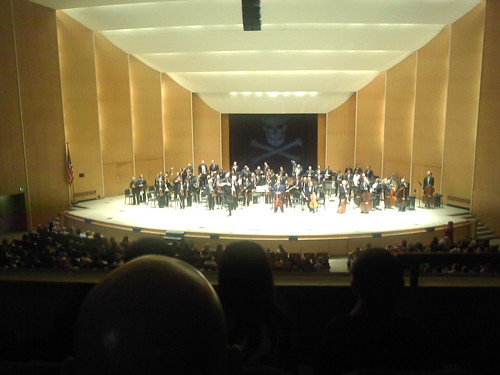
We’ve just returned from attending the Buffalo Philharmonic’s “Family” concert this afternoon, which was “Pirate” themed. It was an entertaining hour, with musical selections that were all relevant to either pirates or the sea or both. They started with the overture to The Flying Dutchman by Wagner, although in what is starting to seem like an odd habit for the BPO, they didn’t play the entire thing. I’m not sure what all the abridging is about, over at Kleinhans, but it’s starting to get really disconcerting to hear pieces I know well and then note the absence of parts of those pieces. I suppose the rationale today was that it was a children’s program and the entire ten minute overture might lose them at some point, but…well, I’m a fan of playing the entire work, as I’ve noted previously.
Anyway, they did one of the Pirate King’s numbers from The Pirates of Penzance, a selection from Debussy’s La Mer, the storm from Peter Grimes by Britten, and a couple of welcome selections of film music: Captain Blood by Korngold and Pirates of the Caribbean, credited to Klaus Badelt but really written by Hans Zimmer. Everything was played with lots of vim and vigor by the BPO musicians (minus a few of the personnel, whom I assume must have been given days off as the orchestra has just returned from a Florida tour), even if conductor Joseph Young set some awfully brisk tempi and kept things moving a bit too quickly for my tastes. (A little rubato never hurt anyone, folks!)
The selections were played amidst a running storyline of sorts as Maestro Young tried to win over the guest “pirate crew” (played by members of a local college men’s choir) and let him onto their crew. He conducted a good portion of the program wearing an enormous tricorn on his head, which was nice. I keep waiting for the tricorn to come back into fashion, but I think it may be done.
Anyhow, it was an enjoyable hour at the BPO. These family concerts are fun. Now, if I could get the Resident Kid to get more enthusiastic about them! But Rome wasn’t built in a day, and I remember that when I was her age, going to orchestra concerts wasn’t my favorite thing to do, either. Took me a few years of playing an instrument before I decided I loved the idea of concert-going.
Last night, for the first time in more years than I like to admit, The Wife and I attended a Classics concert by the Buffalo Philharmonic Orchestra. How long has it been? Well…a while. Maximiano Valdes was the music director; the concert we attended back then was conducted by Arie Lipsky, and it wasn’t even at Kleinhans. It was in the auditorium of the high school in Olean, before we were even married.
Yeah, it’s been a while.
Since then, the orchestra has gone through the financial hard times that every orchestra has gone through, but it’s also gone through an artistic revitalization that began when Valdes left and JoAnn Falletta took over. Since then the visibility of the orchestra in cultural circles has gone up dramatically, with new recordings on Naxos and the orchestra’s private label, concerts broadcast on national radio, performances at Carnegie Hall, and so on. This week the orchestra embarks on its first tour — of Florida — since it traveled on a month-long journey to Europe in 1989. Heady, heady times for the BPO!
And yet, we didn’t attend until last night. (We did attend a “Family” program a couple of years back and are going to another in two weeks.) We were gifted some time back by my sister with a gift certificate for orchestra tickets, and the first of the concerts we chose for ourselves was last night’s program. Why that one? Well, because the major work on the program was one of the biggies in my life, a work I’ve referenced many a time in this space over the years. They were playing Rachmaninov’s Symphony No. 2 in E minor, a work without which I could not live, and a work that I know so well that I can quite literally “play” it in my head. More on that later, though.
The first half of the program was utterly wonderful, starting with Rossini’s overture to Semiramide. I confess that I’m not totally up to snuff on my Rossini; aside from William Tell and Barber of Seville, I can’t readily discuss his music much. But this overture was scintillatingly played, featuring some wonderfully deft work by the woodwinds and the horns. I was terrifically impressed with the orchestra’s level of unison playing; Maestro Falletta’s work has clearly made the orchestra play with more precision than I ever remember hearing from them before.
The Ravel Piano Concerto came next. Our soloist was an Italian pianist named Fabio Bidini. I’d never heard of him before, but in my experience, that doesn’t matter one whit. Along with the BPO. he turned in an amazing performance of the Ravel Concerto, a work of many influences: French impressionism mixed with jazz motifs. I’d never heard this work before (in fact, until a few days ago, I thought the orchestra was performing the more famous Ravel Piano Concerto for Left Hand), but I enjoyed it a great deal. It has all the “big Ravel moments” one could ask for, in addition to many quieter, meditative moments, such as the way the second movement is seemingly played halfway through by the solo piano alone, in an effect so captivating that it was almost a surprise when I saw the string players lift their instruments at last. It felt almost like a reverse of Beethoven’s Emperor Concerto, in which the symphonic exposition is so good and so long that when the soloist finally reappears, it almost comes as a surprise.
Mr. Bidini made it very easy to tell that the Ravel had ended, when he exploded out of his seat and was pumping Falletta’s hand even before the clapping had swept through half the hall. Bidini eventually offered an encore, which he did not identify (I believe it was a nocturne or etude by Chopin).
Intermission came, and we had already had a memorable night of music making. And the Rachmaninov Second Symphony was still to come. And sadly, this is where things got a bit problematic.
My first intimation came before the concert even started, when I read the program notes for the piece. The Philharmonic likes to print running times for pieces in the programs, and they indicated that the Rach 2 would take 46 minutes. That made my brow furrow a bit. As I’ve noted, I’ve lived with this piece for over twenty years now, more than half my life, and I’ve heard it performed live once before as well (in college, by the Shanghai Symphony Orchestra). I’ve never once seen a recording of this work that took less than 55 minutes, and some go over an hour, if the conductor’s tempi are particularly broad. To bring this piece in, in 46 minutes? Unless Maestro Falletta was about to set some very quick tempi indeed, there was only one way I knew of that the Rach 2 could be that short.
It goes back to the history of the piece in question. Rachmaninov was the “next in line” in Russian Romanticism in music to Tchaikovsky. Rachmaninov’s problem was that his brand of brooding Russian Romanticism was quickly going out of style. The Second Symphony premiered in 1908; Stravinsky’s game-changing ballet Le sacre du printemps would premiere just five years later. While the Rach 2 was initially a success, over the course of the 20th century Rachmaninov’s music tended to be viewed as anachronistic, especially the poor Second Symphony, whose 60-minute average length seemed to mid-century modernist ears as bloated self-indulgence.
So it was that through most of the 20th century, the Rach 2 was only performed in editions that removed up to twenty minutes of music. Many of these cuts were sanctioned by Rachmaninov himself, although I would be very surprised if these cuts were not somewhat coercive in nature — it was either cut the piece, or never get it played. The era of long symphonic works was, for the most part, over. It wasn’t until the 1970s that conductors started exercising fidelity to Rachmaninov’s original score, starting with Andre Previn in the very 1973 recording that was my eventual introduction to the work. Every recording of the Rach 2 I have ever heard has been made since Previn’s, and every one has been of the complete symphony. In truth, I had simply assumed that the edited version was no more, and that forevermore the Second Symphony would be known in the way that Rachmaninov himself originally conceived and composed it.
Alas, it turns out that the edited version is alive and well and in the hands of the Buffalo Philharmonic.
For me, it was literally like hearing eighty percent of the work. Not a huge amount was cut — they didn’t take an hour work and make it into a 35 minute work — but enough was cut that every time I started to lose myself in the piece, there would be a cut, which would eject me from the piece. I just can’t fathom why Maestro Falletta would have chosen to perform the edited version, except for one possible reason: that the length of concerts is mandated by musician’s union by-laws, and the program simply could not have accommodated the entire piece. If that’s the case, then…well, they should have performed Rachmaninov’s Third Symphony instead, as that one actually is about 45 minutes long.
The orchestra’s sound is amazing — it’s almost as if the orchestra was built to play this kind of repertoire. The winds and the brass complement the strings so wonderfully, and the strings’ sound is so lush, that the Rach 2, at times last night, sounded almost perfect. So why not play the entire piece? Especially to cut the third movement, eliminating the amazing passage where the violins reprise the long melody that had first been sounded by the solo clarinet?
Rachmaninov’s Second is an epic work. That’s the only way I can describe it. It’s the musical equivalent of a long Russian novel. By cutting it, the epic is made smaller, and I don’t understand why. An hour is not abnormally long for a symphony — it’s long, to be sure, but not abnormally so. Beethoven’s Ninth takes 65 to 70 minutes. Berlioz’s Symphonie fantastique tends to clock in at around 55 minutes. I don’t think that Bruckner or Mahler ever wrote a symphony between them that took less than an hour.
The Buffalo Philharmonic played most of the Rachmaninov Second about as well as the piece can be played. I just wish they had played all of it.
If anyone out there was, like me, wondering what music Takahiko Kozuka used during his long program at the Olympics, it’s Michael Kamen’s Guitar Concerto. I know it’s been recorded, but I’m not sure where.
This is a public service provided by Byzantium’s Shores!
Back when we first got our flatscreen HD television, a bit less than a year ago, everybody told me that two things justified the purchase: movies, and televised sports. Now, with movies, this is clearly the case. Sports, I suppose; the only sport I watch much at all anymore is football, and it certainly does look better in HD, especially in a widescreen format so when the players are lining up, I can even see what the safeties are up to. (With the Bills, they’re usually gesturing back and forth to see if the other knows where he should be, and then falling back as deeply as possible so as to allow opposing receivers to get ten yards of forward progress before they’re even touched.)
Well, there’s another reason. As is our New Year’s tradition here at Casa Jaquandor, we watched the Great Performances PBS telecast of the annual New Year’s From Vienna concert on New Year’s night, as we’ve done for years. (I actually started watching this concert while I was in high school.) The concert — performed by the Vienna Philharmonic under a different guest conductor each year — is always accompanied by wonderful photography and dance in and around various locations in Vienna, relating to the history of that great city and of Austria during the time of the Strauss family. It’s always been a gorgeous thing to watch, but this year was the first time we got to watch the concert in HD, and it was more than gorgeous: it was revelatory. Details from the Musikverein and the other locales just burst from the screen. The telecast was just amazingly beautiful, in a way I’d never appreciated before in the more than twenty years I’ve been watching this concert every year.
The musical part of the performance, by the way, was first rate in every way. The conductor was Frenchman Georges Pretre, and he made the effervescent elegance of the Strauss music shine forth so amazingly that the notes themselves seemed to sparkle. How I wish I could attend this concert in person, just one time! Here are two of the numbers from that concert, the most famous final two encores. I was unable to find a video of the first that includes the wonderful tradition in which the first notes are interrupted by applause, prompting the conductor to address the audience with a brief New Year’s message, but the music itself is the thing. Here is On the Beautiful Blue Danube, accompanied this year not by ballet dancers but with a photographic journey along the Danube from its source to its mouth at the Black Sea:
And here’s the final encore, by tradition the final piece played every year. Also traditional is the rhythmic clapping, directed to loudness or softness by the conductor. The Radetzky March:
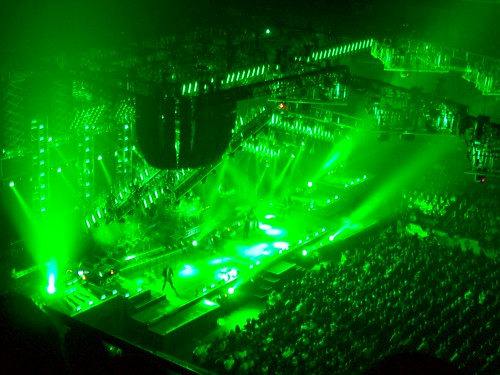
Last week, we attended one of the two performances staged here every year by the Trans Siberian Orchestra. If you haven’t heard them, well, they’re an odd mixture of classical music, traditional Christmas music, and arena rock. Electric guitars are joined by electric violinists and synthesizer artists and a drum set the size of Poughkeepsie, all fronted by a series of vocalists who all tend to sound like Meat Loaf after smoking a carton of Marlboro’s.
You wouldn’t think that this kind of thing could possibly work, but somehow it does, even though it is occasionally very odd. It ends up being a lot of fun, though. We like their music a lot, and the show was a great time, even if it started about twenty-five minutes late and ran a lot longer than we expected (it ended just before 11:00 pm, and we didn’t get home until midnight).
One funny thing came after the first set, when one of the leaders stepped forward to introduce the members of the band. One of the group’s founding members was there; he’s from Buffalo. Two others that night were from Binghamton and Horseheads, both towns in the Southern Tier of New York, about three hours away. There’s always a local connection, isn’t there?
(The TSO has two touring groups, splitting the band’s members equally, which is how they’re able to have shows in so many cities in so short a time.)
I’m not sure we’ll go see them every year, but we’ll absolutely go again. I wanted to see lasers and fire and bright lights and rock band pyrotechnics, and I got all of those and more!
I love the Susan Boyle story. I really, truly do. I think it’s the greatest thing that a woman who stands outside the “norm” of what we look for in terms of stardom these days came forth with her own talent and blew everyone away. It’s just fantastic.
But I was looking at her new CD the other day, and I was struck by some of the song choices on it. In truth, it’s full of songs that I like, so maybe I’ll give the album a listen someday. But it struck me as funny to see a song like “I Dreamed a Dream”, a showtune in which a single mother who has just lost her factory job because everyone found out she’s been turning to prostitution to make ends meet tells her sad story about the guy who “took her childhood in his stride” but then “was gone when autumn came”, on the same album as “Amazing Grace”, in which the grace “that saved a wretch like me” is extolled. No real point here, but I found that juxtaposition interesting.
Some time ago a reader asked me to recommend a list of filmscores that represent a good place to start with exploring the wonderful world of film music. I’ve been kicking that request around for a long time, and I’m finally going to attempt an answer.
The problem is that film music is a very large field, despite that it looks, at the outset, to be fairly small. But consider: films have been around for around a century, and films have had music pretty much the entire time. The world of film music runs the gamut from composers who knew some of the great masters to composers who started their careers in rock bands. Erich Wolfgang Korngold knew Mahler and Strauss; Danny Elfman was in Oingo Boingo. Both are beloved in film music circles, often times by the same fans. There is film music written in the dense German Romantic tradition; there is film music written in the Impressionistic tradition; there is film music written in the atonal tradition; there is film music written in the neo-Romantic tradition; there is film music that draws heavily on jazz or other ethnic musical traditions.
Clearly, then, it would be impossible to distill all of film music down to a single list of ten carefully-chosen scores, and that’s not what I’m after here. This list is just a starting point: what I’d recommend to a musically curious person who said, “Hey, what’s film music all about, anyway?” This is in no way intended to be a Top Ten Film Scores of All Time, although there isn’t a score here that I don’t include among my very favorites.
(These are in no special order, by the way. I’m writing them as they come to me.)
1. Vertigo, Bernard Herrmann.
Herrmann is considered one of the greatest of all film composers, and with very good reason. His body of work comprises dramatic music of the highest order. He was especially good at composing music that could sum up, very succinctly, the emotional fabric of a film. Herrmann was Alfred Hitchcock’s composer of choice for most of his films. His most famous bit of music is probably the “slashing strings” figure from Psycho, but I choose Vertigo because it’s more subtly suggestive of unhealthy and obsessive love. It is lush and sumptuous music that nevertheless fills the listener with a sense of disquiet. This is psychological music of the first order.
2. Casablanca, Max Steiner.
Steiner was one of the foremost composers of what film music fans tend to refer to as the “Golden Age”. Why was it golden? Well, in those days, musical literacy was a lot more common than it is now, so the directors and producers could be assumed to know something about music, which meant that they would understand what their composers were talking about, and be more inclined to listen to what they had to say. The idea of a director needling a composer because his score did not reflect the temp-score closely enough would have been laughable. Composers were treated as important members of the film-making team, and the music was generally taken more seriously. (Of course, I also think that the appellation “Golden Age” reflects a certain degree of taste on the part of many listeners of film music, a matter of stylistic preference. Much film music of this period was orchestrally dense in the Germanic symphonic tradition.) Casablanca gives us a perfect example of a filmmaker being able to call on musical literacy that is no longer assumed to be essential to a good education: in the famous scene where Victor Laszlo, incensed that the Germans are raucously singing their German anthems, commands the band at Rick’s to play La Marseillaise. Producer Hal Wallis instructed Max Steiner to score this scene for full orchestra, rather than use the scoring for the band onscreen, in order to make the moment that much more iconic. How right he was.
As for Steiner’s score to Casablanca, it’s a fascinating listen not just because it’s a fine, fine score in its own right, but because Steiner is able to create an emotionally and dramatically engaging score mainly using two melodic ideas that aren’t his own: La Marseillaise, and the song “As Time Goes By”. Steiner employs a lot of minor-key quotes from the French anthem, suggesting that Casablanca is full of French people who can’t be free, and of course, “As Time Goes By” is the film’s love theme.
Casablanca‘s score yields yet another of the great anecdotes of luck or fortune that led to the film being as good as it is. Steiner, professional as he was, hated “As Time Goes By”, and lobbied hard to have the song tossed aside in favor of something original that he would write. Steiner very nearly got his way, but this would have required re-shooting several scenes, because the song is actually referred to by title in the film’s dialogue. Those reshoots were impossible, however, because by this time, Ingrid Bergman had already moved on to her next role and cut her hair very short for whatever that film was. So “As Time Goes By” stayed.
Anyway, Casablanca is valuable to a first-time listener because it’s so easy to trace the melodies through it, from beginning to end.
3. Chinatown, by Jerry Goldsmith.
Noir scores of the 40s and 50s tended to be full-orchestra affairs. As fine as they often were, they also tended to be just as lush and Romantic in their sound as a great many other scores of those eras. With Chinatown, however. Jerry Goldsmith wrote a score using a very small ensemble, and he spotted the film sparingly, allowing silence to do its work when it is the best tool used. Chinatown also employs some compositional styles that would have been used by the composers of the period in which Chinatown takes place – prepared piano, atonal effects, and a jazz-influenced main theme, heard during the opening credits played by a solo trumpet.
4. Ben Hur, by Miklos Rozsa.
If there’s a film music lover out there who doesn’t love at least one score to one of the old Biblical epics, I’ve yet to meet that person. The large-scale Biblical epics of the 50s and 60s tended to all boast fine scores, and in many cases, the scores outshine the films themselves by their quality. King of Kings, The Greatest Story Ever Told, The Robe — all films that aren’t seen much anymore at all, but their scores are beloved by film music fans of all ages. For my money, Rozsa’s Ben Hur score is the very best of this subgenre.
These films all tend to give adjectives like “lush” and “Romantic” a new meaning, and Ben Hur is no exception at all. It features a full-sized orchestra and chorus, and the score plays for well over half of the three-hour-plus film’s running time. It’s a thematically rich score as well, featuring many themes along its long journey, and it is by turns thrilling, moving, Romantic, and it is especially tinged with a strong spiritual tone, as Rozsa’s music is required to suggest the holiness of Christ in a film where Christ is a character who is never seen from the front and never heard to speak. Ben Hur is one of the greatest of all film scores, and it’s also one of the most accessible to those who are unfamiliar with film music listening in the first place.
5. The Godfather, by Nino Rota.
Here is a different kind of epic score for a different kind of epic. It is intimate and melodic, as befitting a film whose focus is on a single family and its deeds and misdeeds through several decades. If the score’s musical language seems somewhat limited, that is probably by design, as the film’s focus itself is intensely limited, with the story involving the Corleones through the years, without ever really acknowledging the outside world. Rota’s approach to scoring the film is to infuse each scene with a sense of nostalgia, musically suggesting us the sad passing of an age, even if that age is one of violence and crime and death.
6. The Magnificent Seven, by Elmer Bernstein.
This is, perhaps, the definitive score to a Western. Its sound reflects one of the most influential of twentieth century composers, Aaron Copland, with its thrilling rhythms suggestive of no other place on Earth than the Old West and Mexico, and with its theme, which is one of the most famous melodies ever written for a movie. Bernstein’s career spans the same time, almost exactly, as Jerry Goldsmith’s, and both composers came of age roughly at the tail end of the “Golden Age”. Both then were major composers of the “Silver Age” (which I take to start roughly in the mid-1970s and last until around the early 1990s, although good luck getting filmscore lovers to agree on what the “Silver Age” actually is). And both died just a few years ago, after being active nearly until the end of their lives. Bernstein was nominated for an Oscar just months before his death (for Far From Heaven).
7. Star Wars Episode IV: A New Hope, by John Williams.
Well, duh. But seriously, it’s one of the iconic filmscores of all time; it’s an outstanding example of a leitmotif-based filmscore; and it’s an orchestral masterpiece. Simple as that. (And no, it’s not “ripped off from Holst”.) Williams has been one of the major voices in film music for the last forty years, and in this score you hear why.
8. Apollo 13, by James Horner.
In the clip below, I link the actual scene instead of the isolated music for the reason that this clip, almost more than any other, illustrates just how the ebb and flow of a well-composed score can propel a film’s emotional climate along. This scene, without music, would just sit there on the screen, with certain shots lasting an absurdly long time and others feeling incredibly out of place. The music here starts out solemnly and builds a bit before ebbing back down, and in the seconds before the launch itself, you can hear the music rising and falling, undulating beneath the action, in much the same way that our breath quickens during those final seconds of the countdown before the triumph of the launch itself.
The score uses a Copland-esque sound as well, but in a different way from Bernstein in Magnificent Seven; Horner also supplements his orchestra with synthesizers in nice ways that don’t stand out horribly. (I don’t think Horner has ever been as good as he was in the mid-90s.)
9. Blade Runner, by Vangelis.
The film is considered by many (not by me, although I do kind of like it) to be a classic, and one of its most defining elements is its score, by Greek composer Vangelis. What’s primarily notable is that the score is almost entirely electronic (the only non-electronic thing that I can recall in it is the saxophone in its gorgeous love theme), and it’s on that basis that I cite the score here. The world of Blade Runner is one of the most visually amazing in all of film – the visual design has proven to be extremely influential ever since, in the world of science fiction cinema – and Vangelis produces a score that is a perfect counterpart to it. In the sequence below, the main titles and first few visuals from the film, note the way Vangelis chooses to musically depict the future cityscape we first look upon. At the very first glimpse, 2019 Los Angeles looks hellish and dystopian, but the Vangelis music works against that impression, with a synthesized “harp glissando” as the city fades into view, almost musically symbolizing the curtain going up; and note that rather than write grim and dystopic music (the kind of thing that seems to dominate techno music today), Vangelis’s music is primarily music of awe. In fact, it’s eerily beautiful.
Aside: in searching out that clip, I noticed something interesting. In the clip above, note the “big melody” that is heard at about the 2:58 mark, when we are looking across the city and we cut to the eye of someone looking out over that city. Now watch this clip of the famous “I’ve seen things” speech by Roy Batty at the end of the movie (particularly starting at about the 2:25 mark). It’s the same melody. Is Vangelis telling us that it was Batty’s eye we saw back at the beginning of the film, looking out over the city? Are we seeing some of the things that he has seen? This is the kind of thing that paying attention to film music can bring up.
10. Princess Mononoke, by Joe Hisaishi.
Here we have a great example of Japanese film music, as well as music for an animated film. Animated films can rely on their music to a much greater degree than live action, and this is as good an example as I’ve ever heard – in fact, for my money, Joe Hisaishi is writing some of the finest music for films anywhere today. Music for animated film can sometimes get overlooked, even by film music lovers, for many reasons. Many animated films use songs along the way, and many of the more recent ones are outright musicals, which tend to require different kinds of discussion than “regular” film scores. But musical storytelling is still musical storytelling, and Hisaishi is one of the best.
Pick those up, explore them, and you’re well on your way.
Kunzel has been active for many years, but his most noted accomplishment may be his founding of the Cincinnati Pops Orchestra (comprised of musicians from the Cincinnati Symphony), and the lengthy body of recording work he did with that ensemble. Kunzel’s recording frequently featured film music, and nearly any lover of film music will own at least a few of Kunzel’s recordings. He conducted film music with sparkle and verve, and he will be greatly missed.
Here are a few samples from his baton.
The Magnificent Seven:
The Love Theme from Spartacus:
Gone With the Wind:
“Across the Universe”, by the Beatles (performed by the King’s Singers):
The last few minutes of the 1812 Overture, performed at “A Capitol Fourth”:
Farewell, Maestro Kunzel, and thanks for the music.