Tone Poem Tuesday

 Returning to the work of Black American composer William Grant Still today, and yet another work by a Black composer that makes me think, “Why have I never heard that before?” It’s a work of American Impressionism called Kaintuck, and from what I’ve read it’s intended to express Still’s own feelings and impressions of mist-covered blue grass meadows of Kentucky. It’s not a long work, but it packs a lot of thoughtful lyricism and introspection into its roughly ten minutes. We open with the solo piano playing a motif of leaping intervals, and then the orchestra comes in and meanders thoughtfully with the soloist before fading out with just the soloist again. It’s quite an evocative, wonderful work. So, why have I never heard this before?

As with most such cases, I’m afraid I have a pretty good idea what the answer is…or at least, what it partly involves.

Here’s Kaintuck by William Grant Still.

Share This Post

Recent Reading!

 It’s been a while since I posted an update on books I’ve been reading, so here’s a bit of catch-up!

::  Edge of Sundown is a noir-mystery set in Chicago, by indie writer Jennifer Worrell. A writer who was once a fixture on the bestseller lists for his genre potboilers has spent the better part of a decade in the creative doldrums, until he starts writing what is a marked departure for him: a dystopian thriller in which alien beings are ridding the city streets of “undesirable” elements. But when real-world events start to mirror those in his novel, our hero starts to wonder where the boundary between fiction and reality lies…and that boundary blurs even more when the murders start.

I don’t often read this sort of thing, so I was surprised how compelling it was. There is a palpable sense of dread hanging over the story, even as the climax nears, and Worrell really creates a sense of dark place as she explores Chicago’s seedy underbelly. Highly enjoyable!

::  For my ongoing project of listening to (and writing about) the music of Jean Sibelius, I figured I should bone up on the composer’s life and times. I got a book out of the library, called Finlandia: The Story of Sibelius, by Elliott Arnold. This is an older book, published in 1941 while the composer was still very much alive (and, in fact, Sibelius himself appears to have had input into Arnold’s book). As such, the writing style is very much a throwback, and the tone of the book is one of somewhat relentless praise. If you are looking for a critical study of Sibelius and his music, you won’t find that here. But I just wanted a readable treatment of the composer’s life and times, and this is certainly that. In fact, I found the book valuable for its descriptions of the historical events in Sibelius’s homeland, Finland, a country which wasn’t even an independent nation when Sibelius was born. Sibelius was a highly nationalistic composer (even if he denied ever using actual Finnish folk material in his works), so this book gives a good sense of the events that shaped Sibelius’s attitudes and patriotic fervor.

::  Two rival sea-faring clans try to put their long feud behind them by marrying their two youngest nobles in Daughter of the Deep, a fantasy novel by Lina C. Amarego. The problem is that our heroine, Keira Branwen, is convinced that her new husband, Ronan Mathonwy, is the one who murdered her father. She is expected to push those feelings aside in the name of peace on the seas, but obviously that isn’t about to happen, and Ronan relentlessly insists on his own innocence. There’s no way that peace between the Branwens and the Mathonwys is going to be easily attained by any marriage, and so unfolds a novel full of character and conflict. I enjoyed this one immensely! Daughter of the Deep is the first volume of a duology called The Children of Lyr, and I absolutely intend to read the follow-up. Recommended!

::  For the Love of Music: Invitations to Listening by Michael Steinberg and Larry Rothe is a collection of essays that ran in the magazine of the San Francisco Symphony Orchestra, along with that magazine’s shorter program notes for specific concerts. As such, the book can be dipped into at will, which I recommend doing. There are chapters on Erich Wolfgang Korngold and on Sergei Rachmaninov and the great Chicago impresario Theodore Thomas, along with many more. The essays are often personal reflections on the part of Steinberg and Rothe, informed by many years of love of and listening to classical music. It’s an excellent collection of recent classical music writing.

::  A sadly necessary book, Under a White Sky: The Nature of the Future by Elizabeth Kolbert looks at the state of science today, in this time of climate change and the threats it poses to the natural world and to human civilization in general. This is not a general look at climate change, but rather an examination of a number of “case studies” in which scientists are working on very specific environmental issues, such as preserving a fish that only lives in tiny pools in caves in the Mojave Desert. In another example, Australian researchers are trying to engineer a coral that can thrive in the hotter oceans to come, hoping to somehow preserve the Great Barrier Reef. She ultimately arrives at the folks who are studying the possibilities of direct geoengineering to combat the ongoing warming of our planet, in such ways as dispersing huge quantities of reflective aeresols into the upper atmosphere, hopefully increasing the planet’s albedo in hopes of putting the brakes on continued absorption of solar heat. Who knows if that will work, but the fact that it’s being more seriously analyzed is itself an indictment of humanity’s utter failure to take any major steps to alleviate the problem. Under a White Sky isn’t an optimistic book, that’s for sure…but oddly, it’s not exactly pessimistic, either. My overwhelming feeling is that we’ll just keep not making things exactly better, but just continuing to make things different and figure out how to live with it down the road.

More reading notes to come!

Share This Post
Something for Thursday

 Two selections from the vocal group VOCES8: One is “May It Be”, from the score to The Lord of the Rings: The Fellowship of the Ring, and the other is a setting of a piece called “Nyepi” by Icelandic musician Olafur Arnalds.

I like VOCES8 a great deal. There’s a purity to their sound that elevates just about anything.

Share This Post

Tone Poem Tuesday

 Here’s a curiosity: a film music tone poem that’s actually a tone poem, and not a group of film music cues arranged into one. Composer Michael Kamen (much missed, he died too young and vibrant in 2003) scored the movie Mr. Holland’s Opus, from which this piece comes.

The movie–which I quite like–tracks something like thirty or forty years in the life of Mr. Holland (Richard Dreyfuss), a young man at the start of the film who envisions himself as a composer of serious music. He quickly finds that he’s not going to be able to support him or his wife on that at the outset, so he does the reasonable thing that a lot of people do when they figure they need something to do until they attain artistic success: he becomes a teacher.

At first, his efforts at teaching are not encouraging. He doesn’t see it as his actual job, and it shows, to the point that his students hate the drudgery of his class and he hates the drudgery of teaching them and his principal (played wonderfully by Olympia Dukakis) has to call him out on his awful attitude, saying something like “You actually beat some of the kids to the parking lot when the final bell rings.” Eventually Mr. Holland makes a turn in his teaching when he decides to employ rock-and-roll in his lessons (this is the 1960s, so this doesn’t go over spectacularly well with some folks) and when he actually realizes that a particular student who is struggling with the clarinet is trying to reach him.

Mr. Holland discovers that yes, he can teach high school music, and teach it he does, for the rest of his career: through the Viet Nam War and through his own child’s birth and through the discovery that his son is deaf and through a strange attracted protectiveness he feels toward one very talented pupil who comes along and through the inevitable budget cuts to the music program that will cost him his job in the end. He does compose through all this, and at the end of the film, the school band, along with some of the many alumni he has touched–including that unconfident clarinetist from years before, who is now Governor–sets up to perform the last minute or two of this piece. (Asking questions like why does a high school and alumni band sound so good and when did they rehearse is churlish behavior that should be swatted down with great harshness.)

So Kamen wrote this roughly nine-minute work, called “An American Symphony”, which purports to be the serious composition that Mr. Holland has been writing for all his many years of teaching. Kamen’s music is always impressive, and I miss his film music voice. He tended toward the big and the dramatic (there’s zero doubt in my mind he would have scored at least one MCU movie), and his melodies don’t always exactly leave you humming them, but they reward repeated listening and become quite familiar as you do. For this piece he even paid tribute to Mr. Holland’s breakthrough as a teacher, the realization that he could use rock-and-roll as a means to bringing the kids into more serious music, by adding the electric guitars to his orchestral palate.

It’s an interesting piece, a long-form tone poem written specifically for a movie whose central message is along the lines of “Life is what happens to you when you have other plans.” Here is “An American Symphony” by Michael Kamen, from the score to the film Mr. Holland’s Opus.

Share This Post

Tone Poem Tuesday (and Composer Focus: Sibelius, part 4)

 It’s not Tuesday. Sorry about that.

But let’s give a listen to something our boy Jean Sibelius wrote in 1908: a tone poem called Night Ride and Sunrise. It’s quite an evocative piece, starting with a brief fanfare figure in the brass before settling into a rhythm that suggest hoofbeats along a dark road, the “Night Ride” of our title. It seems as if we’re going to be in for a long stretch without a melody, until one arises in the upper woodwinds, playing above the rhythmic pulse; this melody yearns and stretches and yet somehow manages to stay almost in the background. Our rhythm gives way to long scalewise passages in the winds, as our texture becomes colder, stormier, more dramatic.

Eventually, though, our sunrise arrives, and it is exactly what one might expect from a Sibelian sunrise: shot through with clarity and nobility, with simple magnificence. Even here, when the chorales in the winds and brass take over, there is still momentum to spare in the continuing pulsing rhythms. I’m coming to see that for Sibelius, a blend of textures is always afoot.

Here is Night Ride and Sunrise by Jean Sibelius.

Share This Post

Tone Poem Tuesday

 Greek-born composer Nikolas Labrinakos has come to my attention recently. After growing up in Greece, he went to London to study music composition, eventually getting a Ph.D. from the University of Surrey. He is an active composer of both film music and concert music, and what I’ve heard of his is fascinating and atmospheric, displaying a gift for shimmering, evocative string writing.

The present work, The Last of England, is a pastoral work in the tradition of music by Ralph Vaughan Williams, George Butterworth, and Gerald Finzi. The piece is inspired by the seascape of England’s southern shore, with its cliffs overlooking the great gray expanses of water. Melodies seem to arise from meditative chords and sink back into them again, often with a soloist in the orchestra singing somewhere not quite in the foreground. This isn’t the music of a stormy sea, nor the sad music of the water where all things end, but a singing contemplation of life at the edge of our world’s most permanent feature. The Last of England is neither sad music nor happy music. It is…music that is.

Here is The Last of England by Nikolas Labrinakos.

Share This Post

Tone Poem Tuesday

 French composer Emmanual Chabrier isn’t much known these days, but he is represented in the standard repertoire by his intoxicating dance Espana. That work is one of the most compulsively joyful in its bright orchestrations, sparkling melodies, and effervescent rhythms in the entire classical music canon. This piece, from one of Chabrier’s less-performed operas (and none of his operas are often staged), is cut from the same cloth as Espana, being a five-minute burst of energetic dance.

From what I’ve read, Chabrier is a curious composer in that his work has never really cracked through into the mainstream of classical music, even though his music was greatly admired by great composers who followed, like Ravel and Stravinsky. Chabrier was innovative in his own way, and he may have simply lived too early and therefore just missed a time which might have been golden for his music. Anyway, here’s a bit of pure delight: the Danse slav from the opera The Reluctant King, by Emmanuel Chabrier.

Share This Post

Tone Poem Tuesday


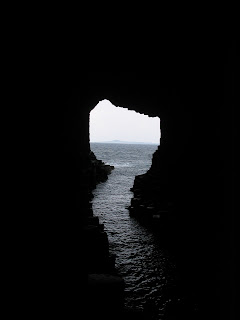
A repeat today (I think), but it’s been a while (I hope). Felix Mendelssohn’s The Hebrides is a concert overture, inspired by the composer’s journeys in Scotland and specifically his tour of the Hebrides islands and a basalt cavern called “Fingal’s Cave”, which is a place that would absolutely appeal to someone of Romantic mindset. The black basalt, the sharp columns, the waves of the sea…in Mendelssohn’s hands, all that became this wonderfully brooding and Romantic work of adventure and heart.

Here is The Hebrides by Felix Mendelssohn.

Share This Post

Tone Poem Tuesday

 One thing I’ve always believed about writing is that if an idea doesn’t work out in one piece, that’s no reason to put it aside forever. I’ve reused a lot of my own ideas over the years, a practice I learned in part from my beloved Hector Berlioz.

Berlioz wrote a concert overture based on Sir Walter Scott’s novel Rob Roy, relatively early in his career. Berlioz wrote very little abstract music; just about everything he wrote had a literary antecedent of some kind, and Scott’s novel was the thing for this piece. And it’s quite a decent piece: it’s not one of Berlioz’s greater works, but it’s a perfectly good concert overture.

Berlioz himself was never satisfied with the Rob Roy overture, but he knew a good idea when he had one: the slow melody in the central part of the overture stuck in his mind, so when it came to write his second symphony, itself based on a literary work (this time Byron’s Childe Harold), a work that was to feature solo viola and orchestra after a generous commission from Nicolo Paganini, Berlioz basically lifted that entire section of his earlier Rob Roy overture and dropped it into the first movement of Harold In Italy, which is one of Berlioz’s greatest works.

Learn from mistakes and lesser works–but don’t be afraid to mine them for ideas!

Here’s the Rob Roy overture by Hector Berlioz.

Share This Post