Tone Poem Tuesday

 One thing I’ve always believed about writing is that if an idea doesn’t work out in one piece, that’s no reason to put it aside forever. I’ve reused a lot of my own ideas over the years, a practice I learned in part from my beloved Hector Berlioz.

Berlioz wrote a concert overture based on Sir Walter Scott’s novel Rob Roy, relatively early in his career. Berlioz wrote very little abstract music; just about everything he wrote had a literary antecedent of some kind, and Scott’s novel was the thing for this piece. And it’s quite a decent piece: it’s not one of Berlioz’s greater works, but it’s a perfectly good concert overture.

Berlioz himself was never satisfied with the Rob Roy overture, but he knew a good idea when he had one: the slow melody in the central part of the overture stuck in his mind, so when it came to write his second symphony, itself based on a literary work (this time Byron’s Childe Harold), a work that was to feature solo viola and orchestra after a generous commission from Nicolo Paganini, Berlioz basically lifted that entire section of his earlier Rob Roy overture and dropped it into the first movement of Harold In Italy, which is one of Berlioz’s greatest works.

Learn from mistakes and lesser works–but don’t be afraid to mine them for ideas!

Here’s the Rob Roy overture by Hector Berlioz.

Share This Post

Tone Poem Tuesday

 It’s April 20! Which means that it’s 4/20, and for a sequence of strange reasons involving some stuff some stoners did years ago, “420” is now a cannabis reference. This stuff is weird, really. I’ve nicked the following from Wikipedia:

In 1971, five high school students in San Rafael, California, used the term “4:20” in connection with a plan to search for an abandoned cannabis crop, based on a treasure map made by the grower. Calling themselves the Waldos, because their typical hang-out spot “was a wall outside the school”, the five students — Steve Capper, Dave Reddix, Jeffrey Noel, Larry Schwartz, and Mark Gravich —designated the Louis Pasteur statue on the grounds of San Rafael High School as their meeting place, and 4:20 pm as their meeting time. The Waldos referred to this plan with the phrase “4:20 Louis”. After several failed attempts to find the crop, the group eventually shortened their phrase to “4:20”, which ultimately evolved into a code-word the teens used to refer to consuming cannabis.

OK, then. I think that story seems pretty accurate, at least as far as my personal dealings with the occasional stoners have gone.

Well, anyway, since it’s 420, I got to thinking about composers and their drug habits. When you read histories of classical music, you quickly realize that a lot of composers spent a lot of their time under the influence of a lot of different stuff. Beethoven loved alcohol, and Berlioz leaned heavily on opium. Cannabis, though? For that I had to do a Google search, and while a number of names did crop up, one cropped up a lot: minimalist and electronica composer Terry Riley. As one writer notes:

One obvious point of consensus emerged right away: If you’re talking about the confluence of marijuana and new music, you’re talking about Terry Riley. The prolific Northern California minimalist composer and performer has never been coy about his recreational predilections (one of his pieces, “Autodreamographical Tales,” includes the sung lyric “Cannabis is a wonderful drug/ Sometimes you’re like a cat on a rug”).

That in turn feeds into some of the distinctive qualities of his music, including gentle, lapping rhythms, beguilingly sweet harmonies, and a seductive dream logic that provides a quasi-improvisatory feel. One person proposed including Riley’s entire discography on such a playlist, which has a certain simple appeal.

I’m not sure I’ve ever heard of Riley before this, but I do find him interesting after listening to today’s selection. I grant that you might not be all that interested in this, but I do like non-traditional approaches to music-making and composition. Riley’s approaches and use of electronics and repetitions of sound proved highly influential, providing ideas that later surface in the music of The Who and in the work of musicians like Mike Oldfield.

Today’s piece, A Rainbow in Curved Air, is an exercise in the dreamy soundscape of repeated sounds, modal improvisations, and experiments in pure sound. Over time the work seems to almost suggest melody, without actually coming out and stating one; it’s a hypnotic and expansive work…which one might well expect from a composer who enjoys his 420 action.

Here is A Rainbow in Curved Air.

Share This Post

Composer Focus: Jean Sibelius (part three)

 Written when was 30, and thus nearing the halfway mark of his productive career, Sibelius’s The Swan of Tuonela is one movement from his Lemminkainen Suite, a collection of four tone poems that tell the story of one of the heroes of The Kalevala, the national epic of Findland. Lemminkainen undergoes a number of tests and trials, one of which is that he is tasked with killing the Swan of Tuonela. Tuonela is the land of the dead, and the swan is a mystical beast living in Tuonela’s waters. Lemminkainen tries to kill the swan, but is himself shot with a poisoned arrow and dies. He is apparently restored to life later in the story, but this particular movement is primarily concerned with the swan itself.

This work is meditative and almost without bombast of any kind, instead engaging a kind of brooding mysticism that reminds me of Rachmaninov’s Isle of the Dead. A solo English horn portrays our swan, moving with churning placidity through its mournful waters, as the orchestra sings plaintively along with it. It’s a remarkable work.

Share This Post

Tone Poem Tuesday

 I have a two-fer today, because I couldn’t decide between these two selections and I figured, since they do kind of go together, why not just use both?

Music for percussion only tends to be somewhat of a novelty, which is a shame since there’s a great deal of musicianship involved in playing percussion, as much as any musical instrument. Percussion is about a lot more than just providing a good, solid whack at particularly dramatic moments in the music. Think of the timpani providing the rolling thunder of the distant, and approaching, storm clouds in the third movement of Berlioz’s Symphonie fantastique, or the almost demonic energy of the snare drummer in Carl Nielsen’s Fifth Symphony. Or the glockenspiel in The Magic Flute, or those mighty pounding timpani in the opening chords of Also Sprach Zarathustra. (Or, if you want to admire the sheer musical thanklessness of a task, consider the poor snare drummer in Ravel’s Bolero, who has to play the same rhythm over and over and over and over and over again, for the work’s entire fifteen-minute reign of terror.

Many laypeople will know about bells and marimbas and that sort of thing, but they won’t realize just how many percussion instruments are actually pitched or how much a percussionist has to think about how they want to produce the exact sound they’re looking for. Timpani, for example, are tuned to specific pitches, so the performer has to have good pitch sense to tune the instrument, and that’s just where it starts. How hard do you hit the surface of the drum? Where on the head do you hit it? It makes a different quality of sound toward the middle as opposed to near the edge. Do you use soft mallets, or hard ones? It all depends! Percussion requires physical skill and every bit as much precision and focus as any other instrument. So if you’re one of those who thinks that the drums are where the musicians who can’t carry a tune go to live, well, get that notion out of your heads, folks!

Here are two works for percussion ensemble alone. The first is Music for Pieces of Wood, by Steve Reich. Five players perform this piece, using instruments called “claves”, which come in different varieties. Claves are pitched, which gives this work a polyphonal feel even as its spellbinding rhythms unfold. The piece almost feels like a bunch of clocks which are all not quite synchronized, and imagine the degree of rhythmic precision it requires for the ensemble to pull off this work!

The other piece I want to feature makes a really interesting contrast with the previous work, even though both are works for percussion. David Crowell’s Music for Percussion Quartet uses pitched instruments like marimbas, giving the work a tonal and melodic element that the Reich piece doesn’t. There are some amazing sounds here too, though: note in the second movement, when the sounds are produced not by striking the marimba’s bars, but by drawing cello bows against them. The result is a kind of droning chord work that reminds me of the pedal drone of a hurdy gurdy or a set of pipes.

So next time you’re listening to your favorite classical work, pay special attention to the percussionists! There’s a lot going on back there.

Share This Post

Tone Poem Tuesday

 Caroline Shaw is a composer, singer, and violinist who has emerged as one of the bright new voices in classical music. She has already won the Pulitzer Prize for one of her works, and she has composed a lot of music already in her 39 years. And I had never heard of her until last week, when I found her name after Googling “21st century classical composers”. I read a bit about Shaw, whose career has taken her from the Baltimore Symphony Orchestra to recording with Kanye West. That sort of eclecticism appeals to me; I have always responded well to artists with as wide a view of their artistic expression as possible.

As of my writing this, I’ve only heard one work by Shaw in its entirety, and it’s the one featured here today. It’s called The Observatory and it was commissioned (and premiered) by the Los Angeles Philharmonic, where apparently it opened a program that ended with Beethoven’s Ninth Symphony. That’s gotta be a hell of a thing for a composer, right? “We want you to write a new work for us, you’ll be filling out the program with Beethoven’s Ninth. You can do that, right?”

Well, Shaw most certainly could. The work is a grand-scaled tour de force, opening with huge chords reminiscent of those that open Brahms’s First Symphony, and then taking a 16-minute stream-of-consciousness tour of wonder. The work’s inspiration was apparently LA’s Griffith Observatory and Shaw’s own love of science fiction and the Cosmos. Obviously these themes drew my attention almost immediately. As Shaw herself writes, describing the compositional process of this piece, on the Hollywood Bowl website:

It was a wild ride, and I remember feeling like an observer of a mysterious workshop that somehow churned beauty out of chaos. There is also something about writing an orchestral work for a summer evening in Hollywood that got me thinking about my favorite genre of film and storytelling — sci-fi. I love the way epic tales of the beyond can zoom in and out, using grand imagined alternate universes to tell stories about ourselves. And I love how music in these films carves and colors our attention to those worlds (in their various scales).

While writing music, I often imagine some kind of visual (usually abstract, sometimes figural, rarely narrative), as a guide for myself and sometimes as a thing to write against. There’s an invisible counterpoint here, but I’d rather someone simply listen and create their own contrapuntal narrative adventure than read an account of mine — to leave space for one’s own observation and reflection, whether it be of the music or their neighbor’s t-shirt or cosmology or tomorrow’s grocery list. (The grand story arcs of our lives sometimes play out in minutiae and the mundane.) And often the imagined visuals that I write to are nothing more than shifts in color or a quick cut between undefined scenes. (Sometimes the juxtapositions and transitions [and parentheticals] are where the stories are.)

I greatly enjoyed this work and I will certainly be exploring more of Caroline Shaw’s music! I wonder if she’s given any thought to film scoring…since the inevitable screen adaptations of my Song of Forgotten Stars books are going to need a composer, eh?

Here is The Observatory by Caroline Shaw.

Share This Post

Tone Poem Tuesday

 A very modern work today, by Canadian composer Cassandra Miller. Duet for Cello and Orchestra is almost avant-garde in its conception: a solo cello plays the same droning two notes, a perfect fifth apart, through the entire work, marking the time insistently throughout even as the orchestra enters and departs at intervals that feel almost random. The orchestral passages start out sounding like trumpet fanfares, but they become increasingly frantic as we move through the work’s thirty minutes. The work apparently quotes an Italian folksong throughout, while our solo cello keeps playing this weird two-note ostinato until the very end, when at last the soloist gets to do something else: a strange kind of cadenza that soars above the orchestra’s dying ostinato.

It’s a fascinating work. Here is Cassandra Miller’s Duet for Cello and Orchestra.

Share This Post

Tone Poem Tuesday

 Here’s an interesting piece! I didn’t realize this was even available online until a few weeks ago when I looked up the composer by name. Linda Robbins Coleman is a composer, conductor, and teacher from Iowa whose symphonic poem Journeys was commissioned by the Wartburg Community Symphony Orchestra while I was there. Yes, I was privileged to take part in a world premiere, under the baton of Dr. Janice Wade

Coleman’s website describes Journeys thusly:

Journeys, A Symphonic Poem, marked a turning point for composer Linda Robbins Coleman in that it was her first large-scale work conceived and produced without utilizing another medium for inspiration. As the composer says, “I chose the title in part because the years leading up to its composition were quite a personal and professional journey for me. When I began to write I discovered that Journeys would not be a programmatic description of a picturesque country or great work of literature, but that it would tend more towards a reflection of where I have been within myself, and where I am struggling to go.

Prior to Journeys, most of my larger works had been for theatre, writing incidental music, scores, or songs for plays ranging from Euripides and Shakespeare to modern and avant-garde productions. All were highly descriptive both in mood and language. This experience enabled me to learn how to experiment with various tone colors to convey the different feelings expressed in plays. But with Journeys I was on my own. Even though my music is very tonal and accessible to all audiences, I still found that expressing personal feelings and moods–from my own script this time–to be a most stimulating challenge.

I hadn’t heard Journeys since I played it back in February of 1992, so revisiting it is a surprising exercise in…well, not nostalgia, but an exploration of things not quite remembered. There is a passage in here that I remember quite clearly, as the piece’s middle section reaches it climax; there is some daunting trumpet writing in there, in which I was required to hit notes loudly that I wasn’t terribly confident of hitting much at all. I did manage to nail them, though.

I’m glad to read that Journeys didn’t disappear down a musical memory hole. It has apparently been performed a bunch of times since, as this recording proves (that is not my orchestra). Journeys is bold and dramatic, and quite modern in its conception. I hope you enjoy it.

Here is Journeys by Linda Robbins Coleman.

Share This Post

Composer Focus: Jean Sibelius (part two)

 Returning to Sibelius!

The land of Karelia is a region in northern Europe that currently comprises sections of Eastern Finland, and Northwestern Russia. Like Alsace-Lorraine between France and Germany, Karelia is a land that has been disputed for centuries, and the scene of many armed conflicts as powers east and west of it struggled to hold it. Today the region of Karelia is split in two.

Sibelius, in his early years of composing, was also fiercely invested in Finnish nationalism and independence, so he was happy to accept a commission from a students’ organization in the Viipuri province, a part of the Karelian region. At first he wrote a tableau of eleven movements, each one with a specific folk-like and rustic character designed to appeal to the nationalistic feelings of the region. Later, Sibelius condensed the larger work down to the Karelia Suite, which is one of his most enduring works.

Unfortunately, the original version of the larger tableau is lost, the score having been burned by Sibelius’s own hand. But most of the orchestral parts survived, allowing a reconstruction in the 1960s, with the missing parts being completed by Finnish musicologists. Luckily the Suite has survived. It comprises two march-like movements, brassy and bold and thrilling, bracketing a Ballade that is evocative and lyrical.

Here is the Karelia Suite by Jean Sibelius.

Share This Post

Composer Focus: Jean Sibelius (part one)

 So here’s something new I’ll be trying for a bit, based on my experience in 2020. I wrote a lot last year about Ludwig van Beethoven, which was fitting since 2020 marked his 250th birthday. I don’t plan to focus on a specific composer every year (or every day or every month) for their particular anniversaries, but I did greatly enjoy spending a lot of time in a specific composer’s sound world, so that’s what I’m going to try to do for a while: spending several months focusing on a particular composer. This isn’t to say that I’ll only be listening to the music of a particular composer, but I’ll be focusing that way.

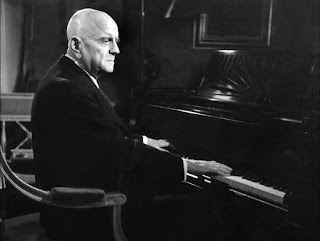
I’m going to start with Jean Sibelius.

Quite a stern looking fellow, wasn’t he? (Obviously the second photo is Sibelius as a younger man. I screwed up the uploading and decided to leave it.)

Sibelius is known as Finland’s greatest composer, and there’s some good reason for that. From what I’ve read, Sibelius’s reputation has waxed, waned, and waxed again in the almost a hundred years since his main period of active composition came to an end. After the mid 1920s, Sibelius’s output dried up almost completely, and he lived out the remainder of his years–thirty of them, until he died in 1957 at the age of 91–composing little. As David Dubal notes in his book The Essential Canon of Classical Music, “[Sibelius’s] lifespan far exceeded his ability to fathom new artistic developments.”

Sibelius, like Rachmaninov (whose own long lifespan took place within the boundaries of Sibelius’s), straddled the transition from Romanticism to Modernism, and thus the transition from traditional tonality to the various systems that followed it. While Rachmaninov kept composing music that made him seem more and more anachronistic as his life progressed (though it did his reputation no harm), Sibelius’s music is more individualistic, so his reputation has had a harder time. Dubal, again:

Sibelius’s place in music history was once more secure than it is now. Around 1920 in various quarters, he was proclaimed the ideal modern composer and an antidote to the seeming chaos of Schoenberg, Stravinsky, and Bartok. But by the late 1940s, his reputation had begun to decline. The composer Virgil Thompson, listening to the great Seventh Symphony, wrote, “I do not believe for a moment that its gray and dirty-brown orchestral coloring is a depiction of either the Finnish soul or the Finnish landscape…I think Sibelius just orchestrates badly.” Thirty years later Harold Schoenberg called Sibelius “a dated bore” but conceded for him “an honorable place among the minor composers,” while giving to the Danish Carl Nielsen “as much sweep, even more power, and a more universal message.”

I cannot at this point comment on Thompson’s impression of Sibelius’s Symphony No. 7, as I haven’t heard it yet. We’ll see. And I may decide that Schonberg is incorrect; again, we’ll see. I do like Carl Nielsen a great deal, but that’s for another time.

In my college years, I only played two works by Sibelius, on the same program, in my freshman year. The big one was the Violin Concerto, which I disliked quite a bit at the time. It was a hard setting in which to get to know a piece of music, though, and I fully grant that my view at the time was very poorly informed. At that point, the orchestra in college didn’t even have a full complement of players until just before the performances, when our music director (my beloved Dr. Janice Wade) would bring in musicians from surrounding towns to fill out the group. On the one hand, I didn’t know shit, being only 17 (I certainly thought I knew shit, but believe me, I most certainly did not), but on the other hand, that’s also a very difficult scenario under which to form a fair impression of a work.

The other piece was Finlandia, which is by far Sibelius’s most well-known and popular work. It is literally a musical love-letter to Sibelius’s own homeland, and it chock full of orchestral color, some deeply exciting material (the middle section somehow feels march-like without being a march), and then a deeply beautiful hymn-like melody that sounds like a folk anthem (even though all the melodies in the piece are of Sibelius’s own invention). Finlandia has become as beloved in Finland as The Stars and Stripes Forever has to Americans, and it’s as good a place as any to enter Sibelius’s sound world. This particular performance adds a choir to the proceedings, for stirring effect.

In future weeks I’ll look at Sibelius’s tone poems (many inspired by the folk epics of Finnish legend), his symphonies, and, yes, that Violin Concerto that vexed me at seventeen. Stay tuned!

Here’s Finlandia.

Share This Post

2021 in the Books: Beethoven, Merlin, and the Hardy Boys meet Veronica Mars

 Here’s some of my recent reading!

::  Beethoven: The Relentless Revolutionary by John Clubbe is simply superb. I wanted to get this one done in time to blog about it during 2020, but getting it done this year is fine.

Beethoven: The Relentless Revolutionary, Clubbe

While not really a “life and works” biography, Clubbe’s book has enough of that within its pages that it would suffice if one was looking for a single-volume account of Beethoven’s life. Clubbe is more interested in tracing through Beethoven’s life and music the influences of late-18th and early-19th century revolutionary history and politics. Beethoven emerges not just as a towering figure in art, then, but as an important historical figure in his own right. Many histories of music and biographies of artists don’t really do this kind of heavy lifting; any history is often treated as incidental. Mozart, for example, is often shown not as a part of history, but as a force of his own, only occasionally interacting with history, such as in his dealings with Emperor Joseph II of Austria.

Beethoven, on the other hand, was profoundly impacted by history, and Clubbe shows this readily by tracing Beethoven’s artistic influences and artistic goals in the light of the revolutions in human rights and political philosophy that shaped that time. Napoleon Bonaparte turns out to be a deeply important figure in Beethoven’s world, going far beyond the famous anecdote of the great composer initially dedicating his Symphony No. 3 in E flat major to Napoleon, and then ripping the dedication away when the Frenchman declared himself Emperor.

Clubbe writes:

Beethoven’s music thus reflects both the turmoil of the age in which he lived and no less the turmoil within himself. As he matured, he affirmed ever more passionately the ideals in which he believed. By focusing on the revolutionary origins of his music, itself a response to the revolutionary age in which he lived, we enter the heart of his genius. For listeners, past and present, who have yearned for political and social change, Beethoven’s music has been and remains an inspiration.

This book is outstanding and I highly recommend it.

::  The Crystal Cave, by Mary Stewart.

The Crystal Cave, Mary Stewart

This was a re-read of the first book in Stewart’s Merlin trilogy, which I first read almost thirty years ago when I went on a massive Arthurian binge during my collegiate years. I was obsessed with “the Matter of Britain” back then, and those stories have held a special place in my heart ever since. I remember finding Stewart’s trilogy, with a fourth book she added on later, in a boxed set in a shopping mall bookstore while on a tour with my college band, someplace in Wisconsin, and I read the four books the following summer. I remember loving them as I read them, but I never re-read them until now, although I’ve intended to re-read them for several years now. Time to get that job done!

Stewart wrote The Crystal Cave in 1970. How does it hold up fifty years later? Quite well, in all honesty. Stewart writes a very historically-focused story here, keeping the fantastical elements to a minimum. The Arthurian saga has always presented problems to those who would write stories based on it, seeing as how there is no single “Arthurian saga”; what we call that, or “the Matter of Britain”, is a collection of tales and stories that accrued and gathered and evolved over hundreds of years. This can result in a lot of versions to take on a disjointed feel, which Stewart avoids by making Merlin, not Arthur, her main character; in fact, Arthur himself doesn’t arrive on the scene, and then only by virtue of being born, until the very end of The Crystal Cave. Everything up to then is Merlin’s story: his questionable birth, his entry into the world of post-Roman Britain mysticism, and his dealings with the pre-Arthurian Kings like Vortigern and Uther.

Stewart’s prose is cooler than I remember, heavy on description and with long paragraphs. In this she might not appeal quite as much to modern readers, but I like this Tolkienesque approach. Her characters are sharply drawn, though, and Merlin’s adventures are interesting throughout. There’s a lot of military maneuvering in this book as armies tromp all over Wales, which is something I didn’t remember from my first reading, but then…it’s been a while!

I will be reading the other two books in the trilogy later this year.

::  The Montague Twins: The Witch’s Hand, by Nathan Page and Drew Shannon.

I checked this out of the library on a whim, because I like to use graphic novels as way to cleanse my reading palate from time to time. This one is an absolute delight. I loved it!

The Montague Twins: The Witch's Hand, Page and Shannon

Basically, what you have here is something that reads like The Hardy Boys mashed up with Veronica Mars, set in a small New England town in the 1960s, with magic and witchcraft thrown in. Actual magic and witchcraft, mind you, not the Scooby-Doo fake magic-and-monsters that always turns out to be Old Man Carruthers in a rubber suit and latex mask, who “woulda got away with it if it hadn’t been for you meddlin’ kids.”

Our leads here are, yes, “the Montague twins”, but they have a larger supporting cast to the point where it seems like actually calling the book The Montague Twins feels like a bit of a misnomer. But they’re two late-teen twin brothers who wear their hair in stylish pompadours and who investigate local crimes. As the book opens, they’ve successfully located the missing dog of the local Very Rich Family Who Owns Everything, and yet oddly, the Very Rich Family doesn’t seem quite as happy with this as they should, which does play in later in the book. There’s a lot of bad-blood history in this book that comes out over the course of its story, not all of which is exactly surprising but a lot of which is satisfying in the “A-ha, I knew it!” way.

What I loved most about this one is that it takes its time. We live in a storytelling epoch in which pacing is seemingly everything, in the sense that the faster-paced the better. One bit of writing advice I see all the time is “Every word must advance your story, and if it doesn’t, cut it!” This has resulted in stories that are constantly rush rush RUSHing their way through their plot beats, with no time for the reader to digest or think or linger in the world or enjoy a quiet moment here or there with characters. The Montague Twins: The Witch’s Hand does not rush, which pleased me greatly. Not every story has to whip by like a damn episode of a CBS procedural, folks!

I read that a sequel is forthcoming to this book. I hope it’s a success and there are more to come!

Share This Post