

Twelve….

The in-between spaces (on the passing of Prince)


One of the stranger parts of having been the kid in high school with very different interests from most everybody else is that whenever a prominent musician dies now, I can almost never join in the chorus of those who claim that musician as a big part of the soundtrack of their lives. It’s very strange, this curious sense of not really being a part of the larger culture that surrounds me.
I had nothing against Prince. I liked some of his music a great deal, and I could leave other stuff of his on the table. I know very little about his output beyond Purple Rain and whatever else he did over the next few years back then. This is not meant as an indictment of Prince in any way at all; it’s just an observation of what was important to me at the time and what remained so. In my teenage years I was not a huge rock or pop listener. At that time, I was going deeply into classical music, and the thing about classical is…well, most of the big ones are already dead. Classical music doesn’t break your heart quite the way I suppose pop music does. I mean, classical music does break your heart, but it’s not the same.
Likewise, when people pass away who are a part of the fabric of my cultural life, there’s a certain loneliness involved. I don’t set out to not really be a part of my own culture, but the heart loves what it loves and really, that’s about all there is to it.
Anyway, farewell, Prince. I kind of wish I’d known you better. And who knows…maybe I will.
Share This Post

Something for Thursday (Alan Rickman edition)

I hate that Alan Rickman died today. I hate that more than I hate that David Bowie died the other day, and I really hated that. I had something picked out for this feature, but I decided to postpone that in favor of a couple selections of music from Rickman films. He was a magnificent actor, and by all accounts, every bit as fine a person as he was an actor.

Share This Post
Mr. Bowie
Something for Thursday: Farewell, James Horner
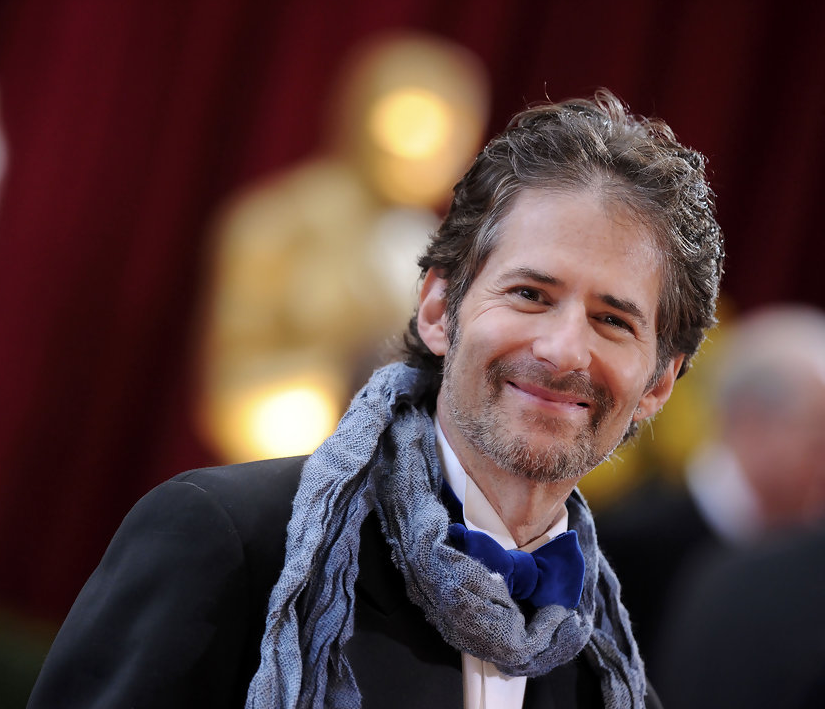
Composer James Horner died the other day when the airplane he was piloting crashed. He was the sole passenger.
This is, quite simply, the worst news to hit the film music world since Michael Kamen, Jerry Goldsmith, and Elmer Bernstein all died within a year of each other.
For me, though, the hit is more directly personal. Although my relationship with Horner’s music has been rather complicated over the years, he still wrote a fair number of my favorite filmscores of all time, and when a score of his connected, it connected. He had the ability to hone in on the precise moment of a given scene’s emotional high point and construct his music to reach its high at the same moment. All film composers strive for this, but Horner’s gift for this was something else.
Moreover, I saw Horner’s career take flight, as he rose from obscurity to, well, stardom in his small corner of the film world. He started writing for films in the late 1970s, and I first encountered him in his fifth film, the Roger Corman space opera flick Battle Beyond the Stars. This is the first James Horner music I ever heard:
That score is still a fun listen to this day, even with all its minor faults: its heavy debt to Jerry Goldsmith (one of Horner’s strongest early influences), its occasionally awful orchestration (there is a track called “Cowboy and the Jackers” when you can hear the trumpet section slowly die), and occasional transitional missteps. Horner wrote a swashbuckling score that was better than the film it accompanied (although the film really is not all that bad, as long as you don’t ask too much of it).
When next I encountered the music of James Horner, it was for another science fiction film: Star Trek II: The Wrath of Khan.
Gone was Jerry Goldsmith’s brightly optimistic bombast from The Motion Picture, and in its place was a lyrical score that had an older and more seafaring quality to it.
It wasn’t all lyricism, though; Horner’s action writing was impeccable, and the film’s climax gives a great example of Horner’s skill for matching the music to the exact visual and the emotional beats of the scene. Here is the music, titled “Genesis Countdown”:
And here is a portion of the scene as scored, starting with the Enterprise backing away from Khan’s crippled Reliant:
This entire cue is a clinic in how to spot a film: you hear the desperation as the ship begins to move so painfully slowly, the drive as Spock climbs down through the ship toward Engineering, a snippet of Horner’s theme for Spock himself as he mind-melds with McCoy, the desperate ticking down of the seconds as the bridge crew realizes they’re doomed, Khan’s final expressions of hatred. When Horner was on, this is what he could do.
Horner would return to Star Trek for the next film, The Search for Spock, but he never did any more Trek after that. This always seemed to me a pity. I would have liked to hear, perhaps, a more light-hearted take on his themes from Treks II and III in IV, perhaps, or maybe his take on the adventures of the Next Generation in any of their films. Alas, it didn’t happen. I next encountered Horner via his score to the SF film Brainstorm, which is notable mainly for being Natalie Wood’s last film and, well, for Horner’s score.
And then there was Krull.
It’s amazing to hear the progression in Horner’s sound from Battle to the Treks to Krull and beyond. You can really tell how much he was learning along the way, and his development along these lines culminated in 1988’s Willow.
One can detect a certain amount of the common lot of the film composer: often the scores are, on balance, better than the films. Not everyone can be John Williams, with a partnership with Steven Spielberg.
Horner was also able to do a lot more than genre films. He scored everybody’s favorite gentle baseball film Field of Dreams, in which he flexed his Americana muscles without quite aping the typical Coplandesque sound, and a couple years later he scored the Robert Redford caper flick Sneakers.
In the mid-90s, Horner reached what was almost certainly the height of his powers, and his filmography from about 1993 to 1998 basically includes one fine score after another, with three that were truly wonderful and one other which would become his single most famous work.
For Ron Howard’s Apollo 13, Horner managed to capture both the optimism of the Apollo moon missions and the elegiac sense, looking back, that that was as far as we were willing to go at that time and for quite a long time afterward. Horner infused that entire film with amazing energy, never moreso than during that film’s incredible rocket launch sequence:
Then there was Braveheart. Horner’s score for this film is amazing, one of my favorites of all time, and I consider its first half to be some of the finest film music ever written. It’s really quite something, what Horner did here. Mel Gibson’s film takes a fairly ‘dreamy’ approach to its subject matter, with long, lingering shots and scenes that feel like meditations. Horner accompanies all this amazingly, never better than in the “Secret Wedding” sequence. This love music is more complex than it seems, with a main melody that is subtly varied through a number of different stepwise progressions, and as the scene becomes more and more intimate in the film, so too does Horner’s score, boiling down to the utter simplicity of the rhythm being set by an ostinato harp. The first half of this score amazes me each time I listen to it.
Also in this same period came what I consider to be Horner’s finest score, Legends of the Fall. This melodrama is actually a favorite film of mine, and Horner’s approach to its big emotions is to basically say, “To hell with subtlety”. It’s a choice that works amazingly well, as Horner moves from big moment to big moment. This is a movie that blends World War I tragedy with Native American mysticism and Depression-era bootlegging with the generational drama of a family of strong-willed men and women underneath the Big Montana Sky, and Horner turns in a lush, Romantic score that proves that sometimes less is not more.
And then, in 1997, Titanic arrived.
Oddly, while I love the movie Titanic to this day, I’m not a huge fan of its score. It does, though, have a number of great moments. Horner would win his only Oscar for Best Original Score for Titanic (he also won Best Original Song that year for “My Heart Will Go On”). Titanic seems to be mostly laughed-at these days, which I always find unfortunate, but Horner did play a crucial part in its success, from the wonderful energy of “Southampton” to the way he scored the scene where Jack shows Rose how to “fly”. Note, in the latter scene, how the music seems to swell, only to swell again, with an upward modulation, when Rose lifts her hand to Jack’s neck, making the kiss all the more intimate.
One thing that’s always struck me about Horner’s Titanic score is how unobvious it is. He doesn’t go for the type of “seafaring” sound that one might expect from a disaster-at-sea film; nor does he particularly try to capture a “British” feel with proper Elgarian pomposity. Horner’s score, even if it’s not one of my favorites of his, still does manage to somewhat lift the film from its period setting, thus helping make the love story a bit more eternal, if that makes any sense.
The best part of this score, though, comes when Horner sends the orchestra home and uses a simple solo piano for the scene when Jack draws the portrait of Rose. It’s the film’s most intimate scene, and the solo piano is an inspired choice.
Listening to all these selections, I’m struck by something I’d never totally noticed before, with regard to Horner’s melodies. He leans toward long melodies that seem at first to meander, before settling into an internal logic that makes a lot of sense.
Since the late 90s, I’ve lost track of Horner a bit. Partly this is because I stopped seeing as many movies, and he wasn’t scoring as many films that I actually wanted to see. Also, it seems that he wasn’t scoring as many films in general. He was active right up to the end, but he wasn’t getting as many of the blockbuster assignments and high-profile films, as tastes in film music have shifted toward the kind of tuneless soundscapes of Hans Zimmer and the like. I think Horner’s style has somewhat fallen out of favor, but he didn’t disappear entirely. The last new score of his that I heard to any significant degree was his music for James Cameron’s Avatar. I didn’t care for it all that much at first, but it has grown on me on repeated listens.
Horner had his detractors, of course, and sometimes they had cause. Over time, it became clear that Horner had little sonic “tricks” that he liked to use repeatedly throughout his scores — a particular motif to indicate that something bad was in the offing, for instance; film music fans would sometimes call this the “Danger Motif”. Another is what I came to call the “James Horner Rolling Chord of Melodic Punctuation”. More than a few times I would see a film with a Horner score and notice these very tricks playing out, and though it wouldn’t much faze the general audience, I knew what was going on.
Horner’s gifts of melody and his skill at spotting a film were always in evidence, however, and I can’t name a single film that he didn’t enhance with his music. After John Williams and Jerry Goldsmith, James Horner’s music was the most familiar to me growing up. His musical storytelling, in its finest moments, stands with any film composer who has ever put pen to paper.
And his voice will be missed. I may not have heard much of his music of late, but I don’t like knowing that there will be no more to discover. I didn’t like everything he did, but I liked most of it and loved a lot of it. Seeing his name attached to a film was always exciting.
So thank you, James Horner. Your music is part of the soundtrack of my life.
Share This Post
Something for Thursday (Geoffrey Lewis edition)
I see that actor Geoffrey Lewis has died. He was a very common character actor when I was a kid, and I saw him in a lot of stuff, most memorably his turn as Orville, best friend of Clint Eastwood’s Philo Beddoe in Every Which Way But Loose and Any Which Way You Can. I know, they’re “bad” movies, but while you can often return to things you loved as a kid and see their faults laid bare, not so for me with these two movies, as ridiculous as they are. (And boy howdy, are they.) But those aren’t the only movies in which Lewis turned up; as I noted, he was in a lot of stuff. One memorable turn was as the town sheriff in the Mel Gibson teacher movie The Man Without A Face. In that film, it would have been easy to have the sheriff be wholly on the side of the townsfolk who eventually turn on the reclusive, disfigured teacher with a questionable past, and there are times when he definitely leans that way, but Lewis plays the sheriff as a man who seems to wearily know what’s really happening but is simply unable (or not entirely willing) to stop it, or at least try to stand in its way.
Lewis was also active in an odd storytelling-music group called Celestial Navigations. I’m sure I’ve featured this here before, but it’s really a fun bit of spoken-word art, and other Celestial Navigations performances with Geoffrey Lewis are well-worth tracking down.
I ain’t makin’ a move, I ain’t sayin’ a word — until somebody pays me!
Thanks for all the great work, Geoffrey Lewis!
Share This Post
Something for Monday
OK, I promise that this blog isn’t going to be all-Nimoy-all-the-time, but after I got done collating the material for the Sentential Links post, I saw this on Facebook. As I’ve noted, I’ve been obsessing somewhat over the Glen Campbell song “Gentle On My Mind” for a while now, ever since I heard The Band Perry’s version on the radio a few months ago. Well, it turns out that Nimoy recorded that song as well, and you know what? He does a pretty damned good job of it. If your only impression of Nimoy as a singer is that “Ballad of Bilbo Baggins” thing (certainly the case with me), you may find this surprising. Wow!
Share This Post
Love, Logic, and Why I Don’t Write Dystopia: Some Rambling Thoughts on the Occasion of Leonard Nimoy’s Passing
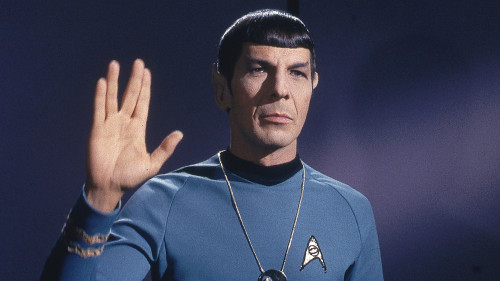
When The Wife and I were on our honeymoon, one of the stops was the Boston Museum of Science. I’m always a fan of science museums. During our visit, we saw a movie in their OmniMax theater. I don’t remember what the movie was, to be honest, but I do recall a bit at the beginning of the show, when the lights dimmed and a voice sounded over the speakers, which said something like this:
Good afternoon! The movie will begin shortly, but before it does, we need to properly calibrate our theater’s sound systems for use. To do this, we have enlisted the aid of a person who grew up in this very neighborhood. You may find his voice familiar.
This was followed by a beat of silence, and then another voice said:
Hello. Who put the BOMP in the BOMP shoo BOMP shoo BOMP; who put the RAM in the RAMALAMADINGDONG.
The second voice, the “local kid made good”, was Leonard Nimoy’s. I think most folks in the audience recognized that voice before he actually said “This is Leonard Nimoy”; his voice was, actually, one of the most familiar I ever knew. Gravelly and distinguished, that voice was, and Nimoy knew how to use it, which words to emphasize and where to pause just ever-so-slightly for effect.
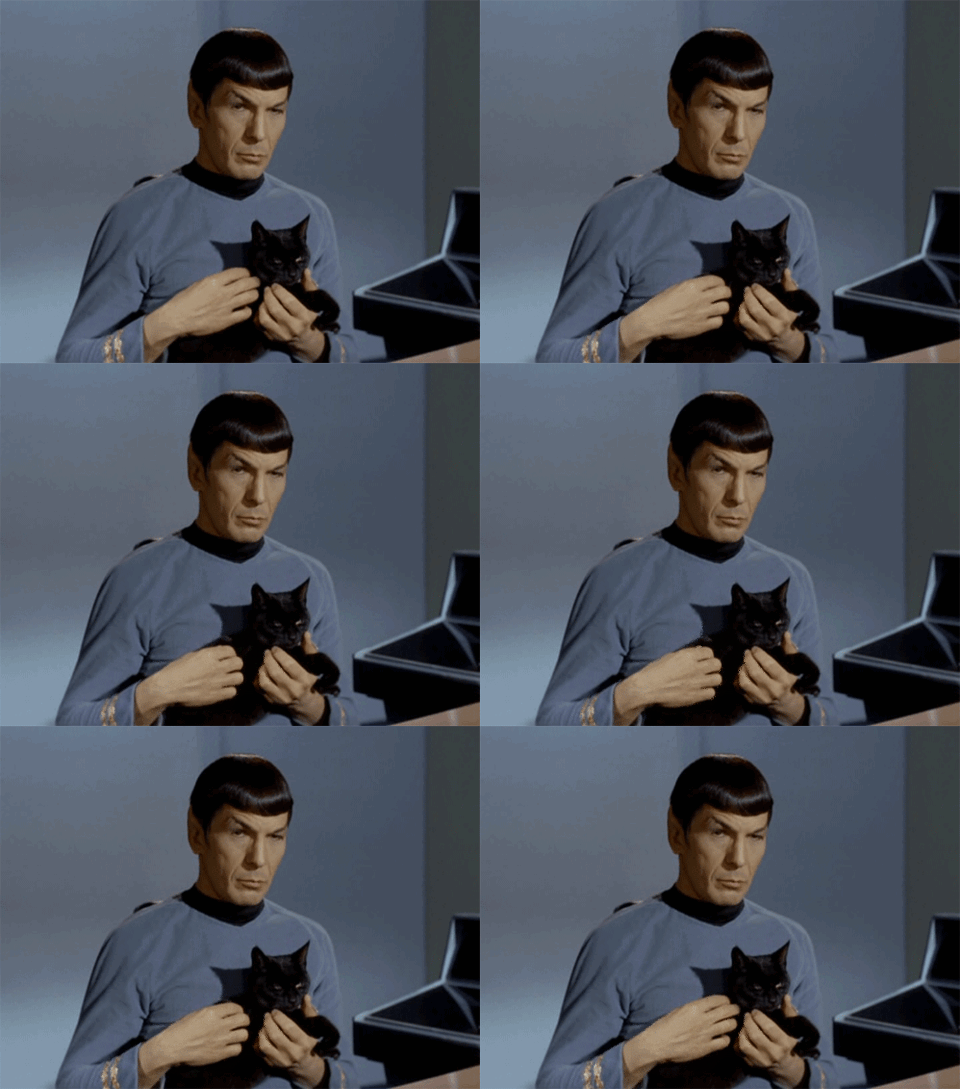
I don’t remember a time when I wasn’t aware of Leonard Nimoy on some level. More precisely, I should say that I don’t remember a time when I didn’t know who Mr. Spock was. I remember Star Trek episodes very early on, all the way back to the first house I ever lived in. Trek was my sister’s thing, but I remember vague images from it. The most specific one I have is at the end of an episode called “Friday’s Child”, when, at the end, all is well and the female guest star’s character has given birth, and observing Dr. McCoy making baby talk to the kid, Spock asks why baby talk is a thing at all.
A lot can be said about Nimoy and Spock, and a lot has been said about Nimoy and Spock over the years. Most fascinating to me was Spock’s arc through the six “Original Crew” movies, from his attempt in The Motion Picture to purge himself of emotion to his own resolution of the “Kobayashi Maru” test to his rescue to his work to put his own brain back together (interesting that no fewer than three major Trek stories, one episode and two movies, devoted large amounts of time to putting Spock’s brain and mind back together), and finally to the confident, competent officer we saw in The Undiscovered Country. In that film, when Kirk and McCoy get in serious trouble and are arrested, Spock just calmly assumes command and immediately begins the investigation to find the evidence to free them. Through that film, Spock acts with a calm acceptance that the truth will come out, that they will find the evidence, and that they will find it by searching for it calmly and logically. It is of a piece with his line in the film about the need for faith, to trust that “the Universe will unfold as it should”.
My personal favorite Spock moment comes at the end of what is certainly one of the very best Trek episodes ever, “The City on the Edge of Forever”. Knowing that if he allows Edith Keeler to live, the future will change and Starfleet and the Federation will never happen, Kirk stops McCoy from pulling her out of the path of the oncoming car. McCoy rages at Kirk:
“You deliberately stopped me. Jim! I could have saved her! Do you know what you just did?!”
And Spock — ever calm, ever logical, ever accepting of what must be — simply says:
“He knows, Doctor. He knows.”
Nimoy knows that he can’t express sadness in that line. He cannot express heartbreak or the awfulness of the choice that Kirk has just had to make, and all the same, Nimoy conveys that Spock knows these things. He knows these things, he knows that they are real, and he does not belittle them in any way.
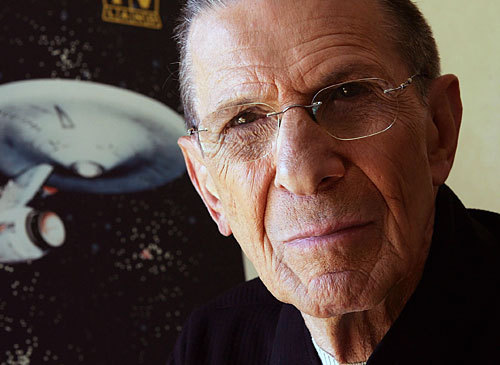
Since I’ve no memories at all of a time before Star Trek, it’s fair to say that it — along with Star Wars, obviously — are the biggest influences of mine in terms of my notion of what the world will look like, hundreds or thousands of years in the future. Will we always face problems and struggles and very real difficulties? Absolutely. But I don’t believe in dystopia. I cannot, will not believe that there is a future in the offing when the world is wrecked and everything is in ashes and only a very few are living well while the rest of humanity exists in dimly-lit squalor. I cannot, will not believe that, and that’s why I cannot, will not write it.
I believe that whatever difficulties and challenges we eventually face, we will do it from a brightly-lit viewpoint where it’s always clear how far we’ve already come. I believe that when we take to the stars, our ships will be beautiful and that they will explore with grace, and that we will confront our futures with logic and science as well as warmth and a twinkle in the eye that’s always there.
Why do I believe those things? In large part, because of a teevee show and some movies that Leonard Nimoy starred in.
After his long and prosperous life, Leonard Nimoy now belongs to the past. But he’ll always be a part of my future…my “Undiscovered Country”.
Share This Post
Sunday Burst of Oddity and All-Around Foolery!
Stuff!
:: I like to think I won’t be too incensed when any of my books gets a bad review or two on the Internet. In fact, I’m planning to read as few reviews as possible…but just in case I need a reminder of how not to respond to a negative review, here’s just such a reminder. The review is the body of the post, and then the author shows up in the comments. And by “shows up”, I mean, he moves in with a couch and everything.
:: If the kids in Stand By Me had thought of this, they would have been home in time for dinner. Just sayin’.
:: I’m loath to admit this, but…I was never a fan of Joan Rivers. I get where her humor came from, but a lot of the time — and especially in the last ten to fifteen years or so — her humor, which always struck me as firmly rooted in anger, stopped being humor at all and just became pure anger. However, I grant that my familiarity with Rivers is mostly a series of snapshots, and for the most part, she only came on my radar when she got noticed for saying something mean, so I concede that my impression of her is less than fair.
However, I must salute her thusly: one time in the 1980s, she had Soupy Sales on her late-night talk show, and she uncorked this fine moment:
More next week!