I’m finding myself more and more interested in street photography, or “streetscape”, as I prefer to call it. Here are a few examples from a walk I took last week around the village of East Aurora.
I do hope someone knows how that last one turned out. I have, ahem, a certain degree of sympathy to people who use the reader boards of public businesses for proposals.
No, that’s not a quote from anything, so far as I’m aware, but we’ve been watching Bridgerton of late so I’ve got that kind of pseudo-Regency era rhythm in my ear. But I am thinking about shutters of late: one shutter in particular, actually. The shutter in my Lumix FZ1000 Mark ii camera!
Shutter speed is one of the three big factors in the management of light that make up photography. Shutter speed is one of the ways one controls how much light, or how little, arrives on one’s camera sensor–but where ISO is an adjustment of sensor sensitivity and aperture size is an adjustment of how much light can pass through the lens to land on the sensor, shutter speed determines how long the available light has to hit the sensor. Shutter speed is how you freeze action: you use a very fast shutter speed to allow light to pass through the lens for a tiny fraction of a second, thus capturing something in the instant it happens. Shutter speed is also, though, how you elongate action, by allowing the light of a moving object to pass through the lens for a long enough time to make a blur in the final image.
So far in my photographic journey, I’ve found aperture size and ISO easier to understand and manage to achieve effects than shutter speed, for various reasons. While I’ve been able to use very fast shutter speeds to freeze objects like a running greyhound, slowing the shutter down to accomplish things like silky-smooth waterfalls or blurred objects has eluded me for the most part, mainly because slow shutter speeds on my camera tend to result in blown-out images because I can’t stop down the aperture or reduce my ISO far enough to overcome the extra light being allowed to hit the sensor. I’ve only had very limited success at this so far, mainly in the forest where it’s already darkened by the tree canopy.
It turns out that the main way around this is an accessory: a filter called an ND filter (neutral density) that cuts down the light entering the lens enough to allow you to slow the shutter down. Now, ND filters come in differing “intensities” (I have a feeling there’s a better term for it that I don’t yet know), and the cheap one that I recently bought is on the weak side, so it’s not going to be super effective. But I’ll get some better ones eventually, once I’m better at all this. Meanwhile, I managed to take this photo yesterday whilst standing on an overpass in town, and I’m quite happy with the result!
Not a super-thrilling photo, by any means, but practice shots are fun, especially when you’re learning something new. The goal is to be able to produce results like this, by Kenneth Hines Jr., a photographer who is quickly becoming one of my main sources of inspiration in this new area:
Taken at Chestnut Ridge the other day. More from that hiking session here. (Life got better when I discovered (a) that macro photography exists, and (b) that my camera has a special macro-focus mode.)
I took this quick photo of Carla and Rosa, enjoying the sun by the patio door, last week. It was just a quick “Hey, that’s cute, let me grab my phone” kind of thing; I didn’t put any effort into composing the shot in any way. I just liked the way it looked.
There’s nothing wrong with Carla’s right eye; it just looks like that in the picture for some reason.
Looking at the result, with the shadows cast across their bodies by the upright parts of the sliding door, reminded me of a conversation I had with a photographer friend years ago, and a lesson he tried teaching me that I didn’t understand at the time.
His name was–still is, I’m guessing, though I’ve lost track of him over the years–Robert, and he was an artist who was skilled in a number of different mediums but who ended up working as a photographer. He was an artistic photographer, that is to say, and his main focus was on the human body. He worked to create images on film (or, later, digital, I suppose) that captured and celebrated the human form in a way not unlike the statue-carvers of Ancient Greece and Rome. Robert chose his models carefully and coached them into poses that made their bodies look astonishingly perfect. Apparently one of his models, upon seeing the result, commented along the lines of “You make us into gods.”
The lesson about light went roughly as follows: Robert emailed me a photograph of his, in which a lovely young model is standing in bright light that is streaming into a dark place…but she is also standing behind a ladder. Thus the rungs of the ladder cast strips of shadow onto her body, and they did so in such a way that the shadows weren’t so much cast onto her body as draped across it, like strips of cloth. He angled the camera in such a way that the shadows were not straight blocks of anti-light, but organic-looking shapes of darkness that followed the model’s curves, the way her body rose here and fell there. It wasn’t just that light was present, it was the way the light was shaped by its blocking of the ladder and by the careful position of what the light was falling on.
I found this interesting at the time, but I don’t think I appreciated it nearly as well as I’m starting to now, as I begin exploring photography in a much more intentional way. I haven’t been getting out when the light is considered “best” by pro photographers–sunrise, sunset, and overcast days–but being in forests can help, as the trees themselves make the light dance and fall in interesting ways.
It’s quite a transition, going from thinking in terms of capturing a scene to thinking in terms of capturing light.
My Sunday Photography Walk was at Buffalo’s Outer Harbor again, with a side-trek into the Tifft Nature Preserve. Photos here…but these are my favorites from the day’s work:
This next is my favorite photo from yesterday. This makes me think that maybe my time practicing photography is not actually time wasted!
I’m going to have to be more selective of which overalls I wear on these outings. I’ll be designating a few pairs specifically for photography, because I find myself going down on one knee a lot, and I don’t want to damage the knees of my favorite vintage pairs, like this pair of Dickies.
Heavens, I think I may be actually getting better at this photography thing! I know it’s only been a short while with this camera, but I’m getting to the point already where carrying this camera around feels natural. Looking around feels natural. Thinking in terms of, “How can I capture this? What’s a neat way of looking at it?” is becoming natural.
Or…at least more natural than it used to feel.
This past Sunday morning I ventured up to Chestnut Ridge for the second time in three weeks. (Titling this post “The Ridge, again” might be a bit confusing, since I didn’t post my thoughts on the photos I took that day yet!) What’s nice about Chestnut Ridge, which is by area larger than Central Park in Manhattan, is that you can go multiple times and not visit the same areas. This time I walked along a different stream, one that has a spot where it tumbles down probably twenty feet or so of incline over a few hundred feet laterally, making for a series of neat-looking miniature waterfalls. This is a spot that ends in a large pool about four-feet deep. Farther upstream the bed is lined by large moss-covered boulders. Here are some of the photos I took that day; more are in a Flickr album, here.
Meantime, here are some of the shots I took the other day. I like how many of these turned out.
Pump House, and Pump House Roof Detail.
I love how these old pump-houses are left to slowly crumble in the forests of Chestnut Ridge. The overgrowth around them and the moss on them really make them feel like something out of the backgrounds in a Hayao Miyazaki movie.
Stair-stepping Stream, the colors of the pool, and life in and atop.
Note to self: Visit this spot in late Spring or early Summer next year, when there is more water flowing. Still, this is a nice bit of flow; I’ve seen it in August with half as much water.The reflected colors of the sunlit forest on the surface, plus the colors of the bottom below, make this almost like an Impressionist painting.Note the fish! and the sunken leaf…and the bubble floating….I’m thrilled I got this as sharply as I did! You can’t really see the water-striders all that well, but they’re not actually my subject here: the shadows on the bottom of their footprints ON the water are.
One thing about deciding to take photography seriously at this point, after years of snapshotting, is that I already have a pretty good sense of what my usual subjects will be and what styles of photography I will gravitate toward. In this case: when I’m around water, I almost get twitchy if I can’t take a photo somehow. Lakes, rivers, streams, cataracts, pools, puddles, the sea: it’s all fascinating to me.
Rushing water: using shutter priority.
These next three photos involve ongoing experiments with Shutter-priority mode. Managing shutter speed is another way of regulating light that reaches the camera sensor, and shutter speed in particular affects how motion is captured. A very fast shutter speed freezes action, while a slower shutter speed allows for blurring of the action. In the case of flowing water, a slower shutter speed turns the same rush of water over some rocks into something gossamer-like, looking like a veil of water rather than a distinct flow. You can see the difference in the next two, taken of the same spot but with different shutter speeds:
This one, I did not get a comparison shot; I just really like how this turned out. Could it be sharper? Sure, as I was free-handing the shot at this point. When shooting with slower shutter speeds, vibrations of the camera itself actually show up in the image as blur, which is why tripods and timers and remotes are tools that help with this sort of photography.
I’m not sure what this rising steam was! Another hiker had passed through just a few seconds before I saw this mist, and I wondered if he had dropped a cigarette there, but I checked and no, he did not. So I suppose this is the mist of water rising from a dead and fallen tree trunk. Getting this was pure luck.
Mossy rocks and the stream. I think, if I were to do this one again, I’d shoot lower–maybe even set up a tripod in the water–so the framing of the shot would eliminate the fallen tree. Fallen trees are a major feature at Chestnut Ridge. They are always in evidence.
Buffalo-Niagara from the Chestnut Ridge Hill
This is one of this region’s best views. From the sledding hill facing north, you can see Buffalo (at right) and, at left in the distance, Niagara Falls, ON. In these two photos you can see two different approaches to editing: the first dials back the saturation while increasing the shadows and highlights, making the area of sunlight in the foreground pop a bit. The second photo is not zoomed at all, showing pretty much the entirety of the view from the Ridge. This one I brightened and dialed the saturation up, quite a bit more than I usually do, even.
By the way, that’s only 13 of the 30 shots that are in the Flickr album linked above…and the Flickr album only contains 30 of the more than 80 photos I took that day! I used to think it was all a matter of composing your perfect shot and then taking it, so you only end up with those perfect shots. It turns out that photographers take many, many more shots than they ever end up using…and that’s OK. It just means I didn’t understand that part of the process. Now, I’m on board.
Well, may I present the Formerly-Named “Hulk”. (We’re working on his new name. Stay tuned.)
It’s funny how when you lose a dog, people wait a respectable amount of time before asking, “Hey, do you think you might get another?” We held off a bit because we didn’t want memories of Cane to color our expectations of and relationship with any new dog; plus, we figured that Carla had her own process to get through. Cane’s passing was a deeply difficult time, and we didn’t want to fall into any trap of failing to honor him properly by charging full speed into a “replacement”.
But, at the same time…eventually you just have to get back on the bicycle, you know? So eventually, earlier this year, The Wife reached out to the local greyhound adoption group. We were on the wait list for a while, but eventually a few dogs started trickling back into the area. It’s a lot harder now to adopt greyhounds, now that greyhound racing is down to just five states where it’s a thing. (They are Iowa, Alabama, Arkansas, West Virginia, and of course, Texas.) We brought one in as a foster…and it turned out that he was not going to be cat-safe. He was around for all of one weekend, and then we had to move him on. Other than that, he was a really nice dog and I’m sure he landed in a perfect home someplace.
A few more weeks went by, and another opportunity to foster came up: a full-brindle boy, just over two years old, who had a mediocre racing history and was now fully retired. His full racing handle was “V.J. Hulked Out”, with a call-name of “Hulk”; as we were fostering him, we were required to call him by that name. So we’ve talked about what to make his actual name once the adoption goes all the way through. I pushed, a little, for Vijay; those first initials made me get all geeky, because one of my favorite supporting characters in any James Bond movie is a guy named Vijay in the India sequences in Octopussy. My family didn’t warm to “Vijay”, and I didn’t feel strongly enough to push hard for it. You have to pick your battles, and “Vijay” was not a battle I wanted to fight. That would have been cool, though!
Since we were actually fostering “Hulk” for the last month or so, there were certain rules the adoption group required us to follow, all of which seem perfectly reasonable. The big one was that we weren’t to post anything about him on social media, until his adoption became official. Well, earlier today we filled out the paperwork and made a nice donation to the group, so now he’s properly official. He’s actually a member of the family now! Huzzah!
Oh, and how is Carla liking having a brother again, albeit this time a younger brother? Well, so far, so good. She’s teaching “Hulk” how to play, how to bug us for treats, how to pace about to let us know he needs to go outside…she’s teaching him to dog, basically. He’s got a good teacher.
Oh, that photo up top? Good picture, innit? I took that just this afternoon! After a few weeks with us he finally felt comfortable enough in the back yard and with us to start running, and he’s really fast–much faster than Cane was, which ought to be interesting if/when I take him to the big fenced dog run at Knox Farm. Unfortunately for him we had to get him neutered the week before last, and part of his healing regimen was no running for 10 to 14 days. Today was Day Eleven and he has shown zero ill effects or discomfort following the procedure, so today we let him have a run. And who just happened to be there with his camera, just waiting for a good opportunity to practice photography in shutter-priority?
More photos to come, obviously. As I write this the Flickr app on my phone is being picky about uploading, so some of the shots that I really want to share will have to wait. Soon, though! You haven’t heard the last of this guy, not by a longshot.
One thing I’ve noticed as I approach photography seriously is that it’s not just about learning new stuff, like all those technical aspects of photography. It’s not all learning about ISO and shutter speeds and aperture values and how to compose photos and more. It’s also about unlearning old habits that were ingrained from years of my cell phones being my primary photo-taking devices.
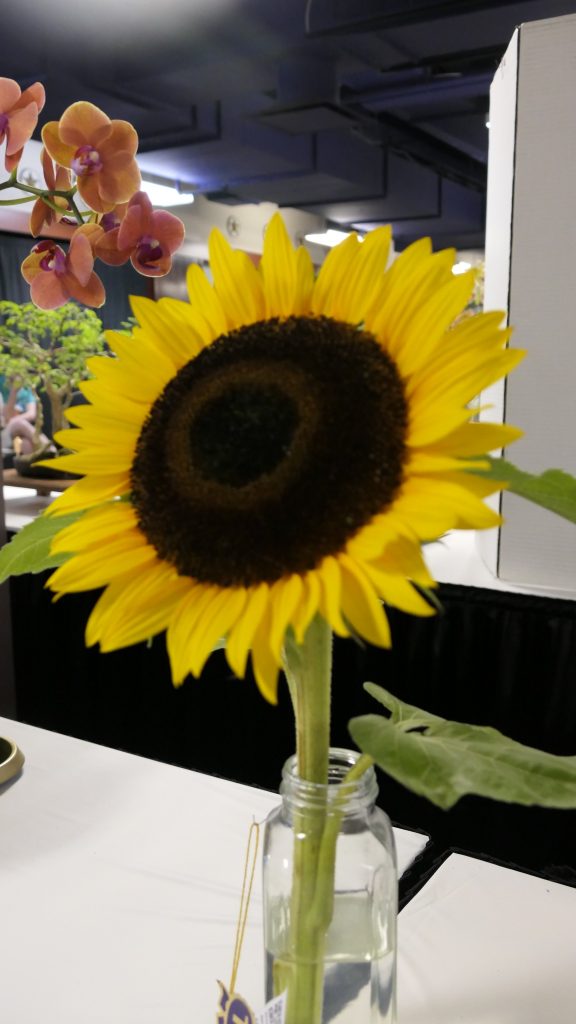
In the case of this particular photo, the lesson is that I can’t just take the “Whip out my phone and take the picture” approach to using an actual camera. I need to slow down, compose, and make sure my focus isn’t screwed up. The result was this particular photo of a winning sunflower blossom at the Erie County Fair (more on the Fair to come sometime soon). I didn’t compose a very good shot, and the subject is blurry.
Oh well, I’m sure I am far from the first person to combat these difficulties in this particular pursuit!
I keep having to remind myself of something that I’ve heard from numerous photographers since I’ve started actively studying it: that on any shoot they may take several hundreds, or even into the thousands, of exposures and only end up with a small percentage of those being “usable”. That’s heartening, a bit; even the pros likely have terrabytes worth of external storage full of photographs that will never see the light of day. I do end up wondering how on Earth anyone got good at this back in the days of film, but that’s a question for another time….
This, from 2011, is still my favorite of all the photos I’ve taken there over the years. Maybe I was a budding street photographer all those years ago, and I didn’t realize it!