National Poetry Month, day four

I found this poem in the collection Good Poems for Hard Times, edited by Garrison Keillor. It’s a moody poem, not at all optimistic, as it hinges upon an unmet person at an awful time in their lives. It casts Ithaca as a cold, bleak place — and assuming that the author means Ithaca, NY, this is not my experience at all, but there’s nothing about my experience that trumps another’s. And besides, perhaps author Leonard Nathan isn’t actually referring to Ithaca, NY but calling back to the mythic Ithaca of Odysseus and his long journey home.

Toast
by Leonard Nathan

There was a woman in Ithaca
who cried softly all night
in the next room and helpless
I fell in love with her under the blanket
of snow that settled on all the roofs
of the town, filling up
every dark depression.

Next morning
in the motel coffee shop
I studied all the made-up faces
of women. Was it the middle-aged blonde
who kidded the waitress
or the young brunette lifting
her cup like a toast?

Love, whoever you are,
your courage was my companion
for many cold towns
after the betrayal of Ithaca,
and when I order coffee
in a strange place, still
I say, lifting, this is for you.

More on Leonard Nathan.

Share This Post

National Poetry Month, day three

An unabashed love poem by Christina Rosetti. This is one of the more heartbreaking poems I know, because it unflinchingly stares at the certainty that all love must end, and that the inevitable ending provides those left behind with terrible choices about how to approach memory.

Remember
by Christina Rosetti

Remember me when I am gone away,
   Gone far away into the silent land;
   When you can no more hold me by the hand,
Nor I half turn to go yet turning stay.
Remember me when no more day by day
   You tell me of our future that you plann’d:
   Only remember me; you understand
It will be late to counsel then or pray.

Yet if you should forget me for a while
   And afterwards remember, do not grieve:
   For if the darkness and corruption leave
A vestige of the thoughts that once I had,
Better by far you should forget and smile
   Than that you should remember and be sad.

Share This Post

National Poetry Month, day one

April is National Poetry Month! And every year I forget about it completely, not realizing that we’re in the midst of National Poetry Month until April 19 or some such thing. Well, not this year! My goal is to post a poem each day this month. Some will be longer than others, some will be serious and some not, some will be love poems and some not. Who knows? My goal is to spend a month exploring some poetry. I’m a firm believer that writers should read poetry in order to get a sense of what can be done with language, and to learn other ways of expressing ideas.

Since today is April Fool’s Day, here’s a poem that has some of that April Fool’s kind of punch, in that the first time you hear it, you think it just has to end a certain way…and then it famously doesn’t. (Also, baseball’s regular season starts on Sunday! Go Pirates!)

Casey at the Bat
by Ernest Lawrence Thayer

The outlook wasn’t brilliant for the Mudville nine that day:
The score stood four to two, with but one inning more to play,
And then when Cooney died at first, and Barrows did the same,
A pall-like silence fell upon the patrons of the game.

A straggling few got up to go in deep despair. The rest
Clung to the hope which springs eternal in the human breast;
They thought, “If only Casey could but get a whack at that—
We’d put up even money now, with Casey at the bat.”

But Flynn preceded Casey, as did also Jimmy Blake,
And the former was a hoodoo, while the latter was a cake;
So upon that stricken multitude grim melancholy sat,
For there seemed but little chance of Casey getting to the bat.

But Flynn let drive a single, to the wonderment of all,
And Blake, the much despisèd, tore the cover off the ball;
And when the dust had lifted, and men saw what had occurred,
There was Jimmy safe at second and Flynn a-hugging third.

Then from five thousand throats and more there rose a lusty yell;
It rumbled through the valley, it rattled in the dell;
It pounded on the mountain and recoiled upon the flat,
For Casey, mighty Casey, was advancing to the bat.

There was ease in Casey’s manner as he stepped into his place;
There was pride in Casey’s bearing and a smile lit Casey’s face.
And when, responding to the cheers, he lightly doffed his hat,
No stranger in the crowd could doubt ‘twas Casey at the bat.

Ten thousand eyes were on him as he rubbed his hands with dirt;
Five thousand tongues applauded when he wiped them on his
shirt;
Then while the writhing pitcher ground the ball into his hip,
Defiance flashed in Casey’s eye, a sneer curled Casey’s lip.

And now the leather-covered sphere came hurtling through the
air,
And Casey stood a-watching it in haughty grandeur there.
Close by the sturdy batsman the ball unheeded sped—
“That ain’t my style,” said Casey. “Strike one!” the umpire said.

From the benches, black with people, there went up a muffled
roar,
Like the beating of the storm-waves on a stern and distant shore;
“Kill him! Kill the umpire!” shouted someone on the stand;
And it’s likely they’d have killed him had not Casey raised his
hand.

With a smile of Christian charity great Casey’s visage shone;
He stilled the rising tumult; he bade the game go on;
He signaled to the pitcher, and once more the dun sphere flew;
But Casey still ignored it and the umpire said, “Strike two!”

“Fraud!” cried the maddened thousands, and echo answered
“Fraud!”
But one scornful look from Casey and the audience was awed.
They saw his face grow stern and cold, they saw his muscles
strain,
And they knew that Casey wouldn’t let that ball go by again.

The sneer is gone from Casey’s lip, his teeth are clenched in hate,
He pounds with cruel violence his bat upon the plate;
And now the pitcher holds the ball, and now he lets it go,
And now the air is shattered by the force of Casey’s blow.

Oh, somewhere in this favoured land the sun is shining bright,
The band is playing somewhere, and somewhere hearts are light;
And somewhere men are laughing, and somewhere children
shout,
But there is no joy in Mudville—mighty Casey has struck out.

Share This Post

“Come, my friends, ‘Tis not too late to seek a newer world.”

Today on Twitter, the indispensible Sheila O’Malley reminded me that today is the birthday of Alfred, Lord Tennyson. Actually, it’s a misnomer to call it a “reminder”, as I never knew Tennyson’s birthday in the first place. But I should have, I think. I’ve adored Tennyson’s poetry for years, going all the way back, most likely to my senior year of high school, which is the year I finally gave in to a suspicion that I’d been harboring going back to junior year: that my English teachers weren’t full of it, and that there really was something to all this literature they kept having us read.

I don’t recall what Tennyson poems we read that year in Mrs. Hultberg’s class, save one: “The Lady of Shalott”, which is one of those poems that caused in me the “mortal wound” that Robert Frost would later speak of*. I come back to it from time to time; in fact, I came back to it just this evening, while I sat outside in the grass while The Daughter had her string bass lesson. It seemed a good time to read a bit of Tennyson, and not just because Sheila put him on my mind. There’s always something about Tennyson that to me suggests sunsets on perfect days. Not sadness, although he can be sad; not an elegy, although he can be elegiac. But with Tennyson, one is always aware that time is passing, that things are changing, that old things are moving into memory and new things are coming to the fore.

When I read “The Lady of Shalott” in high school, I was still a year or two away from the explosion of my great passion for the Arthurian legends. This passion has admittedly cooled in recent years, but I do still get the sense that it’s a slumbering passion, waiting to be awakened one day. Perhaps it was Tennyson’s poem that planted that seed, that sad verse about the cursed lady in her tower, forbidden to look upon the world except through a mirror, until one day she sees Sir Lancelot riding by and hazards a glance, bringing about her own end.

I find that every time I read Tennyson, I end up reading him aloud, or at the very least, mouthing the words. Few authors have this effect on me, if any, but there’s just something about Tennyson’s rhythmic alliterations, and his way of using his lines to suggest the sounds of the very things he’s writing about:

The splendour falls on castle walls
And snowy summits old in story:
The long light shakes across the lakes,
And the wild cataract leaps in glory.
Blow, bugle, blow, set the wild echoes flying,
Blow, bugle; answer, echoes, dying, dying, dying.

Anyone who reads that without sounding it out is entirely, utterly, supremely, missing the point. And Tennyson always needs to be sounded out. In this he is like Shakespeare. His words are sound, and they don’t live in the page. They live on the tongue, spoken.

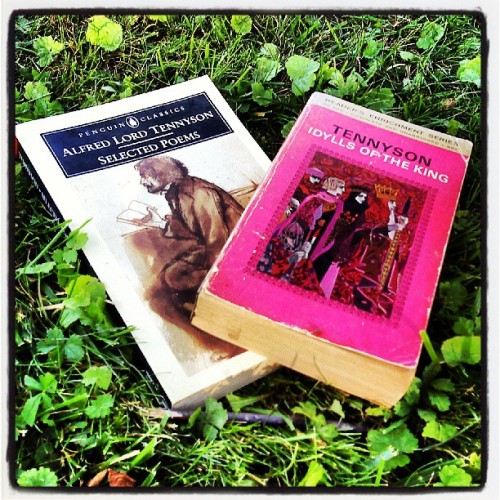
In my collegiate Arthurian craze, I returned to Tennyson and read his Idylls of the King, a cycle of poems he wrote which rather loosely tell the story of King Arthur and the rise and fall of Camelot. I’ve never re-read the entire thing, but I dip into it with frequency. One thing that has always stood out for me is a tiny thing, a minuscule detail, that comes at the end of his version of the tale of Sir Gareth and Lynette. Gareth is a young knight, born of low station, who goes off questing, and he meets a woman named Lynette, who derides him constantly. But through his valor he eventually wears her down and proves himself. In the original Malory, Gareth marries a woman named Lyonors. Tennyson, however, decides to make a change to the ending:

And he that told the tale in older times
Says that Sir Gareth wedded Lyonors,
But he that told it later says Lynette.

Tennyson felt the ending lacking in the original, so he changes it, presumably to suit his view on what the happy ending there should be. But he does it in so interesting a way! He breaks “the fourth wall”, so the speak, and directly implies that he’s not relating history or merely transcribing some old tale; he is recasting the stories in a way that suits his own instincts and also seems to be slyly winking at the reader, almost inviting us to decide the matter for ourselves.

Here is Loreena McKennitt’s setting of “The Lady of Shalott”.


* Frost’s quote:

It is absurd to think that the only way to tell if a poem is lasting is to wait and see if it lasts. The right reader of a good poem can tell the moment it strikes him that he has taken an immortal wound — that he will never get over it.

Truth.

Share This Post

“We few, we happy few, we band of brothers…!”

On October 25, 1415, five hundred eighty-five years ago, a greatly outnumbered English force dealt a crippling military defeat to the French army at a field called Agincourt. Before the battle, the English King, Henry the Fifth, had to rouse the troops, and here is how a playwright of some renown in literary history crafted the King’s speech:

Share This Post

Wow….

I assume that NBC, in a story about the Georgian luger killed the day the Olympics began, just quoted the AE Housman poem that I quote in this old post, because I’m suddenly getting lots of search engine hits for the phrase “Shoulder high we bring you home”. The poem is “To an Athlete Dying Young”, and can be read in its entirety here.

Share This Post

Nevermore

Edgar Allan Poe was born two hundred years ago today. I’ve always loved Poe, and he wrote my favorite poem of all time, “Annabel Lee”:

Way back when this blog was young, I wrote about “Annabel Lee”.

And here’s a reading of “The Raven”, by Christopher Walken:

Tonight I shall sip some cognac in honor of Edgar Allan Poe.

Share This Post

I dream of verse, but live in prose

All month I’ve been aware that it’s National Poetry Month, and all month I’ve been thinking, “Hey, it’s all month long, I can post something about it at some point.” And wouldn’t you know: now it’s the last day of the month, so I’m just getting this in under the wire.

I always want to post more about poetry, but somehow I don’t; maybe this is because poetry is, for me, the most personal of literary regions, and there are ways in which it almost feels unseemly to discuss the poems that mean most to me, like I’m sharing something deeply private that shouldn’t be spoken of in a forum such as this, even though it is (mostly) read by friends. But I do love the poetry.

I tend to read poetry in spurts. I will go a month or two without reading any poetry, and then I’ll binge on it, taking a poetry book to work with me every day to read during breaks. I’m probably due for another such binge in the near future; I suppose it’s a testament to my contrary nature that I am feeling poetic as Poetry Month draws to a close.

Have I written poetry? Yes, I have. Will I post any of my poems here? Not at present. This goes back to my very personal relationship with poetry. The poems that I’ve written in the past have, in almost every case, been written as gifts for loved ones, and I don’t feel that those poems are mine to share here, even though I wrote them. Most of them – and there have only been a few, really – refer to things that only the recipient would know about, and would thus be impenetrable to readers here. (Plus, I’m not at all certain that my poems are any good! Especially the ones where I actually try to work within the confines of an actual form. Sonnets are hard to write, folks.)

But setting all that aside, I figure I could at least share here a few poems that I’ve found most meaningful to me over the years. I’m sure this too will come as no surprise to longtime readers here or those who know me, but the poems that move me most are almost exclusively love poems. Here are a few.

“Love’s Philosophy”
Percy Bysshe Shelley

The fountains mingle with the river
   And the rivers with the ocean,
The winds of Heaven mix for ever
   With a sweet emotion;
Nothing in the world is single,
   All things by a law divine
In one spirit meet and mingle.
   Why not I with thine?

See the mountains kiss high heaven
   And the waves clasp one another:
No sister-flower would be forgiven
   if it disdained its brother;
And the sunlight clasps the earth
   And the moonbeams kiss the sea:
What is all this sweet work worth
   If thou kiss not me?

One of the poets nearest to my heart is Robert Burns:

“A Red, Red Rose”

O, my luve is like a red, red rose,
   That’s newly sprung in June;
O, my luve is like the melodie
   That’s sweetly played in tune.

As fair art thou, my bonie lass,
   So deep in luve am I,
And I will luve thee still, my dear,
   Till a’ the seas gang dry.

Till a’ the seas gang dry, my dear,
   And the rocks melt wi’ the sun,
And I will luve thee still, my dear,
   While the sands o’ life shall run.

And fare thee weel, my only luve!
   And fare thee weel a while!
And I will come again, my luve,
   Tho’ it were ten thousand mile!

This is an anonymous poem, very short. It served as the inspiration for one of the band directors at the high school music camp I attended to compose a piece of music:

O western wind, when wilt thou blow,
   the small rain down can rain?
Christ, if my love were in my arms,
   and I in my bed again!

I’ve never really felt that the poems JRR Tolkien wrote for The Lord of the Rings are as bad as many commentators seem to think; I actually like quite a few of them, none moreso than this, one version of the “Old Walking Song” that crops up throughout the trilogy, the last version:

The Road goes ever on and on,
   Out from the door where it began.
Still round the corner there may wait
   A new road or a secret gate;
And though I oft have passed them by,
   A day will come at last when I
Shall take the hidden paths that run
   West of the Moon, East of the Sun.

The novels of Guy Gavriel Kay, my favorite living writer, are full of poetry and verse, though as in Tolkien, the verse mainly appears in the form of brief quotations from what in the novels are reported to be longer songs. I would so dearly love to hear the full version of the song that contains this lyric, from A Song for Arbonne:

Even the birds above the lake
   are singing of my love;
And even the flowers along the shore
   are growing for her sake.

Another poet whose work often speaks directly to my own heart is Alfred, Lord Tennyson.

“The Miller’s Daughter” (excerpt)

It is the miller’s daughter,
   And she is grown so dear, so dear,
That I would be the jewel
   That trembles in her ear:
For hid in ringlets day and night,
I’d touch her neck so warm and white.

And I would be the girdle
   About her dainty dainty waist,
And her heart would beat against me,
   In sorrow and in rest:
And I should know if it beat right,
I’d clasp it round so close and tight.

And I would be the necklace,
   And all day long to fall and rise
Upon her balmy bosom,
   With her laughter or her sighs,
And I would lie so light, so light,
I scarce should be unclasp’d at night.

And of course, there’s no other way to conclude a post of love poetry than by turning to the Bard himself:

When, in disgrace with fortune and men’s eyes,
I all alone beweep my outcast state
And trouble deaf heaven with my bootless cries
And look upon myself and curse my fate,
Wishing me like to one more rich in hope,
Featured like him, like him with friends possess’d,
Desiring this man’s art and that man’s scope,
With what I most enjoy contented least;
Yet in these thoughts myself almost despising,
Haply I think on thee, and then my state,
Like to the lark at break of day arising
From sullen earth, sings hymns at heaven’s gate;
   For thy sweet love remember’d such wealth brings
   That then I scorn to change my state with kings.

Poetry is why we invented language, I think.

Share This Post