Symphony Saturday (the Return!)

I’ve been meaning to dust off this once-regular feature of mine, in which I take time each Saturday to explore the world of that grandest of classical music forms, the symphony — and what better time than right now?

During the 19th century, Italy did not have a great symphonic tradition as did other nations in Europe. In Italy, opera was by far the most popular form of musical composition, and practically zero symphonies by Italian composers of the Romantic era have entered the standard symphonic repertoire. This is not to say that there were no Italian symphonists during that era, however.

Giovanni Sgambati achieved some renown for his piano music, but he also wrote two symphonies, the first of which is the subject of this post. Listening to the work, it is easy to hear the heavy Germanic influence that Sgambati felt. He was an eager champion of German and Austrian music in Rome, and this symphony, with its decidedly Teutonic feel and sound, definitely shows that. It is clear that Sgambati felt more attuned to the line from Beethoven to Brahms than that from Cherubini to Verdi. The work does not feature the kind of lyricism one might expect from an Italian, but it is full of the kind of Germanic writing that is notable in many a symphony from the north.

Sgambati’s Symphony No. 1, like many an obscure work, deserves to be heard more than it is. Enjoy!

Share This Post

Symphony Saturday

In this installment, we finally reach what is, for me, the most fertile ground for emotionally moving symphonic work ever: late 19th century Russia.

The symphonic tradition, as Leonard Bernstein once pointed out, is a Germanic one, and even in the hands of Russian composers, the formal approach to the symphony is dominated by the fundamental aspects of the form that arose in German and Austria. As Bernstein put it, “Russian symphonies are German ones with vodka substituted for beer.” That’s not a bad way of putting it. The form is still the same, but the melodic material in the Russian realm tends to be much more lyrical and much more folkish in nature. This is only natural, because Russia was one of the great hotbeds of nationalism in music, which became a potent force in the latter half of the 1800s.

(As an aside, it’s interesting to note how nationalism could be such a potent force in driving the creation of some of the most wonderful music ever written, and yet, in politics, the nationalism of the late 1800s eventually led straight to the staggering catastrophe that was World War I.)

Balakirev wanted a Russian “school” of music, as free from Western European influence as possible, and to that effort, he gathered around himself a handful of Russia’s most talented young composers, a group which later became known simply as “The Five”: Balakirev himself, Cesar Cui, Modest Mussorgsky, Nikolai Rimsky-Korsakov, and Alaexander Borodin. Balakirev mentored the other four composers for a time, although his influence waned as he tried to wield stronger and stronger influence over his charges, who were, perhaps, more talented than he. Balakirev was no second-tier musician himself, though, and if his music has been overshadowed and sometimes neglected, that’s more the pity.

In Balakirev’s Symphony No. 1, you can certainly hear the ideas of exotic color and singing lyricism that would shine forth so strongly in later Russian composers, with their symphonies of dramatic build, and their long melodies. This symphony is, in many ways, the start of a path that would lead to such works near to my heart as Rimsky-Korsakov’s Scheherazade, Tchaikovsky’s Symphony No. 5, and ultimately, Rachmaninov’s Symphony No. 2. Here is the Symphony No. 1 by Mily Balakirev.


Next week: A visit to Italy. The Italians are not known for much of a symphonic tradition in the 1800s at all, being the most operatic of countries, but there were still symphonies being written, and we’ll hear one!

Share This Post

Symphony Saturday

After last week’s big dose of heavy Austrian Romanticism, a lighter work seems called for this week: the Symphony in C by Georges Bizet.

Bizet’s life was, in many ways, the archetype of the 19th century artist: he struggled to achieve success, and his moments of triumph were fleeting; he worked himself very hard, which, coupled with awful health habits, led him to an early death; the work for which he would likely be best known forever was unsuccessful at first. The Gods of Art can be a heartless bunch, but at least they let Bizet stick around long enough to give the world Carmen, which after its initial failure went on to become one of the most beloved operas ever written.

The Symphony in C dates from early in Bizet’s life, when he was just 17. He wrote it as a student piece while at the Paris Conservatoire, and though he would reuse tunes from the work later on, Bizet apparently never regarded the symphony as anything other than a thing he did for school, and it was likely never even performed in his lifetime. After Bizet died in 1875, his papers — including the manuscript for the symphony — went to the Conservatoire, where it sat in storage until someone dusted it off in 1933. The symphony’s first performance took place on February 26, 1935, almost sixty years after Bizet’s death and almost eighty years after he wrote it.

The work itself displays none of the heavy-handed German-Austrian density so common to the more familiar symphonic music of the day. Bizet’s touch is light, and the symphony sounds like a youthful work, not in the sense that it lacks sophistication, but in the sense that it abounds with gentle optimism. Here is Bizet’s Symphony in C.


Next week: We’ll start looking at what the Russians have been up to….

Share This Post

Symphony Saturday

I meant to get this one done last week, but time intruded (I can’t believe how much time I spent trying to make my book trailer work!), and I never got the post written. I could have written it, really, but for this series I never write the post without having given the symphony in question a fresh hearing, and this one’s on the long side. Up now is the Faust Symphony by Franz Liszt.

Liszt is far better known as a composer of piano music than for his orchestral output, but that’s not an indication of quality so much as his life’s focus, as Liszt may well have been the greatest piano player in history. He’s certainly on my short list of musicians I would strive to track down and hear were I to gain access to a TARDIS or Doc Brown’s Delorean or Bill and Ted’s phone booth or…you get the idea. Liszt was so great a pianist that his life took on a rock star quality. He used his performing fame to fuel a full and complete musical life, as a composer and a conductor and essayist. Franz Liszt was the total package as a musician. Falling squarely in the Romantic era, you can hear in Liszt a great deal of the connecting tissue that led from Beethoven to Wagner. His music looks back and forward, and though he can be long-winded, his works invariably have moments of searing incandescence.

Years ago, when I was studying music in college, I attended a recital put on by the faculty, which they did once or twice a year. This particular recital ended with one of the piano professors, Dr. Reuter, playing one of Liszt’s Hungarian Rhapsodies. It was a showpiece that, among us music students, pretty much brought the house down. I’d love to be able to hear Liszt himself, at the height of his powers, working that magic on the keyboard.

As for today’s symphony, A Faust Symphony is something of a hybrid, combining the symphony with the idea of a tone poem (or “symphonic poem”, as Liszt would call it). The full title of the work is actually A Faust Symphony in Three Character Sketches after Goethe: (1) Faust, (2) Gretchen, (3) Mephistopheles. It is not intended as a musical telling of the Faust story, but as a depiction of the characters themselves. I’ve never read Faust, and my only real familiarity with the story comes from the large number of musical works I’ve heard, most from the 19th century, that were inspired by it. (Chief among these is Berlioz’s amazing La Damnation de Faust.) The story of Faust had quite a hold on the imaginations of the Romantic era’s great artists, and Liszt was no exception.

This symphony employs typical symphonic construction, particularly in its opening movement, before becoming a cyclical work of tremendous drama in the third, after the lyrical and tender second. In this work Liszt does something quite Berliozian, while anticipating the musical language that would later be called “Wagnerian”. It’s a fine, fine work, atmospheric and brooding and dramatic…it’s Romantic, with all that the word entails. Here is A Faust Symphony by Franz Liszt.


Next time, we return to France for one of two symphonies written by a composer who achieved immortality by writing one of the most popular operas of all time!

Share This Post

Symphony Saturday

Next up: Felix Mendelssohn.

Mendelssohn is a composer I’m not terribly familiar with, I’m sorry to say. Like many of the great musical prodigies, he lived quickly and died young, when he was only 38 years old. In those thirty-eight years he produced a large amount of music with a great deal of staying power: orchestral music, choral music, piano works, and sacred music. I remember playing one of his Songs Without Words back during my piano playing days in high school and college, and Mendelssohn’s Violin Concerto is one of my favorite works of classical music, ever. That concerto is seriously amazing, and if you have a chance, seek it out — as one of the most popular of all concertos, there are performances a-plenty to select from on YouTube. That work is full of gorgeous melody and some truly magical moments.

But we’re about Mendelssohn the symphonist today, so here is his Symphony No. 4. It’s the third symphony he wrote, but he was never quite satisfied with it, so it pretty much stayed in a drawer until after his death. (Side note: People who complain about George Lucas futzing with his movies should really read up on the history of classical music sometimes. There are a lot of beloved works that had multiple versions, and works whose “final” versions are only “final” because those are the versions that existed when the composer died.) This symphony is often called “the Italian”, because it was intended by Mendelssohn as something of a musical depiction of the feelings from his trips to Italy. Mendelssohn wrote a lot of music like this, what I call “travelogue” music — music that’s not intended as precisely pictorial in nature, but music that is inspired by specific places, in which he strives to capture what he feels as the character of those places in his own musical language. It’s important when listening to a piece like, say, Mendelssohn’s Hebrides Overture, to remember that we’re hearing the impressions of a foreign land as channeled through the brain of a German. This problem arises again and again, throughout a great deal of the history of classical music. The filtering of ethnic or national character through a foreign musical language is a constant.

So, the Italian symphony doesn’t sound particularly “Italian” to me, but as noted, that’s not really Mendelssohn’s goal. It does sound like what it is: a danceful, rhythmic symphony with a great deal of charm. Here is Mendelssohn’s Italian symphony.


Next week, we’ll hear another Mendelssohn work, and then we’re off to the Land of Liszt!

Share This Post

Symphony Saturday

This post got swallowed by The Move That Ate Tokyo, but now that routine is at long last shaping up at Casa Jaquandor 2.0, it’s time to get back to this. We’ll continue with the symphonies of Robert Schumann, this time with his Symphony No. 3. Numbering musical works by composers is often a messy affair. This one is numbered ‘3’ of his four symphonies, but it is the last symphony that he wrote. Why 3 and not 4, then? Because 4 was published before 3. Is that counterintuitive? It is to me, but I’m not a musiciologist, so what do I know?

This five-movement symphony bears some structural resemblance to Beethoven’s Sixth Symphony, the “Pastoral”, and like in the second, Schumann combines classical German form and orchestration with his own sense of Romantic lyricism. This symphony has a lot of energy, and even in the slow movements one can sense the forward momentum of the work. Lovers of film music may find a bit of the main melody of the first movement awfully familiar sounding, as there is a section of the main theme from James Horner’s Willow score that sounds eerily similar. The reason for this is an old topic of debate among film music fans.

Anyway, here is Schumann’s Third Symphony, the “Rhenish”.


Next week: Felix Mendelssohn!

Share This Post

Symphony Saturday

OK, folks, obviously I’m not sure I’ll be able to get these posts done on the weekly schedule I’d hoped for at the outset (whilst moving is in progress — by the second week of May, the dust should be in the “settling” stage), but you never know. That’s my way of saying, at the same time, “Sorry for last week” and “I may well miss next week”. But for right now — Robert Schumann is in the offing.

Schumann was one of the archetypal Romantics in not just the history of music, but the history of art. If you went to make a fictional biography of a full-blown Romantic figure in all his glory, the resulting life might well look like Robert Schumann’s. He was enormously gifted, but suffered from mental illness, which led him to spending the rest of his shortened years in a sanitarium after he tried to kill himself by flinging himself from a bridge into a likely filthy river. He had one of music history’s great love affairs in his marriage to Clara Wieck, who was under the legal age when he met her and their affair began. Schumann was a brilliant and fiery soul who burned himself out quickly. One of the oddest stories about Schumann is that he might have become one of history’s greatest pianists, had he not injured one of his hands permanently in the course of trying to strengthen his ring finger by rigging up some kind of contraption to restrict its motion while playing.

Schumann wrote pretty much everything, although I suspect nowadays it’s his piano music that is best known — the great Vladimir Horowitz, for example, nearly always used Schumann’s delicate and gorgeous “Traumerei” as an encore — but his orchestral music is quite good. It takes a pretty good conductor to expose Schumann’s orchestral textures, which can be on the “dense” side. In this performance, conductor Daniel Harding (whose work I am hearing for the first time) does an excellent job of making the various textures shine through in the orchestra (in this case the Mahler Chamber Orchestra). There are places in this performance where the strings become almost ethereal, particularly in the third movement. This symphony is one of Schumann’s “sunnier” works, but it still has moments when it broods. The opening passages here are of particular interest, with a brass chorale over gentle churning in the lower strings. That brass chorale comes and goes throughout the work.

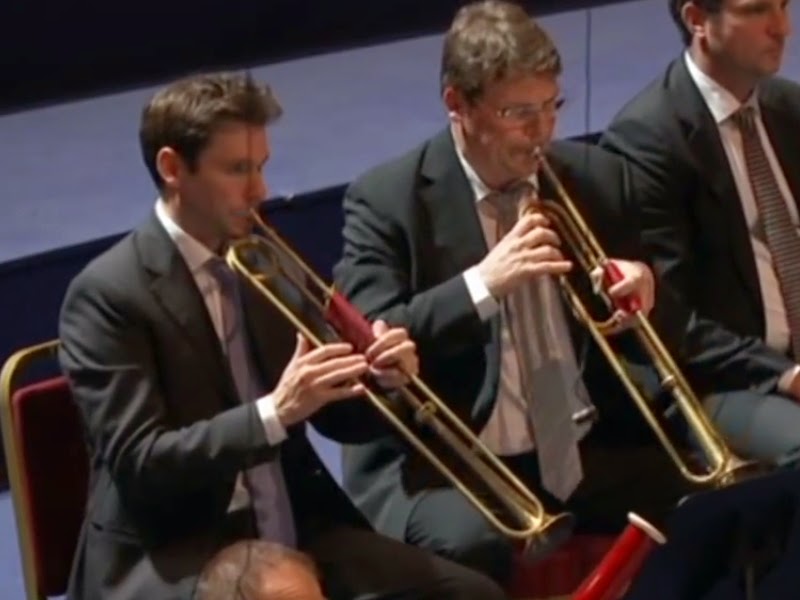
And speaking of brass chorale, get a load of these trumpets!

Those are what you call natural trumpets. Note the lack of any valving or extra tubing. On natural trumpets, the player changes notes by shifting the lip muscles in certain ways (it’s hard to explain in technical terms, but it’s not unlike how one changes notes when whistling). These may be a more modern type of natural trumpet called a “baroque trumpet”, which is a modern variation on the natural trumpet that includes finger holes to allow for better intonation. It’s just always cool to see these types of instruments in action, as the valve trumpets weren’t invented until the early 1800s and didn’t become really the standard until the latter half of the 19th century. Once a trumpet geek, always a trumpet geek!

Here is Robert Schumann’s Symphony No. 2 in C major.


Next week: I’m actually not sure yet. Maybe more Schumann; he did write four symphonies, after all. Or maybe not. You never know!

Share This Post

Symphony Saturday

Today we come to the end of Hector Berlioz’s symphonic output, during which we’ve seen that Berlioz was one of the most unique of symphonists, refusing to adhere to the standards of the symphonic form. This work is no exception. Here we have the Symphonie funebre et triomphale, which was originally written for concert band or military band. Berlioz later added optional parts for strings and choir. Berlioz was commissioned to write this symphony by the French government for use at a ceremony honoring the tenth anniversary of the July Revolution, one of France’s numerous Revolutions in the 18th and 19th centuries. Berlioz wasn’t terribly enamored of the existing government of his day, but figuring that 10,000 francs was 10,000 francs, he dusted off some old, abandoned works of his and reconfigured them for this piece. Apparently the first performance — with an enormous ensemble that couldn’t be heard very well outdoors — was something of a fiasco, but this symphony became fairly popular during Berlioz’s lifetime.

The Symphonie funebre et triomphale is in three movements: The Funeral march, the Funeral oration, and the “apotheosis”. In this piece Berlioz looks backward to the state of French ceremonial music from the early 19th century, with the enormous funeral march to begin and the triumphal march to conclude. The central movement, with its beautiful melody for solo trombone, comes as a welcome respite between these two large, spectacle-filled movements.


Next week: Robert Schumann.

Share This Post

Symphony Saturday

Of all of Berlioz’s literary muses, and there were many, none burned quite so bright in his head and heart than Shakespeare. It was through a performance of Hamlet that Berlioz first saw actress Harriet Smithson, thus inspiring his most famous and enduring work, and it was Shakespeare who inspired Berlioz to write what is, for me, his single greatest symphony and work in general. It’s his third symphony, Romeo et Juliette.

The fact that Shakespeare had such an effect on Berlioz is all the more remarkable given that Berlioz discovered Shakespeare in translation, and given that in Berlioz’s day, translation wasn’t quite so rigorous a pursuit as it is now. The focus was not so much on accuracy, and translators felt little compunction toward changing a work to suit their own ideas. The version Berlioz saw had Juliet awaken in her tomb, so that the lovers could have one last moment together before dying. Translators at that time just didn’t much care about total fidelity to a work, for good or ill. It little mattered, though: Berlioz was thunderstruck.

Nicolo Paganini had commissioned a work from Berlioz, if you’ll remember from last week; while disappointed in the result, Paganini was as good as his word, and paid Berlioz the 20,000 francs he had promised. That influx of cash gave Berlioz the financial freedom he needed to pursue his next work, which is the very symphony we are considering here. And what a work it is. Romeo et Juliette is a symphony mainly because Berlioz says it is. There are almost none of the standard features one might expect from a symphony. Instead of four movements, here we have seven (or even more, depending on how they are counted). Voices feature strongly throughout, culminating in a massive choral finale that depicts the Capulets and Montagues coming together after the deaths of their children. The work is heavily programmatic, going right down the line and basically telling the story of the play in the right order, starting with the fighting in the square and the intervention of the Prince.

With all the symphony’s uses of vocal forces, it might be surprising, then, to note that the most intimate parts of the story are depicted purely orchestrally. Berlioz never allows voices to depict either Romeo or Juliet; instead, when the lovers are called for, the orchestra depicts their moods. This results in the central section of the work, when we “hear” Romeo at the Ball (where he first sees Juliet), the love scene, and then a brilliant and effervescent scherzo depicting Queen Mab (as described in the play by Mercutio). The symphony’s use of voice is pretty much restricted to the people affected most by the two doomed lovers, but the lovers themselves are only shown in the most deeply abstract music of the orchestra itself. That level of music insight is a prime reason why I love Berlioz as much as I do.

Yes, this symphony stretches the very idea of what constitutes a symphony in the first place, but it’s not hard to see the trend continuing through music history later on. In terms of form, this work clearly anticipates Mahler by fifty years; in terms of musical depiction of drama, this work clearly influenced Wagner (who actually sent Berlioz an autographed copy of his score to Tristan and Isolde, noting his admiration for Romeo et Juliette in the inscription). All that, of course, would be of little concern were the music itself not so engaging. Berlioz tended to have an odd time with melody, and this work is no different — but the “Romeo Alone and the Capulets’ Ball” movement is its own little tone poem, and the love music here is, to my ears, utterly rapturous. Even that movement alone amazes in its construction: it begins with Romeo wandering after the ball, struck by love, and we hear the tenors offstage, singing snatches of the main dance music from the ball. But the tenors fade away, and Berlioz’s main melody eventually begins. But somehow it sounds tentative at first, as though Romeo is trying to put what is in his heart into music. Eventually, though, the lovers come together, and the music flowers.

There isn’t a single aspect of Berlioz as a musician that is not in evidence in Romeo et Juliette: his storytelling approach to music, his belief in the power of the orchestra to convey emotion, his skill at writing orchestra textures that still sound fresh to this day. While I have always discounted the notion that music can, by itself, tell a story, this work stands as the finest example I know that that doesn’t mean that story is story and music is music and never the twain shall meet. Here, story informs the music and the music informs the story. If Hector Berlioz really was only known for a single work, and this was that work, he’d be in my personal Pantheon anyway.

The symphony is so large that this performance is in three parts. There are a few complete performances on YouTube, including a very nice live one (with an annoyingly sedate audience). The three parts correspond to the sections of the symphony, which break out like this (courtesy Wikipedia):

Part I

1. Introduction: Combats (Combat) – Tumulte (Tumult) – Intervention du prince (Intervention of the prince) – Prologue – Strophes – Scherzetto

Part II

2. Roméo seul (Romeo alone) – Tristesse (Sadness) – Bruits lointains de concert et de bal (Distant sounds from the concert and the ball) – Grande fête chez Capulet (Great banquet at the Capulets)

3. Scène d’amour (Love scene) – Nuit serène (Serene night) – Le jardin de Capulet silencieux et déserte (The Capulets’ garden silent and deserted) – Les jeunes Capulets sortant de la fête en chantant des réminiscences de la musique du bal (The young Capulets leaving the banquet singing snatches of music from the ball)

4. Scherzo: La reine Mab, reine des songes (Queen Mab, the queen of dreams – the Queen Mab Scherzo)

Part III

5. Convoi funèbre de Juliette (Funeral cortège for the young Juliet): “Jetez des fleurs pour la vierge expirée” (“Throw flowers for the dead virgin”)

6. Roméo au tombeau des Capulets (Romeo at the tomb of the Capulets) – Invocation: Réveil de Juliette (Juliet awakes) – Joie délirante, désespoir (Delirious joy, despair) – Dernières angoisses et mort des deux amants (Last throes and death of the two lovers)

7. Finale:

La foule accourt au cimetière (The crowd rushes to the graveyard) – Des Capulets et des Montagus (Fight between the Capulets and Montagues) – Récitatif et Air du Père Laurence (Friar Lawrence’s recitative and aria) Aria: “Pauvres enfants que je pleure” (“Poor children that I weep for”) – Serment de réconciliation (Oath of reconciliation) Oath: “Jurez donc par l’auguste symbole” (“Swear by the revered symbol”)


Next week: Berlioz’s final symphony, which is, again, rather unique.

Share This Post

Symphony Saturday

In 1833, after a concert of his music, Berlioz was introduced to Niccolo Paganini, who was already one of the most famous figures in the musical world, owing to his unimaginable virtuosity with the violin. (Paganini is one of those figures whose performances would almost certainly be a destination were any classical musicians of today to find the keys to Doc Brown’s Delorean.) Paganini loved what he had heard at the concert, so he officially commissioned from Berlioz a work for solo viola and orchestra, so that he might have a worthy new work to perform on the Stradivarius viola he had just acquired. Berlioz set to work…but Paganini was ultimately disappointed, because he had expected a virtuoso showpiece in which he would be constantly playing, and Berlioz was simply not attuned to that style of thing.

Berlioz never wrote a proper concerto. The closest he ever got was this piece for Paganini, which turned out to be his second symphony. It’s also the only one of Berlioz’s four symphonies to follow the traditional four-movement model, but it has the extensive passages for solo viola, making it a kind-of symphony-and-concerto hybrid, and it is also deeply steeped in Berlioz’s love of literature. This time the object of literary interest is the poetry of Bryon, which led Berlioz to title the work Harold en Italie (“Harold in Italy”), after the hero of Byron’s poem, Childe Harold’s Pilgrimmage. The soloist “plays” the part of Harold as he tours Italy, witnessing such scenes as the treacherous paths in the mountains, a group of pilgrims marching to a shrine, a love-serenade, and in the final movement, a dance and revelry at a camp for outlaws. That fourth movement takes a page from Beethoven’s book by quoting the first three movements before getting down to business, but this is a literary allusion as well as a musical one: Harold, in the form of our violist, is remembering his previous journeys before the revelry begins.

Harold in Italy is, for me, a delightful listen. It’s loaded with Berliozian drama, his weirdly asymmetrical approach to melody is on full display, and his love of interesting orchestral effects shines through (the wonderful moment in the last movement when he sends some musicians offstage to quote the Pilgrim’s March, for one).

Here’s Harold in Italy, performed this time on original instruments by the Orchestre Revolutionnaire et Romantique, with Gerard Causse as the soloist and John Eliot Gardiner conducting.


By the way: the very Stradivarius viola that Paganini owned, inspiring him to commission Berlioz? That viola still exists, and is currently owned by the Nippon Music Foundation.

Next week: What is, for me, Berlioz’s greatest symphony and his greatest work, and by far the strangest symphony he wrote. Maybe. (They’re all pretty strange, you know.)

Share This Post