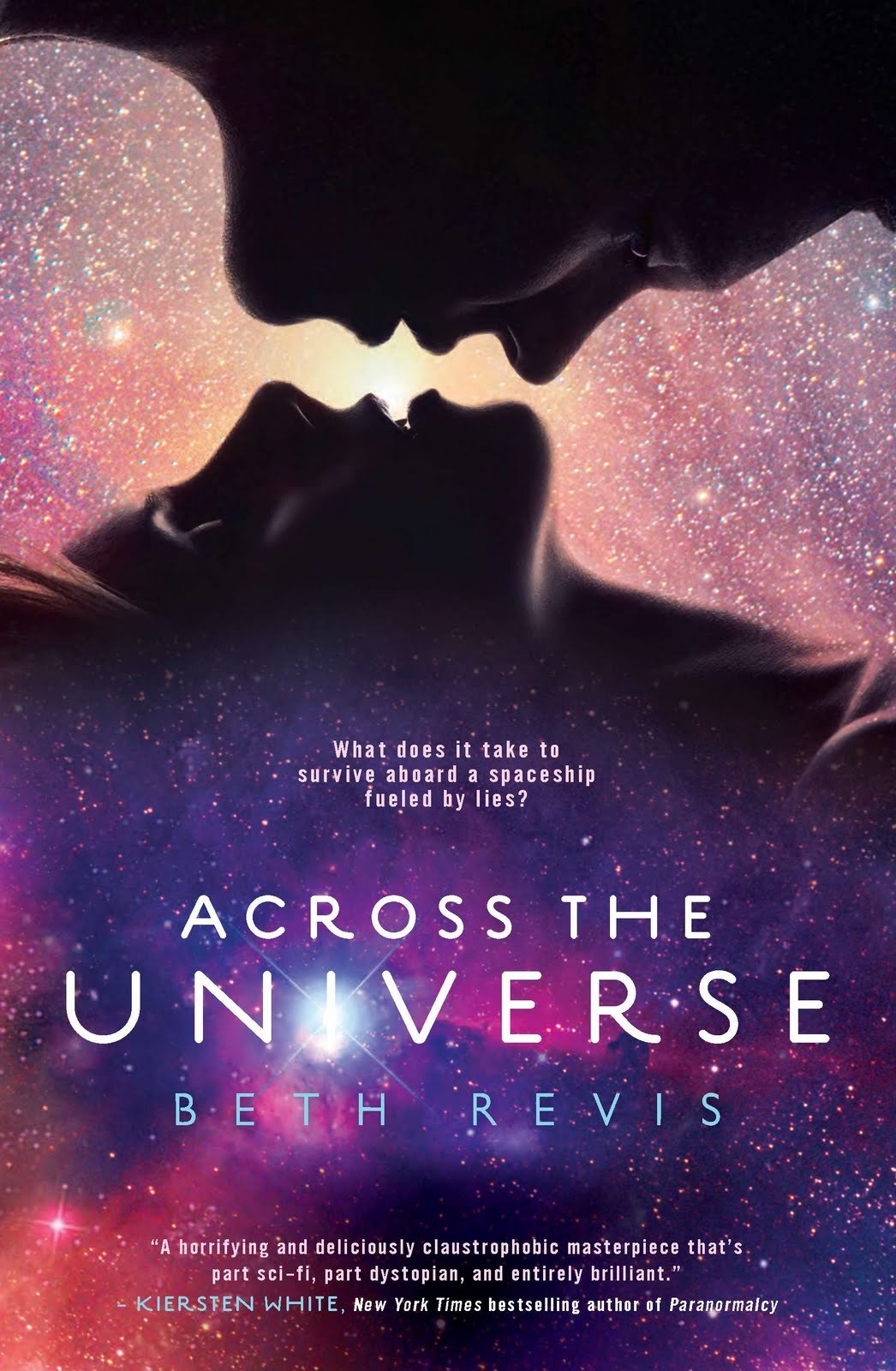

“Across the Universe” by Beth Revis

One theme I see a lot in various science fiction commentary sites and blogs I read is that the genre itself is lagging in readership behind fantasy and horror to a pretty significant degree, and that one of the reasons for this is a comparative lack of ‘gateway books’ to the genre. Generally the idea of a ‘gateway book’ is a book that’s solidly in the genre, but not so solidly as to be inaccessible to people who have been reading it for a while. And yes, this is a definite problem; I found it myself, back when I really started reading SF on a regular basis in the late 1990s. Sometimes the standard tropes of SF can be a bit hard to penetrate, and the genre tends toward terminology that can often be used from one book to the next, so that if you know what it means or indicates, you’re fine, but the first time or two…it can be a bit hard to get into it.

Another problem is that there just don’t seem to be terribly many SF books for young readers these days, be it schoolkids or young adults. Why is this? I honestly don’t know. But when I look through the shelves at bookstores for books for The Daughter, I can find tons of fantasy, dark fantasy, and outright horror. SF is harder to come by, and it usually tends to be future dystopia stuff or steampunk. That’s not a complaint, just a summation of the state of things. But what I’ve always considered to be the heart of SF, the space adventure (whether it’s outright space opera or not), just isn’t around all the much anymore. The usual complaint is that no one is writing today’s equivalent of Robert A. Heinlein’s novels for juvenile readers, and for the most part, this seems to be true.

Which brings me to Beth Revis’s novel Across the Universe, which is the first book in a trilogy (the second, A Million Suns, is already out, while the last, Shades of Earth, is forthcoming). Across the Universe tells a good, old-school science fiction story, with two young adults at its heart. I loved it.

We open on Earth as a girl named Amy is being placed into suspended animation alongside her parents for a several-hundred-year journey aboard a starship called the Godspeed for the settlement of what is hoped will be a new Earth. Then we meet a boy named Elder, who is so named because he is being groomed to eventually be the leader of the ship. The Godspeed is well underway, and Elder is receiving his lessons from the ship’s current leader, Eldest, who is something of a stern taskmaster. (Or so he seems at first, before things start getting a lot darker.) But down in the hold, Amy awakens from her cryogenic sleep. She’s been thawed out, after an attempt on her life. Halfway through the ship’s journey. When she is told this, she realizes that when they arrive and her parents are revived, she will be in her 60s or 70s.

So, Amy is awake on the ship when she shouldn’t be, there is a murderer on the loose, and it turns out that life aboard the Godspeed isn’t quite what it should be, because the Godspeed herself may not be what she should be. Amy is alone on this ship which is run by a tyrannical leader. As the book progresses, several mysteries are resolved, but even more are unmasked, in this first volume of a trilogy.

The idea of a story set entirely on board a generation ship is not new, of course. But in Revis’s hands, it’s an interesting and effective use of a classic SF trope. None of this works without sharply drawn characters, and Revis does an excellent job of putting us into both Amy’s and Elder’s heads, as one tries to adjust to a terrifying situation that is unfair and nothing she ever deserved or envisioned, and the other finds himself rebelling against his longtime father figure as he starts to realize that things in his world are not what he has always thought them to be.

So if you’re looking to introduce a certain young adult reader to SF, this is a good place to start.

Share This Post

Fixing the Prequels: Revenge of the Sith (part four)

one
two
three

Aaaaand again, it’s been ridiculously long for an installment of this series, for which, again, my apologies. But this time the reason is different, aside from the fact that time, as always,, continues to occasionally get away from me. No, this time I’ve genuinely been vexed with how to fix the part of Revenge of the Sith we’re now entering.

This part of the film – the political part – is the most problematic. After a slam-bang first forty minutes or so, the film has to spend half an hour or so going set-up for the last hour, which will include, as we well know going into this one, all manner of grim stuff happening. As a well-established lover of all things Star Wars, I don’t dislike this part of the movie, but I do have to admit that structurally, this is the weakest part of Sith. It’s mostly a lot of talking, and I’ve really had trouble figuring out what to do here.

So part of what I did was reconnect myself with the entirety of the Star Wars saga by rewatching, over the course of six consecutive Sundays, all six movies (in their proper order: ANH, TESB, RotJ, TPM, AotC, Sith). And while I’m on that subject, I highly recommend doing precisely this! When watched in fairly close quarters like that, the emotional beats of the entire story become a lot more clear. And as fas as this blog series goes, the rewatch more than served its purpose, because it crystallized for me a few things about this movie:

1. There are times when George Lucas chooses to linger when he should move.

2. Conversely, there are times when Lucas moves when he should linger a bit!

3. The film doesn’t contain quite enough politics.

4. The film doesn’t quite connect the dots strongly enough with regard to Anakin’s temptation.

Again, these observations are meant more mildly than they might sound. I think that Sith is a fantastic experience, but it could have been even better had the Problem Portion worked just a bit better. The problem here, I think lies in the talky nature of the material and the fact that a lot of the talk is, well, rather stilted and expository in nature. So, what to do?

Well, there are two possible ways we can go. We can add more action in order to give the impression of plot movement by having things explode. I didn’t want to do that because you have to justify action, and I don’t see how to do that and retain what we need of the political material without resulting in a hugely bloated movie, so I’m prepared to stick with the action in the film that exists. That leaves the other option, which is to make all that talking more interesting in itself.

And how do we do that? Well…and given some of my recent postings, I can’t believe I’m saying this…but we need to take a lesson here from Aaron Sorkin.

I may have spent lots of time ripping the guy recently, and for what I feel are entirely justifiable reasons, but if there’s one thing we can learn from the fairly consistent success of Aaron Sorkin’s scripted films and shows, it’s that lots of talking need not be boring. At his best, Sorkin was able to make the corridors of politics a deeply fascinating place. That’s what needs to happen with Sith…maybe not in Sorkin’s style, obviously. I don’t want characters answering every yes/no question affirmatively with “Yeah”; I don’t want people referring to “the thing” or “this thing” or saying “I’ve gotta go do a thing”; I don’t want Anakin complaining to Obi Wan that the Jedi Council has just “screwed me with my pants on”. But more dynamic conversation, more quickly applied, is certainly called for.

So! When we left off, Anakin had started having nightmares about Padme’s death in childbirth, and in an act of total responsibility that I find pretty impressive (especially as no one seems to notice it), Anakin took his problem to Yoda, who then helpfully told him basically, “Death happens. Let it and don’t be sad when it does.” Yoda’s advice is, shall we say, not all that useful.

So now we start getting into some politics. What is the aim here? Well, we have to show Anakin’s increasing ties to the Chancellor eroding his confidence in the Jedi. We also need to establish that the Chancellor is slowly but surely acquiring enormous amounts of power, to the alarm of the Jedi. This story isn’t just the fall of Anakin Skywalker, it’s about the seizure of power by the Sith and the fall of the Jedi order. Now, in the original script and in some deleted scenes, the seeds of what will eventually be the Rebel Alliance are sown, but none of this made it into the finished film, on the basis that those scenes slow things down too much (and this is not a point without merit). Finally, it seems to me that at least a bit of light needs to be shone upon the exact relationship of the Jedi to the Chancellor and Senate, and on the public in the Galaxy’s view of the Jedi. How to do all this? Read on!

Just after Anakin’s scene with Yoda, he runs to get to a war briefing by Obi Wan, and he gets there late. I would add a little bit, in blue, and what didn’t make the film in red:

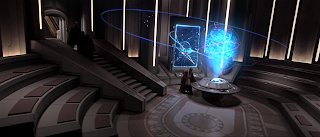
INT. CORUSCANT-JEDI TEMPLE-BRIEFING ROOM-DAY

ANAKIN rushes into the Briefing Room. By the time he reaches the Chamber, the last of the Jedi are leaving. Only OBI-WAN remains at the front of the lecture hall. He is shutting off some holograms and electronic charts and maps.

OBI-WAN: You missed the report on the Outer Rim sieges.

ANAKIN: I’m sorry, I was held up. I have no excuse.

OBI-WAN: In short, they are going very well. Saleucami has fallen, and Master Vos has moved his troops to Boz Pity.

ANAKIN: What’s wrong then?

OBI-WAN: The Senate is expected to vote more executive powers to the Chancellor today.

ANAKIN: What powers?

OBI-WAN: The Chancellor wishes the authority to commission more clones from Kamino, and to appoint regional governors to directly control Republic affairs in their territories.

ANAKIN: Well, that can only mean less deliberating and more action. Is that bad? It will make it easier for us to end this war.

OBI-WAN: Anakin, be careful of your friend Palpatine.

ANAKIN: Be careful of what?

OBI-WAN: He has requested your presence.

ANAKIN: What for?

OBI-WAN: He would not say.

ANAKIN: He didn’t inform the Jedi Council? That’s unusual, isn’t it?

OBI-WAN: All of this is unusual, and it’s making me feel uneasy. You’re probably aware that relations between the Council and the Chancellor are stressed.

ANAKIN: I know the Council has grown wary of the Chancellor’s power, mine also for that matter. Aren’t we all working together to save the Republic? Why all this distrust?

OBI-WAN: The Force grows dark, Anakin, and we are all affected by it. Be wary of your feelings. The Council isn’t concerned about your power, Anakin. But they are concerned about how close you are to Palpatine.

I add the little bit enumerating the specific powers being voted upon because I generally think it’s best to be more specific when you can.

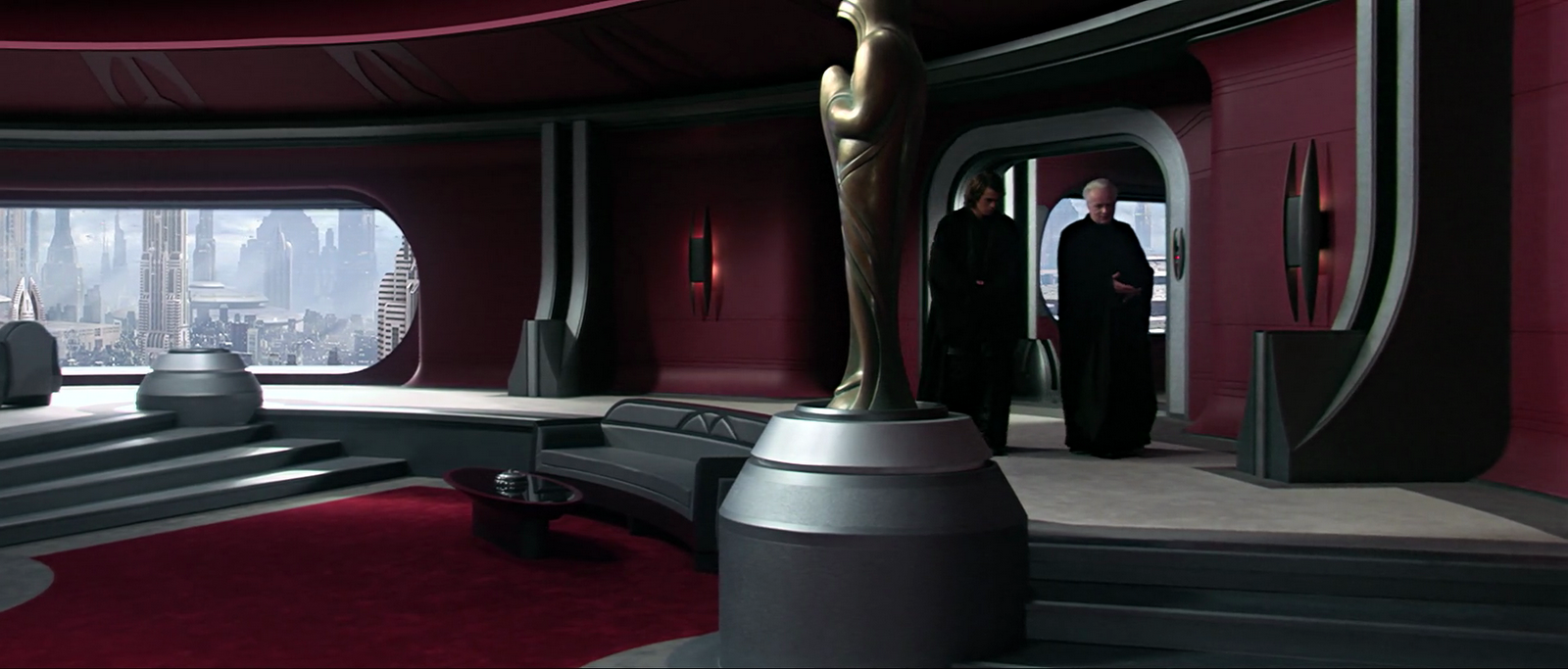
Now, in the movie, we cut right to Palpatine’s office, and Anakin and Palpatine are slowly walking around the enormous room, having a discussion. Only about half of it shows up in the film, though:

INT. CORUSCANT-CHANCELLOR’S OFFICE-DAY

ANAKIN stands with PALPATINE at his window overlooking the vastness of Coruscant. Several buildings have been destroyed. A brown haze hangs over the landscape.

PALPATINE: Anakin, this afternoon the Senate is going to call on me to take direct control of the Jedi Council.

ANAKIN: The Jedi will no longer report to the Senate?

PALPATINE: They will report to me . . . personally. The Senate is too unfocused to conduct a war. This will bring a quick end to things.

ANAKIN: I agree, but the Jedi Council may not see it that way.

PALPATINE: There are times when we must all endure adjustments to the constitution in the name of security.

ANAKIN: With all due respect, sir, the Council is in no mood for more constitutional amendments.

PALPATINE: Thank you, my friend, but in this case I have no choice . . . this war must be won.

ANAKIN: Everyone will agree on that.

PALPATINE: Anakin, I’ve known you since you were a small boy. I have advised you over the years when I could … I am very proud of your accomplishments. You have won many battles the Jedi Council thought were lost . . . and you saved my life. I hope you trust me, Anakin.

ANAKIN: Of course.

PALPATINE: I need your help, son.

ANAKIN: What do you mean?

PALPATINE: I fear the Jedi. The Council keeps pushing for more control. They’re shrouded in secrecy and obsessed with maintaining their autonomy . . . ideals. I find simply incomprehensible in a democracy.

ANAKIN: I can assure you that the Jedi are dedicated to the values of the Republic, sir.

PALPATINE: Nevertheless, their actions will speak more loudly than their words. I’m depending on you.

ANAKIN: For what? I don’t understand.

PALPATINE: To be the eyes, ears, and voice of the Republic . . .

ANAKIN thinks about this.

PALPATINE: (continuing) Anakin . . . I’m appointing you to be my personal representative on the Jedi Council.

ANAKIN: Me? A Master? I am overwhelmed, sir, but the Council elects its own members. They will never accept this.

PALPATINE: I think they will . . . they need you more than you know.

As I watched all six movies, I noticed that George Lucas – even in TESB and RotJ, the ones he didn’t direct – likes to join scenes with conversations already in progress (good example: in ANH, after Ben rescues Luke from the Sandpeople, we cut to Ben’s home and Luke is saying, “No, my father didn’t fight in the wars, he was a navigator on a spice freighter.”). A lot of the time it works, but there are a couple of times – most notably the fireplace scene in AotC — where it doesn’t. This is another such example. I suspect that the scene was cut as is to keep it short and simple, but sometimes short and sweet isn’t so great. Interestingly, this scene as written openly addresses something I wondered about while rewatching the PT: the relation between the Jedi and the Republic. This scene strongly indicates that the Jedi are virtually an independent body, and very rigid in guarding their independence. And that, frankly, seems a tad important to me.

I’d like to establish all this, but I wouldn’t do it this way, with a simple Anakin-and-Palpatine in the office thing. Instead I would replace this whole scene with a longer sequence:

EXTERIOR: Coruscant – Senate building – dusk.

The sun is setting behind the great Senate building.

INTERIOR: Senate chamber.

The Galactic Senate is in session, with PALPATINE presiding from his center rostrum. A SENATOR FROM MALASTARE has the floor.

MALASTARE SENATOR: We have heard the reports from the Jedi that their offensive is pushing back the Separatist armies, but if that were true, how could General Grievous have launched such a devastating attack against the very heart of the Republic? How can we trust the Jedi reports of success when they just barely avoided utter failure in our own skies? Malastare moves that an immediate investigation into this affair be undertaken!

PADME: This is outrageous!

The Senate pod from Naboo floats out into the debate space, bearing PADME and JAR JAR BINKS.

PALPATINE: The Senator from Naboo.

PADME: The Jedi have served the Republic with honor for a thousand generations! If we question them now–

MALASTARE SENATOR: This failure was theirs. The Force did not warn them of the attack, did it? This war grinds on and on, and now, look about you! A third of this body is vacant, and a third of these Pods stand empty because their systems have joined the Separatists! The Jedi are failing us. Chancellor, I serve official notice that Malastare is introducing an amendment to place the Jedi Council under the direct authority of the Chancellor and the Senate!

PADME: No! You can’t–

She is drowned out by the shouts from every Senator in the building as the entire place erupts with fierce debate.

MAS AMEDDA: Order! Order in the Senate! Order!

Through all this, PALPATINE shows almost no reaction, even when he meets PADME’s gaze.

INTERIOR: Senate building – Shuttle bay.

PALPATINE is walking toward his personal shuttle, with MAS AMEDDA and his councilors behind him.

MAS AMEDDA: Will you schedule a vote on the Malastare amendment?

PALPATINE: I shall hold that off as long as I can, but eventually the Senate will force the issue…ah, Anakin!

ANAKIN rises from his seat outside the shuttle.

ANAKIN: Chancellor. I was told you wished to see me.

PALPATINE: I do. Come.

He takes ANAKIN aboard the shuttle.

INTERIOR: Chancellor’s shuttle – continuous.

PALPATINE and ANAKIN sit down inside the shuttle as it departs for the Chancellor’s office building.

PALPATINE: These Senate sessions become harder and harder to control. Odd, with fewer and fewer Senators.

ANAKIN: I watched it on the screen. The Jedi Council will not easily submit to being placed under Senate control, no matter what law they pass.

PALPATINE: I agree, which is why I wished to speak with you. I’d heard that Malastare was planning to propose that amendment, but I’d hoped those rumors were false. Perhaps what I have in mind will ease the Senate’s concerns somewhat.

ANAKIN: Sir?

PALPATINE: I need your help, son. I need you to become the eyes and ears of the Republic.

ANAKIN: I don’t follow–

PALPATINE: The Republic has faced times like these before, Anakin. The Jedi Council’s independence was not always taken for granted. I have decided to invoke a very old statute and make a direct appointment to the Jedi Council.

It starts to dawn on ANAKIN….

PALPATINE: I wish you to be my personal representative to the Jedi. They will resist, but I have the right. Of course, by their own by-laws, this will force them to do what they should have done years ago, and make you a full Jedi Master.

ANAKIN: A Master?! Sir…I am…I don’t know what to say….

PALPATINE: You need not say anything. In fact, if the Council’s reaction is what I expect, you may not even wish to thank me. But the Republic needs you, Anakin. More than you know.

EXTERIOR: Sky above Coruscant.

The Shuttle arcs toward the Capital building.

INTERIOR: Senate building – corridor.

PADME is walking with several other SENATORS.

PADME: We have to start working to assemble a coalition that will back the Jedi Council. We can’t have these divisions in the middle of a war–

A young SENATE PAGE approaches, bows, and hands PADME a slip of paper, which she unfolds and reads.

PADME: Thank you.

The PAGE runs off.

SENATOR: We will not vote to obstruct the Jedi.

PADME: Thank you. If you’ll excuse me, I’m late for a meeting….

She nods a farewell and then heads off down another corridor.

INTERIOR: Senate building – Observation room.

The observation room is near the top of the Senate building itself, overlooking the mighty expanse of the Coruscant city. PADME enters and is greeted by SENATOR BAIL ORGANA and several other SENATORS, including a tall and regal-looking WOMAN.

PADME: Senator Organa? Why are we up here instead of one of our offices?

BAIL ORGANA: Greetings, Senator Amidala. I believe you know the others.

PADME: Yes, good to see you all. (to the WOMAN) You’re newly elected?

WOMAN: Just last month. I am Mon Mothma.

PADME: Oh yes. Of Chandrila. A pleasure, and my apologies – I usually get around to welcoming new Senators more quickly. But why are we up here?

BAIL ORGANA: These observation rooms are informal locations.

PADME: And not subject to Senate guidelines for official business. I think I understand.

MON MOTHMA: Those of us here have concerns about some things that are happening in the Republic, and we think that you may share some of those concerns.

PADME glances from face to face in the room. Something about this seems harmless, and yet deeply significant. She knows that a line is about to be crossed….

PADME: Go on.

The point here is to show a number of things: that the Jedi are facing opposition not just from the Chancellor but from the Senate as well, to get the bit in there about Palpatine intruding upon the functions of the Jedi Council while seeming reasonable about doing so, and to show what is probably the moment when the Rebel Alliance is born.

It really struck me how skillfully Palpatine played the Jedi Council and Anakin and everyone else, when I rewatched the films. He just doesn’t seem all that unreasonable in doing some of the things he does, before he unmasks himself. Of course, a part of that is the amazing performance of Ian McDiarmid, whose performances as Palpatine in the Prequels are, to my mind, criminally underrated. He gives Palpatine a kind of fatherly gravitas that is utterly convincing and all the more chilling when it starts to become clear what he’s up to.

And that’s where we’ll stop. The galactic politics continues next time! Excelsior!

Share This Post

Avengers assemble!!! (no spoilers)

Heavens, what a movie.

I mean, really. Heavens, what a movie.

The Avengers doesn’t quite take the top prize as my favorite superhero movie of all time, but at this point, I just don’t think that Superman is likely to be dislodged from that spot in my heart, ever. But the spot for number two? I think that Spiderman 2 is in that spot…but I’m not sure if The Avengers didn’t just take it over. Or at least tied it.

I loved this movie. It’s thrilling and exciting. Its story is epic in scale, but fairly simple in its particulars. Its characters are all well-drawn and sharply written. Its dialogue crackles. Its action sequences are full of effects that look amazing even in this day and age, and the sequences are not impossible to follow. The Avengers is pretty much a joy from start to finish.

I’m a fan of Joss Whedon’s, although I’m not an obsessive one (I have yet to watch much of Buffy the Vampire Slayer at all), nor one who believes he is infallible (I watched four or five episodes of Dollhouse before I gave up). I do rank Whedon above the other great God Emperor of Geekstuff, JJ Abrams, though; Abrams is a fine director, but his writing just leaves me wanting. I was never a big fan of the Avengers during my own comics reading days, but when I learned that Whedon was writing and directing the film toward which all the Marvel superhero movies of recent years had been building toward, I was terribly excited. And I’m glad to report that this excitement has paid off.

The films leading up to this have, admittedly, been a mixed bag…but a generally likable mixed bag. Iron Man  was a lot of fun; Iron Man 2 a bit less fun, but enjoyable. Thor was a blast, although its blend of New Mexico desert and an Asgard that looked made of freshly-painted plastic felt odd. Captain America was probably the best of all these; I enjoyed the hell out of that one. (Did I ever blog about it? Oh noes, I didn’t! Especially since I didn’t see it until just a month or so ago.)

So, along comes The Avengers. This movie has to reintroduce all these heroes, and do it in such a way that it reminds those of us who saw their individual movies what went on, but doesn’t bog down in reminders for people who didn’t see them. It also has to set up the villain (Loki) and explain what he’s up to. Whedon gets all these various pots boiling, and he does it with flair and confidence. Where lots of superhero movies falter is in their various first acts, but Whedon is able to keep all this pretty interesting. He doesn’t spend too much time in explanations, and gives pretty much exactly as much information as you need to make sense of what’s going on. (And, frankly, he honors the longstanding tradition of superhero comics that everything makes sense as long as you don’t really think about it too closely.)

This isn’t a perfect movie. The pacing is pretty relaxed in the first act, but each act picks up steam, until by the end of the movie, I was left pretty breathless. Whedon is able to make the film large in scale; this feels like a genuine epic, and it doesn’t feel artificially inflated. Here are some great things that Whedon does along the way:

  • He raises the stakes a little at a time. Early on, in the first skirmishes, a given fight might need one hero, maybe two. This changes as the nature of the threats becomes greater and greater.
  • He establishes that in any battle worth fighting, a price will be paid. Anyone familiar with Whedon’s work over the years will know that he definitely likes to do this, and there are moments in this film where I found myself wondering if the price had just been paid, because I know Whedon and his lack of fear when it comes to putting his characters through hell.
  • The battles take their toll on our heroes. Whedon makes them work for it. This is a hallmark of all the great Marvel Comics team battles over the years. Sometimes the team — any team, whether it’s the Avengers, the X-Men, whomever — even loses. And the battles themselves have acts! It’s just classic Marvel Comics storytelling that our heroes have to work to exhaustion just to beat the first wave of attackers, and just as you’re wondering how they can ever defeat what’s next…what’s next comes upon the scene.
  • Whedon gets that superhero teams are not inherently given to teamwork. He knows that there are egos at work, and he shows this. Best of all, he’s able to show all these clashing egos without making us think that any one of them is a complete jerk. I loved that.
I love the acting in the film, as well. All the leads are superb, just as they were in their respective films before. Chris Evans is still able to portray Captain America’s earnest goodness without making him an insufferable boor to be around; Robert Downey Jr. as Iron Man gets all manner of great lines. The best part of the cast may be Mark Ruffalo as Dr. Bruce Banner, who also has to turn into the Hulk on occasion. He’s able to portray Banner as brilliant and cursed, a man who is wounded by his inabilities to always control who he is.
As I mention above, the action sequences are filmed perfectly. Despite the fact that New York City is exploding left and right, Whedon establishes what’s going on and shows it without filling his frame with so much mayhem as to make the shots impossible to follow. And I liked that he engages in minimal cross-cutting, so that when he takes us to see what, say, Black Widow is up to, he stays with her long enough that we know what’s happening.
No, The Avengers is not perfect. It does have moments of slowness, and the motivations of the villains aren’t always obvious. And as much as I’ve enjoyed Alan Silvestri’s music in the past, I don’t think he turned in the best score here; I’d hoped for one big, memorable theme for this film, but it just wasn’t there. In a very real way, if forced to choose one factor that keeps this film (and Spiderman 2) behind Superman in my heart is that Superman boasts a score by John Williams at the height of his powers. But to my mind, there is no flaw in The Avengers that keeps it from being what it is: one of the most entertaining films I’ve seen in years.
A couple of random notes:
::  Yes, Stan Lee has a cameo. But my favorite cameo was from character actor Kenneth Tigar as the “German Old Man”, who talks back to Loki. I’ve always liked Tigar (he was the bomb squad guy in the Lethal Weapon movies, and he was one of the more notable killers against whom Thomas Magnum matched wits on Magnum PI) , and I’m glad to see that he’s still active and acting!
::  Reportedly, Joss Whedon wanted Cobie Smulders as Wonder Woman, back when he was attached to whatever Wonder Woman movie was in development. I’m glad that he managed to get her into the superhero movie world here, as a SHIELD agent.
::  A lot of reviews I’ve seen accuse Samuel L. Jackson of just doing his standard glower through the movie. It’s not like his role didn’t really call for him to do much else, but he did allow his Nick Fury to show what little vulnerability he would.
::  There’s an airplane in this movie that bears a small design similarity to the Serenity. It’s a blink-and-you-miss-it kind of thing, but I sure saw it.
::  If you see it, stay for the very, very end. All the way to the end of the credits. Trust me.
::  Bring on The Avengers II! (And while we’re at it, let’s get the Serenity out of mothballs, shall we?)

Share This Post

A to Z: Zany!

Hey, I made it! It’s the end of the A-to-Z Challenge. Let’s look at some Zaniness, shall we?

According to this site, the word ‘zany’ was first used in English by none other than William Shakespeare, although its origins are apparently Italian:

Somebody zany is amusingly crazy or clownish. If you object to my definition, then you may be in the company of the compilers of several current dictionaries. It’s a hard word to pin down — we all think we know what we mean by it, but we may find describing it in plain English surprisingly hard.

That may have something to do with the way the word has evolved. It was first a noun, to describe a performer in the commedia dell’arte, an improvised Italian comic form of the sixteenth to eighteenth centuries. The zany was a foolish servant, a buffoon, who attempted to mimic the actions of his master, himself a clown. The servant was given the generic name Giovanni (the Italian equivalent of John), much as English servants of the same period were frequently called Andrew (indeed, one English equivalent to the zany was a merry-andrew), or as a Glaswegian might call someone Jimmy as an all-purpose name. In time Giovanni turned into zannie and we imported it in that form.

. We tend to think of zany as meaning a special kind of madcap comedy, one in which questions of sanity are best left at the door. Here’s Merriam Webster on the case:

1: being or having the characteristics of a zany

2: fantastically or absurdly ludicrous (a zany movie)

However, looking at definition number one under zany as adjective, I see that zany can also be a noun. This, I did not know! y interesting word, actually. Merriam-Webster defines it thusly (same link as above, toggle a link there to switch from noun to adjective):

1: a subordinate clown or acrobat in old comedies who mimics ludicrously the tricks of the principal

2: a slavish follower

3a : one who acts the buffoon to amuse others

The noun use of zany seems to have dropped out of usage, in favor of the adjective. I’ve never, to my knowledge, heard of someone refer to a ‘zany’, but I have heard, many times, someone or something described as ‘zany’. So how about some zaniness in fantasy and SF?

Well, there’s quite a lot of comedy to be found in both genres. Fantasy isn’t all long, wordy, and ponderous tales involving plucky rural heroes making their way across a vast continent to the very stronghold of evil; there’s plenty of funny stuff be found. But not everything that is funny is also zany. I’d definitely file the books of Christopher Moore in the ‘zany’ category, and they are cheerfully zany, full of wild leaps in logic and loaded with highly eccentric characters; his books are, in the words of Merriam-Webster, “fantastically or absurdly ludicrous”. That’s part of their charm. Moore writes the kinds of books where two women in a rubber raft at sea find themselves in between two whales who are about to engage in the physical act of whale-love, or where a six-year-old Jesus causes a stir in his hometown when he makes his own face appear in the Passover bread.

Interestingly, Moore has also written a book that fits the noun use of zany, the wonderful Foole, in which Moore tells the story of King Lear from the viewpoint of the Fool…the zany, you might call it.

Lois McMaster Bujold’s “Miles Vorkosigan” books aren’t really zany, per se, but they do have moments when the humor rises to a certain level that’s almost zany. Ditto Scott Lynch’s Gentleman Bastard Sequence (comprising The Lies of Locke Lamora and Red Seas Under Red Skies. I suspect that the Hitchhiker’s Guide to the Galaxy series is pretty zany…but I wouldn’t know. I haven’t read them. (I’ll hang my head in shame.)

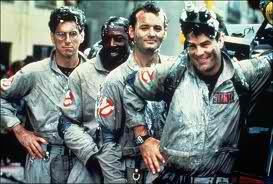
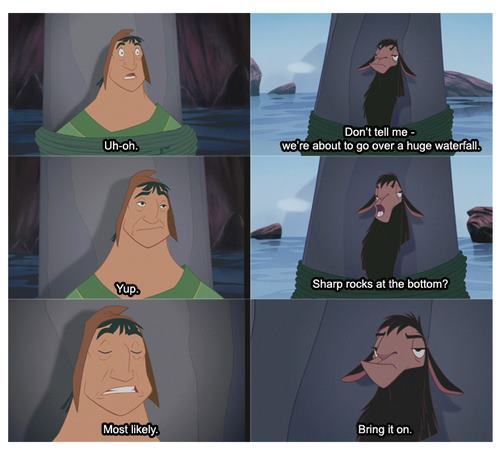
Fantasy and SF in the movies? There, it’s easier to find zaniness on display. Ghostbusters is pure zaniness, through and through. So is Back to the Future, Galaxy Quest, and most of Star Trek IV. Men in Black is zany, and amongst animated films, The Emperor’s New Groove is as zany a film as I can remember. And you have to include the films of Monty Python, which are as zany as it gets and which are often filled with fantastical content.

I’m sure it comes as no surprise that I’m a fan of zaniness, both in life and in fiction. Serious things are good, but zaniness is a part of life, is it not? Life should be a little bit zany…or a lot zany, if you can manage it. The trick is to find your preferred versions of it and incorporate them into your life. Don’t be afraid to, as Merriam-Webster defines it, “act the buffoon to amuse others”…even if it means the occasional pie in the face.

And with that, I come to a successful close of the A to Z Challenge for 2012, Huzzah! Maybe I’ll do this again next year….

Share This Post

A to Z: YAHHHHH!

YAHHHH? What on Earth is that?

Well, it’s a rough transliteration of the final death shriek of Red Leader at the Battle of Yavin in Star Wars Episode IV: A New Hope. He’s just led an unsuccessful attack run on the two-meter-wide thermal exhaust port, failing to get his proton torpedoes to go down the shaft to the reactor (“Negative! It didn’t go it. Just impacted on the surface.”). He orders Red Five (Luke) to gather the remaining pilots (Wedge and Biggs) for one last shot at the exhaust port, before his ship is struck by blaster fire from Darth Vader’s TIE Fighter. Red Leader’s ship sinks toward the surface of the Death Star, and just before he goes up in a ball of flames, he screams, “YAAAHHHHH!”.

So what are we on about here? Acts of self-sacrifice or going-bravely-into-the-night in fantasy and science fiction.

Few things in fiction are more inspiring, frankly, than some person choosing, with their full faculties about them, to undertake an action or series of actions that will result in their deaths but will also result in someone else’s survival. In fact, it’s not even in fiction that this is inspiring, because such actions are typically seen as among the very highest things one can do, and it’s the act of self-sacrifice that makes the Jesus story what it is. Noble acts of self-sacrifice, and their cousins – bravery in the face of certain death – stir our emotions like nothing else. It’s the soldier who throws himself onto the grenade that’s about to explode; it’s the person who gives up their seat in the lifeboat for someone else as the ship sinks.

It’s the man who, bearing an extremely close resemblance to a man who has been falsely imprisoned and sentenced to death, conspires to take his place in prison so that the convicted might rightly go free.

It’s the woman who offers her seat on the last helicopter to the deep underground shelter, as the asteroid nears its humanity-killing collision with Earth, to a desperate woman and her child who weren’t originally offered spots in the survival lottery.

It’s the First Officer who knows that his starship will be destroyed if he doesn’t brave the lethal radiation of the engine chamber and personally mix the matter and antimatter by hand to make the final warp jump to safety possible.

It’s the woman superhero who has realized that her powers are out of control and that she will soon forever lose her command over them, to the ill of all, unless she gives up her own life.

It’s the musicians who, knowing that their escape from the sinking ship is impossible, decide to do what they do best as the waters near: keep playing.

It’s the patriot who, with his head in the noose, states quite clearly that he wishes he could live, just so that he might do it all again.

It’s the freedom fighter on his execution table, refusing to pledge fealty to the despotic King against whom he has struggled for years, just to get the execution over with.

Self-sacrifice and courage in the face of certain death are impulses cut from the same cloth, and when such a moment is captured well in a story, it’s always a moment of power and high emotion. It need not even involve death, really; the final scene of Casablanca is pure self-sacrifice, all the way; Rick is choosing to go to a concentration camp so that Ilsa and Victor can go free. (He can’t foresee that it doesn’t quite work out that way, thanks to the ever-unknowable convictions of Captain Louis Renault.)

Having a character make a choice that brings about doom for themselves, no matter what form that doom might take, so that someone else might prosper, is about the most fool-proof way I can think of to make a character into a hero. You can have a flawed hero, as much as you want, but a true hero, deeply flawed or not, will make that choice each time.

Above I allude to Spock’s self-sacrifice in Star Trek II: The Wrath of Khan. The rest of the crew reciprocates with acts of self-sacrifice in the next film, Star Trek III: The Search for Spock, so that Spock might live. Their sacrifices are real and painful. Near the end of the film, when Kirk and crew have brought Spock back to Vulcan so that his katra (his living essence, just go with it) can be reintroduced to his regenerated body (again, just go with it), they are waiting to see how it went. Sarek (Spock’s father) comes to Kirk, and this exchange takes place:

SAREK: Kirk, I thank you. What you have done–

KIRK: What I have done…I had to do.

SAREK: But at what cost? Your ship. Your son.

[Kirk’s son, David Marcus, had been killed in the course of the film, and Kirk had to put the beloved Enterprise on self-destruct to defeat some Klingons.]

KIRK: If I hadn’t tried, the cost would have been my soul.

Trek III is often derided, and yes, it has its flaws, but it also has this amazingly succinct and wonderful statement of what heroism is all about. And for a virtual meditation on the entire theme of self-sacrifice, Guy Gavriel Kay’s Fionavar Tapestry fills the bill, with so many such acts — including a good number in the last hundred pages — that the trilogy can, for some (myself included), be emotionally overwhelming in spots.

In the end, these kinds of scenes and characters make us ask, does it matter how one falls down? And the answer, as given in The Lion in Winter, is simply this:

Wow, one letter left!

Share This Post

A to Z: Universes

Way back when, movies and teevee shows and books and whatnot used to be pretty much self-contained items. But nowadays, in a lot of cases, as specific movies and teevee shows and books and comics branch out into multiple sequels and spinoff series and all of their sequels, what becomes important isn’t so much the original story. Instead, the entire setting of the story takes primacy. Thus, a Universe is born.

At what point does a fictional setting become a universe? Star Wars takes place a long time ago ‘in a galaxy far, far away’, but at what point did it become possible to talk about the Star Wars Universe? My guess is that it was when other stories started to be told there, other than the original three movies. The emergence of the Star Wars universe seems to me to have arisen in the mid-1990s, when, on the heels of Timothy Zahn’s Thrawn Trilogy, a whole bunch of new books started coming out…and then comics…and then games…and all this before the Prequels started even shooting. Star Wars had become a Universe.

The same thing happened to Star Trek, when it went from being the adventures of a specific crew of a specific ship to also including the adventures of another crew, 80 years later, and then the adventures of the crew of a space station, and then the adventures of…you get the point.

And then there are the big comics publishers, Marvel and DC, both of whom have their own universes. All their respective superhero books take place in the same world, so that there can be crossover appearances that take characters from one book into another. It’s not enough to have Spiderman having his own adventures; no, every so often he has to have a run-in with, say, Daredevil or the Hulk or whomever. Most times this is just fun name-dropping, but it’s also a subtle way for the comics companies to cross-market their other books, the ones you might not be reading.

Famously, the DC Universe became extremely cluttered and complicated over the decades, until the point where the Powers-That-Were decided to do a big storyline in which the entire universe would basically be re-booted. Apparently this didn’t take, as there have been several reboots since the original Crisis on Infinite Earths. Meanwhile, Marvel’s Universe, while not so complex, was still plenty crowded — which allowed Marvel to make money a few times by putting out a Complete Guide to the Marvel Universe, or something like that, which was basically an encyclopedia of just about everybody. And Marvel, too, had its Giant Enormous Crossovers, which they called Secret Wars.

In Firefly, the characters actually refer to their Universe, by calling it “the ‘Verse”. Oddly, nearing ten years after the show’s brief run, the Firefly universe is among the most beloved and yet least explored; all we have are fourteen teevee episodes, a movie, and three graphic novels. That’s it.

So, what’s the difference between a Universe and a ‘World’? For instance, nobody talks about the Lord of the Rings Universe. They refer to its world, or even to the world by its name, Middle-Earth. A Universe seems to me a primarily science-fictional concept, and needs more than one planet to be properly a Universe. But why a Universe, and not a Galaxy? Well…who knows? I personally like the word “Galaxy” better, but what if you start mucking around with black holes and stuff in other Galaxies? What if you start to dink around with multiverses? Aieee! It makes the head explode!

Share This Post

A to Z: Q

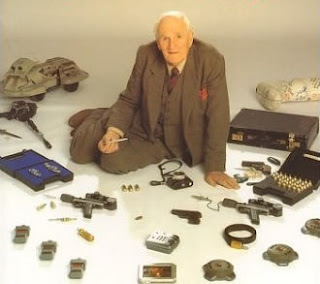
The obvious choice here is to talk about Q, but I couldn’t decide which one. This Q?

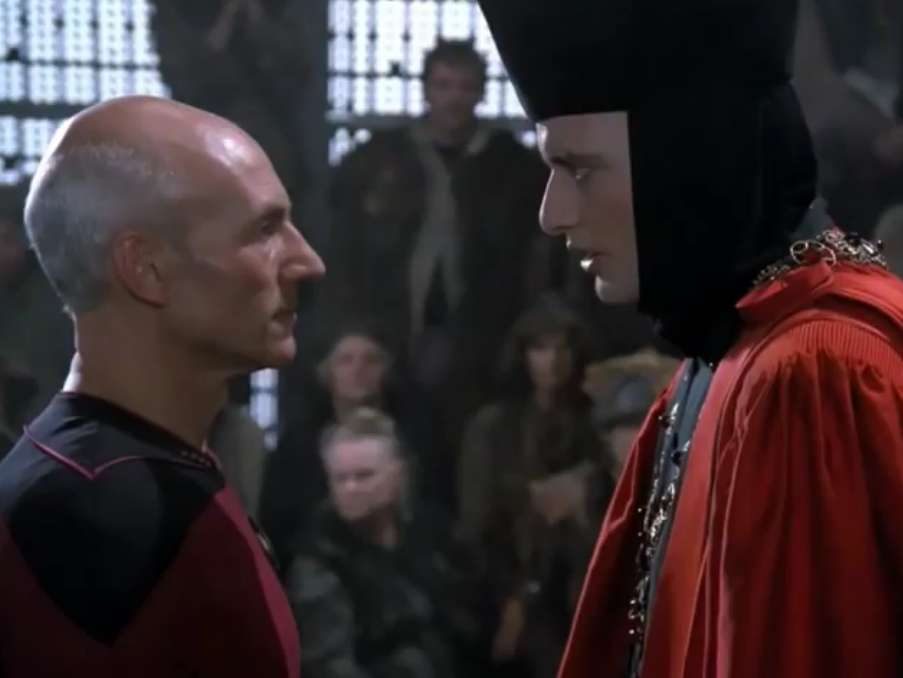
Or this one?

Luckily, this is my personal blog, where the only rules that apply are the ones that I choose for myself, and which I can summarily set aside any time I want, so…let’s talk about both Q’s!

Our first Q is less well-known as Major Geoffrey Boothroyd. (The only time we ever hear his name in the James Bond movies is in The Spy Who Loved Me, when he holds a door open for Agent Anya Amasova, and she thanks him by name.) Q’s first appearance was in From Russia With Love, when M informs Bond during his briefing that “Q branch has been working on something special for you.” In walks our man, looking pretty young and spry back then, played by actor Desmond Llewellyn. He’s got with him a briefcase that has trick catches that, if not opened properly, causes an explosive to go off; contains a rifle that’s nicely broken down into a bunch of small pieces (this was 1962, well before X-ray machines at airports!); and fifty gold sovereigns. There had been a character in Dr. No simply referred to as “the armorer”, who relieved Bond of his Baretta pistol (derisively calling it a fine gun “for a lady’s handbag”) and giving him his trademark Walther PPK, but the guy we would know as Q didn’t come until the second movie.

But it was in the third Bond film, Goldfinger, that Q would become iconic. That’s when he unveils his tricked-out Austin Martin DB-V, with machine guns in the headlights, spinning license plates, homing device trackers, and the ejector seat. It’s too bad that the car doesn’t end up amounting to much…but Q’s attitude toward James Bond becomes clear when Bond says “You’re joking!” in reference to the ejector seat, and Q replies, “I never joke about my work, 007.”

Q was a fixture for most of the remaining Bond films. He wouldn’t appear in Live and Let Die, but he’d be present for all the remaining films until Die Another Day; Q was revealed to be retiring in The World is Not Enough; he even introduced his successor, who was played by John Cleese, in an inspired bit of casting. There was a giant pall cast over the whole thing, though, when Desmond Llewellyn died in a car crash not long after TWINE came out.

The Daniel Craig films have not availed themselves of a Q character yet, which I hope is forthcoming, even if I also hope that the gadgets don’t get too outlandish (the invisible car in Die Another Day was too hard to believe). Maybe in Skyfall; I don’t know yet.

My favorite Q gadgets? I loved the exploding key ring in The Living Daylights, the wrist-activated blowgun of Moonraker, and the fountain pen filled with acid in Octopussy. And my favorite Q moment came in Licence to Kill. In that film, Q actually goes out into the field to assist 007, who has gone rogue. Now, all through Bond’s career, Q has constantly complained that Bond never returns his gadgets in their original working condition. Late in the movie, though, Q is posing as a peasant sweeping a sidewalk when the bad guy drives by. Q alerts Bond via the little radio he has attached to the broomstick…and then, with his job done, he casually tosses the broom aside.

But…what about the other Q?

This Q showed up immediately on Star Trek: The Next Generation, right in the very first scene of the pilot, and he was originally depicted as a representative of a nearly omnipotent species that is deeply ambivalent toward humanity. Played with zeal every time he showed up with John de Lancie, Q put all of humanity on trial through the persons of Picard and the rest of the bridge crew. I think the character of Q went through evolution, though, as all characters do. Originally, Q was seen more as a trickster character, but then he became more of a gadfly through whom the Enterprise crew learned their deeper lessons about the universe and about life. Most of Q’s episodes were highly memorable: it was Q who made the Borg aware of the Federation; it was Q who greeted Picard in the afterlife and somehow arranged for him to experience an astonishing life lesson.

I never liked Q as much when he started turning up on DS9 or Voyager, when the producers started to explore the entire ‘Q Continuum’ and the politics thereof, which had the unfortunate effect of turning Q into, well, another in a long series of alien races with their own concerns and whatnot. When he was by himself (for the most part), Q something unique unto himself.

Share This Post

A to Z: Planets

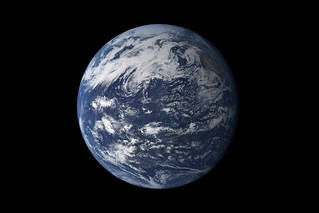
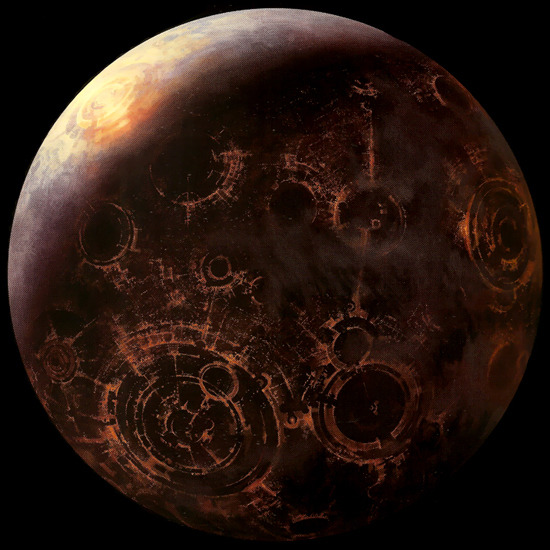
The Water Planet

Arrakis! Vulcan! Tatooine! Alderaan! Barsoom! Akir! Zeist! Veridian III! Hoth! Mustafar! Coruscant! Trantor! Krypton!

All hail the Planet!

Planets are everything. Without planets, we’ve got nothing, in SF. Without planets, we’ve got no place for stories to happen. Planets are where it’s at. Without a nifty planet, your space story isn’t going anywhere.

Some planets are Earthlike in most ways. Others are inhospitable almost to the point where humans can’t live there…but only just. Some planets are gas giants, leaving us to hope for livable environments on the moons; other planets are tiny, cold, airless rocks.

Planets give rise to amazing life forms. There are enormous worms that slither through the sands of the worldwide desert, catching entire towns in their gaping maws. Or there are scavenging little dwarfs, who wander around picking up bits of technology to sell at the settlements. There are planets whose inhabitants are governed by their fiercest passions, and there are planets whose cultures are rigidly devoted to logic and reason. Planets, planets, planets. Planets everywhere.

I speak here more of fictional planets, but it’s always worth remembering that planets are very real in our universe, and not just in our Solar System: planets are places, and reasoning out their motions is one of the greatest achievements of all time. Here’s Carl Sagan on Johannes Kepler and Tycho Brahe:

It’s interesting to note that for a time, in Carl Sagan’s early years in the spotlight, planetary astronomy wasn’t much of a going concern.

(I keep forgetting to include the A-to-Z graphic on these posts. Apologies to the event organizers!)

Share This Post

A to Z: M5

Ah, the supercomputer that is benignly invented as a means of making life easier, but which ends up wanting to kill us all! What a nice, fun, reliable SF trope. All hail our digital overlord, the M5 computer from Star Trek! (And other supercomputers.)

The M5 (from the episode “The Ultimate Computer”) is built by a supergenius named Richard Daystrom, and it is installed on the Enterprise for a series of wargame-style tests that will put the M5-controlled Enterprise against several other starships. Everything is going swimmingly, until the wargames get intense enough that the M5 assumes that it is actually under attack, at which point it opens a computer-driven can of whoop-ass. It turns out that Daystrom used engrams from his own mind to program the M5, so it thinks the way he does – which is unfortunate, as Daystrom turns out to have some psychological issues. The computer is going all-out, which forces Starfleet to also go all out, planning to destroy the Enterprise, unless Captain Kirk can save the day. Which he does, of course, using his tried-and-true method of talking the computer into a logical contradiction that forces it to shut itself down.

Kirk would do this a few other times in the course of the series, and it became enough of a cliché that in the DC Comics Trek series in the late 80s, there was an issue where the Enterprise crew comes up against a supercomputer and the first thing Kirk does is say something like, “Well, I suppose I could try talking it into a logical contradiction. That usually works.” Needless to say, it doesn’t.

But supercomputers with a malevolent bent are certainly not unique to Star Trek. There was the computer in Wargames, the one designed to manage the entire nuclear defense of the United States. There was the Master Control Program in TRON, and, of course, the granddaddy of all malevolent supercomputers, the HAL-9000 in 2001: A Space Odyssey, whose insanity would later be explained in 2010: Odyssey Two, which ends on some tension as the entire crew’s survival depends on HAL, whose sanity is open to question. (To the extent that one can even talk about sanity in a computer.)

And let’s not forget about Skynet. That one turned out poorly, didn’t it? Beware the supercomputers! They’ll kill us all!!!

Share This Post