A to Z: Klingons

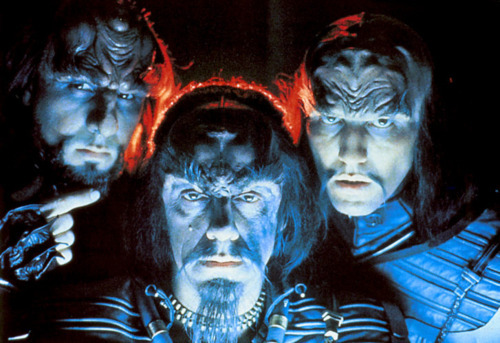
So, let’s talk for a few minutes about Klingons.

If one of the questions on Family Feud was ever “Name a fictional alien species”, I have to think that Klingons have a pretty solid shot to be the number one answer. (“Let me see…Gungans!” BZZZZZZZT “And the Laramie family with a chance to steal!”)

But why is this? Why are the Klingons so memorable?

The obvious first answer is in Star Trek‘s longevity. A thing doesn’t remain a pop-culture concern for as long as Trek has without having some of its terminology enter the pop-cultural lexicon, and the Klingons were the main bad guys of the Original Series, so there’s that. And more than that, a case could be made that the Klingons were the main alien species of the Original Series! More Klingons undoubtedly appeared on Star Trek TOS than Vulcans, and of the first ten Trek movies, there is exactly one in which no Klingons appear. (Wrath of Khan being the one – we see Klingon ships as part of the Kobayashi Maru test, but that’s it.)

I think it’s also easier to remember Klingons because they were often characterized as a group, more than as a race of specific individuals. Until Worf came along as a part of the Next Generation crew, we only saw a few Klingons at a time, and they never recurred (which was a shame – some of those early Klingons would have made great recurring characters, but recurring characters and stories just weren’t the style back then). Klingons were, basically, the ‘Indians’ in Gene Roddenberry’s space western that really wasn’t much of a space western at all. It amazes me to this day that one of Roddenberry’s concepts for pitching the show to the networks was “Wagon Train to the stars”, a concept that fits Battlestar Galactica better, orders of magnitude better, than Trek. But the Klingons were the disposable villains who would pop up, make life difficult for Kirk and company, and then disappear again.

This continued in the movies, too. The main villain of The Search for Spock was Klingon Commander Kruge, who was played very nicely by Christopher Lloyd, and who might have been a decently memorable villain if not for the fact that he was following up Ricardo Montalban as Khan. There’s another disposable Klingon bad guy in The Final Frontier — I don’t even remember his name, that’s how memorable he was – and then, in The Undiscovered Country, the TOS-era crew finally engages the Klingons as more than villains of the week, but as complex individuals. How did that happen?

Well, in between Treks V and VI came TNG, which decided to deepen the canvas a bit when it came to the Klingons. They weren’t boring villains of the week anymore; there was a weekly name attached to them. And with a spot in the regular cast, that meant installing a back story, which in turn meant finally delving into the nature of the Klingon society. TNG often did its best stuff in Klingon-culture related stories; instead of being the warlike goons of TOS, in TNG they were driven by honor more than drive for conquest. The Klingons of TNG came off as kind of a blend of Samurai and Vikings, if that makes sense. It was also interesting to me that as the Klingon Empire came to reach the limits it could reach without engaging in full-on war with other powers, their society turned its quest for honor in battle on itself, so for the rest of TNG and DS9, the Klingons were always engaged in a lot of violent interior politics and sometimes open warfare.

Of course, I can’t write about the Klingons without also mentioning the physical change they went through. In TOS, Klingons were just human-looking people with demonic-looking eyebrows and uniforms of gray and black. In the opening scene of Trek: The Motion Picture, though, the Klingons were well and truly alien, with enormous spiny ridges up their bald heads. This change was never explained, really; I assume that the original thought was to just go ahead and use the film’s large budget to re-do the Klingons in order to make them look a lot more alien, and that we were to just assume that the Klingons always did look like that and we were just supposed to accept the TOS Klingons as such.

But then, DS9 did its brilliant episode “Tribbles and Tribulations”, which had Worf – looking like very much the spiny-head Klingon – having to be in the same room with the ‘human’ looking Klingons. When someone asks him about it, he simply says, “We do not like to talk about it.” I’m sure this has been explained in some novel or some such, but I wouldn’t know. (Heck, they may have explained it in Enterprise, but again, I wouldn’t know.)

Anyway, long live the Klingons. Qapla’!

Share This Post

A to Z: Incunabulum

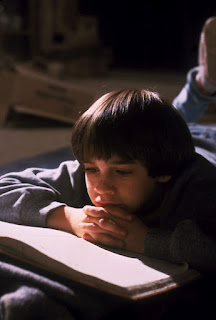
Books abound in fantasy and science fiction. The book is a central plot device or Maguffin or important element in so many stories that to catalog them all would be an exercise in utter futility. But let’s explore some anyway, in this entry. Behold the Incunablum!

Strictly speaking, an incunabulum (plural incunabula) is a book printed in Europe before 1501. According to Wikipedia, this is an arbitrary distinction, which is why I can get away with it here. But it’s a cool word, and it kind of connotatively suggests not just any old book, but rather the types you see a lot in fantasy: big, heavy tomes with lots of pages between leather covers. A locking clasp is also good; witness Indiana Jones’s Bible in Raiders of the Lost Ark.

Books are so often important objects within fantasy and SF stories that I can only offer a smattering here. The Neverending Story is a great example (even if I don’t like the movie all that much), in which the act of reading a story and the act of being in a story are melded into one. Books are a constant thing in the Gothic YA novels of John Bellairs; in one, the young hero’s adult friend is a literature professor, while in another, the adult companion is actually a librarian.

Books are the ultimate symbol, I suppose, of education and learnedness. Showing a person surrounded by stacks and stacks of books is almost a cliché for “This person is smart!” But it can also be shorthand for “This person is really eccentric!” — hence all the somewhat dotty wizards and witches in fantasy literature who are forever losing themselves in the pages of their tomes. And books can also establish one more facet of someone’s ass-kickingness:

Magic books? Those can be found, too. A magical book is at the center of Lloyd Alexander’s Prydain Chronicles, which begins with The Book of Three. Books are the magical gates between worlds in the computer game Myst. Books as central organizing principles of civilization? The original series Star Trek episode “A Piece of the Action” gives us a society that has organized itself around the rules of a civilization they read about in a book they recovered from a crashed starship. Unfortunately, the book was about mob men of Prohibition-era Chicago. This notion would later be repeated in the Next Generation episode “The Royale”, in which some well-meaning aliens construct a ‘world’ for the sole human survivor of a crashed spaceship on their world; they assume that the crappy novel he’s reading is an accurate depiction of human society, so they create that novel’s setting for him. (This is one of my favorite episodes of the series, although it doesn’t seem terribly popular.)

And books can be key moments of villainy, too. George RR Martin has well established King Joffrey’s colossal sociopathic status by the time we get to A Storm of Swords, but that doesn’t stop Martin from giving us a scene where Joffrey receives a very rare book as a wedding gift, and then uses another wedding gift – a sword of Valyrian steel – to chop the book in two. When someone points out that there were only four existing copies of that book in the world, Joffrey shrugs and says, “Now there are three.”

I could go on and on, but I’ll stop there. But remember: books rule!

Share This Post

A to Z: Horses

If there’s an animal more suited to heroism and derring-do than the horse, I don’t know what it is. Horses abound in fantasy and in science fiction. If you want a big heroic moment, you can do it without having a horse there…but a horse or two really helps.

Horses aren’t just well-suited to heroism. Horses lend themselves to tearjerking, too; if you want the audience to sympathize for the main character, well, just kill his poor horse, and that’ll do it. Dances With Wolves starts to become gut-wrenching when Cisco, John Dunbar/DWW’s horse, is killed out from under him.

Horses are, of course, a major factor in The Lord of the Rings. You have Gandalf, claiming for himself Shadowfax, the greatest of all horses, and one of the most heroic moments in the story – book and film – comes when the Riders of Rohan, a culture devoted to the horse, finally arrive on the scene at the Battle of the Pellenor Fields. Even the hobbits get into the horse act, with their use of ponies; Sam’s beloved pony Bill, who gets turned away at the Mines of Moria, is long-missed, and Sam’s relief many months later to discover that Bill has turned up back at Bree is a wonderful moment. And in truth, the fact that the Fellowship is mostly horseless seems to put them at a psychological disadvantage already, before they ever set out from Rivendell.

LOTR also gives us evil horses, in the black steeds that the Nazgul ride in the first half of The Fellowship of the Ring. In the film, Peter Jackson depicts this by use of close-ups of the horse, from strange angles, shots of the spittle dripping from the horse’s mouth, and so on. And when the power of the river is unleashed against the Black Riders, the foaming waters take the form of white horses.

On the flip side of that particular coin we have the sacred horses of Stephen R. Donaldson’s Chronicles of Thomas Covenant, the ‘Ranyhyn”. These horses are larger than their Earthly equivalent, and they are somehow in touch with “Earthpower” – the magic inherent to the world – and will not allow anyone to ride them that they themselves do not choose. One of the most potent moments depicting the power of Thomas Covenant comes when Covenant, as an act of atonement, commands the Ranyhyn to visit Lena, the girl he raped earlier.

Great horses are the key plot point of Guy Gavriel Kay’s brilliant novel Under Heaven, when a distant princess decides to gift a relatively minor man with two hundred fifty of her great horses, an act which sends shockwaves across the dynastic rule of Kitai (GGK’s medieval China). And let’s not forget the Firemares of Krull!

Horses in SF? Well, there are horses aplenty in Firefly, which is fitting as the show is essentially a space western. There are no horses, per se, in Star Wars, but the Tauntauns of The Empire Strikes Back are rather horselike. In Star Trek V, there are beasts on Nimbus III (the “Planet of Galactic Peace”) that aren’t horses, but might as well be. (I think they’re there because William Shatner, who directed that one, is a noted horse enthusiast.) Shatner’s equestrian enthusiasm would be indulged again in Star Trek Generations.

Not SF or fantasy, but here’s a scene from a good movie called Hidalgo, which has Viggo Mortensen playing a guy who, along with his horse Hidalgo, enters a race across the Sahara. I like this scene because it shows the beginning of the race…and what happens once the racers are out of sight of the people watching them start.

All hail the horse!

Share This Post

A to Z: Gagh!

There’s an episode of Star Trek: The Next Generation in which Commander Riker takes part in an officer exchange program and goes to serve on a Klingon vessel for a time. As part of his effort to familiarize himself with Klingon food, he goes to Ten Forward and orders himself up a smorgasbord of Klingon food, all of which looks very odd. The most notable dish here is Gagh, which he later learns is “best eaten live”. (When he looks askance at eating live Gagh, a Klingon japes, “Perhaps we can arrange for one of the females to breastfeed you!”)

So what is Gagh, anyway? Well, the experts, Gagh is:

A Klingon delicacy of serpent worms (pronounced “gawk”). Connoisseurs of Klingon cuisine claim that gagh is best served very fresh — i.e. live.  But it is sometimes served stewed. Gagh is one of the most popular foods served aboard Klingon warships.

Apparently the chief appeal of Gagh is its unique mouthfeel as the live worms pass through your mouth and into your digestive tract to die. Awesome! (It also turns out that in Klingon, Gagh is spelled qagh, so I could have done this one under Q. I haven’t yet pre-selected my Q entry for this series, so I’ve missed an opportunity!) But even vegans don’t have to feel left out, as they can simulate Gagh thusly.

Which brings up the more interesting topic of fantasy and sci-fi food. Food is one of the best ways to convey an alien quality of any situation, which is why we’re told that Klingons like to eat a dish of live worms because they like the feeling of slithery things going down their gullets. “Normal” food in science fiction? Never! There’s not a whole lot of food in Star Wars, but there is “blue milk” at Luke’s table on Tatooine. Jabba the Hutt likes to eat little beasties live, and so on. And Star Trek was forever giving us different alien foods, some of them live, like the eggs that the Cardassians like to eat, the ones that you crack open and see the embryo squirming about inside.

Of course, science fiction food used to be all about taking pills. You’d take a single pill and there’s all your nutrition! Food would be a thing of the past in our technological future. And then you have food, real food, used as a way to suggest certain luxuries. Witness Firefly, when Shepherd Book’s ability to cook with a few actual spices is welcomed warmly, and when he is able to partially guarantee passage on Serenity by giving Kaylee a single strawberry.

Fantasy food tends to be different. In fantasy, food is often where some of the magic happens. The Lord of the Rings gives us lembas, the Elven bread that can sustain a grown man for an entire day in a single bite. In the Chronicles of Thomas Covenant, one of the main foods is aliantha, the berries of The Land, which provide sustenance in much the same way as lembas does. Magical foods abound, and turn out to be an outstanding way to get magic into the story without resorting to wizards and spells; the magic in food is a part of the fantasy world itself, and not a creation of the people in it. There’s even food inside the computer, as TRON indicates, as the programs have to stop and drink some pure energy after escaping the Game Grid.

Guy Gavriel Kay’s use of food is tied to themes of nationality, a common theme in his books. For example, in A Song for Arbonne, much is made of Cauvas Gold, a wine that is especially beloved in the land of Arbonne. And then there is George RR Martin, who provides a lot of descriptives for the foods served in A Song of Ice and Fire. There, food creates mood: when writing about highborn characters in their castles, he lovingly describes a lot of gourmet-sounding foods; on the other hand, when characters are out in the wilderness or among the ‘smallfolk’, the food is characterized as ‘rustic’, at best. So descriptive can Martin be of his food that there’s a blog devoted to recreating it.

Why is food so central in storytelling? Because food is tied to so many prime emotions. Spirituality? Food is a central part of Christian ritual. Food’s a part of football – just try throwing a Super Bowl party with little or no food. Food as love? There’s your chocolate. Food as laughter? My beloved pie in the face. Food as horror? Well, what does Dracula need to live?

Food is also a gateway to character. Jean-Luc Picard has to have his tea (Earl Grey, hot). James Bond and his vodka martinis. When you think about it, food does an awful lot of heavy lifting in stories, doesn’t it!

So next time you’re watching a fantasy or SF show or reading a novel, pay attention to the food! And if you engage a story with little or no food in it, ask yourself if that world seems quite as real as others that tell us what their people are eating.

And you know…I’ll bet with plenty of hot sauce, gagh would be just fine.

Share This Post

A to Z: Diana

So, now we have Diana. But not this one:

Phil Jimenez art in Wonder Woman #600

No, that would be too easy. We’re going with this one!

best villain of all times

Yes, it’s Diana from V, V: The Final Battle, and the series V that lasted only a single season on NBC back in the 1980s. Diana was the show’s main villain, and she was truly rotten to the core. Played with relish by Jane Badler, Diana never had, to my recollection, so much as a second of repentance or any kind of flash of good behavior. No Darth Vader-esque deathbed conversion for her; Diana was the show’s Hitler. (Although that’s probably not the best analogy, since she was a military leader and not a head of state.)

Here’s Diana being all evil and stuff:

In retrospect, I’m not sure how well V holds up. The central SF-nal premise is deeply silly; these aliens have come from across the Galaxy to steal all of Earth’s water, under the notion that water is a very rare commodity. Even given that it was the early 1980s, I think we knew at that point that water was more common than that; just a couple of years later, Arthur C. Clarke’s 2010: Odyssey Two made a key plot point out of the enormous amounts of water ice on Europa. It’s just awfully hard to believe that these aliens can build interstellar FTL starships that are three miles in diameter, but can’t figure out how to feed their people or come up with water.

And the characters are pretty much all stock characters, every one of them, right down to Diana, who could be a fascinating character to explore – what would the aliens’ ethics be, that they’re perfectly willing to slaughter a sentient species for food? Alas, this is never explored, in favor of action and derring-do. Which is all pretty fun to watch, it must be admitted. Diana herself is as one-dimensional as villains get. She doesn’t even get to seem terribly intelligent; her main defining traits seem to be visceral loathing for humans and utter ruthlessness in getting what she wants.

But she’s still really memorable, at least for me, because Jane Badler played her wonderfully.

Share This Post

A to Z in April: Bib Fortuna

Continuing our alphabetical trek through the highways and byways and Fantasy and Science Fiction, here’s a very minor character from Star Wars Episode VI: Return of the Jedi. Bib Fortuna is the chief servant of Jabba the Hutt, to whom falls the duty of being Jabba’s main assistant and, I suppose, major domo.

Now, Return of the Jedi strongly implies that Jabba is an angry sort who tends to go through menial servants at a high rate. The only reason C-3PO is able to fill a job opportunity for Personal Interpreter to Jabba the Hutt is that Jabba reacted angrily to something his last interpreter had told him, and killed him. Bummer. Jabba is also given to torturing his droids in medieval ways, which seems kind of extreme, but what are you gonna do, right? Good help is hard to find.

However, in the Pod Race sequence in The Phantom Menace, we clearly see Bib Fortuna at Jabba’s side, which means that by the time of ROTJ, Fortuna has been serving Jabba for at least 23 years or so. This implies several possibilities:

One: Bib Fortuna is really good at his job.

Two: Bib Fortuna is OK at his job, but really good at not pissing off Jabba.

Three: Jabba isn’t as quick to murderous rage as he’s made out to be.

Now, the third seems the least likely. Not only are we told that he’s disintegrating his interpreter because he doesn’t like what he was told, he also tosses poor Oola into the Rancor pit when she resists his ‘charms’. And he does seem to keep a rather extensive catalog of Ways To Kill Individuals Horribly around, doesn’t he? He’s got a medieval torture chamber for droids, a Rancor, and for a really special execution, he’s willing to whisk his entire court off to the Dune Sea for a game of Feed-the-Sarlacc.

We can probably also rule out Number Two, because of the sheer length of time involved. Jabba really does seem to have a fairly short fuse, and he seems to view death as the proper punishment for all transgressions (unless carbon freezing happens to be involved, but remember, that wasn’t his idea). So I have to conclude that Number One is the case, and that Bib Fortuna may be the greatest single major domo in the history of science fiction. Too bad, then, that he died on Jabba’s Sail Barge…

…or did he? Hmmmmm!

(Actually, according to Bib Fortuna’s entry in Wookieepedia, it’s a combination of One and Two, and he did get off the Sail Barge and go on to live a long life of crime! Check it out, it’s interesting reading, if you’re in any way interested in ‘Expanded Universe’ stuff.)

Share This Post

A to Z in April: Adama!

So I’m launching yet another series, this one called the “A to Z Challenge”. The idea is pretty clear: write posts every day in a Month (excluding Sundays, excepting from that instances like today, when the first of the month falls on Sunday). I, of course, do post on Sundays, so this challenge may well guarantee that something fresh will appear on this blog every day this month. And who doesn’t want that!

So I’m doing this A-to-Z thing, and I’ve decided to give it a Fantasy and Science Fiction turn, as is my wont. So each entry in this series will take its inspiration from something or someone from F&SF, that starts with the respective letter of the day.

Thus we start with Adama, the Commander of the Battlestar Galactica.

Of course, we’ve had not one but two Adamas. The first one was played by Lorne Greene:

And then, in the remake of Battlestar Galactica from the 2000s, Commander Adama was played by Edward James Olmos:

Now, I’m at a small disadvantage because I haven’t yet watched very much of BSG 2003. In fact, I’ve watched barely any of it – all I’ve seen is the three-hour pilot movie, which I am actually currently re-watching as a prelude to watching the entire series. But I think I’ve seen enough of the Olmos Adama to make a small bit of comparison.

Both men are older, somewhat weary starship commanders who might well be at the twilight of their careers when the Cylons, humanity’s ancient enemy race of androids, launches a devastating attack that destroys the human homeworld and most of its remaining star fleet. Humanity is quickly rendered unable to stand and fight, and must instead flee in a desperate journey across the galaxy for a destination that may or may not be there. That destination? The fabled ‘Thirteenth Colony’, called ‘Earth’. So, Commander Adama not only has to rise to the occasion as a military leader; he must also be a political one, as he, his ship, and his crew are pretty much the only thing standing between the rest of humanity and the Cylon forces striving to kill them all off.

I’ve always dug this story set-up. It’s a nifty premise that can go a lot of ways, and I’m looking forward to seeing how it shapes up in the remake series. The earlier version, made with great fanfare in 1978 but canceled after one season because the ratings, while decent, weren’t sufficient to make the show cost-effective, was heavily steeped in Mormon lore and mythology; I expect that the mystical angle is downplayed in the remake series for a more character-driven SF drama. So it is that the later Adama seems to be a more three-dimensional individual than the earlier, Lorne Greene Adama.

Greene played Adama as a noble father figure who was often a source of wisdom to his crew. Olmos captures some of that, but his Adama is more flawed. He is tired and weary and, as the show begins, on the verge of retirement when the Cylons strike. Lorne Greene’s Adama is rarely seen anywhere but the bridge or his quarters, and I don’t recall ever seeing him out of uniform. This contrasts with Olmos’s Adama, who is in his dark, cramped quarters wearing only a t-shirt when his phone rings with the news that the Cylons have attacked. Adama sighs and says, “I’ll be right there.” But when the grim situation becomes clear, he is able to shake off his haze and take command in a forceful way.

There are also hints of future conflicts to come, which were not always in evidence in Galactica 1978. Greene’s Adama must also serve as de facto Head of State, but Adama is confronted by an actual Head of State: the Secretary of Education, who, as the only surviving member of the Cabinet, has just ascended to the Presidency of the Twelve Colonies. There is also conflict between the Olmos Adama and his son, Captain Apollo, whereas there wasn’t much conflict at all between the Greene Adama and his son Apollo. As the remake series dawns, the Adamas have not spoken much since the death of other son Zack. In BSG 1978, we see Zack die and we see the two Adamas commiserate over it.

Lorne Greene brought to the original BSG the gravitas that the show needed. So far, Olmos seems to be doing the same. So which Adama is my favorite? I don’t know yet. But we’ll see!

(By the way, the original Battlestar Galactica series is often derided as being a post-Star Wars bit of genre bandwagoning, and to be sure, the show probably never would have been picked up by ABC if not for Star Wars. But creator Glen Larson was kicking the idea around the networks much earlier in the 1970s, and really, the show holds up a lot better than many seem to think. It’s got its cheesy 1970s elements, yes, but it is not crappy teevee by any means. If you haven’t watched it, check it out. You may be pleasantly surprised!)

Share This Post

Page One: A Princess of Mars

Page One: A Princess of Mars

Here’s Page One of one of my copies of A Princess of Mars. This copy is part of something called the “Library of Wonder”. I bought it off the Bargain Books table at Barnes&Noble. Even though I already owned a copy (an omnibus I bought, in turn, back when I was a member of the SF Book of the Month Club), I couldn’t resist this one. I read A Princess of Mars a while back, and I was surprised at how well the writing holds up after 100 years; I expected a pulpy work that would be difficult to read for its prolix writing, but Burroughs crafts a nice, spiffy, readable tale that doesn’t have nearly as many anachronisms as one might expect. I haven’t yet read any farther into the series, but I intend to. This volume contains the first three of Edgar Rice Burroughs’s “Barsoom” novels, of which the first, A Princess of Mars, has just been adapted for the big-screen. Somewhat infamously, it turns out.

So, why did John Carter fail? I suspect for lots of reasons, not just one.

I’ve heard that there was a change in Disney management during the film’s production, and William Goldman has pointed out in his books that often an incoming exec’s first act of business is to make sure everything that the previous guy greenlit either gets ungreenlit or at least is just tossed out there without hype. I’m not sure about this; it’s one thing to just put the brakes on developing projects, but quite another to purposely scuttle a movie that’s already been made because the $200 million has already been spent. I’ve also heard that director Andrew Stanton was in charge of the marketing, and he made the decision to assume that audiences are more familiar with the John Carter character than they actually are. I’m not sure who was behind the decision to change the movie’s title to simply John Carter, when John Carter of Mars would have been more evocative, and hell, A Princess of Mars would have been in keeping with the book on which the movie was based in the first place.

For my part? I wonder if this isn’t the kind of movie that wouldn’t have failed had it come out, say, twenty years ago, when movies could be allowed to be in theaters for a couple of months, when they weren’t thrust into 18-screen multiplexes on as many screens as possible so as to guarantee massive opening weekends and then a couple more respectable weekends before the movie disappears from release entirely barely a month after its initial appearance. John Carter opened on a Friday, and I was reading about the movie’s box office failure on the subsequent Tuesday. Four days later. That is insane.

Now, I’m not convinced that word-of-mouth can always change a movie from failure to success – remember, The Shawshank Redemption was a box office failure and word-of-mouth didn’t elevate that movie to classic status that everyone’s seen until it came out on video. But still, in this day and age when there are a bunch of movies coming out all the time, and when most folks in my experience only tend to go to movies once or twice a month at most (and many less than that, as the cost of moviegoing is getting to the point where it might well rival the cost of a nosebleed-section admission to an NHL game soon), they tend to only go see whatever the BIG new release is. And that, sadly, tends to be the sequel to the tentpole franchise, or the adaptation of the current favorite book, or whatever. Not a movie like John Carter, which is in turn marketed with ads that really aren’t clear at all as to what the damn movie is about in the first place.

So anyway: I saw John Carter this past Saturday. For a reputed flop, there were a lot of people in the theater to see it. The place wasn’t packed, but the auditorium was probably almost half-full. That’s not bad, especially considering how packed the cinemas were for The Hunger Games. It’s just not the case that no one wants to see this movie. It’s just the case that, for whatever reason, this movie was set up to fail with unreasonable box office expectations that make the movies a sprinting horserace and an ad campaign that simply didn’t get the job done.

My particular screening didn’t start out so well. I attended a 2D showing, because I refuse to see 3D movies. I just can’t do it. I had a headache years ago after sitting through a couple of fifteen-minute 3D flicks at DisneyWorld. And I’m certainly not paying extra for the privilege of having a headache. So 2D it was. But after the previews ended, a title card appears on the screen, accompanied by voiceover: “Please put on your 3D glasses, now!”

Uh-oh….

And yup, they started the 3D version, with the telltale doubling-up of the image that had me in mind of the Monty Python sketch with the double-vision guy planning an expedition to climb “both peaks” of Mt. Kilimanjaro. I wondered if I’d screwed up or ended up in a 3D showing by mistake, but suddenly there were a bunch of folks behind me saying “Wait, what?” and getting up and heading out to the hallway. A Cinema employee stepped in, saw the 3D movie on the screen, and said, “Uh, I gotta go upstairs.” A minute or two later, the 3D version stopped, another minute or two passed, and the 2D version started. Huzzah! And they gave everyone there a free ticket to another movie, which was nice. So I get a free movie, for not that bad of an inconvenience.

(Oddly, when they restarted the movie, we had to sit through the previews again. Are they physically attached to the print of the movie you see?)

So anyway: about John Carter, the movie. Yeah, I loved it, and it depresses me that lost in all the discussion of the movie’s terrible marketing and undeserved fate (which, unless the movie develops surprising legs and then goes on to a remarkable life on DVD, will rule out sequels) is the fact that John Carter is a kind of movie you don’t see much anymore: a rollicking and entertaining adventure movie with high production values. The acting is good all the way around, especially the leads (Taylor Kitsch as John Carter, and Lynn Collins as Dejah Thoris). The visuals are all well-done, with none of the odd muddiness that I’ve noticed in movies shot for 3D. The film is full of wonderful spectacles and set-pieces, and for the most part, the plot isn’t hard to follow, once it gets going. There is a prologue that really doesn’t have much need to be there, and I did find the final battle scene slightly hard to follow as it ended. Also, there are a few pacing problems in the first act, as we cut away from John Carter for a bit too long to learn about Dejah Thoris and her dilemma; in my view, in these kinds of “Fish out of water” stories, it’s best to stay with the fish as long as possible. Those are fairly minor quibbles, though; once the movie settles into itself, about half an hour in, it’s as absorbing an escapist movie as I’ve seen in a long time. Michael Giacchino turns in a typically professional score, sounding a lot like his score to Star Trek 2009, and just as ear-wormy as the earlier score – I’ve had the main theme stuck in my head ever since.

John Carter, and the books that inspired it, aren’t really space opera, but its sister genre, planetary romance. There’s no space here whatsoever. Carter is teleported to Mars – Barsoom, they call it – and there’s an air of steampunk over the entire movie. It feels ‘retro’, and that retro feel is a large part of the movie’s charm.

No, John Carter is not a great movie. But it’s a very good one, well made, a fine addition to its genre. It deserves to be seen and enjoyed, not dissected in some kind of half-assed postmortem on what Hollywood does wrong these days.

Share This Post
Space Battleship Yamato

It seems that, aside from the occasional Star Trek movie, we just don’t do big-screen space opera much in this country anymore. That’s a shame…but at least there’s Japan, who was nice enough to come up with Space Battleship Yamato in 2010. And what a movie this is. This thing scratched nearly every space opera itch I have: war against nigh-unstoppable aliens, a hero who is a discipline case and who has a history, a love story, a crusty captain, a warship that is humanity’s last hope, and so on. And the warship looks like a 20th-century seagoing destroyer…made into a spaceship. You can’t beat this stuff!

Space Battleship Yamato is based on a popular anime series from the 1980s, that was dubbed into English for American audiences and called Star Blazers. I never saw this, so I have no idea how faithful the movie is to the anime, but taking the movie for what it is…it’s a grandly entertaining space opera epic. There’s a massive alien threat to Earth, and the last-ditch effort to gain an edge featuring an enormous warship that is sent across the Galaxy; there are plucky heroes and skilled fighter pilots and talented officers with discipline problems. There’s the old and grizzled captain with a history, and there’s the hero who knows that things may eventually come down to him and him alone. We have desperate assaults on alien fortresses, and acts of noble self-sacrifice all the way around. And there’s the warship of the title, the space battleship Yamato, which is built to look like…a seagoing battleship. Hey, why not?

In the year 2199, Earth is being ravaged under the attacks of the alien Gamilas. The last remaining battleship, the Yamato, is outfitted with a special new super-weapon and sent across the galaxy to the planet Iskandar, where they hope to learn how to counteract the lethal radiation with which the Gamilas have been rendering the surface of Earth uninhabitable. Along the way, secrets about the alien race are discovered, other secrets about the pasts of our characters are revealed, lots of space battles take place, and…well, if you think it should happen in a big-scale space opera movie, it happens here. This movie is almost the Platonic ideal of “Explodey Spaceshippy Goodness”. It’s well-acted, the characters are all pretty memorable, and there are only a few slow moments (and one moment that felt odd for me, as an American, when one of our Japanese heroes delivers a rousing address to the crew, citing the ship’s namesake as inspirational figure). The effects are mostly quite good, and you rapidly get over any of the oddness of a starship that’s built to look like a standard 20th-century battleship. I even loved the opening shot, which is an extreme closeup of someone’s eyeball; the camera zooms back as the lights of blasterfire reflect from the eye, to reveal that the eye belongs to a fighter pilot who is in the midst of a major dogfight. Cool stuff.

I don’t have much more to say about the film than that. But if you want to see a grand space opera movie, track this one down. It’s very much worth the effort!

Share This Post

Happy Birthday Mr. Shatner!

William Shatner’s birthday is today. How old is he? Who cares? Here’s one of my favorite scenes from all Star Trek, from the much-maligned Star Trek V: The Final Frontier.

Trek V is what I consider to be a ‘noble failure’, in that it doesn’t succeed, but even as it falls short it has some really nice moments, and it really tries to do something interesting, something that really involves sending the Enterprise crew into an unexplored place to confront an unknown. The above scene comes early in the film, while the crew is on shore leave, and Kirk, McCoy, and Spock have gone camping in Yosemite. If nothing else, this film understands that at the heart of the original Trek crew is the three-way friendship of Kirk-Spock-McCoy, a fact which the folks in charge of the current Trek original crew reboot seem to be missing completely.

Anyway, happy birthday to Mr. Shatner! May you row your boat gently down that stream for many years to come!

Share This Post