Boom de ya da!

Yeah…I’m trippin’ on the classic Discovery Channel commercial again. This time I’m discovering cool parodies!

The original, for reminder’s sake:

But I didn’t know that the Discovery Channel did a newer version:

And a few take-offs….

I could listen to that friggin’ song all night. Boom de yada!

Share This Post

Meg and Miles

Post corrected below.

Regarding a bit of recent reading:

:: Some years ago — I don’t recall how long — I read the first few volumes in Lois McMaster Bujold’s series of books on the adventures of a man named Miles Vorkosigan. I’m not sure that the series has an “official” name, so for my purposes, I’ll call it the Vorkosigan Chronicles. I’d been hearing about these books for years; it consists of a long series of self-contained novels about Miles Vorkosigan and the people around him, and every time a new book in the sequence would come out, I’d see a flurry of discussion in various forums online as fans of Bujold’s books devoured her latest offering.

This is one of those series where there tends to be a bit of diverging opinion as to the “best” order in which to read the books. One can read them in “story order”, meaning, reading the books in the order that the events within take place; or, one can read them in the order in which the books were published. In truth…I’m not sure which order I went with. Baen Books has reprinted the novels over the last few years in omnibus editions that gather two or three at a time, making it easy to read the books more-or-less in story order, or so I think. Anyway, I started with Cordelia’s Honor, which gathers two novels, Shards of Honor and Barrayar, which tell the story of how Miles’s parents come together and have their famous son. So I read a book consisting of two books, out of publication order.

You can see how this gets a bit confusing.

Anyway, this was the second time I had read Cordelia’s Honor. The first time, I liked the book just fine…but I wasn’t sure I understood the wild love that fans have for the series. I found it genial enough, but I wasn’t overwhelmed. I later read The Warrior’s Apprentice, the first actual book about Miles himself, as part of the omnibus Young Miles. That one, too, I enjoyed…but wasn’t overwhelmed.

So why did I decide to return to the Vorkosigan Chronicles? Well, even though I wasn’t wowed by it, I did like it, and always meant to get back to it. But I’d waited long enough that I figured I pretty much didn’t remember enough of it to keep going, so I figured I’d best start over at the beginning. Which meant going back to Cordelia’s Honor. And this time, I was wowed by the book.

I’m finding that this happens a lot for me when I return to books some years later, especially SF books that I either didn’t dislike but also didn’t find fantastic the first time around. I chalk this up to the fact that I’m a more experienced SF reader now than I was even five, six, seven years ago. I find it easier to pick up on certain SF tropes now than I used to, which makes it a lot easier to read some of these books.

But maybe this shouldn’t have mattered so much in the case of Cordelia’s Honor, as the book is very character-driven. At no point did I get a feeling that I was reading the unfolding of a plot, but rather following the actions of a group of characters, some of whom are deeply sympathetic and some of whom are…deeply not. As the book opens, Captain Cordelia Naismith is commanding a scientific expedition on some planet when her group is attacked by soldiers from the militaristic world of Barrayar. Left behind by her fleeing co-workers, she finds herself depending on the similarly-stranded Barrayaran officer Aral Vorkosigan for her survival. Cordelia is from Beta Colony, a rival world of Barrayar, and as the two work together to survive, they discover plots afoot…and increasingly complex feelings for one another.

I don’t want to give away much, since the story twists and turns in a lot of fascinating ways, but it’s no spoiler to note that eventually Cordelia gives birth to young Miles Vorkosigan, who will be the hero of all the books and stories in the series to come. Miles, though, is not without his own set of challenges; for reasons outlined in Barrayar, Miles is born with his growth stunted and with extremely brittle bones that are constantly breaking. In short, Miles is the last kind of son a man would wish to have in a heavily militaristic society. I look forward to reading how Miles overcomes these challenges in the books ahead; just from the two volumes presented in Cordelia’s Honor, I can tell that Bujold’s approach is to create engaging, sympathetic characters and then put them through hell.

:: Another book that I probably should have read long before this is Madeleine L’Engle’s A Wrinkle in Time, which was published in 1962 and won the Newbery Award. [CORRECTION: Until just today, I always thought that the famed award for Childrens’ Literature was spelled “Nerberry”. It’s actually “Newbery”. Thanks to the reader who pointed this out — that reader being none other than my retired librarian mother. Thanks, Mom!] I had no idea at all what to expect from this book, but even so, it defied the few expectations I had. I expected fantasy, but the book is much more strongly science fictional than fantastic in nature (even taking into account the forever-shifting dividing line between SF and fantasy). As with many books involving children as protagonists, the heroes are misfits — generally unpopular at school and not understood by anyone except for a couple of their peers. They are whisked away on an improbably adventure, this one to rescue their father, who has been missing for years and whom most believe to have basically run off, either with a mistress or for some other reason.

What makes A Wrinkle in Time compelling, in addition to well-done characters, is the ominous tone struck throughout the book, and the fact that it’s so overtly SF. Among books published today, I don’t see a whole lot of SF for kids, but there’s so much in Wrinkle that is SFnal that I end up wondering anew when it was that kids turned away from SF, or had SF turn away from them. Nowadays, it seems that the only real SF-type stuff kids ever see aimed at kids are a lot of Star Wars materials and superhero stories.

Anyway, I’m not sure how A Wrinkle in Time managed to elude me all these years, but I’m glad to have it off my “I should read that sometime” list. Now to track down the others in the sequence.

:: Way back when we were in college, The Girlfriend (now The Wife) bought a goofy book called 14000 Things to be Happy About. And that’s exactly what it is: a giant list of 14000 things you should be happy about.

Things to be happy about

Obviously you don’t just read this thing cover to cover. That way, madness lies. Instead, you dip, here and there, finding things you’re already happy about, or that you should be happy about, or things that you’d be happy about if you were certifiably insane.

Of course, I’d be silly to read anything into this, but it tickles me nonetheless to see two of my favorite things on the same page, out of 14000:

Two of my favorite things...on the same page!

Of course, I’m ambivalent about unbuttered green beans, and I’m not sure why I should find appeal in the rattling of garbage cans, but bib overalls and pie throwing? I’m there!

More book notes, as always, as I read more books….

Share This Post
The Moonraker? Really?

Here’s something cool: a list of the 100 best movie spaceships. I was especially gratified to see that they don’t allow the fact that a lot of those movies are, well, total crap to color their estimation of the ships themselves.

Of course, I do have a quibble or two. Like, the Moonraker. Sorry, but it’s just a space shuttle, and I know, we got a lot of stuff done with the shuttle over the last thirty years, but face it — the shuttle was the Honda Accord of spaceships. Nobody’s excited by one. Frankly, that goes for the shuttles in Armageddon, too.

:: I don’t even remember the ship from Starman, and the photo doesn’t do it any favors.

:: I was also less than impressed with the Narada from Star Trek 2009 — it just seemed like something invented to look threatening on the screen, and there’s nothing from the movie to indicate that it was made with Borg technology or whatever. I suppose this is from the comic book that came out before the movie, but that’s weak tea, as far as I’m concerned. Plus, I didn’t like the way the Narada‘s weaponry was either powerful enough to swat around entire fleets like flies, or wimpy enough to fail to take out individual ships, based on whatever the needs of the plot happened to be at that moment.

:: Space Cowboy’s ship from Battle Beyond the Stars? Among those geeks who have seen that movie, who remembers for a second what Space Cowboy’s ship looked like? If you’ve seen it, you know what ship you remember from that movie. Damn right: Nell, the boobs-in-space spaceship!

:: I always liked the Klingon Bird of Prey from Star Treks III through VI. (I think they might have used it in Generations too, come to that.) Thinking back on Trek, there were a lot of ship designs that I really didn’t like, though — particularly ones from the TNG era, whose Enterprise always looked oddly distended in the saucer section. The Big E on that show looked great from certain angles, and utterly awful from others. And I was never able to figure out which end was up on the TNG-era Romulan Bird of Prey.

:: OK, I know this is geeky fan-stuff, but there are a few Imperial shuttles in use in Return of the Jedi. Only one of them is the Tyderium; that’s the one the Rebels use to penetrate the Death Star shield and land on Endor. The one that Vader uses in the first scene? Not the Tyderium. The one the Emperor lands on the Death Star? Not the Tyderium. The one that Vader uses to bring Luke back from Endor to the Death Star? Not the Tyderium. The one that Luke uses to escape the exploding Death Star at movie’s end (which is what’s pictured in the article)? Not the Tyderium.

:: I’m glad that a little love is given to one of the ship from the Star Wars prequels, which were chock full of fantastic spaceship design. Lots of fans complain that there’s not one single ship in the Prequel Trilogy to root for the whole way through, like the Millennium Falcon. Those fans are dummies.

(OK, maybe “dummies” is too strong a word. We’ll go with “oddly misinformed”.)

Still, a cool article with some surprising entries that I was glad to see on there. Check it out!

Share This Post

X-Files Case Report: “Pilot”

So I’ve decided to embark on something of a long-term project here: rewatching The X-Files. I’d like to rewatch the entire series, start to finish, series pilot to final episode of Season Nine, with the first movie (Fight the Future) thrown in between Seasons Five and Six, and culminating in the movie from a couple of years ago (which I still haven’t seen). Obviously this will take a while, and while I’m not going to try to do this on a weekly basis, I’m hoping for at least two or three of these a month. Maybe more, when I watch them in clusters, as may well happen.

Why? Well, why not? Among the blogs I follow which focus on F/SF/H stuff, rewatches of movies and teevee series and re-reads of books and book series are always in vogue, and right now, nobody that I follow is doing an X-Files rewatch, which gives me a niche. This also gives me a longterm source of content (always nice), and it gives me an excuse to revisit a show that was once beloved to me.

Don’t get me wrong, there: as far as I know, I still love The X-Files. The show was an iron-clad, “can’t miss it” event at Casa Jaquandor for most of its run. But with relatively few exceptions, I only saw the episodes a single time each, upon their initial airings; and there are quite a few episodes from the first three seasons that I’ve never seen. I’m interested now, seventeen years after Season One, partly in how well the show has aged. We’ll see!

My fandom of The X-Files was slow to blossom. I was only dimly aware of the show’s existence for most of the first season. In fact, this was back when FOX was still a fairly fledgling network with only a couple of notable shows to its name (The Simpsons, Married With Children), and if I remember correctly, back then, FOX didn’t even have enough shows to put together and entire weekly lineup. (In some ways, FOX still doesn’t. There are no 10:00 shows on FOX.) I heard of this show that had FBI agents investigating paranormal stuff, but I didn’t watch until my mother, who did watch, recommended the show to me. So I saw a couple of episodes during the first season and came away somewhat favorably impressed, but my attention wasn’t grabbed enough to make me a regular viewer until somewhere in the middle of Season Three.

I’m lucky that I came along then, and not later; the show’s “mytharc” was still pretty manageable at that point, and a new viewer could pick up the basics pretty quickly. I do remember, though, a special episode that aired sometime toward the end of Season Three that was basically a summation of the show to that point. I found that very helpful, and a short while later, the show’s popularity led to video releases of early episodes. Of course, this was before DVD, so these video releases consisted of sets of VHS tapes with two episodes each, and only selected episodes at that – no complete seasons here, just the most important “mytharc” shows with a few of the better “monster of the week” shows thrown in. Anyway, I was hooked, and I didn’t fall by the wayside until Season Nine, which struck me as rudderless, pallid, and just too-much-of-a-good-thing. We’ll see what we find as we go, though.

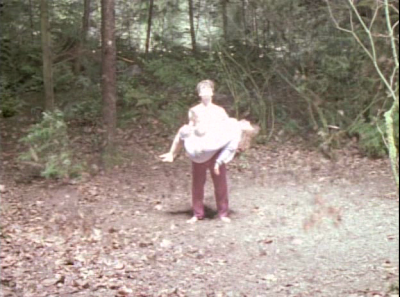
Which brings me to the Pilot Episode. It opens with a teaser sequence, set in the Pacific Northwest, that shows a girl in her nightrobe running through a forest, until she stumbles in a clearing. Here she is met by a human-shaped figure (whose features we cannot see) who is accompanied by a brilliant light; the wind whips up, there is lots of noise, the leaves are blown in circles around them as the light brightens. Cut to twelve hours later, and the girl’s body is found in the clearing by the cops, sporting two circular wounds near her backside. The chief ID’s the body, noting that she went to school with his son; another cop says, “Class of 1989? It’s happening again, isn’t it?”

Cut to Washington, DC and the FBI Headquarters, where a beautiful young agent named Dana Scully reports to her superiors for assignment. She is to work alongside another agent, named Fox Mulder, who has been using his time to investigate cases that are outside the official FBI mainstream. These cases, called “the X-files”, are the kinds of thing nobody wants anything to do with – except for Agent Mulder, who later suggests that it’s only by way of his friends in Congress that he is able to do this work at all. Scully is being assigned for her scientific, skeptical approach; when she asks if she is being expected to debunk Mulder’s work, her superiors manage to say Yes and No in that wonderful bureaucratic way of not saying much at all. Off Scully goes to meet Agent Mulder, who has just caught wind of this strange case brewing out in the Pacific Northwest. After some introductions, Mulder briefs Scully on the odd case and the wounds on the bodies (of which there are four), and then they’re off to Oregon to do some investigating.

This really is one of the better pilot episodes to a show I’ve seen. In the space of about five to ten minutes, we get: an intriguing mystery for the first episode; an establishment of a supernatural/paranormal mood; the introduction of our two main characters, both to us and to each other; the establishment of certain tropes within their relationship; the tense conflict between the official FBI and Agent Mulder; and some initial conflict between Mulder and Scully. They would later come to trust each other in the implicit way of two people who are absolute soul-mates, but there is still constant tension between her skepticism and his willingness to take wild leaps in logic in order to press his case. (Oh, and in the first scene in the FBI Headquarters, there’s an ominous looking fellow lurking in the background who is always fingering a lit cigarette.)

This first case of theirs also sets up so many of the tropes that would dominate the show for the entirety of its run. Alien abduction. Lost time. Mystery elements that are never able to be conclusively explained because the evidence is somehow destroyed or compromised. Implants of unknown origin. Secret government storehouses where old evidence is squirreled away, never to be seriously investigated again. Autopsies of mysteriously deceased persons, and autopsies of mysteriously deceased things that may or may not be persons. Locals who are unwilling to talk to the two FBI agents, and the one local who is. The fact that Agent Mulder is haunted by the disappearance/abduction of his sister. And the solving of the mystery in an unfulfilling way that leaves Scully nothing to report on.

I also noticed that the show’s look that would dominate the first five seasons – dark, cloudy, foreboding, often raining – is in full effect here, as is the moody synth-driven music by Mark Snow (minus the famous main theme, which wouldn’t arrive until the second episode). I was surprised, watching the Pilot episode again, to see just how much of the show’s eventual theme and feel was present right there from the beginning. Everything except The Truth being Out There. But don’t worry – it is. Oh yes.

(Oh, and I promise not to make this series into one long love-letter to Gillian Anderson. But I had no recollection of the pilot featuring a scene with her in her underwear…her skin lit only by the light of a single burning candle….)

Share This Post

“These deadly rays will be YOUR death!”

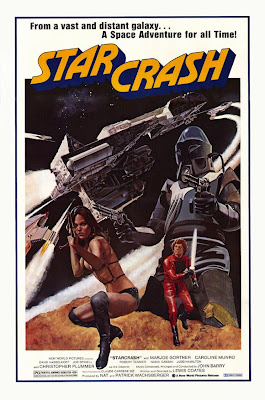
A while back I posted about an old SF B-movie I saw when I was a kid, Battle Beyond the Stars. I saw Battle in this old, somewhat beat-up theater in Hillsboro, OR that often showed double features – which I remember my parents sending me off to with their blessing, only now realizing that it was probably a great way to get an annoying kid out of the house for a few hours. Battle was the main feature that day; the lead-in was another SF flick called Starcrash. Yup, I saw Starcrash in its theatrical run.

If you’re a fan of SF movies, you’ve probably heard of Starcrash — and not in a particularly good way, either. It’s one of the legendarily bad movies of SF history, made on a shoestring budget to capitalize on the SF craze initiated by Star Wars in 1977. I remember kind of digging the movie, when I was 8 years old, but I never saw it again…until a month or so ago. I tracked the film down, wondering just how bad it really was. Is it really one of the worst movies in SF history? Or is it a bit better than I remember?

Well, it’s bad. Really bad. Its badness exists on some kind of epic level. Starcrash is almost a primal force of nature in its badness. Seriously, this is a bad bad BAD movie. But it does have that nice virtue of being bad on a level that’s entertaining in a “watch it just to laugh at it” kind of way.

The main characters is a female star pilot and criminal named Stella Star, who is gamely played by Caroline Munro, a buxom, gorgeous woman whose best-known role was a femme fatale who tries to kill James Bond in The Spy Who Loved Me, but upon whom Bond turns the tables and kills instead. (Interesting Bond trivia: Munro’s Spy Who Loved Me character, Naomi, is the first woman directly killed by James Bond in the movie series. Sure, he’s responsible for a lot of women dying, but she’s the first we ever see expire by his hand.) Stella is flying around with a curly-headed guy named Akton, when they incur the wrath of a couple of space cops, one of whom is a robot named Elle. They are basically blackmailed into searching for a lost ship that carried on it the son of the Emperor of space, or something like that. This is important because there are bad guys about, led by an evil Count, planning the conquering of the Empire. Or something like that.

Starcrash is one of those movies where when you try to summarize it, you find yourself saying vague things and using the phrase “or something like that” a lot.

Much of the middle section of the film settles into routine: Stella and friends go to a planet, find the Prince isn’t there, evade some dangers, and go to the next planet. Eventually there is betrayal, a bunch of mystical stuff involving Akton that makes no sense at all, the Prince turns up (played by David Hasselhoff!), we meet the Emperor (played with benevolent and soporific droning by Christopher Plummer), and we finally find out what the title “Starcrash” means. It involves crashing. Among the stars.

Below the fold are some screencaps of the glory that is Starcrash.

This is what space looks like. Kinda trippy – lots of stars of different colors.

Stella Star, on the right, and her trusty sidekick Akton. Ships in this movie are boxy and square on the outside, and filled with circles and ovals on the insides. Weird.

Stella’s line here – believe it or not – is “First you gotta catch me, you dirty cop!” Note the goofy smile on Akton’s face. That’s his main facial expression.

The evil count.

The evil count dispatches his robot assassins!

Stella is taken prisoner and put into a forced labor camp. Wearing this. Zowie!!!

Oh noes! Attack of the fifty-foot big-breasted sword-bearing robot!

Oh noes! Attack of the badly animated robot assassins!

Oh noes! ‘Tis the Hoff!

Hey, a sword that’s a laser! A saber made of light! What an idea!

The Emperor on his throne, which looks like…geez, how would you describe that thing?

If you decide to watch Starcrash, please prepare yourself for a bad movie. Drinking may help.

Here’s the trailer!

(Poster via)

Share This Post

Lovin’ the Lantern

I just saw this article about the Green Lantern movie that is currently in production. It’s sounding like a pretty nifty production:

See, here’s the the thing – I can’t tell you how Green Lantern will be as a movie, but after visiting the New Orleans set of the film I can tell you that director Martin Campbell and company are working to make the biggest, most epic, most sweeping, most cosmic superhero film yet. Forget Hal Jordan versus muggers in an alley, Green Lantern is really about Hal Jordan battling to save not himself, not his girlfriend, not even just his city but the entire planet Earth. Green Lantern is a huge movie, with set pieces that will be unlike anything you’ve ever seen before. I can’t spoil where the final battle takes place, but it’s an INSANE location – it certainly isn’t your standard issue end-of-the-movie warehouse, bridge or warehouse-like supervillain lair.

And it’s not just Hal Jordan. Green Lantern will feature the entire Green Lantern Corps; while visiting I saw life-sized cardboard cut outs of Tomar-Re and Kilowogg, the alien GLs who help train Hal Jordan. I saw mock ups of Oa, the planet at the center of the galaxy where the Guardians of the Universe oversee the galactic police force that is the Corps. And I saw much, much more – stuff that will make not just GL fans but hardcore space fantasy nerds salivate with excitment. I’m talking massive planetary and space vistas, incredible alien life forms and crazy space ship designs.

Yeah, this better not suck. I’d hate for something to sound so completely made for me and turn out to be a turd in the punchbowl. I am pleased to learn that Martin Campbell is directing; he is very good at directing action sequences that are highly kinetic and yet easily followed by the viewer. I’m looking forward to this.

(If you click through the article, make sure to click all the way through to the large versions of the two pieces of concept art they have posted. The Lantern cemetery is a beautiful, haunting space-opera type of image.)

Share This Post

Readin’

A couple of book notes:

:: A while back, Michael May recommended a book called Napoleon’s Pyramids, which sounded right up my alley:

I had high hopes for Napoleon’s Pyramids. It promised a lot: a swashbuckling hero, a mysterious medallion, an evil count, and an Indiana Jones-esque adventure to unlock the secrets of the pyramids. I’ve learned to be skeptical though about stories that sound too good to be true. There’s always something wrong. The hero is unlikable, the Maguffin is dull, the villain is unbelievable, or the adventure is a bait-and-switch that promises much more than it ever intended to deliver. Napoleon’s Pyramids has none of these problems. It’s exactly what it claims to be and so much more.

I’ll second his recommendation, with one caveat. This book is like a cross between Indiana Jones and the National Treasure movies, set in the Napoleonic era. There are secret societies, ancient prophecies, present-day people who are guardians of ancient lore, exciting chases, thrilling escapes, and interesting characters. You have the French army, the English navy, American spies, mysterious Egyptians, and even Gypsies. All this is mixed together in a plot that is a lot of fun — so much so that you expect to hear music by John Williams or Jerry Goldsmith while you read it.

The book’s pacing slows down a bit as we move into the middle third of the book, but as soon as I became concerned about that, the book picked right back up again. There are twists that are predictable, but I think those are there to distract attention from the twists that are not predictable — and there are quite a few of those.

My one caveat, that I mention above? Michael May did mention that the book is the start of a series. He did not mention that this one ends on a cliffhanger. Aieee!!!

:: Grease Monkey is fantastic. I loved it. What is Grease Monkey? It’s a graphic novel, originally serialized online but now available in a trade paperback, about a young mechanic who comes to live on a giant space cruiser, where he hopes to get a job working on the fighter ships. He is assigned to work with Mac Gimbensky, the very experienced, and very crusty, older mechanic who just happens to be a gorilla.

All of this is in the wake of an alien invasion of Earth, and a subsequent visit by aliens who “uplift” gorillas to human levels of intelligence. The book tells the story of their unfolding relationship, and their trials and tribulations on an immense warship that is a society of its own, with competing squadrons, weaselly mechanics out to steal each others’ secrets, cranky librarians, military officers who desperately want control over everything, and, as our young hero discovers, girls.

As a collected webcomic, Grease Monkey is pretty episodic in structure; there’s no plot that ties everything together, but there are arcs to follow as creator Tim Eldred opens up more and more of his world. The entire story, though, takes place on this one ship, and the whole conceit is great; it’s wonderfully refreshing to read a SF/space opera story where the Admirals and Captains are only supporting characters, and we instead focus on the mechanics who are just trying to keep the fighters flying and find time in between to have dates and read their favorite books.

Grease Monkey also has a wonderful sense of humor. I laughed out loud plenty of times while reading it, and some of the chapters turn out to be elaborate set-ups for jokes that only pay off in the very last panel or two.

Grease Monkey is great stuff. Read it!

Share This Post

Covering up

Lynn comments about a blog devoted to “bad” F/SF book cover art. I put “bad” in quotes because, well, not all of them strike me as being bad.

What interested me, though, is that I had to go all the way to page 19 of the blog to find a book that I actually own. I have that cover. Wouldn’t call it “bad”, just strangely uncompelling. And in fact, if you hate that cover to Carpe Diem, then you can probably rip on any of the other covers in those particular reprints of the Liaden Universe novels, because they all have the same kind of theme: a man, a woman, and a SFnal backdrop like a planet or a spaceship.

Share This Post