Alas, poor Yori! I knew her, Horatio….

Via Cultural Compulsive Disorder, I see this poster for TRON Legacy. It’s a Hungarian poster, actually. Apparently the marketing strategy in Hungary for this movie is a bit different from the one in this country so far:

But I also found this one out there somewhere, so maybe the marketing will now focus on the wimminfolk of TRON as opposed to the teaser posters to date, which have been all-lightcycles, all the time.

I’m looking forward to this movie, even with my trepidation that it may end up feeling more Matrix than TRON. That would be disappointing, given that I’m a big fan of the latter and not a very big fan at all of the former.

Share This Post

Obtaining the Unobtainable

The Wife and I watched Avatar the other day. My reaction to the film is still pretty much what it was: I liked it as a well-made, beautiful-to-look-at SF adventure flick. Nothing earth-shattering from the story standpoint, but just an extremely well-crafted popcorn movie. And you know what? There’s absolutely nothing wrong with that, and in truth, I’m even kind of OK with the film’s Best Picture nomination, since William Goldman has long noted that adventure films and comedies are the hardest movies to get right, and yet, those are the kinds of films that get snubbed left and right at Oscar-time.

I do want to note one thing, though. I remember lots of reviews either lightly making fun of James Cameron, or ripping him outright, for his naming the elusive mineral the mining company in the movie is looking for unobtainium. Well, a few weeks ago I was reading David Brin’s Startide Rising (which I ended up bouncing off and stopping in the middle, despite the book’s somewhat classic status), and I found this passage on page 93:

None of the other moons in the Kthsemenee had the one attribute this one possessed: a core of almost one percent unobtainium. [Emphasis added]

Well, lookee there. Cameron just used a term that David Brin used in a highly-regarded novel years before. What a yutz!

Share This Post

100 more SF books everybody should read!

Lynn found this list, which differs substantially from the last one I did, so we’ll do the same deal this time: already read it; own it and plan to read it; don’t own but plan to read. With occasional comment.

UPDATE: There’s apparently not 100 here. Oh well. Call it the “Almost a hundred”, then.

The Forever War – Joe Haldeman
I Am Legend – Richard Matheson

Cities in Flight – James Blish
Do Androids Dream of Electric Sheep? – Philip K. Dick (I still haven’t read any PKD!)

The Stars My Destination – Alfred Bester
Babel-17 – Samuel R. Delany
Lord of Light – Roger Zelazny
The Fifth Head of Cerberus – Gene Wolfe
Gateway – Frederik Pohl

The Rediscovery of Man – Cordwainer Smith
Last and First Men – Olaf Stapledon
Earth Abides – George R. Stewart
Martian Time-Slip – Philip K. Dick
The Demolished Man – Alfred Bester

Stand on Zanzibar – John Brunner
The Dispossessed – Ursula K. Le Guin (Read it in high school. I’m pretty sure I missed its point entirely.)

The Drowned World – J. G. Ballard
The Sirens of Titan – Kurt Vonnegut
Emphyrio – Jack Vance
A Scanner Darkly – Philip K. Dick
Star Maker – Olaf Stapledon

Behold the Man – Michael Moorcock
The Book of Skulls – Robert Silverberg
The Time Machine and The War of the Worlds – H. G. Wells

Flowers for Algernon – Daniel Keyes
Ubik – Philip K. Dick
Timescape – Gregory Benford
More Than Human – Theodore Sturgeon
Man Plus – Frederik Pohl

A Case of Conscience – James Blish
The Centauri Device – M. John Harrison
Dr. Bloodmoney – Philip K. Dick
Non-Stop – Brian Aldiss
The Fountains of Paradise – Arthur C. Clarke

Pavane – Keith Roberts
Now Wait for Last Year – Philip K. Dick
Nova – Samuel R. Delany
The First Men in the Moon – H. G. Wells
The City and the Stars – Arthur C. Clarke

Blood Music – Greg Bear
Jem – Frederik Pohl
Bring the Jubilee – Ward Moore
VALIS – Philip K. Dick
The Lathe of Heaven – Ursula K. Le Guin

The Complete Roderick – John Sladek
Flow My Tears, the Policeman Said – Philip K. Dick
The Invisible Man – H. G. Wells
Grass – Sheri S. Tepper
A Fall of Moondust – Arthur C. Clarke

Eon – Greg Bear
The Shrinking Man – Richard Matheson
The Three Stigmata of Palmer Eldritch – Philip K. Dick
The Dancers at the End of Time – Michael Moorcock
The Space Merchants – Frederik Pohl and Cyril M. Kornbluth

Time Out of Joint – Philip K. Dick
Downward to the Earth – Robert Silverberg
The Simulacra – Philip K. Dick
The Penultimate Truth – Philip K. Dick
Dying Inside – Robert Silverberg
Ringworld – Larry Niven

The Child Garden – Geoff Ryman
Mission of Gravity – Hal Clement
A Maze of Death – Philip K. Dick
Tau Zero – Poul Anderson
Rendezvous with Rama – Arthur C. Clarke

Life During Wartime – Lucius Shepard
Where Late the Sweet Birds Sang – Kate Wilhelm
Roadside Picnic – Arkady and Boris Strugatsky
Dark Benediction – Walter M. Miller, Jr.
Mockingbird – Walter Tevis
Dune – Frank Herbert

The Moon Is a Harsh Mistress – Robert A. Heinlein (Well, I tried once, and bounced off about halfway through.)

The Man in the High Castle – Philip K. Dick
Inverted World – Christopher Priest
Cat’s Cradle – Kurt Vonnegut
The Island of Dr. Moreau – H.G. Wells
Childhood’s End – Arthur C. Clarke
The Time Machine – H.G. Wells (Hold on, this is on here twice!)

Dhalgren (July 2010) – Samuel R. Delany
Helliconia (August 2010) – Brian Aldiss
Food of the Gods (Sept. 2010) – H.G. Wells
The Body Snatchers (Oct. 2010) – Jack Finney
The Female Man (Nov. 2010) – Joanna Russ
Arslan (Dec. 2010) – M.J. Engh (Given contemporary events, this is a really creepy book.)

In other SF reading notes, I’ll just note here that I stopped reading Startide Rising by David Brin about halfway through. There are tons of nifty ideas in that book, but I didn’t care one bit about any of the characters, to the point where halfway through I was having to look back to the book’s Dramatis personae just to remind myself who was being talked about a lot of the time. Part of the problem, for me, is that a lot of the really interesting stuff in the story (the events of the Streaker‘s finding the derelict fleet) is over by the time the book begins, but another problem is that I just wasn’t roped into caring about the people Brin was writing about. So I looked up a plot summary online just to see where the book went after that, and I’m done. I won’t be bothering with the remaining books in the Uplift series.

Share This Post

Jaran

A while back I bought a copy of Kate Elliott’s novel Jaran on the assumption that it was, at least kinda-sorta, a space opera. It turns out to not really be a space opera at all; it’s more of a future planetary romance type of book. No matter; those are only matters of taxonomy and nomenclature. It’s not a space opera simply because very little of it takes place in space.

So what is Jaran about, then? It turns out to be a science fictional romance story, as well as a tale of an epic journey, a clash-of-cultures novel, and a quite wonderful character study. I actually started the book a year or two ago, read a few chapters, and then put it aside — not, if I recall correctly, out of any negative feeling for the book but because something else came along that I really wanted to read instead right at that moment. The last Harry Potter book or maybe a Guy Gavriel Kay book. Something like that. So I finally got back to Jaran, and in a lot of ways I didn’t want it to end (which is nice because it’s the first book in a four-book series).

Terese Soerensen (known as “Tess” to friends) is the sister of Charles Soerensen, a human who has been given a Dukedom over a number of worlds by humanity’s apparently gracious conquerors, that Chapalii. As sister to a very important man, Tess has a number of responsibilities and obligations that she is less than thrilled about pursuing, especially after her fiance breaks her heart, so she decides to eschew her duties in favor of traveling to a world called Rhui, where she wants to bury herself in linguistic studies. But on her way there, she finds evidence of some kind of odd plot involving humanity’s Chapalii conquerors, so she follows the evidence and ends up stranded in the middle of the grassy steppes of a vast continent. She soon meets the locals, who are human — but who are not technological, and instead live a nomadic existence with the horse as their primary mode of transportation.

These people are known as Jaran, and the first one she meets is one of the most important of all Jaran, a man who wants nothing more than to unite all of the fractious, often-warlike tribes under one banner. His name is Ilya Bakhtiian, and he is unlike any person Tess has ever known.

Over the course of the rest of the novel — and all of this set-up takes about twenty pages — Tess will have to learn a new culture, travel across a continent by horse, investigate the doings of the Chapalii on a planet they’re not even supposed to be on, come to terms with her own emotional pain, and work through her increasingly complex feelings for Ilya Bakhtiian. All of this makes for one of the finer “character-driven” stories I’ve read recently.

I suppose it’s not much of a spoiler to note that Tess and Ilya do fall in love with one another, but the book is praiseworthy for the way it develops their relationship. Both characters are complex and flawed, and their relationship is full of strife and hardship. There were plenty of times when I wanted to slap either Tess or Ilya or both upside the head, and that’s actually a good thing, as that means I had come to care about these people.

Elliott also displays a good gift for language, especially as she creates the recognizable, and yet alien, culture of the Jaran. They all tend to speak with unexpected cadences and rhythms, and the depiction of a matriarchal culture doesn’t feel at all contrived as some SFnal matriarchies do. Many such societies end up seeming like regular old patriarchies with the genders switched, but Elliott avoids that trap in a number of interesting ways.

Here is a passage that I particularly admired. Here, Ilya Bakhtiian is talking to Niko, a wise elder, about his conflicted feelings for Tess and what those feelings may mean for his dream of uniting all the Jaran:

“Loving a woman and wanting a woman are not the same thing.”

Ilya simply stared at him [Niko], perplexed. “Of course, to desire a woman only because she is pretty–“

“I am not speaking of anything so simple. Listen to me, my boy. When you came back from Jeds, you had found the path you were destined to ride, knowing that it would bring you fame that no other jaran had found before you. But the gods play this game with us, challenging us to strive for fame, and yet how many of us can ever hope to beat their players: the wind that never ceases, the deep earth, the rain that dissolves the ashes of the dead, the unbounded sky, and the silent stars. They play their game well. They have only to wait us out to win.”

The rising sun laced hsi pale hair with silver. “Yet now and again, a man or a woman is born who has weapons against these opponents, one who can command quiet, who can see beyond death, one who can hold fire to the old ways and let them burn. You are such a man. You can change the jaran. You are changing them. You can leave this world with a name that will live forever. You can win that game.” He fell silent. Two women spoke in low voices from the etsana’s tent, too far away for words to be distinguishable. From the farther edge of camp, a man hallooed, and a child yelped and laughed.

“But you will die in any case, Ilyakoria. What good is everlasting fame to a man if he dies unloved?”

A wind had come up. It touched Ilya’s hair, stirring it like a whisper.

“Love, Ilya. That is what we who are mortal have been gifted, a gift never given adn never known by the undying. The wind cannot love the plain, but I can love the plain, and I can love much more than that and be loved in return. Fame is something you want. A woman is someone you love.”

(I’m finding, more and more, that I’m less and less interested in stories that don’t have some component of a love story within them. This doesn’t mean that I want every book to be a romance, but it does mean that books where love is not a theme are turning out less interesting to me. I’m not sure why this is the case, but it’s something I’ve noticed in my reading lately in terms of the trends I’ve seen in my reactions to the books I’ve been reading.)

Share This Post

Tanj!

Time for some notes on a bit of recent reading!

:: As much as I love science fiction, I’m the first to admit that my reading history with it is full of holes, and that there are many, many authors who are pillars of the genre whom I have yet to read. I can scratch one off now, because I’ve finally read some Larry Niven. Specifically, the novel Ringworld.

I really don’t know anything about Niven at all, except that he’s done lots of work with Jerry Pournelle, and that he’s mainly known for a series of books or stories called “Known Space”. I’m not even sure if Ringworld is part of “Known Space”, but the book does stand on its own, somewhat – although it is clearly intended to establish a ground-floor of sorts for a possible series. And now I see, according to Wikipedia, that Ringworld is certainly part of “Known Space”, and boasts a number of direct sequels. It also won the Hugo and Nebula awards.

Ringworld is your archetypal “Team goes to investigate an anomaly” tale, and parts of it reminded me, in terms of mood, of Arthur C. Clarke’s Rendezvous with Rama. The Ringworld is a very strange object indeed: an enormous construct built around a far-off star, that basically looks like an impossibly long band of metal (or something) running completely around the star, with the side of the band facing the star terraformed into something akin to a planet surface. The result is a planetscape that is thousands of times roomier than, say, the surface of the Earth. Circadian cycles on the Ringworld are approximated by enormous black panels that likewise orbit the star farther in, which block out the star’s light from points on the surface of Ringworld at regular intervals.

So our expedition quickly forms, consisting of four individuals: humans Louis Wu (a 200-year old man looking for some new solution to his boredom) and Teela Brown (a young woman with no particularly notable qualities, except her extraordinary luck); Nessus (a three-legged alien from a race called the Puppeteers); and Speaker-to-Animals of the warlike kzin race. How these individuals come together, and why, I’ll leave to anyone who wants to read the book, but in just about any story like this, the main source of conflict arises from the differences between the main members of our cast. That is certainly true here.

I won’t give anything away, except to note that the story unfolds in a lot of expected ways; the landing on Ringworld isn’t quite according to plan, and our heroes find a lot on Ringworld that they couldn’t have possibly expected. Niven does a good job of creating and sustaining mysteries on this world, and he also does a great job of conveying what the distances must be like on an object that is literally the size of Earth’s orbit. The immensity of the Ringworld is its dominant characteristic, and as we internalize how huge the thing is, the more mysterious it becomes – especially its relative lack of inhabitants. The mystery becomes, if some alien race surely built the Ringworld so they would have enough room, then why is there almost no sign of them? Niven’s possible answers to this question involve some interesting speculations on the psychology that would result in a species living on such a construct.

The four main characters are fairly interesting, but not tremendously so, and I found the whole notion of the Puppeteers genetically engineering people to select for their luck strained my credulity a bit. The biggest flaw in the book for me, though, was a linguistic tic: since Ringworld dates from an era when characters in SF weren’t allowed to use actual swear words, authors had to either resort to just telling us that their characters had sworn, inventing their own new metaphors for expletives, or – as Niven does here – making up his own swear words. Sometimes in a series this can work, but other times it’s almost nonsensical. In short, I had a very hard time with the word tanj, which is an acronym for “There ain’t no justice”. Every time someone would say “Tanj”, or “Tanjing”, or “Tanjit”, or some variant thereof, I found myself momentarily ejected from the book.

Still, this was an entertaining and intriguing read. Will I read further into Niven, the Ringworld, and Known Space? I’m not sure. But I won’t rule it out.

:: While I love to read comics, I find that I have almost no appetite for superhero comics anymore. At least, not the ones apparently being produced today, to judge by the collections I get from the library. It seems as though every title now, every hero, and every story about every hero, has to be some kind of depressing descent into the tremendous angst at that hero’s heart. And frankly…all that superheroic angst gets a bit boring. I almost want to say, “Yeah, I get it. Loads of pressure on you. You feel responsible for the world but can’t tell anyone because your identity is secret. You’re terrified of a horrible fate befalling your loved ones when your enemies find out. And since you’re a superhero, you’re likely to outlive every one you love, anyway. Buck up and get over it! Have fun!” Where the heck is the spirit of fun adventure that used to be the dominant characteristic of superhero comics?

I’m not claiming that some angsty stuff isn’t welcome. You can go too far the other way, too, and you need some inner conflict to keep the heroes interesting as characters. That’s why Spiderman’s always been one of my favorite superheroes: the very best Spidey stories always managed to blend that sense of fun with just the right amount of angst for Peter Parker. There are very dark things in Parker’s life story, but they’re not dominant and they don’t color his view of the entire world and they don’t cast his stories themselves into depressing light, as Batman’s tend to do.

I think this all started, maybe, with Frank Miller’s The Dark Knight Returns, which I didn’t like nearly as much as I think I was supposed to. Batman, in his current incarnations, tends to be a deeply depressing character. He’s the ultimate wet blanket on the superhero party. And I hate it when I read other titles that seem cut from that cloth. Hence, Spiderman: Reign. I was all prepared to be “Meh” on this book, but now I realize…I hated it.

Like Dark Knight Returns, Reign takes us forward in time, to Spiderman’s elder years, when he’s a white-haired, bearded Peter Parker whose personal life is every bit as much a wreck as it’s ever been. For one reason or another, Parker takes on the Spidey suit again, all the while subjecting us to depressing monologue after depressing monologue about how much he misses Mary Jane, his wife, who is now dead. (I assume this was before Marvel’s awful “Turning back of the clock” to before their marriage.) Why is she dead? I won’t spoil it here, but suffice it to say that it’s perfectly in keeping with the notion that the act of knowing Peter Parker is to commit oneself to an awful fate that’s supposed to be ironic or something.

In Reign, about the only sense of any fun at all comes from Spiderman’s never-ending habit of wisecracking with the people he’s fighting. Other than that, the book is dank and depressing. It reads like if the guy who does Funky Winkerbean wrote a superhero comic.

:: I didn’t hate Justice League: A League of One; I just found it kind of dull. Which is disappointing, because it’s a Wonder Woman story. Sure, the title says “Justice League”, but when Wonder Woman receives a prophecy that sounds like it’s foretelling the death of whoever fights an ancient evil that has just returned to life, she incapacitates all of her Justice League friends, one by one, until she’s left alone to face the threat. It was an interesting conceit, but it kind of illustrates another problem with these kinds of stories: if you want to tell a story about one hero in the DC Universe, you have to at some point explain why the other heroes who are all over the place, including the Man of Steel himself, either can’t or won’t pitch in to help.

This tale pits Wonder Woman against the most ancient of dragons, who had been slumbering beneath a mountain in Europe for centuries but who has now been awakened by some gnome-like creatures. The whole story feels a bit strange, really – as if Wonder Woman has been shoehorned into a tale from Teutonic myth. It doesn’t really work all that well, and in fact, its resolution feels almost perfunctory. The book seems to spend more pages dealing with Wonder Woman’s “betrayals” of her teammates than on her battle with the threat in the story.

:: Somewhat more successful, although still a bit less than the sum of its parts, is Wolverine: The Brotherhood. After Spiderman, Wolverine’s probably my second favorite superhero, mainly because he’s a bloodthirsty redneck with a sardonic sense of humor. I like that. He’s deeply intelligent but nobody realizes it at first, so in addition to his extreme skill at combat and his unbreakable claws, he’s got the built-in advantage in always being underestimated. When he’s well-written, Wolverine is as entertaining as they come.

This story, apparently from a six-issue run of one of the comics titled Wolverine (I’ve utterly lost track of the publication history of these titles and where the solo Wolvie stories fit in with X-Men continuity), has Wolverine living in a crappy apartment in Portland, OR, where he spends his days sitting in a local diner, reading and drinking coffee. He makes a connection with his waitress, a seventeen-year-old girl who keeps a journal in which she refers to Wolvie as “Mean man”. Before this friendship can blossom, Lucy (the girl) is murdered by a couple of machine-gun wielding hoodlums, who also riddle Wolvie with bullets when he comes out of his apartment to see what’s going on. (Lucy had lived next door to Wolvie.) Of course, filling Wolverine with bullets is never a good idea, and now Wolvie’s on the hunt.

His journey takes him into a world of illegal gun dealers and then to a compound somewhere in the mountains of Oregon, where a cultish figure is keeping a harem of kidnapped girls. This is all actually pretty intriguing stuff, and I like Wolverine’s solo stories like this. It always seems a bit more believable than Wolvie squaring off against supervillains, for some reason. My favorite Wolverine story is the Wolverine limited series from the 1980s, written by Chris Claremont and drawn by Frank Miller, which delves into Wolvie’s interactions with the Japanese culture and the idea of Wolvie as fallen Samurai; that tale doesn’t even pit Wolvie against any kind of supervillain at all. Same with this one, although it’s not as well written as the earlier series. The villain turns out to be simply garden variety, and the story seems to be set-up for a following plotline involving the Federal agent who is tailing Wolverine. The collected graphic novel comprises six issues of the series, of which the last consists of Wolverine sitting in a bar, talking with X-buddy Nightcrawler about…what else…his angsty issues. (With Wolverine, it’s his balancing of his human and animal natures.) It’s probably a bit unfair to judge this story on the basis that it’s simply not a complete story, but the talk-over-a-beer-with-Elf issue pretty much brings the story’s forward momentum to a halt. Kind of a shame.

Share This Post

Stars, ships, and ferrets in pants

Time to catch up on some recent reading!

:: Sports From Hell: My Search for the World’s Dumbest Competition by Rick Reilly is a fun piece of sportswriting in which Reilly travels the world in search of really bizarre sports. The ones he finds are both familiar (the “Rock Paper Scissors” championships) and utterly unexpected (World Sauna Championships). Some of these he tries, some he only watches from afar, but all in all, the book is a funny and fascinating look into the world of organized competition. Despite having built a society, we humans still revere competition and have a biological need for it, so we’ll end up competing in anything. Such as, who can sit in an extremely hot sauna (261 degrees) for the longest, or who can sit the longest at a poker table that’s been set up in the middle of an arena into which an angry bull has just been released, or who can hold out the longest after having a ferret dropped into their pants and their belts and cuffs taped shut. Yes, that ferret-in-the-pants thing is real. It’s the cover photo of the book.

Some of the sports are surreal not just for the events themselves, but for the context in which they are played. The bull poker, for example: that one takes place in a prison in Louisiana, and the competitors are inmates. The warden makes a case that allowing competitions like this gives inmates some form of dignity, but Reilly creates an interesting juxtaposition when, at the end of the chapter, after an inmate named Rocky has won the bull poker competition, he gives the reaction of the father of the girl whose murder Rocky is in the pen for in the first place. “I didn’t know that someone who raped and murdered an innocent person would get to ride in a rodeo. That doesn’t sound like hard labor to me.”

My favorite chapter was the one on baseball. Not some kind of special baseball that they play in white-water rapids, or on top of a mountain, or something weird like that. Just regular old Major League Baseball. Now, I used to be as big a fan of baseball as anyone, but various things have sapped my enthusiasm for the game. First, my favorite team has sucked for almost two decades. Second, we haven’t had cable in years, so following baseball is basically a “checking the boxscores online or in the paper” thing now. But third, really — the game has become longer and longer and duller and duller. Hence Reilly’s first complaint, that “Baseball is as dull as Amish porn.” That whole chapter is as good a rant as I’ve read in a while. Here’s a taste:

3. Writers somehow think baseball is male childbirth.

There’s no bigger gap in any sport than the one between misty-eyed Jack Kerouac-quoting baseball writers and red-eyed Jack Daniels-drinking baseball players. Press-box poets like George Will are always waxing nostalgic about the game; everything is roses and sepia tones and tearstained “catches” with Dad. They’ll see some rookie standing with some old vet in the outfield and say, “Imagine the lessons being handed down.” And having been around the game my whole life, having played it, I can tell you the lessons. The old vet is saying, “You see the blonde with the rack sitting behind the dugout? She likes power tools.”

:: Two space opera novels recently joined the ranks of…space opera novels I’ve read. Prophets by S. Andrew Swann (book one of a series called Apotheosis) was a fairly quick and breezy read. Not that it’s a light book, by any means, but it’s fairly short and it’s divided into short chapters, which always helps the pacing along. The book posits a complex spacefaring human society in which there are several groups constantly vying for power (an Islamic Caliphate and the Roman Catholic Church among them) when the existence of a lost human colony, way out in space, is discovered. There’s a race against time to get out there and see what’s going on…and of course, there’s a lot more going on than a simple lost colony.

This is, as noted above, the first book in a series, and from what I’ve gathered, this series is a sequel series to an earlier series by Swann, so I have some catch-up reading to do. This was a fun, fast-paced space adventure story.

:: Also fun, but not quite so fast-paced, but wildly adventurous, is Judas Unchained by Peter F. Hamilton. This is the sequel volume to his earlier Pandora’s Star (previously discussed), and it’s about as long — 1000 pages of space opera goodness. I can’t say too much about it, since it is literally the second half of a pretty massive story, but I did greatly appreciate how Hamilton is mostly able to bring all of the various storylines — and there are a lot of them — together in fairly convincing fashion. The pace really picks up in the last two hundred pages, leading to a nicely whiz-bang conclusion. The series also has lots of ideas and managed to keep me nervous about the fates of characters even in a universe in which death has been rendered an impermanent state. This duology is long, but it’s very impressive. I’m already looking forward to The Dreaming Void, which kicks off a new series set in the same universe.

Share This Post

Striking Back

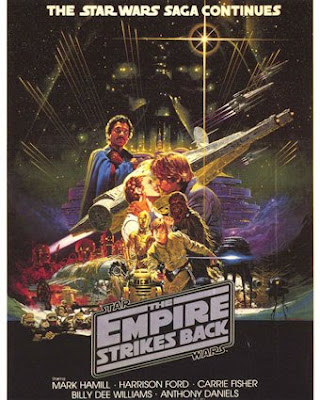
So, thirty years have passed since the release of Star Wars Episode V: The Empire Strikes Back. Wow, I guess. As luck would have it, I watched the film not too long ago — a couple of months, probably — and it still holds up extremely well. This is unsurprising, of course; the film is a bona fide classic.

I’ve read some tributes here and there around the Interweb and around Blogistan specifically, and I’ve found myself of mixed mind about the good words being said about the movie, mainly because a very large portion of comment seems to be of the “Wow, remember thirty years ago when Star Wars didn’t suck?” variety. I’m saddened by that, but hey, nothing I can do about it, either. It gets tiring, though — it seems that every event or happening or milestone that returns Star Wars to public consciousness is followed by the usual “George Lucas is the richest hack in history” comment. Oh well. Par for the course. Put it this way: I’m not much looking forward to 2013’s 30th anniversary of Return of the Jedi.

Empire came out when I was just eight years old, living in Hillsboro, OR. I didn’t see it for a few weeks after it came out, and yet, in those pre-Interweb days, I was able to go see the sequel to Star Wars three or four weeks after its release with zero idea of its story, other than what I’d seen in the TV commercials and such. I knew there was a snowy planet where the Rebels were fighting these big metal dinosaurs, I knew that there was a space chase through some asteroids, and I knew that there was a new character played by some guy named Billy Dee. That’s about it. I certainly had no idea that there was a Jedi master named Yoda, and I was actually surprised when the goofy little green guy in the swamp turned out to be Yoda. I was horribly dismayed when Han Solo got put into carbon freeze, but I thought, “Hey, no prob, they’ll save him before the movie ends.” Yeah…my first ever experience with a cliffhanger.

And I had no idea whatsoever that Darth Vader might be Luke Skywalker’s father.

How was this possible? Well, again, it was pre-Interweb, and pre-cable teevee, and all the rest of that. Also, I was lucky that my school district at the time let out for summer vacation in the first days of June, so Empire had been out for all of two weeks before I lost most contact with my schoolmates, most of whom hadn’t yet seen the movie either. So there was nobody to spoil the thing for me. I went into that movie almost completely blind. Empire was the last Star Wars film I was able to do that with.

Empire is, of course, now nearly universally hailed as the best of all Star Wars movies. There’s a lot to that, to be honest; the film earns its reputation with a superb script, amazingly paced and shot action sequences, a darker turn of events, and what may well be the best music John Williams has ever written. When pressed, I will almost always name A New Hope as my personal favorite Star Wars film, but the pro-Empire arguments are compelling.

Empire‘s beloved status really only started to grow after Return of the Jedi came out three years later. I don’t think it’s so much because Jedi was a bad film, as much as Empire‘s nature — being the middle act of a three-act story — meant that it could only really be appreciated once all the acts were out there, and the middle act’s true function and relation to the rest of the story could be judged. If I preferred Empire when I was a kid, it was mainly because it was shinier and newer than the older, more familiar film.

Here, in tribute, are my two favorite tracks from the entire brilliant score to The Empire Strikes Back. Empire was the first record album I ever bought with my own money. I didn’t even have my own record player at the time, and I had to listen to it in my parents’ bedroom when I wanted to hear it. I’d later get a record player that Christmas (it also had an 8-track tape player!), and Empire was the first thing I played on it. I played that album (a 2-LP set) to death over the next few years, wearing out the gatefold record jacket and putting numerous pops and scratches into the LP’s grooves themselves. Back then, John Williams would arrange his albums to make a “better listening experience”, which meant that tracks were not arranged on the album in the order they were heard in the film and that tracks from entirely different parts of the film were sometimes combined into a single track on the album. I played that album so much that even now, when I listen to subsequent remasterings of the Empire score, with all the tracks in film order, my brain still expects the original album order, with its tracks bearing titles like “The Heroics of Luke and Han”.

The first track is my favorite action cue from the score. Many fans would cite “The Asteroid Field” as theirs, but for me, it’s “The Clash of Lightsabers” all the way. This track underscores the second part of Luke’s duel with Vader, after they’ve moved from the carbon freezing chamber to a mechanical anteroom where Vader starts using the Force to hurl machine parts at Luke. It begins mysteriously and becomes more and more ominous as Vader toys with Luke; the music howls when the big window behind Luke is shattered and the wind begins to pour through the room, sweeping Luke out into the shaft, where he manages to catch onto the gantry and pull himself to safety. Then we cut (at the 1:38 mark) to Leia, Chewie, Lando and the droids as they work their way back to the Millennium Falcon. Lando’s theme (at the 2:00 mark) plays as he announces the evacuation of Cloud City. The rest of the track builds and builds (love the great brass bit starting at 2:36) which ends in first triumph as R2-D2 opens the door to the landing platform, and then the desperate version of the film’s Love Theme as the heroes race for their ship and freedom. This is one of my favorite action cues in all film music.

Second is from earlier in the film, on Dagobah: “Yoda and the Force”. This scene is, for me, the philosophical and emotional heart of just about all of Star Wars, when Yoda takes advantage of the sinking of Luke’s X-wing into the swamp to try to get through to Luke as to what it truly means to feel the Force. It’s a wonderful cue, from the meditative string writing to the noble statement of Yoda’s Theme as he lifts the ship from the water.

Happy birthday, Empire. You’ve never looked better.

Share This Post

“Now that’s what I call a close encounter.”

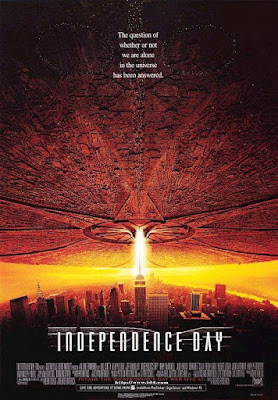
The Daughter and I watched Independence Day last week. It’s the first time I’ve watched the entire movie in ages, and my impressions haven’t changed one bit. I’ve never been one for the idea of “guilty pleasures”, which I take to mean “Things you like even though you know you shouldn’t”; why should I ever think I shouldn’t like something that I already like? Makes no sense to me…but Independence Day (or, famously and quite oddly, ID4 for short) is about as close as I come to having a real guilty pleasure. I like the movie a lot, and yet, there’s so much that’s wrong with it!

(Hmmm, in that sense, it’s not unlike Star Trek 2009 in that regard.)

ID4 is a movie that piles plot hole after plot hole on top of implausibility after implausibility. It’s a movie that posits the horrible deaths of tens of millions of human beings on Earth, and yet is lots of fun to watch. It’s a movie that has the President of the United States personally leading the fighter plane attack on the alien ship at the end of the film, hours after he’s watched his wife die. There is so much stuff in ID4 that doesn’t make sense in any way, and yet the movie is so well-made that it almost never matters. It’s the Teflon movie. I can sit here and rattle off a long list of things that are wrong with it, and yet, when I watch it I get excited at President Whitmore’s cheesy “St. Crispin’s Day” speech; I laugh when the Defense Secretary has to speak up and tell the President that yes, there is an Area 51; I choke up with cropduster pilot Russell Case sacrifices himself to destroy the aliens; et cetera.

I assume anyone reading this far into this post remembers the plot of ID4: aliens attack earth, blowing up city after city while humanity reels. A plucky group of survivors, including the President of the United States, gathers at Area 51, where they figure out how to strike back against an enemy whose ships all have impenetrable shields. Finally the resident computer genius (Jeff Goldblum, of course) figures out how he can use his 1995 Apple Powerbook to infect the entire alien fleet with a computer virus that will lower the shields, and the humans attack. Lots of explodey-spaceshippy-goodness ensues.

I got the DVD out of the library, not realizing that it was one of those “Revised Director’s Cuts” that put about ten minutes or so of stuff back into the cut, so while watching the movie, I kept realizing I was seeing scenes I hadn’t seen before. In some cases, those scenes actually helped smooth over some of the plot holes.

Some random thoughts from the recent viewing of ID4, then:

:: It’s interesting that the film goes out of its way to avoid establishing whether President Thomas Whitmore is a Democrat or a Republican. I have no idea, and based on the evidence in the movie, I couldn’t even hazard a guess.

:: Implausibility watch: Of all the geniuses who are surely working on analyzing the aliens’ signals and transmissions, only the cable teevee genius in New York (Goldblum) is able to figure out that they’re running a countdown?

:: Early on, as the Mother Ship is entering orbit, an Earth satellite is destroyed when the mother ship moves into its orbital path. I never noticed before, but the satellite has “CCCP” painted on its outside. Is that actually supposed to be the Mir space station?

:: Implausibility watch #2: In the event of massive public panic in the largest cities in the world, it’s still possible to drive from NYC to Washington, DC in less than seven hours. (The “Director’s Cut” adds back a bit of footage that shows the drive being less easy than it appeared in the original cut, but it’s still hard to buy.)

:: Implausibility watch #3: One of the closest advisors to the President of the United States would really keep her cell phone number listed “for emergencies”? What kind of emergency would that be? In the original cut, when David (Goldblum) calls Connie (Margaret Colin) on her cell, her first words are, “How did you get this number?” I’ve always thought that odd, since she keeps it listed! But the Director’s Cut fleshes this out a bit, with David having to look up the number, but realizing that she hasn’t listed it under her current real name. (She used his last name, as she is his ex-wife, but she didn’t take his name when they were married.) This still doesn’t explain how it would be useful to her to be listed in the phone book under a different name, but the movie was written and made in 1995 when cell phones were only starting to really take off, so I’ll give them a pseudo-pass on this. It always stands out, though.

:: A couple of additional scenes with Russell Case (Randy Quaid), the drunken cropduster, establish that he didn’t actually father those kids but married their mother. (At least one of them, anyway.) This explains the somewhat troubled relationship between Russell and Miguel, the oldest kid. The scenes also establish that the younger boy is sickly and needs constant “medicine”.

:: Implausibility watch #4: So, Capt. Steven Hiller (Will Smith) can apparently deliver a punch so hard that it knocks the alien unconscious even through the protection of his “biomechanical suit”, and it knocks him out for hours. Although, we do see Hiller later on kicking the crap out of the alien when he gets frustrated, so maybe he’s been periodically beating on the alien in the interim. Plus, the alien is no doubt injured from his crash landing. And besides, it’s a cool moment on screen anyway — Hiller has about half-a-second of “Yeesh, what the hell is that?!” reaction when he first sees the alien, and then he punches it out. Yee haw!

:: Implausibility watch #5: Area 51 has been kept secret for decades, but Capt. Hiller knows it’s there because he saw it while he was flying over it at top speed trying to evade fire from an alien spaceship. Sure!

:: Implausibility watch #6: Backing up a bit, the fire-wave in the tunnel should have killed Jasmine (Vivica Fox). Why would it sweep past an open closet without filling it with flamey-goodness?

:: Added scenes: We get to see a bit of where Dr. Okun (Brent Spiner) is showing David what they’ve learned about the alien technology. There’s even a line in there about computer compatibility, which I suppose is intended to make the stuff about the computer virus later on feel a bit less hand-wavey. Does it work? Maybe.

:: Implausibility watch #7: Capt. Hiller suddenly decides to grab a helicopter and fly off to his old air base so he can…what? Why does he do this? Sure, it enables him to reunite with girlfriend Jasmine, who has also coincidentally found the injured First Lady, but seriously, why does Hiller fly there? This makes zero sense.

:: Unnecessary developments: I can’t imagine how the death of the First Lady is in any way necessary, except to end the film’s second act on as down a note as possible so the third act can be all about redemption and whatnot. It still feels to me like a narrative cheat: the First Lady is injured badly, she barely gets to the company of doctors in time…to die anyway? This is the part of the movie I like least, actually.

:: Implausibility watch #8: Yeah, the computer virus. Sure, fine, whatever. I’ve made my peace with it. Still, like I said a couple months back, it makes me wonder how a sequel might work.

:: OK, have the aliens made zero modifications to their ships in fifty years since that scout ship crashed at Roswell, NM? Hiller and Levenson (the Goldblum character) fly that ship up to the mothership, which allows it to dock and then ignores it until it’s trying to fly away again, and only then do the aliens investigate that ship? The alien control-room guy doesn’t think, “Hmmmm, according to records, that ship’s been gone for fifty years. Should look into that.”

:: Implausibility watch #9: Not so much an implausibility, but I always wondered why, instead of a massive fighter attack, they didn’t wait until the shields were down and then nuke the alien ships. Fifty ships worldwide means fifty nukes.

:: The fighters sure waste their missiles by firing them at enemy fighters instead of concentrating them on the big ships, don’t they? Especially later on, when it turns out that the fighters’ machine guns can also blow up the enemy fighters. Why didn’t they use the machine guns on the fighters in the first place? Then maybe they’re not down to exactly one missile when it comes time to take out the big ship’s “primary weapon”.

:: Had Bill Pullman played his cards right, he really could have become the heir apparent to William Shatner as King of Geek Cool. Instead, fourteen years after ID4, Nathan Fillion is Crown Prince to The Shat. Kind of sad…but Pullman’s performance as the President is all kinds of geek-masculine cool, especially with lines like “Hang on, General. I want another shot at it!” and “We need to give Mr. Case some cover, Gentlemen, let’s plow the road!” Great stuff, there.

:: I remember noticing Devon Gummersall’s name in the credits when I saw the movie the first time, and I didn’t remember him in the movie. He’d been cut, it turns out. He shows up in the Director’s Cut in two fairly forgettable scenes. (Gummersall was the kid with the stringy blond curly hair, Brian Krakow, who had the unrequited crush on Claire Danes’s Angela Chase in My So-Called Life, which was made two years before ID4.)

:: I’ve always wondered why a single nuclear missile would destroy the entire alien mother ship, which we’ve been told is “one fourth the size of Earth’s moon”. There’s no shot of that missile hitting the mother ship’s reactor or anything, just the missile, sitting stuck in the wreckage of the last wall it punched through. I assume the writers did this because otherwise you’d still have millions of aliens ready to invade Earth, but still….

:: Why, with widespread panic about an alien invasion taking place, would The McLaughlin Group still be on teevee?

:: Hey! Assuming that the aliens have been blowing up major cities in order of population, I have to think there’d be a good sporting chance that Buffalo would still be intact after the aliens have been destroyed at the end. And heck, if being one of the only cities still standing after the defeat of an alien invasion can’t help the Buffalo economy rebound, then nothing can!

:: And yet, after all that, what a fun movie!

Share This Post

Trekkin’ across the Universe!

Again from SamuraiFrog. Let’s talk Star Trek!

1. What is your favorite Star Trek movie? (not including STXI)?

Star Trek VI: The Undiscovered Country. I love the character interactions, the Spock-as-Holmes stuff, the large-scale storyline, the tense space battle between the Enterprise and the Klingon Bird of Prey that can fire while cloaked, and I adore the sign-off signatures of the original cast members at the end.

2. What is your favorite scene in STXI?

I prefer to think of this movie as Star Trek 2009, as opposed to Trek XI. Favorite scene? The whole opening, culminating in the birth of James Tiberius Kirk, is the movie’s masterstroke.

3. When were you first introduced to the Star Trek franchise?

I don’t even remember. It was beginning its long life in reruns when I was born, in 1971; I do have very vague memories of the show being on in the house where we lived. For some reason, the very earliest Trek memory of mine is the end of the episode “Friday’s Child”; in fact, the earliest teevee memory in general of mine might well be Dr. McCoy saying “oochie woochie coochie coo” to the baby at the end of the episode.

4. Is there anything Star Trek around the room in which you’re currently sitting?

Ummmm…aside from a couple of DVDs of the movies (and I don’t even own them all yet), nope. I have digital copies of the movies and the scores on my external hard drive, so that’s something. I’d like to have a small Enterprise to go with all my little Star Wars ships, but I haven’t seen one in stores and I haven’t shopped online at all for one.

5. Vulcan ears are: A) cute, B) sexy, C) neither, D) both.

Huh. Never thought much about it. Both, I guess? On the right person?

6. If you could be any other species than human in the Star Trek universe, you would be:

Bajoran. Because I like their noses and ear-rings.

7. Which pet would you rather have: a sehlat or a tribble?

Oh, come on. Who wouldn’t want a “teddy bear” with six-inch fangs? Tribbles just eat and purr and sleep. They’re less-mobile cats.

8. Who might you cast in the role of reboot Nurse Chapel? Khan? Other reboot character?

Nurse Chapel should be played by…well, I have no idea. Any talented young actress would be fine. Khan? I do not want to see Khan. At all. Never again. He’s been done. No Borg, either. New stories, please!

9. Kirk and Spock are:

You know, the degree to which these two characters have been misunderstood by the masses over the years is really staggering. The friendship of Kirk and Spock is not the defining character thing in Star Trek; it’s the friendship of Kirk, Spock, and McCoy. Kirk and Spock are two-thirds of a triad. Leonard McCoy is essential; without him, Kirk and Spock are two guys.

10. If you could give any Star Trek character a chance to be captain of the Enterprise, who would it be?

You know, everybody got the Conn of the Enterprise at some point, except Uhura. That should have happened at some point.

BONUS. Think fast! Give one Star Trek quote from memory.

This has been TOS-heavy, so here’s one from TNG: “If you had earned that uniform, you would know that the unknown is what brings us out here.”

Share This Post

De-rez!

SamuraiFrog points this out: a very well-made trailer for the movie TRON, the original 1982 classic, using only footage from the movie but edited in the style of trailers these days:

Compare with the actual original trailer from 1982:

Trailers have sure come a long way, haven’t they?

Share This Post