
Readin’

Time to catch up on some recent reading I’ve done:

:: As research for a short story I finished drafting a few weeks ago, I read a fascinating book called Stradivari’s Genius: Five Violins, One Cello, and Three Centuries of Enduring Perfection by Toby Faber. This is exactly what the title suggests: an examination of the violin making of Antonio Stradivari, the great Cremonese master whose hand produced stringed instruments that have never been surpassed in quality despite the fact that Stradivari died in 1737. I was most interested in the early parts of the book, the ones that deal specifically with violin making and the technical aspects of Stradivari’s craft, but the remainder of the book traces five specific Stradivarius instruments through the history of Western music. It is a fascinating survey of classical music history not from the typical point of view of the composers, but from the instruments that play the music.

:: My space opera reading project continues at its stready, if slow, pace. A short while back I read A Princess of Mars by Edgar Rice Burroughs (published in this omnibus). Strictly speaking, this isn’t space opera at all, but rather its sister genre, planetary romance. After reading some early space operas months before, I expected the Burroughs work to be enjoyable but generally suffer the same faults of anachronism commonly found by contemporary readers in early SF. I was surprised to find that this was actually not the case, at least to a much lesser degree. Burroughs, it turns out, was a much stronger writer than E.E. “Doc” Smith or Edmund Hamilton, and thus his work seems to fare better in the light of the decades that have passed since he penned these tales. (I say “seems to” because, after all, I’ve only read the one Burroughs book thus far.) A Princess of Mars turns out to be tremendous fun, a rollicking tale of adventure in which Captain John Carter is mysteriously transported from a cave in Arizona to the plains of Mars, where he falls in with various cultures of beastly beings, engages in fights to the death, discovers tremendous powers and abilities, escapes various dangers, and falls in love with the titular Princess of Mars, Dejah Thoris. Make no mistake: this is one fun book, and you can bet I’ll be returning to Barsoom sometime soon. (“Barsoom” being what the natives of Mars call their world.)

Of course, in reading a book like A Princess of Mars, one must suspend disbelief entirely. We now know that Mars holds no ancient civilizations that existed thousands of years before we emerged from the primordial ooze of our own planet, and we likewise now know that there are no canals on the Red Planet. I always find, though, that whether I’m reading Burroughs or a writer like Leigh Brackett, I just don’t care if the stories invent their Marses out of whole cloth.

While I was reading this I saw via Jason Bennion that Pixar is developing the Barsoom novels into a possible trilogy of movies. Now having read A Princess of Mars at last, I’m not sure what to make of this. I don’t know if the books can, or even should, be filmed as they are. Fiction from the early 20th century tends to be, well, less politically correct, and there were a number of spots in A Princess of Mars where I felt a bit of human, or even male, chauvinism creeping into the story. Additionally, the book contains more than a few scenes that are not suitable for the kinds of audiences at whom Pixar tends to aim its films. We’ll see.

:: The Andromeda Stories is a manga that I picked up, assuming it to be space opera, but so far it’s more of a mix of planetary romance and science fantasy. No matter; it’s actually quite engaging. The story involves a world called Cosmoralia where the crown Prince is about to get married and become King; meanwhile, a strange star appears in Cosmoralia’s sky, and then disappears as something strange crashes in a remote part of the planet. Of course, this presages invasion. Subplots include the birth of twins to the new Queen, and the identity of a mysterious female warrior. It’s all enjoyable stuff, even if the book’s lettering style makes it hard to read at times. I find that with reading manga, it’s not the reading right-to-left thing that trips me up, but rather the stylized lettering and the fact that the Japanese sound effects (the “BAM” and “ZOOM” and “KRA-POW!” stuff) are left untranslated. (In the case of the latter, there’s not really a way around this that I can see, other than destroying the feel of the panel by removing the Japanese onomatopoeia and replacing it with English.) Anyhow, I’m liking this story and definitely plan to get the next two volumes as they appear, as well as seeking out the earlier To Terra, by the same creative team.

:: Sticking with space opera, I’ve read a few stories in the anthology The New Space Opera, edited by Gardner Dozois and Jonathan Strahan. So far I’m highly impressed with this antho. The four stories I’ve read thus far are “Saving Tiamaat” by Gwyneth Jones, “Who’s Afraid of Wolf 359” by Ken MacLeod, “The Emperor and the Maula” by Robert Silverberg, and “The Art of War” by Nancy Kress. I enjoyed each of these tales, although I found the Silverberg the finest. There’s a lot of fine fiction here, and I’m looking forward to the follow-up volume.

:: Returning to comics, I was in the library and spotted Joss Whedon’s name on a graphic novel, so I grabbed it. It’s called Fray, and it turns out to be a “Vampire Slayer” story, although one set some indeterminate time in the future from the Buffy TV show, with a new slayer in the lead. Her name is Melaka Fray, and by trade she’s a thief who steals antique artifacts for her criminal boss, when she’s approached by a demon who informs her of her true heritage as a vampire slayer. There’s a new vampire uprising taking place, and it’s Melaka’s job to destroy it. The main problem is that Melaka has no real sense of her own heritage as a slayer, and little desire to live up to it.

As one who found the few individual episodes of Buffy I ever watched quite entertaining but who never bothered to learn the show’s dense mythology in order to really get into the show, I was glad that this graphic novel gives pretty much exactly as much backstory as is needed to understand what’s going on. I assume that a lot of this stuff will be old hat to Buffy fans, but for me, it was easy swallowing. The book also boasts a lot of the snappy dialog one expects from Joss Whedon.

All of this, plus Whedon’s admission in the foreword that he plans to write more comics, makes me wonder why on Earth no one’s decided to do a series of Firefly stories as comics. Talk about a perfect medium for keeping those characters and settings alive!

:: Back to short fiction. As always, The Year’s Best Fantasy and Horror offers a huge amount of excellent fiction in books that are worth buying just for the introductory essays on the status of the genres alone. This year’s edition features, as always, a large amount of short fiction. Good stories here that I’ve read so far are “In the House of the Seven Librarians” by Ellen Klages, “Lionflower Hedge” by Ira Sher, and the delightfully twisted “Dog Person” by Scott Nicholson.

:: Some years ago a friend sent me a copy of The Land of Laughs by Jonathan Carroll. Over the course of two or three moves, this book wound up on a back shelf, forgotten until last week when the friend goosed me about it. Thus I read it in just a few days. What a remarkable tale this is! Thomas Abbey is a quiet teacher in a Connecticut school who harbors an intense fascination for the books of childrens author Marshall France, so much so that he wishes to write a biography of the man. Into his life comes a young woman named Saxony Gardner, who shares his fascination with the same author. Together they begin delving into Marshall France’s life, eventually traveling to his final hometown of Galen, Missouri where they find that France was…ah, but that would be telling. I’ll just note that what starts as a literary love story gradually shifts into horror. Carroll’s characters are among the best I’ve seen in a book; I had that rare feeling of getting to know the people in the story, as opposed to merely watching them. And even though a back cover blurb promised that “the epilogue is a masterpiece of surprise”, I was still surprised when I got there. This is a great book.

And that’s what I’ve been up to, reading-wise.

Share This Post

Snap-hiss

Last week I posted a YouTube thingy collating the ten best sound effects of Star Wars, and I indicated that I thought one sound was horribly missing while one made no sense to be included at all. Here it is again:

The one that I don’t think belongs there at all is the Techno Union guy. I think he’s a neat touch, but he’s a throwaway gag, really. What’s missing? The Millennium Falcon, obviously. That ship has a totally distinctive sound to its engines, such that in the movies you can always tell when the Falcon is onscreen or approaching. The best example of this comes during the Battle of Endor in Return of the Jedi, when there’s a tracking shot that follows some Rebel fighters as they pursue a group of TIE fighters. All of a sudden, you hear the Falcon‘s engines offscreen and the ship then roars into the frame from above, as if overflying the audience.

Other ships have different sounds as well: Slave One‘s engines have a roar of their own, and I love the “lumbering bomber” drone of the Naboo cruiser that lands on Coruscant at the beginning of Attack of the Clones.

Other great sounds in Star Wars? The pod-racers in The Phantom Menace are terrific; many of them have distinctive sounds, especially Sebulba’s racer with that pounding pulse it makes. The blasters held by the destroyer droids have their own sound, apart from most of the other blasters in the series; Han Solo’s blaster also has its own sound. The various astrodroids throughout the films also all have their own sounds, although all are roughly similar to R2-D2’s familiar beeps. And if you really listen carefully, you can tell that the lightsabers don’t all sound the same either. Luke’s green lightsaber from RotJ has a different ignition sound than his earlier, blue saber; Count Dooku’s saber also has its own ignition sound.

That’s what makes the sounds of Star Wars so great: objects of similar types make similar sounds, but none of them ever really make the same sound. This is the type of thing that mechanics know; two cars of the same make, model and year will nevertheless sound slightly different at idle. (George Lucas probably knows this, as he’s an old car hound.) Everything in Star Wars always sounds like a real thing with real moving parts. I love that.

Share This Post

Fixing the Prequels – The Phantom Menace (part one)

Long-time readers will know that I am a member of that terribly small, but incredibly zealous, band of folk: those who admire and enjoy the Star Wars prequel trilogy. I enjoyed, and continue to enjoy, each one of them, and I refuse to view them as disastrous films done in by George Lucas’s money-grubbing hubris. The Daughter and I just watched The Phantom Menace this past weekend, and damned if I still can’t see what it is about that movie that everybody hates with such fury.

But while I do openly admit to loving these films – long posts about each film can be found linked in my sidebar – I do also admit that the films are flawed. Not fatally flawed, in my view, but there are things in each prequel film that could have been done better. So, in this series of posts, I’m going to set out exactly what I think should have been done differently. We’ll start, obviously, with The Phantom Menace, and then proceed on to Attack of the Clones and, finally, Revenge of the Sith.

First, a couple of points about this fairly Quixotic project. One, I’m not going to be bitching a lot about who should have been cast in this or that role (well, with one exception, but that’s less about the actual performance given and more about the character in question) or directed. This isn’t going to be a “Lucas is Teh Suck as a director!” kind of thing, OK? Two, I’m not going to vastly rewrite the prequel stories, because I think the stories and plotting of the prequels are quite solid and well done. What I’m more about here is fleshing out the stories themselves so they work better, not tossing them out entirely. I’m not doing fanfic here. Lastly, for the sake of brevity, I shall employ the following abbreviations:

TPM = The Phantom Menace
AOTC = Attack of the Clones
ROTS = Revenge of the Sith
ANH = A New Hope
TESB = The Empire Strikes Back
ROTJ = Return of the Jedi
PT = Prequel Trilogy
CT = Classic Trilogy

So, on to The Phantom Menace. Here’s how TPM would look if I’d made it.

Intro scenes.

I remember when the backlash started against this film, quite a few commentators complained about the text of the opening crawl, about trade routes and taxation and whatnot. “The film’s thirty seconds old, and I’m already bored!” went the refrain, and frankly, what a stupid refrain that was. The American Revolution, after all, had its routes in clashes and quarrels over taxation and trade routes and the like, and yet no one complains about American Revolution stories on an a priori basis. So the opening crawl stays.

Next, the sequence with the Republic ship landing on the Trade Federation cruiser. I actually like this opening too, and I wouldn’t change anything about it, save one small detail: the accents of the Trade Federation guys. Not because of all that idiotic stuff about them looking and sounding “Chinese” (for my money, they always sounded less Chinese and more like Count Dracula – I kept waiting for them to express their desire to “sok your blod”), but because they’re frankly hard to understand much of the time. The only time in TPM that Darth Sidious is actually referred to by name comes in one of these early scenes, and the accent makes the name almost unintelligible.

There’s also a bit in the original script where two worker droids in the landing bay note the arrival of the Republic ambassadors; one says something like “A Republic cruiser! Do you think that’s trouble?” And the other replies, “I’m not made to think.” I like that exchange and I wish it had been included in the movie.

So, the Republic ship has landed, and the two Jedi ambassadors have been escorted into a waiting room. Here’s where the first thing I’d correct about the prequels crops up: the relationship of Obi Wan Kenobi and Qui Gon Jinn. What’s wrong here is that the script, as filmed, doesn’t really draw the student-teacher relationship strongly enough. This is the young Obi Wan, the impulsive one who would make some bad decisions later on; this is the young Obi Wan on whom the older Obi Wan in the Classic Trilogy would look back somewhat ruefully. We don’t get enough of a view of Obi Wan as the student who doesn’t know everything.

This scene has Obi Wan noting that he feels something strange out there in the Force, something “elsewhere…elusive”. This should have been given to Qui Gon; his greater experience with the Force should make him the one feeling that something is amiss with this otherwise simple-looking matter of a trade dispute. It should have gone like this:

QUI GON: I have a bad feeling about this.

OBI WAN: I don’t sense anything.

QUI GON: This is supposed to be a simple trade dispute, and yet there’s something elsewhere…elusive. Learn to listen to the living Force, young Padawan, and it will tell you things that are not readily apparent.

OBI WAN: Master Yoda has said that I should focus my attention on where I am, and what I’m doing. The future is always in motion.

QUI GON: Yes, well…Master Yoda and I have had our disagreements.

OBI WAN: How do you think the Trade Viceroy will react to the Chancellor’s demands?

QUI GON: These Federation types are cowards. Blockading a planet with minimal defenses is one thing, but defying two Jedi ambassadors? The negotiations will be short.

Something like this would establish Qui Gon as the clearly superior Jedi in this scenario, as well as plant the notion of Qui Gon as something of a Jedi rogue. One of the underappreciated aspects of the entire Prequel trilogy, in my view, has always been the extent to which the Jedi are depicted: many commentators seem to miss the fact that the PT depicts not the Jedi in their prime, but the Jedi when they are in serious decline as an order, when their focuses have become too inward and when they have become too arrogant and decadent in their own power. Here we’d highlight the notion that all is not perfect in the Jedi world, by establishing the notion of a Jedi Master disagreeing with Yoda, who at the time TPM came out was the only true Jedi master (along with Obi Wan Kenobi) with whom we were familiar.

I also like the opportunity to have Obi Wan’s lines reflect a bit of dialogue spoken to Luke in The Empire Strikes Back. In truth, I think that the PT did a fair job of harkening back to the CT, but I’d make the parallels even stronger.

Next, we have the Trade Federation guys confer with Darth Sidious. This scene works pretty well, I think, except that again it’s undermined a bit by the thick accents of the Federation baddies. Also, there’s some dialogue from the original script that didn’t make it into the final scene. Additionally, I’d have the Federation guys show some fear and fealty to Sidious when his hologram appears, something like this:

A hologram of DARTH SIDIOUS appears before Viceroy Gunray and his lackies.

SIDIOUS: I instructed you to not contact me except in the event of emergency, Viceroy.

GUNRAY: Forgive me, Lord Sidious, but the Chancellor’s ambassadors have arrived, and they are Jedi knights.

SIDIOUS: The Chancellor involved the Jedi? That was unexpected.

DOFINE: [this is the other Federation guy] Your plan has failed, My Lord. We cannot go against the Jedi.

SIDIOUS: You fear two Jedi more than you fear me, Dofine? Viceroy, I don’t want this stunted slime in my sight again!

Dofine slinks away.

GUNRAY: Then what shall we do, My Lord?

SIDIOUS: Nothing has changed. A confrontation with the Jedi was inevitable, so we must act now. Begin landing your troops on Naboo.

GUNRAY: Invasion? So soon? Is that…legal?

SIDIOUS: I will make it legal.

GUNRAY: And the Jedi?

SIDIOUS: The Chancellor should never have involved them in this matter. Kill them immediately.

The hologram fades. Gunray turns to his subordinates.

GUNRAY: Begin jamming the communications from the planet, and prepare the armies for invasion.

DOFINE: Yes, Viceroy…but how will we kill the Jedi?

GUNRAY: Droids. Lots of droids.

Then cut back to the rest of this sequence as it unfolds in the film; I’ve always found this whole sequence pretty effective. The only change I’d make is that when the destroyer droids arrive, I’d draw attention to Obi Wan’s suddenly being overmatched: he would try to hold them off himself for a moment or two while Qui Gon continues to cut through the door. This would highlight the notion that he’s young and impulsive. Qui Gon would thus have to stop cutting through the door in order to bail out his young Padawan.

There’s also a line that I like in the original script; Obi Wan remarks, as they’re fighting battle droids, “Offhand I’d say that this mission is past the negotiation phase.”

Oh, and the business with the two Jedi suddenly displaying super speed in escaping the destroyer droids? I’d ditch that and have them escape in some other way – maybe by cutting open a coolant pipe or something to make a distraction. The super speed thing doesn’t really work; it’s a Jedi ability that is only seen this one time and never really comes into play again even though there are times when it seems just what the doctor ordered. The less of that, the better.

Finally, the two Jedi arrive in the landing bay, where they discover the droid armies boarding their ships for the invasion of Naboo. Here I’d highlight the Jedi’s surprise that the Trade Federation is actually invading.

OBI WAN: Battle droids?

QUI GON: It’s an invasion force. They’re invading Naboo.

OBI WAN: From a dispute over trade routes to invasion? I don’t understand.

QUI GON: Nor do I. They destroy our ship, try to kill us, and now an invasion…something else is at work here. We have to warn the Naboo and contact Chancellor Valorum. Stow aboard separate ships, and we’ll meet on the planet.

OBI WAN: Yes, Master. At least you were right about one thing: the negotiations were short!

And then we’re on to Naboo. Next up…the rehabilitation of Jar Jar Binks.

(Seriously.)

Share This Post

Shhhh! Writer at work!


Writer at work, originally uploaded by Jaquandor.

Stop botherin’ me. I’m writin’ here.

Sorry about the dearth of posting the last few days, folks, but the week here at Casa Jaquandor got a bit unexpectedly busy over the last few days. Not bad busy, just a whole lot of stuff that ended up on the plate and being more time-consuming than I’d figured at the time. Plus, I’ve been fending off a minor head cold. Regular posting should begin again tomorrow.

By way of a progress report: I’ve been doing a lot more fiction writing lately — I finished a draft of a horror story a few weeks ago (which is now laying fallow for a time before I edit it) and I’ve started my first-ever actual attempt at a SF story (about two-thirds of the way through the first draft). I’ve also started noodling about with a space opera novel concept I’ve had percolating about my head for a few years now (this one, actually, although I started it over completely) and, believe it or not, a screenplay. And I also mean, once the Halloween festivities are over, to finally get back on track with The Promised King. I’ve also been doing some more reading, movie-watching, music-listening, and I have some longer essays in the hopper for eventual appearance in this space. So, fear not, regular readers: new content is in the offing!

I’d like to thank everyone who has delurked already, and welcome any other lurkers to do likewise, if you’re comfortable. I truly appreciate the fact that anyone at all thinks this blog worth following!

In closing, here’s a nifty item: the Top Ten Sound Effects of the Star Wars movies:

This list is almost perfect: One sound is, in my opinion, inexplicably absent. Which one? Why — that’s for you all to guess! (For extra credit, guess which one I’d replace.)

Share This Post

Harsh Mistress

Robert A. Heinlein yesterday proved that he is still Science Fiction’s Biggest Jerk of All Time by electing to stay dead, rather than participate in the celebrations of his one hundredth birthday. Way to go, RAH. Jerk.

Anyhoo, SF Signal has a slew of RAH links. I’ve got to read more Heinlein one of these years. I’ve read a bunch of his short fiction, but none of his novels. (I started The Moon is a Harsh Mistress a few years back and bounced off it.)

Happy Birthday, RAH.

Share This Post

Clubbing

There’s been some turmoil over the last few days involving the Science Fiction Book Club, of which I’ve been a member for over a year now (and of which I’d been a member sporadically three or four previous times during the 1990s). Basically, the SFBC’s parent company, BookSpan, has been purchased by the corporate behemoth Bertelsmann, which owns BMG/Columbia House. Bertelsmann is therefore set to combine the book clubs it’s just bought with its other direct marketing entities, while also closing some of the smaller book clubs. Most notable here is their book club for conservatives, I suppose; I’d never even realized the other clubs slated for closure, such as one devoted to equestrian-related books, even existed.

The general thought now is that SFBC isn’t going to close, but that it will be altered substantially from the way it currently operates. Part of that was the early retirement of longtime (over thirty years) SFBC editor Ellen Asher and assistant editor Andrew Wheeler. Obviously any time a business changes hands from one owning corporate entity to another, there will be job losses as redundancies are eliminated and as infrastructures from the smaller company are brought in line with those of the larger; however, the elimination of the two people who have probably done the most to give the SFBC its unique approach to SF publishing is troubling, especially since it’s highly unlikely that Bertelsman has a well-qualified SF book editor already on staff.

Over at his blog, writer/editor Jonathan Strahan has been posting quite a bit about all this, and in this post he solicited comments from readers about their experiences with the SFBC. Here is the comment I left:

I’ve been a member at three or four different times since the early 1990s, and I am a current member now. In fact, my current membership represents the longest instance of membership for me. For the last year or so, it’s seemed as if every time I even consider the tiny possibility of canceling, the very next flier to come in the mail had three or four things in it that I wanted.

As I’ve seen mentioned in just about every blog comments thread on the SFBC topic since the turmoil became evident, the main value is in wonderful omnibus editions, and that’s where I’ve taken great advantage of the SFBC. It’s been invaluable over the last two years for my filling in of certain gaps in my collection, and at considerably less expense than if I were to track down the titles on their own, especially of things that just aren’t in print anymore or, if they are, are in expensive trade PB editions. Through SFBC I’ve been able to get nice editions of the Lensmen series by Doc Smith, the Barsoom novels of Edgar Rice Burroughs, Jack Vance’s Demon Princes series, and so on.

Sure, these are “book club” editions of the books, so the paper isn’t quite as good quality and the bindings aren’t as good either, but that doesn’t bother me, as I’m a reader first and a collector second, and I treat my books well anyway, so even the book club editions tend to do just fine on my shelves.

I’ve used SFBC more as a route to hard-to-find fiction than to get the new stuff (although I’ve bought some new stuff from them as well — books by John Scalzi, Charles Stross, and others). While I plan to stay a member for the time being, I am less than optimistic that SFBC will remain a good resource for the type of book-buying I’ve done from them. The fact that all the current turmoil springs from the eternal bugaboo of making the damned stockholders happy does not, it seems to me, bode well for a person like me who is happily digging into the earlier and, in some cases, largely forgotten byways of the genre.

I’m sure we’ll reach a point someday in the future when the concerns of stockholders aren’t given paramount attention on an a priori basis. I just hope I’m still around when we get there.

As I say, I do not currently plan to abandon my membership, mainly out of curiosity for what the new (but not likely improved) SFBC will be. I’m not optimistic about the direction they will take, though; I’ve never once encountered an instance where something got better after the people who were doing out of love were pushed out in favor of people who do it because it’s just a whole new pile of beans to count.

Here’s another SFBC member’s take on the whole thing.

Share This Post

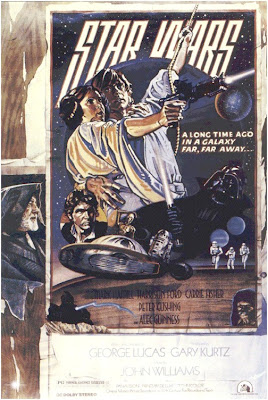
Thirty years ago, in a Galaxy far, far away

It all began thirty years ago today.

Of course, I didn’t see it on opening day; I was five, after all, and it took a while for the thing to become a Big Cultural Phenomenon. My mother says that when she saw in the papers what was going on with this space movie, it was she who decided that come hell or high water, her kids were going to see it. So it was late summer, I think, by the time we finally saw it. Maybe it was early summer. Actually, I honestly don’t recall. The movie came out while we were finishing the school year in LaCrosse, Wisconsin; then we moved to Portland, Oregon. That’s where I saw Star Wars the first time.

And I didn’t like it.

Again, I was five, and I just didn’t get the thing. The only movies I knew were Disney stuff, and my only exposure to SF prior to this was a flick called The Cat from Outer Space. But my sister? She was ga-ga for Star Wars and talked about it constantly. So much so that somehow she won me over, and when I consented to go see it a second time, I thought it was the greatest thing ever.

And I still think that.

Three years later, at the same theater (the Westgate in Beaverton, OR, which I believe is now no longer there):

And then, after we moved to Western New York:

So anyway, thank you, George Lucas and everyone else.

Here are some links to older Star Wars-related posts of mine:

The Saga, complete
Why I love The Phantom Menace
Why I love Attack of the Clones, part one
Why I love Attack of the Clones, part two
Why I love Attack of the Clones, part three
Why I love Revenge of the Sith

The Star Wars toy I coveted above all, mine at last!
Emperor Palpatine calls customer service
A representative post in which I defend the honor of George Lucas
A big Star Wars poll
My favorite visual moments from the Star Wars movies

I’ve done a lot more Star Wars-related blathering than those on Byzantium’s Shores, but those are a good start.

Last week I splurged on The Making of STAR WARS, and I’ve started reading it, but I’m taking this one very slowly so as to savor it and absorb as much of it as possible.

Also, some outside links: D. Trull is another guy who, like me, thinks the Prequels are actually pretty damned good. I’ve been sitting on this link for quite a while, so long actually that everyone’s probably already seen it, but here’s Steampunk Star Wars. Also, some time ago a reader e-mailed me about The Secret History of STAR WARS, which I have not yet read. (I’ll get to it, eventually!)

I don’t know if I’ll have a chance to watch the original film today; there’s lots of other stuff on my plate right now, obviously. But I wasn’t going to allow cruddy life events now let me miss out on Star Wars‘s thirtieth birthday!

Share This Post

How disappointing

John Scalzi gets all gracious in losing the election for SFWA President. I’d say kudos to him for a clean campaign, but I was really turned off by the ads the Swift Spaceship Veterans for Truth ran in LOCUS on his behalf. Sure, he claimed to have no involvement in those ads, but we know better, don’t we?

And the graciousness of Scalzi’s concession is especially cloying. I am so sick of the “reaching across the aisle” stuff that follows every election, for anything! What we need is more reaction like that of Ray Patterson, who after his election defeat for Sanitary Commissioner of Springfield, came back when his successor (Homer Simpson) screwed everything up only to say:

Oh…oh, gosh…you know, I’m not much on speeches, but it’s so gratifying to leave you wallowing in the mess you’ve made. You’re screwed, thank you, bye.

Democracy sucks.

Share This Post