Something for Thursday

The fifth episode of the great Carl Sagan show Cosmos is titled “Blues for a Red Planet”. The episode focuses on Mars: a history of the chase for life on Mars, the clash between the fictional Mars (and the one fervently wished for by men like Percival Lowell) and the real one, the discoveries made on Mars in the 1970s (particularly by the Viking lander), and the prospects for future Martian exploration. How I wish Carl Sagan had lived to see the astonishing advancements in Martian exploration since his terribly untimely death!

Cosmos was a series that paid careful attention to every detail, including its music. Obviously an episode called “Blues for a Red Planet” should include some blues in it, right? But not just any blues: the episode called for an ethereal, other-worldly kind of instrumental blues, and that’s exactly what it got in a track by blues guitarist Roy Buchanan. The track is called “Fly…Night Bird”, and it begins with just the kind of ethereal soundscape followed by equally ethereal blues guitar playing that sounds perfectly suited to the cold days of Mars.

I was going to present that track by itself, but then I found myself curious about the rest of the album on which “Fly…Night Bird” appears. Titled You’re Not Alone, the album is a 1978 release that was apparently a commercial failure for Buchanan, who worked and recorded for years but who never really turned the corner into actual stardom. Instead Buchanan produced highly respected and influential work that is deserving of reassessment and exploration. Sadly, Buchanan appeared to have finally achieved some degree of artistic freedom in the mid 1980s, but he also struggled with personal issues that led to his death in 1988. I certainly knew nothing about Buchanan until I did a bit of research for this piece.

You’re Not Alone is an amazing album, packing in some astonishing music making in its roughly 41 minutes. Only one track, the second side’s opening “Down By the River”, has vocals; the rest is pure instrumental, and the mood shifts across the entire album from blues to psychedelic to pure rock and back again to blues. Listening to this album made me feel like I was in the control of a master who knew what he was doing.

Here is the complete album You’re Not Alone by Roy Buchanan (and others), in two sides. (Come to that, anybody besides me occasionally miss the concept of “Side One” and “Side Two”?)

Share This Post

Something for Thursday

 Autumn is here! And almost like flipping a switch, we went from warm temperatures in the 80s for the last few days to high temps that are unlikely to rise above 70 for the better part of a week. This comes not a minute too soon, to be honest: I am long-since on record for preferring autumn over the other seasons, and that is unlikely to change any time soon.

There’s an old popular song called “Autumn Leaves” that has been covered and recorded a whole lot of times, including this setting for string quartet by the great Japanese composer Toru Takemitsu. Bring on the fall!

Share This Post

Something for Thursday

 In recent times we’ve made various classic rock and 1970s and 1980s hits stations our regular listening when we’re at home hanging out, or when we’re driving about. This is a song I don’t think I’d ever heard much growing up, for whatever reason; I remember hearing it once in a while but it doesn’t seem to have ever been a big enough hit to show up regularly on commercial classic rock stations (with their increasingly boring playlists).

Stevie Nicks is a singer that I’ve never disliked for any reason, but I was never all that big a fan, really…until now. It’s amazing how long it takes you to behold the beauty in what earlier seems, well, not that beautiful. Nicks’s voice is…I’m honestly not sure how to describe Stevie Nicks’s voice. It’s like it’s nasal and sultry at the same time.

Stevie Nicks apparently wrote this song as a duet vehicle for Waylon Jennings, but for some reason Jennings didn’t use the song on the album that has this title, so Nicks recorded it with Don Henley of The Eagles.

Here is “Leather and Lace”.

Share This Post

Something for Thursday

 Here is a selection from John Williams’s score to JFK that seems to match my mood regarding the present and future of America.

I don’t know, folks. I just don’t know. There is no law of nature that says we have to remain on the course we’re on, or that we can’t change it. I just don’t know if we realize the course we’re on or if we even want to change it.

Share This Post

Something for Thursday

 I know I’ve featured this in the past, but it’s my blog and I can do re-runs if I want! And it seems to me that this past week in particular has left a real need for some real beauty.

Hans Zimmer has become known for his bombastic and loud action film scores, and his more recent science fiction soundscapes, but he has also done some tender stuff, very effectively. Here is “The Greatest Woman Alive” from Zimmer’s score to As Good As It Gets.

Share This Post

Something for Thursday

 There’s something to be said for rock dance anthems that have great tunes, a fantastic beat, amazing rhythm…and, well, if the lyrics make sense I guess that’s a bonus, but let’s be honest: when you’re looking for something to play loud on the drive home from work on a Friday, something really good and loud and thumping, you don’t really need lyrics that make sense, do you?

Enter The Killers and their huge 2008 hit, “Human”.

“Are we human?
or are we dancer?
My sign is vital,
my hands are warm
And I’m on my knees
looking for the answer.
Are we human,
or are we dancer?”

See? That makes no sense.

And when I listen to the song, I don’t care a single bit, which I think is rather the point. Singer Brandon Flowers is quoted as saying, in response to people not understanding the “Are we human, or are we dancer” thing (not “are we dancers“, note):

“It’s supposed to be a dance song, it goes with the chorus,” he says. “If you can’t put that together, you’re an idiot. I just don’t get why there’s a confusion about it.”

But really, who cares? From a live performance at London’s Albert Hall, here are The Killers with “Human”.

That would have been a fun show to see, I think….

Share This Post

Something for Thursday

 Last week, Dusty Hill died. He was the bass player for ZZ Top.

ZZ Top is one of those bands that has been a part of the soundtrack of my life pretty much ever since early-adolescence, when I first became aware of rock music. They’re one of those acts that seems like they’ve been around forever, partly owing to their look: famous for their long beards, they cultivated an air of being old when they were still quite young. But there’s also a timeless quality to their music, which plays equally at ease on a classic rock station and an 80s throwback station, and more.

ZZ Top was always known most for its look: black suits and very long beards. They never updated that look at all. ZZ Top was not one of those “chameleon” kinds of acts that shifted with the times; their musical style and their look was always the same. They knew what they wanted to do, who they wanted to be, and the kind of music they wanted to make. And they made a lot of very fine music, too! Maybe they’re not quite at the level of, say, a Bob Seger or Tom Petty and the Heartbreakers, but ZZ Top is every bit as essential to knowing the last forty years or so of popular music in America. (ZZ Top’s own history began in 1969, so they’ve been a thing for more than fifty years.)

By never much changing while maintaining a high standard of excellence, ZZ Top managed to seem like they’d been around forever and always will. They always had that air of “grizzled old veterans of rock”, even if they were only in their mid-30s when I first encountered them, with their big hit, “Legs”.

My favorite ZZ Top song is one of their less-known ones, a power ballad from the Afterburner album. “Rough Boy” is really quite a lovely song, with lyrics suggesting a boy trying to impress a girl even though he’s, well, ‘rough’. Those lyrics go well with Billy Gibbons’s raspy tenor, and the verses alternate with some frankly beautiful guitar playing.

Here are three videos: first the song itself as recorded (and later remastered) for the original album, and then a live version in which the band is joined by guitar legend Jeff Beck. And finally there’s an example of one of my favorite new genres, the “reaction” video, in which a listener with an open mind listens to “Rough Boy” for the very first time ever. (The reaction video is great, but her experience is slightly marred by the fact that she’s also watching the song’s official video for MTV, which is, I must admit, one of the weirder videos out there, and it’s a video whose content has almost nothing to do with the song itself. But her enthusiasm is real; I love these reaction videos!)

And Dusty Hill: Thanks for the music. It will live long!

Share This Post

Something for Thursday (Friday edition)

UPDATE: The video for the performance I chose, for some reason, won’t embed here, so click through to hear the music.

 A day late, but not my usual excuse this time! I wasn’t too busy…in fact, I was all set to post, but I couldn’t pick out a piece of music for this.

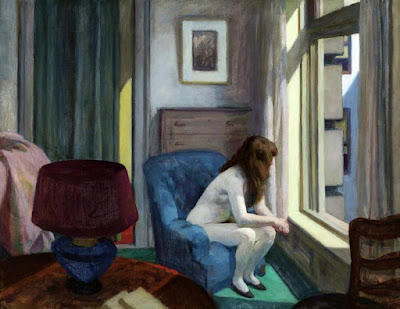
You see, yesterday Sheila O’Malley posted about the work of painter Edward Hopper, the artist behind Nighthawks and other famous paintings that suggest urban loneliness and solitude. In Sheila’s words:

I love the loneliness in Edward Hopper’s work. The insomnia. The urban midnights. The voyeurism. The emptiness. If you’re heartbroken, Hopper is your kindred spirit. I find his paintings very sad, sadness you can wallow in. Many (most?) people do what they can to avoid loneliness. I have never been able to pull it off. All the lonely people, where do they all come from?

Living in a major metropolitan area, you are constantly up against other people’s lives. People have private moments in public. You can peek into people’s windows as you walk by. You give each other privacy as best you can. People can weep on the subway, and nobody freaks out. Everyone clams up, goes into their own private head-space, and the weeping person may as well be in her own room for all the attention she gets. Believe me: having been that weeping person, there’s a comfort in anonymity. There is nothing quite like the freedom to be left alone.

At the same time, there is the sense of being privy to other people’s secrets. There are just so many damn windows. How do other people live? How are they managing?

Here are a few of Hopper’s paintings, including, of course, his most famous painting, Nighthawks.

A lot has been said and written about Nighthawks, and those four people in that cafe…but what catches my eye is the storefront across the street. There’s no merchandise on display in the window. Nothing at all. If the couple from Phillie’s wants to window shop, there’s nothing there to look at. Just a cash register, and a printed bill in the window that we can’t read from this distance, so we don’t know if simply says “closed”, or “closed forever”, or “seized by the IRS”, or…anything at all. And above the storefront…equally vacant windows into offices or apartments.

So, back to the music. I read Sheila’s post and wanted a piece of music that conveys the sense of loneliness that Hopper creates in many of his paintings, and that’s where I struggled. I could have picked a song, maybe the title track, from Frank Sinatra Sings For Only The Lonely, but I just wrote about that album recently and wanted something else. Slow ballads, maybe…or songs about urban life, like Glenn Frey’s 80s potboiler “You Belong To The City”…but nothing really fit, and I’m not sure this piece fits either, but I’m going with it.

Enter Claude Debussy.

Debussy, like Bach and Chopin, wrote a series of short pieces for keyboard that he called Preludes. Where Bach and Chopin used their Preludes to explore each key in the chromatic scale, Debussy did not. This Prelude was written in D minor and is titled “Footsteps in the Snow”. Its character is cold and austere, with one particular motif recurring throughout in almost chant-like fashion. About halfway through we get a genuine break into lyricism, but the mood shift is short before the lyrical melody carries us right back to the work’s core motif, a sad and insistent motif indeed.

Does “Footsteps in the Snow” suggest the same kind of loneliness that Edward Hopper suggests in his paintings? Well…I suppose that’s for the listener and the viewer of the art to decide, isn’t it? Debussy is definitely conveying some kind of cold, quiet, hushed solitude.

Maybe it’s odd to be thinking of quiet urban solitude in the bright summery suburban days of my life right now, but the cold is always coming….

Share This Post