
Love, Logic, and Why I Don’t Write Dystopia: Some Rambling Thoughts on the Occasion of Leonard Nimoy’s Passing

When The Wife and I were on our honeymoon, one of the stops was the Boston Museum of Science. I’m always a fan of science museums. During our visit, we saw a movie in their OmniMax theater. I don’t remember what the movie was, to be honest, but I do recall a bit at the beginning of the show, when the lights dimmed and a voice sounded over the speakers, which said something like this:

Good afternoon! The movie will begin shortly, but before it does, we need to properly calibrate our theater’s sound systems for use. To do this, we have enlisted the aid of a person who grew up in this very neighborhood. You may find his voice familiar.

This was followed by a beat of silence, and then another voice said:

Hello. Who put the BOMP in the BOMP shoo BOMP shoo BOMP; who put the RAM in the RAMALAMADINGDONG.

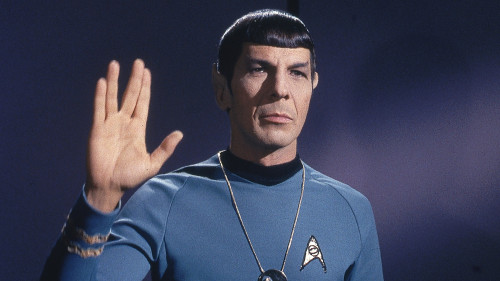
The second voice, the “local kid made good”, was Leonard Nimoy’s. I think most folks in the audience recognized that voice before he actually said “This is Leonard Nimoy”; his voice was, actually, one of the most familiar I ever knew. Gravelly and distinguished, that voice was, and Nimoy knew how to use it, which words to emphasize and where to pause just ever-so-slightly for effect.

I don’t remember a time when I wasn’t aware of Leonard Nimoy on some level. More precisely, I should say that I don’t remember a time when I didn’t know who Mr. Spock was. I remember Star Trek episodes very early on, all the way back to the first house I ever lived in. Trek was my sister’s thing, but I remember vague images from it. The most specific one I have is at the end of an episode called “Friday’s Child”, when, at the end, all is well and the female guest star’s character has given birth, and observing Dr. McCoy making baby talk to the kid, Spock asks why baby talk is a thing at all.

A lot can be said about Nimoy and Spock, and a lot has been said about Nimoy and Spock over the years. Most fascinating to me was Spock’s arc through the six “Original Crew” movies, from his attempt in The Motion Picture to purge himself of emotion to his own resolution of the “Kobayashi Maru” test to his rescue to his work to put his own brain back together (interesting that no fewer than three major Trek stories, one episode and two movies, devoted large amounts of time to putting Spock’s brain and mind back together), and finally to the confident, competent officer we saw in The Undiscovered Country. In that film, when Kirk and McCoy get in serious trouble and are arrested, Spock just calmly assumes command and immediately begins the investigation to find the evidence to free them. Through that film, Spock acts with a calm acceptance that the truth will come out, that they will find the evidence, and that they will find it by searching for it calmly and logically. It is of a piece with his line in the film about the need for faith, to trust that “the Universe will unfold as it should”.

My personal favorite Spock moment comes at the end of what is certainly one of the very best Trek episodes ever, “The City on the Edge of Forever”. Knowing that if he allows Edith Keeler to live, the future will change and Starfleet and the Federation will never happen, Kirk stops McCoy from pulling her out of the path of the oncoming car. McCoy rages at Kirk:

“You deliberately stopped me. Jim! I could have saved her! Do you know what you just did?!”

And Spock — ever calm, ever logical, ever accepting of what must be — simply says:

“He knows, Doctor. He knows.”

Nimoy knows that he can’t express sadness in that line. He cannot express heartbreak or the awfulness of the choice that Kirk has just had to make, and all the same, Nimoy conveys that Spock knows these things. He knows these things, he knows that they are real, and he does not belittle them in any way.

Since I’ve no memories at all of a time before Star Trek, it’s fair to say that it — along with Star Wars, obviously — are the biggest influences of mine in terms of my notion of what the world will look like, hundreds or thousands of years in the future. Will we always face problems and struggles and very real difficulties? Absolutely. But I don’t believe in dystopia. I cannot, will not believe that there is a future in the offing when the world is wrecked and everything is in ashes and only a very few are living well while the rest of humanity exists in dimly-lit squalor. I cannot, will not believe that, and that’s why I cannot, will not write it.

I believe that whatever difficulties and challenges we eventually face, we will do it from a brightly-lit viewpoint where it’s always clear how far we’ve already come. I believe that when we take to the stars, our ships will be beautiful and that they will explore with grace, and that we will confront our futures with logic and science as well as warmth and a twinkle in the eye that’s always there.

Why do I believe those things? In large part, because of a teevee show and some movies that Leonard Nimoy starred in.

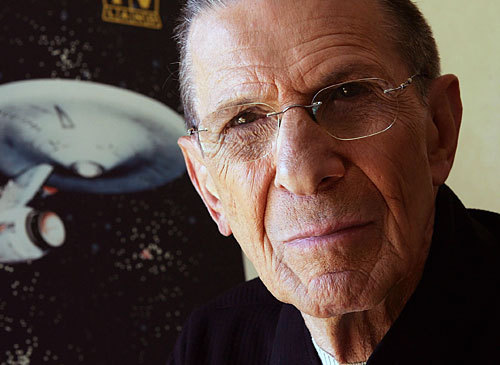
After his long and prosperous life, Leonard Nimoy now belongs to the past. But he’ll always be a part of my future…my “Undiscovered Country”.

Share This Post

If at first you Khan’t succeed….

Over at Tor.com, Emily Asher-Perrin suggests a way to make Khan’s presence in Star Trek Into Darkness make more sense.

There are 72 other super humans who Khan calls “family.” They were of all backgrounds and talents, an entire pantheon of super peoples. If one of them was woken up, not knowing when it was or what he would be asked to do, isn’t it possible that he might lie? That he might tell a powerful military leader in Starfleet that he was Khan Noonien Singh? We know that Khan’s exploits were legendary—of all these genetically engineered people, he was considered to be the Attila, the Alexander, the Caesar. Pretending to be him would likely buy you more respect, more time to figure out what was going on. It would be a smart move that could keep your people alive. The sort of move that a super man might employ when woken from a deep freeze a few hundred years in the future.

I have to admit that I’m starting to feel a little sorry for STID. From what I can see, conventional opinion in geek circles is starting to settle on this being quite possibly the single worst Trek film ever. Earlier this week saw the 25th anniversary of Star Trek V: The Final Frontier, which has always been roundly hated (although not by me). In every discussion I’ve seen of that anniversary, though, almost immediately someone suggests that STID was worse. And yes, I had a lot of problems with the script. But yeesh, the film was at least well-made; I find watching it enjoyable, which is something I certainly can’t say for Star Trek Nemesis.

But back to Ms. Asher-Perrin’s retconning of STID. Of course, its success hinges on the writers wanting things to make sense, and in two of these scripts, we now know that “making sense” isn’t something that matters all that much to Orci or Kurtzman (not to mention Damon Lindelof, who is singularly incapable of writing anything that makes a modicum of sense).

If it turned out that this man was not Khan, then all of his behaviors in the film would suddenly ring more true. Here is an individual, damaged by his circumstances and alone, afraid of losing the only people like him in the universe. He is lashing out against everyone who used him or cornered him. Without the weight of Khan’s original (very different) incarnation hanging over him, this character can be his own thing. And all that wishy-washy indecision that led to the stunt secrecy surrounding his identity in the first place could be put to bed. And we wouldn’t suddenly have to wonder how an alternate reality could change the ethnicity of a character born hundreds of years before the skewed timeline.

I suppose…but then, Ms. Asher-Perrin wraps up with this:

But better yet, we would also know that Khan was still out there… somewhere. And that would always be hanging over our heads, a perfectly poised hammer ready for whenever he was needed.

See, here’s my problem with this: the inflation of Khan into the supervillain of all of Star Trek — or, at least, this generation of Trek. Thanks to one notable episode of the original series and one very good movie, Khan has somehow become elevated to basically being Moriarty to Kirk’s Holmes, or Blofeld to Kirk’s James Bond. And that’s just wrong. These filmmakers clearly see Khan as Kirk’s ultimate nemesis, but Kirk — and Trek isn’t about defeating the villain-of-the-week. Sometimes it can be about that, but not always, and ever since Wrath of Khan, Trek seems to be fixated on this idea of “who will the villain be”, right down to bringing in illustrious actors to play the villains each time out.

That’s my problem with this bit of retconning: it would keep Khan out there as a potential bomb to go off. How long could these writers, who have shown zero understanding of Star Trek other than as single movie as a source of memes and tropes to be mined.

Share This Post

Rule of Acquisition #109

On Star Trek: Deep Space Nine, the Ferengi are established as having a culture so built around business and the pursuit of wealth that they are governed by a series of aphorisms called the “Rules of Acquisition”. I always like #109:

Dignity and an empty sack is worth the sack.

I agree. The hell with dignity. I’ll take the pie in the face every time.

Share This Post

Star Trek Into Frustration

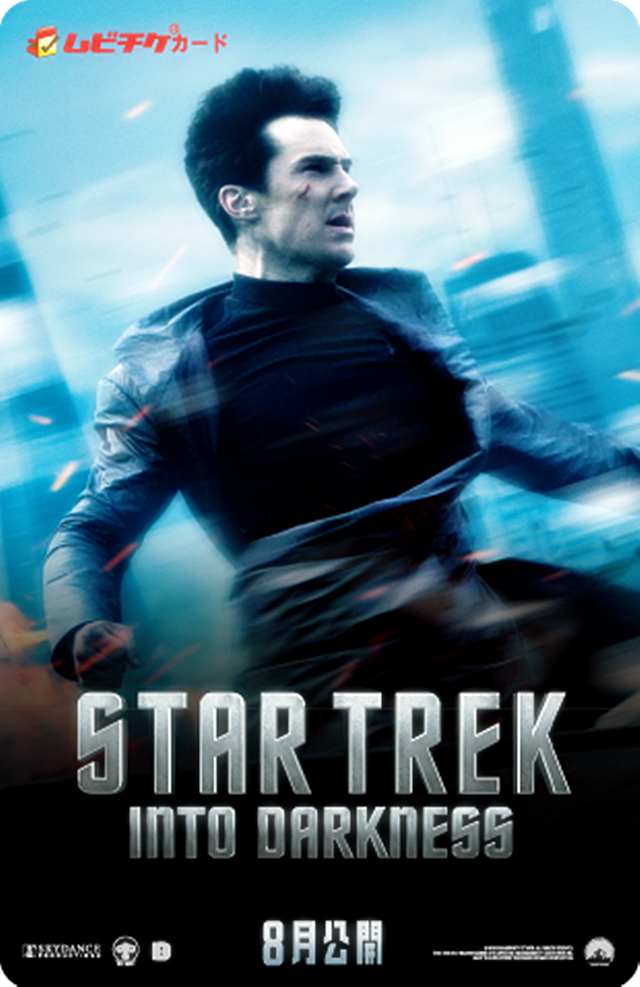
Well, despite my initial intentions to not see the new Star Trek movie until the DVD came out, a number of factors intervened: the fact that we went on vacation (and seeing a movie on vacation is always fun), and The Daughter’s crush on Benedict Cumberbatch. So, off we went to see the movie. I expected that my reaction would be similar to that I had for the first one, and sure enough, it was. I loved watching it. It’s a tremendously entertaining movie, expertly paced, wonderfully shot, beautifully acted. It scratched my ever-present itch for Explodey Spaceshippy Goodness, just like the last one.

And it frustrated the hell out of me on the script end, just like the last one.

On the design end, this bunch of filmmakers is getting so much right. I love the look of the world they’re in; I love that it’s not ‘dystopia as far as the eye can see’, as is so often the case in SF these days. I love the look of the ships, and I don’t even mind JJ Abrams’s somewhat-infamous lens flares. This movie, as much as the last one, looks the part, and it does a really nice way of bringing those old 1960s-era costume designs into a future in a way that doesn’t look completely ridiculous.

Also, the cast continues to be superb. About the only weak link I’ve found thus far is the fellow who plays Sulu, and really, how could you tell, given how little he has to do? This group has real honest-to-God chemistry, and watching them interact is most of the fun.

So why is the script so maddening?

Let’s just get my little “Star Trek fanboy” complaints out of the way first. I know, I know, “This ain’t your daddy’s Star Trek!” But the producers keep saying that basically, yes, it is; it’s the exact same universe, but time went in a different direction, so different stuff happens. So as nifty as the visual is, I can’t get behind the Enterprise hiding at the bottom of an ocean. I can’t get behind starships going to warp speed while in a planetary atmosphere. (They did this in Star Trek IV: The Voyage Home as well, and yes, it bugged me then, too.) And I can’t get behind two starships having a firefight while in warp.

And…Khan.

I really don’t know what the whole purpose of using Khan in this movie was, except to use Khan in a movie. It’s very strange. Benedict Cumberbatch turns in a frankly wonderful performance of the scenery-chewing villain (although he’s so flamboyantly chewing the scenery that I was disappointed that the film put him in an all-black costume, instead of clothing him more interestingly). But the script – but Roberto Orci, Alex Kurtzman, and Damon Lindelof – does absolutely none of its own heavy lifting. When we finally get to Cumberbatch’s big reveal – “My name is KHAN!”, complete with rumble in the soundtrack’s bass – it’s clear that Orci, Kurtzman, and Lindelof aren’t interested in creating their own emotional space here. What they’re after is mining the original. We’re meant to feel something, some kind of dread, when we learn that we’re dealing with KHAN here. But the script doesn’t bother to earn that moment. The proper response there would be for Kirk to blink and say, “Is that supposed to mean something to me?”

Ultimately, the script for this movie is really lazy. It’s lazy in the way it brings Khan in for no real reason other than that he comes with a built-in story that doesn’t need to be explained or elucidated, and it’s lazy in the way it converts Khan into a mad killing machine. The original Khan was a charismatic leader, almost a genetically-enhanced Hitler. He was megalomaniacal and wanted to rule a world that he made in his own image; we see none of that in this movie’s Khan. He pays very brief lip service to his followers, but as they all spend the entire movie in suspended animation, that’s all we know of that. There’s no real sense to what, if anything, really drives Khan to do the things he does, other than a vague “I’m mad at the world!” kind of thing, which is pretty much what Eric Bana had as the bad guy in the last Trek movie. Of course, Cumberbatch is leaps-and-bounds better than Bana as an actor, so he’s able to imbue his Khan with menace that Nero never had, but ultimately, it’s a case of “So what?”

(Brief pause here to note that I’ve always had problems with Star Trek II: The Wrath of Khan on kind of the same basis. Yes, it’s a great movie – although I do not think it the best of the Original Series movies, even though popular culture insists that it is – but I’ve always had trouble with the way it takes the interesting set-up of the original “Space Seed” episode, which ends with Khan and friends being left on a wild and untamed planet, and reduces it to, “Nothing came of that and now Khan is furious and insane”. More interesting, I think, to see what kind of society Khan would have built if he’d had the chance. Wrath does pay lip service to this, when one of Khan’s underlings tries to talk him out of his “Hunt down Jim Kirk” plan – “You have a ship! You have Genesis! You can have whatever you want!” – but that goes nowhere. Wrath uses a great villain to great effect, and yet I always feel that it was a wasted opportunity. Of course, this is hindsight, when back in 1982, if Wrath didn’t do well, Trek as a whole would have likely died on the vine.)

I’ve heard Into Darkness praised for its subplot about the militarization of society and the rise of a security state, but I’m wondering – just what is the justification for all this? In the real world, real events happen that jolt society in those directions. Where is the 9-11 event in Star Trek Into Darkness? We don’t know, so Admiral Marcus’s plot ultimately boils down to more scenery-chewing villainy. Orci, Kurtzman, and Lindelof give us yet more villains whose motivations are barely enough to motivate them to get out of bed in the morning, much less wreak galactic havoc.

“This ain’t your daddy’s Star Trek!” Well, if that’s the case, then why is the entire movie little more than a giant re-creation and inversion of the emotional beats at the end of The Wrath of Khan? Because that’s what this movie is, to the point of recycling dialogue and visual cues. It’s incredibly lazy writing, and it wastes all the strengths in this production. There’s this odd air surrounding the Trek reboot that longtime Trek fans shouldn’t criticize it because it’s a reboot, because it’s new, because it’s made for people now who don’t know anything about Trek as it was. That’s pretty stupid and insulting, though; if not for all those years of Trek fans, there wouldn’t be anything to reboot in the first place, and since these two films are so hell-bent on offering fan service that is almost entirely derived from The Wrath of Khan, it’s extremely disingenuous for the producers to then claim “But it’s a reboot!” Because it’s not a reboot.

Battlestar Galactica is a reboot. You can argue about whether it’s done well or not – I think it is, but I know others who aren’t fans of it and prefer the original – but there is no connection at all between the 1978 show and the 2004 one. They aren’t different timelines in the same universe, they’re completely different shows, and they are about completely different things. Yes, the latter does have a few bits of fanservice here and there (the original theme of the 1978 show being the Caprica National Anthem, for example), but that’s it. That’s how you do a reboot. What Trek is doing is lazy tribute, which isn’t the same thing.

And since they’re not doing reboot but rather tribute, I can criticize them on getting so much stuff wrong. Like starships firing at warp or hiding underwater. And like continuing to get the central relationships of Trek completely wrong by once again insisting that it’s “Kirk and Spock” and not “Kirk, Spock, and McCoy“. God, that annoys the hell out of me. Dr. McCoy is just a supporting player this time around, only there to pop in with a useful plot bit a few times, such as his utterly inexplicable “Hmmm, I think I’ll inject this dead tribble with this guy’s blood!” experiment.

Which brings me to my biggest frustration: Orci, Kurtzman, and Lindelof don’t seem to grasp for one second the implications of the science fiction world they are creating. Consider that at the end of this movie, we can (a) use the transporter to beam ourselves across thousands of light years (so why do we need ships anymore?), and (b) we can bring people back from the dead by injecting them with Khan’s genetically-engineered blood. Either one of these would be a leap forward for our species in a way that would be like cavemen skipping over fire and the wheel and going straight to medieval architecture. But here, these are just plot points. (Yes, original Trek made similar mistakes – say, even if the Genesis project failed, there was still some awfully interesting stuff learned in the R&D phase, right? – but we’re not talking about the sins of original Trek right now.)

So I guess I fall once again into the position of hoping that Trek continues with different writers. Damon Lindelof is a terrible writer, anyway – Prometheus was embarrassing, and Lindelof clearly has gone all-in with his belief that if you just never explain anything logically at all, lots of folks will take that as profundity – and Orci and Kurtzman aren’t a hell of a lot better. Maybe they can be around for a dialog polish, but they continue to fail to understand their own characters and the universe they’re working in, and they write plots more than character-driven stories.

I want a Trek where James T. Kirk has some agency, where he figures things out and takes control. I want a Trek where Spock doesn’t take advantage of a guy’s moment of death to give himself the ultimate snuff film. (Watch the scene where Pike dies and tell me that’s not what’s going on when Spock mind-melds with him, especially later on when Spock admits it. God, that was a skeevy moment.) I want a Trek where Vulcans aren’t just a bunch of people repressing their emotions. I want a Trek where things happen in logical sequence arising out of what’s gone before, as opposed to things happening because that’s what’s gotta happen next. I want a Trek where things like this don’t happen:

KIRK dies. MCCOY is sad.

But then, in the best bit of resurrectional timing since Jesus himself, the dead tribble purrs.

MCCOY realizes how to bring KIRK back to life!

As much as I think Chris Pine does a great job with what he’s given, I want an end to this idea of Kirk as adolescent screw-up with loads of potential if he could just realize it. I have seen that story literally hundreds of times. What was always interesting to me about James T. Kirk was that he excelled as a young man because he was more competent than anyone else. He wasn’t some renegade maverick disregarding the rules; Jim Kirk was a genius who always figured out ways to make the rules work for him. These writers seem to think we need to see Kirk grow into his role, whereas the fact is, he was always there. I’m not sure I can see Chris Pine’s Kirk ever giving this speech, and you know whose fault that is? It’s not Chris Pine’s.


Again: I love the cast, love the look, love the music. I even loved a lot of the dialog, and I find Spock’s relationship with Uhura an intriguing element. Scotty was terrific this time out. There are a lot of elements in place on this version of Trek that are wonderful, so I pray that next time out, the script lives up to them instead of just putting them through the paces of a plot that basically boils down to fanservice.

Share This Post

They will be, oh, I don’t know, TREKKING at some point, yes?

The new Star Trek movie has a title: Star Trek Into Darkness.

OK.

The new Star Trek movie also has a teasing synopsis:

After the crew of the Enterprise find an unstoppable force of terror from within their own organization, Captain Kirk leads a manhunt to a war-zone world to capture a one man weapon of mass destruction.

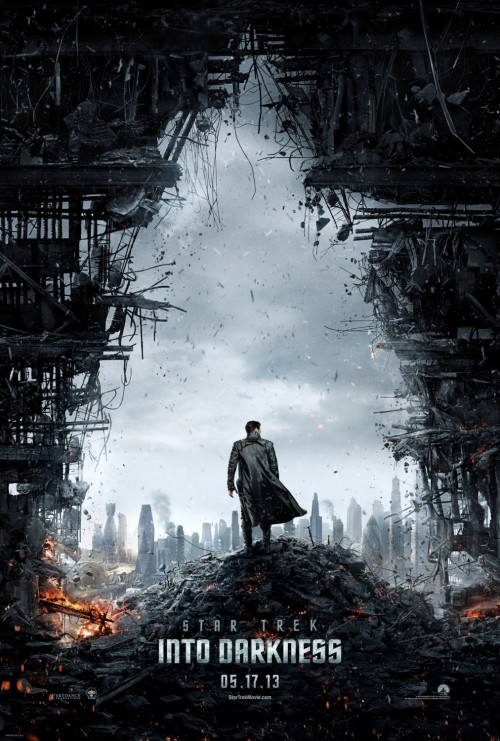
And, the new Star Trek movie has a poster:

OK. Now, I haven’t seen the movie yet, obviously. And I liked the last one, despite its nonsensical plot and complete mishandling of any characters not named Kirk, because it was a very slickly made entertainment with great-looking visuals, fun dialogue, and a frankly wonderful cast. But you know what this rebooted incarnation of Star Trek doesn’t seem to have?

Star Trek.

Again, I haven’t seen the movie, so it’s entirely possible that it will be a very good film. But here’s the thing: Star Trek was a lot of things over the years, even as it creatively petered out in the Enterprise and Star Trek Nemesis days. It was sometimes good old fashioned space opera. It was military science fiction. It was sociological SF. It was comedy. It gave us some of the best time travel stories ever. It produced an outstanding submarine thriller in The Wrath of Khan, and it did political allegory at times very well (Star Trek VI: The Undiscovered Country), and at times it did political allegory not very well at all (The Omega Glory). Star Trek told some of the best love stories I’ve ever seen, whether the love was romantic love (“The City on the Edge of Forever”), the love between friends (“The Empath”, Star Trek III: The Search for Spock), or the love between fathers and sons (“The Visitor”).

But what Star Trek never was, even in its most flamboyant journeys into explodey-spaceshippy-goodness (“Yesterday’s Enterprise“), was a tent-pole action franchise. And between that title, that synopsis, and that poster, that sure as hell seems like what the current creative team is shaping up Star Trek to be. So I guess we’ll see no more exploring strange new worlds and new civilizations, then? Will this crew at no point be boldly going much of anyplace at all, certainly not where no one has gone before? I mean, look at that poster. What are we looking at? The optimistic future? A future of science, and of exploration? Or are we looking on twisted, mangled wreckage with some bad-ass villain standing in the middle of it?

I know, I know. It’s a reboot, so they’re telling ‘new stories’. But you can only take the concept of a reboot so far before it becomes unrecognizable. You can make Sherlock Holmes a modern-day detective, but you can’t make him a tee-totaling policeman with a wife and kids. You can’t call your movie a remake of Rashomon and only tell the story from one viewpoint. If your Romeo and your Juliet live at the end and get married, then they’re not Romeo and Juliet.

And if the Enterprise crew is an action star split into seven people…then it might be a fun movie to watch, like the last one was. But it won’t be Star Trek.

Share This Post

Film Quote Friday

“Darmok” is one of the most memorable episodes, and for me a high point, of Star Trek: The Next Generation. The Enterprise makes contact with a people, the Tamarians, whose language has resisted all efforts at translation, to the point where not even the Universal Translator can make head nor tail of what they are saying. Their language appears to be based on random citations of stories, an extreme way of talking in metaphor and citing examples from a rich storytelling heritage to make one’s point. As someone who often thinks in terms of stories I’ve read or seen and who frequently cites them in the case of arguing various points, this hits home for me.

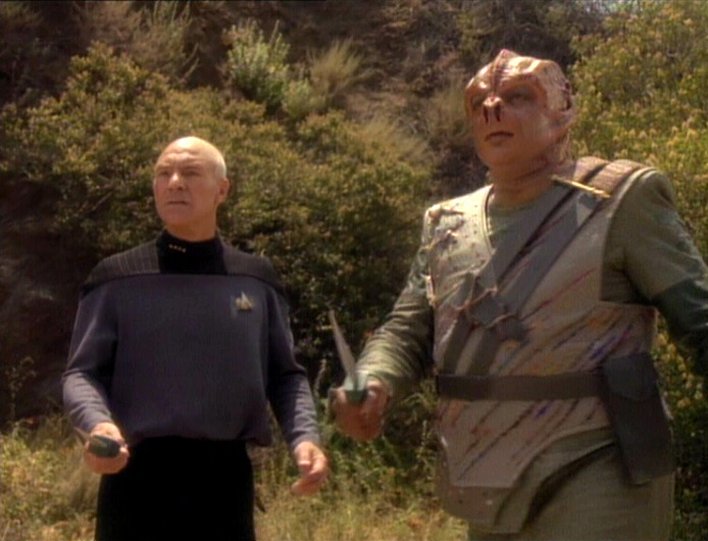
In the episode, Captain Picard and Captain Dathon (of the other ship) go down to a planet surface to face a ‘monster’, to suffer a shared danger, which Dathon hopes will somehow forge a connection between them. It takes Picard a while to realize that Dathon’s ‘kidnapping’ of Picard to the planet surface is intended as an act of friendship, and it takes him a bit longer to put together just what some of the Tamarian phrases mean. They do battle with the creature, and manage to fight it off…but Dathon is mortally wounded. At night, Picard and Dathon sit by a campfire. Dathon is clearly in great pain:

DATHON: Darmok and Jalad at Tanagra.

PICARD: Our situation is similar to theirs. I understand that. But I need to know more. You must tell me more about Darmok and Jalad. Tell me. You used the words, ‘Temba, his arms wide’ when you gave me the knife and the fire. Could that mean give? Temba, his arms wide. Darmok. Give me more about Darmok.

DATHON: Darmok on the ocean.

PICARD: Darmok. (draws on the soil) The ocean. Darmok on the ocean. A metaphor? For being alone? Isolated? Darmok on the ocean.

(Dathon writhes in pain)

PICARD: Are you alright?

DATHON: Kiazi’s children, their faces wet.

PICARD: Temba, his arms open. Give me more about Darmok on the ocean.

DATHON: Tanagra on the ocean. Darmok at Tanagra.

PICARD: At Tanagra. A country? Tanagra on the ocean. An island. Temba, his arms wide.

DATHON: Jalad on the ocean. Jalad at Tanagra.

PICARD: Jalad at Tanagra. He went to the same island as Darmok. Darmok and Jalad Tanagra.

DATHON: The beast at Tanagra.

PICARD: The beast? There was a creature at Tanagra? Darmok and Jalad, the beast of Tanagra. They arrived separately. They struggled together against a common foe, the beast at Tanagra. Darmok and Jalad at Tanagra.

DATHON: Darmok and Jalad on the ocean.

PICARD: They left together. Darmok and Jalad on the ocean.

DATHON: The ocean. (another spasm) Zinda! His face black, his eyes red. Callimas at Bahar.

PICARD: You hoped this would happen, didn’t you? You knew there was a dangerous creature on this planet and you knew from the tale of Darmok that a danger shared might sometimes bring two people together. Darmok and Jalad at Tanagra. You and me, here, at El-Adrel.

DATHON: Kira at Bashi. Temba, his arms wide.

PICARD: My turn? No, I’m not much of a story teller. Besides, you wouldn’t understand. Shaka. when the walls fell. Perhaps that doesn’t matter. You want to hear it anyway. There’s a story, a very ancient one, from Earth. I’ll try and remember it. Gilgamesh, a king. Gilgamesh, a king, at Uruk. He tormented his subjects. He made them angry. They cried out aloud, send us a companion for our king. Spare us from his madness. Enkidu, a wild man from the forest, entered the city. They fought in the temple. They fought in the street. Gilgamesh defeated Enkidu. They became great friends. Gilgamesh and Enkidu at Uruk.

DATHON: At Uruk.

PICARD: The new friends went out into the desert together, where the great bull of heaven was killing men by the hundreds. Enkidu caught the bull by the tail. Gilgamesh struck it with his sword.

DATHON: Gilgamesh.

PICARD: They were victorious. But Enkidu fell to the ground, struck down by the gods. And Gilgamesh wept bitter tears, saying, ‘he who was my companion through adventure and hardship, is gone forever.

At this point, sadly, Dathon dies. It’s a haunting moment in a terrific script, made all the better by Patrick Stewart and guest star Paul Winfield (as Dathon). It amuses me that they have Picard claim to not be a very good storyteller, and then he goes on to make even this Cliff’s Notes version of the Epic of Gilgamesh riveting.

I’ve heard some fans over the years wonder why they never revisited the Tamarians on Trek. I’m not sure, but I do think that as good as the Trek writers were, they weren’t always great science fiction writers, and to really be done well, the concept needed someone on the order of, say, a Vernor Vinge. The idea of a society whose collective memory has become so ingrained as to literally form the basis of its language is a fascinating one, and it would need to be done justice.

Share This Post

A to Z: Q

The obvious choice here is to talk about Q, but I couldn’t decide which one. This Q?

Or this one?

Luckily, this is my personal blog, where the only rules that apply are the ones that I choose for myself, and which I can summarily set aside any time I want, so…let’s talk about both Q’s!

Our first Q is less well-known as Major Geoffrey Boothroyd. (The only time we ever hear his name in the James Bond movies is in The Spy Who Loved Me, when he holds a door open for Agent Anya Amasova, and she thanks him by name.) Q’s first appearance was in From Russia With Love, when M informs Bond during his briefing that “Q branch has been working on something special for you.” In walks our man, looking pretty young and spry back then, played by actor Desmond Llewellyn. He’s got with him a briefcase that has trick catches that, if not opened properly, causes an explosive to go off; contains a rifle that’s nicely broken down into a bunch of small pieces (this was 1962, well before X-ray machines at airports!); and fifty gold sovereigns. There had been a character in Dr. No simply referred to as “the armorer”, who relieved Bond of his Baretta pistol (derisively calling it a fine gun “for a lady’s handbag”) and giving him his trademark Walther PPK, but the guy we would know as Q didn’t come until the second movie.

But it was in the third Bond film, Goldfinger, that Q would become iconic. That’s when he unveils his tricked-out Austin Martin DB-V, with machine guns in the headlights, spinning license plates, homing device trackers, and the ejector seat. It’s too bad that the car doesn’t end up amounting to much…but Q’s attitude toward James Bond becomes clear when Bond says “You’re joking!” in reference to the ejector seat, and Q replies, “I never joke about my work, 007.”

Q was a fixture for most of the remaining Bond films. He wouldn’t appear in Live and Let Die, but he’d be present for all the remaining films until Die Another Day; Q was revealed to be retiring in The World is Not Enough; he even introduced his successor, who was played by John Cleese, in an inspired bit of casting. There was a giant pall cast over the whole thing, though, when Desmond Llewellyn died in a car crash not long after TWINE came out.

The Daniel Craig films have not availed themselves of a Q character yet, which I hope is forthcoming, even if I also hope that the gadgets don’t get too outlandish (the invisible car in Die Another Day was too hard to believe). Maybe in Skyfall; I don’t know yet.

My favorite Q gadgets? I loved the exploding key ring in The Living Daylights, the wrist-activated blowgun of Moonraker, and the fountain pen filled with acid in Octopussy. And my favorite Q moment came in Licence to Kill. In that film, Q actually goes out into the field to assist 007, who has gone rogue. Now, all through Bond’s career, Q has constantly complained that Bond never returns his gadgets in their original working condition. Late in the movie, though, Q is posing as a peasant sweeping a sidewalk when the bad guy drives by. Q alerts Bond via the little radio he has attached to the broomstick…and then, with his job done, he casually tosses the broom aside.

But…what about the other Q?

This Q showed up immediately on Star Trek: The Next Generation, right in the very first scene of the pilot, and he was originally depicted as a representative of a nearly omnipotent species that is deeply ambivalent toward humanity. Played with zeal every time he showed up with John de Lancie, Q put all of humanity on trial through the persons of Picard and the rest of the bridge crew. I think the character of Q went through evolution, though, as all characters do. Originally, Q was seen more as a trickster character, but then he became more of a gadfly through whom the Enterprise crew learned their deeper lessons about the universe and about life. Most of Q’s episodes were highly memorable: it was Q who made the Borg aware of the Federation; it was Q who greeted Picard in the afterlife and somehow arranged for him to experience an astonishing life lesson.

I never liked Q as much when he started turning up on DS9 or Voyager, when the producers started to explore the entire ‘Q Continuum’ and the politics thereof, which had the unfortunate effect of turning Q into, well, another in a long series of alien races with their own concerns and whatnot. When he was by himself (for the most part), Q something unique unto himself.

Share This Post

A to Z: Klingons

So, let’s talk for a few minutes about Klingons.

If one of the questions on Family Feud was ever “Name a fictional alien species”, I have to think that Klingons have a pretty solid shot to be the number one answer. (“Let me see…Gungans!” BZZZZZZZT “And the Laramie family with a chance to steal!”)

But why is this? Why are the Klingons so memorable?

The obvious first answer is in Star Trek‘s longevity. A thing doesn’t remain a pop-culture concern for as long as Trek has without having some of its terminology enter the pop-cultural lexicon, and the Klingons were the main bad guys of the Original Series, so there’s that. And more than that, a case could be made that the Klingons were the main alien species of the Original Series! More Klingons undoubtedly appeared on Star Trek TOS than Vulcans, and of the first ten Trek movies, there is exactly one in which no Klingons appear. (Wrath of Khan being the one – we see Klingon ships as part of the Kobayashi Maru test, but that’s it.)

I think it’s also easier to remember Klingons because they were often characterized as a group, more than as a race of specific individuals. Until Worf came along as a part of the Next Generation crew, we only saw a few Klingons at a time, and they never recurred (which was a shame – some of those early Klingons would have made great recurring characters, but recurring characters and stories just weren’t the style back then). Klingons were, basically, the ‘Indians’ in Gene Roddenberry’s space western that really wasn’t much of a space western at all. It amazes me to this day that one of Roddenberry’s concepts for pitching the show to the networks was “Wagon Train to the stars”, a concept that fits Battlestar Galactica better, orders of magnitude better, than Trek. But the Klingons were the disposable villains who would pop up, make life difficult for Kirk and company, and then disappear again.

This continued in the movies, too. The main villain of The Search for Spock was Klingon Commander Kruge, who was played very nicely by Christopher Lloyd, and who might have been a decently memorable villain if not for the fact that he was following up Ricardo Montalban as Khan. There’s another disposable Klingon bad guy in The Final Frontier — I don’t even remember his name, that’s how memorable he was – and then, in The Undiscovered Country, the TOS-era crew finally engages the Klingons as more than villains of the week, but as complex individuals. How did that happen?

Well, in between Treks V and VI came TNG, which decided to deepen the canvas a bit when it came to the Klingons. They weren’t boring villains of the week anymore; there was a weekly name attached to them. And with a spot in the regular cast, that meant installing a back story, which in turn meant finally delving into the nature of the Klingon society. TNG often did its best stuff in Klingon-culture related stories; instead of being the warlike goons of TOS, in TNG they were driven by honor more than drive for conquest. The Klingons of TNG came off as kind of a blend of Samurai and Vikings, if that makes sense. It was also interesting to me that as the Klingon Empire came to reach the limits it could reach without engaging in full-on war with other powers, their society turned its quest for honor in battle on itself, so for the rest of TNG and DS9, the Klingons were always engaged in a lot of violent interior politics and sometimes open warfare.

Of course, I can’t write about the Klingons without also mentioning the physical change they went through. In TOS, Klingons were just human-looking people with demonic-looking eyebrows and uniforms of gray and black. In the opening scene of Trek: The Motion Picture, though, the Klingons were well and truly alien, with enormous spiny ridges up their bald heads. This change was never explained, really; I assume that the original thought was to just go ahead and use the film’s large budget to re-do the Klingons in order to make them look a lot more alien, and that we were to just assume that the Klingons always did look like that and we were just supposed to accept the TOS Klingons as such.

But then, DS9 did its brilliant episode “Tribbles and Tribulations”, which had Worf – looking like very much the spiny-head Klingon – having to be in the same room with the ‘human’ looking Klingons. When someone asks him about it, he simply says, “We do not like to talk about it.” I’m sure this has been explained in some novel or some such, but I wouldn’t know. (Heck, they may have explained it in Enterprise, but again, I wouldn’t know.)

Anyway, long live the Klingons. Qapla’!

Share This Post