A to Z: Q

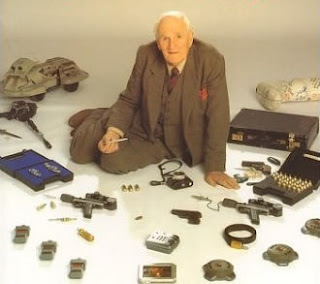
The obvious choice here is to talk about Q, but I couldn’t decide which one. This Q?

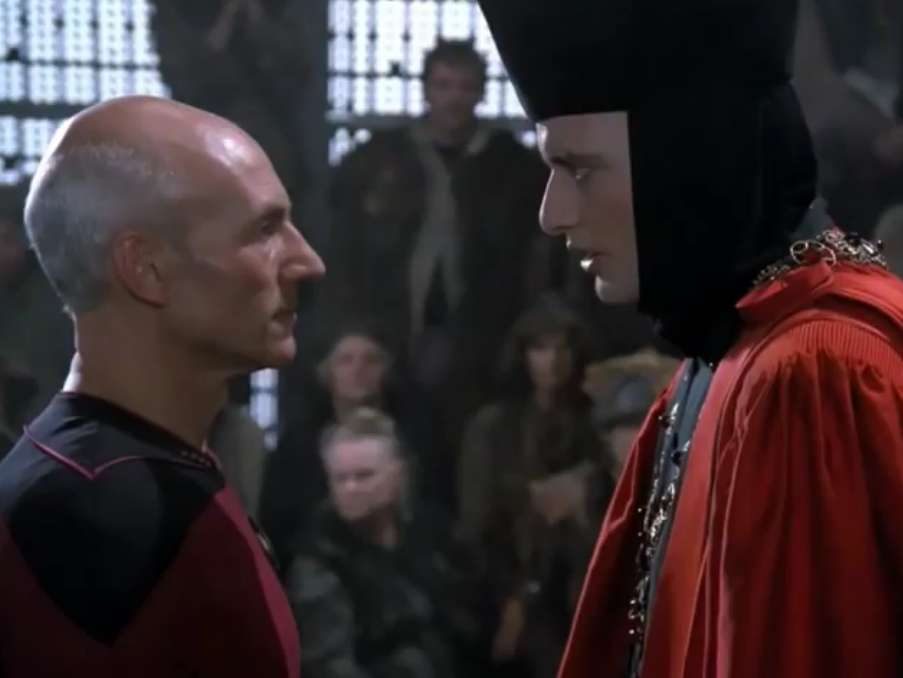
Or this one?
Luckily, this is my personal blog, where the only rules that apply are the ones that I choose for myself, and which I can summarily set aside any time I want, so…let’s talk about both Q’s!

Our first Q is less well-known as Major Geoffrey Boothroyd. (The only time we ever hear his name in the James Bond movies is in The Spy Who Loved Me, when he holds a door open for Agent Anya Amasova, and she thanks him by name.) Q’s first appearance was in From Russia With Love, when M informs Bond during his briefing that “Q branch has been working on something special for you.” In walks our man, looking pretty young and spry back then, played by actor Desmond Llewellyn. He’s got with him a briefcase that has trick catches that, if not opened properly, causes an explosive to go off; contains a rifle that’s nicely broken down into a bunch of small pieces (this was 1962, well before X-ray machines at airports!); and fifty gold sovereigns. There had been a character in Dr. No simply referred to as “the armorer”, who relieved Bond of his Baretta pistol (derisively calling it a fine gun “for a lady’s handbag”) and giving him his trademark Walther PPK, but the guy we would know as Q didn’t come until the second movie.

But it was in the third Bond film, Goldfinger, that Q would become iconic. That’s when he unveils his tricked-out Austin Martin DB-V, with machine guns in the headlights, spinning license plates, homing device trackers, and the ejector seat. It’s too bad that the car doesn’t end up amounting to much…but Q’s attitude toward James Bond becomes clear when Bond says “You’re joking!” in reference to the ejector seat, and Q replies, “I never joke about my work, 007.”

Q was a fixture for most of the remaining Bond films. He wouldn’t appear in Live and Let Die, but he’d be present for all the remaining films until Die Another Day; Q was revealed to be retiring in The World is Not Enough; he even introduced his successor, who was played by John Cleese, in an inspired bit of casting. There was a giant pall cast over the whole thing, though, when Desmond Llewellyn died in a car crash not long after TWINE came out.

The Daniel Craig films have not availed themselves of a Q character yet, which I hope is forthcoming, even if I also hope that the gadgets don’t get too outlandish (the invisible car in Die Another Day was too hard to believe). Maybe in Skyfall; I don’t know yet.

My favorite Q gadgets? I loved the exploding key ring in The Living Daylights, the wrist-activated blowgun of Moonraker, and the fountain pen filled with acid in Octopussy. And my favorite Q moment came in Licence to Kill. In that film, Q actually goes out into the field to assist 007, who has gone rogue. Now, all through Bond’s career, Q has constantly complained that Bond never returns his gadgets in their original working condition. Late in the movie, though, Q is posing as a peasant sweeping a sidewalk when the bad guy drives by. Q alerts Bond via the little radio he has attached to the broomstick…and then, with his job done, he casually tosses the broom aside.

But…what about the other Q?

This Q showed up immediately on Star Trek: The Next Generation, right in the very first scene of the pilot, and he was originally depicted as a representative of a nearly omnipotent species that is deeply ambivalent toward humanity. Played with zeal every time he showed up with John de Lancie, Q put all of humanity on trial through the persons of Picard and the rest of the bridge crew. I think the character of Q went through evolution, though, as all characters do. Originally, Q was seen more as a trickster character, but then he became more of a gadfly through whom the Enterprise crew learned their deeper lessons about the universe and about life. Most of Q’s episodes were highly memorable: it was Q who made the Borg aware of the Federation; it was Q who greeted Picard in the afterlife and somehow arranged for him to experience an astonishing life lesson.

I never liked Q as much when he started turning up on DS9 or Voyager, when the producers started to explore the entire ‘Q Continuum’ and the politics thereof, which had the unfortunate effect of turning Q into, well, another in a long series of alien races with their own concerns and whatnot. When he was by himself (for the most part), Q something unique unto himself.

Share This Post

A to Z: Klingons

So, let’s talk for a few minutes about Klingons.

If one of the questions on Family Feud was ever “Name a fictional alien species”, I have to think that Klingons have a pretty solid shot to be the number one answer. (“Let me see…Gungans!” BZZZZZZZT “And the Laramie family with a chance to steal!”)

But why is this? Why are the Klingons so memorable?

The obvious first answer is in Star Trek‘s longevity. A thing doesn’t remain a pop-culture concern for as long as Trek has without having some of its terminology enter the pop-cultural lexicon, and the Klingons were the main bad guys of the Original Series, so there’s that. And more than that, a case could be made that the Klingons were the main alien species of the Original Series! More Klingons undoubtedly appeared on Star Trek TOS than Vulcans, and of the first ten Trek movies, there is exactly one in which no Klingons appear. (Wrath of Khan being the one – we see Klingon ships as part of the Kobayashi Maru test, but that’s it.)

I think it’s also easier to remember Klingons because they were often characterized as a group, more than as a race of specific individuals. Until Worf came along as a part of the Next Generation crew, we only saw a few Klingons at a time, and they never recurred (which was a shame – some of those early Klingons would have made great recurring characters, but recurring characters and stories just weren’t the style back then). Klingons were, basically, the ‘Indians’ in Gene Roddenberry’s space western that really wasn’t much of a space western at all. It amazes me to this day that one of Roddenberry’s concepts for pitching the show to the networks was “Wagon Train to the stars”, a concept that fits Battlestar Galactica better, orders of magnitude better, than Trek. But the Klingons were the disposable villains who would pop up, make life difficult for Kirk and company, and then disappear again.

This continued in the movies, too. The main villain of The Search for Spock was Klingon Commander Kruge, who was played very nicely by Christopher Lloyd, and who might have been a decently memorable villain if not for the fact that he was following up Ricardo Montalban as Khan. There’s another disposable Klingon bad guy in The Final Frontier — I don’t even remember his name, that’s how memorable he was – and then, in The Undiscovered Country, the TOS-era crew finally engages the Klingons as more than villains of the week, but as complex individuals. How did that happen?

Well, in between Treks V and VI came TNG, which decided to deepen the canvas a bit when it came to the Klingons. They weren’t boring villains of the week anymore; there was a weekly name attached to them. And with a spot in the regular cast, that meant installing a back story, which in turn meant finally delving into the nature of the Klingon society. TNG often did its best stuff in Klingon-culture related stories; instead of being the warlike goons of TOS, in TNG they were driven by honor more than drive for conquest. The Klingons of TNG came off as kind of a blend of Samurai and Vikings, if that makes sense. It was also interesting to me that as the Klingon Empire came to reach the limits it could reach without engaging in full-on war with other powers, their society turned its quest for honor in battle on itself, so for the rest of TNG and DS9, the Klingons were always engaged in a lot of violent interior politics and sometimes open warfare.

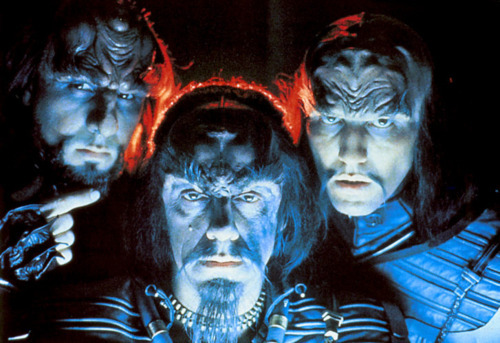
Of course, I can’t write about the Klingons without also mentioning the physical change they went through. In TOS, Klingons were just human-looking people with demonic-looking eyebrows and uniforms of gray and black. In the opening scene of Trek: The Motion Picture, though, the Klingons were well and truly alien, with enormous spiny ridges up their bald heads. This change was never explained, really; I assume that the original thought was to just go ahead and use the film’s large budget to re-do the Klingons in order to make them look a lot more alien, and that we were to just assume that the Klingons always did look like that and we were just supposed to accept the TOS Klingons as such.

But then, DS9 did its brilliant episode “Tribbles and Tribulations”, which had Worf – looking like very much the spiny-head Klingon – having to be in the same room with the ‘human’ looking Klingons. When someone asks him about it, he simply says, “We do not like to talk about it.” I’m sure this has been explained in some novel or some such, but I wouldn’t know. (Heck, they may have explained it in Enterprise, but again, I wouldn’t know.)

Anyway, long live the Klingons. Qapla’!

Share This Post

A to Z: Gagh!

There’s an episode of Star Trek: The Next Generation in which Commander Riker takes part in an officer exchange program and goes to serve on a Klingon vessel for a time. As part of his effort to familiarize himself with Klingon food, he goes to Ten Forward and orders himself up a smorgasbord of Klingon food, all of which looks very odd. The most notable dish here is Gagh, which he later learns is “best eaten live”. (When he looks askance at eating live Gagh, a Klingon japes, “Perhaps we can arrange for one of the females to breastfeed you!”)

So what is Gagh, anyway? Well, the experts, Gagh is:

A Klingon delicacy of serpent worms (pronounced “gawk”). Connoisseurs of Klingon cuisine claim that gagh is best served very fresh — i.e. live.  But it is sometimes served stewed. Gagh is one of the most popular foods served aboard Klingon warships.

Apparently the chief appeal of Gagh is its unique mouthfeel as the live worms pass through your mouth and into your digestive tract to die. Awesome! (It also turns out that in Klingon, Gagh is spelled qagh, so I could have done this one under Q. I haven’t yet pre-selected my Q entry for this series, so I’ve missed an opportunity!) But even vegans don’t have to feel left out, as they can simulate Gagh thusly.

Which brings up the more interesting topic of fantasy and sci-fi food. Food is one of the best ways to convey an alien quality of any situation, which is why we’re told that Klingons like to eat a dish of live worms because they like the feeling of slithery things going down their gullets. “Normal” food in science fiction? Never! There’s not a whole lot of food in Star Wars, but there is “blue milk” at Luke’s table on Tatooine. Jabba the Hutt likes to eat little beasties live, and so on. And Star Trek was forever giving us different alien foods, some of them live, like the eggs that the Cardassians like to eat, the ones that you crack open and see the embryo squirming about inside.

Of course, science fiction food used to be all about taking pills. You’d take a single pill and there’s all your nutrition! Food would be a thing of the past in our technological future. And then you have food, real food, used as a way to suggest certain luxuries. Witness Firefly, when Shepherd Book’s ability to cook with a few actual spices is welcomed warmly, and when he is able to partially guarantee passage on Serenity by giving Kaylee a single strawberry.

Fantasy food tends to be different. In fantasy, food is often where some of the magic happens. The Lord of the Rings gives us lembas, the Elven bread that can sustain a grown man for an entire day in a single bite. In the Chronicles of Thomas Covenant, one of the main foods is aliantha, the berries of The Land, which provide sustenance in much the same way as lembas does. Magical foods abound, and turn out to be an outstanding way to get magic into the story without resorting to wizards and spells; the magic in food is a part of the fantasy world itself, and not a creation of the people in it. There’s even food inside the computer, as TRON indicates, as the programs have to stop and drink some pure energy after escaping the Game Grid.

Guy Gavriel Kay’s use of food is tied to themes of nationality, a common theme in his books. For example, in A Song for Arbonne, much is made of Cauvas Gold, a wine that is especially beloved in the land of Arbonne. And then there is George RR Martin, who provides a lot of descriptives for the foods served in A Song of Ice and Fire. There, food creates mood: when writing about highborn characters in their castles, he lovingly describes a lot of gourmet-sounding foods; on the other hand, when characters are out in the wilderness or among the ‘smallfolk’, the food is characterized as ‘rustic’, at best. So descriptive can Martin be of his food that there’s a blog devoted to recreating it.

Why is food so central in storytelling? Because food is tied to so many prime emotions. Spirituality? Food is a central part of Christian ritual. Food’s a part of football – just try throwing a Super Bowl party with little or no food. Food as love? There’s your chocolate. Food as laughter? My beloved pie in the face. Food as horror? Well, what does Dracula need to live?

Food is also a gateway to character. Jean-Luc Picard has to have his tea (Earl Grey, hot). James Bond and his vodka martinis. When you think about it, food does an awful lot of heavy lifting in stories, doesn’t it!

So next time you’re watching a fantasy or SF show or reading a novel, pay attention to the food! And if you engage a story with little or no food in it, ask yourself if that world seems quite as real as others that tell us what their people are eating.

And you know…I’ll bet with plenty of hot sauce, gagh would be just fine.

Share This Post

Happy Birthday Mr. Shatner!

William Shatner’s birthday is today. How old is he? Who cares? Here’s one of my favorite scenes from all Star Trek, from the much-maligned Star Trek V: The Final Frontier.

Trek V is what I consider to be a ‘noble failure’, in that it doesn’t succeed, but even as it falls short it has some really nice moments, and it really tries to do something interesting, something that really involves sending the Enterprise crew into an unexplored place to confront an unknown. The above scene comes early in the film, while the crew is on shore leave, and Kirk, McCoy, and Spock have gone camping in Yosemite. If nothing else, this film understands that at the heart of the original Trek crew is the three-way friendship of Kirk-Spock-McCoy, a fact which the folks in charge of the current Trek original crew reboot seem to be missing completely.

Anyway, happy birthday to Mr. Shatner! May you row your boat gently down that stream for many years to come!

Share This Post

Whatever that guy said? Do the other thing!

It’s easy to Captain the Enterprise!

I think that at some point, Worf should have just said, “Captain! I recommend we hold position and do nothing whatsoever.” This would likely have been met with Picard replying, “No, Mr. Worf, issue a Red Alert, lock all phasers on target, all crew to battle stations, raise all shields, and FIRE!”

Share This Post

Two of Three


_DSC8763-1, originally uploaded by preloc and kanar.

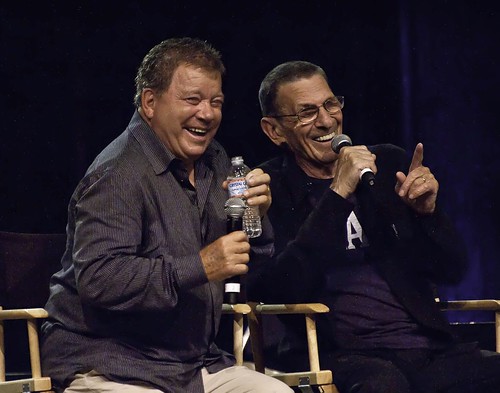
Last week saw the birthdays of William Shatner (born March 22, 1931) and Leonard Nimoy (born March 26, 1931). Best to both! It’s too bad DeForest Kelley is no longer with us; way too many folks think of Star Trek‘s “Original Series” characters as Kirk and Spock instead of the real dynamic of Kirk, Spock, and McCoy. (Kelley was born January 20, by the way; if he were still around, he would be 91.)

The best recent tribute to Leonard Nimoy, of course, comes from the Christmas episode of Season Two of The Big Bang Theory. In the episode, Penny tells Sheldon that she has got him a Christmas present, which gives Sheldon pause, as he had no intention of exchanging gifts with Penny, and now he feels he must, out of social obligation. But he devises a strategy: he will buy a whole bunch of gift baskets from Bath&Body Works, and when he sees what Penny’s gift is, he will give her the basket that he judges the best match for what she has given him. Hilarity ensues.

(What does that have to do with Leonard Nimoy? Watch the clip!)

Share This Post