Bad feelings, and the people who have them

What haven’t we done in this space in quite a while? Why, rant about someone’s inability to understand Star Wars, that’s what!

Cracked.com, always one of my favorite websites, has a piece up today called “5 Movie Fan Theories That Make More Sense Than The Movie”. There’s a bit about, you guessed it, Star Wars. Here it is:

Star Wars: Obi Wan Kenobi is OB-1, Clone Warrior

One of the most intriguing aspects of the original Star Wars trilogy was the brief mention of something called “The Clone Wars” — in the first film, those three words alone are enough to change Luke’s perception of Obi-Wan Kenobi from “cave-dwelling old creep” to “badass space warrior.” The thing is, in those early movies they never actually told us what exactly the Clone Wars was, which somehow makes it sound even more epic: For over two decades, literally the only thing fans knew about it was that it involved clones and warring.

Of all the wild theories fans came up with during those cold, lonely Star Wars-less decades, there’s one that stands out …

The Awesome Fan Theory:

The “clones” were artificially grown Jedi, and Obi-Wan was one of them — thus the clone designation “OB-1.”

Picture this: Millions of cloned Jedi Knights battling across planets and spaceships in a badass whirlwind of laser-force space death. A “star war,” if you will. It makes sense: If you had to clone someone to create an army of warriors, a powerful Jedi would be the most logical choice.

According to this theory, the name Obi-Wan Kenobi is actually a transliteration of his serial number: OB-1, first in a line of star-warring space wizards. In the first movie, Obi-Wan uses the alias “Ben Kenobi,” supposedly because he’s hiding from the Empire, but that doesn’t really make sense: Why would you keep the same last name if you didn’t want to be found? This would explain where the alias came from: It was the name of the original Jedi he was cloned from (and therefore his “father”).

Oh, and it closes a gigantic plot hole in the prequels: The reason the old man Obi-Wan doesn’t seem to remember any of the events of the prequels (such as not remembering having ever seen the droids before, or that Darth Vader built Threepio) is that the old man is just a clone. Also, imagine the awesomeness of the surprise ending they could have included in Episode II, in which the future Darth Vader starts his march toward evil by pushing the original Obi-Wan Kenobi off of one of those high walkways they apparently design into every spaceship.

What We Got Instead:

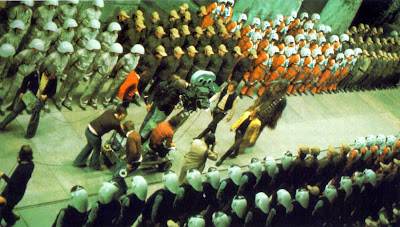
In Episode II: Attack of the Clones, we find out that the Clone Wars was actually a war between some crappy robots and … an army of Boba Fetts. The Jedi are sort of standing in between, and then they’re all killed by the Boba Fetts. Yeah.

Oh yeah. These guys are way cooler than an endless apocalyptic horde of Jedi.

As for Obi-Wan, he forgot all about R2-D2 and C-3PO after spending three whole movies with them because … you know what, at this point we don’t even care.

This is the first time I’ve ever heard this “fan theory” in action. In all honesty…it’s a pretty cool idea. But I have to admit that I was never really traumatized by not knowing what the “Clone Wars” were all about. Sure, I wanted to know, but I didn’t devote a whole lot of thought to it. I figured it was a bunch of wars. Involving clones. Why worry about it?

But the rest of this is awfully wrong-headed. Surely it’s not that difficult to pay attention to details? Starting with the question of why Obi Wan would use his original last name when he’s in hiding, it should be remembered that he’s not in hiding on Coruscant or some other heavily-populated central world. He’s hiding on a sparsely-populated planet way out on the Outer Rim, a planet that isn’t really even part of the Empire yet. There’s no real reason for the name “Kenobi” to be particularly troublesome; the only people who really know about him are the Emperor and Darth Vader, and neither of them really has any reason to be concerned with events on Tatooine. In fact, Vader himself may be subconsciously intending to avoid that planet entirely, since it’s where he grew up and met Padme.

And really, for all we know, “Kenobi” is like “Jones” in the Star Wars universe.

But the Cracked.com commentary goes off the rails when the writer assumes that the fan theory would fix a major “plot hole” in the Prequel Trilogy. The statement that “Obi Wan doesn’t seem to remember what happened in the Prequels” is just silly. First of all, he never said that he had never seen the droids before. All he said was, “Don’t seem to recall ever owning a droid.” Owning. And he hasn’t. He’s worked with droids, but none has ever really called him “Master”.

Second — well, he’s got to be careful, doesn’t he? When the droids show up in his life again in A New Hope, he can’t possibly expect them, and he can’t just start babbling at them: “Hey, R2! I haven’t seen this little droid in twenty years! And C-3PO! How’s it going!” He can’t do those things because Luke is right there, and Luke has no idea who he is or what he represents. And it’s not like they have time, over the ensuing course of events, for Obi Wan to give Luke a lengthy recitation of the events of the Clone Wars. What does Cracked think that Obi Wan is supposed to do?

And third, of the two droids specifically — it’s well-established in Star Wars that astromech droids (R2-D2) and protocol droids (C-3PO) are pretty much a dime a dozen. It’s also established that Obi Wan doesn’t think too highly of droids in his early life. And there’s just no real reason for Obi Wan to even know that Anakin built C-3PO. Maybe he knows, maybe he doesn’t. Cracked is assuming that the characters know as much as we do, and there’s no reason to make that assumption.

There. Been a while since I ranted in defense of Star Wars — I’d forgotten how good it felt!
Share This Post

Fixing the Prequels: Revenge of the Sith (part 1)

I’ve been meaning to get to this for a while, but various things have distracted me and kept it pushed down the priority list for several months. But now, it really is time to start the final edition of Fixing the Prequels, by turning to the final film in the trilogy, Revenge of the Sith.

Before I begin, it’s worth a reminder of what I’m about here. I love the Prequel Trilogy (abbreviated ‘PT’ hereafter), and have since I saw each individual film on first release. I found them all involving, exciting, and in the case of Revenge, emotionally crushing at times. I know I’m a minority in this, but I’ve never much cared about that. Even so, I must admit that as much as I love the Star Wars prequels, I don’t love them unreservedly, because they are flawed. There are things wrong with them.

That’s not an unusual opinion, but I think that my view as to the degree of that opinion is. Most folks seem to hold the flaws of the PT as fatal flaws, sinking the films to the point where the only appropriate response to them seems to be outright mockery. I don’t believe that. I think that a lot of the flaws in the films are overblown; others arise from misinterpretation or possibly a failure to understand what George Lucas was at times really getting at. And still more perceived flaws in the PT come, I think, not from a sense of genuine error on Lucas’s part but the simple fact that, by the time Lucas made these three films, tastes had changed in a lot of ways.

So when I talk about “fixing” the prequels, I’m not about wholesale rewrites and bagging on the direction of the films in all particulars. I point out flaws along the way, but my goal is also to highlight the things in these films that I find admirable, the things that keep me coming back to them frequently. My approach is to address two kinds of flaws: the ones that I think are real, genuine flaws, and the ones that I’ve heard cited as flaws from other people over the years but which I either don’t see as flaws or as fatal flaws. I’m about credit as much as criticism here, which I think is a more measured response to them than a lot of the people who deeply despise the Prequels would admit. It has long interested me that, in almost all cases of such discussion, the people who hold a negative view of something are the ones who invariably claim to be seeing the thing objectively. My response is to simply point out that having a negative opinion is not seeing something “objectively”; it’s having a negative opinion.

And now, with all that preamble behind us, let’s move on to discussing Revenge of the Sith, a fascinating film that even as I write this I’m not sure about, as to how I’d go about “fixing” it. This is mainly because I’m not entirely sure what I think is wrong with it. But as I work through the film, I expect some thoughts will crystallize. So let’s start at the beginning, which means as it always does in a Star Wars movie, a crawl:

War! The Republic is crumbling under attacks by the ruthless Sith Lord, Count Dooku. There are heroes on both sides. Evil is everywhere.

In a stunning move, the fiendish droid leader, General Grievous, has swept into the Republic capital and kidnapped Chancellor Palpatine, leader of the Galactic Senate.

As the Separatist Droid Army attempts to flee the besieged capital with their valuable hostage, two Jedi Knights lead a desperate mission to rescue the captive Chancellor. . . .

It sets things up nicely. I especially like that opening: “War!” This crawl is pretty blunt, with none of the “politics” stuff that many claim to have been bored by in the first two Prequels. (How they could be “bored” by a couple of lines of text is something I’ve never figured out, but no matter.) What stands out to me in this crawl, however, is that second sentence in the first paragraph: “There are heroes on both sides.” That’s an interesting line, there; it seems out of place, but I think it works in an interesting way: it calls to attention the ambiguous nature of the Clone War, the War to Preserve the Republic: we know that it’s basically a fake war, started for no other reason than to trick the Republic into destroying itself.

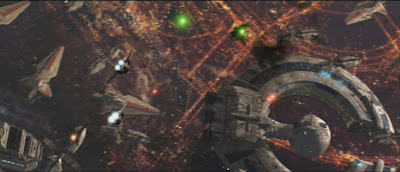
Revenge opens with a massive space battle, of which I’ve heard many differing opinions over the years. Detractors say that it plays like a video game on the big screen, and is impossible to follow. This has always struck me as odd, because it’s always seemed to me that George Lucas goes out of his way to make this incredibly frenetic space battle as easy to follow as possible.

After the crawl, we have our traditional pan down to a planet and a spaceship. (AOTC, remember, actually followed its crawl with a pan up.) The planet is Coruscant, and the ship is a Republic attack cruiser. The music dies away almost completely at this point; all we hear for about thirty seconds is a steady, but off-kilter (because it’s in 5-4 time), beat of drums. The camera starts to zoom in on the cruiser, when two new ships enter from behind: small fighter craft. Only two. We follow these two ships as they skim over the surface of the cruiser, out into space beyond it, and then back and dive. The camera follows over the edge of the cruiser, and there – spread out before us – is the enormous space battle.

As soon as the two Jedi starfighters come into view, the music starts in again, with the famous “Force theme”. We don’t need any dialogue or to even look into the cockpits to know that our two Jedi are flying these ships. Also, of all the ships coming and going in the skies above Coruscant, these are the only two ships of this type. This isn’t like A New Hope, when Luke Skywalker was only one of a bunch of X-wings. Even more, the Jedi starfighters are, by design, similar to what will eventually become TIE fighters, and those ships’ thrusters emit cone-shaped blasts of exhaust (presumably because the battle is taking place high in Coruscant’s atmosphere, as opposed to in the vacuum of outer space).

Another thing that interests me about this space battle is that we see almost none of it. Really. This battle clearly involves several times as many ships and combatants as the big battle at the end of Return of the Jedi (of course, a one-to-one comparison there isn’t easy because that one has a Death Star in it), but aside from lingering shots that quickly flash by, we are shown nothing of the battle itself. Nothing of the strategy, nothing of which side is winning and which is losing, nothing of tactics. All we see of this battle is what Anakin Skywalker and Obi Wan Kenobi see as they fly through it, on their way to General Grievous’s flagship. The battle is frenetic, and there is a lot happening onscreen, but it’s not at all hard to follow, so far as I can tell. The battle is entirely secondary to their main concern: getting through it alive to land on General Grievous’s ship and find the Chancellor.

So, after quite a bit of space derring-do that involves flying directly through a cloud of attacking fighters, evading missiles, and dealing with a bunch of small droids who get onto a fighter’s hull and then scuttle about taking the ship apart, our two Jedi heroes land on Grievous’s ship. I like a lot of the dialogue through here: at one point, Obi Wan notes “This is why I hate flying!”, echoing two lines from Attack of the Clones. I also like how when Obi Wan’s ship is infested by the buzz droids, Anakin’s first notion is to blast them off, which has Obi Wan screaming in protest, at which point Anakin says, “I agree. Bad idea.” So he comes up with something else.

What I also like about this whole sequence is John Williams’s music, which is full of interesting things like quotes from the “Force Theme”, sections in 5/4, and one heroic quote of the Rebel Spaceship Fanfare when R2-D2 dispatches the last buzz droid. This was a musical touch that I liked immensely.

Anyway, back to the General’s ship, where Obi Wan and Anakin have just landed. There’s an interesting touch here as the two Jedi take on a typically large number of battle droids: Obi Wan leaps out of his ship and ignites his lightsaber before his ship has even slid to a stop; Anakin, however, waits until he’s stopped completely before grabbing his saber and hopping out to join the melee. I like that. It’s the kind of tiny detail that gets lost amidst a lot of the melee, the kind of blink-and-you-miss-it thing that nevertheless illustrates something about the story and our characters.

Now Obi Wan and Anakin must make their way to the observation deck where the Chancellor is being held captive. This involves more run-ins with battle droids, malfunctioning elevators, and relying on R2-D2 when R2 is dealing with his own problems. (He has to hide from a couple of battle droids when Obi Wan starts talking to him through his comm-link.) I wouldn’t change any of this material, because the banter and chemistry between Obi Wan and Anakin really works pretty well, in my opinion:

ANAKIN: I sense Count Dooku.

OBI WAN: I sense a trap.

ANAKIN: Next move?

OBI WAN: (grins) Spring the trap!

And this, the transition from the space battle to the derring-do aboard General Grievous’s ship, is a good place to stop. Next time we’ll rescue the Chancellor, land half a ship, and find out that Anakin isn’t always shooting blanks. Excelsior!

Share This Post

I have a bad feeling about this

In all the years I’ve been reading dumb commentary online about Star Wars, I don’t think I’ve ever read a more wrong-headed assertion about it than this one:

If there was a moment when the culture of enlightened modernity in the United States gave way to the sickly culture of romantic primitivism, it was when the movie “Star Wars” premiered in 1977. A child of the 1960s, I had grown up with the optimistic vision symbolized by “Star Trek,” according to which planets, as they developed technologically and politically, graduated to membership in the United Federation of Planets, a sort of galactic League of Nations or UN. When I first watched “Star Wars,” I was deeply shocked. The representatives of the advanced, scientific, galaxy-spanning organization were now the bad guys, and the heroes were positively medieval — hereditary princes and princesses, wizards and ape-men. Aristocracy and tribalism were superior to bureaucracy. Technology was bad. Magic was good.

That’s the entire bit about Star Wars in the article, which makes a point about…something, I guess. I didn’t bother reading the article, actually; I just read the Star Wars bit and realized that I’m not terribly interested in the insights of a guy who can’t be bothered to be even remotely in the ballpark on what a movie is about.

Share This Post

Trust your feelings!

I’ve been enjoying AICN’s “Behind the Scenes Picture of the Day” series, and for obvious reasons, I really dug this one:

I also see that the official release date for the Star Wars films on Blu-ray has been announced. I won’t be acquiring these right off the bat, unless the current DVD player at Casa Jaquandor goes belly-up between this day and that. I’m not upgrading to Blu-ray until I absolutely have to; I still don’t see any compelling need whatsoever for this new format other than Sony saying, “Holy crap, we need one last physical format to soak everybody with before everything is all-digital-download!”

And I’m amused, of course, by the huge chorus of people shouting “I’m not giving George Lucas any more of my money!”, as if he’s the one and only filmmaker releasing films successively in one format and then the next and then the next.

Share This Post

The Lucas Itch

I love me some John Scalzi, but that creates problems for me because as much as I loves me some John Scalzi, I loves me some George Lucas way more. And John Scalzi most certainly does not love him some George Lucas much at all. Today Scalzi responds to someone who is responding to a four-year-old post of his, which leads me to look at that four-year old post itself. And now I really wish I hadn’t. Because…well…it’s crap. Crap of the “My opinion of [Item X] is fact” crap. And I think, largely, that Scalzi wrote the original post because he thought of a new way to speak negatively about Star Wars, which is a pastime he rarely fails to engage in when the opportunity presents itself.

How else to take this statement:

Star Wars is not entertainment. Star Wars is George Lucas masturbating to a picture of Joseph Campbell and conning billions of people into watching the money shot.

He goes on to describe the entirety of Lucas’s output in Star Wars in lots of negative ways, including maintaining his “masturbation” imagery by use of the adjective “Onanistic”. OK then.

Here’s the thing, though — Scalzi seems to make some odd assumptions regarding the concept of “entertainment”. Take this, for example:

There is nothing in the least bit “popular” about the Star Wars films. This is true of all of them, but especially of Episodes I, II and III: They are the selfish, ungenerous, onanistic output of a man who has no desire to include others in the internal grammar of his fictional world. They are the ultimate in auteur theory, but this creator has contempt for the people who view his work — or if not contempt, at the very least a near-austistic lack of concern as to whether anyone else “gets” his vision. The word “entertainer” has as an assumption that the creator/actor is reaching out to his or audience to engage them. George Lucas doesn’t bother with this. He won’t keep you out of his universe; he just doesn’t care that you’re in it. To call the Star Wars films “entertainment” is to fundamentally misapprehend the meaning of the world.

There are an awful lot of assertions here, with no evidence or citations to back them up. No working definition, for example, of what we’re even talking about with respect to “entertainment” is forthcoming. But on what possible basis can George Lucas be said to not be “reaching out to his audience to engage them”? You can argue all you want that he’s not successful in his efforts, but that’s not remotely the same thing as saying he doesn’t try at all.

Or take that word “popular”, in Scalzi’s first sentence above. Again, no definition is given, so I have no idea what Lucas could have included in a Star Wars film that would satisfy Scalzi’s desires here, but…well, as far as I can see, this is still false. Sure, Jar Jar Binks was a deeply unpopular character, but is that because Lucas openly decided to include something unpopular, or was he trying to include something that he hoped would be popular? Given that the “goofy sidekick” has been a standard element in storytelling since, well, forever, I think the latter is more likely. Ditto in Attack of the Clones, when Lucas tried to include another trope that has been deeply popular throughout the years, the youthful romance. Again, you can argue that Lucas failed — but failure is not synonymous with not making the attempt in the first place. (Again, I’m assuming Scalzi’s meaning here, because he doesn’t clarify matters at all.)

Then there is this:

What’s interesting about mythology is that it’s the residue of a teleological system that’s dead; it’s what you get after everyone who believed in something has croaked and nothing is left but stories. Building a mythology is necrophilic storytelling; one that implicitly kills off an entire culture and plays with its corpse (or corpus, as the case may be). It’s one better than being a God, really. Gods have to deal with the universes they create; mythmakers merely have to say what happened. When Lucas started Star Wars with the words “A long time ago in a galaxy far, far away…” he was implicitly serving notice to the audience that they weren’t participants, they were at best witnesses to events that had already happened, through participants who were long dead.

I’m sorry, but this is deeply, deeply silly. It just is.

Storytelling is, by its very nature, not participatory. At all. I have never, not once, been a “participant” in any movie I’ve ever seen. I wasn’t a “participant” when I saw Casablanca. I wasn’t a “participant” when I saw Titanic. I wasn’t a “participant” when I saw The Lord of the Rings. I wasn’t a “participant” when I saw 3:10 to Yuma. I wasn’t a “participant” when I saw…you get the idea. And this isn’t just true of movies: how would I “participate” when reading The Pit and the Pendulum? How would I “participate” in Rendezvous with Rama? How would I “participate” in The Once and Future King? or Maus? or Pride and Prejudice? or Old Man’s War? Was I supposed to think of myself as a “participant” in any of these?

To my knowledge, there’s only one form of storytelling right now in which you can participate, and that is the video game. (Which is why I think that games are a pretty exciting development in artistic terms.) Yes, there are arts and entertainments in which you can participate. You can act in a play, for instance. Sing in a choir. But there is nothing about The Bourne Identity that is more “participatory” than any Star Wars movie. The notion makes zero sense.

And besides, the disdain Scalzi is showing here for the “Once upon a time” storytelling trope here is pretty troubling. Was Walt Disney not an entertainer, then? How many of his movies start off with “Once upon a time” and follow Campbellian storytelling tropes that have been around for thousands of years? For many years, Westerns were one of the most popular film genres. And yet, every single Western ever made, by definition, was about characters long dead doing events that were over years and years before. So, come to that, is every historically-set movie ever made.

And besides that, why can’t there be multiple reasons to do something? Can’t George Lucas want to spin a story from mythological cloth and entertain at the same time? I’d bet that if you were to ask George Lucas if he wanted to entertain with his Star Wars movies, he’d likely consider it silly that anyone ever assumed otherwise. I’ve read the interviews and heard the commentaries, and I’ve heard nothing that rules out the notion that Lucas wanted to make films that would entertain people. But Scalzi’s entire argument assumes that the films do not entertain. Or, in other words: Scalzi’s entire argument assumes Scalzi’s own opinion of the films as fact.

Unfair? I don’t think so. There’s this:

Now, hold on, you say: If the Star Wars films aren’t meant to be entertainment, how come so many people were entertained? It’s a fair question; after all, there’s not a single film in the series that made less than $200 million at the box office (and those are in 1980 dollars). I’m happy to allow it’s entirely possible to be entertained by Episodes IV, V and VI, due to their novelty and the intervention of hired guns who aimed for entertainment even as Lucas was on his holy quest for mythology. Even then, however, Return of the Jedi was pushing it. I defy you to find any person who was genuinely entertained by Episodes I, II and III. Episode I in particular is an airless, joyless slog; in the theater you could actually hear people’s expectations deflate — a whooshing groan — the moment Jar-Jar showed up. After the first weekend of Episode I, people went to the prequel trilogy films for the same reason so many people go to church on Sunday: It’s habit, they know when to stand and when to sit, and they want to see how the preacher will screw up the sermon this week. You know what I felt when Episode III was done? Relief. I was done with the Star Wars films. I was free. I’m not the only one.

That line there — “I defy you to find anyone entertained by the Prequels” — now reminds me that I have read this post before, and responded to it. But I must have skimmed it before, because so much of this is silly, condescending, or both. Now I know that Scalzi’s not suggesting that all churchgoers go to church out of just “habit”, but I wonder what percentage of churchgoers he thinks do. Still, the whole exercise reeks of some kind of desperate reaching: “Since I’ve already established that Star Wars isn’t entertainment, I must come up with some other reason why people keep seeing the damn things. And that means that I must argue that millions of people are doing something for some other reason completely.”

That last bit — “I was so relieved after the last one came out! I was free!” — is just stupid. Scalzi could have been “free” of Star Wars any time he wanted to be. I decided that I was “free” of The Matrix after the first one; I never bothered watching the next two. I’ve stopped watching many a teevee series after I decided that I didn’t like it anymore. Good example: ER. I loved that show for years, but then it lost me, so I stopped watching it. It went on another five seasons after that. Did I feel “free” when ER finally went off the air, five years after it stopped entertaining me? No. Because I had, you know, stopped paying attention. The notion that people were going to Star Wars movie after Star Wars movie out of some robotic notion that they had to is just nonsensical.

But I’ve heard arguments like that before. Another good example is Titanic, a movie that has suffered as vicious a backlash since it was beloved in its initial release as I’ve ever seen. Now it’s not uncommon to hear people say that the movie wasn’t popular because lots of people liked it; no, it’s because of armies of thirteen-year-old girls who went to the movie over and over again to drool over Leonardo DiCaprio.

Maybe I’m being unfair to Scalzi, either by misreading or misrepresenting. But I don’t think so. His whole argument hinges on assumptions as to George Lucas’s intentions and a definition of “entertainment” that I don’t find well-taken. Ultimately it boils down to saying “Star Wars isn’t entertainment because I didn’t find it entertaining.”

Share This Post

20 Questions about Star Wars

01. Who is your favorite character from the original trilogy?

Han Solo. He’s got the coolest ship, the coolest weapon that isn’t a lightsaber, and I like his character arc from outsider who doesn’t believe in anything to full-fledged member of the cause.

02.How would you rank the original trilogy, in order from favorite to least favorite?

A New Hope
The Empire Strikes Back
Return of the Jedi

03. What are two of your favorite action scenes from the original trilogy?

The rescue of Luke and the escape from Vader at the end of TESB, and you know what? I’m gonna stick up for the Ewok battle, which I’ve never disliked (although it could have used a bit less broad comedy).

04. What do you consider the most emotional scene from the original trilogy?

Darth Vader’s rejection of the Dark Side. In fact, I think that scene is even more powerful in light of the Prequel trilogy, because now we have some idea of what must be going through his head as he watches his son there, writhing on the ground from the same Dark Side lightning that the Emperor used to kill Mace Windu at the time that he first rejected the Good Side. The scene is edited together so brilliantly — Vader stands there, watching; Luke screams “Father, please!”; Vader watches some more; the Emperor starts to get caught up in his own glee; Vader glimpses at the Emperor and sees the joy in Palpatine’s eyes; Vader looks back at his son; Vader looks back at the Emperor…and then decides that he can’t do this Dark Side thing any longer. That scene packs an amazing wallop for me.

05. Do you have any favorite toys or collectibles based off the original trilogy?

Mostly ships. (I should probably do a post of my Star Wars toys one of these days. It wouldn’t be a terribly long post, really.)

06. Which character had the most unsatisfying death in the original trilogy?

None of them are particularly “unsatisfying”, really — I’m not even bothered by Boba Fett’s demise, although a little more of a bad-ass exit wouldn’t have been unwarranted. Maybe a bit of a fight with Han before Han manages to set off the jet-pack, or something like that.

07. What’s your favorite ship or vehicle from the original trilogy?

The Millennium Falcon.

08. Who is your favorite character from the prequel trilogy?

Obi Wan Kenobi.

09. How would you rank the prequel trilogy, in order from favorite to least favorite?

Revenge of the Sith
Attack of the Clones
The Phantom Menace

10. What are two of your favorite action scenes from the prequel trilogy?

Obi Wan’s fight with Jango Fett on Kamino and his subsequent pursuit of him through the asteroid belt of Geonosis; Obi Wan versus Darth Vader on Mustafar.

11. What do you consider the most emotional scene from the prequel trilogy?

I found Revenge of the Sith almost emotionally overwhelming, starting with Anakin’s turn to the Dark Side. His subsequent acts of betrayal were terribly sad. One moment stands out: when Plo Koon is leading a contingent of clone troopers into battle, and they receive the go-ahead for Order 66. He turns to them, yells “Come on!”, and then looks on in shock and bewilderment as they aim their weapons at him. John Williams’s music for this sequence is some of the best of the entire Saga.

12. Do you have any favorite toys or collectibles based off the prequel trilogy?

Again, mostly ships. I never did much with action figures, although I do have a couple.

13. Which character had the most unsatisfying death in the prequel trilogy?

We’re straying into Fixing the Prequels territory here, aren’t we? I don’t have a problem with Padme dying essentially of a broken heart, since she hasn’t just lost Anakin but her beloved Republic — she has lost the very world in which she wanted to raise her children. I think Lucas was striving for something very operatic here, and deaths from broken hearts aren’t unheard-of in opera. But it should have been drawn a bit more clearly, I think.

14. What’s your favorite ship or vehicle from the prequel trilogy?

There are wonderful ships all through the Prequel Trilogy; I love just about all of them. Picking just one…oh geez, I don’t know. Maybe the Jedi starfighters in Revenge of the Sith, the ones that are on the way to being TIE Fighters.

15. If you could get a personalized Star Wars themed license plate for your car, what would it say?

E CHU TA. (Points to whomever can identify that!)

16. Do you have a favorite Star Wars based video game?

I really need to start playing some Star Wars games. I haven’t played any of ’em. Yeesh!

17. Have you read any of the Star Wars books (expanded universe), and if so, what are your favorites?

I haven’t read any in a long time. I started following them eagerly when they started coming out in the early 90s, but too many were coming out too quickly and the quality tended to be very uneven, so I eventually stopped. I wouldn’t mind reading a few now, but I’m not sure which are the “good” ones.

I loved Timothy Zahn’s novels, though.

18. Are you a fan of the “Clone Wars” cartoon series?

I don’t have Cartoon Network, so I haven’t seen any of it. I need to.

19. What (or who) do you hope to see in upcoming Star Wars TV series?

I’d like to see stories that take place well outside the scope of the “Big Story”. Maybe follow some Corellian pirate around, or something like that. I’d like to see tales that follow characters who aren’t Sith or Jedi or tied somehow to the fate of the Republic. Small-scale stories, perhaps. It’s a big galaxy!

20. If you were stranded on a desert island with one Star Wars character, who would you want it to be and why?

R2-D2. Seriously, he’s an intergalactic Swiss army knife. He can start fires, cut firewood, stun game so I can kill it, scan for passing ships, and so on.

Of course, if my choice was between R2 and Princess Leia, then….

Share This Post

Yes, Virginia, you CAN like Star Wars!

This little girl loves Star Wars — but the boys in her class shamed her into leaving her Star Wars water bottle at home.

I remember this kind of crap from when I was a kid. I didn’t see it as bullying, which I always interpret in its more brutal traditional forms: the group of big kids hanging out on a particular corner because they know the smaller, weaker kid has to pass that way to get home, for example. But this kind of relentless “Make fun of her until she buckles” stuff is bullying, as much as any “Hey kid, gimme your lunch money” thuggery. But I like this father’s approach: blog the story, solicit comments from women who love Star Wars too, and use those comments to show the kid (who is really cute, by the way) that it’s OK to like Star Wars and that those little boys can suck it.

Yes, I’m a guy who loves Star Wars. But I know plenty of women who love it too, and as a kid, I might not have come to love it had I not had a bigger sister who, at the time, adored it.

And besides, the little girl can always point out that if Star Wars is for boys, why is it that so many men in the movies get their asses kicked by two women, Padme and Leia?

Share This Post