
I’ll have more to say about Raiders of the Lost Ark later this week (the movie came out 40 years ago this week!), but for now, here is John Williams conducting the Vienna Philharmonic in one of the most iconic of his many iconic themes, the Raiders March. I especially love Marion’s Theme, which forms the mid-section of this march; her theme has a lot more of a yearning sensuality to it than any of Williams’s lyrical themes from the Star Wars movies to that point.
Tone Poem Tuesday (and Composer Focus: Sibelius, part 4)
It’s not Tuesday. Sorry about that.
But let’s give a listen to something our boy Jean Sibelius wrote in 1908: a tone poem called Night Ride and Sunrise. It’s quite an evocative piece, starting with a brief fanfare figure in the brass before settling into a rhythm that suggest hoofbeats along a dark road, the “Night Ride” of our title. It seems as if we’re going to be in for a long stretch without a melody, until one arises in the upper woodwinds, playing above the rhythmic pulse; this melody yearns and stretches and yet somehow manages to stay almost in the background. Our rhythm gives way to long scalewise passages in the winds, as our texture becomes colder, stormier, more dramatic.
Eventually, though, our sunrise arrives, and it is exactly what one might expect from a Sibelian sunrise: shot through with clarity and nobility, with simple magnificence. Even here, when the chorales in the winds and brass take over, there is still momentum to spare in the continuing pulsing rhythms. I’m coming to see that for Sibelius, a blend of textures is always afoot.
Here is Night Ride and Sunrise by Jean Sibelius.
Share This Post
Tone Poem Tuesday
Greek-born composer Nikolas Labrinakos has come to my attention recently. After growing up in Greece, he went to London to study music composition, eventually getting a Ph.D. from the University of Surrey. He is an active composer of both film music and concert music, and what I’ve heard of his is fascinating and atmospheric, displaying a gift for shimmering, evocative string writing.
The present work, The Last of England, is a pastoral work in the tradition of music by Ralph Vaughan Williams, George Butterworth, and Gerald Finzi. The piece is inspired by the seascape of England’s southern shore, with its cliffs overlooking the great gray expanses of water. Melodies seem to arise from meditative chords and sink back into them again, often with a soloist in the orchestra singing somewhere not quite in the foreground. This isn’t the music of a stormy sea, nor the sad music of the water where all things end, but a singing contemplation of life at the edge of our world’s most permanent feature. The Last of England is neither sad music nor happy music. It is…music that is.
Here is The Last of England by Nikolas Labrinakos.
Share This Post
Tone Poem Tuesday
French composer Emmanual Chabrier isn’t much known these days, but he is represented in the standard repertoire by his intoxicating dance Espana. That work is one of the most compulsively joyful in its bright orchestrations, sparkling melodies, and effervescent rhythms in the entire classical music canon. This piece, from one of Chabrier’s less-performed operas (and none of his operas are often staged), is cut from the same cloth as Espana, being a five-minute burst of energetic dance.
From what I’ve read, Chabrier is a curious composer in that his work has never really cracked through into the mainstream of classical music, even though his music was greatly admired by great composers who followed, like Ravel and Stravinsky. Chabrier was innovative in his own way, and he may have simply lived too early and therefore just missed a time which might have been golden for his music. Anyway, here’s a bit of pure delight: the Danse slav from the opera The Reluctant King, by Emmanuel Chabrier.
Share This Post
Tone Poem Tuesday
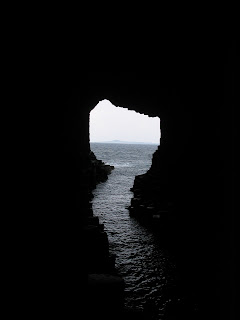

A repeat today (I think), but it’s been a while (I hope). Felix Mendelssohn’s The Hebrides is a concert overture, inspired by the composer’s journeys in Scotland and specifically his tour of the Hebrides islands and a basalt cavern called “Fingal’s Cave”, which is a place that would absolutely appeal to someone of Romantic mindset. The black basalt, the sharp columns, the waves of the sea…in Mendelssohn’s hands, all that became this wonderfully brooding and Romantic work of adventure and heart.

Here is The Hebrides by Felix Mendelssohn.
Share This Post

Tone Poem Tuesday
The sky is beginning to show some streaks of light over in the East there, behind our mount’in. The morning star always gets wonderful bright the minute before it has to go,–doesn’t it?
-Stage Manager, Our Town (Act I)
It seems a little strange to me that at this point in my life, as I’m six months away from turning fifty, that as ubiquitous as it is on amateur and school stages throughout the country, I have only seen the play Our Town produced exactly once.
It was in 1981 or 1982, thereabouts, when I was in fifth grade. The theater club at St. Bonaventure University, where my father was in second year of teaching, put it on, and that year my father was sharing an office with a guy who was very much involved with the theater, and who actually played the Stage Manager part in that production. I remember finding it an odd play at first: There were virtually no props, aside from the costumes. When one of the characters is supposedly in her kitchen making breakfast on May 7, 1901, she was pantomiming things like frying bacon and pouring milk from a pitcher. Later on, two high school sweethearts who live next door to one another are talking through their windows at night; this is done via two step ladders, which are placed side by side. And when the play’s final scene, set in the graveyard, rolls around, there’s just some chairs on stage. No stones, no backdrop other than the backstage curtain.
Ten-year-old me figured this was all because the college theater troupe couldn’t afford props and decided to do the play as best they could. I didn’t realize that this was quite deliberate on the part of playwright Thornton Wilder, who opens the play with the empty theater:
No curtain.
No scenery.
The audience, arriving, sees an empty stage in half-light.
Presently the STAGE MANAGER, hat on and pipe in mouth, enters and begins placing a table and three chairs downstage left, and a table and three chairs downstage right. He also places a low bench at the corner of what will be the Webb house, left.
After this, the Stage Manager begins addressing the audience in a monologue that literally introduces the play, starting: “This play is called Our Town.” He proceeds to slowly bring the audience into the scene, through Wilder’s meandering-by-design speech that creates the town of Grover’s Corners, New Hampshire. Even though he’s just set up the “set” that will be the houses of the two families we primarily follow, our Stage Manager gives a description of the town itself, pointing at things as though they’re really there: Main Street, the railway station, where the Polish neighborhood is, the various churches. Only after a bit of this–which, in the hands of a good actor, is quite engrossing–do we get to seeing actual characters on stage, actually acting like they’re in a play.
But that vacancy of physical props gives the whole thing a dreamy quality, which connected with the Stage Manager’s lengthy meandering monologues about the history of Grover’s Corners and what life there is like, keeps the audience feeling like they’re not witnessing a story so much as inhabiting a few moments in this town’s long life. Wilder knew what he was doing here: all the details he chooses for his town are familiar and somehow distant. Most of us probably think of our towns as having been like this, I suspect: an old town where nothing much happens, where people keep on living, and where no one notable ever really emerges. A few times Wilder presses the Stage Manager’s constant breaking of the “fourth wall” even farther, at one point even enlisting a couple of members of the audience (who are planted actors, obviously) to ask questions about Grover’s Corners (“What kind of culture is there?” and “Is no one in Grover’s Corners aware of social injustice?”)
Now, many years later, I see that Wilder’s metatheatrical approach echoes something that has vexed playwrights not just in his time, but for all time. Even Shakespeare had to grapple with the nature of his stage versus the stories he wanted to tell within it, as we hear in the first speech of the Chorus in Henry V:
O for a Muse of fire, that would ascend
The brightest heaven of invention,
A kingdom for a stage, princes to act
And monarchs to behold the swelling scene!
Then should the warlike Harry, like himself,
Assume the port of Mars; and at his heels,
Leash’d in like hounds, should famine, sword and fire
Crouch for employment. But pardon, and gentles all,
The flat unraised spirits that have dared
On this unworthy scaffold to bring forth
So great an object: can this cockpit hold
The vasty fields of France? or may we cram
Within this wooden O the very casques
That did affright the air at Agincourt?
O, pardon! since a crooked figure may
Attest in little place a million;
And let us, ciphers to this great accompt,
On your imaginary forces work.
Suppose within the girdle of these walls
Are now confined two mighty monarchies,
Whose high upreared and abutting fronts
The perilous narrow ocean parts asunder:
Piece out our imperfections with your thoughts;
Into a thousand parts divide on man,
And make imaginary puissance;
Think when we talk of horses, that you see them
Printing their proud hoofs i’ the receiving earth;
For ’tis your thoughts that now must deck our kings,
Carry them here and there; jumping o’er times,
Turning the accomplishment of many years
Into an hour-glass: for the which supply,
Admit me Chorus to this history;
Who prologue-like your humble patience pray,
Gently to hear, kindly to judge, our play.
In the end, of course, we start to get a hint of what Wilder is really driving at. Everything in our world is ultimately transitory, and all the remains is time and death. I suppose this is one thing that makes Our Town a staple of high school theater: along with being really cheap to produce, it’s got the kind of big theme that appeals to young people, its main characters actually are young people, and the whole meta-theater thing somehow feels more modern than it actually is (the play is now more than eighty years old). None of which is to suggest that Our Town should not be as common as it is…but its appeal is pretty easy to understand.
All of which brings me to the Tone Poem for today! Our Town has been filmed several times, for television and for the movies, and the 1940 film featured an Americana score by none other than Aaron Copland. Copland would later reduce his score to a ten-minute orchestral suite, which he dedicated to his friend, Leonard Bernstein. It’s a work of gentle sweetness, suggesting in its simple strains just the kind of town that Grover’s Corners is.
Most everybody’s asleep in Grover’s Corners. There are a few lights on: Shorty Hawkins, down at the depot, has just watched the Albany train go by. And at the livery stable somebody’s setting up late and talking.–Yes, it’s clearing up. There are the stars–doing their old, old crisscross journeys in the sky. Scholars haven’t settled the matter yet, but they seem to think there are no living beings up there. Just chalk…or fire. Only this one is straining away, straining away all the time to make something of itself. The strain’s so bad that every sixteen hours everybody lies down and gets a rest.
(He winds his watch.)
Hm…eleven o’clock in Grover’s Corners.–You get a good rest, too. Good night.
–Stage Manager, Our Town, Act III
Share This Post
Tone Poem Tuesday
One thing I’ve always believed about writing is that if an idea doesn’t work out in one piece, that’s no reason to put it aside forever. I’ve reused a lot of my own ideas over the years, a practice I learned in part from my beloved Hector Berlioz.
Berlioz wrote a concert overture based on Sir Walter Scott’s novel Rob Roy, relatively early in his career. Berlioz wrote very little abstract music; just about everything he wrote had a literary antecedent of some kind, and Scott’s novel was the thing for this piece. And it’s quite a decent piece: it’s not one of Berlioz’s greater works, but it’s a perfectly good concert overture.
Berlioz himself was never satisfied with the Rob Roy overture, but he knew a good idea when he had one: the slow melody in the central part of the overture stuck in his mind, so when it came to write his second symphony, itself based on a literary work (this time Byron’s Childe Harold), a work that was to feature solo viola and orchestra after a generous commission from Nicolo Paganini, Berlioz basically lifted that entire section of his earlier Rob Roy overture and dropped it into the first movement of Harold In Italy, which is one of Berlioz’s greatest works.
Learn from mistakes and lesser works–but don’t be afraid to mine them for ideas!
Here’s the Rob Roy overture by Hector Berlioz.
Share This Post
Tone Poem Tuesday
It’s April 20! Which means that it’s 4/20, and for a sequence of strange reasons involving some stuff some stoners did years ago, “420” is now a cannabis reference. This stuff is weird, really. I’ve nicked the following from Wikipedia:
In 1971, five high school students in San Rafael, California, used the term “4:20” in connection with a plan to search for an abandoned cannabis crop, based on a treasure map made by the grower. Calling themselves the Waldos, because their typical hang-out spot “was a wall outside the school”, the five students — Steve Capper, Dave Reddix, Jeffrey Noel, Larry Schwartz, and Mark Gravich —designated the Louis Pasteur statue on the grounds of San Rafael High School as their meeting place, and 4:20 pm as their meeting time. The Waldos referred to this plan with the phrase “4:20 Louis”. After several failed attempts to find the crop, the group eventually shortened their phrase to “4:20”, which ultimately evolved into a code-word the teens used to refer to consuming cannabis.
OK, then. I think that story seems pretty accurate, at least as far as my personal dealings with the occasional stoners have gone.
Well, anyway, since it’s 420, I got to thinking about composers and their drug habits. When you read histories of classical music, you quickly realize that a lot of composers spent a lot of their time under the influence of a lot of different stuff. Beethoven loved alcohol, and Berlioz leaned heavily on opium. Cannabis, though? For that I had to do a Google search, and while a number of names did crop up, one cropped up a lot: minimalist and electronica composer Terry Riley. As one writer notes:
One obvious point of consensus emerged right away: If you’re talking about the confluence of marijuana and new music, you’re talking about Terry Riley. The prolific Northern California minimalist composer and performer has never been coy about his recreational predilections (one of his pieces, “Autodreamographical Tales,” includes the sung lyric “Cannabis is a wonderful drug/ Sometimes you’re like a cat on a rug”).
That in turn feeds into some of the distinctive qualities of his music, including gentle, lapping rhythms, beguilingly sweet harmonies, and a seductive dream logic that provides a quasi-improvisatory feel. One person proposed including Riley’s entire discography on such a playlist, which has a certain simple appeal.
I’m not sure I’ve ever heard of Riley before this, but I do find him interesting after listening to today’s selection. I grant that you might not be all that interested in this, but I do like non-traditional approaches to music-making and composition. Riley’s approaches and use of electronics and repetitions of sound proved highly influential, providing ideas that later surface in the music of The Who and in the work of musicians like Mike Oldfield.
Today’s piece, A Rainbow in Curved Air, is an exercise in the dreamy soundscape of repeated sounds, modal improvisations, and experiments in pure sound. Over time the work seems to almost suggest melody, without actually coming out and stating one; it’s a hypnotic and expansive work…which one might well expect from a composer who enjoys his 420 action.
Here is A Rainbow in Curved Air.
Share This Post
Tone Poem Tuesday
I have a two-fer today, because I couldn’t decide between these two selections and I figured, since they do kind of go together, why not just use both?
Music for percussion only tends to be somewhat of a novelty, which is a shame since there’s a great deal of musicianship involved in playing percussion, as much as any musical instrument. Percussion is about a lot more than just providing a good, solid whack at particularly dramatic moments in the music. Think of the timpani providing the rolling thunder of the distant, and approaching, storm clouds in the third movement of Berlioz’s Symphonie fantastique, or the almost demonic energy of the snare drummer in Carl Nielsen’s Fifth Symphony. Or the glockenspiel in The Magic Flute, or those mighty pounding timpani in the opening chords of Also Sprach Zarathustra. (Or, if you want to admire the sheer musical thanklessness of a task, consider the poor snare drummer in Ravel’s Bolero, who has to play the same rhythm over and over and over and over and over again, for the work’s entire fifteen-minute reign of terror.
Many laypeople will know about bells and marimbas and that sort of thing, but they won’t realize just how many percussion instruments are actually pitched or how much a percussionist has to think about how they want to produce the exact sound they’re looking for. Timpani, for example, are tuned to specific pitches, so the performer has to have good pitch sense to tune the instrument, and that’s just where it starts. How hard do you hit the surface of the drum? Where on the head do you hit it? It makes a different quality of sound toward the middle as opposed to near the edge. Do you use soft mallets, or hard ones? It all depends! Percussion requires physical skill and every bit as much precision and focus as any other instrument. So if you’re one of those who thinks that the drums are where the musicians who can’t carry a tune go to live, well, get that notion out of your heads, folks!
Here are two works for percussion ensemble alone. The first is Music for Pieces of Wood, by Steve Reich. Five players perform this piece, using instruments called “claves”, which come in different varieties. Claves are pitched, which gives this work a polyphonal feel even as its spellbinding rhythms unfold. The piece almost feels like a bunch of clocks which are all not quite synchronized, and imagine the degree of rhythmic precision it requires for the ensemble to pull off this work!
The other piece I want to feature makes a really interesting contrast with the previous work, even though both are works for percussion. David Crowell’s Music for Percussion Quartet uses pitched instruments like marimbas, giving the work a tonal and melodic element that the Reich piece doesn’t. There are some amazing sounds here too, though: note in the second movement, when the sounds are produced not by striking the marimba’s bars, but by drawing cello bows against them. The result is a kind of droning chord work that reminds me of the pedal drone of a hurdy gurdy or a set of pipes.
So next time you’re listening to your favorite classical work, pay special attention to the percussionists! There’s a lot going on back there.
Share This Post
Tone Poem Tuesday
Today was annoying and obnoxious, so I’m just declaring today done. Feh.
(No, nothing bad, just one of those days where the planned work not only doesn’t go as easily as it should, but it also keeps getting interrupted by people who think that their new work outranks my planned work. And yes, in a couple cases, they were right, but still…Feh! Feh, indeed.)
Anyway, on days like this I resort to stuff I can just toss up here without a whole lot of commentary. Here’s Tchaikovsky, with cannons. Because hey: cannons.