
Tone Poem Tuesday

 Caroline Shaw is a composer, singer, and violinist who has emerged as one of the bright new voices in classical music. She has already won the Pulitzer Prize for one of her works, and she has composed a lot of music already in her 39 years. And I had never heard of her until last week, when I found her name after Googling “21st century classical composers”. I read a bit about Shaw, whose career has taken her from the Baltimore Symphony Orchestra to recording with Kanye West. That sort of eclecticism appeals to me; I have always responded well to artists with as wide a view of their artistic expression as possible.

As of my writing this, I’ve only heard one work by Shaw in its entirety, and it’s the one featured here today. It’s called The Observatory and it was commissioned (and premiered) by the Los Angeles Philharmonic, where apparently it opened a program that ended with Beethoven’s Ninth Symphony. That’s gotta be a hell of a thing for a composer, right? “We want you to write a new work for us, you’ll be filling out the program with Beethoven’s Ninth. You can do that, right?”

Well, Shaw most certainly could. The work is a grand-scaled tour de force, opening with huge chords reminiscent of those that open Brahms’s First Symphony, and then taking a 16-minute stream-of-consciousness tour of wonder. The work’s inspiration was apparently LA’s Griffith Observatory and Shaw’s own love of science fiction and the Cosmos. Obviously these themes drew my attention almost immediately. As Shaw herself writes, describing the compositional process of this piece, on the Hollywood Bowl website:

It was a wild ride, and I remember feeling like an observer of a mysterious workshop that somehow churned beauty out of chaos. There is also something about writing an orchestral work for a summer evening in Hollywood that got me thinking about my favorite genre of film and storytelling — sci-fi. I love the way epic tales of the beyond can zoom in and out, using grand imagined alternate universes to tell stories about ourselves. And I love how music in these films carves and colors our attention to those worlds (in their various scales).

While writing music, I often imagine some kind of visual (usually abstract, sometimes figural, rarely narrative), as a guide for myself and sometimes as a thing to write against. There’s an invisible counterpoint here, but I’d rather someone simply listen and create their own contrapuntal narrative adventure than read an account of mine — to leave space for one’s own observation and reflection, whether it be of the music or their neighbor’s t-shirt or cosmology or tomorrow’s grocery list. (The grand story arcs of our lives sometimes play out in minutiae and the mundane.) And often the imagined visuals that I write to are nothing more than shifts in color or a quick cut between undefined scenes. (Sometimes the juxtapositions and transitions [and parentheticals] are where the stories are.)

I greatly enjoyed this work and I will certainly be exploring more of Caroline Shaw’s music! I wonder if she’s given any thought to film scoring…since the inevitable screen adaptations of my Song of Forgotten Stars books are going to need a composer, eh?

Here is The Observatory by Caroline Shaw.
Share This Post

Tone Poem Tuesday

 A very modern work today, by Canadian composer Cassandra Miller. Duet for Cello and Orchestra is almost avant-garde in its conception: a solo cello plays the same droning two notes, a perfect fifth apart, through the entire work, marking the time insistently throughout even as the orchestra enters and departs at intervals that feel almost random. The orchestral passages start out sounding like trumpet fanfares, but they become increasingly frantic as we move through the work’s thirty minutes. The work apparently quotes an Italian folksong throughout, while our solo cello keeps playing this weird two-note ostinato until the very end, when at last the soloist gets to do something else: a strange kind of cadenza that soars above the orchestra’s dying ostinato.

It’s a fascinating work. Here is Cassandra Miller’s Duet for Cello and Orchestra.

Share This Post

Tone Poem Tuesday

 Works that are entirely for percussion are always interesting. I just discovered this one today: it is called Six Japanese Gardens, for mixed percussion and electronics, written by Finnish composer Kaija Saarioho. Not only did I just discover this work today, I just discovered Saariaho today! Apparently a BBC poll of musicians and composers ranked her as the greatest living composer, which seems to indicate to me that there’s a lot of fruitful exploring to do, as far as her music goes.

This work is a dreamy and meditative piece (not all percussion pieces are loud headbangers!), apparently commissioned by a music school in Japan in remembrance of that country’s own great composer, Toru Takemitsu. Saariaho has written that her basis for the piece was, as the title indicates, impressions of six gardens she saw while in Kyoto during the summer of 1993.

It’s a very interesting piece, by turns calming and exciting, as Saariaho explores specific rhythms in each section of the work and accompanies the soundworld of the percussion instruments with prerecorded electronic material. It all blends together to make a fascinating dreamscape of a piece. Solo percussion works, for me, always have something of a cleansing effect: without tone or melody (for the most part), my ear is able to focus on something else entirely: rhythm and pure sound, and the form that follows from the use of these instruments as exclusive expressive devices.

Give this a listen!

Share This Post

Tone Poem Tuesday

 Here’s an interesting piece! I didn’t realize this was even available online until a few weeks ago when I looked up the composer by name. Linda Robbins Coleman is a composer, conductor, and teacher from Iowa whose symphonic poem Journeys was commissioned by the Wartburg Community Symphony Orchestra while I was there. Yes, I was privileged to take part in a world premiere, under the baton of Dr. Janice Wade

Coleman’s website describes Journeys thusly:

Journeys, A Symphonic Poem, marked a turning point for composer Linda Robbins Coleman in that it was her first large-scale work conceived and produced without utilizing another medium for inspiration. As the composer says, “I chose the title in part because the years leading up to its composition were quite a personal and professional journey for me. When I began to write I discovered that Journeys would not be a programmatic description of a picturesque country or great work of literature, but that it would tend more towards a reflection of where I have been within myself, and where I am struggling to go.

Prior to Journeys, most of my larger works had been for theatre, writing incidental music, scores, or songs for plays ranging from Euripides and Shakespeare to modern and avant-garde productions. All were highly descriptive both in mood and language. This experience enabled me to learn how to experiment with various tone colors to convey the different feelings expressed in plays. But with Journeys I was on my own. Even though my music is very tonal and accessible to all audiences, I still found that expressing personal feelings and moods–from my own script this time–to be a most stimulating challenge.

I hadn’t heard Journeys since I played it back in February of 1992, so revisiting it is a surprising exercise in…well, not nostalgia, but an exploration of things not quite remembered. There is a passage in here that I remember quite clearly, as the piece’s middle section reaches it climax; there is some daunting trumpet writing in there, in which I was required to hit notes loudly that I wasn’t terribly confident of hitting much at all. I did manage to nail them, though.

I’m glad to read that Journeys didn’t disappear down a musical memory hole. It has apparently been performed a bunch of times since, as this recording proves (that is not my orchestra). Journeys is bold and dramatic, and quite modern in its conception. I hope you enjoy it.

Here is Journeys by Linda Robbins Coleman.

Share This Post

Tone Poem Tuesday

 Florence Price, who was one of my major musical discoveries (maybe “revelations” is a better term?) of 2020, wrote this wonderful String Quartet in G Major in 1929, and…that’s just about all the information I can find about it. It’s worth remembering that some of Price’s music was lost after her death, and more would have remained forgotten had a cache of her papers and manuscripts not been found in a dilapidated house in Illinois many years after her passing.

This quartet opens with a beautifully lyrical allegro, sunny and cheerful. But it’s the second movement where the quartet really shines: combining a slow tune that is redolent of old spirituals with a more bouncy section that’s almost jazzlike, it’s in the second movement that you can really feel Price’s Black heritage.

This is the website for Laena Batchelder, that quartet’s lead violinist, by the way. She seems very talented and with a good taste for eclectic music.

Share This Post

Tone Poem Tuesday: The Beethoven Jubilee Begins!

Beethoven

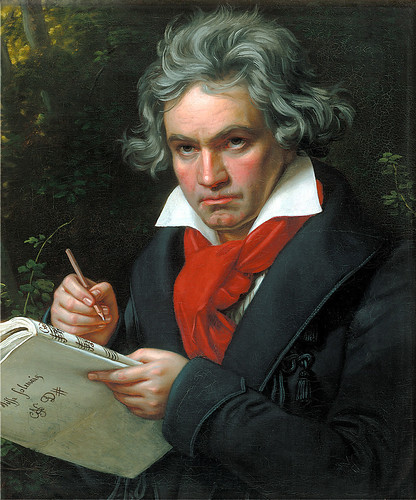
 This is the month when Ludwig van Beethoven turns 250 years old…fifteen days from now, to be precise. In honor of this, I’ll be stepping up the frequency of Beethoven-related posts–not quite daily, I expect, but there will be a lot of Beethoven this month, with a special post on the 16th, Beethoven’s actual anniversary. Let’s kick things off with an overture to one of Beethoven’s signature works, his only opera, Fidelio. Among Beethoven’s passions–in fact, after music, maybe his greatest passion–were the ideas of freedom and liberty. Beethoven lived in a deeply revolutionary era (I am reading a book about this aspect of his personality right now, but more on that later in the month), and he believed deeply in the liberal ideals that France would express as Liberté, Egalité, Fraternité. These values inform his opera, in which a woman goes undercover as a man to rescue her husband, who has been unjustly accused. The opera itself is a great work, and its overture (which was the last of four that Beethoven composed for it, being ever the perfectionist) is representative of many of Beethoven’s finest aspects as a composer.

Let there be Beethoven!

Share This Post

Tone Poem Tuesday

 First off, I think it’s high time I admitted that this series has morphed away from an exclusive focus on tone poems toward a general focus on whatever piece of classical music I’m grooving on at any point in time, so that’s what it’s going to be, even if I continue to call it “Tone Poem Tuesday” for reasons of alliterative nature (and the fact that I don’t really feel like launching a new posting series with new title). OK? OK!

So, naturally, let’s turn our attention to a piano concerto.

Florence Price, a Black composer who lived from 1887 to 1953, has appeared a number of times in this space over the last several months, and when 2020 is over, I wonder if her music might not be the finest musical discovery I make this year. Every work of hers I hear is vibrant and full of drama and color, and this concerto is no exception. It is lush and romantic in its orchestration, but distinctly Black in its musical language and its thematic material.

The work is in a single movement that nevertheless has three distinct sections within: the big first “movement”, the slow second movement, and a spritely third. We open with a solo trumpet sounding the first notes of what will be the first section’s main theme, a tune that is redolent of a spiritual, and that theme does in fact dominate a movement that is as big and bold in its statements as any great Romantic concerto. Then, in the slow movement, there is another gorgeous melody with a strong folk-like character (its pentatonic nature makes it even sound less moored in a specific time and place), before the final dance-like allegretto begins. It sounds like ragtime to me, but on reading a bit, apparently the finale is based on the juba, a specific dance from the plantations that predated ragtime.

Price’s concerto is one of the most delightful things I’ve heard all year, and I’ve heard a lot of delightful music this year. There is sweep and energy and emotion and lyricism and, in the end, a compellingly rhythmic dance that leaves the toe tapping, if I may invoke a rather tired cliche.

And it does all this in roughly eighteen minutes. Florence Price does something wonderfully economical here.

The work was performed in the early 1930s, with Price herself as the soloist, but unfortunately it appears to have utterly disappeared since then, until apparently in 2012 a composer named Trevor Weston was commissioned to recreate the work based on orchestral parts. Price’s own autograph score is long lost. Once again I am struck by how tenuous our grip truly is on the artistic work of our forebears.

Here is the Concerto in One Movement by Florence Price. Please give it a listen! And really, give it at least two. It deserves it.

Share This Post

Tone Poem Tuesday

 Charles Lucien Lambert (1828-1896) was born a free person of color in Louisiana. A talented pianist and composer, he moved as a young man to Paris where his son Lucien-Leon joined him in music-making, and their compositions were received warmly in Europe and later in Brazil, where they eventually settled.

As always seems to be the case, I can only find the very sketchiest of biographical details about these composers. This work is an overture, apparently: it’s called “Ouverture de Broceliande”. I didn’t even know if “Broceliande” is an opera, or an operetta, or a ballet…or if the piece if a concert overture with no theatrical work associated…until just a few minutes ago, when I turned up the fact that it’s actually an overture to a grand opera about the Arthurian legend.

The work itself is a compellingly melodic and exciting piece that certainly feels like the overture to something good to follow. It even felt to me rather like the opening credits to an old-school swashbuckler movie, like a spiritual ancestor of Korngold or Steiner. The sound isn’t heavily Wagnerian, though; Lambert’s overture sounds more like Chausson or Saint-Saens. I hope more of the music of both Lamberts comes to light.

Share This Post

Tone Poem Tuesday

 Admittedly, I am phoning it in a little this week. Here’s a virtuoso showpiece for cornet and wind band, setting the Italian folksong “The Carnival of Venice”, as played by Wynton Marsalis and the Eastman Wind Ensemble, conducted by Donald Hunsberger. Many a high school and college trumpet player was driven to heights of hero-worship which Marsalis released this album back in 1988 or so.

Share This Post