
Light!!!!

A coworker recommended a company to me a while back, knowing my love of flashlights.

Hold on, let’s start here: one of my favorite paintings at the Buffalo AKG Museum.

Giacomo Balla, “Dynamism of a Dog on a Leash”

Nice, huh? I like the suggested motion in the dog’s figure and in the leash. I always linger on this one when I get to where it hangs in the museum.

Now, where was I? Oh yeah, flashlights.

(Yes, the painting is relevant. Bear with me.)

The flashlight company is called OLight, and my coworker likes to tell me–rather mischievously–when they’re running sales. Whenever he says this, my response is always the same: “Oh lord, don’t tell me that!” Because if there’s one thing that’s almost guaranteed to get me to part with money, it’s a flashlight. (By the way, that old post of mine, linked above? All but two of those flashlights are now distant memories, and I don’t even remember the little red keylight that was apparently two bucks at Home Depot whenever I got that.)

But anyway, back to OLight. I do not visit that site with any regularity at all, because they’ll get a lot more of my money if I go too often. Heck, I just looked up the URL to link it above and I almost clicked four things to put in my cart! Dangerous, it is! However, sometimes there is necessity, and thus I have to discuss my one time (thus far) purchasing from OLight.

Enter the dogs.

Specifically, Hobbes.

When we adopted him last year, it was late in the summer when the nights were starting to settle earlier. Cane, you’ll remember, was mostly white with a few brindle spots, so we could see him in the back yard even when it was totally dark; we knew where he was and could corral him to bring him in when we let him out there to do his business either at night or in early morning. Hobbes, however, is completely brindle, so The Wife realized pretty quickly that it was going to a problem seeing him when he was let loose into the yard when it was dark.

She brought this concern up, and then I visited the OLight site…and saw this item here:

Now, was this a case of my phone listening to me and making sometime appear? I don’t know, but I do know that based on what I read, this is what the doctor ordered: a small light, with a multi-colored LED set-up on each end, about the size of one of those small McCormick spice containers, with a carabiner-style clip for attaching to stuff…like a backpack, or a belt loop, or somewhere on one’s person or on a dog’s leash.

Yup, this appeared to be just what the doctor ordered. Or rather, it’s what “the doctor” suggested and what I ordered. I got two of them, one for Hobbes and one for Carla. And then we proceeded to not use them for almost a year because Hobbes got injured and to this day he hasn’t been released into the yard on his own recognizance. But as our night-time dog walks are increasingly happening when it’s dark out, we have started using them even though the dogs are leashed. Hobbes doesn’t wear his yet, but on a lark I threw one on Carla’s collar one night. We wondered how she would react…and she didn’t. At all. She just does all her normal walk stuff with this light hanging from her collar. It barely weighs an ounce, so I’m not sure she even physically notices it, aside from seeing light.

And this is where our painting above comes into play, because a few times I’ve snapped Carla’s picture while walking, and the results put me immediately in mind of my favorite painting at the Buffalo AKG!

On the lower pic, it may appear that Carla has somehow red-shifted, because note the blue on her backside! That blue glow is actually coming from Hobbes’s light behind her. These lights can be set on each end to red, green, blue, or white, or flashing between all of those–and the ends can be set independent of the others, so I can set it to red and blue (on Bills game days!) or maybe red and green once we’re into the holidays. Visibility for one’s dogs is always a good idea, and I like having these for safety reasons.

Is that all I bought on that first OLight order? Why, no! I got a small flashlight for The Wife to carry in her purse or bag, and I got a small pen light to hang on my keychain because I’ve been in want of such a thing since my last keychain light died. Currently that’s all I have from OLight. But I’m sure that will change at some point, as I am highly impressed with what I’ve seen of their products thus far.

(Note to self: It’s probably time to update the “Flashlights I own” post….)

Share This Post

Gettin’ jiggy

So one of my bosses asked me if I could cut a buffalo out of a piece of wood with a jigsaw.

I said, “I dunno, I can give it a shot!” I then gave a bit of caution, because I’m not very experienced with the jigsaw. It’s not a tool I use in my daily life very often; the most I’ve used a jigsaw for is cutting plexiglass (and it’s not great at that stuff, or at least I haven’t figured out my technique, but that’s a topic for another time). I had to warn my boss that there was a good chance my resulting wooden buffalo would end up looking more like Josh Allen’s infamous potato-buffalo:

One of the offices at work had an old buffalo insignia on display (from a promotional sign we used once). I traced that onto a piece of plywood and started cutting.

And you know what? I might have a new skill!

A coworker painted them (I made two), one red, one blue. Here’s the final result, in blue.

As the experts on The Repair Shop might say, “Brilliant! I’m quite happy with that.”


Share This Post

From the Books: “Measure Twice, Cut Once”

I saw a news item the other day that carpenter Norm Abram is retiring from his decades-long job on the teevee show This Old House, which he has been on for over 40 years. I haven’t watched a lot of This Old House, but I have caught it now and then, and it’s always an enjoyable show from which I learn things when I do catch it.

Abram is also an author, and one of his books is a favorite of mine: Measure Twice, Cut Once: Lessons from a Master Carpenter. This small, short book is just what the subtitle says: a series of practical lessons from a person who has been practicing their particular trade for many years. Abram doesn’t go in for a lot of preachy “what it all means” motivational stuff in this book (with a couple of exceptions); he just writes clearly and succinctly about tools and their use and how to approach jobs. This is not an “intro to carpentry” book, but rather the kind of thing you might want to read if you know your way around a toolbox but don’t feel like you know your way around a toolbox, know what I mean?

Toolboxes

Working with my father, I didn’t have a toolbox of my own at first. He had plenty of tools, and I borrowed what I needed. Leather toolbelts hadn’t yet come into fashion; when they did, I was an early convert. My dad never wore a toolbelt. He wore bibbed overalls with loops and pockets for various hand tools sewn on them. He wore them over his work clothes all year, even, to my astonishment, in the worst heat of summer. I wore a cloth nail apron and carried the tools I needed at the moment until I graduated to my own toolbox and leather toolbelt.

There are several kinds of toolboxes, each with advantages and disadvantages. Some carpenters carry triangular wood boxes with pole handles but no covers. These days, I often see carpenters lugging around five-gallon drywall compound buckets with drop-in dividers with slots for tools. They’re not very elegant, but every tool is visible and easily reached. There is almost no stacking, which leads to pawing through layers to uncover the desired tool.

My dad carried a metal carpenter’s box with square corners. Its hinged cover swung open to reveal a shallow removable tray sitting over a larger storage compartment. His toolbox was long enough that a 28-inch level could be stored on the underside of the vocer. A level is delicate and doesn’t benefit from being stacked with other tools inside the box. The level fit over two blocks of wood that were secured to the cover with screws; it was then held firmly in place with homemade metal clips. The tray had limited space for smaller items, such as nail sets, a chalk line, pencils and other marking tools, a plumb bob, and drill bits, which we put in an old metal bandage container.

Measure Twice, Cut Once, but Don’t Measure At All If You Can Avoid It

Never measure unless you have no choice. Instead, base your marking and cutting on the actual situation. For example, I would never measure an exterior wall for a piece of siding, then go off and measure a length, cut it, and bring it back to install. It doesn’t matter how long the siding needs to be: I hold up a length where I intend to install it and mark it in place for cutting. It’s the actual length that’s important, not the numerical symbols on my tape measure.

Tape measures vary. The longer they’re used, the more they stretch. The hook at the end gets gummer up or bent enough to cause slight variations in readings. I don’t assume that my own tape is perfect. If I’m working along, I know that all the measurements are taken from my own tape and therefore profide uniform variations from a true standard. But if I’m working with other carpenters and each of us uses his own tape, with a unique variation from true, the consequences take on real importance. I’ve often seen carpenters argue at a lumber pile about whether a piece was cut to the right length, only to find out that their tapes were not equal.

The Right Way

I saw a funny movie recently about a carpenter and his three sons. The father, who had just died, spoke some of his best lines form his coffin. For instance: “There’s only two ways to do things. There’s the right way and there’s my way. And they’re the same way!” The line reminded me of my somewhat autocratic grandfather. He was a supervisor in a woolen mill, but he knew carpentry and performed it well. In his generation, the family was large and close, but my grandfather was boss and no one dared disagree with him. My dad, on the other hand, never said or implied that his way was the right way. But since he hadn’t come from a tradition of open discussion, he and I didn’t talk about carpentry as much, looking back, as I wish we had.

In my generation, technology has changed many hand tools and introduced the power tools that have largely superseded some of them. Yet many aspects of carpentry are very much as they were in my father’s day or in my grandfather’s. Even if the tool has evolved, the method is the same. There are many situations in which nothing works as well as a hammer and a chisel. I can’t imagine technology reaching the point where there would be no need for the deceptively simple technique of scribing.

What has declined from my dad’s generation to mine is the prevailing standard of skill in carpentry. My father could do many things by hand that I’ve never practiced enough to do, such as ripping a long board by hand in an admirably straight line. Recently I helped renovate an old house in Salem, Massachusetts. A number of handsome frame houses in Salem’s historic district have overlapping clapboards on their sides and backs; the facades, however, are made of very long boards butted square against each other to make a flat surface. An overlapping clapboard can be less than perfectly straight, but there can’t be much divergence when the boards are butted. In Salem, many facades reveal an excellent fit everywhere in long boards sawn and planed two centuries ago–by hand.

Carpentry was once a classic trade in the sense that techniques were treated as secrets to be revealed only to the chosen few, handed down from one generation to the next. Much of my time during the past two decades has been spent demystifying the skills of carpentry and woodworking so that any interested person can acquire the tools, learn the techniques, and practice them to a desired level of skill. Hence this book. It will discuss the contents of the ideal toolbox of today, not the tools that sufficed for my father’s superior carpentry. But as I describe hand tools and offer tips on techniques I’ve adopted, I never forget that much of what I know and practice was handed down to me from my dad and others of his and earlier generations. I hope these lessons will give you the confidence to use more tools, to augment your toolbox and workshop, and to share your experience and wisdom with others.

I find that I tend to respond most positively to people who view knowledge as something to be shared widely and often. Carl Sagan, Norm Abram, Anthony Bourdain…these kinds of people are the guiding lights of my world.

Share This Post

Shiny!

Let’s talk about flashlights!

I’ve written before–wow, that post is more than ten years old–about flashlights that I use regularly at work and such. And all of those flashlights from that post are still around, except, sadly, the one with the laser pointer on it; that one died a while back. But my love of flashlights lives on! Every day at work I have a flashlight on my person, and of course I am never happy to own just one daily work-horse flashlight. I now have four such flashlights, and I rotate through them all. Here’s the current lineup:

Cool, eh?

Here they are, each shining in a different lighting mode (except the one at left, which only has one mode):

I don’t rotate these daily. Rather, I use one for a few weeks at a time and then I use one of the others. For daily-use pocket flashlights, I tend to prefer roughly the sizes seen here, though there is a bit of variance. Here they all are, from a higher angle, switched off:

Aside from the red one at left, they’re all roughly the same length. Let’s run them down, left to right!

First up we have a flashlight by Amprobe:

This is the most obscure light in my kit. I don’t even know where to buy these; I got this one through The Day Job, where for a time this was the brand flashlight that we could order. This one is longer, but it’s also thinner, which is a nice trade-off. The red brushed-metal casing is lovely, and the light is very bright, powered by two AA batteries. I like this flashlight a great deal.

Pluses: Bright light, pocket clip and a wrist strap; AA battery use.

Minuses: Only one light setting, and the light cannot be focused.

Next is a flashlight by Klein Tools, which is one of my favorite tool companies.

I also love the tactile feel of this light, with that rubber Klein grip (well known to anyone who owns any of Klein’s screwdrivers). It’s a stubby light, but it’s not heavy and its orange brushed-metal look is also nice to look at. This flashlight, as well as the other two below, uses three AAA batteries, all inserted into a cartridge that is in turn about the size of a standard C battery.

What’s really cool about this light is its double nature. If you look to the photo up top, you’ll see what looks like five LEDs on the flashlight’s side. That’s exactly what those are, which means that the Klein flashlight can also be used as a worklight in tight places. This functionality is helped along even more by the fact that the flashlight’s bottom contains a powerful magnet so you can stick this light someplace and have it shine on what you’re working on! That is cool.

Also, the main light is encircled by a rubber ring that glows in the dark. This means that the flashlight’s ring will, after use, be all glowy for a bit. This looks kind of cool, but I have to admit that I am not totally sure how useful this is.

Pluses: Size and comfort of use; orange casing looks great. Two light modes: standard flashlight and work light. Magnet in base so the flashlight can be stuck someplace for use as a work light.

Minuses: Only one light setting on the main lamp; No ability to focus the beam.

Next up is a flashlight by a company called Coast.

I don’t know a great deal about Coast, but their flashlights are carried by Home Depot (at least in my area), and I actually own several lights by Coast. This is the only one that I ever carry around with me. It’s a nice flashlight with a black “tactical” look, even if this is probably too small to be a tactical flashlight. The knurled casing looks great, and the light is again a nicely bright beam, powered again by three AAA batteries.

The Coast light also adjusts for focus by twisting the lens piece one way or the other, which is great. There’s a nice big belt clip, too. I use this one a lot.

Pluses: Bright beam, two light settings, nice clip.

Minuses: Mine has started getting a bit touchy about if it wants to turn on and stay on.

Finally, the one I’ve owned the longest (I actually wrote about this light in that original post linked above), my MagLite Mini. This wonderfully bright flashlight has three settings: full brightness, half brightness, and a pulsing “signal” mode which I expect would be useful if you’re lost in the woods and are singaling help. The beam also focuses, though not quite as well as in the Coast light.

I used to keep up with Maglite a lot, but I don’t see their products at Home Depot very much these days, so I hope Maglite is hanging in there!

Pluses: Light-weight; three light modes. Shines very brightly; I can illuminate spots on the high ceiling at work with this one.

Minuses: No clip or strap of any kind. This flashlight has to live in my pocket when I’m carrying it around. Sometimes the flashlight “forgets” what mode it’s in, so when I click the power switch, it…hiccups.

The MagLite flashlight has been in my collection for over a decade and is still going strong (in fact, it’s my pocket-flashlight of the day as I write this), and I’ve owned each of the others for a while too; I’ve had the Klein light for four or five years, and the other two a couple of years each, so these flashlights are quite durable. Durability is important in a flashlight. I’ve bought many a spiffy flashlight over the years that I thought would be keepers, only to have them die quickly.

I do also have other flashlights like pen lights and work lights with magnetic bases and there’s a larger version of the Coast light which I use for brighter rooftop or ceiling inspections. You really can never have too many flashlights, in my opinion.

In fact, maybe this week I’ll stop by Home Depot or Lowe’s and see what’s new in the wonderful world of flashlights!


Share This Post

On Car Repair and Duct Tape

 It’s always struck me as strange that a lot of folks will, when they learn that my day job involves fixing stuff, make some remark about how I must use a lot of duct tape. I also get a particular Internet meme shared with me: It’s a guide to fixes of all kinds, consisting of two questions:

1. Does it GO and it’s supposed to stay put? (Answer: Use duct tape!)

2. Does it STAY PUT and it needs to go? (Answer: Use WD-40!)

Now, I do use WD-40 and other penetrating greases on occasion, but I have to admit: I hate using duct tape for general repairs, and I generally refuse to use it at work for any purpose other than taping thick rugs down over spots where our tile floor breaks. As a means of fastening things together, I personally feel that if I resort to duct tape, I’ve failed as a professional. Yeah, it’s one of those weird “honor” things. We’ve all got an honor thing about something, and duct tape is one of mine. (Another? Papermate and Bic pens. Yuck!)

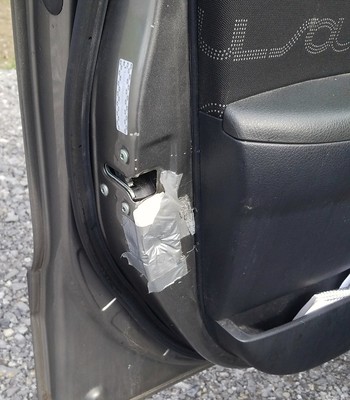
But there is one repair for which I used duct tape without regret. It was a repair–you know what, let’s put quotes on that, because even I can’t call this a genuine repair–there’s one “repair” I made using duct tape. One time my car door wasn’t closing all the way. It would feel closed, but it wouldn’t be registering as closed. The “Door Ajar” warning light would come on, and even more annoyingly, the dome light would come on as well. I find the dome light enormously distracting when I’m driving in darkness, so this was a frustration. This went on for a few days until I realized what the problem was. It was related to…the seatbelt.

There’s this weird thing that tends to happen to me in cars: the seat belt doesn’t retract all the way, like it’s supposed to. This happens to me a lot. I don’t know if it’s something about the shape of my body or something, if the belt twists in such a way when I use it that it doesn’t snap all the way back, or if it’s a thing that happens to everybody. But once in a while, the seat belt will stop retracting and just kind of hang loose. More often than not, then, the belt hangs into the damned door frame, so when I go to shut the door I close it on the seat belt itself, sometimes catching the entire buckle between the door and the frame. This in turn results in the door not closing properly, but latching enough that I have to unlock the door to fix things.

So: I turn the car off, unlatch the seatbelt and flick it to my left, from where its spring-loaded mechanism is supposed to retract it. Then I pay no attention as I grab whatever I need and get out of the car. Most times I shut the door and go about things normally…but once in a while, I hear an obnoxious metallic CRUNCH sound and notice that the door is not closed. The damned seatbelt has caught in the door frame again! I swear a few times, take care of business by opening the door and untwisting the belt so it can do its thing correctly, and then close the door again.

But.

One time, the buckle managed to get in between the door and the frame at the exact spot where the door’s shape is supposed to depress the door switch that tells the car that the door ain’t open. And of course the damned buckle dented the door at that exact spot. It’s a tiny dent, so tiny you can’t even see it unless you’re poring over the door itself trying to figure out why the door-close switch isn’t working. The switch itself is working just fine, see! With the car turned on and the door open, you can press it with your finger and make the car think the door is shut!

Yup. That tiny dent, barely a fingernail’s thickness in depth? That was sufficient to make the door not click the switch. I couldn’t see any feasible way of repairing the door to make the switch work myself, and I sure as hell wasn’t taking the car to the shop for this dumb repair, which I could see resulting in a whole new door. Screw that.

So…enter the duct tape.

A disposable wipe cloth, folded up and taped to the door at that spot? That worked wonders.

Stupid duct tape.

Damnable Duct Tape!

I hope this doesn’t come up too much when I’m sitting around the fires in the halls of Repair Valhalla.

Share This Post

Screws fall out all the time, the world’s an imperfect place.

xkcd nails it on screws!

In my day job I see a lot of different screws. There are way more screws out there in the wonderful world of mechanical fasteners than Randall Munroe even bothered to depict here, but the reactions to the existence of those other non-Philips or non-flathead (or “straight blade”) screws tend to run like this. I don’t know how many times in my years at this job it’s happened, but if I had a dollar for every time I’d had this conversation:

“Uh, Kelly? I was gonna do this job myself but then I saw the screws and they look like normal screws but they’re got this square thing in the head instead of Philips and is that a real thing and do they even make a driver for those?!”

This is when I say “Why yes,” and I pull my from pocket my trusty Klein 11-in-1 driver, and for one brief moment, I achieve a status in their eyes that is absolutely Gandalfian or Dumbledoresque.

Now, when I encounter a screw that I do not have a driver for, that’s when my command of expletives comes in handy, because really, there’s just no need to use a screw that obscure!

Share This Post

Remissful blogger is remissful.

I’ve been remiss (!) in noting that MD Jackson of Skylarking has awarded me one of those blogging award things, this one called the “Versatility Award”. This is because I’m a versatile blogger. (I know, it’s just like the title of the award!)

So, as is usual with this type of thing, I’m supposed to provide seven facts about myself and then give the award to several other bloggers. I usually skip these steps, but what the hey…only problem is, after nine-plus years of blogging, I’m almost at a loss as to what facts I still can ‘reveal’ about myself that aren’t common knowledge to those who read this blog on any kind of basis, regular or not.

By way of a bit of navel-gazing, I’ve noticed a substantial drop in traffic round these parts lately. What I think has happened is that Google may have shuffled its image hit results, because those seem to be the hits that I’m not getting as much of anymore. I don’t expect traffic to ever jump here again, really — it may fluctuate upward a bit, but I suspect that my average number of viewers is pretty much calcified in place. That kind of bums me out, but as I’ve noted, it’s also a bit liberating in a way. I’ve wondered occasionally over the years if it’s my blogging versatility that’s kept this blog from ever becoming highly trafficked, but now…well, who cares.

Anyway, seven facts!

1. My first-ever job, as I’ve noted before, was as a technical-services assistant at the library at St Bonaventure University. I was one of several people who did things like put new card pockets in the backs of books, weeded cards from the card catalog, and stuff like that. I don’t imagine very many of those tasks are the same now…but that was my first real job. I went from never having worked to suddenly working eight-hour shifts during summer after my senior year. That was quite a shock to the system. I probably should have had a part-time job at some point before that, but in high school I was a social stick-in-the-mud and thus didn’t really need a whole lot of money over and above my allowance from my parents.

2. My current job at The Store, as I’ve noted before, involves the use of a lot of power tools, and I’ve grown quite proficient and knowledgeable about tools and their uses in seven years. I can do a lot of stuff, and it’s been a thrill learning it all and continuing to learn. I’m enormously lucky to have scored a job that provides literally years of learning opportunities and skills which will serve me well in other areas of life. And boy howdy, did I have a lot to learn. When I first got hired, in my first few days a manager asked me to put some paper towel dispensers up on several walls. He handed me a drill with a driver bit and some drywall screws and sent me off…but I had to go back to him for help, because the screws were Philips head and the bit in the drill was for slotted screws, and I didn’t know how to change a bit in a drill.

3. I have an odd fascination, as I’ve noted before, with pies in faces. I think a pie in the face is all kinds of awesome…but I hate seeing newly-married brides and grooms smearing wedding cake all over one another. This irritates me to no end. It strikes me as godawfully inappropriate and never makes me laugh. The Wife and I did not do this. Neither of us wanted to do it.

4. I’m not a fan, as I’ve noted before, of mashed potatoes. I don’t like the flavor or the texture, and gravy doesn’t save them, either. But mashed potatoes do fall into that odd category of “Foods I don’t like but yet always look really good to me when I see them”. Mashed potatoes on someone else’s plate look so yummy! So does pineapple on pizza, and so does sauerkraut. But I’m not a fan of any of these. (I do think that cooking meat in sauerkraut does wonderful things to the meat. The ‘kraut itself, I can take or leave. Like it on Reuben sandwiches, though. And just today I tried some on a hot dog, and that was OK.) And no, broccoli does not fall into one of those categories. Broccoli looks, to me, like it tastes: the Food of the Devil.

5. I realized a while back that in my current work-in-progress, the space opera novel, I’m envisioning one of my characters as Nichelle Nichols in the Star Trek III-IV-V era. I thought that the older Uhura really had this sexy, “Don’t make light of my opening and closing hailing frequencies because I can kick your ass without so much as reaching for my phaser” thing going on.

6. Vegetarianism isn’t for me, but I do like to explore vegetarian options now and again and am planning to do more of it. Veganism strikes me as an approach that makes some fairly odd assumptions regarding the suffering and ‘exploitation’ of animals. The ‘raw food’ movement? That’s the one that makes me want to eat a bacon cheeseburger out of spite. Judgmental? Sure. Hey, I’ve got limitations, same as everybody else.

7. To this very day I have never attended a single rock concert. The closest I’ve come was “Classical Mystery Tour”, a Beatles tribute band that performed with the BPO a year ago. (Which was, truly, a wonderful concert.) In all honesty, I don’t really think I’ve missed anything — except for Van Halen.

OK, there are seven facts about me. All of them are certified true, or your money back. Now to give the Versatile Blogger award to others! As always, this comes with absolutely no obligation to play along.

Jason Bennion of Simple Tricks and Nonsense blogs about his difficult relationship with his father, his sadness over the space shuttle program ending, his thoughts on movies, and occasionally his experiences as a fairly liberal guy with a beard living in deeply conservative, facial-hair-free Salt Lake City. I just wish he could post more, but judging by how often I see him post things on Facebook like “Yeah, it’s 7:00 and I’m still at the office”, I can totally understand why he is limited.

Lynn Sislo of Violins and Starships has been a daily read of mine for years, and I see no sign of that ending. She’ll put up a post about a sewing project and then blog about the science fiction book she’s just read, and other topics in between. Endlessly fascinating blogging from the wilds of Oklahoma!

SK Waller of Incurable Insomniac is also a fantastic blogger from the wilds of Oklahoma. She’s had a tough go of it through life, but she writes openly and honestly about it all. Hers is a musical soul, and she’s got a lot of songs to sing. I constantly wish for her to have a big success story.

Roger Owen Green of Rambling with Roger is the very picture of intellectual curiosity. He’s one of those folks who engages with the world in such a way as to always have something new and interesting to say. And he blogs every day. That’s amazing in itself, these days in Blogistan!

In truth, I could pass out two dozen of these and still have room for more; most of my favorite bloggers now are the “versatile” types. Single-subject blogs have to be very fascinating or well-written to keep my interest, and I’ve almost completely given up on political blogs entirely (I still have four favorites that I check in on, once or twice a week). I get the sense that blogging is settling into a niche hobby, like all others. But it’s still my hobby! Thanks for all the versatility out there, Blogistan!

Share This Post

I am Locutus!


Locutus, originally uploaded by Jaquandor.

You will service me. All your power tools will be added to my own!

I bought a Brinkmann LED headlamp the other day, for use when I’m on the scissor-lift at work — oft times I’m doing work up there above the level of our lights and occasionally a little light would be helpful. Now, I’ll have it, by strapping this thing to my hard hat. Interestingly, it has a red light for night vision. Cool!

Wow, do I love tools!

Share This Post

Carpenterizin’

Occasionally at work I get to do some carpentry by myself. Now, I’m really pretty green as far as carpentry goes, but I’m learning as quickly as I can given that my only real opportunities to practice come at work (but when we get a house, hoo boy, then it’s Carpentry Central!). When there are big projects to do — building of cabinets, for instance — I tend to wait until one of the more experienced carpenters in the company division is in residence, and then I pay as much attention as possible whilst helping. On simpler jobs, though, I go at it myself. Two weeks ago I had to build three of those A-frame type signs, which were intended for display along the street during special events.

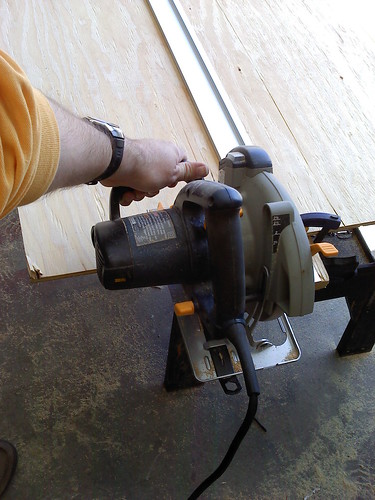
A-frames aren’t hard to make, really — just time-consuming, as they involve quite a bit of cutting and joining. I had to cut six 3*5 sections of plywood out of full-sized, 4*8 sheets, using my circular saw:

It cuts! In circles!

My weapon there is a fairly cheap Ryobi saw, which gets the job done for my purposes. If and when I get more serious about this stuff, I may upgrade to a higher quality saw, but for now, this one’s just fine for me. (Although, when I bought it a couple of years ago, the first thing I did was to replace the enclosed blade with a better one, a blade that had twice the number of teeth and a thinner kerf to boot.)

The 3*5 plywood sheets were for the faces of the signs; I built the frames themselves out of 2*4s which I cut down to proper sizes using a miter saw. I then joined the 2*4s together using one of my favorite gizmos, my pocket-hole jig. Pocket-hole joining is amazing to me: not only do they result in strong joints, but they’re amazingly easy to do. Here’s the jig in action:

Drilling pocket holes

You just clamp your workpiece in the jig and then use the bit that comes with the jig to drill your pocket holes. Then, afterwards, you simply drive your screws through the pocket holes into the piece you’re joining to the pre-drilled piece, and everything gets pulled together really nicely. I love the pocket-hole jig. Long live the pocket-hole jig!

Unfortunately, I didn’t think to actually take photos of my finished signs, so imagine they look kinda like this, but with better carpentry and no skateboard dude.

Share This Post