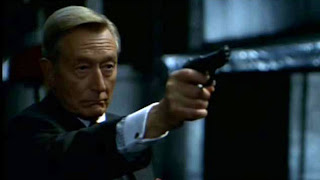
Actor John Neville, of Baron Munchausen and X-Files fame (wherein he played the ‘Well-manicured Man’, one of the conspirators and ally of the Cigarette Smoking Man), has died. He was a fine actor and will be missed, even if he did help pave the way for the alien colonization of our planet.
X-Files Case Report: “Gender Bender”
(Fox Mulder)
good breeding ground for tales of supernatural suspense, so it was
just a matter of time until The X-Files got there.
“Gender Bender” is that episode, and it’s…well, I
literally could not decide if I liked it or if I didn’t.
– or she picks him up – and they return to a
hotel room for a bit of action. Unfortunately for the man, the bit of
action turns out to be fatal…and then the woman leaves the hotel
room…as a man.
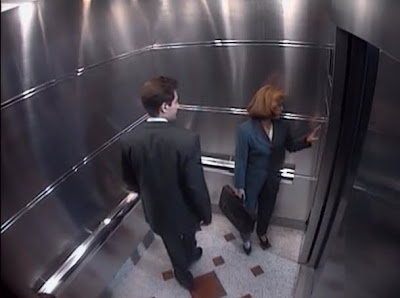
summoning to Agents Mulder and Scully, who show up to do their
investigative work. A bit of dirt on the victim leads Mulder to
conclude that there is some connection between the murderer and a
specific area in Massachusetts, an area noted for being the home of a
hyper-secretive religious sect called “The Kindred”. Mulder
and Scully approach some members of the Kindred on the street –
they are clearly modeled on the Amish, only a lot creepier – and
while Mulder gets nowhere, Scully manages to get one of the Kindred
men to open up a bit, by showing concern for their horse. A very odd
moment happens then, when the man seems to almost seduce Scully right
there, in the middle of the street.
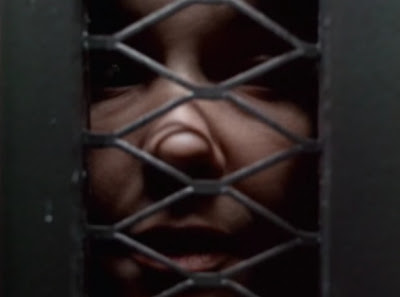
very strange stuff involving the Kindred, their practices when one of
their own dies (rituals involving catacombs beneath a barn,
slathering the dead with white clay, and holding the bodies in what
can only be described as ‘gestation tubes’, whereupon the dead man
starts to acquire the features of a woman).
murderer is an escapee from the Kindred, and that the Kindred
desperately want to maintain their secretive way of life, which means
that they want to handle the lapse of one of their own themselves,
without the aid of the FBI. This is eventually what happens, when
Mulder and Scully track the killer and corner him, only to have the
Kindred show up and then disappear with him. When the agents return
to the Kindred farm, they find it completely abandoned, with the
catacombs sealed with white clay, and a freshly-made crop circle in
the field.
like this episode or not. The standard X-Files
creepiness-through-atmosphere is in full force here. And the acting
is really top-notch, especially the guy who plays Brother Andrew, the
Kindred member who seduces Scully. It was a good choice, casting a
guy who is not particularly handsome, as a guy who apparently oozes
enough sexual energy to bend Scully to his will. It’s eerily
believable, in some way.
offers even less by the way of answers than most episodes of The
X-Files, and that’s really saying something. Most times
we’re told, or at least led to suspect, what has been going on, but
here…I got nothin’. A religious sect that somehow regenerates its
members, changing genders in the process? And they all give off
enormous amounts of pheromones? And what is with the crop circle?
Were they aliens? I think they basically tried cramming too much into this episode. Supernatural murder through sex is a fascinating concept that could have been explored well on its own (and maybe it was, later on in the series…I don’t recall offhand), but here there are too many elements to really be dealt with in any kind of satisfactory way. The Kindred themselves are potentially fascinating, but again, they’re in and gone from the series too quickly to say.
is a typically well-made episode…but it’s an atypically
unsatisfying one.
Share This Post
X-Files Case Report: Beyond the Sea
Share This Post
X-Files Case Report: “Fire”
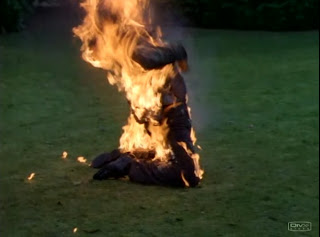
“Fire” is another episode that I’m seeing for the first time via this rewatch, and I have to say – it’s a terrific episode. Written by Chris Carter, this one has a lot going for it: a strong story, a compelling and eerie villain, and some more of Mulder’s backstory with some good character moments.
Share This Post
X-Files Case Report: “Eve”
“One girl was just abducted.”
“Kidnapped.”
“Potato, po-tah-to.” (Mulder and Scully)
“Eve” is one of the stronger episodes of the first season, and it’s actually a very memorable tale, only partially undone by some poor storytelling in the last act.
A shocking murder takes place in Connecticut, where a suburban father is found sitting on his daughter’s backyard swing set. His skin has gone completely white, and there are two distinctive puncture wounds in his neck. Only his daughter is there to see.
This sounds like a vampire story at first, but when learning of the case, Mulder’s initial hypothesis is alien abduction, based on blood loss that resembles that in cattle mutilation cases. Since the daughter reports having seen nothing, Mulder interprets this as a “time loss”, similar also to that of alien abduction cases. This is the direction in which things are going, when another murder takes place in San Francisco – under identical circumstances. When Mulder and Scully investigate this one, they find that this victim also has a daughter, who is identical to the daughter of the first victim.
There are a number of twists and turns in the course of this case, but it eventually turns out that the two girls are the second-generation progeny of a woman ‘created’ in secret US government eugenics experiments that took place at the beginning of the Cold War. The experiments created children with strong psychological connections to one another – and also with deep psychoses. The earlier woman – named ‘Eve’ – used her job as a fertility doctor to inseminate couples with her own created embryos, leading to the births of identical children on opposite sides of the country – but children who somehow already know of each other’s existence.
This is all very eerie and effective, until the final act, when Mulder and Scully are taking the two girls to where they can be treated or observed or some such thing. The girls are planning to kill Mulder and Scully, and their plan is to poison their soft drinks with digitalis, the same poison they had used on their own fathers. The script establishes that the poison has a very sweet flavor, so it’s maddening when Mulder and Scully both comment on how sweet their drinks taste but don’t put two and two together. Mulder figures things out, though, when he realizes he’d left his car keys on the counter of the truck stop where they’d bought their drinks. He goes back in, grabs his keys, and finds a couple drops of the poison right there on the counter. This whole scene is just awfully done. The rest of the episode is very good; I can’t believe the writers (Kenneth Biller and Christopher Brancato) couldn’t come up with a better way to have Mulder or Scully figure things out.
My only other quibble is the show’s apparent growing reliance on the Deep Throat character to show up and provide an infodump at some point. Mulder always seems to have his source of information that jump-starts his investigations.
Nevertheless, the episode has a nicely chilling premise, its first three acts have enough shifts that we don’t know what’s going on, and the last scene is one of those niftily eerie ways The X-Files had of ending things on a note of non-resolution. It’s a very good episode that is mainly marred by some deus ex machina in the end.
Share This Post
X-Files Case Report: “Fallen Angel”
Hot on the heels of the lackluster “Space” comes an episode that marks a serious improvement: “Fallen Angel”. This is a terrific episode, one that establishes a surprising amount of background for the mytharc that would come to dominate the series.
In eastern Wisconsin, a police officer is patroling a rural route out in the middle of the woods when he sees a large fire in the distance. Meanwhile, a military air-traffic monitoring station is tracking something that is traveling very fast and on an erratic flight path. This something disappears from their screens in eastern Wisconsin, and the commanding officer immediately places a phone call to his superiors that they have a “fallen angel”. Something has crashed in those woods. Our intrepid cop is investigating, but we see POV shots of something stalking him, and the last thing we see before cutting to the credits is the cop’s death screams.
When we return, Mulder is already on the scene, trying to infiltrate what is now a military operation in the woods there. Through flashbacks, we see how he learned of the crashed aircraft: Deep Throat told him. Mulder is taking on considerable risk, as he is going far off the FBI’s standard jurisdiction and methods. He gets in close enough to get a look at what’s happening, and it’s quite clear that this wasn’t an Iraqi jet crashing (the cover story put out, which is pretty silly, as Mulder points out – an Iraqi jet over Wisconsin?!); he takes photos of what is no airplane we’ve ever seen. But of course he’s discovered and captured, and his camera is confiscated and his film destroyed. (Yes, we’re still pre-digital cameras here.) A somewhat bad-ass military officer threatens Mulder with everything under the sun after putting him in some kind of ad-hoc lock-up, which is where Mulder makes the acquaintance of a guy named Max Fenig.
At first glance, Max is an obsessive hippie-type of UFO enthusiast, wearing a baseball cap with the NICAP logo (National Investigative Committee of Aerial Phenomena). Max has been tracking this case, and it turns out that he’s part of an underground UFO community for whom Mulder’s work is legend. Max also has some issues of his own, though; poking through the trailer which Max drives around the country pursuing UFO reports, Scully notices that he is taking very power anti-psychotic medications. Is Max Fenig for real? Or is he a crank whose UFO experiences are simply a result of pre-existing psychological conditions? Well, this is The X-Files, which means that our answer is…a bit of both.
I was also interested by the depiction of the alien itself. We never see “it” directly; there are shots from its point of view as it moves very quickly across open spaces, very near to the ground, and in long shots, the alien is only “visible” as a transparent distortion of the air that quickly moves by. Very early on, The X-Files was clear to establish that its aliens were not all of one stripe. They weren’t all “grays” with the big heads, giant eyes and tiny slits for mouths. Sometimes they were something much more menacing.
“Fallen Angel” establishes a good many tropes that will be part-and-parcel of the show’s UFO-based mytharc over the next seven seasons: government awareness of the UFO threat; possible government encouragement of the UFO threat; Mulder’s status as a possible hero figure to shadowy groups that wish to investigate the UFO threat; military involvement in operations to keep the whole thing secret; and the very fact that Mulder is not as rogue an element as he might think himself to be, but that he and Scully are themselves pawns in some larger game they cannot understand.
“Fallen Angel” ends with Mulder and Scully on the receiving end of harsh criticism from an FBI higher-up, who is this close to pulling the plug on the X-Files project altogether, when he is called off the attack by none other than Deep Throat himself. This is where questions start to pile up on top of questions: just who is Deep Throat? What is his interest in supplying Mulder with information? Why is he seemingly encouraging Mulder and at the same time acting as an obstacle? When the FBI guy protests, Deep Throat says: “Keep your friends close, but your enemies closer.” It’s a fairly chilling end, because someone we’ve been led to see as an ally of Mulder’s is now claiming to be an enemy.
It’s hard not to look back on “Fallen Angel” (and, I suspect, a lot of the early mytharc stories) in light of the fact that the mytharc lost a great deal of focus as the show went on several seasons past its shelf life. But at the time, “Fallen Angel” stood out as a major early turning point in the mytharc, and now it stands out as a major early episode in terms of its sheer quality.
Share This Post
X-Files Case Report: “Space”
It’s a bit of lore in UFO circles that astronauts saw strange things outside their spaceships during their flights in the Mercury, Gemini and Apollo days, although – of course – nothing really “official” has ever come of it. This is the basis for “Space”, which is a kind of odd-feeling episode. In one way it feels overstuffed, and in another way it feels undercooked. I’m not really sure what to think of this episode, except to note that it’s the first real misfire of the series.
The teaser sequence opens in the 1970s as the first images of the Viking Mars Lander come back, revealing fascinating stuff about Mars such as the oft-cited “Face on Mars”, a mountain that is said to look like a sculpted humanoid face. (Of course, the official explanation by NASA and most scientists is that the mountain is a natural formation that bears little, if any, actual resemblance to a face and is only similar to it in the Viking survey photos owing to issues of light and resolution limitations in the camera. But of course, that’s exactly what they’d want you to think, isn’t it!)
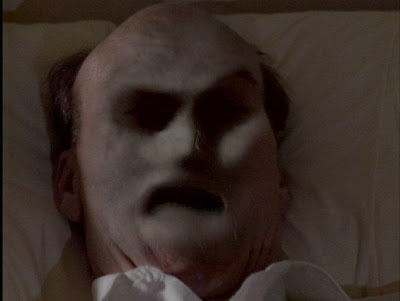
Cut to the “present day” (meaning, 1993), when one of the early astronauts is now running Mission Control in Houston. And there’s something weird about this guy, in the way his face seems to shift when he is alone in his hotel room, shifting so it looks like the Face on Mars. He flashes back to his spacewalk during a Gemini mission, a spacewalk during which he reported something coming straight at him. Will this thing rear its ugly head now, during a space shuttle mission? Naturally!
But even so, this episode’s approach toward the paranormal element is kind of odd. It’s understated to the point where Mulder doesn’t even really hypothesize about something “possessing” this astronaut hero of his until the very end of the episode; during much of the show, Mulder and Scully are mainly doing actual FBI-type investigating.
I really don’t have much to say, ultimately, about “Space”, because…well, it’s not that good of an episode. Nor is it really a bad one, either; it’s the first one I’ve watched in this project that feels to me like a filler episode. Oh well; you can’t win ’em all.
Share This Post
X-Files Case Report: “Ice”
“We are not who we are.”
Back when I was watching X-Files episodes on VHS releases that only included six episodes from each half-season, the episodes in those packages were chosen for either story (being part of the mytharc) or quality (being judged by the producers as particularly good). “Ice” was one of those episodes in the first set of tapes, and it’s a very memorable episode indeed, even if it too ends up being pretty derivative of an earlier film, in this case John Carpenter’s The Thing.
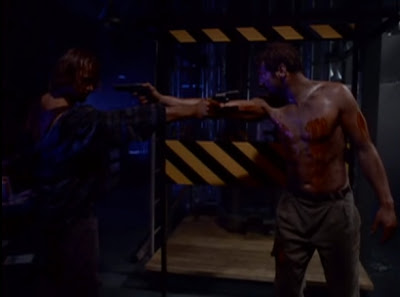
We open at an ice core research station way up in the Arctic, on a glacier-bound spit of land on the north coast of Alaska. Everyone in the station is dead, save two men, who are beaten and bloodied; these two end up with their guns trained on one another – before they each lower their guns. And then, still staring at each other, they both lift their guns to their own temples. Cut to an outside shot of the station, as we hear the two gunshots. After the titles, Mulder and Scully are sent with a doctor, a biologist and a geologist to find out what happened to the expedition. What drove the original group of scientists to kill one another? And whatever that may be, is it still there?
Well, this is The X-Files, so we already know that the answer to that second question is going to be “yes”. What results is a finely-crafted episode that follows the tried-and-true formula of locking our heroes in a small place, secluded from any possibility of rescue, and then giving them reasons to not trust one another.
It turns out that the scientists there had been drilling ice core samples from the glacier, which turns out to be on top of a meteor impact crater, and that something was in the ice: a worm-like parasite that invades a host and then causes it to become paranoid and aggressive. This thing got into the scientists and drove them to kill one another, and of course it’s still alive and kicking. This is made quite clear by the infection of the seaplane pilot who flew our heroes up there in the first place, when he is bitten by the dog who is the only remaining living thing in the station. Thus the episode plays out as “Who is infected, and who isn’t? Who can be trusted to still be themselves, and who cannot?”
“Ice” was written by James Wong and Glen Morgan, a duo who were behind a lot of the best X-Files episodes of the first few seasons, and who went on to be the main force behind the second season of Millennium and the creators of the Final Destination series of horror films, among other things. Their work is marked by excellent character writing and snappy dialog, and they manage to create just the right air of distrust among the principals, even between Mulder and Scully. Notable also is the episode’s supporting cast, featuring teevee stalwarts Xander Berkeley, Felicity Huffman, and Steve Hytner (later Banya on Seinfeld).
“Ice” is a terrific episode, one of the best of the first season and of the show’s early run.
Share This Post
X-Files Case Report: “Ghost in the Machine”
“The machine’s a monster, Scully! It’s already killed two people.”
Looking back on some of these early episodes, it’s surprising to me to see how derivative some of these shows were of other, earlier stories from movies and teevee. “Ghost in the Machine” gives us a computer run amok, a computer that’s been given so much authority and sensory input that it achieves sentience and acts in self-defense. Our main villain here is the COS, or “Central Operating System”, but while watching this episode, I kept thinking back to earlier computer villains: the Master Control Program (MCP) from Tron, HAL-9000 from 2001: A Space Odyssey, and the M5 from Star Trek‘s original series episode “The Ultimate Computer”.
This episode is pretty straightforward, then, and there’s really not even any ambiguity in the way it unfolds, so we’re not even watching the mystery unfold for ourselves as Mulder and Scully investigate things. We know, right from the teaser, that it’s the computer that’s doing it all, and the rest of the episode is mainly waiting for Mulder and Scully to get there, too.
It’s not a waste of an episode, by any means. The production values are typically excellent, although the episode does, by virtue of its subject matter, seem a lot more dated than some of the other episodes I’ve already watched. This was still the age of computers being gigantic machines in rooms, with lots of blinking lights for no reason; the word “Internet” isn’t mentioned at all. Mulder’s informant, Deep Throat, shows up to add some helpful paranoia about the government’s interest in a computer that can defend itself, which is really when the episode starts to become more than simply a boilerplate story of technology gone haywire.
The other notable aspect of the episode is the introduction (and fairly quick dispatching) of one of Mulder’s old partners, a guy who has fallen on hard times in the FBI – not unlike Mulder himself – but for different reasons. There’s an interesting dynamic between these two characters, and it’s a shame that the writers basically introduced this guy to provide a personal connection for Mulder’s involvement in the case later on when he gets killed off.
Sorry to make this entry so short, but I’m really hard-pressed to come up with anything much to say about this episode. It’s just kind of “there”.
Share This Post
X-Files Case Report: “Shadows”
“I’d say you people already suffer from full denial.” (Agent Mulder)
The X-Files was so much more than aliens and government conspiracies; it actually drew on just about every occult phenomenon it could find over the course of its run. Here we have a good, old-fashioned ghost story.
A businessman named Howard Graves has committed suicide, leaving his trusted assistant, a woman named Lauren, to clean out his office. As she leaves, though, a desktop memento suddenly moves, and she turns back to see it in a different spot than where she left it. Not thinking much of this, she takes it with her. Cut to later, when she stops at an ATM on her way home. She is jumped by a couple of hoodlums who drag her, screaming, into an alley. Cut to still two hours later, when two young people come along, looking for a place to “crash”, when they find the bodies of the hoodlums. The men were killed by having their throats crushed from the inside, and they’ve been exposed to so much electrostatic electricity that even though they’ve been dead for six hours, their bodies are still twitching on the slab and their tissue hasn’t even started to cool.
Mulder and Scully get wind of this when they are brought in to consult by a pair of taciturn NSA agents (or CIA or some other shadow government group). When they share no information with our FBI heroes, Mulder speculates that they are involved because the case shows earmarks of psychokinesis. They begin to suspect that Lauren is somehow psychokinetic, but it gradually turns out that it’s really Howard Graves’s ghost that is behind everything.
A fairly standard story plays out: Graves, it turns out, was actually murdered by the business partner who claims to have loved him like a brother, and Graves felt a father-like devotion to Lauren, owing to his having lost a three-year-old daughter years before who would have been Lauren’s age in the present day. Howard Graves has not left this mortal coil because he still has work to do.
This tale, of course, is somewhat strongly reminiscent of the movie Ghost, which had come out a few years earlier. It’s a nicely done episode, mostly interesting for the performance of Lisa Waltz as Lauren, for some nicely brisk writing, and for the fact that the show seems to be going in one direction at first (psychokinesis) but actually turns into something else (ghosts). It’s also interesting in that Scully’s skepticism is dialed back a bit, and at the end she seems quite accepting of the ghost story.
Finally, this episode continues to demonstrate just how the world has evolved in less than twenty years since it originally aired. When Mulder and Scully must look for information on Howard Graves, they aren’t able to just Google the guy; Scully has to spend quality time with a microfiche machine, manually searching through newspaper archives for a mention of the guy. Shadows aired about eighteen years ago; eighteen years before that, I suppose Kojak was the norm of teevee police procedurals. The distance between the world depicted in Season One X-Files and Kojak seems a lot closer than the present day and the world of Season One X-Files. I even remember reading commentary on Usenet, back during the first couple of seasons, in which Mulder was made fun of for always having his cell phone with him!
Next up: “Ghost in the Machine”.