X-Files Case Report: “The Jersey Devil”

“Unlike you, Mulder, I would like to have a life.”

As I wrote in the intro to this series, I didn’t become a regular viewer of The X-Files until the show was in its third season, so there are a lot of episodes from seasons 1, 2, and 3 that I have never seen. That’s one primary motivation for doing this series in the first place, now that we live in a time when watching old episodes of shows that we may have missed is one of the easiest things in the world to do. I remember how it wasn’t always thus; watching reruns of Star Trek as a kid, on an independent teevee station, meant that I could go quite some time without seeing a particular episode – and, in fact, there actually is one episode of Star Trek: The Original Series that I have not seen, to this very day. (It’s “Dagger of the Mind”.)

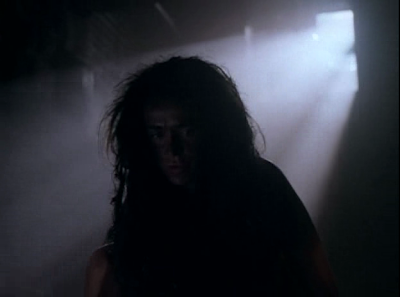
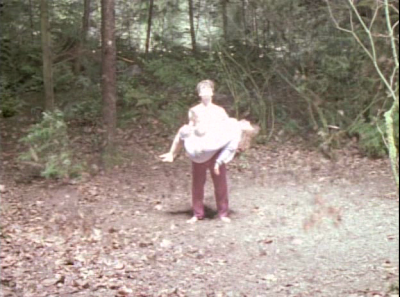
So, the fifth episode of The X-Files is the earliest in the series that I have never seen. “The Jersey Devil” is a pure “monster of the week” tale: there are no hints of government conspiracies or alien abductions here. Instead, we have some kind of wild thing on the loose in the woods outside Atlantic City, NJ. We first see this thing in the teaser sequence, set in the 1950s; a family is driving at night on a back road to Atlantic City, when they get a flat tire. The father is jacking up the car, says something to his wife, and while he’s in midsentence gets violently yanked into the woods where he is partially eaten. Cut to the present day, when something is preying on homeless people in the back streets of Atlantic City.

Mulder, of course, immediately connects the dots between the current murders and the case from 1950-something, and immediately postulates the existence of something called the Jersey Devil, which is apparently some kind of cannabalistic beastie living in the Jersey woods and preying on people. Eventually it turns out that the current Devil is a descendent of the one from the 1950s, and is actually a female.

Along the way, Mulder ends up annoying the local police, as he so often does. This leads to a typically X-Files-ish ending as the police are intent on doing one thing, Mulder is intent on doing another, and as often happens, Mulder ends up deeply disappointed.

There’s really not a whole lot to say about this episode. Part of the reason is that the show’s mystery is short-changed by quite a bit of screentime devoted to Mulder and Scully’s personal lives – that is, Scully’s desire for a normal personal life and Mulder’s lack of awareness that there even is such a thing. Scully goes to a friend’s kid’s birthday party; she goes on a date with some guy. The date is predictably interrupted by the waiter who comes over and says, “Agent Scully, you have a phone call.” Guess who it is. (This was the early 90s, when the only person on teevee who obsessively used a cell phone was Fox Mulder himself.) At this point in my rewatch, I’m wondering how soon the show will reach the point where we stop hearing so much about their personal lives.

This episode is basically OK – not great, not bad. It’s the first “meh” installment of the series. The next one up is “Shadows”.

Share This Post

X-Files Case Report: “Conduit”

“I want to believe.”

At this point in the series, we’ve already seen the poster in Mulder’s office that would become one of the iconic props of The X-Files, the one with the flying saucer on it and the slogan in big letters at the top. That poster always struck me as slightly odd, in the context of Mulder’s office: it states “I want to believe”, but as is very clear from the outset of the series, Mulder already does believe. But it turns out there’s one thing that Mulder isn’t sure he believes or not, a thing which is one of the most important aspects of his character. It is whether or not his sister is still alive and will one day come back to him.

“Conduit”, our fourth episode, is the second to deal with alien abduction as its subject. Here, though – quite strikingly, as in comparison with the pilot – it’s not nearly as clear, from the way the episode frames its events for the viewer, that abduction is really what’s happened. There are odd things that happen, to be sure, things that probably can’t be explained without resorting to alien abduction hypotheses, but at the same time, we don’t see strange beings carrying out abductions, as we do in the pilot. The evidence is much more circumstantial, which makes for a generally creepier episode.

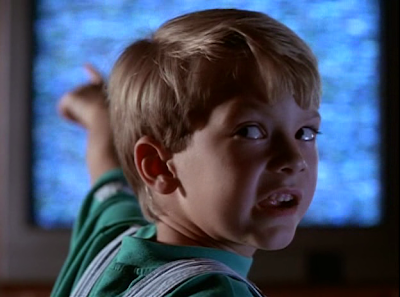
The story takes place in Iowa, where a family is camping beside a lake when there are bright lights, loud sounds, and sudden enormous heat. When the effects subside, the teenage daughter is missing, and the young son has started to show some very strange signs of having been, well, messed with a bit. For one thing, he is spending hours in front of a teevee that is tuned to no channel, claiming to be receiving signals from the television, which he is translating as sheet after sheet after sheet of paper of 1s and 0s. It turns out that the 1s and 0s encapsulate almost totally random pieces of data and information – bits of music, detail from Da Vinci drawings, and the like – and the sheets of binary also turn out to be something else, in one of the episode’s best “surprise” moments. All this leads Mulder to suppose that the boy is a “conduit”, being used by aliens for some purpose.

Of course, Mulder believes that the girl has been abducted by aliens, and of course Scully is unwilling to commit to that hypothesis with the evidence at hand. The missing girl is a juvenile delinquent, and she has been known to hang out with a local biker gang, leading most people to suppose that she has simply run off with them. Things take a dark turn, however, when the girl’s boyfriend’s body turns up, and when NSA agents turn up, claiming that the boy has somehow gotten hold of classified information.

Mulder is particularly driven in this episode, insisting on continuing the investigation into the girl’s disappearance when all evidence seems to have run dry. His motivation is quickly made clear, as this episode begins to flesh out the great driving force behind Mulder’s work: the abduction of his sister when he was a child. The episode ends with Scully listening to a tape of a hypnotic therapy session Mulder once underwent, which concludes with the interviewer asking Mulder if he believes that his sister, Samantha, is alive and will come back; Mulder replies, as the final credits begin, “I want to believe.”

This episode is very well written and directed – the production values of even the early episodes of The X-Files are superb – but I did find the episode marred by something that probably wasn’t its fault. The first five seasons of The X-Files were filmed in the Vancouver, with locales around that city doubling for whatever locale the episodes were set in. Usually this worked out fine, but there were times when it really didn’t. Now, I don’t expect that Lake Okoboji will be familiar to anyone who doesn’t have some kind of connection to Iowa, but it amused me – and, unfortunately, undermined the episode a bit for me – to see Iowa’s Lake Okoboji stood in for by a Vancouver-area lake, surrounded by very tall pines and hills higher than you’ll find pretty much anywhere in Corn-belt Iowa. This had the effect of ejecting me from the story a bit, but I’m not sure what the producers really should have done – made up a different locale, perhaps.

The next episode will be the first of a bunch from Season One that I have never seen before. We’ll see what happens. I, too, want to believe!

Share This Post

X-Files Case Report: “Squeeze”

On the trail of a killer, Mulder and Scully find, in an abandoned building, a giant nest made of old newspaper scraps and bound together by some kind of fluid that Mulder reaches out and touches.

SCULLY: I think it’s…bile!

MULDER: Is there any way I can get it off my fingers without betraying my cool exterior?

For the most part, episodes of The X-Files can be grouped into three categories. The first two episodes, the pilot and “Deep Throat”, were also the first two episodes in the “Mytharc” category. That’s short for “mythology arc”, and it is those episodes which tell the serialized story that takes place over the entire run of the series. One of the other two categories hasn’t shown up yet, and I’m not sure when its first appearance is, so we’ll hold that one – which I call “Creepy Comedies” – in abeyance. The third category, though, makes its first appearance here, in the third episode of the series. These are the “Monster of the Week” episodes: self-contained stories that don’t advance the overall storyline of the show, but instead pit Mulder and Scully against…well, monsters. You can’t have a SF/horror show without monsters, can you?

Now, I should point out that those categories aren’t hard-and-fast; there are “Monster of the Week” episodes that are also “Creepy Comedies”, and there are overlaps the other way as well. The categories would become more clearly marked in later seasons, when the big Mytharc episodes would be saved for the beginning and ends of the season and the sweeps periods in between, with everything else mostly being MotW’s or CC’s. In the first few seasons, however, things were much more of a free-for-all. (I tend to think that’s one reason why the show’s mytharc in general became harder and harder to follow, but we’ll address that as we go, I suppose.)

“Squeeze” introduces us to a particularly nasty killer whose MO is to somehow enter dwellings or offices, violently murder the occupant and rip out their liver, and then depart again without leaving any trace of entrance or exit. That is, any normal trace of entrance or exit. He’s got to get in and out somehow, and Agent Mulder will be the one to figure it out, much to the chagrin of fellow FBI agents who view him as a total crackpot who isn’t even worth having around on standard investigations (which this turns out to not be). Mulder’s tendency to odd theories leads him to look for evidence where no one else even thinks to look, which then leads him to discover that the current killer’s fingerprints are identical to those of a killer from a series of similar crimes thirty years ago…and thirty years before that…and thirty years before that.

However, the FBI agents in charge of this case don’t want to hear any of this, and for his troubles, Mulder endures a lot of mocking as he pursues the investigation in his own way. Scully’s loyalties are challenged as she is presented with an opportunity to further her career and steer herself back into a more “normal” path up the FBI ladder, as opposed to “wasting her time” following Spooky Mulder on his wild alien chases. I suppose it’s no surprise which path she chooses, in the end, especially when in a bit of spite the other FBI guy (whom she knew from FBI school) torpedoes Mulder’s stakeout of the real killer.

As for the killer himself, Eugene Victor Tooms is one of the series’s creepier creations. He is clearly not insane, but he is terribly, terribly dangerous. Tooms hibernates for thirty years, and when he awakens, he must find sustenance – by consuming human livers. And there’s something about his skeleton and his musculature that allows him to contort his body in ways that allow him to crawl through ducts and chimneys that are barely big enough for a large cat. Tooms’s serene expression when being questioned is chilling, as is the way he smiles at episode’s end as he looks at the tiny slot on his asylum door through which his guards put his meals.

This episode establishes to a great degree how sceptically Mulder is viewed by the rest of the FBI, and not for the last time is Scully put in the position of having to choose between expediting her rise in the Bureau and sticking with Mulder in his bizarre investigations and crazy theories. Those decisions get easier as the series goes by, but early on, the show does a very good job of showing that Scully is seriously thinking about these things. She doesn’t know Mulder well enough, yet.

Eugene Victor Tooms would return later in the season, in the episode “Tooms”. We’ll get to that one soon enough, but for now, “Squeeze” is another early high-point in the series’s run.

Share This Post

X-Files Case Report: “Deep Throat”

“Mr. Mulder, why are those like yourself who believe in the existence of extraterrestrial life on this Earth not dissuaded by all the evidence to the contrary?”

“Because…all the evidence to the contrary is not entirely dissuasive.”

“Precisely.”

“They’re here, aren’t they?”

“Mr. Mulder, they’ve been here for a long, long time.”

That exchange comes at the end of “Deep Throat”, the second episode of The X-Files. Even more than the Pilot, “Deep Throat” establishes a lot of the groundwork for what is to come over the course of the series. More tropes are introduced: Government secrecy and conspiracies; government collusion with apparent alien visitors; shadowy governmental agencies which are apparently above the law; the continual failure of Agents Mulder and Scully to come away from their investigations with any proof at all of what they know to be the case. And most importantly – indicated by the title of the episode – the establishment of an inside source of information who will be Mulder’s confidant and informant, but who may or may not be on Mulder’s side.

This story takes place mainly in an Idaho town near an Air Force Base that does not appear on any maps, due to the secretive nature of its work. A pilot there has turned up at home, cowering in the corner and covered with terrible rashes and skin lesions. The Air Force takes him into custody, and holds on to him for several months, telling his family nothing at all of his whereabouts or status. Somehow Mulder gets wind of this and tells Scully that “we’re heading to the Spud State to investigate a little kidnapping.” When Scully asks why Mulder is interested in an apparent kidnapping with no “paranormal” element, Mulder replies, “This case has a smell to it. A certain ‘paranormal bouquet’.”

But before leaving for Idaho, Mulder is confronted by a dark-suited man who tries to warn him off the case and tells him that he can give Mulder information when it is in his best interest to do so. We’ll never learn this man’s name; we will only know him as “Deep Throat” (which I don’t recall anyone in the show actually calling him). This, too, will be something of a meme throughout the show’s run: people telling Mulder things in sufficiently vague terms that he doesn’t really have a great deal of choice to make.

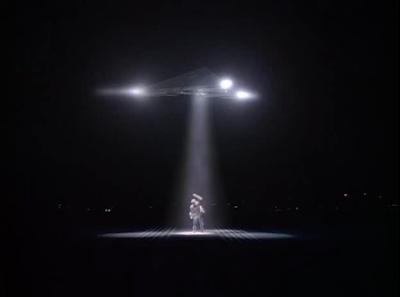
Off go Mulder and Scully to Idaho, where they learn that experimental aircraft are being tested – but the aircraft are capable of speeds and maneuvers impossible in current aeronautical technology, which leads Mulder to hypothesize that the government is working on technology gleaned from the UFO that crashed in Roswell, NM in 1947 (the Air Force base in the episode being one of the places to which wreckage of that craft was taken). Suddenly the missing pilot is returned to his family, but he seems very strange now, oddly passive and childlike, and he can’t remember anything. Mulder thinks he has had memories erased, but Scully thinks that’s impossible; more likely, the strange pilots up there are the washouts of a testing program who couldn’t handle the stress.

Anyway, our two agents meet a couple of teenagers (one of whom is played by a young Seth Green) who like to sneak onto the AFB grounds and watch the test flights (which happen at night), which of course leads Mulder to do the same…only he gets caught, after seeing one of the aircraft up close and personal. Mulder’s whisked away by men who are doing something medical to him. Meanwhile, Scully is on her own and has to figure out how to get Mulder back, which she finally does – only to discover that he has no memory of the last twelve hours. They return to Washington, with Scully indicating in her field report the completely inconclusive nature of their investigation. Mulder, meanwhile, meets again with his new informant. The exchange above closes out the show.

“Deep Throat” is a fine, fine episode, and in retrospect, it’s probably one of the most important in the series’s run. It establishes so much of the dynamic that would later dominate the show’s developing mythology, especially the knack Mulder has for being right while never being able to come up with any evidence. I also like how Mulder and Scully are still at odds quite a bit of the time, with the trust between them still not there and with Scully basically approaching her assignment to the X-files with professionalism but also with skepticism bordering on conviction that all of it is complete BS.

This episode also establishes the high level of production values that were a key part of the success of The X-Files. Many shots are downright cinematic in nature, as is the way the showrunners are able to shoot around the Vancouver area in ways that double for the less-mountainous areas of Idaho. I also liked the framing of the episode’s final scene, in which Mulder is jogging on a college track when Deep Throat comes to visit him; there is a nice combination of long shots and close-ups that makes the scene nice to look at. The X-Files is often credited with bringing cinematic production values to television, and it’s easy to see this influence in this episode.

So, what is to come? The truth, after all, is out there!

(Oh, this was also the first episode to use the show’s signature titles sequence, complete with Mark Snow’s distinctive X-Files Theme and the “Truth is out there” tag line. The pilot’s credits had simply run over the opening scene, after the teaser.)

Share This Post

X-Files Case Report: “Pilot”

So I’ve decided to embark on something of a long-term project here: rewatching The X-Files. I’d like to rewatch the entire series, start to finish, series pilot to final episode of Season Nine, with the first movie (Fight the Future) thrown in between Seasons Five and Six, and culminating in the movie from a couple of years ago (which I still haven’t seen). Obviously this will take a while, and while I’m not going to try to do this on a weekly basis, I’m hoping for at least two or three of these a month. Maybe more, when I watch them in clusters, as may well happen.

Why? Well, why not? Among the blogs I follow which focus on F/SF/H stuff, rewatches of movies and teevee series and re-reads of books and book series are always in vogue, and right now, nobody that I follow is doing an X-Files rewatch, which gives me a niche. This also gives me a longterm source of content (always nice), and it gives me an excuse to revisit a show that was once beloved to me.

Don’t get me wrong, there: as far as I know, I still love The X-Files. The show was an iron-clad, “can’t miss it” event at Casa Jaquandor for most of its run. But with relatively few exceptions, I only saw the episodes a single time each, upon their initial airings; and there are quite a few episodes from the first three seasons that I’ve never seen. I’m interested now, seventeen years after Season One, partly in how well the show has aged. We’ll see!

My fandom of The X-Files was slow to blossom. I was only dimly aware of the show’s existence for most of the first season. In fact, this was back when FOX was still a fairly fledgling network with only a couple of notable shows to its name (The Simpsons, Married With Children), and if I remember correctly, back then, FOX didn’t even have enough shows to put together and entire weekly lineup. (In some ways, FOX still doesn’t. There are no 10:00 shows on FOX.) I heard of this show that had FBI agents investigating paranormal stuff, but I didn’t watch until my mother, who did watch, recommended the show to me. So I saw a couple of episodes during the first season and came away somewhat favorably impressed, but my attention wasn’t grabbed enough to make me a regular viewer until somewhere in the middle of Season Three.

I’m lucky that I came along then, and not later; the show’s “mytharc” was still pretty manageable at that point, and a new viewer could pick up the basics pretty quickly. I do remember, though, a special episode that aired sometime toward the end of Season Three that was basically a summation of the show to that point. I found that very helpful, and a short while later, the show’s popularity led to video releases of early episodes. Of course, this was before DVD, so these video releases consisted of sets of VHS tapes with two episodes each, and only selected episodes at that – no complete seasons here, just the most important “mytharc” shows with a few of the better “monster of the week” shows thrown in. Anyway, I was hooked, and I didn’t fall by the wayside until Season Nine, which struck me as rudderless, pallid, and just too-much-of-a-good-thing. We’ll see what we find as we go, though.

Which brings me to the Pilot Episode. It opens with a teaser sequence, set in the Pacific Northwest, that shows a girl in her nightrobe running through a forest, until she stumbles in a clearing. Here she is met by a human-shaped figure (whose features we cannot see) who is accompanied by a brilliant light; the wind whips up, there is lots of noise, the leaves are blown in circles around them as the light brightens. Cut to twelve hours later, and the girl’s body is found in the clearing by the cops, sporting two circular wounds near her backside. The chief ID’s the body, noting that she went to school with his son; another cop says, “Class of 1989? It’s happening again, isn’t it?”

Cut to Washington, DC and the FBI Headquarters, where a beautiful young agent named Dana Scully reports to her superiors for assignment. She is to work alongside another agent, named Fox Mulder, who has been using his time to investigate cases that are outside the official FBI mainstream. These cases, called “the X-files”, are the kinds of thing nobody wants anything to do with – except for Agent Mulder, who later suggests that it’s only by way of his friends in Congress that he is able to do this work at all. Scully is being assigned for her scientific, skeptical approach; when she asks if she is being expected to debunk Mulder’s work, her superiors manage to say Yes and No in that wonderful bureaucratic way of not saying much at all. Off Scully goes to meet Agent Mulder, who has just caught wind of this strange case brewing out in the Pacific Northwest. After some introductions, Mulder briefs Scully on the odd case and the wounds on the bodies (of which there are four), and then they’re off to Oregon to do some investigating.

This really is one of the better pilot episodes to a show I’ve seen. In the space of about five to ten minutes, we get: an intriguing mystery for the first episode; an establishment of a supernatural/paranormal mood; the introduction of our two main characters, both to us and to each other; the establishment of certain tropes within their relationship; the tense conflict between the official FBI and Agent Mulder; and some initial conflict between Mulder and Scully. They would later come to trust each other in the implicit way of two people who are absolute soul-mates, but there is still constant tension between her skepticism and his willingness to take wild leaps in logic in order to press his case. (Oh, and in the first scene in the FBI Headquarters, there’s an ominous looking fellow lurking in the background who is always fingering a lit cigarette.)

This first case of theirs also sets up so many of the tropes that would dominate the show for the entirety of its run. Alien abduction. Lost time. Mystery elements that are never able to be conclusively explained because the evidence is somehow destroyed or compromised. Implants of unknown origin. Secret government storehouses where old evidence is squirreled away, never to be seriously investigated again. Autopsies of mysteriously deceased persons, and autopsies of mysteriously deceased things that may or may not be persons. Locals who are unwilling to talk to the two FBI agents, and the one local who is. The fact that Agent Mulder is haunted by the disappearance/abduction of his sister. And the solving of the mystery in an unfulfilling way that leaves Scully nothing to report on.

I also noticed that the show’s look that would dominate the first five seasons – dark, cloudy, foreboding, often raining – is in full effect here, as is the moody synth-driven music by Mark Snow (minus the famous main theme, which wouldn’t arrive until the second episode). I was surprised, watching the Pilot episode again, to see just how much of the show’s eventual theme and feel was present right there from the beginning. Everything except The Truth being Out There. But don’t worry – it is. Oh yes.

(Oh, and I promise not to make this series into one long love-letter to Gillian Anderson. But I had no recollection of the pilot featuring a scene with her in her underwear…her skin lit only by the light of a single burning candle….)

Share This Post