
Not much need for a lot of introductory stuff here, I suppose; just one of the most gorgeous unions of piano and cello in existence. Here’s Rachmaninov’s famous Vocalise.
Sabrina
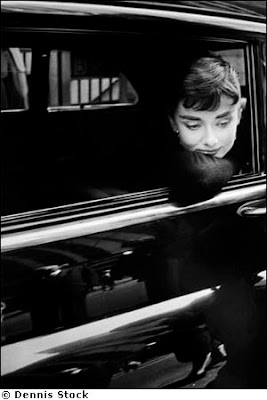

You would think that I, having nursed a terrible crush on Audrey Hepburn for years and having admired Humphrey Bogart for even longer, would have seen the original Sabrina by now. And, until a few weeks ago, you would have been wrong. But now you’d be right, because I finally watched the movie a while back. Take that, Big Hole in my Movie Watching Resume!
Anyhow, I did see the remake of Sabrina when it came out years ago, the one with Harrison Ford as Linus, Julia Ormond as Sabrina, and Greg Kinnear as David. The basic story was not altered much at all for the remake, as I remember it: Sabrina (Ms. Hepburn) is a young girl, on the cusp of womanhood, who is about to leave for schooling overseas. Her father is the chauffeur for the Larrabee family, and she harbors an enormous crush on David (William Holden), the young playboy whose dalliances are constantly being covered for by his stiff, business-driven, older brother Linus (Humphrey Bogart). When she returns from Paris, Sabrina has blossomed into a gorgeous young woman indeed, so much so that she finally does catch David’s eye – but by this time, David has become engaged to the daughter of another very rich family with whom the Larrabee company desperately wants to do business, so his attraction to Sabrina is less than convenient. So Linus takes it upon himself to woo Sabrina himself, just to divert her attention until the deal can be completed.
Of course, anybody who’s ever seen a romantic comedy knows what’s going to happen next: Linus really does fall for Sabrina, and she really does fall for him, and it seems that all might end well when Sabrina naturally learns that Linus’s courtship was originally a ruse of sorts. It’s all very typical romantic comedy stuff, although I suppose this kind of thing was much fresher in the 1950s when the original Sabrina was made.
Nonetheless, the movie is totally charming. I haven’t seen William Holden in much else, but his portrayal here of a spoiled, carefree rich playboy is spot on; he smiles and laughs his way through the movie. His character is less important, naturally, than Hepburn’s and Bogart’s. Fortunately, the movie has Audrey Hepburn and Humphrey Bogart.
Bogart is a bit older here than he was in Casablanca, and at first he seems an unlikely romantic lead in Sabrina – but that’s exactly the point. He’s playing a man who has no use at all for romance being forced by circumstance to behave as though he does, and Bogart conveys this so effortlessly that I was tempted to think that this was the real Bogart…but he was an actor, so it probably wasn’t. He’s not an older version of Rick Blaine; Linus Larrabee is someone totally different. Although Linus, like Rick, is alone by choice, he’s not really alone out of cynicism but because his world simply doesn’t allow for anything but loneliness. However, there are flashes that buried beneath the surface of this boring businessman is a man with some passions, and as the film progresses, Sabrina manages to awaken those passions before Linus even realizes that it’s happening.
Sabrina is also, at times, wickedly funny, weaving moments of farce into the story effortlessly. This movie manages to convince us that, sure, a guy could totally forget that he’d stuck a pair of champagne flutes into his back pocket and thus sit on them, getting pieces of glass embedded in his backside.
In terms of specific comparisons between the original Sabrina and the Harrison Ford remake, all I can really remember is the very last scene of each. In the remake, Ford’s Linus goes to Paris to find Sabrina, and then he has a speech of some sort in which he declares his love (“Save me, Sabrina-fair; you’re the only one who can.”). It wasn’t a particularly effective moment, in all honesty. Much more effective is the way the original ends: with Sabrina sitting down on the deck of the ship that’s taking her to Paris, and Linus coming around the corner, walking jauntily as he approaches her. They hug, and then “The End”, with not a single word said. Why it is that remakes so often feel the need to have their characters say things that the people in the original didn’t have to say at all has always been beyond me.
Share This Post
A Random Wednesday Conversation Starter
Walking through Italy
So, in my first ever “Make Me Read” poll, you all chose for me to read Hemingway’s A Farewell to Arms over Sylvia Plath’s The Bell Jar. I must admit that I was a bit surprised; for some vague reason I thought you would all select the Plath book, but it was Hemingway by a wide margin.
Before this, I had only read Hemingway once, and that was way back in high school when one of my teachers (I can’t even remember which one) assigned The Old Man and the Sea. I don’t remember my impressions of that book, except that even then I noticed Hemingway’s sparse literary style and bare-bones approach to telling a story.
Farewell is autobiographical in nature: it tells the story of an American soldier in World War II who is wounded and falls in love with one of his nurses, as actually happened to Hemingway himself. The real-life drama, of course, turned out differently than does the tale in Farewell, at least so far as I know. But it’s not hard to see how the state of affairs at the end, as Frederic Henry walks back to his hotel, could lead him to a long life of depression and eventual suicide – the path that Hemingway himself would follow. Of course, that wasn’t Hemingway’s thought when writing Farewell, as he published it in 1929, when he still had more than thirty years of life ahead of him.
One thing that often bothers me when I read a work of classic literature is that since the work is a classic, familiarity is often assumed, even by the books themselves. I have a feeling that I would have found Farewell a bit more involving, and effective, had I not already been informed by the dustjacket blurb that the novel is a tragedy, focusing on the “doomed” affair between Frederic and Catherine. I suppose most people who haven’t read Hemingway are supposed to know that he’s not the sunniest of writers, so this is to be expected, but as it was, I kept reading the book with a sense of impending doom that I’m not entirely certain Hemingway intended. Nevertheless, that tragic outcome really is terribly sad, when it arrives. It’s an interesting kind of tragedy, totally different from Greek tragedy (where everything is already ordained by the Fates) or Shakespearean tragedy (where tragedy unfolds from fatal character flaws). No, Hemingway’s tragedy is the more mundane sort, which makes it doubly haunting: Hemingway’s tragedy is nothing more than the observation that we live in a world where awful things happen for no particular reason at all.
For the first two-thirds of the book, the love affair between Frederic and Catherine proceeds along nicely enough, along with the travails of a soldier at war. It’s only in the last third of the book that the affair becomes torrid, at the same time that the war becomes well and truly insane. The last third of the book is harrowing, starting with the breakdown in the Italian army and the insanity that soon grips everyone, even as the war itself is dying down. Frederic’s escape from the Italians, after he’s been marked to be executed, and his subsequent escape with Catherine are all gripping episodes, but it’s in the final chapters that we learn that all has been for naught anyway.
Here is a quote that stood out to me, when I got to it. Frederic Henry ruminates a bit after someone protests that the Italian war effort “cannot have been in vain”:
I was always embarrassed by the words sacred, glorious and
sacrifice and the expression in vain. We had heard them, sometimes
standing in the rain almost out of earshot, so that only the shouted words
came through, and had read them, on proclamations that were slapped up by
billposters over other proclamations, now for a long time, and I had seen
nothing sacred, and the things that were glorious had no glory and the
sacrifices were like the stockyards at Chicago if nothing was done with
the meat except to bury it. There were many words that you could not stand
to hear and finally only the names of places had dignity. Certain numbers
were the same way and certain dates and these with the names of the places
were all you could say and have them mean anything. Abstract words such as
glory, honor, courage, or hallow were obscene beside the concrete names of
villages, the numbers of roads, the names of rivers, the numbers of
regiments and the dates.
Thanks to my readers for having chosen A Farewell to Arms. I’m glad I read it.
Share This Post
Make Me Read!
OK, I am now working my way through Guy Gavriel Kay’s A Song for Arbonne, which means that it’s time for you, the Readership, to decide what I read next. Up for selection this time are two works of old literature that I’ve meant to read for years, and it’s time to knock one of them off. And that’s where you come in!
First is The Nibelungenlied, the great German epic poem that tells the tale of Siegfried and his adventures; the other is The Sagas of the Icelanders, which is a collection of, obviously enough, Icelandic sagas. I’ll run this poll for one week, so let the voting commence!
(The poll is in the sidebar, near the top.)
Share This Post
Sentential Links #170
Our one hundred seventieth edition of Sentential Links! This occasion calls for…more links.
:: This is Roger Moore’s second Bond movie, and one of his best. (Huh-whuh?!)
:: She denies this, but we’re often late because she’ll take on one last thing – doing one last load of laundry, pick up a few things. I’m usually late because i just lose track of time reading. (And a happy anniversary to them!)
:: Ich liebe dich meine schöne, süße Frau.
:: David: So was that whole kids thing the dealbreaker you mentioned?
Me: Actually, no. It was more about his misuse of apostrophes.
Share This Post
Unidentified Earth #68


Sunday Burst of Weirdness
Oddities abound!
:: This isn’t weird, but rather, stunningly cool: Artificial Owl, a blog devoted to photography of abandoned things throughout the world. Shipwrecks, abandoned military sites, old lighthouses that no longer glow, and more. I spent a long time yesterday surfing its archives. Go check it out.
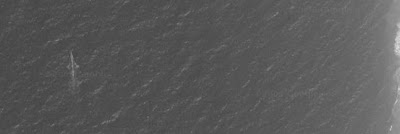
:: Following a pointer from the above-linked blog, I was noodling about on Google Maps on the coast of Mauritania, when I saw this:

What do you suppose that is? A single dolphin or whale? A shark? A small boat that leaves a wake suggestive of those things? It’s about a thousand feet off the shore. There are more of those visible as I scroll along the shoreline.
:: Two employees at Yellowstone National Park were fired for…wait for it…urinating into Old Faithful. The funniest part of the linked story is the matter-of-fact statement that “the geyser was not erupting at the time”. Thanks for spelling that out!
:: Shamus linked a version of this video, one that had music added. I like the version without music better — or, at least, I like “no music” better than the music selected for that version, so here’s the no-music version. It’s a timelapse-photography film of a cargo ship navigating the ship channel in Houston, TX.
It turns out that there’s a lot of this kind of thing on YouTube — just search “ship timelapse” and you’ll find a bunch of videos. Here’s one I particularly liked, of a cruise ship traversing the Panama Canal. In this one you get to see the timelapse of the locks filling or emptying, raising and lowering the ship; I like how the decks fill with people who want to watch the action when they arrive at the locks.
Cool!
:: And this certainly is weird: FOX has renewed Dollhouse, despite its lackluster ratings in a dead-end Friday night timeslot — i.e., the timeslot that led FOX to give Firefly the heave-ho. FOX, doing right. Who knew.
More weirdness next week!
Share This Post
Twelve



Twelve years ago today, the woman pictured here voluntarily became my wife. I’m not entirely sure what possessed her to do that, but I’m glad she did, because it spared me the trouble of kidnapping some woman and holding her captive in my basement. Thanks, Dear!
Kidding aside, I’m glad I had her to walk beside me, and for me to walk beside, over these years — both the good times and the bad. I’m luckier than I deserve, I suspect. Hoping for twelve more years, and twelve more after that, and twelve more after that….
(And a few months ago, on her birthday, I posted 100 things I love about her. Always a good post to revisit!)
Share This Post
“You only have one life to live. So make it chicken shit, or chicken salad!”
I’m not sure if I’ve ever held forth on the movie Cousins before in this space, but I recently watched it again and wanted to flesh out my thoughts on it a bit.
Cousins is a remake of a French movie that I’ve never seen. It came out in 1988 or 1989, somewhere in there, so by this time it’s full of the kinds of fashions we like to laugh at nowadays. (Mullets and big hair, chiefly. I actually like the big hair, but the mullets, not so much.) It’s directed, very well, by Joel Schumacher, a guy who isn’t on anybody’s list of great directors but whom I think tend to produce well-made films (from a technical standpoint).
In the movie, Ted Danson plays Larry, a dance teacher who is married to Tish (Sean Young, who never looked more beautiful). Isabella Rossellini plays Maria, who is married to Tom (William Petersen, ten years before he started following the evidence). In the opening scene, Larry’s Uncle Phil marries Maria’s mother, so Larry and Maria become cousins of some sort. They also meet in the reception hall after the reception has ended, because neither is sure where their respective spouses have disappeared to. Well, it turns out Tom and Tish have been doing the dirty (Tom turns out to be quite the philanderer), and after Larry and Maria realize this, they decide to pretend to be having their own affair in order to get back at them. It’s a little joke…except they end up becoming close friends and then falling in love with one another. Hilarity ensues.
Of course, this is a remake of a French movie, so it all gets more complicated than that. Uncle Phil dies of a heart attack after being married for a couple of weeks, and then Larry’s father Vince (Lloyd Bridges, who has most of the film’s best lines) shows up and starts to woo Maria’s mother. More hilarity ensues.
It’s hard to honestly appraise a movie like this, since one must acknowledge that a state of affairs anywhere remotely resembling this one would result in all manner of emotional trauma for all concerned. (The movie does address, in passing, the effects of all this on Maria and Tom’s daughter.) But the movie itself is awfully well-made, with chemistry positively dripping between virtually every couple it shows us, so I end up looking past a lot of that. Of course Danson and Rossellini have great chemistry; the movie wouldn’t work at all if they didn’t. But so do Danson and Young, and so do Rossellini and Petersen, and so do Young and Petersen. Heck, in a couple of scenes, even Danson and Petersen have good chemistry (although as rivals). It’s also to the film’s credit that its characters do bad things without being bad people. Even Petersen’s Tom, the “cheating husband”, is a fairly low-grade jerk who is genuinely hurt when he realizes that he’s losing his wife. “Are you in love with him?” he asks; “If I am I’ll get over it,” she replies. “Yeah,” he says, in return. “We were in love once, and we got over it.” (It is kind of unfair the way the movie’s finale leaves Tom in a limbo state; we get some idea that Tish will be just fine, but Tom’s just tossed aside.)
Of course, this is a romantic comedy, so one must also judge it by if it makes one laugh, and it certainly makes me laugh. The Lloyd Bridges character has zinger after zinger (“At my age, you don’t want to get too close to an open grave”, “I’d rather have a case of the clap than a case of that wine.”), and there’s a hilarious scene set inside a wedding theme park where one of the cherubs is shown smoking behind a bush.
And the score is wonderful. Angelo Badalamenti writes a very French-sounding score (apropos, obviously), bound by two main themes: a love theme in waltz time (heard in a big way when Larry and Maria run away on Larry’s motorcycle), and a simpler, beautiful theme for Maria. In a very nice touch, Maria’s theme turns up throughout the film as diagetic music, played by street musicians as Larry and Maria wander by. The movie is also great looking, filmed in Vancouver, with lots of sweeping shots of that city’s environs. Cousins is wonderful froth, if that’s what you’re looking for.