On Romance and the Teevee

Lance Mannion wonders:

The rule is that on just about any TV series these days, whatever the genre, no matter if it’s a comedy or a drama, every unattached main character must at some point become attached. There must be a love interest.

If that love interest can be another member of the cast, so much the better. It saves on salaries. You don’t have to hire two new actors. The writers are spared the trouble thinking up two new characters who must be likable, a requirement that makes it highly probable that they won’t be in the least—they’ll be “likable.”

Don’t worry if the characters pairing up are unsuited for each other. Don’t worry if there’s no chemistry between the actors playing the newly coupled couple. Don’t even worry if there’s another character one of the lovers would be a better match for. Apparently audiences need to be assured that their favorites aren’t sleeping alone.

Love is always a good thing. Hence, the rule.

When did this rule kick in anyway? It wasn’t in effect when I was a kid. There was no rule that regular characters had to pair off like swans and turtle doves. None of my favorite shows had a love interest. Captain Kirk didn’t have a love interest. Jim Rockford didn’t have a love interest. Hawkeye Pierce didn’t have a love interest. They had love interests, plural. Even into the ‘Eighties, main characters on TV shows were unabashedly and cheerfully serially monagomous. MacGyver didn’t have a love interest. Magnum didn’t have one.

When the writers felt like writing a mushy story they invented a character that a guest star was brought in to play for one or at most two episodes before she or he got killed, betrayed the hero or heroine, or decided for the hero or heroine’s own good that they had to part forever.

That’s how they handled in on the Ponderosa. How many wives did the Cartwright boys go through. Little Joe alone filled whole cemeteries with the women he loved and lost to illness, bullets, or an Indian’s arrow. That was the Bonanza Way and if it was good enough for Ben, Adam, Hoss, and Little Joe, it’s good enough for Shawn Spencer…

In his comments, I noted:

Two thoughts on “Why romance”: first, it’s probably a logical outcome of shows observing that they have internal continuity; most shows nowadays, if not actually being serialistic in nature, will at least structure things so that characters grow over time, and previous exploits/adventures/cases/whatever can be reference on occasion. Thus, a viewer who tunes into a sporadic episode of, say, CSI can follow along, while a viewer who is a big fan and never misses an episode is kept going by whatever serialistic storylines the show has going on. Second, the focus on romance could come from the media’s ongoing obsession with demographics. Maybe they just figure that romances that don’t always end with a death or a plane ticket at the end of the hour will keep the women tuning in more often?

I’m going to flesh out my comments here a bit, though. First, in re-reading Lance’s post, I see that he says that Magnum didn’t have a love interest. He’s referring, of course, to Thomas Sullivan Magnum, played ably by Tom Selleck. And Lance isn’t quite right here. Magnum did have a love interest: his ex-wife Michelle, who turned up several times through the show’s run. Early on in the series, we learn that Magnum married Michelle in Vietnam, and she was killed in a hospital bombing shortly thereafter. But then, in one of my favorite episodes of the show’s run, he learns that she’s not dead, but for various reasons he has to let her go, because she faked her death and married another. She comes back a few years later, figuring in the almost-series finale in which Magnum “died”, and then she returned the next season only to be murdered for real this time. OK, the particulars aren’t necessary, but what matters is that Magnum did have a love interest.

But I think what Lance is getting at is the series regular kind of love interest. Michelle wasn’t there every week, on Magnum PI. That’s probably a good thing, though; by keeping her appearances infrequent, it reinforced the notion that whomever else may come, Michelle was the love of Magnum’s life (and, after her death, their daughter Lily). And each time Michelle showed up, enough information was given in the episodes’ expositions that casual viewers who didn’t watch every episode could figure out who she was. So when did we make the transition from “one love per episode” to “sustained lovers” on teevee shows?

Well, I’m not entirely sure, to be honest, but I suspect the change was fairly gradual. Lance also mentions Captain Kirk’s girlfriend-of-the-week. (Of course, few of those could actually be considered “loves”.) The movies would postulate that Carol Marcus was the real love of his life, of course; or rather, the second love of his life, after the Enterprise. But regular loves started showing up in sitcoms in the 1970s, right? I don’t remember Richie Cunningham’s beloved girlfriend being an official regular, but she was there quite a lot, right up until he married her. And then Fonzie himself got married. Laverne and Shirley had that Carmine guy. Part of these quasi-regular love interests were probably put there for realism’s sake — after all, how could they explain a high school kid in the 50s having a different girlfriend every week? That would have made no sense. And eventually the show went on long enough that having Fonzie constantly toting another name from his little black book around stopped working, so they came up with something new. (Didn’t save the show, of course. It was gone pretty soon thereafter.)

With the arrival of Cheers, we saw the beginning of the extended sitcom romance, didn’t we? Sam and Diane meet in the first episode, and flirt a while. They’re on-again, off-again. Diane goes away and gets engaged to someone else (enter Frasier Crane). She dumps Frasier, back with Sam, and so on. Why did this happen? Well, right around the time Cheers was starting up, the grand prime-time soaps of the 80s were gathering steam: Dallas was huge, Dynasty and Knots Landing were rising. And before those, there was Little House on the Prairie, which had quite a lot of serialistic content itself. Even if that show didn’t rely on season-long storyarcs the way the soaps did, they still had actual events that took place and had reverberations for a long time to come: Laura meeting Almanzo, the Ingallses adopting Albert, Mary starting that school for the blind, et cetera.

The change came on gradually, but I think the early 80s is really when episodic teevee started to reflect the notion that characters aren’t just going to stay static forever; they get older and their lives move on. Surely the rigidly episodic nature of teevee shows occurred to people even during the 50s and 60s, didn’t it? Did anyone ever wonder, a la the kids in Stand By Me, how come the Wagon Train never got anywhere?

Ultimately, I think Lance’s “rule” that shows must always have a love interest is there pretty much because romance draws in the viewers, for the most part. Or it keeps them. And anyway, not every show has a love interest for the hero, does it? Jack Bauer hasn’t had a steady one. (Renee Walker might be that, or she might not. This past season had some sexual tension between them, obviously, but nothing happened that went anywhere.) Earl on My Name is Earl didn’t have one. I’m not as up on the show, but I don’t think that House has one (unless you figure that he’s bound to end up with Cuddy, but that’s not the same as a constant love interest). Grissom had one on CSI, but that was on-again, off-again; I’m not sure that Mack Taylor or Horatio Caine have regular love interests on NY and Miami. (Mack’s wife was killed on 9-11-01; Caine is in love, I think, with the cop who married his brother.)

In general, though, I think that Lance’s rule stems from a general shift to a more serialized way of watching teevee. Law and Order excepted, there just aren’t that many shows consisting of self-contained episodes anymore.

Share This Post

Sunday Burst of Weirdness

Oddities abound!

:: I can’t help but start laughing whenever I hear the theme song to Benny Hill. Not sure what that is, since I’m not generally a huge fan of Benny Hill to begin with, but wow, that tune just hits my funny bone, for some reason.

That said, this use of it is blasphemous, I say. Blasphemous!

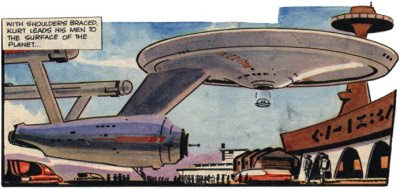
:: Star Trek fans who were around in the 1970s may remember a really bad series of Trek comic books from Gold Key Comics. These were really bad. As in, awful. Their awfulness has become something of a legend in the annals of comic book adaptations…but I didn’t know, until I read this SFSite article, that there was a similar thing going on in Britain, with some other company doing awful versions of Trek comics, with hilarious results that came from the creators not even having seen the show before they started putting their comics out there. Check out this panel, full of jaw-dropping bad-Trek hilarity:

So many errors! The Enterprise landing on a planet! The landing party led by Captain Kurt! The landing party disembarking the ship via a staircase that pops out the bottom of the secondary hull! All that is funny, but what made me laugh out loud was the depiction of the forward sensor array (the ball-turret looking thing at the bottom of the saucer section) as some kind of shuttlecraft that just drops right out of the ship for a landing. That just struck me as gut-bustingly hilarious.

:: 20 Brilliant Bookcases. A few of these notions are interesting-looking, but there’s only one here that strikes me as genuinely useful. But then, I’m pretty much utilitarian when it comes to storing books.

More next week!

Share This Post

The pipes still work!

Sorry for the radio silence the last few days, but Real Life got pretty busy for a few days, so busy that in the few moments I had where I could conceivably have posted something, I just didn’t feel like it. No, nothing bad happened; in fact, it was all good stuff. The Daughter had her first concerts as part of a couple of school music groups: she was in chorus Wednesday night, and then the orchestra (she plays the double bass) the second. The first concert ended up being quite long, as the program featured a number of groups from two different elementary schools in the district; the second was shorter, but there was an ice cream outing afterwards. Curse you, Cold Stone Creamery! (And the cute teenager who was making our sundaes that night said several times while making mine how much she loves whipped cream. I think she was flirting. Yay, me! I still got it!*)

We also had to finally get finished up on our teevee viewing, by knocking off the Grey’s Anatomy season finale. Wow, I love that show. The finale featured one of the more effective “OMG!!” moments I’ve seen on a teevee show the last few years, when the identity of the horribly-injured-in-a-disfiguring-way-if-he-even-survives John Doe was revealed. (I realized who he was about a minute before the actual reveal happened.) And the show had me thinking, “Oh, don’t die, Izzie! Don’t die!” Which is amazing because I can’t stand Izzie. There’s some good writing, there.

But anyway, that’s why there was a profound lack of blogging the last few days. Normal posting will resume…soon. Heh.

* OK, I know, not really. She was just happy and bubbly with all the customers. Yeesh.

Share This Post

Sentential Links #171

Time for the weekly linkage:

:: Not to diminish Mancow’s experience, but if he thought that was torture, think what the real deal must be like. You are snatched out of nowhere, flown across the world, kept awake for days on end in a freezing room with little food, woken every time you fall asleep on your metal bed, thrown against the wall with that lovely procedure known as collaring, slapped, had dogs threatening you, yelled at and beaten, and so on and so forth. That goes on for a couple weeks to soften you up, then you are dragged by multiple burly men and waterboarded repeatedly. You have no dead man’s switch like Hitchens did, you have no “safe” word to stop the process, there are no cameras and friends there to make sure you are alright. These people have been abusing you non-stop for days or weeks, for all you know this is when they finally kill you.

Of course it is torture. I’m sick and tired of having this stupid damned debate. (Amen to that. A while back, when Sean Hannity brayed that he’d undergo waterboarding and “he’d do it for the troops”, I thought, “OK, you blowhard. But let’s do it right. Let’s have someone grab you off the street, throw you into a van, blindfold you, and drive you to someplace you have no idea. Then let’s have them strip off your clothes, deprive you of food for days, not say a word to you except to tell you to stand up or lie down; let’s have them randomly beat you. And then let’s have them waterboard you. No cameras to record your bravado. No knowledge that after ten seconds it’ll all be over. Let’s have them waterboard you, over and over and over again, until you scream for no more. And then, well, lather, rinse, repeat. Days, weeks, months, until you finally confess whatever it is we want you to confess. And then…we’ll do it again. For fun, this time. And if you get out alive, at least you’ll have the knowledge that you did it “for the troops”.

Anyone whose moral compass includes waterboarding is not someone I want around me, for anything at all.)

:: Oh, God, imagine there’s bacon on one side of my mouth and sausage on the other and they meet and have hot and angry make-up sex in the middle while a salt lick cheers them on.

:: Just for fun I decided to read something popular for a change; a bestseller throughout the English speaking world and across Europe. My first thought was The Recess by Sophia Lee.

:: One of the interesting outcomes of having married a man 12 yrs older than myself is that along with my husband came four step kids, two of which were closer to me in age than my spouse.

:: I often look at footage of the wildfires that sweep through the western states and think, “If only we had giant fire fighting robots.” (I have never thought this in my life. But I’m going to start.)

:: If we can have an entire “Antiques Roadshow” in which we slobber over household objects from the 1890s and declare them Invaluable Reminders of Our Venerated Past, why stop with Tiffany lamps? Why the hell not preserve a dirt road that we can say with complete confidence is in exactly the same configuration as when Elijah White led his 35th Virginia Comanches to attack a contingent of Federal cavalry on the night of January 17, 1865? What would such a road be, if not an antique?

:: Hell hath no fury like a middle schooler with a Twitter account!

All for this week.

Share This Post

Remembering (a repost)

Know, all who see these lines,
That this man, by his appetite for honor,
By his steadfastness,
By his love for his country,
By his courage,
Was one of the miracles of the God.

— Guy Gavriel Kay

“The Green Field of France”, by Eric Bogle

Well, how do you do, young Willie McBride,
Do you mind if I sit down here by your graveside?
And rest for awhile ‘neath the warm summer sun,
I’ve been walking all day, and I’m nearly done.
I see by your gravestone you were only 19
When you joined the great fallen in 1916,
I hope you died quick and I hope you died clean
Or, Willie McBride, was it slow and obscene?

Did they Beat the drum slowly, did they play the fife lowly?
Did they sound the death-march as they lowered you down?
Did the band play The Last Post in chorus?
Did the pipes play the Flowers of the Forest?

Did you leave a wife or a sweetheart behind
In some faithful heart is your memory enshrined?
And, though you died back in 1916,
To that faithful heart are you forever 19?
Or are you a stranger without even a name,
Enshrined then, forever, behind a glass pane,
In an old photograph, torn and tattered and stained,
And faded to yellow in a brown leather frame?

Did they Beat the drum slowly, did they play the fife lowly?
Did they sound the death-march as they lowered you down?
Did the band play The Last Post in chorus?
Did the pipes play the Flowers of the Forest?

The sun’s shining down on these green fields of France;
The warm wind blows gently, and the red poppies dance.
The trenches have vanished long under the plow;
No gas and no barbed wire, no guns firing now.
But here in this graveyard that’s still No Man’s Land
The countless white crosses in stand mute in the sand
To man’s blind indifference to his fellow man,
And a whole generation who were butchered and damned.

Did they Beat the drum slowly, did they play the fife lowly?
Did they sound the death-march as they lowered you down?
Did the band play The Last Post in chorus?
Did the pipes play the Flowers of the Forest?

And I can’t help but wonder, no Willie McBride,
Do all those who lie here know why they died?
Did they really believe when they answered the call,
Did they really believe that this war would end wars?
Well the sorrow, the suffering, the glory, the pain
The killing and dying, was all done in vain,
For young Willie McBride, it all happened again,
And again, and again, and again, and again.

Did they Beat the drum slowly, did they play the fife lowly?
Did they sound the death-march as they lowered you down?
Did the band play The Last Post in chorus?
Did the pipes play the Flowers of the Forest?

Share This Post

Opening hailing frequencies, Captain

UPDATED below.

Seldom have I been more conflicted over a movie than I am over Star Trek. I mean, wow, am I of two minds on this movie. It’s as if the film has managed to split me right down the middle, which calls for something I haven’t done in a while on this blog: a full-on geek-out of epic proportions. Beware SPOILERS! I hold nothing back.

I loved watching it. Absolutely loved watching it. I don’t remember a more enjoyable piece of pure entertainment than Star Trek. Maybe the first Pirates of the Caribbean movie. As a piece of pure moviemaking, Star Trek is just about as good as it gets. Seriously. The cast is all wonderful, the direction outstanding, the editing is spot-on – there are maybe two or three minutes in the whole movie where the pacing flags a little, and those moments are over just as you notice that the moment in question is running a bit on the long side.

How about that casting? Chris Pine and Zachary Quinto are the most important players here, obviously, as James T. Kirk and Spock. Both are superb. What’s so impressive is that neither man tries to ape their forebears, William Shatner and Leonard Nimoy, instead choosing to create the characters as written for them, and yet also capturing the essence of the characters we all know so well. Karl Urban’s Leonard McCoy is just terrific; most commenters seem to think he’s just giving an eerily accurate impersonation of DeForrest Kelley, but I don’t think that’s quite fair. His McCoy is acid-tongued and emotional, and he gets to zip off the iconic “I’m a doctor, not a ____” line as well as make an angry reference to Spock as a “green blooded ____”, but surely that’s the essence of McCoy, not just of DeForrest Kelley. The remaining bridge crew is all superbly cast, even if there are a few too many riffs on Chekov’s thick Russian accent. (And of course, we all know that Chekov wasn’t on the Enterprise from the launch of Kirk’s captaincy, either. But more on continuity and canon later.)

Eric Bana as Nero, the Romulan villain, is OK, I guess. He doesn’t get much to do except look really angry and revenge-driven. He’s not an interesting villain, actually. Better is Bruce Greenwood as Captain Christopher Pike, who is presented as a father-figure to Captain Kirk. He has a ton of screen presence and charisma, which is exactly what that part needs; if Kirk’s going to grow into that, we need to see an example first.

Yup, this is how to make a movie, all right. Problem is, I’m not sure it’s how to write one. As great a time as I had watching it, I fear that Star Trek is kind of like the M. Night Shyamalan film Signs: the more you think about it afterwards, the less good it looks. (And nobody gets to say “But it’s a movie, you’re not supposed to think about it!” Nonsense.)

Plotwise, storywise, and to some extent characterwise, Star Trek is kind of disappointing in some regards, disappointing in others, and downright annoying in still others. The problem is that relatively few of the developments in Star Trek‘s story make sense. Some are contrived, others are just full of that good old fantasy element of SF, “handwavium”. Now, it’s true that virtually all SF relies to a certain extent on handwavium, but Star Trek positively drips with it.

While I noted above that there are virtually no boring moments in Star Trek, there are plenty of moments that made me think, “Hey, wait a minute.” Taking just one, Spock’s marooning of Kirk on the ice planet: first, doesn’t that seem a bit Draconian? Doesn’t the Enterprise have a brig he can lock Kirk up in? Second, how lucky is it that Kirk is marooned a mile or two from a crappy ice cave where Spock Prime (as he’s called in the movie’s credits) is hanging out, conveniently located to explain the whole plot? And then, how lucky is it that both of these fellows are marooned a mile or two farther away from the crappy outpost where Montgomery Scott is cooling his heels? This whole sequenced bugged the living hell out of me. In fact, Spock Prime’s presence irritated me. But more on that later on, as well.

I recall reading some positive reviews that cited the movie’s ability to avoid Next Generation-like reliance on technobabble to make its impossible stuff happen, but does it, really? A beach-ball sized glob of “red matter” is used, one drop at a time, to create black holes in the center of planets, thus destroying them? A drill that cuts holes to planetary cores? Temporal rifts? All of this is technobabbly, handwavium BS. Again, nothing against handwavium, but Trek has always made some attempt to make its nonsensical stuff seem believable. Sometimes that’s a case of “show, don’t tell” – note that in Wrath of Khan, no discussion at all is given to how the Genesis Device actually works; it just does. And I’d accept the handwavium here, if there wasn’t a lot of other complete nonsense going on that was avoidable. Spock refers to a single supernova that threatens to “destroy the entire Galaxy”. How the hell is one supernova going to do that? The blast wave of the nova, even if powerful enough to destroy a galaxy, would take centuries upon centuries, literally thousands of years, to traverse the entire Milky Way. This was complete nonsense that jolted me out of the movie. Ditto the way Spock is able to stand there on Hoth Delta Vega and watch as Vulcan is destroyed. There’s no way those two planets are that close. They would have to be orders of magnitude closer together than Earth and Mars. This, too, was complete nonsense that jolted me out of the movie. In fact, in terms of plausibility, this is the second-worst thing I’ve ever seen in a Star Trek movie. (The worst is Soren’s missile in Generations, the one that flies from the planet surface to the star in about eight seconds, leaving a contrail as it goes.) And then there’s the whole “going through a black hole takes you back in time” nonsense. This isn’t even close.

Other things bothered me about the movie, as well. For all the stuff early in the movie about James T. Kirk being a screwup and a delinquent, he undergoes a massive shift when he gets on board the Enterprise: suddenly he’s uber-competent and right about everything. There’s no real sense of growth to Kirk in this movie; one minute he’s the screwup with potential and the next he’s displaying “command fitness” out the wazoo. What lessons, really, does Kirk learn in this movie? He really doesn’t learn any, which is unfortunate. Everybody else learns from him, but he’s presented at the beginning of the movie as needing to learn the most.

I also didn’t like the Kobayashi Maru test. I’d like Kirk to have acted the part more, instead of just lazily goofing his way through a test that he knew he’d win. I’d have liked it if it had been the way he originally described it in TWoK: “I reprogrammed the simulation so it was possible to rescue the ship.” (My emphasis.) Instead, he simply reprograms it so he will rescue the ship. That was disappointing.

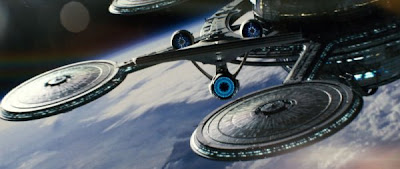
In terms of the film’s general look and appearance: I didn’t dislike the new Enterprise as much as I thought I would, honestly. I’m not big on how the rear ends of the warp nacelles light up when the ship is going to warp; the nacelles aren’t thrusters, after all. (I know they’re dumping all of the previously established canon as far as events in the series, but surely they’re not summarily dumping everything, right? The fictional idea behind warp drive still has to be the same, or else the creators here are just being dishonest.) The bridge is still too bright, too Apple Computer like, and the front viewscreen is no longer a viewscreen, but an actual window, apparently. (And there’s one shot in the movie that seemed to me to indicate that the bridge is now at the bottom of the saucer section! I could be wrong here – the shot was over in seconds – but if I’m right, that’s a huge change, and not one I much like. Why would a new timeline lead to a completely new design of starships? Did anyone else see this shot?)

And that brings me to the time travel stuff. I’ve had mixed feelings about this, ever since the film’s writers started giving interviews in which they indicated that they’re not resetting the Trek continuity to zero but rather kicking off a new timeline in which nothing has changed. The implication is that all the “standard”, or “canonical”, adventures of Kirk and company are still happening, to the Kirk and company in that timeline, where now we’re going to be following the adventures of Kirk and company in this timeline. This is, of course, pure handwavium, of the “have our cake and eat it too” variety. That’s all well and good for the writers, but is that really what happens in Star Trek?

Consider the chain of events. Apparently, in “Trek Prime”, Nero gets all pissed off and takes a mining ship after Spock’s attempt to save the galaxy from the exploding supernova destroys Romulus. But they end up going through the black hole and back in time (ouch). Pretty soon, Nero commits an act that changes history: he attacks the Kelvin, causing George Kirk to die heroically instead of living to raise his son. Now, everything is different. History has been changed.

Freezing the action right there: a few of the very best episodes of Trek ever made involve the changing of history. Most famous is “The City on the Edge of Forever”, in which Dr. McCoy, driven mad by an accidental overdose of some drug, jumps through the Guardian of Forever and winds up in 1930s New York, where he somehow prevents Edith Keeler from dying. Keeler goes on to found a peace movement that keeps the US out of WWII, allowing Germany to take over the world because they develop the atom bomb first. Also, just about every list of the best episodes of The Next Generation I’ve ever seen cites “Yesterday’s Enterprise”, in which the Enterprise-C gets thrown forward in time before it can accomplish what it needs to accomplish, again changing history (this time resulting in a Federation at war with the Klingon Empire). Both times, it’s taken for granted that history must be restored.

Other Trek time travel adventures include Assignment: Earth, in which the Enterprise travels back to 1968 and very nearly ends up a party to changing history again, and “Tomorrow is Yesterday”, when the Enterprise accidentally ends up in 1967 Earth and is seen by an Air Force pilot, whom they then beam aboard the ship and then realize have to beam back without his knowledge of having been there, lest history be changed. The best of the TNG movies, First Contact, has the Borg going back in time to take over Earth in the 21st century and preventing the Federation from ever existing; Captain Picard and the Enterprise-D have to fix history.

So, returning to the current Star Trek: Spock ends up with Nero back in time, and soon realizes that Nero has changed history. With all of that precedent in Trek lore for restoring the proper timeline, what does Spock do?

Nothing. And consider, he’s got his own ship, he knows how to travel in time (he calculated the equations for the time travel to get some humpback whales once), and failing time traveling in his own ship, Spock knows of an uncharted planet where resides a device called the Guardian of Forever. He could try to set things right…and doesn’t. He just accepts the “new timeline”, and at the end of the movie, is seen going off with the rest of the surviving 10,000 Vulcans who are left in the galaxy to re-establish their culture.

I’m sorry, but what the hell is that?!

Seriously, here, WTF? Why would Spock just blithely accept his fate in the “new timeline”? This makes no sense whatsoever. It would have been poetic, maybe, if Spock had tried, but failed, to set things right; maybe that could have ultimately been how Spock finally dies for keeps, and in all the “Hey, we gotta fix what we screwed up in time traveling!” stories ever made, I only remember one in which the time traveler doesn’t get it exactly right. And that’s a segment from one of the “Treehouse of Horror” episodes of The Simpsons. They could have had Spock being unsuccessful in restoring history, and realizing at the end that history is just going to go on now, in its rewritten state; that would have been poignant and gutsy.

Instead, we get this: Spock acting in very un-Spockish way, and some stuff about new timelines co-existing with old timelines from the creators. However, nobody in the movie indicates that the old timeline is still intact and just a dimension or two over to the left, so as far as they’re concerned, this is the way things are gonna be. All of that leaves me to believe that the writers’ babblings in the press about co-existing timelines was just as bunch of made-up nonsense to mollify the fans, who are annoyed at the prospect of a Jim Kirk who will never meet Edith Keeler.

Here’s my problem with that whole “co-existing timelines” thing: it renders the old stories irrelevant. Suddenly there turns out to be a lot less at stake than there might have been otherwise. Why should Kirk allow Edith to die, if he knows that there’s another timeline out there somewhere in which she does die, so why not just save her and have her love? Everything just becomes a bunch of dull counterfactuals. That’s what bothers me about the concept of a reboot – or rather, this particular concept of a reboot.

On reboots in general: they’re not all comparable. People like to justify this Trek reboot by citing Battlestar Galactica, the Batman movies, or the James Bond films. None of those comparisons hold, though. The original BSG lasted just nineteen episodes, so there’s really not much to cheapen by the existence of a reboot. Batman had four movies before the reboot with Batman Begins, and comics movies are a special case, anyway, since the movies exist outside the continuity of the comics in the first place. That leaves Bond – but the whole notion of James Bond being the same guy in Die Another Day and Dr. No is just silly on its face, so this isn’t the same kind of thing. It’s the reality of what exists right now, but the logic just doesn’t hold up.

Another note about canons and continuity: even if I grant that we’re in a new timeline now that starts with the destruction of the Kelvin, there’s still a remaining fact that the producers didn’t seem to realize: you still have to respect the established canon to that point. Which means that you have to deal with certain realities of Star Trek canon: Kirk has an older brother named Sam, who doesn’t appear to exist in the movie. You know who else has an older brother? Spock. So where is Sybok? And so on.

I also didn’t care for some of the depiction of the Vulcans in the movie. For a race devoted to logic and the suppression of emotion, they sure are a goofy bunch, as shown in Star Trek. A culture that advanced only manages to get 10,000 people off the planet? And the response of the “Elders”, whose job it is to keep the culture alive, to the imminent threat of planetary catastrophe is to go hide in a cave? And I’m sorry, but Sarek should never openly admit to loving Amanda. We know that he loves her, and that he shows it in the best Vulcan way, but to say “I married her because I loved her” just stood out as a staggeringly un-Vulcan thing to say. There’s no way Mark Lenard would have stood for that line! And McCoy refers to his divorce, but does his daughter Joanna exist in this timeline?

Other random observations and things:

:: We all know that James T. Kirk is a womanizer, but I didn’t much like how this movie depicts him as having an eye for anything that has the attributes of being a female and having a pulse. This can be chalked up to his being more of a delinquent slacker in this movie than Kirk Prime, but still, it got a bit annoying.

:: I like Michael Giacchino’s score a lot, although I would have liked to hear more of the classic Alexander Courage Trek Fanfare. At times the score called out for it, and it wasn’t there.

:: Why on Earth does Leonard Nimoy give the “Space, the final frontier” speech at the end? By the logic of the film, we should be hearing Chris Pine’s voice there. That made no sense.

:: I just loved the design of the end credits, with all of those nifty alien worlds and stuff. It looked like updated versions of the kinds of planets you used to see on the covers of cheap SF paperback novels.

:: So Nokia is going to survive the next 200+ years as a company? Really?

:: I had no problem with the relationship between Spock and Uhura. That’s fine with me.

:: It probably would have made the cast overstuffed a bit, but I would have liked to see Chris Chapel and Janice Rand in there somewhere.

:: Lots of people are wondering where Nero disappears to for twenty years. My assumption is that his nifty, bad-ass mining ship took some serious damage when it got rammed by the Kelvin, and making repairs to a ship from the future when the technology doesn’t exist probably takes a while. Twenty years? Well…the movie asks us to swallow the notion that a bit of “red matter” the size of a marble can destroy a planet, so why not?

:: But as for Nero’s ship — I didn’t get the design. What are all those appendages for? And why is the “flight deck” filled with ankle-deep water? A ship from the 2300’s doesn’t have floor-drains and plumbing?

:: I’m sorry, but I hated that they were building the Enterprise on Earth’s surface…and there goes another bit of continuity, too. Remember, in TOS, the Enterprise was not a new ship when Kirk took command; the events of “The Cage” are specifically indicated in “The Menagerie” to have taken place thirteen years earlier. That would mean that technically, the Enterprise should already be cruising around under Captain Pike’s command when young Kirk is joyriding in the hot-rod. I know, we’re in a new timeline, but there are limits to what I’m willing to accept as having been changed here. Enterprise should not be virtually out-of-the-box new when Kirk takes over the center seat.

:: The moment where Sulu screws up going to warp speed echoes a similar moment in an old Trek tie-in novel by Vonda McIntyre, called Enterprise: The First Adventure. That novel is a telling of the “Trek Prime” first voyage of the Enterprise under Jim Kirk’s command, and in fact, it’s actually a decent novel, well worth checking out. Kirk’s assignment to the Enterprise is what ultimately causes his break-up with Carol Marcus, and soon he’s getting to know a new crew. Anyway, there’s a moment at the beginning where the Enterprise is leaving spacedock, and Sulu messes up, causing the ship to lurch or something like that.

:: So, what’s next for Trek? The sequel has already been greenlit by Paramount, so I assume in two or three years we’ll be queuing up for Star Trek II…again. JJ Abrams has observed that the Enterprise crew could always meet Khan Noonian Singh again…for the first time, again. Or something like that. I personally don’t want that; nor do I want to see Borg again. Surely we can actually get a new adventure? Actually see some exploring of strange new worlds and new life and new civilizations? You know, going places boldly? In fact, it might be nice to have an exciting SF Star Trek adventure that never has the ship firing phasers or torpedoes. But if we have to bring back old Original Series characters for updating, how about some of the others? How about Klingon commanders Kang and Koloth? How about Harcourt Fenton Mudd? But really: how about a new adventure? Continually revisiting old characters is still fan-service for the Trekkers, and even they probably get tired of the same old thing every time out. (Of course, it’s to be noted that the least successful previous Trek flicks are the ones that tried to show something new instead of posing sequels or follow-ups to previous stories: TMP, The Final Frontier, and Insurrection. But then, I actually like those movies more than most, so….)

Well, anyway, Star Trek is a movie that bugged me, vexed me, annoyed me…and also entertained the crap out of me. Weird. JJ Abrams is a good director. I’m not much impressed by his writing, but his directing is spot on. (I know, he didn’t write Trek. I’m referring to past scripts of his.) I’ll be getting the DVD, you’d better believe it. All complaints aside, the movie did manage to hit my “explodey spaceshippy space opera goodness” sweet spot. Good on them for that much!

(Other blogger reviews I enjoyed were Jason Bennion, here and here; Snell; and Torie Atkinson.)

UPDATE: OK, I expected one, and I got it: a snooty comment from someone saying “You think too much. It’s just a movie.” Well, if I want to take that attitude into a movie, I’ll go see whatever Michael Bay’s got coming out. I expect more from Star Trek, and I didn’t get it here. Yes, it’s a wildly fun movie to watch. No, it doesn’t make any damn sense. The best Star Trek stories are the ones that are entertaining and manage to make sense; this movie got half the equation right. That’s my position, and I’ll think about it as much as I want.

Share This Post

Teevee!

Wow, am I glad that the teevee season is over. The only thing we have left to watch, here at Casa Jaquandor, is the finale to Grey’s Anatomy, so don’t be spoiling it in comments, people! Some thoughts on various shows:

:: Yeah, we’re still not done with Grey’s, but I found this season very strong, overall — there were a lot of good storylines, and the show chemistry was considerably aided by the addition of Drs. Hunt and Robbins. Hunt is the Army vet who has taken over trauma at Seattle Grace; he’s the new love interest for Christina Yang and his emotional problem (everybody’s got one, after all) is that he suffers from a small bit of PTSD. Just a bit. Like when he woke up in Christina’s bed, looked up at the rotating ceiling fan blades, flashed back to chopped blades, and started strangling Christina. Oops. (She got better, but it was still a bit of a speed-bump for their relationship.)

Robbins is a pediatric surgeon who is also the love interest for Callie Torres, who over the last year has realized that she is a lesbian. Torres came out to her controlling family at the end of the season, with disastrous results.

The season featured the ongoing and occasionally tempestuous relationship between Meredith Grey and Derek Shepard (“McDreamy”). They finally agreed to marry, after Shepard suffered a massive loss of confidence and spent some time moping in the woods. The most notable plotline was that of Dr. Izzie Stevens, who spent a big part of the season hallucinating her dead fiance, to the point of actually “making love” with him (not sure what the mechanics there involved, but we’ll leave that alone). Denny’s reappearance was eventually explained, not mystically, but medically: Izzie’s got a brain tumor! Yay! Well, OK, not really. What was impressive about all this is that the Grey’s writers managed to get me to feel sympathy for Izzie, which is odd because until this year, I’ve generically hated Izzie. Wow!

:: Hell’s Kitchen was its usual basket of fun, mostly a blend of Gordon Ramsay screaming at people and laughing at the travails of some incredibly irritating contestants. Lacey may have been the most annoying person to ever appear on HK, which is no mean feat. I liked that Danny ended up winning. Not much to say, really, about HK other than that.

:: The Amazing Race had a pretty strong season, in my opinion. A lot of people I’ve seen commenting on it online seemed disappointed in it, but I thought it was terrific. It featured some surprises (one team thinking it had won a leg, only to have Phil say, “The Race is still going. Here’s your next clue.”), some interesting obstacles that I hadn’t seen before (one team incurred a four hour penalty for breaking a couple of rules on the same leg, another ended up getting eliminated because one of the racers had to pee before checking in), and some unusually gonzo detours and roadblocks (rolling giant cheeses downhill, jogging a few miles in a Siberian city in their underwear, and my favorite, pie-throwing in Austria). I didn’t hate any of the three teams in the finale, although the team I liked the least ended up winning (Tammy and Victor), while the team I liked the most (Margie and Luke) came in third because Luke got too frustrated at the final roadblock. I do wish that the TAR people would change things up a bit on the finales; it seems like whoever comes out of the final roadblock first pretty much wins the race by default. That kind of saps the energy from the last fifteen or twenty minutes of each finale.

:: The Office was kind-of hit-and-miss all year, although they pulled it out at the end of the year, I think, with Michael’s resignation, creation of his own company, and then his leveraging of that company into getting his old job back. The finale’s final moments, with Jim and Pam learning that she’s pregnant (no words spoken, but that’s about the only possible interpretation, right?), were wonderful, and as a Buffalonian, I was amused that the Buffalo branch of Dunder-Mifflin is getting the axe. (Why does Utica get to keep its branch? Screw Utica!)

:: I had to let my Watching 24 series of posts fall by the wayside because our camera died and we took about two months to get around to replacing it. That’s what happened there, if anyone was wondering. 24 had about three-quarters of a good season this year, but then it sagged at the end, which was disappointing. Usually, 24‘s seasons tend to sag a bit in intensity for a few episodes in the middle — say, between Hours Twelve and Fifteen — before the writers start getting things ramped up again for the finale. This year was different: they actually managed to keep things intense through three-quarters of the season, all the way up to Hour Eighteen or thereabouts, and then things got dull quickly. What happened? Well, there were just too many villains in the season, and it got to be too much. It started out with Tony Almeida being the bad guy; then it turns out he’s working for Colonel Dubaku. We’re thinking that Dubaku’s the main baddie — but he’s just working for General Juma! So it’s Juma, right? Not so fast: Juma turns out to be working for Jonas Hodges, who was a wonderful villain, played by Jon Voigt in some seriously fun scenery-chewing. But Hodges was disposed of too, with a new reveal of yet another shadowy villain, played by Will Patton. (I don’t even remember this guy’s name.) Oh, and Tony Almeida, who had originally been a bad guy who was revealed to be a good guy, turned out to actually be a bad guy after all, albeit one working on his own agenda and not for any of the season’s major villains, not really. Oh, and Kim Bauer turned back up at the end of the season, right in time to get herself in danger again (although not from feral mountain lions).

I read that the 24 writers actually took advantage of the time given them by the decision after the writers’ strike a year ago to simply postpone the series a year in order to rewrite the season’s last six episodes. Turns out that maybe they should have stuck with their original scripts. Oh well. It was still a fun season with some great moments (the deaths of Bill Buchanan and Larry Moss), one great new character (FBI Agent Renee Walker, played by the beautiful and talented Annie Wersching, and officially dubbed on AICN as — I swear I am not making this up — “Rack Bauer”), and some terrific action sequences. It also featured a fictional President so inept at picking people to work the high levels of her administration that if he watched the show this year, Jimmy Carter was probably screaming, “Oh come on!”

:: I still like My Name is Earl, although apparently most people don’t. Oh well. I thought it was still funny, but now it’s off NBC and out there hoping to be picked up by another network. We’ll see.

:: I also love 30Rock more and more. It’s just terribly clever and funny, full of teevee injokes that only a tiny portion of the audience probably ever get, and I’m more and more in awe of Tina Fey each week. She’s just an amazing, amazing talent, and she’s willing to do just about anything for the laugh. I love that.

:: I didn’t pay much attention to CSI: Miami this year. Nor did I pay much attention to CSI: NY, and I haven’t watched any of the original CSI in two or three years now. I guess my interest in those has petered out.

:: What else? American Idol was more fun this year than last, I think, and the final came down to two guys I liked just a shade out of equally — I liked Adam Lambert a bit more, but not enough to be annoyed that he lost. Kris Allen did very well too, and I was happy that for just the third time since I’ve watched the show (and the first since Season Four) the finale didn’t come down to someone I liked versus someone I disliked.

:: I watched the last couple of episodes of House. Still a good show, but I have to note that House’s drug problem is becoming less and less interesting, even if he is now officially crazy. I hope the show milks his stay in the mental hospital next year a bit.

:: I haven’t watched Dollhouse since the finale, but I do have the episodes downloaded, so I’ll catch up on that during the summer. I also want to start watching Battlestar Galactica, now that it’s done. (I’ve only seen the pilot teevee-movie.)

:: And finally, apparently Scrubs has been picked up for another year, which will take place without John Dorian working at Sacred Heart, since Zach Braff decided to leave the show. I’m torn here — I’d rather my favorite show go out while it was still on top, rather than keep limping on without its heart and soul, but who’s to say it can’t keep going on with the cast it’s assembled, plus some new people? They introduced some interns this year who are actually fun characters, my favorite being the jaded and cynical Dr. Mahoney, dubbed “Jo” by JD owing to his seeing her as being similar to Jo from The Facts of Life. Can the show survive, thus reworked? I’d be skeptical, if Season Eight hadn’t been so consistently brilliant. Seriously, Scrubs had as good a year as I’ve ever seen a sitcom have.

And that’s the state of my teevee viewing.

Share This Post