Oh Bella…OH Bella…oh BELLA…OoooOOHH!!!

Fellow blogger-in-arms SamuraiFrog was recently casting about for a book he wanted to read and summarize snarkily on his blog; when he wondered if Twilight might fill the bill, I saw an opportunity to prevent that awful, awful book from sullying my personal library one minute longer. I offered, and SamuraiFrog accepted, and thus it was that I mailed him my copy of the damned smelly thing. A few weeks later, he began summarizing the book. A sample of his impression:

You know, I can already tell why this book is so popular–Meyer is such a vague, unclear writer that literally anyone could be Bella Swan. She’s so bland and lifeless that she becomes a template that any reader can graft their own identity onto and, in a flash, Bella is soooo just like them. It really appeals to that part of a person that’s narcissistic and wants something really special to happen to them. Bella’s not a flesh-and-blood, three-dimensional character, she’s Stephenie Meyer’s one-dimensional wish fulfillment. She’s anyone’s wish fulfillment, if this is your sort of thing. The book might as well be written in second person like a Choose Your Own Adventure: “You go to a new school. People are fascinated by you, because you are clearly better and more interesting than them. Why doesn’t anyone understand you? Not that you need people to understand you to be special, of course. You’re a beautiful swan!”

But did his impression change at all when he got to Chapter Two?

After a lengthy, uninteresting treatise on Bella’s first experience with snow–it’s mushy, weird, and irritating–and whether or not she likes the local library, we find Edward returned to school. Now he’s suddenly personable and talkative. They do a lab assignment together that Meyer not only manages to make seem like total dry-humping, but makes it hard to decide which character she’s more cloyingly precious about. Both characters are just oh-so-super smart. Bella’s done the lab before, but that’s not enough for Meyer–Bella was also in AP biology at her old school and is just naturally a genius and an underachiever at the same time. (She’s read her current English assignment, Wuthering Heights, several times before, but will read it again just for fun.) Edward is apparently the smartest kid in the class.

“Dry-humping” is a perfect term for these scenes, as I recall them; even moreso the forest scene that finally convinced me the book was complete shite. But I do recall this odd habit Meyer had of making Bella the smartest kid to ever set foot in Water or Tree or Town or Ville or whatever the hell the name of the town in Twilight is. (I also recall the annoying meme in the book in which big-city Bella has already learned what the students in the one-horse podunk town are just now getting to.)

Anyway, SamuraiFrog is doing one chapter a week, on Sundays. He’s done Chapters One and Two already. Snark directed at a worthy target is always fun!

Share This Post

Musical Parking Lot at Schmitt Music

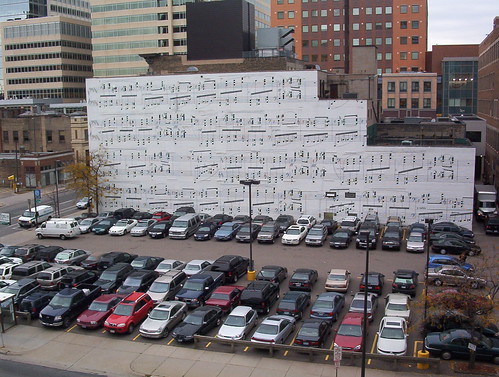
I saw this photo used to illustrate a post over at Matthew Yglesias’s blog. The post is about drawing inferences about liberals or conservatives based on car ownership rates or something like that, but I was just struck by the building, which is adorned with a segment from a piece by Ravel. I can’t believe that in a number of trips to the Twin Cities while in college, as a music major, that I never saw this!

Share This Post

Let’s go Bucs!

Once I was a baseball fan, but my enthusiasm for the game has taken a number of hits over the years. The game itself has become slower and slower; World Series games are allowed to start at 8:30 pm and frequently end after midnight; the steroid era has taken its toll; and most of all, my preferred team, the Pittsburgh Pirates, are on the verge of setting the all-time MLB record for consecutive losing seasons. That, in itself, is mind-boggling.

Yes, they’re a small-market club, and yes, MLB doesn’t do nearly enough to keep its small-market clubs economically able to play along with the big-market clubs. But even the other small-market teams around MLB manage to put it together at least once in a while, but not so the Pirates, who continually stink. The pattern has been set ever since 1992, the last time they fielded a winner: they bring up a bunch of youngsters; the youngsters either play well or disappoint; the ones who disappoint leave; the ones who play well are traded for more prospects, and the team stinks again. Lather, rinse, repeat: the Pirates are now on their fourth or fifth “rebuilding project” since 1992.

What they’re doing now is aggressively trading guys with the goal in mind of restocking a farm system that’s been depleted on talent during the last run of not-so-great baseball. Yes, they’re piling in prospects — not exactly blue-chippers, but they’re adding guys who could be decent major leaguers eventually, if the things I’m reading are any guide. But then, it doesn’t really matter who they add, because the guys who become good won’t be good enough to make the team a contender but they’ll be good enough to be trade-bait to other teams. They traded their best offensive player earlier this year (after signing him to a long-term deal last year), and today they swapped out more players for prospects.

So basically, the Pirates are like the Springfield tire-fire on The Simpsons. With the Pirates, the fire sale never ends!

Share This Post

“Leave the gun. Grab the canoli.”

I figured, a while ago, that it was high time I eliminated a particularly large gap in my movie watching career. I’ve long indicated that stories about the Mob and organized crime in general aren’t my cup of tea, to the point where I refuse to see Goodfellas as the rightful Best Picture of 1990. Sorry, Scorsese fans, but I will always love Dances With Wolves more. But, while I have little interest in watching stuff like The Sopranos, I decided that I should at least venture to see the most celebrated film ever made in this genre. So it was that I watched The Godfather, at long last.

Now, I’ve seen bits and pieces of The Godfather over the years, many and many of the bits and pieces. It turned out that when all those bits and pieces were added up, I had, in fact, seen most of the movie’s important parts; the overall plot came as no surprise to me at all, except in a few spots where I finally got to put together the story mechanics behind some very famous scenes. I wasn’t going into the movie with any kind of chip on my shoulder, mind you; I expected The Godfather to be a very good movie. But wow, what a movie. That’s about all I have to say about it, really, in terms of overall appraisal. The Godfather is just an awfully good film. So, some random observations:

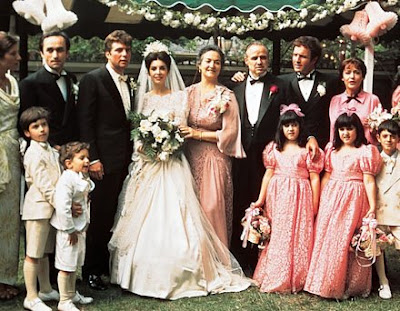
:: You know you’re watching a special movie when you’re unaware, or only occasionally aware, of the passage of time. The opening scene, at the wedding of Don Corleone’s daughter, seems over pretty quickly, and yet it’s about half an hour long. And yet, look how much of the movie is set up in that scene! It’s really pretty amazing. Virtually everything is foreshadowed in that half an hour, and it’s foreshadowed so artfully that we don’t even realize we’re being foreshadowed, most of the time. (And when we do realize it, the eventual payoff – such as the “service” that Bonaserra is eventually called upon to perform – is surprising in itself.)

:: Passage of time in the movie itself, within the story, is hard to get a handle on, and it seems as though the events of the Corleone family and their enemies don’t occupy any real relationship to the world around them. It is unclear as to how many years go by in the course of the film; Michael Corleone is back from Sicily for a minute or two of film time and it turns out that a year has gone by. Don Corleone himself goes from elder with lots of vitality to ancient patriarch before our eyes.

:: The passage of time thing brings up a larger point, that the world the film depicts – the world of the Sicilian mob in New York – is a totally insular one, isn’t it? There’s almost no depiction of any connection to the doings of the outside world, except as they relate to the criminal activities of the Corleones. It’s also interesting to see that law enforcement plays almost no role in this movie. There’s a dirty cop who isn’t around very long, and during the wedding that opens the film some FBI agents are taking down the license plate numbers of those in attendance, but that’s about it, isn’t it?

:: I wish I hadn’t known about the decapitation of the race horse before it happened; I’ll bet that was a shocking moment to audiences back when this film came out. Instead, I’m kind of saying to myself: “Hey! That’s the horse whose head gets chopped off to make a point to this arrogant prick!”

:: It’s interesting to me that “Luca Brasi” has become a pretty well-known character name in pop culture these days, for a character in a three-hour movie who has very little actual screen time. Luca Brasi isn’t around very much at all, is he?

:: The only part of the movie that lagged, in terms of pacing, was the part set in Sicily. It just wasn’t terribly interesting, although it did establish the root of Michael Corleone’s later ruthlessness.

:: My favorite line of dialogue in the movie is “Leave the gun. Grab the canoli.”

I will watch the sequels at some point.

Share This Post

Sentential Links #175

Links for the link-hungry:

:: It was a surprising loss of an icon that many of us grew up with. And, for better or worse, when those things that connect us to a happier past are gone, it makes us feel a little more removed from that past. Of course I know that there are more important issues to worry about. But, as a human being, I am capable of caring about more than one thing at a time.

:: We would still need to have conversations about our argument, we would need to apologize and let go, and talk about it … but the real forgiveness began with no words, barely any eye contact even, dancing around to “Man in the Mirror” in the men’s dressing room.

:: I choose to remember Michael as this force so powerful that on the Motown 25 special, he performed two non-Motown songs, mesmerizing the audience with his moonwalk, and forever stamped his ticket as a pop legend.

:: One could argue that just as the words, the text, can (and should) stand alone, the songs, the performances, can. (Amen.)

:: My heart goes out to the family and fans of Michael Jackson. His death was indeed tragic. But it was hard to watch the media coverage and not be struck by the absurdity of it all. Here are a few things I observed.

:: Farrah was a true American success story. From humble beginnings to a seasoned and respected actress. I loved her. I emulated her. Every generation has their icon and Farrah, for me, was mine. Marilyn was before my time, and I grew up watching and idolizing Fawcett. To watch her go from child-girl, to woman was life changing. And the last moment of her life, to be filed with that much power, and hope and strength went right through me. Farrah was more than just a great actress, she was a great human being. I’ll miss you Farrah. You inspired me. And I’m certain that wherever she is, somewhere off in the distance she can hear:

“Good morning, Angel.”

:: Is it worth saving dolphins, who were not and are not endangered, at the expense of sea turtles, sharks, and many other fish species who are endangered? (Older, but fascinating, post that brings up some issues of which I’d been unaware. via.)

:: It’s my belief that private industry is usually able to deliver more efficient outcomes to the consumer than the government could.

But usually isn’t always. And health insurance, as Will seems to admit, is one of those exceptions.

:: A few trillion (more actually) to kill a bunch of foreigners in a couple of wars that have yielded almost nothing but instability and suffering? It would be unpatriotic to bring up the price tag.

A couple of trillion in tax cuts for the insanely wealth heir and heiress set? Opposing them would be class warfare.

$1.8 trillion to cover American citizens who (frequently) must choose between food and medicine, their kids welfare and medical treatment, life and death…?

Well, that is a lot of money. Government needs to be more fiscally responsible. Let’s not get carried away. Looks like socialism to me. Just think of the deficits. Does David Broder think the bill is bi-partisany enough?

:: In true MGM studio form, there’s no shortage of talent involved: the physically magnificent ensemble; Frances Goodrich and Albert Hackett’s script and Johnny Mercer’s songwriting that do their best to sell frontier chauvinism with ruddy charisma; Cedric Gibbons’ vibrant sets. And of course, the groundbreaking choreography of Michael Kidd, most notably in the immortal barn raising sequence, where he orchestrates an unprecedented display of footstomping physicality into a harmonious symphony of force and grace. But it’s Donen’s endless playfulness with space that animates all these pieces into magical motion. (Ayup. I love me some Seven Brides for Seven Brothers.)

:: There was a period in the mid- to late-80s when adolescent boys everywhere had a collective crush on Elisabeth Shue. (I love me some Karate Kid too. And yeah, Elizabeth Shue….)

All for this week.

Share This Post

Unidentified Earth #72

OK, we took a week off last week, but now we’re back to full strength, or so it would seem…wouldn’t it? Hmmmm…anyway.

We have three entries that still have no guesses to them: UI 69 (a location west of the Mississippi), UI 70 (a location in the British Isles), and the last entry, UI 71 (a location in New York State). I know, lame hints, but I’m running low. (And to be honest, I initially didn’t even remember what UI 71 was! But now I’ve remembered. Ha! Hmmmm….)

And here’s the new puzzler:

Where are we? Rot-13 your guesses.

Share This Post

Drivers – I could do without ’em.

Several times in recent weeks I’ve posted over on my Facebook profile about goofy habits people seem to have nowadays when driving, things that people didn’t always do and actually wouldn’t do at all if they would just remember the fairly simple rules of Right of Way that we all learned way back in Driver’s Ed class. It’s starting to get maddening. Maddening, I say!

First off, take the four-way intersection. It’s well-established that when multiple cars arrive at such a place, they go in order by who got there first. This is usually easy enough, although I do occasionally see the idiot who thinks that stopping behind someone who has stopped at a stop sign actually constitutes stopping at the stop sign himself, and thus, he goes as soon as the guy in front of him goes, so the person who should be next starts moving forward and then has to slam on the brakes again because Mr. Thinks He’s Next In Line is going of his own volition. I’ve blogged about this before, I think.

But the real problem comes when two cars arrive at an intersection at the same time. Oh noes! What are we to do? Well, the Driver’s Ed teacher told us, didn’t he? The car on the right goes first. So: assume a four-way intersection where the streets correspond to the compass points. I’m going north; Driver #2 is going West. We arrive at the same time. Picturing this scenario, Driver #2 goes first, because of the two of us, he’s on the right. But if we flip this around – I’m going south and he’s going west – then I go first, because now I am on the right. (This is from the perspective of the drivers, obviously.) This should be easy enough – but not anymore. I don’t know if we’ve forgotten basic Right of Way in this country, or if we’re just trying too hard to be polite, but what seems to always happen now in these types of cases is instead of the person on the right going first, we now engage in an annoying ritual. See, I know my Right of Way, so I know that I have to wait until Driver #2 goes – but I see that Driver #2 isn’t going. Instead, he’s sitting in his car, staring at me, until he finally waves at me to go.

Even worse is when Driver #2 waves for me to go when they stopped first! Yes, this happens too. So commonplace has the annoying “No, you go!” approach to Right of Way become that if I see I’m going to arrive at an intersection at the same time as another driver, I will actually exaggerate my braking on purpose just so I arrive there second, in hopes of avoiding the whole “I’m on the right” thing and instead triggering the “You go because you got there first” rule. And you know what almost always happens when I do this? No dice. Driver #2 starts the “No, you go!” hand waving.

Well, I used to just shake my head and go, but no longer. My new approach is to refuse to go, no matter how much hand-waving Driver #2 goes. If he’s got the Right of Way, I am going to sit there motionless until he goes, whether he realizes he’s got Right of Way or, more likely, decides that I’m being a jerk and resumes driving, wondering why I spurned his magnanimous behavior. Maybe I am being a jerk, but we came up with those rules for a reason: so intersections don’t become morasses of drivers staring at each other in an effort to determine who’s going first. My last straw on the “No, you go!” approach to determining intersection Right of Way came a week or two ago when I guy actually arrived first at the intersection, indisputably first, as in, he was first by four or five seconds. He still waved insistently at me, and as I finally conceded and pulled through, I glanced over and saw that he was intently studying a piece of paper which probably contained directions from MapQuest or something. And I thought, “Yeah, stopped at an intersection is where you want to be doing that.”

This sort of nonsense is one reason why I have become an even bigger fan of roundabouts (or rotaries, or traffic circles, or whatever they call them where you are) of late. I’ve always loved them, but now, I think they are supremely fantastic and I can’t believe there isn’t more of a drive to replace every single four-way stop in the country with a circle. Even those rural four-ways in the back country of Texas, where you can go six years without seeing two cars arrive at the same time. Roundabouts are awesome because they remove nearly all of the guesswork; traffic tends to keep moving, and drivers arriving at the roundabout only have to concern themselves with the cars in the circle. They are so much easier, so much more intuitive, so much less time-consuming, and so much safer. Whoever invented the first roundabout should be on the dollar bill of some large Western country.

My other big complaint of late? Yield signs, and the fact that people insist on treating them as full stop signs. At a number of suburban shopping plazas I tend to frequent around the environs of Casa Jaquandor I find spots where I have a Stop sign where the other drivers have Yields. This seems pretty obvious to me: I stay stopped until everyone’s through the intersection and I can go. But no – there’s always someone who thinks that they must stop at their Yield sign, look over at me, and start with the “No, you go!” handwaving nonsense again. Now, sometimes this isn’t total jerkiness at play; I realize that. One such plaza has an eighteen-screen multiplex next door to Target, so if you’re trying to leave the Target lot in the period after the weekend’s big blockbuster has let out, frequently the Yield-stoppers are really being nice because otherwise you’d be sitting there forever. (I myself tend to always err on the side of letting people out of their intersections if it’s clear they’re never getting out unless someone actually lets them.)

But what happens so often is that it’s not an effort to let me into an otherwise steady stream of traffic; what’s clear is that people are simply treating Yield signs as Stop signs. Just today I arrived at an intersection in a parking lot/service road at the same time as another car; I was on the right, so had we both had Stop signs, I would have had Right of Way. But while I had a stop, he had a Yield, so all he really had to do was slow down and proceed through the intersection. Instead, he came to a full stop himself and, you guessed it, gave me the “No, you go!” bit. This annoyed me on several levels: first, he obviously didn’t know what he was really supposed to do at a Yield, and second, he didn’t even notice that he was in the right lane of the wide-enough-for-two-lanes driveway, so the two or three cars behind him just swung over, went around him on his left, and proceeded through the intersection! Had I obliged his “No, you go!” waving, I’d have been T-boned by the people he never saw because he was too busy trying to be magnanimous to me. Ugh!

Other annoying things I’ve noticed lately haven’t fallen into the “Right of Way” category, but a more general “How to be a dick when driving” thing. Case in point: last week I’m approaching a big intersection near Casa Jaquandor, where two different four-lane roads come together, plus another two-lane road off to one side. (For those familiar with the area, it’s Southwestern Blvd. and Orchard Park Road; Lake Ave. also goes off from there.) I’m northbound on Orchard Park Rd, but I’m going to be turning right onto Southwestern, so I’m in the righthand lane. This was Sunday morning, so the traffic was pretty light; only one car was in front of me, a guy about five or six car lengths ahead of me, in the left lane because he’s going straight. So I’m almost at the intersection; I’ve even got me turn signal on already, as do the two or three cars behind me that will also be making right turns on Southwestern. Easy, right? I’ll be able to make a simple right-on-red and go on my way.

Except that the guy in front of me, the guy in the left-hand lane who isn’t turning right, at the very last second swerves over into the right lane and stops at the red light, thus preventing any of us behind him from going right-on-red. We had to wait for the full cycle of traffic lights before we could go, and at that intersection, this takes five minutes. I spent those minutes trying to shoot laser beams from my eyes such that they would hit his rear-view mirror and burn the flesh from his head. (This failed. Stupid laser eyes…never work when I want them to….) Now, it’s possible that he had a right-hand turn of his own to make after the intersection (there’s a large gas station there), but I’ve been in that situation myself, and it’s just not that hard to get from the left lane into the right to make the turn; especially given that most cars in the right-hand lane are turning at the intersection and not after it, thus creating natural openings in traffic to move into, and given that this particular gas station’s entrance is about two hundred feet past the intersection and not immediately after it, so this guy really gained nothing by suddenly cutting me off. Other words? He was being a dick.

So that’s what it boils down to: learn your Rights-of-way, and don’t be a dick on the road. Please oh please.

Share This Post

Something for Thursday

I didn’t get around to picking something out ahead of time, so now I’m late…and, as it happens, timely. Here’s Michael, as I prefer to remember his work:

And here’s something in remembrance of Farrah Fawcett:

I don’t really remember much of Farrah Fawcett, to be honest; she was off Charlie’s Angels before I became aware of the show’s existence, and since I was six or seven, the show was more interesting to me for the action and funny detective stuff than for the beauty of the three leads, whoever they might have been. Nothing against Farrah, but she was never really on my personal cultural radar screen. But still, for these two to die at fifty and sixty-two? Harsh, Mr. Reaper. Harsh indeed.

Share This Post