Murder! Whiskey! Sexy!

In catching up on some teevee viewing of late, it seems that my oft-stated mission to adopt no new teevee shows to watch regularly has already failed, as The Wife has taken a liking to the CBS mystery show The Mentalist, which I’ve also been watching and finding enjoyable, although not quite as much as she does. (I’d love for the main character to be wrong once in a while, for instance. And not just “wrong” as in “out on a limb but all ends well”, but really really really wrong, as in, “fingers the wrong guy for a murder” wrong.)

The show is about a small group of detectives in the California Bureau of Investigation (which means that I suppose all episodes will take place in California, as opposed to shows using FBI characters, which are able to set their episodes anywhere in the US — while still filming in California, I guess) who investigate murders and stuff. The murders tend to be oddball kinds of things: one episode opens with the detectives wandering through a deserted field, having been told by anonymous letter that they’ll find a body there; while commenting on the lack of a body, a skydiver plummets to his doom about ten feet from where they’re standing with a comically-timed thud. There tends to be a lot of gallows humor on this show.

The title Mentalist refers to the most unusual member of this crime solving team, a guy named Patrick Jane who is extremely smart, extremely knowledgeable about human social behaviors, and freakishly observant. He sometimes seems almost psychic, but his flashes of insight always turn out to hinge on his ability to put together a couple of things he’s observed previously — such as his noting that a guy in a wheelchair has scuffed shoes, or that a psychologist claims ignorance of something he should know about given that he has a whole shelf of books devoted to the topic. Stuff like that.

We didn’t find this show until more than halfway through the season, so we didn’t watch the episodes in any sort of order, and now that we’re in re-runs, CBS has moved the thing around a bit, but now we’re able to go back to the beginning thanks to the magic of watching stuff online. This is nice because now we see a bit of the show’s backstory. It turns out that Patrick Jane is a former teevee psychic who used to go on shows like Oprah and allow audience members to contact their deceased family members; what’s especially refreshing is the show’s rigidly skeptical outlook toward stuff like that. Jane is a fraud, he knew he was a fraud, and he knew all along that he was simply exceptionally gifted at cold reading. However, he goes on teevee five years prior to the events of the series and talks about a serial killer disparagingly, and the serial killer murders Jane’s wife and daughter as a result. So it turns out that even though The Mentalist is generally a “one episode, one mystery” show, there is some kind of serial backstory flowing through it, as Jane is understandably obsessed with tracking down “Red John” (the serial killer), who is depicted as Moriarty to Jane’s Holmes.

As soon as we saw the first of the “Red John” episodes, giving the show some backstory and giving a bit of dark background to our hero Mentalist, I was reminded of one of the shows we liked to watch back in the 1990s, Profiler, which ran on NBC on Saturdays (paired with The Pretender and canceled despite decent ratings so NBC could run that awful Extreme Football crapfest that only lasted a single year). Profiler featured FBI agents who jetted all over the country investigating terrible crimes, led by a female agent (Samantha Waters) who had an ability to “see” the crimes from the eyes of the victims and the criminals, thus allowing her to have special insight. Her ability was never really explained as being psychic or not, where Patrick Jane’s is pure observation; but like The Mentalist, Profiler had a long-running backstory in which the heroine was pursuing, and being pursued by, a brilliant serial killer who had murdered her husband.

The Mentalist has more of a sense of humor about it than Profiler did; the latter could get downright grim on occasion. (But not so grim as the similarly-themed Millennium, which, while brilliant in its first two seasons, was also deeply depressing at times.) The cast has good chemistry, which is nice to note, although as I note above, it would be nice if the show would have Jane being completely wrong once in a while. (Of course, we haven’t seen all episodes yet, so maybe that’s happened and we missed it.)

So now I have a new show to watch. Joy.

Share This Post

They’re jamming all frequencies, Captain!!!

Just a quick “check-in” kind of post, since I’m still quite busy and don’t have much time for blogging. My father-in-law has been visiting from Idaho since last Tuesday, and he departs for home tomorrow, so spending time with him has obviously taken precedence over blogging; hence my radio silence here. So my usual weekly features — the Sunday Burst of Weirdness, Unidentified Earth, and Sentential Links — will be on hold until next week. I also need to upload a whole mess of photos to Flickr, which I’ll do later in the week as well. Regular posting should resume tomorrow evening, though. Thanks for checking in!

Share This Post

“Eight astronauts strapped to the back of a bomb. My bomb.”

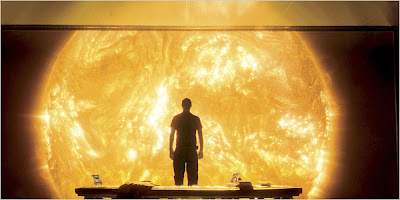
A friend of mine sent me a copy of a science fiction movie from a couple of years ago called Sunshine, which I’d never heard of before. And it’s really a very good film.

The plot isn’t terribly complex: at some indeterminate point in the future, the Sun is “going out”, but some physicist figures out how to make a kind of “solar bomb” that can restart the Sun. A ship is sent to deliver this bomb into the Sun, but that expedition fails for unknown reasons, so a second expedition is sent. Shortly into the movie, the ship – called Icarus II, for obvious reasons, with the first ship, the failed one, being Icarus I — passes beyond a spot beyond which they can send no more messages back to Earth. From that moment on they are alone, and from that moment on, things start going awry.

First off, this is a movie that knows how to handle an implausible Maguffin. If a Star Trek; The Next Generation episode had a star going out and the crew trying to “restart” it, we’d be treated to at least one scene, if not more, in which lots of folderol about subatomic particles and space-time continua and the like would be bandied about in hopes of making it all sound as though it’s not what it is: pure BS. Instead, this movie gives the whole “dying Sun” thing exactly as much explanation as I give here in this post. The movie doesn’t care about the plausibility of the premise or how it could be glossed over; an opening monologue establishes the situation in four or five sentences, and then we’re on board the Icarus II.

This movie falls into that most reliably involving of genres: the “diverse group of people have to get something done by a certain time or absolute disaster will unfold, and meanwhile, everything that could possibly go wrong does” tale. Will the crew have enough oxygen for a return trip? Will the ship suffer damage in a meteor storm? Will the bomb even work? Will they succumb to whatever mysterious fate awaited the Icarus I? Will they manage to keep their psyches in check? The answers to at least a few of those questions are “No”, which is what makes for a gripping movie.

The film takes its time in getting moving, introducing us to its characters and creating some real sense of wonder in a few terrific scenes, such as one man’s desire to look upon the brightest sunlight he can, and another when the entire crew gathers before an immense viewscreen to watch a transit across the solar surface of the planet Mercury. When the tension starts to increase, it does so slowly at first, and then things get worse faster and faster, as the ship gets closer and closer to the sun. There are many excellent character moments — most of the characters in the film are memorable people, refreshingly enough — and the various moral dilemmas they all end up facing all seem quite real. Visually, the film is extremely well done; the effects aren’t terribly complex, but they don’t need to be and despite the film’s plot involving the sun going out, everything the movie shows us feels plausible enough. You really get the feeling that if we build a big ship for an expedition to the Sun at some point, that’s what the ship is going to look like.

The movie starts out slowly, and builds up its tension until it’s one of the more effective SF thrillers I’ve seen. There is a gradual shift in tone in the film — I don’t want to say too much, but eventually there’s a killer on the loose — but it all worked for me, very well. This movie drew me in and did so quickly.

The performances are all terrific; the cast is necessarily small, and fortunately there is excellent chemistry amongst them, which is an essential ingredient for a film as tightly focused as this one. The only actor I recognized by name was Michelle Yeoh as one of the crewmembers, although I was impressed by Rose Byrne (who, when I looked her up, turns out to be the actress who played Dorme in Star Wars Episode II: Attack of the Clones, a performance of a bit part that I praised a short time ago) and Cillian Murphy as “Capa”, an actor whose looks remind me eerily of Judson Scott. (Holy crap, Judson Scott is about to be 57 years old! How did that happen!)

I recommend Sunshine highly. I found it a deeply satisfying SF film.

Share This Post

Spaceships that go “Whoosh”!

No matter how far afield I go, I always return to my true reading love: space opera. Here are notes on a few recent space opera reads, with qualification in one case.

:: As I noted when I posted about John Scalzi’s Old Man’s War, military SF isn’t really my thing. I like it once in a while, but a lot of times, Mil-SF seems to come too close to being “war porn”: fiction for people who really like war. My space opera tastes require some of that good old “sensawunda”, along with some elements of the fantastic. Usually you won’t find that in Mil-SF in great degree. Well, you don’t find that in great degree in Scalzi’s OMW follow-up The Ghost Brigades, either, but what you do find is a compelling story with finely written characters and a complex and fascinating plot that deepens our view of the universe Scalzi had set up in his first novel.

For those not up to speed, in OMW we learn that Earth is the homeworld for the expansion of the human species throughout space. Unfortunately, lots of other alien species are also trying to expand throughout space, and it turns out that Scalzi’s alien races aren’t of the Star Trek type, willing to be lived along with in peace and harmony after Captain Kirk or Picard drops by to kick-start them out of whatever weird habit it is that they’ve got going on. No, Scalzi’s aliens hate humans and want to kill them, and for the most part, Scalzi’s humans hate the aliens and want to kill them right back. So the stellar human government, the Colonial Union, has created an army of enhanced humans called the Colonial Defense Force (the CDF), whose ranks are filled with the elderly from Earth who want to leave their world behind and get a new lease on life (by taking on a new, enhanced body). Hence the title Old Man’s War.

Mentioned also in OMW was the “special elite forces” of the CDF, the “Ghost Brigades”, whose ranks are filled not with elderly recruits but with soldiers specifically cloned from the DNA of the dead. This second novel focuses attention on these special forces soldiers and the trials they face as clones. The plot is fairly simple, at the outset: the Colonial Union is facing a daunting alliance of three alien races, who are being aided by a traitorous human who is giving the aliens information on the Colonial defenses. In an attempt to access the memories of this traitor – who has left behind a clone in an attempt to fake his own death – the CDF proceeds to “grow” a new soldier out of the traitor’s clone’s body, a soldier named Jared Dirac, whose memories do, in fact, later begin to surface. The questions become not just where is the traitor and what has he done, but also why he has done it at all. The answers to these questions are pleasantly surprising.

The Ghost Brigades is a stronger book, overall, than OMW, which was much less a plot-driven tale than an episodic one. TGB maintains a tighter pace, which picks up quite a lot of steam as the climax nears, and the resolution is particularly satisfying, if a tad bittersweet. (Yes, bittersweet. In a Mil-SF novel.) I was especially pleased that some of the questions I had about the ongoing political nature of the OMW universe are explored here; I figured Scalzi had some answers up his sleeve, and here he gives them. TGB is a terrific read. I give it two stars. Why only two? Because Scalzi says something mean about the Ewoks in the book, and that’s just not nice. Otherwise he’d get three and a half.

(I’m pretty sure I recall Scalzi indicating that his intention with TGB, at least in part, was to write a book in a series where it wasn’t necessary to have read the first one. Since I’ve read the first one, I can’t say for sure how well he achieved that goal, but my sense is that if you haven’t read OMW, you might not pick up on some nuances in TGB but you’ll be able to understand the book just fine.)

:: Somewhere I got the idea that Andre Norton’s Moon of Three Rings was a space opera, but it’s not. It’s got some of that space opera feel, but the entire book takes place on a single planet, with nothing happening in space per se, which makes it not space opera but space opera’s sister genre, planetary romance. Oh well. I love a good planetary romance as much as a good space opera, just as long as I know I’m reading one so I’m not getting halfway through the book and thinking, “Where are all the spaceships?” (Now, there is a sequel to Moon of Three Rings which I haven’t yet read, called, I think, Exiles of the Stars. Maybe that’s a space opera? I’ll report back when I read that one.)

Anyway. To my knowledge I’ve never read any Norton before, which makes her a pretty big hole in my SF reading life. Andre Norton died a few years ago, and she was one of the most prolific SF writers of the 20th century. How she managed to slip through the cracks of my reading life until now, I’m not sure, but I’m glad to have finally got round to her and I plan to read more of her in the future.

Moon of Three Rings takes place on the planet Yiktor, where the trade ship Lydis has just landed. Crewman Krip Vorlund decides to go out and see some sights, eventually taking in a “beast show” – an exhibition of Yiktor’s exotic wildlife – that is run by a charismatic priestess named Maelen. Before Vorlund can return to his ship, however, he is kidnapped by a “Combine” which intends to use Vorlund as a tool to gain weapons from the space traders in order to continue their conquest of all of Yiktor. Maelen comes to Vorlund’s rescue, but her method is somewhat unique: she causes Vorlund to switch bodies with a beast of Yiktor called a “barsk”. The barsk is a wolf-like beast, and now Krip Vorlund finds himself in a race against time: he is evading his pursuers at the same time he is trying to recover his own body and then make it back to his ship before it blasts off again.

As noted, this was my first encounter with Andre Norton. It took me a little while to get into her style, but once I did, I realized that she had a finely honed voice and a gift for descriptive imagination. Her alien environments are alien enough to be exotic but not so alien as to be unrecognizable, and she is able to convey the nature of various beings without resorting to easy metaphors (like my use of “wolf-like” in the preceding paragraph). One thing that did take a bit of getting used to was likely specific to this novel: she alternates between the viewpoints of Krip Vorlund and Maelen every couple of chapters, but each is written in first person, so it was a bit difficult getting used to this. Fortunately she varies the voices of these characters nicely, and I noticed that she didn’t do the obvious thing of basically saying, “OK, now let’s go view these same events through the other person’s eyes now.” Each time the viewpoint changes, the story keeps going from the place the other character had left it. I appreciated that.

I don’t know how much Norton I’ll ever get to read; she was very prolific. But I definitely plan to read more.

Finally, a regular reader of this blog and a regular correspondent of mine offered up a recommendation way back when I first announced my desire to read as much space opera in one lifetime as I can: an old book called Space Viking by H. Beam Piper. Just finding this book proved a bit difficult. Several times I would locate a copy on eBay, only to get outbid on it (or have to pass it up in moments of lean economic activity). The book has actually shown up on Project Gutenberg, so I figured I would have to read it that way eventually – until a few months ago when I was in Barnes&Noble and just happened to see that Space Viking had been reissued in mass-market paperback by Cosmos Books. Score! Anyway, Space Viking was one of the books I took with me on my trip out west for my mother-in-law’s funeral. I started it on the plane ride home, and finished it over the subsequent weekend.

What’s Space Viking about? Well, it is a tale of murder and revenge, of love and loss, of space wars, of rogues and knaves, of court politics and the nature of history, lots of worlds, lots of characters, and nice big spaceships. And it packs all that into under 250 pages. No overwriting here, nosiree, Bob.

As the book opens, Lord Lucas Trask is marrying his beloved, a woman named Elaine; however, before the ink is dry on their marriage license, Elaine perishes in an attempt by an insane local noble to kill both her and Lord Trask. After the murderer escapes by stealing the newly built starship Enterprise, Trask decides to go after him and pursue revenge by becoming a “Space Viking”. Space Vikings are precisely that: men who raid lesser worlds and steal their goods. In this way Trask begins to build a force, which over time becomes influence over several worlds, which over more time becomes the beginnings of something of an Empire. Meantime, the whole revenge thing percolates in the back of his mind.

It’s really something of a throwback to read something like Space Viking, a book which is more than forty years old. It doesn’t read like “Old SF”, though, at least as far as I can tell. Sometimes when I read old SF novels, they really do seem old; not so this one. Its scientific content isn’t all that great, but Piper is more concerned with exploring themes of morality and history than dealing with the newest scientific ideas of the day, and his focus is constantly on his characters and their actions instead of the settings and the “Gee whiz” stuff.

Anyway, track down Space Viking. It’s a terrific read.

Share This Post

Sentential Links #174

Linkage…always linkage….

:: It is not comforting to me that we seem to be leaving the makeup of the Supreme Court to the admissions committees at the Yale and Harvard Law Schools.

:: If you’re a citizen of a state other than ours, you can be forgiven for thinking that New York follows the accepted and established forms of governance to be found elsewhere. Nothing could be further from the truth. (Our State Senate debacle in a nutshell. Ugh. Both of these links via.)

:: Whenever I find myself talking about new media to skeptics of an older generation who worry that the standards online are too debased, I try to remind people that the real debasing came with the rise of multi-channel cable news. In terms of the Iranian elections, the world’s top newspapers have the people on the ground reporting the main facts, and there’s lots of smart analysis from legitimate experts all over the web, but on television if it can’t be captured by two talking heads debating each other it’s like it never happened.

:: It’s also likely that people were feeling the pinch before the official recession, but it went unnoticed because unless rich people see their portfolios shrink, the economy is fine in the media’s eyes. But in the light of the epic failure of the American car industry, we also have to ask ourselves—could it be that people started to realize that casual dining chains suck, and took their eating out dollar somewhere else?

:: I’ve spent the last few weeks revisiting Prydain, a land I loved very much when I was a kid but haven’t really been to in a very long time.

:: Erasmus: “When I get a little money I buy books; and if any is left I buy food and clothes.”

:: I was going to make a crack about how Becky conveniently arranged the parade to conclude at the cemetery where Wally’s grave was, but in all likelihood in the world of Funky Winkerbean it’s impossible to plan a parade — indeed, it’s impossible to plan a trip of any significant distance — that doesn’t end up at a graveyard.

:: The first time I saw him, he was striding toward me out of the burning Georgia sun, as helicopters landed behind him. His face was tanned a deep brown. He was wearing a combat helmet, an ammo belt, carrying a rifle, had a canteen on his hip, stood six feet four inches. He stuck out his hand and said, “John Wayne.” That was not necessary. (John Wayne was all kinds of awesome.)

More next week.

Share This Post

Unidentified Earth #71

We’re almost caught up, with the exception of last week’s UI 70, a place where astronomical knowledge can come into play, and the preceding UI 69, around which no one has circled the wagons to guess correctly. But UI 68 was pegged as Tintern Abbey, the Wales church-in-ruins that served as inspiration to one of William Wordsworth’s more famed poems. Congrats, guessers!

And now for the new puzzler:

Where are we? Rot-13 your guesses!

Share This Post