Sentential Links #173

Time for the clicking of links.

:: This is a disgrace, and is emblematic of everything that’s wrong with Buffalo. (Some salty language here, but seriously, what Alan’s describing here and in a series of subsequent posts is nauseating. It’s sometimes as if Buffalo enjoys sucking.)

:: Official Russian history. The gold standard for truth and objectivity.

:: It’s interesting to me to see how my perspective on stories and characterization has evolved over the years; TRUE LIES is a quite different experience for me now than I remember it being on first, or subsequent viewings. (I wish I could remember where I first read this suggestion, but somebody once wrote that the movie’s perfect ending would have had Arnold saying something to Jamie Lee Curtis something like, “How can I make up that other stuff to you?” and then, cut to a hotel room, lights out, with Curtis sitting in a chair as Arnold starts doing a striptease. That would have been better than the actual ending.)

:: The amazing science fiction future is actually fantasy. Jetpacks and rayguns are the equivalent of dragons and magic. Buck Rogers is the scientific equivalent of Harry Potter. You can’t have your jetpack any more than you can have Excalibur.

:: I think there is a presumption that people should be able to decide for themselves what facts about themselves to reveal; and that decent people should respect this, absent some compelling reason not to. (Ed Whelan is a shit, pure and simple. He deserves the flak he’s getting. He pitched a hissy fit in the only way he could think of; what he did is the blogging equivalent of the time in grade school when some other kid got mad at me at the lunch table so he squirted mustard onto my cookie. What an ass. Hilzoy has it exactly right, here.)

:: Mr Buchanan made the argument for her himself with his confidence that his audience would know what he was sneering at when he sneered at Pinocchio and the troll under the bridge.

A language isn’t an assemblage of words. It’s a collection of shared references.

You can’t speak English well unless you know what troll and what bridge and what happened to him.

:: I wish I could personally slap every single person who ever used the phrase “legislating from the bench”. That’s just code for “making decisions I disagree with.” (Couldn’t agree more.)

:: Why wouldn’t Archie want to marry Betty?

The answer is simple. (Another salty language alert…but a hilarious post. But I sure wish somebody could explain just why Archie has a tic-tac-toe sign shaved into the side of his head. I asked on Facebook and nobody knew!)

:: Yet another piece of evidence that, in a lot of ways, the 1970s and ’80s were a much better time… (I remember that intro well; Kung Fu used to air in the afternoons on the independent teevee station in Portland that also had Star Trek on after school. I didn’t quite understand Kung Fu, but it was there. Once, when I was working in the restaurant ten years ago, I was standing near the front door with our hostess, who was an older lady with a wicked sense of humor. A guy walks by on the street outside with a backpack filled to the gills, walking in that slow amble of a guy walking very far, and my hostess says, “Huh. Guy looks like Kung Fu.” She was happy that I got the joke.)

:: When people who are the “other” in this society succeed, they’ve often learned to navigate both the majority culture as well as their own. For instance, I know there are things that I don’t have to endure because I’m a male. I don’t always know what they are, but I surely know they exist.

:: I do know that if love transcends the boundaries of life and space and time, I have amassed more than enough to carry me safely to my next destination. And I hope that I have left enough behind to help light a path so that we may one day meet again. (I saw this linked on the AOL main page — it’s the final post of a man who died of cancer last week. It’s…well, it’s exactly what you’d expect. Deepest condolences to his family.)

More next week.

Share This Post

Books! Books! Books!


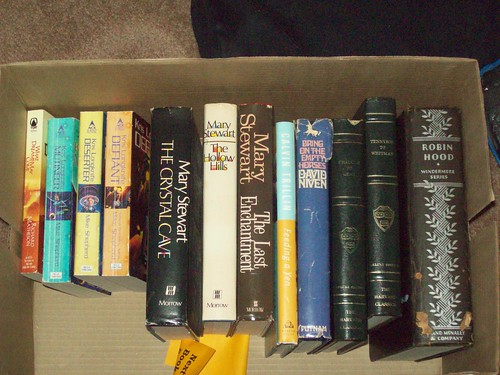
Book sale haul!, originally uploaded by Jaquandor.

This weekend marks the quarterly Used Book Sale at my local public library, and this photo shows the books I bought for myself. (There were other things for The Wife and The Daughter.) This sale was more productive, owing to the fact that they were able to have the sale in the usual room again; the sale in March was put in a tiny room about one-third the size of the usual room, owing to remodeling that was going on at the time.

From left to right, we have:

:: What Dreams May Come, by Richard Matheson. I never saw the movie, but I like Matheson a lot.

:: Three SF books featuring a heroine named “Kris Longknife”. I’m not sure I’ve ever heard of these before, but they looked fun, so there they are.

:: Mary Stewart’s King Arthur trilogy. (The books are in order.) I was thinking a few weeks ago that I really should re-read these, as I adored them when I first read them way back in 1992 and I’ve never re-read them since. Now I have nicer hardcovers to read. My MMPB’s of these books are OK, but the problem is that with many fantasy books published MMPB format in the late 80s and early 90s, maps tended to be nearly illegible. (I had a MMPB Lord of the Rings where the map was almost completely unreadable.)

(There was a fourth book that Stewart added later on, called The Wicked Day, which tells the story of Camelot’s fall from the viewpoint of Mordred. She wrote a sympathetic Mordred that was so effective that I’ve had trouble with standard, “villainous” Mordreds ever since.)

:: A food book by Calvin Trillin. I’ve heard good things about Trillin and not much read him.

:: Bring On the Empty Horses! by David Niven. I’ve wanted to read this for years, but the Buffalo and Erie County Public Library’s copy is non-circulating, for some reason. This is a Hollywood memoir by one of the wittiest men ever. (The title is from one of the more notable set directions from Michael Curtiz, one of Hollywood’s great directors but also a man who had trouble with English as a second language. When, after a number of nominations, he finally won the Oscar, he started his speech with: “Always a bridesmaid, and never a mother.” My favorite Curtiz fractured-English tale is when he told someone he wanted a poodle on the set, so the prop guy went and got him a poodle; Curtiz exploded and yelled, “Not a dog! A poodle! A poodle of water!”) Anyway.

:: Two poetry collections, because I can’t help myself. Too bad they didn’t have the third volume.

:: An old illustrated version of Robin Hood. I picked it up, hoping it was Howard Pyle, but it wasn’t. Still, it’s a handsome volume and I’ll do more research on it at some point.

All in all, a satisfying take, even if I didn’t see anything that I thought would make a good sale on eBay.

Share This Post

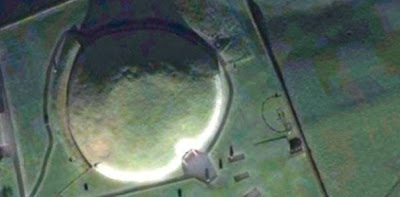
Unidentified Earth #70

OK! We have two identifications: UI 66 has been pegged as the Johnson Space Center in Houston, TX — otherwise known as the location of “Mission Control”. (Although I’m not sure what the object pictured there is — some kind of antenna, maybe?) Also, UI 67 was finally pegged as Riverside, IA — the town that has proclaimed itself the future birthplace of Captain James T. Kirk. Hooray! UI 68 is, however, still Unidentified, which strikes me as a poetic turn of events, and no one has yet shown enough pioneering spirit to peg the location of last week’s UI 69. Hmmmm.

And that brings us to the new puzzler:

Where are we? Rot-13 your guesses, folks!

Share This Post

Sunday Burst of Weirdness

Oddities abound!

:: I’m sure we’ve all noticed that sooner or later, everything reputed to be bad for you turns out to be not so bad for you, as long as you use it in moderation. Hence, lard makes a comeback. I’m interested by this, seriously.

:: If you are near death, take care of your parking arrangements first, because….

:: Can any fans of M*A*S*H refer me to the episode that featured a female Arabic suicide bomber? I’ve seen a lot of the show, but not every episode.

:: Oddly, for all the weird behavioral tics of our two very dumb cats, jumping on the counter isn’t one of them, which means that I won’t be able to put this plan into action.

More next week!

Share This Post

Serves me right for not being musical.

A reader recently asked how one goes about cultivating an interest in music in children, apropos of this post of mine from last week in which I noted that The Daughter has this year taken up the string bass. Some thoughts on that:

:: I suppose that making an instrument a simple requirement might work — “You’re taking piano lessons, Johnny, so suck it up and practice your Czerny!” — but that also runs the risk of backfiring, in the same way that forcing the reading of Shakespeare on eighth graders can permanently stunt their desire to read the Bard (or see his plays).

But music is such a useful thing to learn. It doesn’t always seem useful, though, which is part of why music is always one of the first items on the chopping block when school budget cuts happen. In addition to simply enriching one’s life if one can appreciate music beyond whatever the “pop crap of the day” happens to be, music can also be a good path to the learning of discipline and work that might not reveal itself in other pursuits. It’s a lot easier for a kid to understand why it’s important to practice scales over and over again than it is for them to understand why they should have to do 40 examples of the same math problem in a single night. (Or, maybe not. I rarely did all of my math homework.) So how to encourage it?

Well, one general rule can be adapted from the usual advice as to how to raise a good reader: it helps if the parents read themselves. A kid who grows up surrounded by books and who regularly observes her parents reading and taking pleasure in reading is exponentially more likely to enjoy reading herself. Likewise, a kid who grows up surrounded by music will, I suppose, by exponentially more likely to take at least some kind of passive interest in music when the time comes.

This doesn’t necessarily imply that the parents have to play an instrument. Just having an environment in the home where lots of music is heard helps, and the more diverse the music, the better. I remember hearing, as a small child, music from classical to Broadway to country, and more. Music was a standard feature in our home, so it was perfectly normal.

Now, I was also predisposed to see music as a respectable activity by virtue of my sister’s constant practice of piano and, eventually, the French horn. (I even remember, very vaguely, the place we bought our piano from. I don’t recall a whole lot, but it was in Portland and we rode upstairs in an immense cargo elevator.) Even so, I didn’t decide that I wanted to play an instrument on my own until my school band teacher, Mr. Beach, summoned me to the band room to inquire as to my interest. I thought, “Hey, why not.”

It was fifth grade when Mr. Beach recruited me for band. After one year of French horn, I switched over to cornet/trumpet, and I played that for a further two years before I finally decided that I actually wanted to be good at the damned thing. So after about two-and-a-half years of bring in band, I finally saw the virtue of practice. It takes time. Practice is drudgery, right up until the moment of epiphany when a music student realizes that practice is nothing more than playing for an audience of oneself. But up until that, getting me to practice was like getting a kid to enjoy bathing. My parents had to order me to practice every night.

As for The Daughter, she simply announced last year, either just before the school year or a few days into it, that she wanted to play an instrument. We’d occasionally made the suggestion to her before, with a “maybe someday” answer, but we never forced it. She knew that The Wife and I both played instruments in our youths, and she’s been around music all her life, especially in church. I figured she’d show an interest sooner or later, and she did.

So that’s my advice: don’t try to force music on your kids, but surround them with it. The rest will take care of itself.

Share This Post

Something for Thursday

I haven’t made much reference to my fiery passion for the music of Hector Berlioz in quite some time, so I’m going to rectify that. YouTube turns out to be an interesting source for older recordings of classical music — older recordings, with mono sound that can still provoke a deep thrill, with that ability mono has to allow many details in the orchestration to shine through in a way that stereo recordings, for all their warmth and vitality, can sometimes allow to fall back into the mix. For those who only know Berlioz through the Symphonie fantastique, here is one of his other popular compositions, his thrilling concert overture Le corsaire. Sir John Barbirolli conducts the Halle Orchestra. Note how far back the orchestra sits from Barbirolli; he’s a good seven or eight feet from his concertmaster. I found that interesting.

Share This Post

“Let your memory be like a blade in my soul.”

Tigana was Guy Gavriel Kay’s fourth novel published, and the first after the Fionavar Tapestry trilogy. It stands with a number of marked differences from Fionavar, pointing the way toward themes and a general approach to fantasy that would dominate GGK’s work for the next six novels, until Ysabel. (Time will tell whether Ysabel represents a momentary diversion or a whole new direction for GGK.) With Tigana we get not a series novel but a stand-alone work that focuses on the political goings-on in a fantasy domain that is nevertheless based closely on a real locale, the better for GGK to examine historical themes and events without being constrained to observing the outcomes of history too precisely. Here, GGK delves into the fantastical history of a fictional analogue of Renaissance Italy.

As the book opens, we find ourselves enmeshed in the politics of the peninsula of The Palm, a roughly hand-shaped peninsula that is divided into a number of smaller duchies and principalities, many of which look upon the others with suspicion. Each of the kingdoms owes allegiance to one of two tyrants, both wizards: Alberico and Brandin. Alberico is an extremely harsh dictator, killing any messenger who brings him bad news and responding to acts of insurrection with the random executions of dozens of people. (His preferred method of execution, “death-wheeling”, is never described, but its brutality can be inferred from afar). The other tyrant, though, is the one who commands more attention, because of the events that have gone before, roughly twenty years prior to the main action of the book.

The title Tigana refers to one of the kingdoms of the Palm, the principality of Tigana, a land of very long and proud history whose royalty traces its lineage all the way back to the god and goddess they worship. However, in the time of the novel, Tigana is a forgotten land – literally forgotten. In the final battle of the war in which Brandin took control, his son was killed; and in his grief, Brandin used his powers of wizardry to call the worst curse he could think of down upon the whole of Tigana. He strips the land of its name. Only those who are native to Tigana remember it, but anyone else not only forgets it, but they can’t even hear the name “Tigana” when spoken. Brandin insures that Tigana itself will die out completely once all of her native sons and daughters are dead, a generation hence. Working against this curse is the exiled Prince of Tigana, Alessan, and a band of fellow natives of Tigana he recruits throughout his travels as a wandering musician. His plan is to engineer a war between Brandin and Alberico, knowing that to destroy one tyrant whilst the other lives is to allow that other to rush in and fill the power void. What ensues is an amazing story of war, patriotism, revolution, court politics, magic, the morality of adhering to causes in the face of complete destruction, and all through that, love.

What makes Tigana such an effective novel is, in addition to GGK’s gifts for language and character, the moral ambiguity he conveys throughout. It would be easy enough to cast both tyrants as completely evil and Prince Alessan and his cohorts as pure and good, but GGK isn’t content to do this, and it is this – his willingness to present heroes as partly villains and villains as partly heroic – that tends to elevate his novels above many others. Alessan does things in the course of the book that cast question on his goals and his devotion to them; we wonder, at many junctures, if he is really doing the right thing in striving so hard to bring Tigana back into the world. At one point, he uses his own magical power as a Prince of Tigana to bind a free wizard to him, literally enslaving the man; the wizard, Erlein di Senzio, bitterly points out that things in the Palm have actually been much better since Alberico took over. There are no easy answers in Tigana.

Moreover, while Alberico himself is depicted as a sadistic and cruel lout, Brandin is portrayed with a startlingly high degree of sympathy for a dictator in a fantasy novel. Brandin’s grief for his son is very real, as his love for his wife, Dianora. This kind of thing makes Tigana a very refreshing read: I find myself not entirely rooting for Alessan, nor did I find myself rooting against Brandin. The eventual moment of reckoning, when it comes, is partially satisfying and partially bittersweet and partially very sad. Tigana is a book where some villains get what they deserve, while others don’t deserve what they get.

Tigana was the first GGK novel I read all the way through, way back in fall of 1993. I had previously started, but not finished, A Song for Arbonne. (I don’t recall why I didn’t finish that one, except that it wasn’t because I wasn’t enjoying it. Even while reading it I made a mental note to get back to this one.) I last re-read Tigana in 1999 or 2000, if memory serves; it had been a while, so long, in fact, that I was happy to discover that some of my earlier preconceptions about the book no longer held. I liked certain characters more than I recalled liking them before (Dianora chief among them), but I was again struck by what I’ve always felt is a problem with the book’s pacing. GGK’s books never stick to a single point-of-view the whole way through; instead, he switches back and forth among fairly large casts of characters. With Tigana, I have always felt as though he didn’t quite have the kinks worked out of this particular approach, as entire sections of the book become engrossing, only to bring on a switch to another person’s POV. What’s more is that the early part of Dianora’s part of the tale is given over to a long section of backstory. It’s basically an infodump. Now, GGK is a far superior writer to, say, David Weber, to name a writer who is famously prone to disastrously momentum-killing infodumps, so when GGK does this, it’s not fatal to the book. But it is noticeable.

Another facet of GGK’s books that is always noticeable is that they rarely end with a full-stop. He is superb at leaving that lingering sense that life does go on for the characters, even if we can’t follow along and see what that life entails. I won’t spoil it here, for those who haven’t read it and might, but the device he uses to end the novel is inspired, and it’s generated some serious discussion on nearly every forum on which I’ve seen this book discussed. The other thing that always stands out for real GGK fans are the tiny references he includes in all of his books to Fionavar; remember, Fionavar is the first of all worlds, so each of his novels to come along after that reflects this in some tiny way. It’s a tradition that actually started with Tigana, the first of his books after the trilogy.

Tigana is a wonderful, superb book, and it’s a testament to GGK, I think, to say that it’s never been my favorite book of his. But on this re-read, I found myself appreciating it a great deal more.

Share This Post

Fixing the Prequels: Attack of the Clones (part seven)

part six
part five
part four
part three
part two
part one

I suppose I should try to make some effort to update this series more often, huh? One entry a month isn’t getting it done. I’m only now approaching the halfway point in Attack of the Clones.

Anyhow, Anakin and Padme have arrived on Naboo, met with the Queen and spent a night with Padme’s family (remember, I restored all of that material to the film). Next we turn our attention back to Obi Wan Kenobi, who is now arriving on the oceanic world of Kamino to investigate the source of the toxic dart. I’m not going to quote all of this from the screenplay, because frankly, there’s virtually nothing from this scene that I would change. It’s one of the best bits in the entire PT. Why? Well, I love the way the mystery unfolds: we’re probably expecting Obi Wan to receive a less-than-enthusiastic welcome, but as soon as gets off his ship, the somewhat elegantly beautiful Kaminoan Taun We greets him with: “We’ve been expecting you. We were beginning to fear you weren’t coming.”

The Kaminoans are, for me, the best aliens in the entire PT, with their long bodies and nearly indistinguishable features; and yet, there is something undeniably feminine about Taun We versus Lama Su, the Prime Minister who gives Obi Wan his tour of the cloning facility. I also love the whole design of the Kamino cloning facility in the first place, with its gleaming white walls and floors and that teardrop-shaped chair that drops down out of the ceiling for Obi Wan to sit in. And I love when the mystery deepens at the mention of Jedi Master Syfo Dyas, who has apparently been dead for ten years. (Right around the Trade Federation blockade and invasion of Naboo, interestingly enough – what Lucas has done here is to subtly indicate that the invasion of Naboo wasn’t the only thing the mysterious Darth Sidious had going on back then.)

So anyway, as Lama Su begins to show Obi Wan around the cloning facility, we return to Naboo as Anakin and Padme arrive at the resort in “the lake country”. Here is where, for most fans, so far as I can tell, the very worst material in the movie resides. I don’t hate it as much as most – hell, I don’t really hate it at all – but the Naboo Lake Country scenes do need some revision. So, for the rest of this post, we’ll be doing that.

In the movie, we see the boat pulling up to the resort. I’d actually start a bit earlier, and actually show the boat moving across the surface of the water:

EXTERIOR: NABOO – LAKE – BOAT.

An elegant-looking speedboat cruises across the surface of a spectacular lake, vast and deep, set amidst very high mountains on all sides. The boat is piloted by a Naboo commoner; sitting in the rear are ANAKIN and PADME. PADME looks very happy to be here; ANAKIN looks very ill-at-ease.

PADME: I think that my soul comes from here. (looks at Anakin) Annie, you look awful. Are you afraid?

ANAKIN: There’s more water in this lake than on my entire planet.

PADME: Your planet has a lot of water. It’s all in the atmosphere or trapped so far underground. If Tatooine were closer to the industrial worlds of the Republic, perhaps–

She trails off, seeing his discomfort.

PADME: You can swim, can’t you?

ANAKIN: Of course I can swim. All Jedi are taught to swim. I just don’t like to.

PADME: We’ll have to see if we can change that!

He looks at her, and she smiles. He looks marginally more happy.

Then, the arrival, and they walk across the veranda to look over the panorama of the lake. This leads us up to what I suspect is the most loathed line of dialogue in Star Wars history:

ANAKIN and PADMÉ stop at the balustrade. PADMÉ looks out across the garden to the shimmering lake and the mountains rising beyond. ANAKIN looks at her.

PADMÉ: When I was in Level Three, we used to come here for school retreat. See that island? We used to swim there every day. I love the water.

ANAKIN: I do too. I guess it comes from growing up on a desert planet.

[Obviously I’d leave this out, as it would clash with what Anakin just said on the boat about being uncomfortable around this much water.]

PADMÉ becomes aware that ANAKIN is looking at her.

PADMÉ: …We used to lie on the sand and let the sun dry us… and try to guess the names of the birds singing.

ANAKIN: I don’t like sand. It’s coarse and rough and irritating, and it gets everywhere. Not like here. Here everything’s soft… and smooth…

He touches her arm. PADMÉ has become receptive to the way he looks at her but is nervous.

Ah, yes: the infamous “I don’t like sand” pickup line. Interestingly, though, we can contrast the movie versus the script. Here he says that here, everything is soft, while in the movie, he addresses Padme: “Not like you. You’re everything soft.” The line is obviously quite a bit less creepy in the original wording.

Now, I’ve never objected to this line, as I’ve indicated in previous posts on this movie. I’ve always seen it for what it is: an attempt by an awkward young adult who is trying, without a great deal of self-confidence, to win over the girl he’s desperately in love with. I simply have never had a problem with the idea of Anakin saying something like this. I’ve always figured that the awkwardness of this line was intentional, because when you really look at this script, it stands out that every single awkward line of dialogue is given to Anakin. He sounds awkward by design.

In the film, when Anakin says “I don’t like sand”, Padme has a very subtle reaction: she shifts, ever so slightly, and her face kind of freezes in the way women tend to freeze up a bit when the guy they’re with has said something that they’re not sure whether to ignore or acknowledge. Lucas might have drawn the contrast a bit more strongly by encouraging a stronger reaction from Natalie Portman, but it’s there anyway. In any event, you know what? I would not cut that line – especially in light of the fact that the line is followed by some material that, in what is emerging as a real pattern with AotC, isn’t in the finished film! According to the script, Padme notes Anakin’s attempts at poetic seduction and continues trying to make conversation:

PADMÉ: There was a very old man who lived on the island. He used to make glass out of sand – and vases and necklaces out of the glass. They were magical.

ANAKIN: (looks into her eyes) Everything here is magical.

PADMÉ: You could look into the glass and see the water. The way it ripples and moves. It looked so real… but it wasn’t.

ANAKIN: Sometimes, when you believe something to be real, it becomes real.

They look into each other’s eyes.

PADMÉ: I used to think if you looked too deeply into glass, you would lose yourself.

ANAKIN: I think it’s true…

ANAKIN kisses PADMÉ. She doesn’t resist. She comes to her senses and pulls away.

PADMÉ: No, I shouldn’t have done that.

ANAKIN: I’m sorry. When I’m around you, my mind is no longer my own.

He looks at her.

The scene would have worked a lot better this way, I think, although I’d cut out the stuff about losing yourself when you look into glass. I’d have had Padme’s voice trail off after “It looks so real…but it wasn’t….” Anakin would hold her eyes, and then draw her in for the kiss.

The kiss itself and the aftermath are actually perfectly done in the movie; I like how she walks away, leaving Anakin to awkwardly apologize and just stand there, wondering what the heck he’s done wrong. Here’s one instance where I wouldn’t follow the script. He certainly wouldn’t say, “When I’m around you my mind is no longer my own.” I’m glad that line didn’t make it into the movie.

After this scene, we cut back to Kamino, for more of Obi Wan’s tour of the cloning facility. Still nothing for me to say, since I like this sequence a lot too, although here we have something of a difficulty that also afflicts The Empire Strikes Back: events on two different worlds are intercut, seeming to imply that they’re happening simultaneously, but the stuff happening to one character or set of characters seems to imply a longer period of time than the stuff being depicted at the same time happening to the other character(s). In TESB, logic would suggest that Luke has to be on Dagobah for quite a while, right? Maybe even a few months? But it doesn’t really seem that Han, Leia, Chewie and C-3PO spend that same amount of time stuck on board the Millennium Falcon trying to fix the ship. But we know that they do, right? They have to, in order for everything to work out right.

Here, the same kind of thing happens. The stuff with Padme and Anakin at the lake house doesn’t seem to take a single afternoon; rather, a few days at the least. But Obi Wan’s exploration of Kamino doesn’t seem to take days at all, does it? But maybe it does. Anyway, the investigation on Kamino continues, with Obi Wan learning interesting things about the cloning process itself (such as the fact that the development process is accelerated), and about the clones themselves (that the seed person for all this cloning is a bounty hunter named Jango Fett). We also learn that Fett wanted a son, a clone of himself who isn’t accelerated; thus we learn the origin of Boba Fett. He’s a stormtrooper who never became a stormtrooper. I actually like this, although it would have been nice to learn a bit more about Jango himself: what made him the ideal person on whom to base an entire army of clones? What qualities does he bring? Something like this:

OBI WAN: Why was a bounty hunter used as the basis for an army?

LAMA SU: We conducted a great deal of testing on a number of suspects over several years before beginning the cloning process, I can assure you. Jango Fett’s testing was the best we found. He is extremely skillful with arms of all sorts, as well as a superlative pilot. He is also single-minded in pursuit of a job he has been appointed to do. What he does not have is an inquisitive nature; he does not seek to understand why he is asked to do the things his employers request of him. These traits make him an ideal soldier, wouldn’t you say?

OBI WAN: I suppose. I should very much like to meet Jango Fett.

LAMA SU: We shall arrange it.

In the script, it is mentioned that the Kaminoans thought a Jedi would be the logical choice for a clone army, but Jango Fett was hand-picked by Master Syfo-dyas. I don’t remember if that line made it into the film, but it’s an interesting facet of what’s going on: clearly someone was acting as Syfo-dyas after Syfo-dyas was killed.

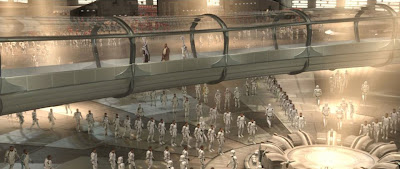
There’s a bit more talk of clones, and then Obi Wan looks on the finished article: platoons of clone troopers boarding ships. It’s a nice culmination to the scene, and what’s all the better is that we don’t know what’s going on with these clones. Who are they going to be attacking? What side will they be on, if anyone’s? What is going on here? John Williams does something interesting with the music here, in scoring the shots of the clone army with the same theme he had used in TPM to underscore the droid armies. Who is the enemy here, and why?

We then cut back to Naboo. Anakin and Padme are having a picnic and talking politics. I’m not sure what the general consensus on this scene is, but I’ve always liked it. Here’s how it goes:

EXTERIOR: NABOO, MOUNTAIN MEADOW – LATE AFTERNOON

PADMÉ and ANAKIN are in the middle of an idyllic hilly meadow, its lush grasses sprinkled with flowers. At a distance, a herd of SHAAKS graze contentedly. Beyond is the shimmering expanse of the lake. Several other lakes stretch to the horizon. The warm air is full of little floating puffballs. They sit on the grass, in a playful, coy mood, talking. PADMÉ is picking flowers.

PADMÉ: I don’t know…

ANAKIN: Sure you do… you just don’t want to tell me.

PADMÉ: Are you going to use one of your Jedi mind tricks on me?

ANAKIN: They only work on the weak-minded. You are anything but weak- minded.

PADMÉ: All right… I was twelve. His name was Palo. We were both in the Legislative Youth Program. He was a few years older then I… very cute… dark curly hair… dreamy eyes.

ANAKIN: All right, I get the picture… whatever happened to him?

PADMÉ: I went into public service. He went on to become an artist.

ANAKIN: Maybe he was the smart one.

PADMÉ: You really don’t like politicians, do you?

ANAKIN: I like two or three, but I’m not really sure about one of them. (smiling) I don’t think the system works.

PADMÉ: How would you have it work?

ANAKIN: We need a system where the politicians sit down and discuss the problem, agree what’s in the best interests of all the people, and then do it.

PADMÉ: That is exactly what we do. The trouble is that people don’t always agree. In fact, they hardly ever do.

ANAKIN: Then they should be made to.

PADMÉ: By whom? Who’s going to make them?

ANAKIN: I don’t know. Someone.

PADMÉ: You?

ANAKIN: Of course not me.

PADMÉ: But someone.

ANAKIN: Someone wise.

PADMÉ: That sounds an awful lot like a dictatorship to me.

A mischievous little grin creeps across his face.

ANAKIN: Well, if it works…

PADMÉ stares at ANAKIN. He looks back at her, straight faced, but can’t hold back a smile.

PADMÉ: You’re making fun of me!

ANAKIN: (sarcastic) Oh no, I’d be much too frightened to tease a Senator.

PADMÉ: You’re so bad!

PADMÉ picks up a piece of fruit and throws it at him. He catches it. PADMÉ throws two more pieces of fruit, and ANAKIN catches them.

ANAKIN: You’re always so serious.

PADMÉ: I’m so serious?!

ANAKIN then starts to juggle the fruit. PADMÉ laughs and throws more fruit at him. He manages to juggle them too until there are too many, and he loses control and ducks, letting food fall on his head. They both laugh.

ANAKIN stands in front of a SHAAK, yelling at it and waving his arms. PADMÉ starts laughing as ANAKIN runs in circles, chased by the SHAAK.

I’m glad this last bit didn’t appear in the movie. It just reads silly, doesn’t it? Instead we cut to the two of them frolicking in the meadow, with Anakin showing off by trying to ride some kind of large beastie that looks like a six-legged cow with a wildly distended arse. He falls down and appears to be trampled, but he fakes unconsciousness until a scared Padme rushes to his side. I like this little bit as well, and the only change I’d make would be to make the cow-beasties look a little less ridiculous. All I could think, first time I saw the movie, was, “How can that thing’s tiny little legs hold up that gigantic arse?”

But the thing is, I like all of these scenes, really; especially the scene with Anakin and Padme chatting in the grass. Sure, they’re talking politics, but what else are they going to talk about? That’s what Padme’s all about, really, and it’s important that we hear her talking about herself at some point (especially with the earlier scenes in her family’s home cut from the movie). I like how the scene establishes Padme as intelligent and quick to disagree when she sees fit; I also like how it shows Anakin starting to regain some confidence around her, even to the point of grinning bashfully when she realizes he’s teasing her. (Kind of, anyway.) I consider this another entry in the surprisingly long list of well-done character scenes in the Prequels, considering that the general wisdom is that George Lucas can’t direct actors to save his life. If anything, this scene is worthy because we get to see this smile from Padme:
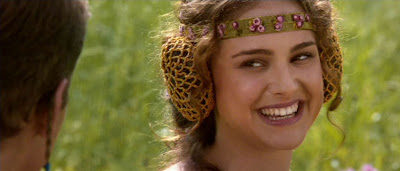
And right after that, we’re back to Kamino, where we have one of my favorite scenes in any Star Wars movie: Obi Wan’s meeting with Jango Fett.

EXTERIOR: TIPOCA CITY (RAINSTORM) – DAY

Rain lashes the city. Below, mighty waves pound the stilts, breaking almost to the height of the platforms. A large AVIAN carrying a RAIN-SOAKED RIDER flies above the water toward a floating city.

INTERIOR: TIPOCA CITY, CORRIDOR – DAY

TAUN WE and OBI-WAN stand in front of the door of Jango Fett’s apartment. TAUN WE waves his hand, and a muted bell RINGS. As they wait, OBI-WAN notes the door lock entry mechanism. Then the door opens, and a ten-year-old boy, BOBA FETT, looks at them. He is identical to the boys in the classroom.

TAUN WE: Boba, is your father here?

There is a brief pause.

BOBA FETT: Yep.

TAUN WE: May we see him?

BOBA FETT: Sure.

Another brief pause, then BOBA FETT steps aside, and TAUN WE and OBI-WAN go through.

INTERIOR: TIPOCA CITY, FETT APARTMENT – DAY

OBI-WAN, TAUN WE, and BOBA FETT enter the apartment. OBI WAN looks around the room.

BOBA FETT: Dad! Taun We’s here!

JANGO FETT comes in from the bedroom. He wears a jumpsuit. He is unshaven and mean looking, his face pitted with scars of old wounds. There are a couple of weird tattoos on his muscular forearms. He eyes OBI-WAN with suspicion.

TAUN WE: Jango, welcome back. Was your trip productive?

JANGO FETT: Fairly.

OBI-WAN and JANGO FETT size each other up. BOBA FETT studies both of them.

TAUN WE: This is Jedi Master, Obi-Wan Kenobi. He’s come tocheck on our progress.

JANGO FETT: That right?

JANGO FETT’S eyes fix OBI-WAN coldly.

OBI-WAN: Your clones are very impressive. You must be veryproud.

JANGO FETT: I’m just a simple man, trying to make my way in the universe, Master Jedi.

OBI-WAN: Aren’t we all?

OBI-WAN eyes the half-open bedroom door, through which a couple of pieces of body armor can be seen on the floor. JANGO FETT registers OBI-WAN’S look. He moves in front of him, blocking the view.

OBI-WAN: Ever make your way as far into the interior as Coruscant?

JANGO FETT: Once or twice.

OBI-WAN: Recently?

JANGO FETT: (eyes Obi-Wan carefully) Possibly…

OBI-WAN: Then you must know Master Sifo-Dyas?

JANGO FETT: (in Huttese) Boba, close the door.

BOBA FETT moves to close the bedroom door. JANGO FETT smiles thinly at OBI-WAN.

JANGO FETT: Master who?

OBI-WAN: Sifo-Dyas. Is he not the Jedi who hired you for this job?

JANGO FETT: Never heard of him.

OBI-WAN: Really.

JANGO FETT: I was recruited by a man called Darth Tyranus on one of the moons of Bogden.

OBI-WAN: No? I thought…

TAUN WE: Sifo-Dyas told us to expect him. And he showed up just when your Jedi Master said he would. We have kept the Jedi’s involvement a secret until your arrival, just as your Master requested.

OBI-WAN: Curious…

JANGO FETT: Do you like your army?

OBI-WAN: I look forward to seeing them in action.

JANGO FETT: (grinning) They’ll do their job well, I’ll guarantee that.

OBI-WAN: Thanks for your time, Jango.

JANGO FETT: Always a pleasure to meet a Jedi.

OBI-WAN and TAUN WE go out. The door slides closed. JANGO FETT turns to his son. He is deep in thought.

BOBA FETT: What is it, Dad?

JANGO FETT: Pack your things. We’re leaving.

As I noted, one of my favorite scenes in the entire Star Wars saga. It’s very well acted, between Ewan McGregor and Temuera Morrison, and there’s real tension there as Obi Wan is realizing that something is very amiss here, even if he can’t tell exactly what. I also like the chemistry between Morrison and the kid who plays young Boba Fett; they have a comfort level with each other that nicely conveys father-and-son.

After that scene, we cut back to Naboo for some more of Anakin and Padme, passing the time. We’ll do that next time, though, because we’re coming up on what I consider to be the most damaging scene in the entire PT, as far as Anakin’s relationship with Padme goes, and I want to devote some time to discussing it and proposing my fix. So that’s where we’ll start next time. Tune in!

Share This Post

Sentential Links #172

Linkage for the weary:

:: Look, it’s not racist to oppose a Latina judicial nominee, or to oppose affirmative action, or to point out genuine evidence of ethnic bias on the part of minorities. What we’re seeing here, though, is people clinging to the belief that Sotomayor has to be some mediocrity who struck the ethnic jackpot, that whatever benefit she got from affirmative action must be vastly more significant than her own qualities, that she’s got to be a harpy boiling with hatred for whitey, however overwhelming the evidence against all these propositions is. This is really profoundly ugly.

:: Libertarians actually have an entree into the debate. But because they generally act like jerks, freaks, or both, their ideas are generally rejected by the people. (Alan decided to poke some Libertarians with a stick, which is always a fun thing to do. I especially love how Libertarians think that the way to convince people to support them is to start lecturing on how our problems today are all Woodrow Wilson’s fault, because when someone’s struggling to keep a job, find a job, make a mortgage payment, or get health care, they’re really keenly interested in learning how everything is the blame of the guy who was in charge a hundred years ago.)

:: This a website promoting hitchhiking. (Wow, I thought hitchhiking was gone. I haven’t seen a hitchhiker in years. Decades, perhaps. “Cool Tools” is a nifty blog, by the way.)

:: What a computer would need to compete in Diplomacy is the ability to read human beings’ intentions (which is no doubt coming) and the ability to mimic human behavior by convincingly lying its ass off, which one hopes is a little further down the road.

:: Not only is the car a mistake, but the Renaissance notion of tidy, regular street geometry is an error. The use of paper to plan cities, which also originates in the Renaissance, is also an error. The notion that architecture is an art form, not a craft, is another crucial error in thought about urban design.

:: Thank heavens aliens and their flying saucers are so thoughtful! As reported by Fox news — yeah, imagine that — a Russian scientist claims that an alien spaceship crashed into an incoming asteroid in 1908 to save the Earth.

:: One can be an environmentalist and a humanist. The key is to make this planet habitable, sustainable and humane. It is this last crucial point that the Gainists and deep ecologists have failed to grasp, and in so doing, have come to represent a dangerous and misguided ideology.

:: It hurts me to read that. No. It’s not hurt. It’s fear. I don’t want to go back there.

But I do want to write about it.

I want to write about so much.

Nothing is wrong. Everything is going according to plan. I just can’t see the end. The conundrum of the writer. Neither could Fitzgerald. But he wrote it all down anyway.

Share This Post