
Staring back….

I’ve written on The Abyss before, but I just watched it again a little while ago, and if anything, I love it even more. This is one of those movies that gets better each time I watch it. I genuinely believe it’s an underrated classic, overshadowed by the films in James Cameron’s oeuvre that bracket it: Aliens (which I don’t like) and Terminator 2: Judgment Day (which I consider classic).

For those who haven’t seen The Abyss: it’s set in the late 80s, before the end of the Cold War. A US nuclear submarine is cruising near an extremely deep trench in the Caribbean (the titular “abyss”), when it’s buzzed by some kind of underwater phenomenon that travels extremely quickly with astonishing maneuverability, and which interferes with whatever electrical systems it comes near. Is it some kind of Soviet weapon? Or something else? They don’t find out, and the sub is caught in the turbulent wake of the “bogey” just as its electrical systems all go haywire, meaning that the sub can’t avoid crashing into the walls of the trench. The sub goes down, eventually coming to rest a couple of thousand feet down, flooding and killing all the sailors on board, but not before they can launch their log buoy.

So a recovery mission is launched. The problem is that the Navy can’t get its recovery equipment and vessels into the region before the hurricane that’s on its way will get there, so they recruit the crew of an experimental undersea oil drilling platform, “DeepCore”, (referred to throughout the film as “the rig”) to do the job of inspecting the sunken sub. A team of Marines are sent down to the rig to help, and of course, the Marines don’t get along terribly well with the oil workers who populate the rig; and the Marines are accompanied by the rig’s designer, the alpha-female Lindsay Briggman, who happens to be the estranged wife of the rig’s foreman, Virgil “Bud” Briggman. Hilarity ensues as the hurricane on the ocean surface results in great damage to the rig under the sea, as Bud and Lindsay battle one another, as the Marines execute their own orders without telling anybody else, and as the commander of this bunch of Marines starts to show signs of underwater psychosis. Add to that a race against time as the rig is cut off without its replenishing oxygen supply, the strange underwater bogeys that may or may not be aliens, and the nuclear menace when the Marines’ secret orders turn out to involve removing a warhead from the sunken sub.

(You know, I’m not sure they’re Marines. Navy SEAL’s, perhaps? I don’t recall. Yeesh. And I just watched the movie.)

Anyhow, I’ve never understood why this movie doesn’t have a better reputation than it does. Not that its reputation is bad, mind you; my general sense is that it’s well-regarded, but it wasn’t really embraced by the general public. One reason is probably the theatrical cut of the film, in which the role of the undersea aliens is a bit reduced, and in which one of Cameron’s main subplots, the Cold War tensions being exacerbated by the rescue operation in waters very near Cuba, was completely cut from the movie.

That’s not entirely a bad thing, since while I do think the Director’s Cut is better than the theatrical cut, it’s not across the board better. The problem is that James Cameron has never, not once, been a filmmaker who counts subtlety among his bag of tricks, so the Cold War stuff is driven home hard, hard, hard. We see news reports highlighting the events between the US and the Soviet Union, which is all well and good, except that Cameron also throws in some odd “Joe Citizen” interviews in which supposed people on the street say things like “Geez, the Russians love their kids too, so why are we doing all this?” This stuff doesn’t work very well, and more on some other problems with the Cold War subplot in a bit.

What really works with this movie – really, really works – is the creation of a complete setting that is totally believable, filled with details that feel totally plausible. To my knowledge, there’s nothing at all like Deepcore anywhere in existence, but the movie has extensively thought out what such an undersea drilling rig would be like and what life would be like for the men and women working there, with the result that the setting works. That’s worldbuilding, in the best sense of the word. Everything looks real, like it has a purpose. Everything clanks and clunks like metal on metal; the ceilings and walls are covered with pipes that constantly drip water in various places; the place is cold and dark and dank, and yet the people who work there consider it home, and they live in the place with an eerie acceptance of the awesome pressure of water all around them. There’s also a keen sense of family among the cast: the crew of the Deepcore rig really do seem to have been working together for a number of years. They know the same songs, they share the same in-jokes, and they speak to each other in the kind of shorthand that only people who have worked in close quarters for a long time can do.

The film draws much of its tension from the claustrophobic settings of the rig, which are made even more claustrophobic by the fact that they’re a mile underwater. There is also palpable sense of fear, both fear of the unknown and fear of the possible nuclear disaster unfolding. There are a number of very finely-done action sequences, foremost among these being a chase sequence involving two submersibles. And the movie also features one of the more creative riffs on the “defuse a bomb by cutting the correct wire” meme I’ve seen.

The music is by Alan Silvestri. It’s mostly a serviceable score that doesn’t really call attention to itself, but like most Silvestri scores, it’s got some nice ideas and fine moments.

What don’t I like about the movie? Well, the ending always feels like a small let-down. In the Director’s Cut, the entire last act ends up feeling not unlike The Day the Earth Stood Still. It’s mostly effective, but again, Cameron’s lack of subtlety actually harms things a bit, when he chooses to drive home the film’s anti-nuke message with all the delicacy of a brick thrown through a plate glass window. Still, I’m always deeply touched by the aliens’ final reason for not causing the seas to wipe the Earth clean of the human menace. (And, to be frank, the visuals in the film’s very last scene always look fake to me. I wish they’d have found a better way to shoot some of what happens at the very end.)

Tiny quibbles, though. I watch The Abyss once every year or two and it always feels fresh and exciting to me. It’s a terrific movie that should have a higher reputation than it does. I consider it a modern SF classic.

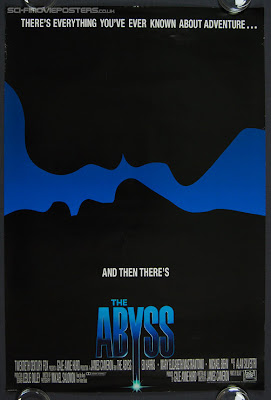
EXTRA NOTES: I’d never seen the poster art above until I Googled about a bit for an image to use for this post. I like that image, a lot — the blackness surrounding the deep blue of the dark water, forming the profiles of the man and woman. Cool poster! Image taken from here.

Also, back when I was doing Unidentified Earth posts, I had a location I was going to use but never did, because I figured nobody would get it. But it’s really cool. The underwater scenes for the movie were filmed in the containment building of an unfinished nuclear power plant near Gaffney, South Carolina; they actually built a scale set for the DeepCore rig and then filled the containment building with water around it. It turns out that the DeepCore set has never been dismantled, and can still be seen there…and on Google Maps’s satellite images. Here is the location:

And here are some photos taken by a couple of folks who actually hiked onto the site to see the abandoned set.

Share This Post

Game theory

One of the most prominent authors in the “New Space Opera” movement is Iain M. Banks (who apparently also writes fantasy, but under the name “Iain Banks”, without the ‘M’), whose highly-regarded novels are all set in a far-future society called “The Culture”. It’s the ultimate human paradise, apparently, with all needs taken care of by society and with people having achieved a status of near immortality. (Death is probably still a certainty, but it’s put off for a very long time when the only ways you can die are to perish in various mishaps or the like.) Banks also represented a fairly large gap in my SF reading history, which I’ve begun to correct, starting with The Player of Games.

Now, the fact that I haven’t read much Banks isn’t entirely my fault. Banks is a British writer, which means that for various reasons I’m not really privy to, his work has had a spotty publishing history here in the US. (In fact, the copy I own of Banks’s Consider Phlebas, which I bought in Canada, is specifically labeled on the back cover: “Not for sale in the US”.) Of late Banks’s older Culture novels have started to appear again, courtesy the Orbit label, so I can finally start collecting him, which I intend to do, seeing as how I enjoyed The Player of Games a great deal.

Our hero in The Player of Games is Jernau Morat Gurgeh, a man who is one of the greatest, if not the greatest, gamers of the entire Culture. He plays nearly every game that has ever existed, and he plays each one at an extremely high level. He is one of the greatest masters of strategy games to ever live, and as the book opens, he is bored. Desiring new challenges, he learns of a far-off star empire whose entire society revolves around a game that is so massive and so complex that whoever wins the game becomes Emperor. Gurgeh is entranced by the notion of such a game, and he undertakes the journey to the Empire of Azad to play their game. What unfolds there is fascinating, occasionally harrowing, and always surprising.

Gurgeh is an interesting character. Banks doesn’t portray him terribly heroically; in fact, Gurgeh is quite flawed. But his flaws don’t necessarily stop us from rooting for him, even when a stupid act on his part results in his being blackmailed by a sentient robot drone. The whole book is also based on a very nifty idea, this game whose very complexity determines who will rule the Empire. It is to Banks’s credit that he doesn’t really try to give a good description of the game or its rules; he throws out little details here and there that suggest aspects of the game, but for the most part he leaves it all up to the reader. That’s a wise choice, seeing as how the reader’s imagination is really the only place where a game like this could exist.

The book also has some wonderful Sfnal touches, the most striking being the planet whose biological life cycles are based on the frequency with which a fire that constantly circumnavigates the globe sweeps by. I’ve also been told that a key motif in Banks’s Culture novels is that the starships tend to have distinctive names that are often jocular in nature. One ship is called the Limiting Factor, which isn’t terribly funny, but another is called the Kiss My Ass, which kind of is. Having not read any of the other Culture books, I found The Player of Games a fine introduction to a milieu that is apparently very large and complex. The book remains pretty well on point throughout, with fine pacing and a cast of characters that isn’t too unwieldy to keep straight. It’s a different kind of space opera, to be sure; this isn’t the kind of space opera that has great fleets of warships pumping energy rays at one another. But it is, most definitely, space opera. And it’s a fine one. I’m looking forward to continuing exploring the Culture.

Share This Post

Sentential Links #180

Wow, I’ve done 180 of these posts now. Where does the madness end! Where, I ask you!!!

Anyhow, the linkage:

:: I’ve long wondered if there would be a point at which Sarah Palin went just a little too far for the political mainstream. A whole lot of political observers noticed the obvious lies, the cringe-worthy ignorance, the petty feuds, and the bizarre behavior, but wanted to maintain the fiction that Palin was a credible political figure. After all, John McCain wanted her to be one heartbeat from the presidency — and 60 million Americans agreed.

Maybe, just maybe, her “death panel” message on Facebook — complete with lies, poor writing, policy confusion, and family exploitation — will be enough to convince the skeptical that Palin really is that far gone? (God, we can only hope so. What amuses me about Palin isn’t so much her brazen stupidity, but rather her stunning hypocrisy. Citing her family’s apparent trailer-park morality is just an awful, beyond-the-pale use of her family to make a political point, but holding up Little Trig while squealing “Barack Obama wants to kill my baby!” like the Stepford Moron is A-OK, I guess. Whatever.)

:: End of rant. But since every post is required to have a political point of some kind these days, here it is for this one: there was nothing unusual about my experience. Barely even anything to get upset about, really. So if you wonder why I’m not bothered by the idea of government-funded healthcare, that’s why. Frankly, my dealings with the government, on average, are better than most of my dealings with corporations. The government might sometimes provide poor customer service just because they lack the motivation to do better, but corporate America routinely provides crappy customer service as part of a deliberate and minutely planned strategy. I’ll take my chances with the feds. (I couldn’t agree more. The “free market” does not magically generate great service. It just doesn’t.)

:: If you’re like us, you saw this image and thought, “sweet, finally a circular saw that comes with its own roll of toilet paper!” But unfortunately, tool technology isn’t that advanced yet. (One evening a couple of weeks back, I was finished up my online stuff and gearing up to do some writing when I clicked one more link and found myself at Tool Snob, a blog about tools. I then spent the next two hours wandering through the archives there, tool-obsessed geek I have become. Seriously, I’ve become one of those guys who gets the same excitement for a trip to Home Depot or Lowe’s or even the local hardware joint that I used to get for a decent toy store when I was a kid. Now, I haven’t quite rated those places up in my heart to equal status with a trip to a bookstore, but the day may soon come.)

:: Television, I’m sorry to say to those moralist Republicans, is extremely conservative, because all television executives care about is money, which means they can’t piss off any portion of their audience.

:: “There are two means of refuge from the miseries of life: music and cats.” (It was “Cat Week” over there, so go have a look.)

:: Oh my God, is she going to TAKE WALLY TO HIS OWN GRAVE? (Yup, that’s exactly what she’s doing. Wow.)

:: Why, you may ask, would you want to learn facts that are wholly fictional? Would you not be better off learning facts that are, in fact, factual? Don’t be foolish. Factual facts are boring, pedantic, pedestrian things. Fictional facts are scintillating, interesting, and other attractive adjectives.

:: I knew this was unwise, but hey: Girlfriend and Nintendo? (What a choice…and condolences to Shamus.)

:: I was babysitting for my mom’s friend Kathleen’s daughter the night I wrote that first fan letter to John Hughes. I can literally remember the yellow grid paper, the blue ball point pen and sitting alone in the dim light in the living room, the baby having gone to bed. (Everybody and their brother is linking this, but sometimes there’s a reason why everybody and their brother links something.)

More next week!

Share This Post

How to insult Alan Bedenko

Alan Bedenko is apparently amused at the low-quality of insults directed his way by the local libertarian whom he enjoys taunting, so it seems to me that what’s needed are better insults. Here are some trial-balloons for Alan’s perusal. Let’s see if these hit the mark!

:: Alan Bedenko wouldn’t know a good pizza if it bit him on the arse.

:: Alan Benenko is too provincial and needs to see more of the world than his subdivision in Clarence.

:: Alan Bedenko’s dream car is a Ford Pinto.

:: Alan Bedenko would know more if he’d quit drooling on the pin-ups of Sarah Palin and read a bit.

Anybody else?

Share This Post

Sunday Burst of Weirdness

Oddities abound!

:: You know what’s always good for amusement? Chinese translated to English!

:: SDB points this out:

This looks like a blast (heh), although I have to call BS on the “house of bricks”, since it’s not a structure: it’s just a wall, with no mortar at all between the bricks. You could walk up to that and knock it over with a stick. But still, the vortex cannon looks fun. I want one!

:: This is “weird” in the sense of “I would never have known about this if not for the Interweb”. There’s a place in India that is the wettest place on Earth, where the natives cross the local waterways via bridges — made from the living roots of trees. Wow. Some stunning photography here.

More next week!

Share This Post

A test post….

I may have figured out what was causing this blog to not be terribly functional in Internet Explorer, but if any readers could weigh in as to whether that’s still the case, I’d certainly be appreciative. Thanks, folks!

(What I saw when using IE was that the blog would load, but as soon as I would try scrolling down the front page, I’d just get “Out of Memory at Line 32” errors that would prevent the blog from scrolling anywhere, so much as past the masthead image. The moral of the story is, of course, that everybody should use Firefox, but I can’t wait for that to happen, right?)

Share This Post

AGGHHH

Can anyone with more tech cred than I offer a hypothesis as to why this blog creates “Out of Memory” errors in Internet Explorer? I’ve updated both Java and Flash to the latest versions, and the errors still come. What’s going on? This doesn’t affect me at home at all since I use Firefox, but still, I’d like IE users to be able to use this blog. What gives? Do I need to once and for all update to a new Blogger template?

Share This Post

From the Ashes

So I was wandering the magazine aisle at work the other day, and I saw a new issue of Realms of Fantasy Magazine. This struck me as odd, because RoF ceased publication a few months ago. So what gives?

Well, a new publisher has picked up Realms. By “new publisher”, it actually turns out to be an old publisher working under a new name: Warren Lapine’s old DNA Publications company is apparently now Tir Na Nog Press. Lapine’s former company ran into trouble some years back, and I remember reading that there was some bad blood left behind in the wake of DNA’s failure, but here’s hoping that that’s all behind them. Anyway, I’m glad to see Realms is sticking around.

Share This Post

Pailin’ in comparison

If there’s a stupider person in American public life than Sarah Palin, I don’t want to know about it. Of course, I’ll bet there is a stupider person out there, because there’s always someone stupider. But boy howdy, is that woman just plain stupid. She’s a complete, blithering idiot. Yeah, Sarah — Barack Obama’s death panels are going to slate your little baby for an early visit from the Angel of Death.

What a complete buffoon. Thanks for putting her up to the national microphone, John McCain. You’re a great guy.

Share This Post

Something for Thursday

Gerald Finzi was a twentieth century English composer who wrote mostly meditative, pastoral works in the tradition of Ralph Vaughan Williams. Finzi’s output was small, but full of vital warmth. Here is his Eclogue for Piano and Strings.

Share This Post