Blocked!

A couple of weeks ago I started using the AdBlockPlus extension for Firefox. I had mixed feelings about doing it. I’m generally of the view that advertising has become ridiculously present in our lives; I came to this realization about ten years ago (or maybe more) when I first noticed that the plastic stick you use at the grocery store to put between your order and the next person’s at the checkout line had ads printed on it. I remember thinking, “Does every single area of blank space nowadays have to be seen as a spot to plaster advertising?” That’s why this blog doesn’t carry ads, and why I have no plans to ever carry ads here.

However, I recognize that websites have to be able to sustain themselves. This blog is a hobby of mine, and I use the free server space that Blogger (now Google) allows me, and it’s fine. Serves my needs and such. If I was a bigger blogger, getting lots more traffic, maybe I’d think differently of using ads here; maybe I’d want the blog to generate at least a few quatloos for my trouble. Especially if I moved it to a hosting company on my own, but for now, that’s not a problem for me. For other sites, it’s a real issue, so I’ve accepted the need for ads all over the Interweb, even though it bugs me quite a bit. In general, though, I just ignored the ads completely. On sites that had an advertising “splash page”, I would click the “Skip this ad” link as soon as it appeared. And I never click through on ads themselves, unless by mistake in committing an errant click of the mouse.

However, ads have become more and more annoying over the last year. More and more pages — still a minority, but enough that I notice — aren’t just running print ads or simple picture ads, but ads with lots of funky animation. Or ads that suddenly embiggen across the entire Firefox window if I happen to move the mouse over them. Or ads that automatically expand across the window until I track down the tiny, hard-to-spot “Close ad” box that banishes the ad back to the sidebar. I’ve also tired of something I’d noticed online a lot but never realized until recently was actually an effect of advertising: the way some content-driven sites will structure long articles to run across many multiple pages, so at the end of a fairly brief page, you have to click for the next page and load everything anew. This results in reloading all of the ads, and since “ad views” are basically functions of how many times ads are loaded, this translates to increased ad revenue for the site by forcing me to keep reloading the ads if I want to read the entire article.

I was able to live with all of this, even though it was getting more and more annoying. However, in recent months, some ads have actually seemed to grind Firefox to a halt — the program will just sit there for a few minutes, not letting me click anything, and then I’ll finally get an error message that “A script on this page has stopped working”. This, I don’t need. So once I realized that the ads were the problem, I took the plunge and added AdBlock to Firefox. Now, things are going a lot nicer — pages are loading more quickly and a lot less annoyingly. It doesn’t affect the way pages look to me, all that much, since I’ve conditioned myself for the most part to not look at ads at all to begin with. But ads that were almost antagonistically pushy in forcing me to deal with them, or ads that were actually bogging down my browser? Those are unacceptable.

Some sites have apparently started to notice adblocker usage and now post small disclaimers asking users to consider allowing their ads to be loaded, and I recently read of one site that actually experimented with a tech-trick to prevent their site from loading at all on browsers running an ad blocker. While asking to be whitelisted is one thing, that last is something else, and if some site did that to me, my response would be to simply stop going there at all. I don’t like advertising, but I’ll accept its presence as long as that’s all it is: a presence that I don’t have to acknowledge in any other way except to let it be there. But when ads force themselves upon me, that’s the dealbreaker.

Share This Post

It’s Pi Day!

(image via)

Yup, time to celebrate the Lord of All Irrational Numbers, the King of All Ratios and the Mostest Cool of All Formulae, “A equals pi R squared”. It’s Pi Day!

Here’s Wikipedia on Pi:

π (sometimes written pi) is a mathematical constant whose value is the ratio of any circle’s circumference to its diameter in Euclidean space; this is the same value as the ratio of a circle’s area to the square of its radius. It is approximately equal to 3.141593 in the usual decimal notation (see the table for its representation in some other bases). The constant is also known as Archimedes Constant, although this name is rather uncommon in modern, western, English-speaking contexts. Many formulae from mathematics, science, and engineering involve π, which is one of the most important mathematical and physical constants.[5]

π is an irrational number, which means that its value cannot be expressed exactly as a fraction m/n, where m and n are integers. Consequently, its decimal representation never ends or repeats. It is also a transcendental number, which implies, among other things, that no finite sequence of algebraic operations on integers (powers, roots, sums, etc.) can be equal to its value; proving this was a late achievement in mathematical history and a significant result of 19th century German mathematics. Throughout the history of mathematics, there has been much effort to determine π more accurately and to understand its nature; fascination with the number has even carried over into non-mathematical culture.

I never saw the cult film Pi, but I heard some good things about it.

Here are a few randomly-selected videos involving Pi:

Of course, we’re talking about the mathematical concept of Pi, not other kinds of Pi, like Magnum PI:

And yummy as it may be, we’re definitely not talking about pie:

Coconut Cream Pies!

All hail Pi!

Share This Post

Save the Night!

Roger solicits opinions on Daylight Savings Time, so here’s mine: I hate it. I think it’s stupid and a giant annoyance.

Look, I like sunlight as much as anybody, and being outside is nice and all and I like it too. But I’m not one of those “OMG, it’s summer and I’m not outside! I’m doing something wrong!” people who could cheerfully go outside as soon as I’m changed out of my work clothes and not come back in until after 11:00 except to get a drink or use the bathroom. And I like it to get dark, when my body feels that it should be dark.

I simply don’t like it when it’s light enough outside to read at 9:30 pm.

I think it goes back to when I was a five years old in Kindergarten with an 8:00 bed time; there was something about being put in bed and told to go to sleep when the friggin’ sun wasn’t even down yet that bugged me on a deep, deep level. And to this day, I really don’t like those long days of early summer when the refreshing cooling darkness never seems to come until it’s too late to enjoy it.

I like sunlight, but I like moonlight and stars too and I hate shortchanging one in favor of the other.

Share This Post

Staying the couriers from their appointed rounds

Lance Mannion writes a full-throated paean to the United States Postal Service:

Delivering the mail isn’t a side-business the Government has become stuck with. It is part of the business of governing. Privatizing the mail is like privatizing democracy because it makes the flow of information that democracy can’t exist without something to be bought and sold and therefore something that can be owned and controlled by those few who can pay the most for it. Ordering the Postal Service to make money, even if only enough to break even, is part of the ongoing conservative effort to commodify all that ought to belong to all of us and by doing so make it theirs. Theirs to sell, theirs to hoard. Theirs to use as a way to control us.

While I’m not as romantic about the postal mail as Lance is, I generally agree with his position that the Postal Service should be operated whether it generates money or not. I grow weary of the entire notion that a thing is only worthwhile to the extent it makes money.

I’m reminded a bit of the pressures that public libraries face. If I had a nickel for every time some conservative has told me that libraries are kinda-sorta superfluous in the days of Amazon.com, I could probably treat my family to a nice pizza dinner. Same thing.

Share This Post

The Colors of Earth, Water, and Heaven

I recently found a graphic novel on the shelves at the library called The Color of Earth. It turned out to be the first book in a trilogy (the other volumes being The Color of Water and The Color of Heaven), so I put in my request for the other two volumes and read the entire trilogy. And am I glad I did.

The Color Trilogy (as I’m calling it here) is written and drawn by Kim Dong Hwa, a Korean comics creator; the term for Korean comics, which I’d never encountered before, is “manhwa”, and The Color Trilogy is apparently the first work by Kim to be translated and published in the United States.

The idea of romance comics is appealing to me, but the ones I’ve tried reading have, for the most part, been a mixed batch, so I was a bit apprehensive about this series. It turned out, fortunately, that The Color Trilogy is much more than a romance comic. It’s a coming-of-age story, a picture of life in small village Korea many years ago, a meditation on the meaning of love, and a wonderful character study of two compelling women.

As The Color of Earth opens, we meet a widow who runs a tavern in a small farming village somewhere in Korea, with her daughter, Ehwa, who is on the cusp of puberty and just starting to wonder about things like boys. Over the course of three volumes, Kim chronicles the lives of these two women, the older and the younger, as both begin to find love again, the older with a wandering artist who comes through town every few months, and Ehwa with several young men in the area before she settles on the one whom she loves.

Along the way, Ehwa wonders about the changes her own body is undergoing, so a great deal of the trilogy consists of discussions between her and her mother about the nature of female maturity and the nature of a woman’s heart and how women approach love as opposed to how men do. Occasionally there are long monologues, such as this, by the widow:

The heart of a woman is really strange.

There are days we long for a fireplace where we can warm our hearts through the night. If we don’t have one, we grumble, but we take solace in the company of family and friends.

Yet through it all, we yearn for that fiery hearth that we can tend to all through the night.

Though summer is already here and the summer solstice is just around the corner, my heart aches and I feel cold. I long for that someone and I feel cold…For no apparent reason, I feel cold.

The pacing in these books is slow and bucolic, reflecting the turning of seasons and the passing of time as Ehwa grows from pre-pubescent girl to young woman on the verge of marriage herself. I liked the slow pacing a lot; the books take their time not only to take the emotional drama of Ehwa and her mother seriously, but they also allow the village to take on a life of its own, through additional characters such as the raunchy-tongued men who frequent the tavern and Ehwa’s best friend, who is a lot more open about sexual experimentation than Ehwa is, both to Ehwa’s partial distaste and partial envy.

The books have a number of motifs wound throughout its narrative, foremost among them being discussions of native Korean flowers and how their own reproductive life cycles illustrate truths about men and women. I also appreciated how the book’s translator doesn’t substitute English metaphors for Korean ones, but simply uses the Korean ones and then provides an asterisked footnote explaining what each metaphor means. (Much of this, admittedly, has to do with Korean slang for sexual organs or situations.)

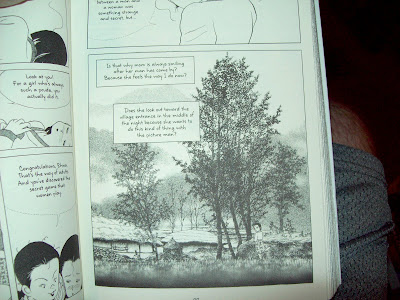
The art of the books is simply wonderful; beautiful compositions abound, and it sometimes feels as though every other page consists of a panorama of the Korean rural countryside. Some pages are dense with so much detail that the work almost resembles a woodcut; others are clean and sparse in the best way of traditional Asian art. Characters are drawn in a less-stylized way than in manga, so readers acquainted with Asian comics primarily through manga (or anime) may be surprised by the expressiveness given the characters’ faces. The Color Trilogy is a beautiful work. Here are a couple of art samples:

This series is highly recommended.

Share This Post

Something for Thursday

Oh, crap.

Yes, it finally happened. It’s not that I didn’t get around to posting this until now, or that time got away from me. It’s that I literally forgot today was Thursday.

Ugh!

So anyway, here’s something I’ll be returning to in a future post: the miraculous third movement of Rachmaninov’s Second Symphony, in its entirety. This person has helpfully divided it into two videos, but done so in a very logical way. I’ll be exploring his performances of the entire symphony, because I’ve long had it in mind to write a really exhaustive post annotated the work and why I think it’s such a towering masterpiece. But for now, here’s the movement. Play the second part after the first, obviously. This works very well, actually, as there is an actual break in the music as Rachmaninov wrote it, a second or two of heavenly silence before things start again.

(I think a part of my deep internalization of this piece is helped by the fact that I never heard the awful pop song based on melodies from this movement, Eric Carmen’s “Never Gonna Fall In Love Again”, until just a few years ago. I heard it, of all places, on the Muzak at The Store. I stopped in my tracks and just stood there in some kind of shock when I realized that the crappy musical wallpaper I was hearing was my beloved Rachmaninov. Betrayer most foul!)

(Apropos of my recent complaint about the Buffalo Philharmonic’s almost wonderful performance of this beloved piece of mine, the section they cut from the performance starts at the 1:20 mark of the second video (roughly) and picks back up at about 3:55.)

Share This Post

The Final Answers!

OK, I’m finally getting around to finishing off Ask Me Anything! 2010. It was, as usual, a lot of fun, and maybe I’ll start doing this twice a year instead of just once. Every six months seems good, so maybe we’ll play again in August.

Anyway, to finish up the queries, we have a question on writing from “Quince”: Some “how to” books on writing think the idea of keeping notes is pointless as this time is better spent on writing. I thought keeping a file of possible characters and plot lines for future writing would be helpful. What is your opinion? How do you organize your writing?

There’s more than one way to skin a cat. Ultimately, the best answer is to do what works best for you. Unfortunately, figuring out what works best for you can be a chore in itself. If the writing’s easy and the stories pour out, and yet you never make a professional sale (if selling your work is a goal in the first place), then maybe one thing to re-evaluate is the approach. But then, maybe not. There’s just no way of knowing.

The caution against keeping notes can be well taken, as some folks will spend all of their time creating notes and character sketches and plot outlines and backstories and all the rest, and never actually tell the tale they want to tell. It’s the writing equivalent of the “Just one more source!” malady that can afflict graduate students, who put off starting their dissertations until they read just one more source. If you’re an outliner or a character-sketcher or both, you have to be able to step back at some point and say, “OK, time to actually start writing.”

As for me…I’m incredibly unorganized. I make no outlines whatsoever. None. I also make no character sketches at all. None. I don’t make a list of each character’s physical appearances, likes, dislikes, personal histories, and so on. I’ve tried going this route, and it just never feels like writing to me. I always find the whole exercise a little humdrum; I’d much rather see what my characters are doing.

Part of that comes from viewing my characters as beings in themselves: I don’t want to know them as well as possible before I ever write because I view my writing as the vehicle in which I get to know my characters. The benefit here is that they often end up surprising me and that I always learn things about them that I didn’t know when I started.

So I’ll go into a new story with only a few vague notions to mind about what the characters are like, and then I’ll make up the rest as I go, finding out new things along the way. I have a story right now involving a married couple whose big hobby is big white water kayaking; their marriage isn’t in the best shape because she tends to dominate him and disrespects his motivation for kayaking because of his love of nature, where she kayaks purely for the challenge and competition of it. That’s all I know as I start. I don’t know what things they’ll tell me along the way. And that’s the way I like it.

Now, with regard to the space opera project I’ve been working on of late, I’m not making notes beforehand — but I am keeping notes as I go, both names of characters mentioned or introduced and locations mentioned or introduced. Otherwise, the thing will get away from me and I’ll end up with continuity gaffes galore. But that’s after-the-fact note taking, not generating notes before.

But again: this is all my approach. There’s nothing that says it’s the right one, except that it’s right for me.

Roger has two questions in waiting:

You have a nom de plume. But now your Facebook page, with your real name, shows up on your blog. So Jaquandor wasn’t an attempt at some pseudonym-driven privacy?

It was, initially, years ago. “Jaquandor” was created in 1998 or thereabouts for me to use on Usenet, which was the main way of discussing stuff back in the day. I’m not sure if people who posted pseudonymously constituted a majority or not, but many folks on the old newsgroups used noms de plume. So when blogging came along and I jumped aboard in February of 2002, I brought the “Jaquandor” name (or “brand”) along for the ride. The plan was to continue being pseudonymous, but over time I felt that staying strictly pseudonymous was proving an obstacle to the kind of posting that I wanted to do. The “official” end of my pseudonymous posting came when I joined Green Man Review as a reviewer. I wanted to link my reviews from the blog, but they were under my real name, so I decided, hey, what’s the difference.

I still use the name “Jaquandor” because…well, I just like the name and figured I’d keep using it. There was never any “moment” where I decided to “come out”; it was just a process over time. One interesting thing I’ve discovered is that as I reveal more and more stuff about myself, just how much of it gets no reaction at all. I think a lot of people get freaked out by “putting themselves out there for the whole world to see”, and they never really consider that maybe the world will look, say “Huh”, and move on to something else. I mean, there’s stuff I’ve said in this space that I thought would surely have someone asking, “Hey, what’s up with that?” And aside from the whole overalls thing, nobody has. That interests me.

By the way, I’ve indicated a number of times that I got the name “Jaquandor” from a comic book, an SF comic from Marvel Comics’s “Epic” line, that came out in the mid-1980s, called Six From Sirius. The book was written by Doug Moench and had art by Paul Gulacy. I really would love to see more of those characters, but there were only two four-issue limited series featuring them, sadly enough. But anyway, I suddenly thought, “Hey, I can take a picture of the comic in which Jaquandor appears!” So here he is, the fat bearded gent in green:
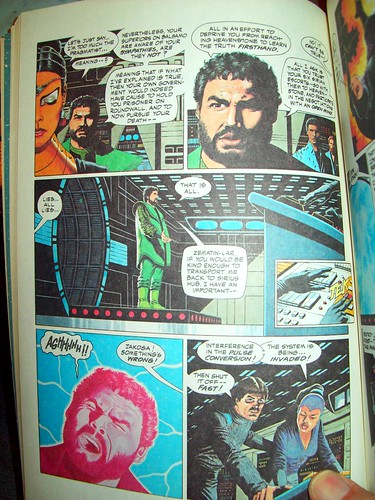
The fate of "Jaquandor"!

He only appears in one scene, during which he briefs our secret-agent heroes as to their mission (which is basically the Cuban Missile Crisis in space). That lower-left panel is Jaquandor’s last hurrah, as he is “beaming” out on their transporter thing at the same moment that something evil decides to beam in. So yes, I named myself online after a comic book character who appeared in one scene and then suffered a grisly death. Huzzah!

Roger also asks:

I’m interested in your development of faith, or lack of same. Did you grow up in a church-going family? Do you attend religious services currently? How do your current values/faith diverge from your former or current religious tradition? How has faith and/or belief in a supreme being helped or hindered you in times of personal difficulties?

Well now…there’s a tough bunch of questions. In order, no, I did not grow up in a church-going family. I saw this, and continue to see it, as a wonderful gift given my by my parents; I was allowed to develop my own worldview, and to see that worldviews will continue developing all our lives. What I believe now is different from what I believed when I was in college, and what I believe now is different from what I suspect I’ll believe twenty years from now. Or forty years, if I’m still around.

I do now attend church services regularly, but here’s the thing: my faith is so weak that I’m not sure it can be called faith at all. It’s more of a yearning, I suppose. I go to church because I love the story of it all, but I’m not sure I believe the story. I have a lot of points that trip me up on the whole thing: the omnipotent and good God who creates a world containing evil, the idea of humans as inherently flawed before we’re ever born, the fact that the Old Testament openly depicts a God in whom I’m surprised anyone would want to worship, and so on. I’m just not sure that I really believe. Maybe I don’t.

See, for me, the problem with saying “I am a Christian” means that I’m also saying “I am not a Buddhist”, or “I am not a Taoist”, or “I am not a Muslim”, and so on. Any “I am X” statement implies “I am not Y”. And I see too many things in other religions that speak to me deeply for me to rule them out completely. Putting it another way, the single part of the Bible that gives me the most trouble is John 14:6. The most common interpretation I’ve heard of this is that only those who believe in Christ will reach Heaven; everyone else does not. That passage bothers me, has always bothered me, and likely always will bother me. I cannot in my heart endorse the “Only Christians go to Heaven” view. If I get to Heaven and the Dalai Lama has been sent elsewhere, I’m going to wonder what God’s priorities are.

One can probably tell that belief in the supreme being hasn’t been terribly helpful to me in times of need. I just don’t know that God is there, listening. What is always helpful is people.

This answer probably hasn’t been terribly satisfying.

Roger also asked my thoughts on this interview with former Canadian figure skater Elvis Stojko.

From the introduction:

But some members of the skating community believe the sport’s effeminate image is increasingly a problem. Last year, Skate Canada told athletes and officials to talk up the sport’s toughness in order to attract more of a “hockey crowd,” and three-time world champion Elvis Stojko, the first man to land a quadruple-triple combination jump in competition (in 1997) and a skater known for his butch style, has spoken out on the issue. The sport really needs to start emphasizing “masculinity, strength and power,” Stojko has argued, if it wants to be taken more seriously. His remarks infuriated some gay groups, who perceived them as a slap in the face to the sport’s traditional fans.

Skating does tend to seem a bit effeminate, I suppose. At times. Not always, but right now, the effeminate stuff seems to be pretty dominant (except for the Russians, who seem utterly sexless — if there’s a more robotic skater than Evgeni Plushenko, I haven’t seen him). But there’s always been a healthy mix of that, so I’m not really sure. Saying that men’s skating should be more about masculinity and power seems possibly correct at first glimpse, but I fear that it would lead farther and farther into the dominance of jumping.

I confess that I haven’t much thought about these kinds of issues within skating. I do know that I’ve lost touch with the sport in general the last couple of years, because for whatever reason, it doesn’t seem to be as big a deal as it was ten years or so ago. I remember the World Figure Skating Championships being a big deal, always televised in prime time (at least the big events). The last couple of years, World’s has been hard to find. Why is this? I’m not sure. Has the sport waned a bit? Is it “too effeminate”? I don’t know. I do think that some of the personalities in the sport have become pretty outlandish, but…you know, I just don’t have a big opinion on this right now. I do think there’s a degree to which the sport is kind of homogenized these days; everybody kind of looks the same, which wasn’t the case during the 1990s when you had wildly different types of skaters in Stojko, Philippe Candeloro, Todd Eldridge (perhaps my favorite skater ever — I loved the guy) and, yes, the sexless Russians (Alexei Yagudin excepted — I thought he was amazing).

I’m not sure if the problem is too little butch as too little personality.

Finally, Charlie actually reminded me that I never answered a question that he had e-mailed last year. Basically, he was wondering about a falling-out I had with a professor in college. I was reticent to answer this one, and over time I pretty much put it out of my mind until I’d forgotten it completely, but I think it does deserve something of an answer, even if the story…well, I didn’t really present the best side of myself on this one, and the “Hey, I was only 20!” excuse rings hollow at this point.

It had to do with the band director, a guy named, believe it or not, Robert E. Lee. Dr. Lee was beloved of band members and alumni, but from the outside, he was seen as a highly quirky individual. He was pretty eccentric, even by tenured college music professor standards. One time, when the band was on tour, we stopped to get lunch at a McDonalds, and Dr. Lee bought a Happy Meal. When someone asked why he’d bought a Happy Meal instead of one of the other combo meals, he replied in his typically booming voice, “Because I’m happy!” His conducting could be hard to follow at times, when he really got into a piece, because he’d dispense with the traditional beat pattern and just start windmilling his arms a lot. He’d stop a rehearsal in its tracks to suddenly give the band a lecture on why they shouldn’t take up the offers of the prostitutes in the cities in Europe, never minding that the band wasn’t slated to go to Europe for another year and a half. He would talk to wind players about the need, when playing their instruments, to have a “wall of teeth”. (Not one person ever understood what he meant by this or why it was good.)

He had some maddening habits as well; the one that drove me batty was his tendency to cut pieces of music if certain passages were proving troublesome. He would just say “We’re not going to play that part, so when you get to two measures before point D, jump to five measures after point G.” I hated that. My view was that if a part of a piece was hard, you worked on it until it wasn’t, and that cutting music was basically denying what the composer had written. (Obviously, my attitude on this has not changed.) He became obsessed with a modern composer whose work I didn’t much like, so starting with my sophomore year, this composer’s newest work was always on our program.

Of course, it was always easier to see the negative than the positive. Yes, the music cutting was maddening and yes, Dr. Lee seemed in my eyes to waste a lot of good rehearsal time talking about odd topics. But I would only realize later on other things, such as the fact that for an old guy who’d been in the band business for more than thirty years by the time I came under his baton, he was constantly looking for new pieces and new works to learn, and his general enthusiastic approach to music — all music was singing, to him — was, I later realized, utterly correct.

But at the time I was pretty clueless, and Dr. Lee, for all his usual warmth and gregariousness, could, at times, be amazingly tone deaf at times in dealing with people. There were times when he would say something that was so insensitive that one almost couldn’t believe he’d say them. Lots of people had stories about things he’d said in that vein.

My own story, which is pretty brief, involves the European tours. The major music ensembles at college (at the time, the band and choir) would go on a European tour every four years. The way that broke out for me was that the European tour would be my senior year. However, the tour cost each student a couple of thousand dollars, if I remember correctly. I didn’t have a job, and I wasn’t about to try to ask my parents to foot that bill — they were already spending enough just to send me to school in the first place — so I decided that, regrettably, I wouldn’t be able to be in band my senior year.

So on audition day, I was walking through the music building, and Dr. Lee stopped me in the hall and asked if I was going to be in band. I replied, “Do you want me to be?” He thought for a moment and said, “Well, you’re not going to Europe, so…no.” And away he walked. It was very blunt and, I felt at the time, very dismissive of a person who’d been part of his band for three years prior. In short, it really pissed me off, and I made little effort to keep my ire secret. Of course, what I didn’t see then was that his position, however bluntly phrased, was the correct one: the entire year, for the band, would be preparation for Europe, so what use would I be if I wasn’t going?

I filed that under “Live and learn” and pretty much forgot about it until just a couple of years ago, when I got home from work, opened the mailbox, and took out an envelope that was addressed with handwriting I hadn’t seen since college. Dr. Lee had distinctive handwriting, and even after not seeing it for thirteen or fourteen years (whatever it had been at the time), I recognized it immediately. Inside the envelope was a brief note of apology from Dr. Lee for “what he had done to hurt me”. It couldn’t have possibly been more unexpected. I’d had no idea that he’d ever even been aware of how I’d felt at the time.

So yes, I wrote back, telling him basically what I admit above: that I’d overreacted to a perceived slight and never really considered, until much later, the correctness of his position. I said some things about music, told him about my life since college, and signed off. I also inquired as to his health, since it’s not unusual for people who are in bad health to seek to make redress for things they’ve done earlier in life. Dr. Lee wrote back one more time, to indicate that he was doing just fine and planned on many more years of life (he’s been retired for some time now, and I think that 1993 tour ended up being his last European tour) and that he was glad the hatchet was buried. It all felt very surreal; when I read his first letter, I remember having to stop and think a minute to remember why I’d been so pissed at him in the first place. Once I did remember, I almost immediately thought, “Oh, you 20-year-old dumb ass, he was right, even if he was kind of a dick in the way he went about it.” So, chalk another ass-kicking my younger self is going to receive if I ever get hold of Doc Brown’s DeLorean.

You know what keeps me up at night? Wondering what my fifty-eight year old self is going to want to come back in time and kick my ass for when he gets hold of Doc Brown’s DeLorean.

And that brings Ask Me Anything! 2010 to a close. Thanks for asking, everybody!

Share This Post
I see you!

I loved Avatar.

I really did. I loved the thing. It hit so many of my sweet spots that I found myself utterly involved in it barely fifteen minutes in. Even with its dialogue that often barely manages to rise above the level of “serviceable”; even with its Cameron-style foreshadowing delivered with all the subtlety of a ball-peen hammer to the forehead; even with its cardboard cut-out villains who have almost no depth, no characterization, and no complexity to their motivations other than money-making and gratuitous warmongering.

I loved it despite those flaws, because Cameron is just such a damned good storyteller that he can usually make big flaws disappear into the background and yes, because the visuals amazed me.

I was going to write a long piece about the movie, but then I decided to just go the “randomly unconnected thought” route. So here are random thoughts about Avatar:

:: Yes, I lost myself in the visuals. The movie was just beautiful to look at. I was awestruck by one shot after another. Especially the tree that has the spores that bob in the air like jellyfish, and the way the ground lights up when the Na’vi walk on it.

:: No, I wasn’t bothered by the word “Unobtanium”. Sure, maybe they should have come up with a name of their own, but really — if they’d done that, no one would remember it as soon as the lights came back on at the end of the movie. And besides, if you look at the names of some of the lab-created elements on the periodic table, some of them are just as goofy: “Californium”, anyone?

:: The movie seems to paint the military with a pretty broad brush, but I think Cameron was trying not to do this, although not terribly successfully. He does make clear that these aren’t actual US military (a point Gregg Easterbrook missed completely when he bitched about the movie on his Tuesday Morning Quarterback column, but I’m not looking for the link right now), by pointing out that they’re hired by whatever corporation hired them and by showing them, in a briefing scene toward the end, as being not all guys in fatigues but also fat guys in crappy T-shirts. But Cameron didn’t do enough to draw this distinction, so his depiction of military, seems kind of damning. (Of course, I’m not sure how fair this perception is, since in the course of the film we only really get to know two military people other than our hero, Jake Sully: the helicopter pilot with a conscience, and the lunatic “Roger Ramjet” who is the main baddie anyway.)

:: The movie is not original in the least degree, except for one idea that never really gets any kind of great SFnal treatment: the notion of the movie’s biosphere as being an enormous information transfer thing. Cameron flirted with a really nifty idea there, in positing that the spiritual “We’re all connected!” thing common to “savages” is an actual physical reality on this planet, but he didn’t take it far enough. That should have been the starting point for an amazing movie, not the ending point. It really is “Dances With Wolves In Space”, but I was fine with that.

:: In talking about the movie in his football columns, Easterbrook (again no links, because I’m lazy) kept referring to the movie as a “cartoon”, thus displaying the commonly held belief that animated movies are inherently lesser works than live-action movies. Easterbrook can suck it.

:: James Horner’s score is OK. There are a couple of big moments when the score takes flight, but for the most part, if you’ve heard Horner a few times, you know what to expect here.

:: Sometimes I really wish James Cameron would hand his script to someone and say, “Can you make this a little more subtle, please?” The movie was awash in the occasional foray into dialogue so clunky it made me laugh (a lot of the warmongering military talk fell in this vein), and as usual, Cameron sure likes to beat us over the head with foreshadowing. “Wow, that body-suit weapon thing looks cool! I sure hope someone goes mano a mano with that guy in that suit!” “So, you say that there’s this one flying beastie whom nobody’s ever been able to ride? Interesting….” “You can theoretically transfer everything from one brain to another? That may come in useful….”

:: SamuraiFrog hated the movie. I understand most of his criticisms, even if I don’t share them.

:: For the most part, Avatar is…well, it’s a movie. I liked it a lot. I had a great time watching it. It entertained me. I don’t see it as some kind of magnificent game-changer, though. Visually it raises the bar. Story-wise, it’s just good.

Share This Post

Tapping the microphone….

Hey, folks! Sorry for the lack of posting the last day or so. I actually intended to post something or other yesterday, but I got bitten suddenly by the most obnoxious of all bugs. You know the one. It’s the bug that makes you look around your primary workspace and think, “Oh my God, this area is a complete disaster that is unfit for any human activity whatsoever! Bring me a garbage bag and a Swiffer, Jeeves! There’s a good man!”

Anyway, I’m still not back in the swing of things, but I’ll get there. Right now I don’t have a hell of a lot to say, so why not go watch the trailer for TRON Legacy?

Share This Post

Sentential Links #197

Linkage. Closing in on 200 of these posts, wow!

(As an added bonus for this week, no politics! I’m a bit burned out on reading about Republicans right now.)

:: I am seriously in love with this game right now. (Super Mario Bros. was one of the initial games we got for our Wii, in addition to Wii Play, which I got more because it came with an extra Wiimote than anything else. I’m starting to look into other games, but it’s a testament to how good Super Mario Bros. is that it’s taken this long for us to start thinking, “Hmmm, we should get another game or two one of these days.” And I have to note that there’s something weirdly meta about me wearing a red shirt and overalls and playing a video game where the character I’m controlling is a guy wearing a red shirt and overalls. Whoa….)

:: In 1966, a show that was about some young and very attractive people stranded together on a deserted island could get away with pretending that the young and attractive people wouldn’t notice that they were young and attractive and act upon it. Gilligan and the Professor were assumed to be as blind as little boys to the fact that Ginger and Mary Ann were girls, and, despite Ginger’s occasional vamping, she and Mary Ann were only that much more aware of sex than a couple of sixth grade girls would be than they’re younger brothers. The four of them were very tall children because most of the audience was made up of children and to them life on a desert island would be no phone, no lights, no motor cars, not a single luxury, but they wouldn’t count sex as one of those missing luxuries. Parents knew better but they were glad to let it slide because of the kids. (A Gilligan’s Island movie. I’m frankly surprised it took this long for this to come about. I, too, don’t much see the point, because it’ll have to be all “contemporary”, which means lots of crude sex jokes and whatnot where Lance points out that the show didn’t have any sexual content at all. Oh well. It’ll probably suck, but it could redeem itself a bit with some good coconut cream pie action, I suppose. BTW, in spite of my lifelong fascination with red-heads, in this particular case I was always in the Maryanne camp.)

:: And God so loved us that He sent us his Messenger, whose wings were golden and wondrous! And this Messenger did help us out once in a while, but often He would mope, or complain, or forget where He was or what He was doing. The disparity in earning power between Him and His wife was always a source of tension…

:: When we first saw Jurassic Park and the T-Rex came out of no where to kill the Velociraptor at the end, we all thought the same thing… awesome. It was just that, not much more thought went into it. Upon a thousand viewings later though questions like these start to crop up.

:: Oh, those wacky Latinos and their crazy funeral traditions involving respect for the dead. Don’t they realize that the true purpose of funerals is for therapy and that any other consideration is just plain silly and old-fashioned?

:: I went into it completely open to any new experience that might visit itself upon me. It was late, and I went around the living room lighting candles and switching off the electric lights. I put the Chopin nocturne on the stereo and went to the little bar area that sits between the dining room and the kitchen. (Steph drinks absinthe so you don’t have to!)

All for this week. Tune in next week!

Share This Post