Dear Carl

You know what you are when you hold disgusting, bigoted beliefs because your religion tells you to?

You’re a disgusting bigot.

Thanks for the opportunity to clear that up.

BTW, I saw this comment on Facebook this morning:

People will vote for him because they don’t see the advantage in voting for a “good person,” if Cuomo even represents that. How does Carl being bigoted or homophobic affect them? How does having an open minded person affect them? If the open minded person raises their taxes, drives away business, and makes their children leave for NC, can you blame them for voting for the nut?

Yup, I can blame them. They could have chosen a candidate who wasn’t a nut, and who would channel their frustration into reasonable policy goals that would move things in a direction they like. Instead, they chose a lunatic whose approach is to say whatever leaps into his brain; who has advanced only a few policy ideas, each of which is a laughable non-starter; whose only appeal to his voters is anger that won’t go anywhere at all. Anger can be useful, but Paladino’s brand of anger won’t be. You can bank on it.

So yes, I can totally blame people for voting for the nut.

Share This Post

55 Questions about books

Brazenly stolen from Sheila! I thought I had done this one before, but after a brief search of the archives, I don’t think I have, although some variation of these questions have turned up many times before in other book quizzes.

1. Favorite childhood book?

I probably need to go with The Chronicles of Prydain by Lloyd Alexander here. I’ve mentioned it in this space many times, but multiple mentions never hurt anybody, did they? It’s the series that put me firmly in the “OMG, I love a good epic fantasy!” track, pretty much for life. (Even if it does get harder to find what I consider a good epic fantasy.)

But I also have to mention The House with a Clock in its Walls, by John Bellairs. My love of the gothic, the horrific, stems from that book. It continues to amaze me that there are no film adaptations of Bellairs’s books! The Treasure of Alpheus T. Winterborn or The Curse of the Blue Figurine would make amazing books — albeit with some pitfalls that would have to be handled correctly by filmmakers, specifically the fact that in just about every Bellairs book, the young hero’s best friend is an adult. When done poorly, that’s just a train wreck.

2. What are you reading right now?

Coyote, by Allen Steele — an SF book (first in a series) about the colonization of an Earth-like moon 40-some lightyears away. So far, so good.

Moby Dick, by Herman Melville. I’m reading this in small pieces, about ten to fifteen pages a day, and am as of this writing about 150 pages from the end. I’m surprised by the fact that there’s not a whole lot of story in the book, and by the degree to which Melville’s chapters about whales and the sea are absolutely amazing.

The Love You Make: An Insider’s Story of The Beatles, by Peter Brown and Steven Gaines. I’m only a little way into it.

I’ve also been dipping into What Do YOU Care What Other People Think? Further Adventures of a Curious Character, by Richard Feynman. I like to have books around to “dip” into, like poetry collections, cookbooks, essay compilations, “how-to” books (the “Dummies” books tend to be great for this kind of reading).

3. What books do you have on request at the library?

Right now, none, but I use the library and my request list very frequently.

4. Bad book habit?

Hmmmm. When I want to blog a passage from a book, I often prop it open on my desk, beside the computer, using whatever I can grab to weigh it down so it stays open to the right page. Sometimes this results in the book snapping shut anyway, causing stuff to fall all over.

5. What do you currently have checked out at the library?

The Beatles book and the Feynman book, mentioned above; a few others that I don’t recall offhand because the stack is out of my line of sight right now. We go to the library weekly, and I never leave without a few books. Sometimes I come up with nifty stuff from the New Books section; other times I browse the older stuff and grab interesting items. I also like to check out things that look like they’re not checked out very often at all, in hopes that my checking it out will give it a stay of execution next time the library weeds the collection.

6. Do you have an e-reader?

No. I suppose I will have to, someday, but I really like paper. Here’s a wonderful article about the social aspect of reading that Kindles and the like may damage beyond repair:

Remember when you could tell a lot about a guy by what cassette tapes—Journey or the Smiths?—littered the floor of his used station wagon? No more, because now the music of our lives is stored on MP3 players and iPhones. Our important papers live on hard drives or in the computing cloud, and DVDs are becoming obsolete, as we stream movies on demand. One by one, the meaningful artifacts that we used to scatter about our apartments and cars, disclosing our habits to any visitor, are vanishing from sight.

Nowhere is this problem more apparent, and more serious, than in the imperilment of the Public Book—the book that people identify us by because they can glimpse it on our bookshelves, or on a coffee table, or in our hands. As the Kindle and Nook march on, people’s reading choices will increasingly be hidden from view. We’ll go into people’s houses or squeeze next to them on the subway, and we’ll no longer be able to know them, or judge them, or love them, or reject them, based on the books they carry.

7. Do you prefer to read one book at a time, or several at once?

Several. People sometimes ask how I can keep multiple books straight in my head; if the books are different, then it’s easy. In fact, it’s easy anyway. How do you keep from confusing all the teevee shows you watch straight in your head? Same thing with books.

8. Have your reading habits changed since starting a blog?

I don’t read any more or less since then, but I do pick up reading recommendations from Blogistan all the time.

9. Least favorite book you read this year?

This year? Hmmmmm…it’s been a while since I genuinely disliked something. The last book I really remember disliking was Twilight, but that was almost two years ago. I had to dig through my archives to find the last time I panned a book, and here it is. It’s an epic fantasy that just didn’t grab me, at all.

10. Favorite book you’ve read this year?

Guy Gavriel Kay’s gloriously beautiful Under Heaven, which I reviewed for GMR and followed up upon here.

11. How often do you read out of your comfort zone?

Tough question, mainly because I’m not terribly sure of what my “comfort zone” is. I’m more like to choose something to read because it interests me, rather than because it falls within some set of parameters delineating the extent to which I like to challenge myself.

12. What is your reading comfort zone?

See above.

13. Can you read on the bus?

Sure, if I was a bus rider. I can read on planes and in cars, though. No doubt I can read on trains.

14. Favorite place to read?

Home. I also like to read in coffee places, though.

15. What is your policy on book lending?

“You will return this, under penalty of death.”

16. Do you ever dog-ear books?

Never intentionally.

17. Do you ever write in the margins of your books?

I used to — I have a bunch of college texts that I suppose I’ll never be able to donate anywhere because of all the underlining and marginalia I used to do. Now, though, not as much.

18. Not even with text books?

Ummmm…what?

19. What is your favorite language to read in?

English.

20. What makes you love a book?

It depends on what the book is about, right? If it’s fiction, I want characters I can understand and care about. I also want a setting that seems real, even if it’s not. I love the “sense of wonder” (or “sensawunda”) that the really good SF can create. I want adventure, and I don’t mind bad things happening to characters, but I don’t want unending gloom-and-doom, either.

For nonfiction, I need clarity, good explanations, evidence of the writer’s passion, and lively prose. I hate dry, academic writing.

21. What will inspire you to recommend a book?

If I love it, I’ll recommend it…maybe. Problem is, finding someone for whom the recommendation might work. Most of my heavy-duty reading friends are online.

22. Favorite genre?

Science fiction, fantasy, and horror.

23. Genre you rarely read (but wish you did?)

Huh. I don’t read much romance or Westerns, but I don’t really wish I did. Not that I avoid those genres; they’re just not as much what I like as the stuff I already read.

24. Favorite biography?

Berlioz and the Romantic Century, by Jacques Barzun; Carl Sagan: A Life in the Cosmos, by William Poundstone; Skywalking: The Life and Films of George Lucas, by Dale Pollack; The Moon’s a Balloon, by David Niven.

Truth to tell, I don’t read enough biographies.

25. Have you ever read a self-help book?

Not many, unless “How To” books count. Stephen King’s On Writing, perhaps. Oh wait, that also counts as biography! Score!!!

26. Favorite cookbook?

Oooooh, I love cookbooks. I’ve always had great luck with Emeril Lagasse’s books; my favorite is his Emeril’s Potluck book.

27. Most inspirational book you’ve read this year (fiction or nonfiction)?

The afore-mentioned Under Heaven, by GGK. It’s inspirational in the way that all great books are.

I also find inspiration in small places: for instance, articles in how-to magazines that teach me something new or that make me simply realize, “Oh yeah, I could totally do that!”

28. Favorite reading snack?

I like to snack, I like to read. When I do one is not necessarily dependent upon when I do the other.

29. Name a case in which hype ruined your reading experience.

I wouldn’t say this has ever happened, except for times when something hyped turned out to be something I loathed (hello, Twilight!). I have hesitated from reading books that were heavily hyped, though. Such as Dr. Strange and Mr. Norrell or The Lies of Locke Lamora.

30. How often do you agree with critics about a book?

I rarely pay the slightest attention to reviews.

31. How do you feel about giving bad/negative reviews?

I’ll do it if it’s a review book for GMR or elsewhere, or if my reaction to the book was so negative that I just have to rip it. (Again, hello, Twilight!) Mostly, though, I don’t bother finishing books I don’t like, and I rarely bother to write about them.

32. If you could read in a foreign language, which language would you chose?

Russian.

33. Most intimidating book you’ve ever read?

I don’t get “intimidated”, per se. No matter how many times Brothers K defeats me, I’ll never be intimidated by it.

34. Most intimidating book you’re too nervous to begin?

Again: I’m not intimidated to read.

35. Favorite poet?

Tennyson. Or Shakespeare.

36. How many books do you usually have checked out of the library at any given time?

Between 6 and 18.

37. How often have you returned book to the library unread?

All the time.

I’ve said this before, but I do like repeating myself, so: I just don’t understand readers who don’t use libraries. I don’t get it. I love to buy books as much as anyone, and if I stopped buying now and only read what I own at this moment until I read everything on my shelves, I suspect that several years will have elapsed. But I’ll never ever ever be able to afford to own a copy of every book I’d like to read. Being able to read, for free? What possible rationale could I have for not doing this?

38. Favorite fictional character?

Just one? That’s madness, utter madness! But OK, I guess…ummm…Bilbo Baggins.

39. Favorite fictional villain?

Lady Macbeth? Iago? Lord Voldemort? Alpheus T. Winterborn? Father Baart? So many.

40. Books I’m most likely to bring on vacation?

I usually bring whatever I’m already reading, plus another book or two and maybe a magazine if I’m planning to be gone more than a day or two.

41. The longest I’ve gone without reading.

I’m never not reading, but sometimes I go through “slackish” spells during which I read a lot less.

42. Name a book that you could/would not finish.

Brothers K. But I’ll get there, oh yes.

43. What distracts you easily when you’re reading?

Teevee. The cats, who decide that their need for attention outweighs my need for literature. The Wife, telling me that dinner is ready.

44. Favorite film adaptation of a novel?

On Her Majesty’s Secret Service. The Lord of the Rings. Harry Potter and the Prisoner of Azkaban.

45. Most disappointing film adaptation?

Presumed Innocent was kind of disappointing — it made a riveting book into a fairly lackadaisically-paced thriller. And maybe I’m stretching things, but as fun as they are, the Spiderman movies take some awful liberties with the Spidey mythos.

46. The most money I’ve ever spent in the bookstore at one time?

Around a hundred bucks, probably.

47. How often do you skim a book before reading it?

No set time, really. Some I’ll skim a lot before reading; others I won’t touch at all from the time I put it on the shelf after purchase to the time I read it.

48. What would cause you to stop reading a book half-way through?

Characters who bore me; a plot that refuses to do anything interesting. Sometimes I “bounce” off books, too; for one reason or another (and sometimes a reason I can’t even put my finger on) I’m just not “feeling it” with that particular book, and it’s on to something else.

49. Do you like to keep your books organized?

To a small extent, but I don’t do very well at this, primarily because I don’t have nearly enough shelves and thus resort to the dreaded Enormous Stacks of Books On The Floor And Tables Syndrome. Not at all conducive to organization. So when I want to find a specific book, I often have a struggle on my hands.

Once in a great while I’ll become convinced that I own a certain book and spend lots of time searching for it…only to eventually remember that while I heavily considered buying it, and maybe even carried it around the bookstore for an hour or two, I ultimately didn’t make the purchase after all.

50. Do you prefer to keep books or give them away once you’ve read them?

I prefer to keep, but once in a while I do a mini-purge.

51. Are there any books you’ve been avoiding?

I don’t necessarily avoid books, but I just keep finding stuff I’d rather read. I’ve had Master and Commander on my shelf for years, but I just never get round to it. Why? I dunno. No real explanation.

52. Name a book that made you angry.

Hello, Twilight! The stench-filled awfulness of that book really pissed me off. And then there was the Nicholas Sparks book that was a sequel to an earlier book…in which neither of the lovers dies, so guess what happens in the sequel! (And yet, I can’t quit the guy. Sigh….)

53. A book you didn’t expect to like but did?

Hmmmm. I never read anything I don’t expect to like on some level. I was surprised at the extent to which I loved Kushiel’s Dart; I was just in the mood for a good Fat Fantasy, and it was so much more than that.

54. A book that you expected to like but didn’t?

I’ve been disillusioned with George RR Martin’s A Song of Ice and Fire series, ever since the series stalled after the fourth book, A Feast for Crows. The first two books in the series were amazing, wonderful, and brutal; the third was still good, but it started to feel a bit like brutality and shock for the sake of brutality and shock. The fourth, though, was a mess, with Martin actually admitting in the Author’s Note that he’d basically taken a much larger book and chopped it in half just to get something out there.

I also expected to like Twilight. I really did. Vampires? Teen romance? If done well, that book would have been awesome. Instead, it was the worst reading experience of my last five years.

55. Favorite guilt-free, pleasure reading?

I don’t believe in guilty pleasures. (Except, possibly, for the fact that I don’t hate Nicholas Sparks but feel like I maybe should!)

Wow, that was a long quiz. Fun, though!

Share This Post
Falling


Taughannock Falls, originally uploaded by Jaquandor.

OK, I didn’t want my one-sentence rant about Carl Paladino (the next post down) to be the top-most item on this blog for most of the day, so here’s a pretty picture. This is Taughannock Falls, located near Ithaca. We were just there last week (more pics to come from that trip). We’ve gone this time of year for the last three or four years, although we don’t stop by Taughannock Falls each year (even though it is very easy to get to). This year, the week preceding our trip was much rainier than usual, so I figured there’d be a lot more water going over the brink than we’ve seen in the past, and I was right. What a beautiful spot.

(I would have liked to get a pic of The Wife and I there, in front of the Falls, but some putz was taking up most of the scenic overlook with his tripod. My photo, taken by hand with our little $70 Kodak point-and-shoot, probably turned out just as nice as whatever he was doing!)

Share This Post

Sentential Links #223

Linkage! Time fer linkage here!

:: Pie is more meaningful than old world family recipes. (I just found this blog last week. It’s a blog by a woman who actually lives in the “American Gothic” house and likes overalls. And the title of the blog is The World Needs More Pie, which I always agree with. Overalls and pie? Awesome!)

:: I guess I’m just trying to say that while GRACE is my passion, my mission, I’m not always filled with it myself. I can be as ungracious as the next person.

:: Some of films most loved time travellers all come together to make me relive every high school dance I ever went to. (Love this. New blog to me, btw.)

:: What kind of world would we be living in if every selfish, self-infatuated little prick decided he was a Howard Roark or a John Galt?

Seemed to me Dostoevsky had already asked and answered that one.

A world in which selfish, self-infatuated little pricks take axes to the heads of little old ladies.

:: When people put me on hold and force me to listen to their music I should be able to force them to listen to my music. That’s only fair, right?

:: Arg. Reason # 34,567 why life in the 21st Century sucks…

:: Thanks to the many faithful readers who took time out of their busy weekends to email me the great news that millions of dollars are going to be spent creating a Family Circus movie. (The comments on that story I linked to are actually pretty great, my favorites being “Hell yeah! This means The Lockhorns can’t be far behind! Team Loretta!” and “Who asked for this? Ida Know. Who wants to see it? Not me.”) (Oh, no. No no no noooooo. Not a Family Circus movie. Please oh please. I beg of you, in the name of all the souls in all the world. Besides, what would that movie look like? Would the image be a circle projected at the center of a standard movie screen?!)

:: Fun comics fact: Uncanny X-Men #164 to Excalibur #24 take place over a single 365-day period, according to Chris Claremont. (Kitty Pryde’s 14th birthday takes place while she’s in space, infected with a Brood embryo, while her 15th birthday takes place right after she returns from the Cross-Time Caper.) This means that everything during that span, including both Secret Wars, Iron Man’s losing his company during his descent into alcoholism and his subsequent return to power as CEO, Spider-Man changing his costume from red-and-blue to black and then back to red-and-blue, Captain America being stripped of his super-heroic identity by the federal government and returned to power, several line-up changes in the Fantastic Four, the entire invasion at the hands of the Dire Wraiths and subsequent war, the destruction of Xavier’s mansion and the seeming death of the entire team of X-Men, the Mutant Massacre, and the temporary conversion of New York into a demonic outpost of the Limbo dimension…all take place in one year. Gives a new definition to “annus horribilis”, doesn’t it? (Aieee!)

:: The only thing I’m 100% sure about? I never want to see scattered hairs in a freezer again.

More next week!

Share This Post

Sunday Stealing

Time to steal from Sunday Stealing again!

1. When you looked at yourself in the mirror today, what was the first thing you thought?

“Should I make the pumpkin coffee again, or go with espresso roast?”

2. How much cash do you have on you?

None. I’m at home, and therefore not carrying my wallet on me right now.

3. What’s a word that rhymes with DOOR?

Bloor. It’s one of the major streets in Toronto.

4. Favorite planet?

Coruscant.

5. Who is the 4th person on your missed call list on your cell phone?

No idea. It’s a number I don’t recognize, and they didn’t leave a message on the day they called. Most likely a wrong number.

6. What is your favorite ring tone on your phone?

Whenever The Wife calls me, the tone is “All You Need Is Love”. Everyone else is the main theme to Star Wars.

7. What shirt are you wearing?

My orange henley. (Underneath a pair of Key hickory-striped overalls, if you must know.)

8. Do you label yourself?

Everyday at work I have to wear a nametag, so I literally do label myself!

9. Name the brand of the shoes you’re currently wearing?

No shoes right now. I’m barefoot.

10. Bright or Dark Room?

Sometimes I’m in the mood for each.

11. Did you do anything to celebrate John Lennon’s 70th yesterday?

I posted this on my blog.

12. What does your watch look like?

Black plastic band, digital face, silver bezel. It’s a pretty basic digital watch.

13. What were you doing at midnight last night?

I was either finished up my reading for the night, or I had just turned out the light and was dropping off into slumber.

14. What did your last text message you received on your cell say?

It’s from The Wife, reminding me to pick something up.

15. Where is your nearest 7-11?

It’s about a ten minute drive away, in downtown Orchard Park.

16. What’s a word that you say a lot?

“Huh.” In a tone of bemusement. Not “Huh?” as a question. A statement. “Huh.”

17. Who told you he/she loved you last?

The Wife. We always close out phone calls to one another that way.

18. Last furry thing you touched?

Julio, our cat. He was in bed while I was taking a brief nap.

(BTW, “Furries” don’t bother me. It’s not my thing and I don’t get the appeal at all, but who am I to judge? Do what you want! Live and let live, you crazy kids!)

19. How many drugs have you done in the last three days?

I don’t do drugs, unless we count my blood pressure medication. I haven’t even taken any ibuprofen in the last week.

20. How many rolls of film do you need developed?

Yeesh! None. Our film camera died a few years back. We’re all digital now, baby! (I remember the first digital camera I ever saw, and wow, was that thing mindblowing — all you had to do was pull out its onboard 3.5″ floppy disc to transfer its 1 megapixel photos to your computer! Wow!!!)

21. Favorite age you have been so far?

This one.

22. Your worst enemy?

James Woods. What an SOB. Luckily, I am often able to distract him with pieces of candy. (Sorry…Family Guy reference there. I don’t think I have any enemies.)

23. What is your current desktop picture (extra points if you post it.)?

Right now I’m going classic: the famous “Nighthawks” painting.

24. What was the last thing you said to someone?

“Would you get outta my way?!” (Said to Lester, who decided to walk right in front of my feet as I was on my way to the kitchen.)

25. If you had to choose between a million bucks or to be able to fly what would it be?

If I could fly, I’d bet I could use that talent to earn a million bucks. So, that!

Share This Post

Jaguars splat the Bills….

Jacksonville Jaguars 36, Buffalo Bills 26. So, for Bills fans, yet again:

What it feels like to be a Bills fan these days

The game was blacked out on local teevee, since (a) as the Bills get crappier and crappier, fans are more and more apathetic about them, and (b) the Jags aren’t much of a draw anywhere, so you can’t even count on fans of the other team to help fill the place up. (The Bills’ game against the Steelers, later this year, will probably sell out, since Pittsburgh’s one of the NFL’s elite teams and since Pitt is only a 3.5 hour drive away, and fans will undoubtedly be able to get tickets for that game, cheap.) So I didn’t see any of the game, which is fine by me.

Looking at the stats, then, it seems pretty straightforward. The Bills’ games in 2010 are probably all going to split into two varieties: games in which the offense plays well but the defense can’t hold the other team off at all, and games in which the offense stinks just as badly as the defense. Today’s game was the former type of game, apparently; they ran the ball well (albeit not enough), and the passing game appears to have clicked, with Ryan Fitzpatrick completing 20 of 30 for 220 yards, 3 touchdowns, and no interceptions. He also spread the ball around, with seven different Bills making catches, and four guys catching multiple passes. Not bad.

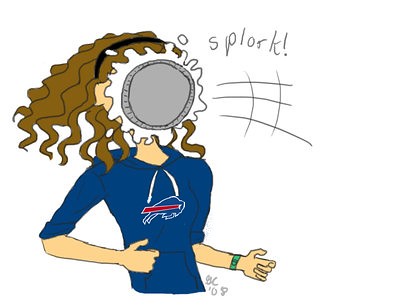
The defense, however? A continuing train wreck. Only two sacks, one by a cornerback; over 200 rushing yards yielded yet again; et cetera. Thus, once again, despite a good day for the Bills on offense, it’s pie-in-the-face time yet again.

Luckily, next week we can absolutely guarantee that Bills fans will not be pie-faced. Because next week, the Bills don’t play. Oy….

Share This Post

Representin' against the Big C!


Pink!, originally uploaded by Jaquandor.

It’s Breast Cancer Awareness month, so here’s my pink t-shirt. Which I own because I like pink. Pink is nice.

No, I do not own pink overalls. Even I have limits!

Share This Post

“He’s the darkness, reaching out for the darkness.”

Oliver Stone’s Nixon is an amazing film. I kind of wish Stone was still making movies like this: densely packed films that overwhelm the audiences with information and tell their tales in complex, non-linear ways. Well, maybe Stone still is making movies like this; in truth, I haven’t kept up with his career much over the last ten years.

It’s easy to see Nixon as a companion piece to the earlier JFK, and in many ways, it almost is. But it’s also a very different film, even while using many of the same techniques of the earlier film. Nixon is more meditative, more of a character study, than a film interested in posing a particular hypothesis, as was JFK. (To a certain extent, anyhow – people often refer to “Oliver Stone’s conpiracy theory” regarding the JFK assassination, but when you actually watch the film, no real, concrete hypothesis is ever actually advanced.)

Nixon seems generally focused on the way that the very strengths, or gifts, or skills that allowed Richard Nixon to ascend to the highest political office in the United States were the ones that brought about his downfall. A “tragic hero” will often have a bunch of good qualities, and one not-so-good quality that causes everything to fall apart. Nixon, however? His power came via his paranoia, and deserted him by the same route.

The film opens with a brief educational film about salesmanship (“What you’ve got to remember, Bob, is that you’re selling yourself!”), and then we’re into the story proper. The overall device of the film is Nixon, alone in his study during a series of nights toward the end of his Presidency, reflecting on the events of his past, most often by listening to his infamous tapes of his Oval Office conversations. The film is told in a series of flashbacks, then, and not always in the real order of events, but in the more real way in which we tend to remember things: the memories that surface as they seem relevant to the events of our present-day lives. At times, Nixon is remembering past political events, and at others, he is remembering past personal moments with Pat, the love of his life.

To me, the question of authenticity with regard to a film like this misses the point. I remember watching discussions of the film on news shows when it came out, back in 1995, and the topic always seemed to revolve around the extent to which Stone captured the “real Nixon”. Some folks attacked the film on that basis, others praised it; I remember one commentator – I think it may have been Bryant Gumbel – who said, “I don’t think it’s the Nixon, but rather a Nixon”. That seems pretty astute to me. Those closest to Richard Nixon seemed fairly adamant that Stone did not depict the “real Nixon”, but even those closest to us don’t know our real selves as well as they might think. Is Stone’s Nixon a “real” Nixon? I suspect that he captures some of Nixon’s qualities well, others not so well. I also suspect that Stone emphasizes some of Nixon’s qualities a bit in the interest of making a better movie. I think that Nixon is to Richard Nixon as Henry V is to King Henry the Fifth.

Of special interest to me when I watched Nixon a couple of weeks ago was the way no one ever really spells anything out directly. Nixon himself seems to be talking in code with his assistants much of the time, and at no point does anyone say, “Hey, we should break into the DNC offices at the Watergate and see what we can find out.” At no point does Nixon say, “We need to cover this up!” Everything is happening, or has already happened. This plays into one of Stone’s themes of the film, which is stated outright in the scene of the odd moment (which really happened) when Nixon left the White House in the middle of the night, went to the Lincoln Memorial, and ended up interacting with the protesting kids there. Referring to the war, one girl says: “You can’t stop it, can you? You’re powerless.”

Stone conveys this as well with a lot of fascinating cinematography. As in JFK< he employs a lot of different looks and styles throughout the film, sometimes shooting things "straight", while other times using black-and-white, or making the film very grainy in spots, or using lots of fades and superimpositions of stock footage to convey the magnitude of the issues Richard Nixon faced or the hugeness of his character. In many "Presidential" films or teevee shows, such as The American President or The West Wing, the White House is shot as a beautiful place where our patriotism and commitment to democracy is literally made physical. No so in Nixon; the White House here is an ominous place, and place of fear and dread in the face of historical forces that cannot be tamed.

Stone often frames scenes from odd angles, and many scenes depict dark shadows contrasting with brilliant light streaming in through windows. An early scene shows Nixon in his personal study, sitting beside a roaring fireplace while the air conditioning is on at full blast.

Nixon seems increasingly shocked, over the course of the film, to learn just how little control even a President gets to have over the forces around him, and by the time he really comes to grips with this, he is on the brink of ending his Presidency. Even late in that particular game, though, he continues to assert that a lack of control was what got them, in the end: “We never got our story out,” he says to Alexander Haig. Nixon relishes the moments, all too few, when he gets to feel as though he is in control, such as when he puts a wealthy donor in his place or chews out Henry Kissinger. But he also reacts with increasing anger when his efforts at control fail, such as when a press conference goes awry or when his own wife tries to criticize him over dinner.

That brings me to the film’s central relationship, that of the marriage of Richard and Pat Nixon. It’s really an amazing relationship, as movie marriages go; it is not depicted as a relationship of blind love that is independent of everything else in Richard Nixon’s life, nor is it depicted as Pat’s Lady Macbeth to Richard’s Macbeth, with Pat being ambitious and desiring of power all her own and only being in the marriage because it’s the best route for a woman to real power in mid-20th century America. Pat Nixon is shown as being literally the only person in Richard’s life who is ever willing to criticize him or tell him when he’s wrong, but she is also there for him through everything, except for one brief period when she considers divorce. Even then, however, Richard brings her back from the brink, and even after all of her disgust during the long unfolding of Watergate, when Richard at last stands alone in the White House on that last night of his Presidency, ruined and emotionally drained and devastated, it’s Pat who comes to him and gives him the only consistent shoulder he’s ever known on which to lean.

Nothing in this movie would work without some great performances by the cast, and there isn’t a single weak link among them. Stone assembles an astonishing supporting cast here; so much so that if this movie had been made in the 1970s, the posters would have included one of those rows of thumbnail photos of the stars along the bottom. James Woods, Bob Hoskins, M. Emmet Walsh, Saul Rubinek, EG Marshall, Madeleine Kahn, Tony Goldwyn, Mary Steenburgen, David Hyde Pierce, Ed Harris, and the like – Nixon might be the single most star-studded film of the 1990s to not feature Kevin Bacon in any role at all. But the two performances that center the film, that absolutely ground it, are Joan Allen as Pat Nixon, and Anthony Hopkins as Richard.

The film made a pretty wise choice as regards the “look” of Richard Nixon. They didn’t go overboard in trying to make Hopkins look like the genuine article; they gave him roughly the same haircut and I assume some prosthetic teeth to make his smile look more Nixonian, but after that, they relied on Hopkins to do it all through the magic of acting. He plays Nixon as a somewhat hunched-over, physically awkward, gravelly-voiced man who never seems to exude much by way of charisma, but rather gets what he wants from others because he simply won’t accept anything else. Nixon is a bundle of nervous energy, and Hopkins plays him as a man who sweats too much, grins at odd moments, and can’t figure out what to do with his own hands.

Hopkins’s performance is endlessly fascinating to me, coming as it does in the same period as a number of other performances by him that are all unique: there is nothing of Hannibal Lecter to be found in Hopkins’s Richard Nixon; nor is there to found any of Mr. Ludlow from Legends of the Fall, CS Lewis from Shadowlands, or anyone else. Hopkins’s Nixon is really a singular creation, so much so that the spell is actually broken twice over the course of the film, both involving Oliver Stone’s use of archival footage from the Nixon years. One is of a Nixon mask, being paraded about at a protest rally; the features are distorted, but we can still see that it’s a mask of the real Nixon; the other is at the very end of the movie, when Stone shows us footage of the real Mr. And Mrs. Nixon walking to Marine One for their final departure from the White House.

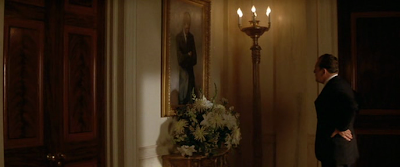
Joan Allen’s Pat Nixon is equally remarkable, because hers is a quieter performance as the only person who gets to talk back to Dick Nixon and not only get away with it but be able to stick around afterwards. She is, by turns, thrilled by him, devoted to him, angered by him, disgusted with him, and in the end, deeply empathetic to him. We can see the pain on her face when she sees him, alone in the White House, talking to the portrait of John F. Kennedy, in one of the film’s finest moments (“When they look at you, they see what they want to be. When they look at me, they see what they are.”) The keenest moment of insight as to Nixon’s character – as the film depicts it – comes when Dick is gearing up for his 1968 run for President, six years after he’s sworn to Pat that he’s done running for office. She is angry that he has been making plans without telling her, but she still feels the old hunger and the pain from the last two losing campaigns has mostly faded, so she is willing to stand with him once again – in fact, she even hungers for it herself, telling him “This time, we’re gonna win. I can feel it.” And Dick takes her in his arms and dances, in the best Nixonian fashion: awkwardly and gracelessly.

John Williams’s score for Nixon is, to my mind, one of his more underrated efforts. He juxtaposes a cheerfully optimistic Americana sound with more downbeat and dark music as Nixon begins to spiral out of control. Stone closes the film with a musical choice that seems odd, at first, but is really amazingly fitting: the Mormon Tabernacle Choir’s a capella rendition of Shenandoah. There isn’t much in the film by way of period popular music, as instead Stone relies on Williams’s sound world to help immerse us in the world of Dick Nixon.

As with JFK, a companion book was released for Nixon, containing the film’s screenplay, a number of archival documents (including transcriptions of the Nixon tapes), and essays by the filmmakers, historians, and figures from the Nixon administration (John Dean and E. Howard Hunt). Here is an excerpt from an essay by Christopher Wilkinson, one of the film’s writers:

The more we got to know Nixon, the more it struck us how odd he was. He was a man who referred to himself in the third person and called his wife “Buddy”. He was physically awkward, socially graceless, and sexually repressed. Other than Bebe Rebozo, he had no real friends. When he needed to relax, he would just sit silently with Rebozo. For hours. Bob Haldeman was with him for nearly twenty years and never shook his hand.

The was a strange man, an extremely strange and mysterious man.

I cannot remember the precise moment when we started to empathize with Nixon. To begin to understand the tragedy of his life. To appreciate the true dimensions of his character.

Nixon came from nothing – the wrong schools, the wrong clothes, the wrong parents – and, by dint of hard work and self-sacrifice, rose to the heights. In many ways he is the American Dream incarnate, the self-made man who tortured himself to be a Somebody. And he never gave up. He came off the canvas again and again, rehabilitating himself, reinventing himself. Admittedly, the notion of Nixon the Indestructible is often trotted out to evoke sympathy for him.

But it’s true.

There are other poignant and peculiar details that reached us, that slowly eroded our contempt. The emotionally distant mother who rarely touched him. The brutish father who directed fits of blind rage at him. The lonely, clumsy boy who was sure that no matter what he did, he would never be good enough.

And the dead brothers. First his beloved little Arthur. Then Harold, outgoing, attractive, a boy Richard idolized. A boy whose lingering death allowed the family to afford Richard’s tuition to law school.

The guilt.

When Nixon fell in love with Pat, he drove her on dates with other boys to prove himself to her. He wore her down with a barrage of flowers and letters. He would do whatever it took to win her and he never let up until she was his.

Classic Nixon.

The only clean campaign he ever ran was 1960. Kennedy (like Harold) was everything Nixon was not – handsome, charming, articulate, witty. Nixon could have used any number of smear tactics against him; the religion, the Mob connections, the women. But he didn’t. He respected Jack Kennedy more than any opponent he had ever faced. So, for the only time in his political life, Nixon played it straight.

And Kennedy stole the election from him.

The fact that he didn’t completely come apart during the crushing pressure of the final days of Watergate is a testament to his bullheaded resolve. To his perverse brand of courage. Everyone was against him. The country wanted his head on a pike and he wouldn’t give it to them. A lesser man might have run screaming and drooling down Pennsylvania Avenue. Or had a stroke. Or committed suicide. But not Nixon. He wouldn’t give them the satisfaction.

As President, he did more to desegregate the schools than any of his predecessors. He created the first and most effective Environmental Protection Agency. He has few (if any) Presidential peers in foreign policy: the spectacular opening of China, achieving detente with the Russians. Accomplishments that Nixon, the quintessential Commie hunter, was uniquely suited for. If a liberal Democratic President had tried it, he would have been crucified.

And Nixon would have brought the nails.

Nixon stretched our idea of what greatness is. He is a huge character who embraces the entire American landscape from its loftiest ambitions to its most malignant schemes. To understand Nixon is to understand what we have been. To understand Nixon’s destiny is to understand what has happened to us. To understand Nixon’s life is to understand the history of our times.

What strikes me now, on reflection, is the way the Nixon political playbook has come to dominate American politics in our day, forty years after Nixon held office, with its dirty tricks and coded appeals to our baser instincts. But Nixon’s actual policy goals now form the farthest boundary to the left that our politics are willing to allow voice. It’s amazing to me that if a Republican candidate came along now, espousing Richard Nixon’s policy goals, that candidate wouldn’t even make it out of the primaries. Things that a Republican President did forty years ago would be labeled as unforgivably liberal — Socialist, even — if a Democrat did them today.

What a great, disturbing film this is. Just like Richard Nixon himself.

Share This Post

Sunday Burst of Weird and AWESOME!

Oddities and Awesome abound!!!

:: A couple I’d have never thought belonged together, until I saw them: Jack Skellington and Betty Boop. (Second photo.) Awesome!

:: Little girl writes letter to Johnny Depp, asking him to help her mutiny against her teachers. Depp obliges…well, except for the mutiny part. Johnny Depp: Awesome!

:: Interesting article about Designing the Enterprise-E for Star Trek: First Contact. I did like that Enterprise more than the Enterprise-D (the Next Generation ship), and I’ve always thought it too bad that that ship was only around for three films, only one of which was really good. Oh well! Although one thing in the article stands out: the Enterprise-E was designed to “fight the Borg”. That kind of sums up, in my mind, the degree to which Rick Berman either lost his sense of what Star Trek was all about, or never had it to begin with. There’s no way that Starfleet would design an entire enormous ship like that for the purpose fighting a single enemy in a single war!

:: xkcd revists the Map of Online Communities. I think that to depict me on the map, the map would have to be a globe, and I’d be a space probe launched from that globe several years before.

More next week!

Share This Post