Now, I think I’ve alluded in the past that when I see a Complete Shakespeare on the shelves at the Library Book Sale, I often can’t pass it up. And there is a Complete Shakespeare to be had, more often than not. This is why I now own, off the top of my head, six Complete Shakespeare’s.
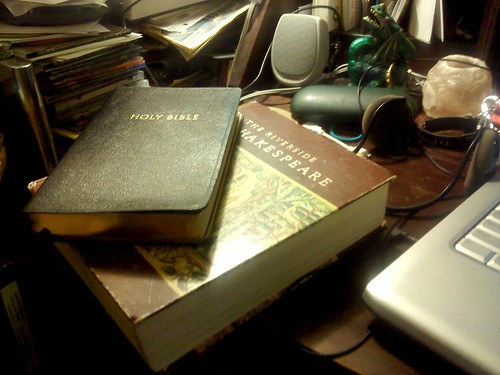
Now, these are all different in various ways. Two — the Riverside pictured here and another one whose publisher I can’t recall — are clearly intended for students, containing within them numerous footnotes, background information, essays on Shakespeare, and so on. The other four are intended for readers; they have a lot less in terms of “extras”, although one is lavishly illustrated with engravings throughout, and one is a Cambridge edition printed in 1906. I got this one because it’s pretty and old.
Will I acquire any more Complete Shakespeare’s? Maybe, maybe not. I won’t be buying any that don’t catch my eye for any particularly special reason, but I also don’t rule out that possibility, either. And one craft-type thing I wouldn’t mind doing someday is making my own hollow book, for the keeping of Various And Sundry Things. I could hollow out a Bible, but really, the only thing those are good for hiding are rock hammers, and I don’t even own a rock hammer. (Yeah, a little light Shawshank humor there.)
But here’s something that bugs me: I have never seen a Complete Shakespeare that wasn’t something of a doorstop. This bothers me, especially when I compare a typical-sized Complete Shakespeare to the Bible. Look at the comparison in size there! You can easily carry a Bible around with you in your book bag; in fact, I suspect that many Bibles are printed in such a way as to encourage precisely that.
Now, a Complete Shakespeare does have quite a few more words in it than a Bible. A bit of Googling turned up these numbers:
Word count of the Bible: 774,746*
Word count of Shakespeare’s plays: 928,913*
So, throwing in the Sonnets and other poetry, just to make a random guess, a Complete Shakespeare would have somewhere around 1,100,000 words. And that means that it would theoretically possible to make a Complete Shakespeare, using typography and paper stock, that is only half again larger than that Bible pictured above. I do own a Study Bible that is twice as thick as that KJV there in the picture (same dimensions of length and width); its extra thickness comes from all those extra materials that make it a “Study” Bible: maps, essays, sidebars, inserts, and so on.
So why can’t there be a Complete Shakespeare that is printed like most Bibles? So I can carry it around? Why not?
Share This Post