Something for Thursday

I have a sneaking suspicion that I may have posted this before, but I’m not wading through two or three years’ worth of Something for Thursdays* to find out. I’ve always loved the music of Richard Wagner. Always, always, always. As long as I’ve been aware of Richard Wagner I’ve loved his music. So it’s a bit of Wagner today.

The thing with Wagner is that, if he’s a food, he is a very, very heavy bread, the kind of bread that’s an inch thick and sits in your stomach like a brick after you swallow it. Oh, and it’s dark bread. Almost black, really. Thick, dark, heavy bread. The kind of bread that, when you make a sandwich with it, you have to use spicy mustard and thick cuts of ham just to taste anything other than bread. The kind of bread where…well, that’s enough. There’s such a thing as overkneading a metaphor.

But anyway, of all of Wagner’s music, this is the piece of his that works its magic on me more than any other. The overture may be my favorite form of shorter orchestral work, but in Wagner’s hand, the overture — or Prelude — reached heights that no one else has reached since. Fifteen minutes of a great musical journey…here is the overture to Tannhauser.

When that famous chorale theme recurs at the overture’s end (the 1:49 mark of the second video), the effect is astonishing, with those shimmering strings that weren’t there the first time we heard this same theme. And when the entire orchestra takes up the theme, with those magnificent trombones leading the way, it’s nearly overwhelming…and then Wagner tops it off, at the very end, with the brass in a slow arpeggio that to me sounds like the Heavens opening. I never listen to Wagner unless I’m willing to go somewhere, emotionally. To listen to Wagner is to listen to the most purely proud musical arrogance — in the best sense of the word — that has ever been written. Wagner is not a composer who for one second even considers that his listener may not wish to follow him where he wants to go.

Oh, two final notes: Check out the 3:24 mark, when you can see the trumpets and the trombones. I don’t know if it’s still the case, but for many years, the Chicago Symphony was regarded as having the greatest brass section in the world. That trumpet player sitting there, next the trombones, is Adolph Herseth, who was likewise for years regarded as the greatest symphonic trumpet player in the world (as well as one of my personal musical heroes, especially when I was a trumpet player in college — let other trumpet players lust after Wynton Marsalis’s skill, what I wanted was the ability to completely dominate an orchestra the way Herseth could). And check out what Sir Georg Solti — one of the greatest Wagnerian conductors of all time — has his horns do at 4:04 and 4:30. He directs them to lift their instruments up so the bells are pointed, not into their own laps as is normally the case with the French horn, but at the back wall, to make their counterfigure heard brightly.

What a wondrous, magnificent overture. This is one of the most perfect pieces of symphonic music I know.

* Or would that be “Somethings for Thursday”? Hmmmm….
Share This Post

X-Files Case Report: “Conduit”

“I want to believe.”

At this point in the series, we’ve already seen the poster in Mulder’s office that would become one of the iconic props of The X-Files, the one with the flying saucer on it and the slogan in big letters at the top. That poster always struck me as slightly odd, in the context of Mulder’s office: it states “I want to believe”, but as is very clear from the outset of the series, Mulder already does believe. But it turns out there’s one thing that Mulder isn’t sure he believes or not, a thing which is one of the most important aspects of his character. It is whether or not his sister is still alive and will one day come back to him.

“Conduit”, our fourth episode, is the second to deal with alien abduction as its subject. Here, though – quite strikingly, as in comparison with the pilot – it’s not nearly as clear, from the way the episode frames its events for the viewer, that abduction is really what’s happened. There are odd things that happen, to be sure, things that probably can’t be explained without resorting to alien abduction hypotheses, but at the same time, we don’t see strange beings carrying out abductions, as we do in the pilot. The evidence is much more circumstantial, which makes for a generally creepier episode.

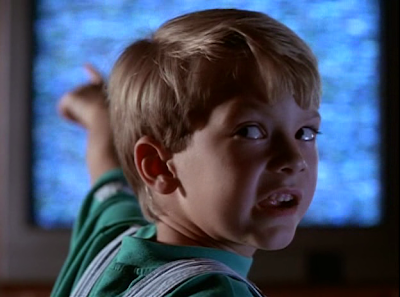
The story takes place in Iowa, where a family is camping beside a lake when there are bright lights, loud sounds, and sudden enormous heat. When the effects subside, the teenage daughter is missing, and the young son has started to show some very strange signs of having been, well, messed with a bit. For one thing, he is spending hours in front of a teevee that is tuned to no channel, claiming to be receiving signals from the television, which he is translating as sheet after sheet after sheet of paper of 1s and 0s. It turns out that the 1s and 0s encapsulate almost totally random pieces of data and information – bits of music, detail from Da Vinci drawings, and the like – and the sheets of binary also turn out to be something else, in one of the episode’s best “surprise” moments. All this leads Mulder to suppose that the boy is a “conduit”, being used by aliens for some purpose.

Of course, Mulder believes that the girl has been abducted by aliens, and of course Scully is unwilling to commit to that hypothesis with the evidence at hand. The missing girl is a juvenile delinquent, and she has been known to hang out with a local biker gang, leading most people to suppose that she has simply run off with them. Things take a dark turn, however, when the girl’s boyfriend’s body turns up, and when NSA agents turn up, claiming that the boy has somehow gotten hold of classified information.

Mulder is particularly driven in this episode, insisting on continuing the investigation into the girl’s disappearance when all evidence seems to have run dry. His motivation is quickly made clear, as this episode begins to flesh out the great driving force behind Mulder’s work: the abduction of his sister when he was a child. The episode ends with Scully listening to a tape of a hypnotic therapy session Mulder once underwent, which concludes with the interviewer asking Mulder if he believes that his sister, Samantha, is alive and will come back; Mulder replies, as the final credits begin, “I want to believe.”

This episode is very well written and directed – the production values of even the early episodes of The X-Files are superb – but I did find the episode marred by something that probably wasn’t its fault. The first five seasons of The X-Files were filmed in the Vancouver, with locales around that city doubling for whatever locale the episodes were set in. Usually this worked out fine, but there were times when it really didn’t. Now, I don’t expect that Lake Okoboji will be familiar to anyone who doesn’t have some kind of connection to Iowa, but it amused me – and, unfortunately, undermined the episode a bit for me – to see Iowa’s Lake Okoboji stood in for by a Vancouver-area lake, surrounded by very tall pines and hills higher than you’ll find pretty much anywhere in Corn-belt Iowa. This had the effect of ejecting me from the story a bit, but I’m not sure what the producers really should have done – made up a different locale, perhaps.

The next episode will be the first of a bunch from Season One that I have never seen before. We’ll see what happens. I, too, want to believe!

Share This Post

A hundred words for….

One enduring urban legend that’s nicely poetic even though everybody knows it’s nonsense is the old “The Eskimos had eight hundred words for snow” chestnut. However, even if this was true, I’m not sure how much of a linguistic amazement this would be. I mean, I hear lots of different ways of referring to snow all the time:

Snow
Sleet
Squall precipitation
Lake-effect flurry
Snowy shit
F***ing snow
That white shit
The shit that’s all dirty and muddy on the side of the roads in February
“Oh shit, when did this start?” (uttered when you walk outside into a flurry after being inside a while)

It goes on.

One of my Facebook friends, who lives in New York City, seemed less than excited that she’s about to experience a second Nor’easter in three weeks. The first one dumped a lot of snow in her region, and the second isn’t supposed to be as bad…but that’s small consolation when you’re barely dug out of the last one. Anyway, she opined about how sick she is of hearing the word “Snowpocalypse”. I was going to suggest the obvious “Snowmageddon”, but she had already declared her antipathy for that one, too.

My suggestions?

Snowfest
Snow-a-rama

And my favorite:

SNOWLAPALOOZA!

Man, if there’s not already some kind of winter festival called SNOWLAPALOOZA, there needs to be. And it must be held right here, in Buffalo. So come on, Organizers of Buffalo’s Social Scene! Start the planning now for SNOWLAPALOOZA 2012!

Share This Post

Tippecanoe and….

Well, I have no idea what the hell to blog about right now. I could babble about football a bit, but the Bills’ season is done and there’s only so much gabbing I can do about the NFL Draft that’s not for four months anyway and I don’t really care about any of the college bowl games, so football’s out. And I said all I had to say felt I should say about the shootings in Arizona the other day, so forget about that, too. I’ve got some books I could blog about, but I still need to write the posts. I keep meaning to start my Fixing the Prequels series on Revenge of the Sith, but that’s not ready to go yet. Teevee shows have mostly been in reruns, and I haven’t seen too many movies lately. So what else is there?

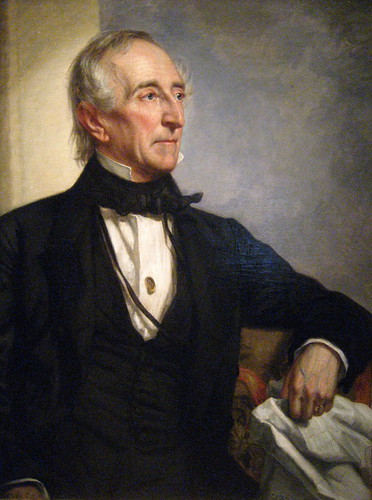
Well, there’s this guy.

John Tyler 1790 - 1862

That’s John Tyler, the tenth President of the United States. Tyler ascended to the Presidency because he was the Vice President when the ninth President, William Henry Harrison, died one month into his term of office. There was actually quite a lot of confusion over this, as the Constitution wasn’t actually clear about what happened upon the death of a President. The problem was one of wording. What the Constitution actually says, in Article II Section 1, is this:

In Case of the Removal of the President from Office, or of his Death, Resignation, or Inability to discharge the Powers and Duties of the said Office, the same shall devolve on the Vice President, and the Congress may by Law provide for the Case of Removal, Death, Resignation or Inability, both of the President and Vice President, declaring what Officer shall then act as President, and such Officer shall act accordingly, until the Disability be removed, or a President shall be elected.

Basically, no one was sure if Harrison’s death meant that Tyler actually assumed the Presidency, or if he just stayed Vice President but with the powers and duties of an actual President. Even though the Congress eventually passed resolutions declaring that Tyler was, in fact, the President in fact as well as in duty, this was a point of contention for his opponents, who would refer to him as “Acting President” or “His Ascendency”.

Tyler’s biggest accomplishment was the annexation of the former Republic of Texas. I think that’s a good thing, even though I tend to not be enamored of all things Texan these days. I suppose we ultimately have Tyler to blame for the Dallas Cowboys, for one thing.

Tyler left office in 1845 but lived another seventeen years. As the nation moved inexorably toward the Civil War, Tyler stood up to be counted…on the Confederate side. In fact, he stood up on the Confederate side to such a degree that he was actually elected to the House of Representatives of the Confederate States of America. He died in 1862 before assuming that office, but it seems to me that John Tyler may well have been the only President who went on to commit an act of treason against the United States. I’ve often wondered what would have become of him had he lived beyond the end of the Civil War.

Why do I have John Tyler on the brain today, though? Because of something I read on Twitter this morning. I couldn’t believe it and had to look it up, but I’m damned if it wasn’t true. Follow along with me here: John Tyler was born in 1790 and died in 1862. He was married twice, and with those two wives, Tyler had 15 children. The last of his children was born in 1860, when Tyler was either 69 or 70 years old. But what gets really interesting is his fifth son with his second wife. That would be Lyon Gardiner Tyler.

Lyon Tyler was born in 1853 and died in 1935, at the age of 82. He had something in common with his Presidential father: he was fathering children at a ripe old age himself. He had a son born in 1924 (when he was 71, and when President Tyler had been dead for 62 years), and another in 1928 (when he was 75). Both of these sons are still living today, which means that our tenth President, who was born during the first term of our first President, has two grandchildren who are still with us during the first term of our forty-forth.

Who says that history can’t be a bit mindblowing sometimes?

Share This Post

Sentential Links #234

Here we go….

:: Do not – and I repeat, DO NOT (Note within note: This is bolded, Self!) – share this story with anyone, as your klutzy behavior is a tad embarrassing, even to me. Let them all think that last post went flawlessly, and you were off for an exciting, exotic trip in record time.

:: Birds are everywhere in Mount Auburn; this is why I first came here, to watch them. I could barely see the stones for the warblers, vireos and tanagers. Now, having seen a surfeit of birds, I still come here for them, and everything.

:: Now, you’d think that every issue of Wonder Woman would be a “Women’s Lib Issue.” But this is 1972, the Equal Rights Amendment and “women’s lib” is on everybody’s tongue, and you just know this story is going to be so monumentally ham-fistedly-topical-yet-not-in-any-way-seriously-challenging-the-status-quo that it would probably make my mind explode.

:: Anyway, Joan is 70 today, and I thought I needed to acknowledge that.

:: There is, I would claim, something almost indescribably profound about this lack of resignation to that which is most inevitable.

:: In 1826 a couple of guys opened a restaurant there. They built a half circle shaped oyster bar. Sitting where we were, in booth #1, I could look at the old bar and imagine Daniel Webster sitting there as he often did, slamming brandy and downing plate after plate of oysters. Up on the second floor is booth #18, John F. Kennedy’s favorite spot. (I’ve been to Boston a bunch of times, but never to this place. Next time….)

:: So I went to the release page for it, and when I saw the distance, I was shocked: that galaxy’s not big, it’s freaking huge.

More next week.

Share This Post

Oh, come on, studios!

I can see why movie studios would want to put the clamps down on people who try to put entire movies up on YouTube, but leveling copyright objections at two-minute clips from movies just seems silly. Those clips, when used in blogs and Facebook-sharings and Twitter feeds, constitute free advertising for their movies. If I had a nickel for every time I’ve posted a clip from some movie and had someone comment afterwards along the lines of “Hey, I’ve never seen that but now I think I will!”, I could probably buy a dinner at a nice restaurant, like Mendy’s.

(Which is my way of saying that Universal needs to stop blocking clips of Love Actually. Wankers!)

Share This Post

Let me get this straight….

This is a political rant, which I’m going to put beneath the fold. Comments are also closed for this post. Don’t read the whole thing if you don’t like it when I go all political.]

After reading a lot of hand-wringing from right-wingers today, it strikes me that the only way they would ever accept that maybe, just maybe, their years and years of increasingly violence and eliminationist rhetoric might have had any bearing on today’s events in Arizona would be if the gunman were to have, say, posted videos of himself saying “I’ll kill for you, Sarah Palin!” to YouTube, or maybe left a Facebook status message of “I’m off to kill that Democrat now!”

Right-wing rhetoric in this country has been a cesspool of violent fantasy for years. This will come as no surprise to anyone who has followed, as I have, the work of journalist David Neiwert, but the vehemence of the denials does surprise me a little. Ezra Klein said it well:

But today’s shooting was a reminder of what real political violence in this country could look like, and the awful recognition that it could’ve easily fit with comments made by trusted political figures should stop us cold. We’re lucky to live in a country where political violence is rare. We’re lucky that that doesn’t appear to have changed. But that may be dumb luck that we’re benefiting from. It is hard to look through those statements and believe that we’re doing enough to keep our political system peaceful.

It should stop us cold, but it doesn’t. Instead, the violent rhetoric from the Right is downplayed and denied, and lots of false equivalency — “Your side does it too!” — is tossed around. There’s a screen-grab of some DailyKos diarist making the rounds of the Rightwingers, because a DailyKos diary is the same thing as a former candidate for Vice President and current Big Leader on the Right running an ad where Congressional opponents are “targeted” using gun-sights.

Here is WNYMedia.net‘s Christopher M. Smith, from a discussion thread on Facebook:

By its very nature, the [attempted] murder of a Congresswoman is a political issue. Especially when the person who allegedly committed the act is evidently an adherent to various crypto-libertarian and right wing ideologies. So, to wonder how straight the line is from a political leader who targeted the victim with a gunsight in a mainstream political campaign to the assassination by gun of that very Congresswoman is not “out of bounds” by any means.

No matter how you look at it, we need to think about changing the tone of political discourse in this country away from “second amendment remedies” to losing elections (Angle), being “armed and dangerous” (Bachmann) over the healthcare bill and “reloading rather than retreating” and taking out political opponents using implicitly violent imagery (Palin). It’s time everyone grew the f*** up and realized the consequences of their language. [slightly edited by me for clarity and language]

The only way this could not be political is if the killer’s motivations had turned out to be completely apolitical. The only assassination of a political figure, successful or not, that I can recall filling that bill is John Hinckley Jr.’s shooting of Ronald Reagan; I have to figure that if today’s assassin had been attempting to impress a girl, that would have come out by now.

But even so, that’s a very short list of examples of violent right-wing rhetoric Chris gives. There’s no reason why he had to stop there; as a long-time denizen of the blogosphere, I’ve seen a ton of it. I’ve seen one right-wing blogger selling coffee cups with a picture of a gun on one side and the slogan “So many liberals, so little time!” on the other. I’ve seen another who offered shirts with the slogan “Rope. Tree. Journalist. Some Assembly Required.” on it. And it goes back farther even than that; I remember how, after Waco in 1993, G. Gordon Liddy went on the radio and advised his listeners that if they saw ATF agents coming toward them, they’d do well to “take the head shot”. For those who want to wade into this cesspool, the work of journalist David Neiwert is the place to start. Or just peruse this timeline.

As Ezra said, this should give us pause — but I doubt it will. I suspect that lots of Right-wing bleating and screaming will have its usual effect, and that soon enough, we’ll be hearing from the Concern Trolls of the Beltway Village, the Deeply Serious people, that we need to tone down the rhetoric on “both sides”. There will be lots of cautionary tut-tutting about how we can’t “politicize” this incident, possibly with reminders of the “awful politicization” that took place at the funeral of Senator Paul Wellstone. (Well, it really didn’t take place there, but no matter — it’s almost part of the official narrative now.) And of course, the “both sides need to tone it down” camp will be right, because they’ll have a crazy murderer gunman on one side, and a DailyKos diarist on the other. And thus the center line will get nudged rightward yet again.

Oh, and this act will never actually be seen for what it is: Terrorism. Because terrorism is done by brown people with bombs, not white people with guns.

Ugh.

[Again, comments are closed for this entry.]

Share This Post

Saturday Centus

This is a weekly meme-thing that I always want to do on a Saturday, but which I always forget about. I suppose I could do it a day or two later anyway, but for some reason that always feels wrong somehow. Anyway, it’s a simple little writing game where Jenny Matlock provides a brief writing prompt, and participants write a 100-word entry using the prompt in some way.

This week’s prompt is actually a photo:

My entry:

“When Life Hands You Frozen Oranges”

“Whoa!” said the Cheerful one.

“Yeah,” replied the Grumpy one.

“It snowed, eh?”

“Yeah.”

“All over our oranges.”

“Yeah.”

“That’s tough.”

“Uh-huh.”

“We moved from Canada to be orange growers, and look what happens.”

“Yeah.”

“Sucks, eh?”

“M-hm.”

“Snows in Canada, eh?”

“Yeah.”

“Not supposed to in Florida.”

“Nope.”

“Sure a shame.”

“Yup.”

Silence as two formerly-Canadian would-be farmers look over their snow-covered orchard.

“Back home they crush frozen grapes to make ice wine….” said the Cheerful one.

Beat…

“Yesss….” said the Not-as-grumpy-as-before one.

Thus was born Ice Orangeade. Which was very successful…in Canada.

I hope my liberal use of hyphens — hyphenated words being counted as one word by OpenOffice’s word count tool — doesn’t constitute cheating! (I’m also not sure if the title counts toward the word count, either. If it does, then I’m disqualified.)

Share This Post

Wait, what?

Bill O’Reilly talked to an atheist, and came up with this gem of an argument:

O’REILLY: I’ll tell you why [religion’s] not a scam, in my opinion: tide goes in, tide goes out. Never a miscommunication. You can’t explain that. You cannot explain why the tide goes in.

SILVERMAN: Tide goes in, tide goes out?

O’REILLY: See, the water, the tide comes in and it goes out, Mr. Silverman. It always comes in, and always goes out. You can’t explain that.

If that’s the state of scientific literacy on O’Reilly’s side of the aisle, it’s no wonder that we’re pretty much doomed. Wow.

Share This Post