…is not actually a long and thought-out blog post, but rather, a series of Internet meme-photos with the captions altered. So here are some Y U No… pics in honor of A Game of Thrones.



The official site of Kelly Sedinger: Reader, writer, photographer, and dreamer
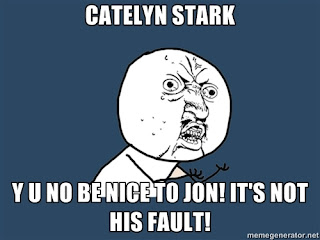
…is not actually a long and thought-out blog post, but rather, a series of Internet meme-photos with the captions altered. So here are some Y U No… pics in honor of A Game of Thrones.
I’ve seen British period dramas referred to as “Bigscreen episodes of Masterpiece Theater“, which I suppose is kind of an apt description. But it’s something of a dismissive description, isn’t it? It seems designed to put off the kind of people who think that watching stuffy Brits on Masterpiece Theater is the stuff of torture. And it can be, if what’s on Masterpiece Theater isn’t all that good. But when it is good, what’s wrong with that?
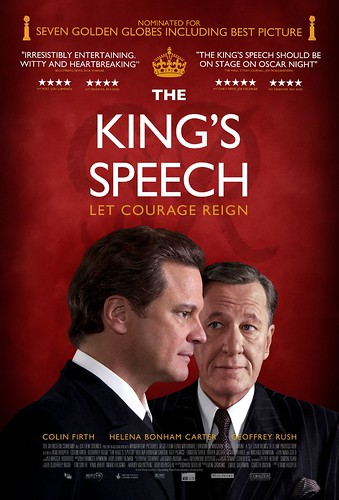
This is what I kept thinking of while recently watching The King’s Speech: “This reminds me of Masterpiece Theater.” And not in a bad way, mind you, because I’ve always liked the good things on Masterpiece Theater. But it’s the air of the story: very little by way of visual invention; instead, it’s very solidly produced drama, with a good script, acted out by a great cast. Aside from a few stylistic things along the way, there’s no real feel of a particular “director’s hand” in The King’s Speech.
The story follows a particular Prince of Wales who is destined – although, being second in line, he doesn’t know it – to be King George V of England. This particular Prince has a deep problem that seemingly makes any public life nearly impossible: he has a terrible stutter. The King’s Speech would probably be the best movie I’ve ever seen about a stutterer, if not for A Fish Called Wanda. As it is, this movie runs a nice second.
Colin Firth plays the future king, Prince Albert, the Duke of York, who in the first part of the film is frustrated by his stutter when he needs to speak in public but is also thankful that as second in line, he isn’t called that often to perform acts of oratory. He seeks out some treatments, but none of them work; it is his wife (Elizabeth, the Duchess of York, played by Helena Bonham Carter) who visits yet another ‘expert’ on the treatment of stuttering, one Lionel Logue (Geoffrey Rush). Over the course of the film Logue provides Albert with treatments, most of which Logue has developed on an ad hoc basis over his life. And over the course of the film the two men develop a deep friendship, despite Albert’s insistence that they cannot (because of his station) and Lionel’s insistence that when the door closes in his office, and it’s just the Prince and Lionel, then it’s Lionel’s rules that must be obeyed.
Of course, we know – without even needing to consult the history books – that Prince Albert will, in fact, become King; we also know that he will be called to address his entire nation via the relatively new medium of radio, and that this speech will be either his big triumph or the hill on which he dies. How it goes really isn’t a surprise at all, and it shouldn’t be; for all the historical drama, Masterpiece Theater production full of Brits thing that this movie has going on, it’s pretty clear early on that The King’s Speech is simply a new version of one of storytelling’s most classic tropes, the student who must learn from an enigmatic and idiosyncratic teacher if he/she is to triumph over his/her foes. The only difference is that here, the foe that must be triumphed over is a part of Prince Albert’s own character. It’s an inner struggle, and it’s only in that that The King’s Speech differs much in structure at all from, say, The Karate Kid.
A problem is established for which a person needs help. The person has a tentative, untrusting meeting with a teacher who promises to help. The lessons begin, and they’re a bit confusing at first, both to the student and to us, watching it. But over time, as the connections begin to form, the lessons make more sense, and the story builds to the inevitable conflict, whether it be against a particular boxer, the rich blond black-belt karate dude, or against the expectations that the King will fail to deliver a stirring speech to his nation in a time of war.
Ultimately, what makes The King’s Speech compelling is pretty much what makes all movies compelling that tell familiar stories: the characters and the relationships amongst them. Albert and Lionel form a friendship based in deep respect for one another and, even, need, without ever really coming out and saying it. Albert, obviously, needs help with his stutter, but Lionel needs some kind of acceptance. Lionel, it seems, is an amateur actor who wishes to play the lead in something, anything, but who seems eternally relegated to secondary roles. In helping the future King, he finally – in some way – achieves his wish. I also like how the film makes a gentle feint in the direction of having the King turn away from his teacher, but this well-worn and frankly unsurprising turn is avoided by the two men having a frank conversation.
Tom Hooper’s direction is fairly understated; he seems content for the most part to let his actors do most of the heavy lifting after he decides where to put the camera or how to light the room. In fairness, there are a lot of interesting choices to be made there, and Hooper makes them. He rarely puts his actors in the center of the frame, for instance; they are always slightly off to the left, or close to the bottom. The lighting is generally bright and washed out; this is not your standard English drama with long walks in gorgeous gardens while everyone talks about God Save the King. After watching a bit of the film, I started to wonder why Hooper just didn’t go all-in and shoot The King’s Speech in black-and-white.
The King’s Speech won the Best Picture Oscar for its year. I’ve seen some evidence out there, amongst the various pop-culture and film-oriented sites that I frequent, that the general opinion is starting to settle that The King’s Speech was unworthy of that award, and that it should have gone to The Social Network instead. Speaking for myself, I personally found The King’s Speech far more engaging and interesting, particularly in its human interactions, than The Social Network, which largely left me cold. Obviously your mileage may vary…but The King’s Speech lingers in my memory much longer than The Social Network did.
(Apparently Tom Hooper is now helming the filmed adaptation, long-awaited, of the Les Miserables musical. Well, he’s got his work cut out for him. I’ve made that movie in my head to the point where I can read the credits over the final montage.)
Linkage…but first, Slinky-age!
Wow, those fellows need to get out more. Which is my way of saying, yes, I’m sad that I didn’t think of this myself. (And at the very end, I can’t help thinking, “Dude, watch out! You’ll lose your fingers that way!”)
Anyway, the linkage!
:: Before I went on Lexapro, I said to the doctor that I felt like I was living on a thin precipice beneath a giant, sucking whirlpool that I couldn’t get past. I don’t feel like that now, haven’t in years, and maybe the drug helped me get past it and I need instead to focus on controlling my anger for myself, by myself, instead of just letting the drug numb me to it. (For various reasons, SamuraiFrog is abandoning his antidepressants, and he’s blogging frankly and honestly about the experience. I hope it all works out for him, and for his wife.)
:: I know I’ve mentioned before in these pages that I think Chuck Norris sucks and the people who like him kind of suck, but just to remind you: Chuck Norris sucks and the people who like him kind of suck. (Yes, SamuraiFrog again, but it’s from a different blog he writes for, so we’re all good.)
:: It’s been well established established that Dagwood and Herb use aggressive, angry breakdancing as a way to express extreme negative emotion. (Note to self: learn to spin around on your head like that! It would be awesome!)
That’s a pretty bold statement. Unfortunately, it’s also impossible.
More next week!
This week’s prompt is straight-forward, if a bit macabre. I’m going back to my science fiction roots here:
Two robots looked down on the fires of Earth from their orbital platform. They were there to monitor the climate, but with no one left to report it to, what now?
“Do you think anyone will remember humans?” asked the younger robot, with a quivering synth-voice. Its emotion chip was state-of-the-art.
“We will,” replied the older, robot. His emotion chip was first-gen, so he wasn’t given to sentiment. “We know where the bodies are buried, anyway.” He pointed to a screen. “Cold front in North America,” he said.
“Snow in the Caucasus,” said the first bot.
I wonder what did us all in. I hope it wasn’t us.
Time to get some stuff off my chest!
:: If you are standing somewhere, talking to another person or a small group of persons, please look around. If you are standing within ten feet of an entrance to the place where you are standing, please move out of the way. NOW.
:: If you run into someone you haven’t seen in quite a while in a grocery store or a place like Target, don’t stand where you are to catch up. These kinds of places almost always have some kind of cafe or seating area now; go get a cup of coffee and catch up all you want.
:: If we’re going to have a warm winter with significantly less snowfall than usual, fine. But do we have to have 50+ mph winds every second or third day?
:: I don’t think it’s too much to ask that a retail establishment hours of operation as listed on the website actually match the hours of operation that are listed on the door. Nor do I think it’s too much to ask that a retail establishment actually abide by the hours of operation that are listed on the door, if there is a discrepancy.
:: If you want me to actually read in its entirety your long list of reasons why Obama is the worst President in American history, you probably shouldn’t lead off with “#1: He FAKED the assassination of Osama bin Laden!”. Save the crazy for the end. (A bit difficult, that, as the list was ninety percent crazy.)
:: News websites that lure me in with vague headlines piss me off. I’d rather see the headline “Actor Ian Abercrombie dies” than “Seinfeld Regular Dies”.
:: There are lots of tools designed for prying stuff. A slotted screwdriver is not one of them.
:: Slotted screws suck. Why do they even exist?!
:: I love it when a piece of equipment’s casing is secured together with seven or so Philips head screws…and a single tamper-resistant TOR-X screw. Because it’s fun having to use two drivers to open the cabinet up!
:: The only Presidential candidate talking about moon bases is the whacko moral-midget Newt Gingrich. And he’s talking about them wrong, anyway.
:: I’m rapidly tiring of an apparent retail trend to put teevees displaying video content everywhere. I almost never see anyone watching the video content. All the teevees do is suck up energy.
:: I hate when I take too long to write a blog post, and am thus late in getting the pork roast into the oven. To the kitchen!
One down, four to go: I finished re-reading A Game of Thrones the other night. As noted the other day, I’m going to read something else before returning to Westeros (and the lands beyond the Narrow Sea) for A Clash of Kings. (What book will that be? I wonder!)
So…what do I make of A Game of Thrones?
As I’ve noted a number of times, my overall impression of the series is that it starts off very strong and gets less good with each book. I’ll need to read the others before I can verify whether this is the case or not, but for now, my original view is somewhat confirmed: A Game of Thrones is a very strong book, indeed. But it’s also a changed one when one knows what’s coming. The moments that were clearly designed to shock no longer do so, and instead, I find myself being more attentive to George RR Martin’s story architecture than simply being swept along in the momentum of his narrative. The question I kept asking myself during this re-read is simply this: What is this story about?
I don’t mean this as a criticism, but I once compared A Song of Ice and Fire to a soap opera, and I have to admit that I’m standing by that comparison. All the trappings of soap operas are here: families with long-standing enmities between them, members within the families who are both honorable and complete louses, threats from within and from without, et cetera and so forth. I don’t mean it a criticism when I say that often A Song of Ice and Fire feels to me like General Hospital with swords and dragons.
I’m also intrigued that the series, by its very nature and structure, seems to have absolutely no protagonist. Instead, we have the very soap opera-ish conceit that every person is the protagonist in their own story. And besides, protagonists are overrated, anyway.
So, to return to the question: what is A Song of Ice and Fire about? Well, given that we’ve got a story that currently stands at somewhere around 5000 pages in length, it’s not going to be about a single thing, is it? It’s about a lot of things. Here are some of them:
:: A Song of Ice and Fire is about the passing of conflict from one generation to the next. Every family depicted here has a history of not much liking the other families, and every family is depicted in multiple generations. Every conflict, it seems, is handed down to the kids to deal with. Especially the Starks versus the Lannisters.
:: A Song of Ice and Fire is even more about the demands and expectations placed upon children by their parents. If there’s one dominant recurring motif in A Game of Thrones, this is it. How is it that the child of Eddard Stark who so seemingly manifests his father’s honorable qualities is Jon, the bastard he sired outside of his marriage (and whose mother he refuses to discuss…now there‘s a plotline that’s certainly not a dangling thread!)? Arya, too, seems to be cut from the block of Ned…but she’s a girl, so it matters little, and by book’s end, Arya’s been used as a marriage pawn to buy an alliance, even though she’s not even present to know about it. Then there is Tyrion Lannister, the misshapen dwarf who is loathed by his father and only allowed to be useful when preferred older brother Jaime is out of the picture. And let’s not forget Samwell Tarly, who was so hated by his father that he was given the choice of either joining the Night’s Watch or find himself the victim of an unfortunate ‘accident’. Yeesh, indeed.
And then there’s young Robert Arryn, who is still breastfeeding at six years of age. He actually isn’t falling short of his parents’ expectations, as father Jon is dead and mother Lysa is something of a protective lunatic.
It interests me that of all the characters in the book, the ones I like the most are the ones who are children whose success in things will depend greatly on their abilities to outstrip the expectations placed upon them by their fathers and by their world. Here I’m talking about Jon, Arya, Tyrion, Daenerys, and good old Samwell Tarly.
:: A Song of Ice and Fire is about great, vast, huge, oceanic amounts of suffering caused by people in power who care about two things, and two things only: Keeping their power, and avenging personal slights. That’s it. What motivates Robert Baratheon to muster an army and ride to war against the reigning Targaryen dynasty? A personal slight. What motivates all of Cersei Lannister’s scheming against King Robert? A personal slight. What motivates Viserys and Daenerys? Nothing more than the desire to get back the throne that was stolen from their family.
The only characters not motivated by some kind of personal slight or out of a desire for personal power seem to be the Starks themselves — all they want is to get everything nice and peaceable again so they can all go back to living in Winterfell, far away from all the various intrigues and dark things going on – and the men of the Night’s Watch up on the Wall, who are on guard against whatever very dark things there are that live in the icy, frozen North. There’s a real sense in which only the men of the Night’s Watch are concerned with the survival and protection of the entire realm of the Seven Kingdoms.
So, A Song of Ice and Fire is about suffering, and hereditary conflict, and grown-ups who drag their children into their conflicts and saddle them with all the issues that come from expectations, both unfulfilled and those that are impossible to fulfill. What a good thing that Martin is a fine writer with a gift for often sparkling dialogue, because otherwise, this would be an insanely depressing series to try to get through. Even as it is, an awful lot of depressing stuff happens. We’re talking about a book that in the first hundred-fifty pages has one kid getting pushed out a tower window when he saw something he shouldn’t have, another kid basically getting forced to go join the Night’s Watch (a lifetime commitment of hardship) because he’s not wanted around by his step-mother, and another innocent kid getting sucked into her sister’s mischief and having her pet wolf killed because of it. Heavens.
I mention above that I noticed more of Martin’s story architecture on this re-read, and it surprises me to see that some of the plot developments that shocked me the first time seem almost contrived the second time. Cersei’s manipulation of Robert into ordering the murder of Sansa’s pet direwolf is a good example. The first time I read this, I remember being viscerally surprised by this, and it certainly went a long way to cementing a hatred of Cersei as a character. But this time, I don’t know…it just felt forced to me, as if Martin felt a need to really get the audience firmly on the anti-Cersei side of the fence.
Ditto a bit later on, when Ned Stark decides that he’s had enough of being King Robert’s Hand, resigns the position, and makes arrangements to leave King’s Landing. Problem is he’s attacked that night by Jaime Lannister and his men – for something his wife has done – and he’s injured, this forcing him to stick around, so that the rest of the plot can unfold. There are more such false-feeling moments in the book, where it seems as though Martin is simply providing plot-related reasons as to why characters can’t do the very obvious thing.
A special note about Ned Stark: he’s a deeply likeable, deeply honorable man. And yet, he’s a complete idiot whose time in King’s Landing is marked by one mistake after another. This is a guy who places his trust in another guy who is well-known for being somewhat slithery as an individual, was once notably in love with Ned’s wife, and who specifically tells Ned, “You don’t want to trust me.” Ned carries on an open investigation as to why Jon Arryn was killed, not bothering in the least to cover his tracks or look like he’s not investigating; and when he discovers the reason, he tells the guilty party about it and leaves it up to them as to what to do! This, obviously, goes exceedingly poorly; so poorly does it go, in fact, that it quite frankly makes Ned Stark the dumbest blockhead in the entire book. Who else can compete? Well, there’s Robert Baratheon, who is an awful King; seriously, folks, when a King cuts off virtually every discussion of some matter of statecraft with something like “Enough of this, let’s go hunting/whoring/have a tournament!”, you’re not dealing with a good King.
Joffrey? He’s a brutal bully, and that’s all. He’s stupid as a post and acts with no agency of his own…but then, he’s not really supposed to. Cersei? She’s a very lethal blend of stupid and shrewd, able to play Ned and Sansa like cheap violins but also sanctioning governing decisions after Robert’s death that even her own family members judge to be awful notions. Sansa?
Ah, now Sansa is a special case. I remember hating her when I first read the book, but this time through, I didn’t dislike her nearly as much. Again, part of this is probably sympathy from knowing just how disastrous her dream-life is about to become, but also, it’s partly because I can understand her blissful naivete. The only thing I’m not sure of is how her blissful naivete even exists in the first place; Winterfell does not strike me as a place conducive to the raising of children who harbor deep illusions about the coldness of the world. No, I don’t dislike Sansa now nearly as much as I did.
But Catelyn? Not nearly as fond of her now as I remember being. I find her attitude toward Jon to be deeply ugly, and her indulgence of her instincts as soon as Tyrion practically drops into her lap is the event that pretty much causes the entire state of the world to ride off the rails. True, she does come to her senses later on, but after the damage is done. I remember Catelyn as being more likeable than she came off on this re-read. Maybe I’m misremembering, though. Catelyn is one of the book’s most three-dimensional characters, though.
I’ve heard praise of the worldbuilding of A Song of Ice and Fire for years, but to be honest, I just don’t see it. Westeros is your basic northern European-style realm, with frozen wastes to the north, warmer climes to the south, important strongholds in various places, lands that are often trampled by war, et cetera and so forth. No mechanism at all is posited to explain seasons of varying length, magic and religion exist but aren’t explained much at all, and so on. No, the strength of A Song of Ice and Fire is not in the worldbuilding; it’s in the people that inhabit it. And I’m fine with that. I’m also fine with all the foreshadowing that goes on, and the fact that knowing a lot of what comes, I can see now how Martin sets a lot of it up. Now, I rather doubt that Martin really plans for what seems like a throwaway detail in Game of Thrones to come back as a fairly major point in, say, A Storm of Swords; but it’s to his credit that he clearly knows his world and the history he’s creating enough to be able to use stuff he’s done earlier to good effect later. Even with things like the afore-mentioned plot contrivances, I never get a feeling of Martin not being in control. (This, I fear, is yet to come.)
Next up, obviously, will be A Clash of Kings. After I read Nine Princes in Amber by Roger Zelazny (and a few graphic novels, to be determined).
I decided to watch St. Elmo’s Fire, the coming-of-age flick from 1985 starring quite a bit of that group of actors known as “the Brat Pack”. I vaguely remember watching the movie way, way, way back in the late 80s or maybe early 90s. And by ‘watching’, I mean, ‘being in the room reading comic books while the movie was on the teevee’. So my recollection is, shall we say, rather hazy.
Turns out I shouldn’t have investigated those memories, because…well, that movie is Crap On Toast. Seriously. What garbage. I decided to try to make it bearable by mocking it on Facebook. Here are the things I posted:
So I’m watching “St Elmo’s Fire”, which I may well have never seen in its entirety. I’m about half an hour in. My plan is to watch until I encounter a character who isn’t an asshole. I’m gonna have to watch the whole movie, aren’t I?
(This was answered almost immediately by two friends saying, ‘Yes’. Ouch.)
Oh god…a scene with a welfare queen. This isn’t a movie about actual young people in the 80s, it’s about what William F. Buckley thought young people in the 80s were like.
(Few things have the ability to INSTANTLY piss me off like the whole ‘Welfare Queen’ stereotype, and this was it, in spades. A white woman with her five kids with her, all of different races, who keeps responding to her case worker’s attempts to interest her in job training with “Just gimme my check.”)
Obviously my memories of the 80s may not be entirely reliable, but I don’t recall women dressing either like streetwalkers or underneath at least four layers and buttoned up to the lower lip.
(Seriously, just look at the Mare Winningham character. She dresses like an cast extra on Little House: The Ever More Chaste Edition.)
If ever there was a person who just can’t wear an earring, it’s Rob Lowe.
(It’s an awful earring.)
Rob Lowe tries to get his hand under her (the Mare Winningham character) skirt…but he has to pull up about eight yards of fabric to get there!
(This just cracked me up. He literally has to move his hand back down like three times to get the skirt far enough up that he can get a hand under there. It’s like she has to walk around on stilts, just so her skirt isn’t dragging on the ground. And this is seconds after she reacts to Rob touching her breast as though he’s just zapped her with a cattle prod.)
Sweaty Rob Lowe is faking the hell out of that sax solo, I tell you! I keep waiting for CJ to walk up to him and say, “Sam, get your ass back to the office. Toby’s pissed at you.”
(A Georgetown bar is full of people rocking out to Rob Lowe on the sax as though he’s Kenny G Van Halen or something.)
This movie is dragging my lifelong crush on Ally Sheedy outside, where it plans to beat my poor crush to death with a tire iron.
(Every time Sheedy was onscreen, I was reminded of Harrison Ford’s great line from Working Girl, which he says to Melanie Griffith when she shows up at a function in a gorgeous dress: “You’re the first woman I’ve seen at one of these things who dressed like a woman, not how a woman thinks a man would dress if he were a woman.”)
Ahhh, the 80s…when eyeglasses were large enough to cover the vision span of four people!
(Holy shit, this movie has the Biggest Eyeglasses EVER.)
I have to think that anybody who has ever seen, oh, any movies at all takes one look at the city block that St Elmo’s Bar is on and immediately yelps out, “Hey! The Universal backlot!”
(Ayup. This really broke the illusion for me. All that location shooting, and they couldn’t do a couple of establishing shots someplace real?!)
Rob gets fired from his lucrative bar gig. Probably shouldn’t have attacked the guy who showed up with his wife.
But it’s all good, because he lets out a massive rant outside, gets kicked to the ground, and is well on his way to make-up sex within thirty seconds! Yay, him!
(This scene made no sense.)
Clearly the place to have a heart-to-heart with your friend is at the homeless shelter where she’s doing volunteer work. WHILE she’s doing volunteer work.
(Another really odd scene, with Demi Moore and Ally Sheedy showing up at Mare Winningham’s homeless shelter to give her life advice, which is basically, ‘Give in and make love to your boyfriend.’ OK then. Winningham is wearing a long skirt with a bib and shoulder straps, not unlike overalls, over a button-down shirt which is over a turtleneck. Were the entire 80s a study in layers?)
In this scene, Ally Sheedy is wearing a frilly bow tie under the incredibly frilly collar of a blouse that is in turn under a jacket that has a really frilly collar. Were the 80s the frill decade?
Rob’s having sex in a hot tub. Or at least he was. House owner got home early. Whoops. Hate when that happens.
(I thought that the producers had cast a Latino actor, named Mario Machado, as an Asian character. Turns out he’s of Chinese and Portuguese ancestry. So I was wrong.)
Emilio Estevez apparently believes, as do all movie men, that turning up the collar of their suit jacket has the same effect as opening an umbrella.
(I never understand this.)
Stalking Andie MacDowell is creepy on two levels. Because it’s stalking, and because it’s Andie MacDowell.
(Cheap shot, I know, but there’s just always been something about Andie MacDowell that’s just a bit ‘off’ for me. I have a terrible time with Four Weddings and a Funeral on that basis.
Wow…as Emilio goes in to confront Andie, we get the “Person who shot JR” POV shot, complete with people stopping and staring at him! Every movie should include a shot like that.
(Here’s what I’m talking about. This seemed a very odd stylistic choice for this movie.)
And for this she lets him go home with her?!
(I guess obsessive stalking wasn’t deemed creepy until that guy killed Rebecca Schaefer.)
Rob is starting to realize what a loser he is. Took him half the movie. Took me thirty seconds of the movie. Yay, me!
THIS is Emilio’s plan to win the heart of Andie MacDowell? Pretending to be rich?! Did we wander into a “Three’s Company” episode?
(Apparently she’s also stupid and will think that he’s become rich overnight. Great plan, this.)
I’d forgotten how in the 80s, all men wore neckties, but the men who weren’t to be taken seriously wore their ties so loose that the knot is eight inches below their collar.
(I hate neckties. They’re stupid.)
Ooh, I gotta stop. This movie is terrible. Ye Gods. I’m just gonna read the WikiPedia plot summary and call it a night on this one.
For the record, I gave up just after the party scene where Ally Sheedy accuses Judd Nelson of cheating on her. I just couldn’t even muster up enough emotional investment to make fun of the thing any more after that.
I really don’t have anything insightful to add about St. Elmo’s Fire. It just isn’t good. It’s annoying 80s fluff, the kind of thing that makes me wonder why so many people seem to fetishize that decade. I do like that title song and the synthesizer love theme, though. That’s good. But the movie? The Breakfast Club it ain’t.
After reading a wonderful book called The Wilder Life: My Adventures in the Lost World of Little House on the Prairie by Wendy McClure, I feel the need to make a literary confession: I’ve never finished reading the Little House on the Prairie books. For me, fourth grade was the Laura Ingalls Wilder year. After that, it was pretty much over, aside from reruns of the Little House on the Prairie teevee show.
My teacher that year, Mrs. Pies, decided that the Little House books would comprise our “reading aloud” activity for the entire year, where each day she would read a bit of one of the books to us, for maybe twenty minutes to half an hour. We did the books in order, starting with Little House in the Big Woods and getting as far as By the Shores of Silver Lake. Over the next summer I read The Long Winter, and then…well, I started Little Town on the Prairie, but by then, I think I’d petered out.
There’d been a kind of communal experiencing of the books, my classmates and I, as Mrs. Pies read them aloud, and yeah, I liked The Long Winter. But my enthusiasm was flagging by then, we’d moved across the country so I’d never be able to discuss any of that stuff with those kids again, I was discovering fantasy by way of Lloyd Alexander. I have never gone back and finished the series; nor have I re-read them, even. I don’t really remember a whole lot about the books. I remember the teevee show somewhat better, since that aired in reruns every day after school, and I knew enough to note the differences between the show and the books (where the heck did adopted son Albert come from?!).
My memories of the books, then, are a bit on the vague side. For instance, I remember being rather baffled by Farmer Boy — after two books with Laura and Mary and Pa and Ma and company, what the heck were we doing talking about some kid named Almanzo? What was with that highly odd bit about the bullies in the one-room schoolhouse who had literally beaten the last teacher to death, and their defeat by a guy who’d borrowed father’s bullwhip? And the long lecture Almanzo received when he asked his father for a penny or something so he could buy a lemonade, a request that resulted in a lecture on the Sanctity of Work and Almanzo’s gift of a silver dollar and his decision to go buy himself a “good suckling pig”? That whole book just seemed strange.
(Here’s something odd that’s stuck in my mind for thirty-plus years: the “Almanzo gets a lecture on work” chapter wasn’t read by Mrs. Pies, but by a substitute who was an older lady with a gravely, two-packs-a-day voice who tended to speak really loudly. I remember when she got to the end of that chapter, when Almanzo says, “I’m going to buy a good suckling pig!”, this teacher read that last sentence in a Very. Loud. Staccato. Delivery! Before she slapped the book down on the desk. Really weird.)
And then there was the transition from On the Banks of Plum Creek to By the Shores of Silver Lake. The previous book had ended on a typically plucky and upbeat note, but Silver Lake starts off, basically, with “Mary had gone blind and the family had to move. And on the day they moved, Laura went out to get the dog but found him dead.” Yeesh! But Mary was really a goody-two-shoes, wasn’t she? I remember one incident (don’t recall which book) in which Ma suggests that the girls put away something they’ve been looking forward to having – not sure what it was – and Mary says something along the lines of, “Yes, we should put it away, Laura. It will help us to learn self-denial.” Yeesh, again. Self-denial? Sign me up!
The book I remember best is The Long Winter, which is probably because it’s the one I read myself. The fact that I remember it as well as I do probably indicates something positive about Wilder’s writing, since, as I noted above, I’ve never re-read it. But I recall the book opening on a very hot day, with Laura taking sugar water out to Pa in the fields; I remember the Indian who gives the town the warning about the coming winter (and Ma’s reaction, “Indian? What Indian?!” to which Wilder notes, “Ma despised Indians”). I remember Almanzo and his brother hiding their seed wheat from the starving town, and his reasons for doing so (for which he gets atonement anyway when he ventures out with a friend into danger to try and find a farmer who had a good wheat crop). And so on and so forth. But after that book, I’m sorry to say that I honestly lost interest in the ongoing adventures and fates of the Ingallses and the Wilders. Not even the fact that by this time we were living in Allegany, NY – just fifteen miles or so down the road from Cuba, NY, birthplace of Charles Ingalls – could rekindle my interest. I guess I’d moved on. I had new friends, new places to explore, and that same summer I’d discovered Lloyd Alexander, and with him, epic fantasy. (Not that I was done with Kid-Lit Westerns: a year later I’d be introduced to John D. Fitzgerald and The Great Brain. Now those, I read in their entirety.)
So anyway, I didn’t have much of a “Wilder Life”. Not so Wendy McClure, who has been a big fan of the books for all her life, and who decided to make a series of pilgrimages to the actual, physical sites in which the books took place: her “Laura experience”, as it were. McClure travels all over the mid-United States, seeking out what evidence is left in various locales from the books that the iconic literary events happened there. Thus she travels to Pepin, WI, to seek out the Big Woods (which, after I look at the map, I realize were located not far from La Crosse, which is where we lived when I was in kindergarten). She travels to Plum Creek, where she takes off her shoes and goes wading. She goes to De Smet, South Dakota – the Little Town on the Prairie – and to nearly every other location of significance in the life of Laura Ingalls Wilder.
Each time she goes to one of these places, McClure seems a bit disappointed…or maybe that’s not the right word. But the tangible connection to the books and to Laura Ingalls Wilder herself eludes McClure, for the most part, and instead she finds herself interacting with people who love the books or the “Little House” phenomenon but not in the same way. There are fundamentalist Christians who believe that we are living in the End Times and who think the “Little House” books serve as a good functional blueprint for the way Christians are supposed to live; there are other families who are far more well-versed in the teevee show than in the books themselves. (Reading about folks like this, one wonders if they are surprised to learn that the citizens of Walnut Grove actually didn’t dynamite their town.)
I was interested to read about McClure’s uneasy relationship with Farmer Boy, the book in which the Ingallses disappear so we can learn about Almanzo Wilder’s youth. Even in fourth grade, Farmer Boy seemed like a ‘weird cousin’ of a book, and thinking back, I do realize that McClure’s main complaint – that everything in the book turns out well for the Wilder family and they pretty much fail at nothing – is not without merit. McClure posits that Farmer Boy was Laura Ingalls Wilder’s own idealization of the world of her youth, just as for many today, the “Little House” books themselves are the same thing. They certainly are for McClure, who goes to great lengths to experience what Laura experienced. All the way to churning her own butter, which she describes thusly:
I would come to learn several things about buying a butter churn on eBay:
1. Most of the churns are not actually for churning. I’d thought I was in luck when I saw dozens of listings for charming wooden churns come up on the Search Results page. That was before I realized they were all four inches high and used to hold toothpicks. It turns out that on eBay, churns are far more common as an empty signifier than as signified object, with an alarming number of churn-shaped things used to hold plants, cookies, paper towels, and toilet paper. The idea that you might actually want an old-fashioned churn to do the task for which it was named starts to seem kind of strange.
2. Newer dash churns seem to exist, but nobody wants to admit it. Apparently every dash churn is an antique, even when it’s listed as ‘never used’. How is this possible? Was churn hoarding a popular hobby back in the day? Maybe people received multiple churns as wedding presents and just stuck the extra in closets, the way we do today with stick blenders? It’s a mystery!
3. When talking to friends about buying a dash churn, one must be careful when making hand gestures. Do not simulate holding the dash in your hands and pumping it up and down, lest it appear you are talking about hand jobs. (Let’s not talk about how I learned this lesson.)
4. The cost of shipping and handling for a dash churn with two-gallon stoneware crock will surprise you. I think it was enough to pay for one of Mary’s semesters at Iowa College for the Blind.
You have to admire that level of dedication to finding out what things were like in the Big Woods and on the Prairie. I can honestly say that I have never felt the slightest inclination to churn my own butter.
Reading McClure’s book fills in some of the blanks for me, as far as Laura Ingalls Wilder’s life goes. It’s interesting to read about the things she left out of the books, and the ways she ‘corrected’ the chronologies so as to make for better novels. I was actually surprised to learn that there actually was a baby Charles, in between Carrie and Grace, who died in infancy; I always figured that the teevee show made that up in order to give Laura a chance to blame herself and run away from home so she could find the highest mountain in the area in order to get closer to God so she could bargain for her baby brother’s return but to find guidance from a guy who looks suspiciously like Ernest Borgnine but who may actually be an angel. (Whew. I’m not making that up – and seriously, if you want to watch something that will jerk your tears and jerk them hard, get a hold of that two-part episode. Boy Howdy. It’s one of those things that can make me tear up if I just think about it enough.)
I know that as a kid, we stopped by one or more of the various Little House sites on our trips across the country, but my memories of these are very vague. No, I never had much of a “Wilder Life”, and the Little House books are, for me, books I read and not a whole lot more. They’re in the backdrop of my literary life, but not a major part of it. I’m glad to have read McClure’s book, though; reading about someone’s enthusiastic passion is always a joy, no matter whether the passion is shared, as long as the book is well-written. And this one is. Long Live Laura!
