Twenty-two shades of Crap

I have zero intention of reading Fifty Shades of Grey, because…well, life’s just too short, and I already read Twilight. But Kerry read it and reports. A sampler of her opinions on this book:

2) Her catch phrase, the thing she utters in all and any circumstance, is “Holy crap.” For example, when she’s at the climax, if you will, of an erotic moment with her dominating hero, she will scream “Holy crap.” “Holy crap” is never a sexy thing to say.

3) The male character, in turn — god-like, well-educated, nuanced sex fiend that he is — often says things like, “You look mighty fine, Ms. Steele. Mighty fine.” WHO SAYS THAT? It makes him sound like a cross between Pa Ingalls and the lumberjack on Brawny paper towels. Not sexy. Not one bit, even if you lived in the Pacific NW in the 1800s.

Of course, the whole point of reading these books seems to be to read about Teh Sex, and my recent experiences with George RR Martin convince me that my tolerance level for badly written sex is very, very low. So I don’t think I’ll be reading this book, or sequels, or whatever.

(Huh…maybe it’s the title. Shades of Gray is the title to one of the most loathed episodes of Star Trek: The Next Generation, a crappy clip show that has them drilling holes in Riker’s head.)

Ugh!)

Share This Post

Sentential Links

Links!

:: When all writing is 144 characters long, there won’t be anymore books written in a generation or two – who would ever have the attention span left to read one?

:: Ray Bradbury made a transit as well. He moved from this world to the next — the Undiscovered Country from whose bourn no traveller returns. Whatever there is in that country — celestial figures with white robes and harps or a surfeit of nothingness — I’m sure he will have no trouble speaking the language.

:: It’s telling that we read Bradbury for his short stories. They are stylish glimpses at possibilities, meant for contemplation. The most important thing about writers is how they exist in our memories. Having read Bradbury is like having seen a striking glimpse out of a car window and then being whisked away.

:: “Looking back over a lifetime, you see that love was the answer to everything,” Ray said once, in an interview.

ASIDE: I haven’t said anything about Ray Bradbury because, well, many others have said it better, and I give a small selection of them above. Bradbury is yet another of those writers whose work I have not read enough of but whose work I’m somewhat familiar with; in his case, it’s mostly through his short fiction, which is invariably amazing, no matter what his subject matter at the time may be. Ray Bradbury lived long and he certainly prospered. If there are such things as souls, I hope his is among the stars!

Non-Bradbury links:

:: Here’s a simple rule: if you want to be a musical, you have to write original songs. (Well, let’s be careful here. Many of the most beloved film musicals of all time don’t have any original songs, as they are film adaptations of stage musicals. And two of the musicals most often cited among lists of greatest musicals ever, Singin’ in the Rain and An American in Paris, almost exclusively feature recycled, existing songs. There are two original numbers in Singin’, and none in American in Paris, which uses the songs of George Gershwin, who had been dead fourteen years when the film came out. The fact is, filmed musicals that recycle songs from earlier works have a very long pedigree.)

:: Batman has the Joker, G.I Joe has COBRA, Sheriff Roscue P. Coltran has the Duke boys and I have a guy that is the spitting image of Wilford Brimley at the county dump.

:: The truth is physical comedy is the most enduring. I LOVE LUCY will be funny 100 years from now. Last night’s hilarious DAILY SHOW will not.

:: The next transit is due on December 10, 2117. I suppose there’s always a chance that someone will develop a longevity serum in the next couple decades… (Nah. Cryogenics, man. That’s the way to go.)

More next week!

Share This Post

Sunday Burst of Weird and Awesome

Oddities and Awesome abound!

:: Ever wonder how the events of Pulp Fiction unfold in real time, as opposed to the film’s nonlinear depiction of the story? Wonder no more…here’s a timeline!

(via)

:: PopSpots is a site that figures out the exact locations that great events in popular culture took place, such as the location depicted in Edvard Munch’s The Scream. The site is NYC-centric, but still fascinating.

:: PIXAR’s rules of storytelling. A lot of good food for thought here, for those interested in the telling of tales. I will admit that i don’t agree with item #7, which indicates that you need to figure out your ending first. I like the endings to arise as I go, and I rarely start a story with an ending in mind; when I do have an ending in mind, it’s only the very basic idea of what happens at the end, as opposed to any detailed stuff. I prefer to let the characters end the story.

But then, I’m a guy with a bunch of unpublished manuscripts and rejection notes. They’re a movie studio with a gazillion dollars and the good will of the entire planet. Hmmmmm…nah, I’m gonna be pigheaded and keep doing it my way! Take that, PIXAR!

More next week!

Share This Post

Film Quote Friday

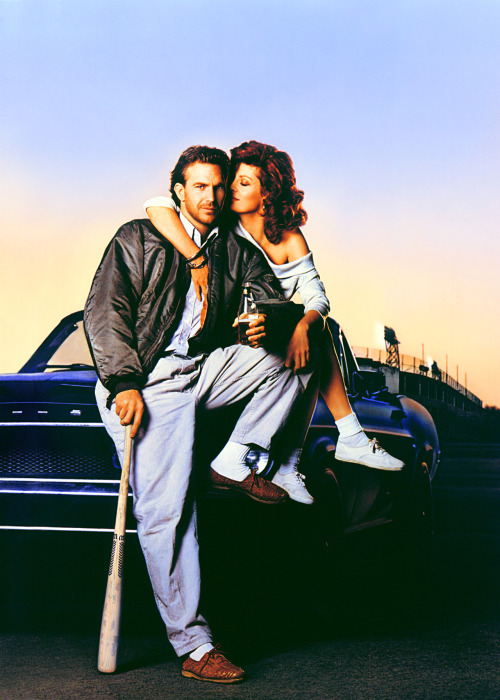
Yup, it’s baseball! Specifically, my favorite baseball movie of all time, Bull Durham. I won’t wax totally poetic about the movie, having done that before, but…I’ve got baseball on the brain. Why?

Well, I have a friend at work whose favorite hobby is collecting sports autographs. And while he does buy signed items from memorabilia stores and online, he does most of the legwork himself: he goes to the ballpark and the arena and the stadium and various other places and gets stuff signed himself. He’s got a ton of great stories about the hobby and the thrill of the autograph chase, such as a time he and some friends went into a hotel bar, one at a time, to get Jim Plunkett, the onetime Raiders quarterback (and two-time Super Bowl MVP), to sign. The punchline that night was the last guy, who went up to him with a photo of a Raiders quarterback wearing number 16…only to have Plunkett tell him, “That’s not me.” He’d approached Plunkett with a photo of George Blanda.

Anyway, this weekend my friend has a shot at getting the autograph of the oldest active athlete in his collection: baseball pitcher Jamie Moyer. Moyer is 49 years old, and after starting the season with the Rockies and getting cut, signed a minor-league deal with the Orioles this week. They sent him to AAA Norfolk, who play this weekend at Buffalo against our Bisons. Moyer is scheduled to pitch tomorrow.

Moyer was born with JFK was President, less than a year after my parents were married. He made his Major League debut on June 16, 1986, when Ronald Reagan was President. The top movie at the box office the week of Moyer’s debut was Back to School, starring Rodney Dangerfield. And even though Moyer made his MLB debut in 1986, he would not win his first World Series ring until 2008, when he pitched with the Phillies.

What does this have to do with Bull Durham? Well, there’s something Crash Davis-esque in Moyer’s refusal to retire before he’s damned good and ready. As Annie Savoy says in the film after Crash gets cut by the Durham Bulls and travels to the next town down the road to try to catch on with another team in a slightly smaller, slightly crappier ballpark, “You have to respect a ballplayer whose just trying to finish the season.”

Of course, Jamie Moyer is something of the opposite of Crash Davis; if Crash is the guy who keeps playing and playing and playing and yet he can’t quite crack the Majors, Moyer’s the guy who keeps playing and playing and playing and the Majors can’t get rid of him. Moyer’s never been a great pitcher, but he’s been solid enough for long enough, and a baseball rotation isn’t worth anything if it doesn’t have a solid guy going up there every fifth day so the staff ace’s arm doesn’t fall off.

Anyway, here’s a great scene from Bull Durham. Tough to pick one, as the movie has nothing but great scenes.

CRASH COMING OUT OF THE SHOWER -- Toweling off, watching the 
               innocent, vulgar fun. He sits down in front of his locker, 
               drying his hair, when the CLUBHOUSE BOY approaches:

                                     CLUBHOUSE BOY
                         Hey, Crash -- Skip wants to see ya.

               CRASH RISES AND HEADS FOR SKIP'S CUBICLE -- Wearing only a 
               towel and his shower shoes.

                                                                    CUT TO:

               INSIDE SKIP'S OFFICE -- Skip and Larry sit in postgame 
               routine, checking charts, smoking, half dressed.

               CRASH ENTERS as he's still drying off.

                                     CRASH
                         Yeah, Skip, you wanted to see me?

                                     SKIP
                         Crash, shut the door.

               And it hits him. Crash looks at Skip, who looks down at the 
               floor, unwilling to face Crash who then looks at Larry, who 
               also looks away nervously.

               CRASH SHUTS THE DOOR -- The party rages beyond.

                                     SKIP
                              (heartfelt)
                         This is the toughest job a manager 
                         has...

               CLOSE ON CRASH -- He's been in the game too long to be 
               surprised; nonetheless, he's surprised. And hurt. His stoicism 
               is professional.

                                     SKIP
                         The organization wants to make a 
                         change... now that Nuke's gone they 
                         wanta bring up some young catcher...

                                     LARRY
                         Some kid hittin' .300 in Lynchburg... 
                         probably a bust.

                                     SKIP
                         I put in a word for you with the 
                         organization -- told 'em I thought 
                         you'd make a fine minor league manager 
                         someday... Might be an opening at 
                         Salem next year --

               EXTREME CLOSE UP ON CRASH -- His eyes are moist.

                                     SKIP
                         Helluva year, Crash -- you know how 
                         it is.

               Silence.

               Crash stands there nearly nude. He just nods slightly. Without 
               rancor or bitterness, he turns and re-enters the raucous 
               locker room.


Share This Post

Something for Thursday

Before the series finale episode of House MD aired, FOX played promos for the show, using this song that I’d never heard before, by a group I’d never heard of before. This is one of those spiritually hypnotic songs that, when well done, I tend to find absolutely and utterly captivating. It’s hymn-like in its musical approach, and since those ads started airing, I can’t get enough of this song…so much so that I’m almost afraid to sample anything else by this band. I kind of want this song to exist all by itself, in some ethereal realm. Here’s Drew Holcomb and The Neighbors, with “Live Forever”.

Share This Post

From the Books: “Coming of Age in the Milky Way”

Last night saw a rare, and spectacular, astronomical event: the transit of Venus across the Sun. There were many amazing pictures from this event, and Phil Plait provided some terrific coverage. The event reminded me, specifically, of a passage from a favorite book of mine, and one which I’ve been planning to dig out for a re-read soon: Coming of Age in the Milky Way by Timothy Ferris.

This book constitutes a one-volume history of the human species’s discovery of its own roots in, and relation to, the Universe. In that respect, the book covers quite a bit of the same ground as Carl Sagan’s Cosmos, although Ferris’s focus is more on a narrative approach than Sagan’s more free-form exploration of the Cosmos. Still, Coming of Age in the Milky Way contains some of the finest science writing I’ve read, and I strongly recommend it.

In the following selection, Ferris relates the mobilization of the scientific world in the 1700s to use that era’s coming transit of Venus as a means of measuring the distances between the planets, further establishing the size of what was then thought to be the entire Universe. The transits had been predicted by Edmund Halley nearly a century before, and he had admonished his scientific descendants to take advantage of the opportunity, because by recording the timing of the transits as they unfolded from different parts of the world, a triangulation could be employed to survey the size of our sky.

What’s most amazing to me about this is the sheer hardship endured in the name of scientific discovery, hardship that we tend to overlook in the onward march of discovery today, when the transits can be observed and recorded by spacecraft orbiting our world and beaming their data back to us so that I, sitting at my desk, can look at the images on my laptop. I can see the transit of Venus without getting up from my desk, except to get a bottle of water. These guys? Read on to see what they had to put up with to see a Venusian transit….

As for Venus, its transit on December 6-7, 1631, was visible only from the New World and appears to have been viewed by not a single human being, and the transit of November 24, 1639, was observed by two people, the English astronomer and clergyman Jeremiah Horrocks and his friend William Crabtree. Alarmingly for Horrocks, who was a clergyman, the transit occurred on a Sunday, when he was obliged to preach two sermons. He rushed home from church, peered through his telescope at 3:15 pm, and saw Venus, “the object of my most sanguine wishes…just wholly centered on the Sun’s disk.” Venus, like Mercury, looked smaller than had been predicted – Kepler thought Venus would cover one quarter of the sun, an enormous overestimate – and so to behold its apparent tiny size helped improve human appreciation of interplanetary distances. But Horrocks had no way to measure the apparent diameter of the disk precisely, and, since he was but one observer, he could not have triangulated Venus even if he had possessed an accurate clock. Crabtree, for his part, was so overwhelmed by the sight of an entire world dwarfed by the Sun that he made no coherent notes at all, prompting Horrocks to protest that “we astronomers have a certain…disposition [to be] distractedly delighted with light and trifling circumstances.”

But the world had changed by the time the transits of Venus of 1761 and 1769 came due. Astronomy had become an organized science, conducted by professionals, sponsored by scientific societies, and supported by government funds. Now at last, it was felt, science had the resources to sound the dimensions of the solar system. Halley’s implorations were remembered, and the transits were scrutinized by scores of observers equipped with micrometers, accurate clocks, and brass telescopes mounted on hardwood tripods at sites as far away as Siberia, South Africa, Mexico, and the South Pacific.

And, to an extent, the transit observers succeeded, though not without suffering some sufficient tribulations to remind them that while the motions of the planets may be sublime the affairs of this world are marbled with chaos. The astronomer Charles Mason and the surveyor Jeremiah Dixon, later of the Mason-Dixon Line, were attacked by a French frigate while making their way to Africa (this was during the Seven Years’ War) with a loss of eleven dead and thirty-seven wounded; they reached Cape Town under military escort and observed the 1761 transit, only to find that they differed by many seconds in their estimate of the time when Venus had entered and left the disk of the sun. William Wales timed the transit from Hudson Bay, Canada, after enduring mosquitoes, horseflies, and a winter sufficiently severe that, as he noted with empirical exactitude, a half-pint of brandy left unattended iced over in only five minutes. Jean-Baptiste Chappe d’Auteroche, dispatched by the French academy into the depths of Russia, raced across the frozen Volga and through Siberian forests in horse-drawn sleds, arrived at Tobolsk six days prior to the transit, posted guards to repel angry mobs who blamed him for causing spring floods by interfering with the sun, and managed to observe the transit. He died eight years later in Baja California after timing the 1769 transit, of an epidemic that spared but one member of his party, who dutifully returned his data to Paris. Alexandra-Gui Pingre was rained out for most of the transit in Madagascar, lost his ship to the British and was returned to Lisbon under British guns; a humanist as well as a scientist, he took comfort in the ship’s rations of spirits: “Liquor,” he wrote, “gives us the necessary strength for determining the distance of…the sun.”

Least fortunate of all was Guillaume le Gentil, who sailed from France on March 26, 1760, planning to observe the transit the following year from the east coast of India. Monsoons blew his ship off course, and transit day found him becalmed in the middle of the Indian Ocean, unable to make any useful observations. Determined to redeem the expedition by observing the second transit, Le Gentil booked passage to India, built an observatory atop an obsolete powder magazine in Pondicherry, and waited. The sky remained marvelously clear throughout May, only to cloud over on June 4, the morning of the transit, then clear again as soon as the transit was over.

[excerpt of Le Gentil’s journal excised]

Worse lay ahead. Stricken with dysentery, Le Gentil remained in India for another nine months, bedridden. He then booked passage home aboard a Spanish warship that was demasted in a hurricane off the Cape of Good Hope and blown off course north of the Azores before finally limping into port at Cadiz. Le Gentil crossed the Pyrenees and at last set foot on French soil, after eleven years, six months, and thirteen days of absence. Upon his return to Paris he learned that he had been declared dead, his estate looted, and its remains divided up among his heirs and creditors. He renounced astronomy, married, and retired to write his memoirs. Cassini, eulogizing Le Gentil, praised his character but allowed that “in his sea voyages he had contracted a little unsociability and brusqueness.

(top image via)

Share This Post

Delurk!

Just a reminder that I’m doing Delurking Week here on Byzantium’s Shores, so go ahead and delurk, if you please, and leave a comment! Anonymous comments are open (but I’ll be closing them again on Friday evening or Saturday morning, because holy crap, the comments spambots are agressively trying to establish a beachhead here now that I’m temporarily opening the anonymous stuff).

Delurk, folks! Do it for the children! Do it for America!

UPDATE: Sorry, folks, but relentless spambots (I’ve deleted at least twenty spambot attempts today) and one irritating troll compel me to close anonymous comments early. Deleting spam is not how I want to spend my day. Comments from registered users are still welcome, though!

Share This Post