
From the John Willaims score to Superman, here is “Leaving Home”. The eerie music at the beginning comes just after Pa Kent’s funeral, when young Clark Kent finds the remnants of his ship from Krypton hidden in the barn cellar; this is followed by some of the most gorgeous Americana Williams ever wrote as Clark bids farewell to Ma Kent before heading north. Williams’s gift for melody in this phase of his career was so prolific that the wonderful theme that dominates the second half of this cue is heard in this one scene, and this one scene only.
A Random Wednesday Conversation Starter
As of today….
Answers the Sixth!
Continuing my catch-up detail on Ask Me Anything! August 2012, I’ll wrap up all of Roger’s questions!
Here’s something I plan to do, so I’ll let you try first: come up with a list of the 20 (or 25) most important/influential people in your life. I’m particularly interested in those people who may be out of your life now (a music teacher, a lost friend) who you look back and see their impact.
With respect…I’m going to save this one for a future post. This one will take a lot of thought!
What do you think of the 1986 Paul Simon album Graceland? I know you hadn’t heard the album, but were you aware of the controversy over Simon going to South Africa, albeit to record with black South Africans?
Some background: a while back, I admitted someplace (was it here?) that I had never heard Graceland, the Paul Simon album from 1986. I didn’t ignore the album out of any dislike for Mr. Simon. It’s just that, like many things, it slid by me when it came out because I was into other things at that time, and it remained pretty much forevermore one of those pop culture artifacts that I just plain missed at the time. (Not unlike, as I’ve noted many times, Kurt Cobain and Nirvana.)
Well, Roger decided that this constituted a fundamental failure on my part to explore a fine work of art, so he sent me a copy of the album, which I have now listened to in its entirety about seven or eight times (with some internal dipping here and there). I realize this falls into the general category of “Water is wet, film at eleven!”, but…Graceland is just wonderful.
I knew going in that Graceland features musicians from South Africa, and that this represented quite a cultural event in the 1980s, since Apartheid had not yet ended in that country. What I didn’t know was the general upbeat nature of the album. I was kind of expecting a more meditative work, dealing with issues of heavy import such as the relations between the races in a divided country. Instead, the record is…well, I found it a much for fun listening experience than I had expected. That surprised me. (I was also completely unaware of any controversy surrounding the album; I just looked that up, to discover that some people felt that Simon had broken sanctions against South Africa in going there to record his album. I can kind of see the point, but to me, economic sanctions are different from cultural ones.)
I was also surprised that the African elements in the album aren’t as forward as I had expected. I have a sad suspicion that this represents some kind of stereotype-based thinking on my part, but I honestly expected the kind of faux-African sound that marks the score to The Lion King. I wasn’t even aware that I had that expectation in my head until I listened to the album the first time and realized that some of it is just straight-up pop, and when the African sounds become undeniable and unmissable, they are…well, they’re uniquely refreshing. My favorite track on the entire album, for this very reason, is “Diamonds on the Soles of Her Shoes”.
The song is also effective, as are most on the album, because Simon’s lyrics tell a story. These songs have the feel of poetry combined with music, instead of many song lyrics which just sound like nonsensical rhymes set to a catchy tune.
Anyway, Graceland is just terrific, and I am indebted to Roger for finally getting it into my hands.
And a more general question: How many times do you need to listen to an album before feel that you know an album? (It’s three for me, BTW.
I’ve never really considered this. It’s a good question. I’m not sure what it is to ‘know’ an album. I can get a general sense of the album’s ebb and flow after a couple of listens — two or three — but for a more thorough exploration of an album’s themes, it takes me longer than that. Sometimes it can even take years, depending on the album! It’s not uncommon for me to listen to some work or album that I’ve ‘known’ well for years and still hear something new, or suddenly grasp something about a particular song, or the like.
Ultimately, I’m not sure that I ever really ‘know’ an album. But then, I am possessed of a constant fear that I am, in fact, a dolt who is masquerading as someone who knows something about anything. This is a useful attitude for a writer, I think — if nothing else, I’m motivated to create works that by definition I will know better than anyone else.
Have you made any plans for your funeral? I assume your wife knows your desires, but do others (e.g., embalming v cremation, organ donation,) should you and your wife die at the same time?
Not asking who, but have you made a decision where your child should stay should both of her parents pass away? What were the bases – her familiarity with them, their income, their values (religious or otherwise), their politics, the size of their house, their age?
Yeesh…I’ve given this very little thought at all, actually! I like to joke about being cremated and then snuck into pepper-shakers at some restaurant or other, but that’s obvious gallows humor. In truth, my attitude on this is basically for those left after I shuffle off to do whatever they feel is easiest and best for their peace of mind. I’m reminded of an episode of Star Trek: The Next Generation, when a Klingon dies and Picard or someone asks one of the Klingon survivors what they want done with the body, and the response is, “The body? That’s just an empty shell. Do whatever you want with it.” I know that a lot of people have definite desires for what is to happen with their remains — where to bury, where to be scattered, et cetera — but in all honesty, I have little such opinion, as I figure that I’m not likely to care afterwards, so why care now?
Having said that, I suddenly realize that I’ve never signed my organ donor card. I should probably do that. And I have always admired my paternal grandmother, who had her body donated to a medical school after her passing, so that the next generation of doctors might learn something from her. I’d be lying, though, if I didn’t envision something along the lines of the opening credits sequence of the old Jack Klugman show Quincy, which showed Quincy starting an autopsy for a group of police academy cadets, only to watch them all pass out.
OK, that’s it for Roger! Next time, we’ll wrap this whole thing up with some more lighthearted queries.
Share This Post
Ayup….
So I just finished doing the manuscript mark-ups for Princesses In SPACE!!! (not the actual title) a short while ago, so blogging can start again. Thanks for hanging in there, folks! (Although the pace will remain on the light side, as I’m starting a vacation this coming Thursday and I have a second draft of the book to generate.)
I have no idea at this point if I’ll be successful in cutting the word count down by the nearly 20,000 words I’d been hoping for, because although there were many spots in the book where I sliced and diced with liberal used of red ink (I refilled a fountain pen with red ink three times for this job!), there were a number of places — not a large number, but a number nonetheless — where I had to add material. So we’ll see how the second draft shakes out, length-wise. That work will begin tomorrow, and I expect it to not take quite as long as the first manuscript mark-ups — I’d love to have the second draft done by mid-October.
And now, to bed….
Share This Post
A fine ship



OK, radio silence starts…now!

Folks: it’s crunch time. I have less than a hundred pages of manuscript left to mark up, so I’m going to do something drastic: I’m going into radio silence here until I’m done with the entire manuscript. Next time I post here, I will have moved on to generating the second draft!
Here’s what this entire process looks like, for those wondering:
Catch you all on the flip side — and as ever, thank you for your patience!
Share This Post

“I’d rather be in jail than be in love again!”
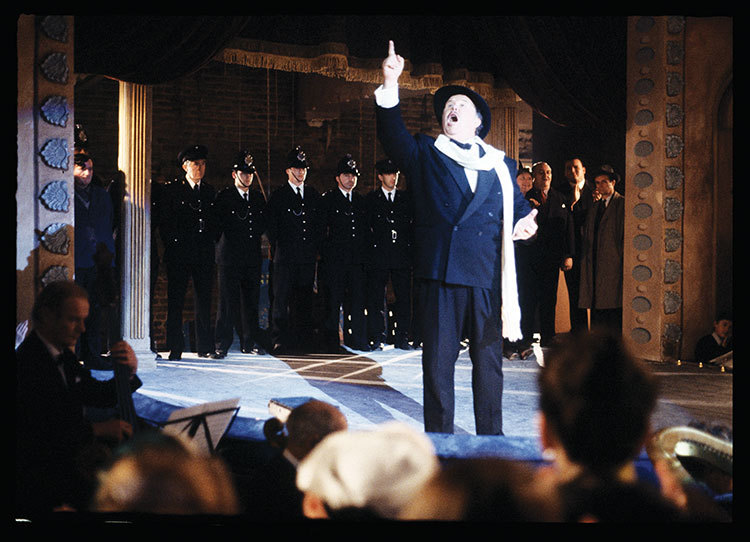
Years ago, when we’d been dating a year or so, The Girlfriend (now The Wife) rented a movie for us to watch. It was a British comedy that I’d never heard of, called Hear My Song. We both absolutely loved it, and it’s been one of those movies that I’ve wanted to watch again ever since, even though it’s been really hard to locate a copy, to the point where it then became one of those movies of which I have greatly fond memories that maybe I don’t want to revisit, on the off chance that my memories of it are more nostalgic than accurate. Or, to put it another way, I was afraid that maybe this movie had been visited by the Suck Fairy.
Well, Hear My Song is, as of this writing, available for streaming on Netflix, which proved to be a temptation too great. So I watched it, and…absolutely loved it again.
Adrian Dunbar (who co-wrote the movie, and who would later secure semi-immortality in Star Wars lore by playing Senator Bail Organa in The Phantom Menace, only to see his scenes cut entirely from the film and the role recast with Jimmy Smits in the subsequent Prequels) plays Mickey O’Neill, a young man who runs a dinner club and musical revue. The place isn’t making great money (in the first scene, Mickey has to take the stage himself) and he isn’t popular with his landlords, who decide to evict after a scheme to let word of mouth sell tickets for a crappy singer named Franc Cinatra results in bad blood. His next money-making effort is to book Irish tenor Joseph Locke, who is legendary in this town but has lived in Ireland for more than thirty years because he’s wanted for tax evasion.
Locke is the Maguffin of the movie. First, no one is sure if the guy claiming to be Locke is really Locke or not, and second, Locke didn’t just evade taxes as much as he literally ran out of town, avoiding arrest by inches (and by pushing a cop off the boat on which he was fleeing) and running out on the affair he was having with a local beauty queen. This beauty queen turns out, later on, to be Mickey’s girlfriend’s mother, and after she has a late-night tryst with the man claiming to be Joseph Locke, she loudly announces that he is not. Ouch. Mickey loses the theater, his girlfriend, everything…unless he can get to Ireland and bring back the real Joseph Locke.
There’s nothing in this movie that’s really all that surprising at all, at least until the end, when things turn in a way that is reminiscent of endings like The Shawshank Redemption‘s, in that elements that have been in place the entire way suddenly turn out to be relevant in surprising and deeply pleasing ways. I don’t want to spell it out, but this movie has one of my favorite endings, ever.
But an ending can’t work as well as this one does by being clever; it also has to have the emotional heft to it, and this one does. This is a movie about likable people who have, occasionally in their lives, done unlikable things, but in most cases they are trying to atone for them, or recognize their misdeeds when they come back to haunt them. There isn’t a single unflawed character in this film, all the way to Mickey himself, who seems emotionally stunted in some ways, and whose main skill in life seems to be a gift for bullshit. (One of his favorite tricks is to appeal to the older generation, who lived through World War II, by giving a speech that starts off with “I grew up in peacetime.”
With comedies like this, it’s easy to describe them in such a way that makes them sound like serious dramas. Hear My Song is most definitely a comedy; in fact, it ranks high on my personal list of funniest movies I’ve seen. A scene involving a bar full of Irishmen trying to assist one of their brethren with a dental problem is hysterical, and the best gag involves our two drunken heroes and their curiosity as to the depth of a particular well. More than that I must not say.
Hear My Song is, for me, so good that I don’t understand how it’s managed to fall so completely off the radar. It has a wonderfully witty script full of memorable characters, it’s photographed beautifully, the music is fantastic, and the cast is tremendous, led by Dunbar and by Ned Beatty as Joseph Locke (the real one). And if you’ve ever watched Star Wars: A New Hope and wondered just how good an actor William Hootkins really was (he sadly died a few years back), well, Hear My Song will give you an answer.
What a wonderful, wonderful movie!
Share This Post
Answers the Fifth!
I know, I know…with all this editing work I’ve been doing, I’ve been ridiculously remiss in getting Ask Me Anything! August 2012 done, to the point that we’re closing in on October 2012. Oy…but herein I’ll take another whack at getting some of these queries answered!
From Roger:
Should Sally Ride come out as gay sooner, as in during her lifetime? It wasn’t a secret to her friends, but some have suggested that it may have been more inspirational.
It’s easy to say that, and I tend to agree that it would have been pretty inspirational to have Sally Ride go open with her homosexuality earlier in life. I think that every openly gay person who lives a normal, productive, and in Sally Ride’s case, exceptional life moves the needle toward ‘Gay Acceptance’ a little more, and that’s a good thing.
But…Sally Ride wasn’t just an inspirational figure, she was a person, and even though circumstances of her life made her an inspirational figure, I can’t hold her to account for choosing not to be such a figure in all aspects of her existence. I am in no way disappointed in her reluctance to come out, if indeed it was reluctance at all. If her line of thinking was “That part of my life is mine and it’s nobody’s business but mine”, I have a hard time taking her to task for that. So ultimately, no, I don’t think she should have come out sooner, unless she wanted to. Which it doesn’t seem that she did.
Do you think the punishment for Penn State in light of the Jerry Sandusky scandal was too strong, too lenient, or appropriate? What do you say to those who believe those who did nothing wrong (current students at Penn State, e.g.) are suffering the bulk of the punishment?
I think it was just about right. That program needed to get hit hard, because the ‘football is king, and coach is God’ mentality there led to a sickening coverup of a child molester. And I’m not interested in all the Oliver Stone-esque readings of the Freeh Report, or the red herring chases that people engage in who are still slavishly in thrall to the Ghost of Holy Joe. I have seen nothing compelling to make me think that things happened pretty much as they’re said to have happened, and I suspect that things may have actually been worse.
As for who I feel sorry for? Well, I feel sympathy here for two, and only two, groups of people. The first are Sandusky’s victims and their families, and the second is the current players who have to take the field wearing the scarlet A. They didn’t sign up for this, and I do feel sorry for them. In fact, I think there’s something admirable about players who opted to stay put and try to help make things there better again — but at the same time, I have zero problem with any player who looked at the carnage and said, “Yeah, I want no part of this shit” and took the transfer to someplace else. I can understand both viewpoints and I don’t see either as more moral than the other.
Who do I not feel sorry for? Penn State students and alumni and fans. Sorry, but you do not have a God-given right to root for a great football program, you do not have a God-given right to your mental picture of Doddering Old Joe Paterno as a figure of Christ-like reverence, and even more than that, there’s nothing super-special about Penn State and its students and “the experiences and the special bond they share” than there is at any other college. In general, I tend to find the whole college-nostalgia thing really odd. I loved my college years and it was a deeply formative time in my life (not just because I met The Wife there). But I graduated nearly twenty years ago, which means that as far as I can see, I have no more ‘special bond’ with someone going there now than I do with someone going to, say, the University of New Mexico. Hell, I’d be surprised if more than three or four professors I had classes with are even there anymore, so for me to start chanting “We are Wartburg!” just feels like a lot of lame clinging-to-a-past.
Everybody had wonderful college professors, everybody made friendships in college that will last their lives, everybody had experiences at college that they will carry with them all the rest of their days. Everybody. The Penn State notion that there’s something special! mystical! transcendent! about Happy Valley that other schools can’t touch is just so much mental self-boosterism. Ultimately, to me, Penn State is just the latest big institution to get caught doing Bad Acts.
In 2013, Barry Bonds, Sammy Sosa, and Roger Clemens will be eligible for the baseball Hall of Fame. If you were voting, what you you do? Also your votes re: Mark McGwire, Raffy Palmiero, A-Rod and Manny Ramirez (eventually), and, what the heck, Pete Rose?
I’d vote them in, every one. Except for Pete Rose.
Baseball’s steroid era is an unfortunate time, but it was also a time when MLB really didn’t have any strong policies in place to deal with it — just a kind of “You’d better not do this!” kind of thing. If baseball was really serious, they’d have implemented testing with clear guidelines for punishments in the result of failed tests. Having someone get outed years after they played of having broken rules that weren’t really rules doesn’t seem strong enough a case to keep someone out of the Hall of Fame, especially if, in the case of a Bonds or a Clemens, they were awesome anyway. I’m not sure that steroids made Bonds such a baserunning threat or helped him in the field.
Here’s an analogy: a third-grade teacher addresses her class on the first day of school. “OK, Kids, here’s the rule. In each of your desks is a candy bar that I put there. You are NOT allowed to ever, ever, EVER, eat the candy bar. It is FORBIDDEN for you to eat the candy bar. Now, I will never check your desks to see if the candy bar is there. I will not watch what you eat at lunch time, and even though I will leave the room unattended for ten minutes each day, I will still NEVER look to see if your candy bar is there.” So the school year goes on, and ends, and the kids move on…until ten years later, when someone rats out Joey, and the school says, “Well, gee whiz, Joey, you don’t get a diploma then.” That make sense to anyone? Not me.
But Pete Rose? Well, baseball does have clear rules about gambling and betting, and he broke them, and he’s never shown any real remorse. If he wants to really apologize in a way that makes Bud Selig happy, that’s fine, but his grudging approach of “Fine, I’m sorry, you happy now? Gimme me plaque at Cooperstown now.” is just really off-putting.
Now, if they wanted to induct Rose into the Hall with an asterisk on his plaque explaining that he was banned and why, I don’t have much of a problem with that. But as it is now? He broke one of baseball’s most sacred rules, and he needs to pay the price.
More answers to come!