
You’d think that after doing the whole blogging and social networking thing for as long as I’d have, I wouldn’t be surprised that a tweet I quickly tossed off after reading about what a cold-hearted son-of-a-bitch Mitt Romney is actually got some attention, but…yeah, it’s a nice surprise. In a collection of reaction tweets to Romney’s waving-of-the-flag for conservative assholedom, Andrew Sullivan quoted mine. Woot!
“Sacre Bleu!” (musings on a Christopher Moore novel)
(So I read Lance Mannion’s review of this book, and I wanted to refer to mine…only to discover that I wrote it but never posted it. Oops.)
Any serious reader has, I suppose, an honor roll of authors whose work is so worshipfully and reverently awaited that matters of economics do not factor into the decision to buy the new book – in other words, an “Authors To Buy In Hardcover Immediately Upon Release” list. Now, my list of these has been terrifically short for a long time: it’s basically Guy Gavriel Kay, and…that’s about it. Except that I think it’s time I put Christopher Moore on the list as well. I haven’t found Moore’s work as consistently good as GGK’s, but Moore hits heights that, for comedy, are for me as sublime as GGK’s best fantasy work. So Moore is officially one of my “Buy in hardcover” authors. I’m sure this news will thrill him deeply. (Or it won’t affect him in any way whatsoever because he won’t know about it because he’s a successful author and I’m a blogger who gets two hundred hits a day and a lot of those are people searching for photos of Melissa Rauch.)
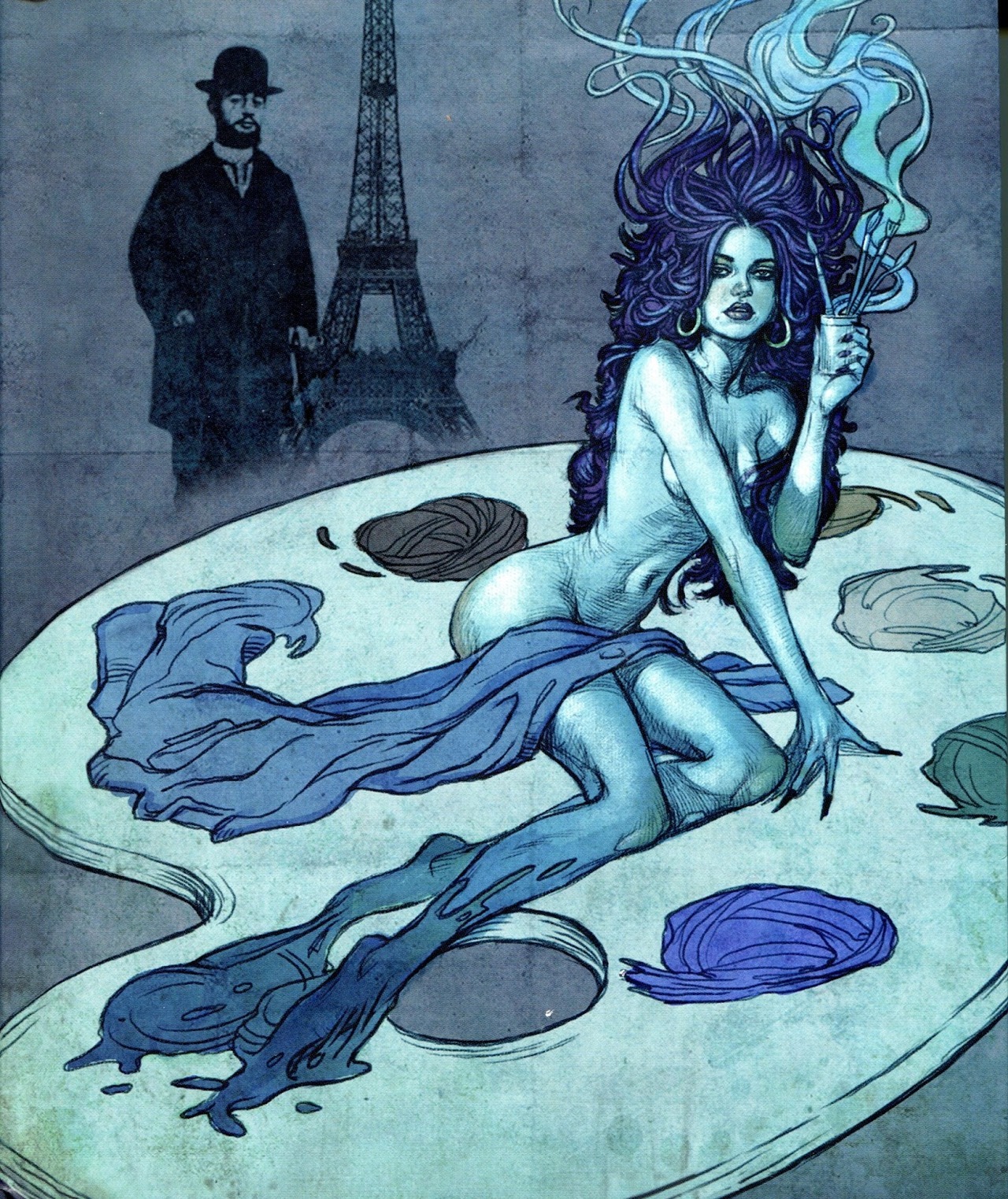
All of this brings me to Moore’s newest book, Sacre Bleu.This is a novel about…the color blue. I kid you not; Moore decided that he wanted to write a book about a color, so he did just that. So, how does one write a book about a color? Well, if you’re Moore, you delve into the inner world of the French Impressionist painters, and you posit that there’s a certain kind of blue paint that they can only procure from a certain, mysterious individual who travels around with a woman who sometimes seems to be…someone else. And if you’re Moore, you add in supernatural goings-on, gonzo explanations for things that happened in real history. And if you’re really fortunate, you get to have your book on the color blue printed with a blue cover and with the body in blue ink, and you get to have many of the paintings you mention in the course of the book depicted right in the text.
Yes, they really pulled out all the stops for Sacre Bleu. It’s a fine physical specimen of a book to begin with. But is it worth reading? Well, we’re talking about Christopher Moore here, who as far as I can recall hasn’t yet really had a dud (although I wasn’t entirely thrilled with You Suck or The Stupidest Angel, and I have yet to read Bite Me).
The book opens with one of the seminal events in the history of human art: Vincent Van Gogh’s suicide. Although, for Moore, it actually isn’t a suicide; it’s an attempt by Van Gogh to procure more of the special blue paint that goes awry. All the rest of the book’s shenanigans descend from this event. And, as we’re talking Moore, there are a lot of shenanigans.
What I’ve found most thrilling in the best of Moore’s recent books is his willingness to move beyond his early, California Coast-centric work for more ambitious subject matter to mine for madcap comedy. Here he takes on one of the most fruitful eras in the history of Western art, and it’s clear that Moore has done his homework. He spices the book with an amazing degree of period detail, not just in the setting of late 19th century Paris, but in the specifics pertaining to the art itself and the community of painters that lived and worked at that time. Even as Moore’s unique brand of lunacy unfolds, the period details are totally convincing.
What helps here is the design of the book itself: it is printed in blue ink, and the text actually includes – very helpfully – actual images of the paintings themselves which are mentioned in the story. This one aspect of the book really helps ground the visuals of the book for me, as a reader.
This is Christopher Moore, of course, so there are also familiar tropes to be found as well. Our hero is a likable, earnest young man who is also at times slightly clueless, who is drawn into a somewhat strange tale involving a woman who seems far older and wiser than he. He is surrounded by a cast of characters that is idiosyncratically memorable, and all this is treated in the usual Moore way, with more than a few laugh-out-loud moments to be found along the way. My only complaint about Sacre Bleu is that it takes a bit longer to get a hold on things with this book than usual, but as he almost always does, Moore won me over.
And by the way: I read Sacre Bleu immediately following George RR Martin’s A Dance with Dragons. As I noted back then, Martin’s approach to writing sex scenes is, well, not my cup of tea. Here, by contrast, is how Christopher Moore does it. (Writes about sex, that is. I have no idea how he…well, you know.)
He stepped up to her, took her in his arms, and kissed her. And off came the chemise, off came the pantaloons, then his shirt, then the rest, and they were on each other, on the fainting lounge, completely lost in one another. There may have been pounding on the door at one point, but they didn’t hear it and didn’t care. Where they were, no one else mattered. When, at last, she looked down from the lounge, at him, lying on his back on the floor, the light from the skylight had gone orange, and the sweat sheen on their bodies looked like slick fire.
It’s night and day, isn’t it? Moore writes simple, elegant sex scenes that include a smattering of detail: the fact that Lucien is on the floor after, while she is not, and the orange glow of late afternoon through the skylight on their bodies. Contrast that with George RR Martin’s apparent bonus he gets from the publisher for each use of the C-word.
Long live Christopher Moore!
Share This Post
A brief update, before I disappear, hippopotamus-like, beneath the bubbles….
Well, I’m about 150 pages shy of the last page of the Princesses In SPACE!!! manuscript, so things are coming along nicely on that front. I want to have the markups done by two weeks from yesterday, so it’s really grindstone time now….
Bear with me, Constant Readers! New content here will show up, I promise!
Share This Post
Something for Thursday
In Memoriam 9-11-01: “The City of Dead Works” and “Elegy”
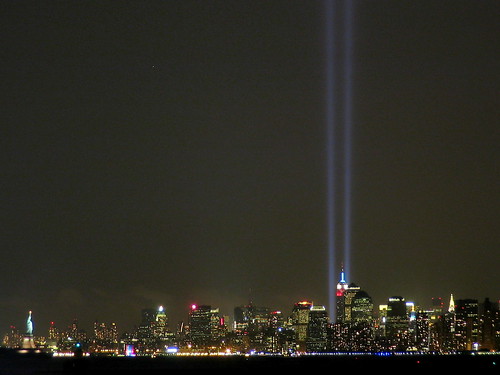
I re-post this every year on this date. It is the first piece of fiction I wrote after the awful events of 9-11-01.
There is never any rest for me, the Ferryman of the Dead.
I pole my barge across the black waters and up to the pier. So many wait this time, many more than usual. I wonder what has happened, what event has sent me this many. “Come aboard,” I say. “I will take your coin for passage.” One by one they file past me, each handing to me the coin that they never knew they had. It is the coin which determines where they shall be taken to rest, its metal shaped and determined by life. The coins of these dead are gold, every one of them purest gold. Six thousand come aboard my barge, and each has passage for the farthest and greatest of destinations. In that moment I know that something truly dark has happened; the gold coins are always forged in moments of darkness. I am the Ferryman. I can give them no answers to what lies behind their haunted, questioning eyes. I can only take them on this, the last of all journeys.
When they are all aboard I take up the pole and push away from the pier. The barge always feels the same, no matter how many stand upon its decks. Whether six or six thousand, it is all the same to me. I guide us out onto the River Styx. Some of the people look worried, but there is no need for fear. This river can do them no harm. They are already dead.
This is to be a long journey, I know – it always is, to this destination. As I guide the barge through the black waters, I look on the faces of those who have come to me. As different as these people all look, they all have the same expressions of shock, disbelief, and withering sadness. Here is a man of business, talking into a cell phone. He is trying to call someone, anyone, who will tell him that it’s all a dream, that it didn’t happen, that he didn’t die in a blast of fire, smoke, glass and steel. There is a mother who is explaining to her daughter that they won’t be going to Disneyland after all. And there, a group of firemen stand together, realizing that soon they will meet all their brothers-in-arms who have gone into the infernos before them. So many now – colleagues once in business and now colleagues in death, people who have never before met but now have the gravest thing in common. As the current takes hold, I look back at the pier. There are more gathering there. There are always more. They will wait. Time does not exist for the dead.
“Please,” a young man says as he turns to me, “I have to go home to my daughters.”
“You are going home now,” I reply. “To the home where all eventually return.” Two black rocks slide past on either side, the rocks that mark the passage of the circling Styx.
“This can’t be,” a woman cries out. “My mother needs me.”
“She will be with you soon enough.”
“When?” Her voice pleads, and yet there is no solace that is mine to give.
“I cannot say,” I reply. “The Ferryman has no hand in Fate.”
The tears come then, tears from the six thousand that run over the gunwales and into the river which has been fed by tears for centuries. All tears are born in the River Styx.
“Where will you take us?” someone asks.
“To the place you are promised,” I answer. I recall the words of a poet: Will there be beds for all who seek? Yea, beds for all who come.
One our left we approach the Hills of the Damned, an endless stretch of shattered lands which reach away into the blackness. The waters echo with the cries of all those who have been taken to the Hills for the agony they have brought on the living. I consider the bag of six thousand gold coins, and I realize that I will have to journey to the Hills this day. There will be a person, perhaps more, who will pay me with a coin of black tin; but not on this journey. As the hills recede behind us, the unending cries of the damned become fainter and fainter until they are drowned out by the lapping of the waters upon the sides of the boat and the marker stones that we pass. The six thousand fall silent, each realizing that it is not a dream. I would offer solace, but as ever I cannot. I am the Ferryman.
We come around a particularly dark bend, and before us lies a very wide expanse of water, as if the Styx has become an ocean – which in some sense it probably has. And beyond that expanse are the thousands of twinkling lights that I have come to know so well. One man, a fireman, sees them too. “What is that?” he asks.
“It is the City of Dead Works,” I reply. The lights of the city glow on the horizon, and every one of the six thousand turns toward them as the Styx impels us onward. As we come ever closer to the city, the glittering lights reflect off the black water.
“I don’t understand,” someone else says. “The City of Dead Works?”
“Aye,” I reply. “Behold!”
From behind us, golden light: the Sun of the Dead is rising as it always does when the dead come near the City. Above us the firmament is turning purple, then blue; soon the light of the Sun will illuminate the City of Dead Works. As the sky lightens, the true scope of that city becomes plain: it stretches away into the land, farther than any eye could see. Not even the highest-soaring raven, cavorting in the breezes and zephyrs of the dead, could take it all in. It is bigger by far than any one city ever built by the hand of men, because it encompasses some part of all of them. Perhaps it is bigger than all of the cities ever built. Now the sun’s first rays come up behind us, and the first buildings can be seen down by the water.
“That one looks Egyptian,” a woman says.
“The Great Library of Alexandria,” I tell her. “Once the greatest repository of learning the world had ever seen, now only a memory to the living and a reality only to the dead.”
A man points to a building high upon a rock. I nod.
“The Temple of Solomon,” I say.
“There are ships in the harbor,” says another. Thus for him I name the ships: Arizona, Indianapolis, Lusitania, Bismarck, Wilhelm Gustloff, Cap Arcona. And many, many others. I scan over the impossibly vast city and spot Dresden, as it was; and beside it the cities of Hiroshima and Nagasaki. And how many smaller villages, tucked into the hills beyond the City? None can say. The Sun of the Dead shines upon those hills now, and the great stone statues in the likeness of Siddhartha Gautama.
“I don’t understand,” a young man says. “Why this City? Why here?”
I only shake my head as we continue to float by the City. I do not point out the fairly small, nondescript office building that sits near the water. It is not a particularly remarkable building; nor was it, really, until the fuse was lit. The six thousand almost don’t recognize it.
Almost.
Not one word is uttered as we slide past the Alfred Murrah Federal Building. Then we turn away from the City of Dead Works, and head again down the waters of the Styx toward distant hills and the place where these people will join their brethren.
“Who lives in that city?” It is a priest in a fireman’s coat.
“No one lives there,” I tell him. “The City of Dead Works is not for people. It is for the buildings and the ships. It is for the books and the music, the sculptures and the paintings which are gone forever. It is for everything destroyed by craven people in the name of foolish wars, for everything judged forfeit in the face of transitory desires.”
The Styx takes us into the Golden Hills. Soon we will be there, and the six thousand will go where they belong. And then the Styx will complete its circle, taking me back to the pier where more dead await.
“We will be there soon,” I say. “Soon we will be at the Elysian Fields, where all heroes go – for that is what you all are. It is what you have bought with your lives, with the shaping of your coins into gold.” No one replies. We near the last bend now, and before us lie the Elysian Fields, where peace reigns and where heroes dwell; where all is light and voices are always raised in song. The Sun of the Dead shines warmly on Elysium.
But they do not see it. They, the six thousand, all gaze back behind us upon the City of Dead Works. It will soon be behind us forever as we round the last bend of the River Styx into Elysium. I know they all need one last look upon that City, and I do not grudge them that. For myself, I do not look back; the eyes of the Ferryman are ever forward. But I know. I know that the City of Dead Works is different now. I know that it has changed. I know that the people who come with me now to Elysium, the dead around me, look back on the two soaring towers of steel that now rise above the City where there had been no towers before.
I know these things.
I am the Ferryman of the Dead.
And this, a piece called “Elegy” by Mark Camphouse, is the first piece of music I was able to listen to after that day. It took me three days, if I recall correctly, to feel like music again. This piece has stayed with me ever since I played it in the Wartburg College Concert Band back in 1989-1990, as a freshman. It remains, to this day, for me one of the most profoundly effective musical meditations on grief and death and, ultimately, hope for a better tomorrow that I have ever heard. This performance is by the United States Marine Band. I made the video using images of the World Trade Center and the events of 9-11-01 that I found online.
Share This Post
Revising my Remarks
A couple of commenters point out a couple of deficiencies in my Answers post from yesterday, dealing with The West Wing.
Firstly, most seriously, Roger points out that I forgot CJ Cregg. Ugh. I can’t believe I didn’t include her. She was in most of the clips I pointed out, but somehow, it just slipped my mind to actually include her.
And that, in a way, is pretty illustrative of CJ’s character arc through the entire series. In the first season, it quickly becomes clear that while she is seen as an able press secretary, she is not really seen as an effective voice for policy, and the ‘inner circle’ of the White House senior staff seems to view her as a potential danger, given her close friendships in the press corps. This leads to an incident where CJ is told that nothing more is going on and that she can release the reporters for the night, only to have to call them back an hour later when Leo tells her that a pretty big military operation is underway. But she gradually learns to take charge, learning more and more about her job, until finally, five years in, President Bartlet makes her his new Chief of Staff, a position she holds until the series ends with the inauguration of President Santos.
Here’s a nice moment where CJ stands her ground before a couple of high-ranking military men:
And here’s another where CJ decides to smack down a snotty reporter who had earlier taken her to task on her own news program for taking time to change clothes before briefing the press on a suicide bombing in Israel in which two American teenagers were killed:
One of my favorite storylines in the series’s final episodes was CJ’s wondering about her own future. She had an opportunity to oversee a massive philanthropic fund, a welcome change from the White House; but she also had a vague job offer from incoming President Santos. At the same time she had a growing relationship with reporter Danny Concannon, and she had to figure out just what it was that she wanted to do once her time with President Bartlet was over. Seasons Six and Seven were really quite good.
Ben asks, what about Toby and Will? Well, in Charlie’s original question, he mentioned that I’d already addressed Toby, and I did in this old post of my favorite episodes, in which I make clear that Toby is my favorite character, as my list is pretty Toby-centric. Ben also asks, what about Will Bailey. And, well…I just never warmed up much to Will. He really wasn’t the most interesting character to me. Will came in as basically a replacement for Sam Seaborn, and after Sorkin left just half a season later, Will ended up being the Chief of Staff for the new Vice President. This kind of hobbled the character, because the writers made it clear that Vice President Russell was a lightweight who had no business being Vice President at all. Seeing Will in the employ of a lightweight made Will look pretty lightweight, so Will Bailey just never really rose to anything in my mind.
Still, his first meeting with Toby is a nice scene:
OK, there we go!
Share This Post
Two Very Public Service Announcements
One: Even though I’m not doing any kind of hiatus, blogging will be sporadic until I get the manuscript mark-ups done on Princesses In SPACE!!! (not the actual title). You knew that. But also, I’ve decided to forego the Sentential Links feature until after the election is over, because it’s just too tempting for me to post a bunch of “Romney sucks!” linkage. I don’t want to do that. It’s easy enough to find that sort of content about if you really want it. Any political things I have to say that I just gotta get out, I’ll either Tweet or post on my Tumblr, which is basically a collection of useless stuff, anyway. I’m a terrible Tumblr-er.
Two: I won’t be posting any regular recaps of the Buffalo Bills’ games this season. It’s not that they suck, it’s just that I don’t really want to write much about football anymore. So…I won’t!
Back to our regularly scheduled insanity….
Share This Post
Answers the Fourth!
Thanks for bearing with me, folks…writing the novels is still the priority here, but I do need to get some new stuff up here once in a while, right? So anyway, let’s crank out a few more answers for Ask Me Anything! August ’12.
Charlie, who follows me on Twitter, asks: You do a nice job on your blog of listing your favorite Toby moments. What are your favorites for other WW mains?
Huh. Interesting question! I’ve made no secret of the fact that I am generally a lot less happy with the work of Aaron Sorkin nowadays, where I used to be a raving fanboy of his. A while back I re-watched the first three seasons of The West Wing (those are the only ones I have on DVD), and I found that the shows just don’t flow the way I remember them doing. I also find that the show isn’t nearly as liberal as many assume. Yes, it’s about a Democratic President and a Democratic White House, so there’s a generally liberal bent, but in large part, real honest-to-God liberalism just doesn’t carry the day very often on The West Wing. On the rare occasions that someone actually puts forth a strongly liberal idea, the conversation invariably tilts away from the liberal idea and instead to why it can’t happen, why it can’t work, how wouldn’t-it-be-nice-if-we-lived-in-that-world, et cetera. And additionally, for such a liberal show, the conservative viewpoint carries the day awfully often.
But anyway, that’s not what’s asked. What we’re asked is, what are favorite episodes of mine from a standpoint of the actual characters?
President Bartlet’s finest episode, for me, is “Two Cathedrals”, the finale to Season Two. This episode finds Bartlet at his lowest point. He has just revealed his multiple sclerosis to the nation, and his beloved personal aide, Mrs. Dolores Landingham, has died in a car wreck. He comes terribly close to just chucking it all and refusing to run for a second term, after an amazing scene in which he takes the National Cathedral all to himself and scolds God in English and Latin. How Martin Sheen did not get an Emmy for this episode is beyond me.
Sam Seaborn’s best episode? I’ll pick “And It’s Surely To Their Credit”, in which Sam must come to terms with the fact that, on the President’s orders, Leo McGarry has hired conservative commentator Ainsley Hayes to work at the White House. Hayes (Emily Procter) had demolished Sam on a teevee show a few days prior, and he’s still angry with her on that level and on the principle that they’re Democrats, dammit, let the Republicans win the White House if they want to have Republicans in the White House. Sam is openly hostile to her, until someone else is even more hostile towards her — sending her a bouquet of dead flowers with a card simply reading “Bitch” — which acts like a glass of water thrown in his face. The best episodes are the ones where the heroes don’t always look their best.
Leo McGarry’s finest moment comes in the third season, “Bartlet For America”, when Leo is called before Congress to testify about Bartlet’s failure to disclose his MS during the first Presidential campaign. This episode mixes in flashbacks to the campaign, starting with the very moment when Leo came to see then-Governor Bartlet at the New Hampshire Statehouse and proposed that Bartlet run for President. John Spencer had to carry this episode, not just in the flashbacks, and in the Congress scenes, but at the end, when he had to describe what it’s like to be an alcoholic. It’s an amazing episode.
Donna Moss’s best moments, to me, came much later, during the last season, when she had a string of great moments, not any particularly great episodes in themselves. She eventually became a high-ranking member of the Vice President’s campaign, a campaign that lost (to Congressman Matthew Santos), and which drove a wedge between her and Josh Lyman. But they eventually reconciled, worked together again on the Santos campaign, and finally came together as a couple as Santos won and as Lyman became White House Chief of Staff and Donna became Chief of Staff to the new First Lady.
Actually, you know what? Donna did have a great episode, “Stirred”, which included a subplot in which Donna is trying to get Josh to have the President declare a National Proclamation or something like that for her retiring English teacher from High School. This scene is the result:
Josh Lyman? His standout moment comes in “Noel”, the Christmas episode for Season Two, which deals with Josh’s PTSD after he had been shot and very nearly killed during the assassination attempt on the President. This is an episode that really can’t work until we’ve been around these characters a while; it has to seem natural that Donna is the one who picks up on Josh’s erratic behavior and that the breaking moment comes when Josh raises his voice to the President while standing in the Oval Office. Bartlet doesn’t get angry, he doesn’t even say anything. He just glances at Leo, who takes Josh out of the room and orders him to sit with a counselor. And, at the end, this:
First Lady Abbey Bartlet’s moments come in “In the Shadow of Two Gunmen”, just after the President has been shot. Her first instincts are to react as a doctor, so she is asking all kinds of medical questions about what has happened. Then she realizes that she has to tell the anesthesiologist about the President’s MS, and she has to break the news to the rest of the team how bad Josh’s injury is. All this happens in and around flashbacks to the early campaign, when it wasn’t even clear that Bartlet even wanted to run for President and wasn’t really inspiring his team.
Here’s a great moment from a first season episode, in which Abbey and President Bartlet have their first Oval Office argument:
Charlie Young is an interesting character in that the spotlight usually isn’t directly on him, but he’s always there, as Personal Aide to the President. He’s one of my favorite characters, because he stands in pretty stark contrast to everyone else on the show: he is a lot younger than anyone else in the White House staff, and he is smart but not totally immersed in this world until he gets plucked out of a job pool (he wanted to be a messenger) for consideration as the President’s personal aide. Through the show’s run we get to see Charlie’s slow maturing and growth, during which he catches the eye of the President’s daughter Zoe, which causes the President all manner of fatherly annoyance.
In the episode “Celestial Navigation” (which happens to be the episode that made me a fan of the show, after I missed most of the first season to that point), this happens:
Did I miss anyone?
Charlie also asks: What’s your take on pros in the Olympics? Should celebs like LeBron or Federer leave the spotlight for others?
I have never been able to figure out my exact take on this. I really haven’t. While I can appreciate that basketball fans may have loved seeing the original Dream Team all together on one squad, it just looked ridiculous to me. Blowouts aren’t really all that interesting unless it’s your team doing the blowing out, and aside from a generic sense of rooting for American athletes, I really don’t care about basketball. But having pros in hockey at the last Winter Games really made for a magnificent tournament, didn’t it? So I just don’t know. I think that a case can be made for the Olympics to showcase the best in the world who choose to compete, which would include pros, and a lot of those sports don’t even have real pros anyway.
Ultimately…I just don’t know how I feel about this. I mean, sure, a Roger Federer is going to take away some spotlight from someone else, but if the Olympic Gold is therefore won by some amateur who couldn’t even hope to win a set against the likes of a Roger Federer, well, what’s the point of an Olympic Gold? So ultimately, I guess I can see some of the arguments against pros in the Olympics, but I’m just not really bothered by it. Wishy-washy? You bet!
More answers to come, and more quickly. I think. I’ve said that before, you know….
Share This Post
Making Piece

Grief is an odd emotion. It’s deeply unpleasant at first, and it pretty much stays unpleasant the longer it’s there. But you eventually reach a point where even though it’s unpleasant, you don’t mind grief all that much, because at least it means that you’re remembering. It just becomes a part of the deal, the cost of doing business. It’s either accept the grief or force yourself to never, ever indulge the happy memories. Grief is the price of admission to memory.
And besides, what’s the alternative? I suppose you could live a life where you never have to grieve – but in order to do that, you have to live a life where you never love, where you never open yourself up to something so much that it hurts forevermore when you lose it. There are lives, I suppose, that are grief-free, but they are either too short to feel anything or too stunted to feel anything. A life that was worth living, a life that was lived well, involves grief.
Obviously I’ve had to deal with grief a lot over the last seven years (or eight, really – Little Quinn’s life brought grief of its own, as soon as it began). One thing I’ve found is a certain kinship with those others who are visited by grief; it’s almost as if, having encountered grief myself, other people somehow become more real to me when I learn that they, too, have encountered it. That seems a bit silly, frankly, but there is a certain ‘club’ feeling when it comes to loss. You meet people who are grieving, and they become more than other people. They are fellow travelers on a sad road that you’re traveling yourself.
One such person is Beth Howard, the blogger behind The World Needs More Pie. I discovered her blog, of all ways, by looking not for fellow travelers in grief but for fellow travelers in overalls. Reading her blog quickly made clear that she had taken on a fairly Quixotic mission for herself: she was an evangelist for the power of pie to heal and to forge connections between people and to just generally make the world a better place. She makes pie constantly, and she teaches people of all walks how to make pie, and she sells or gives away pie. About the only she doesn’t do with pie is throw it, but as she blogged once, I’ve got her covered there, anyway! She does all this in a trusty pair of overalls whilst living in the American Gothic house in Eldon, IA.

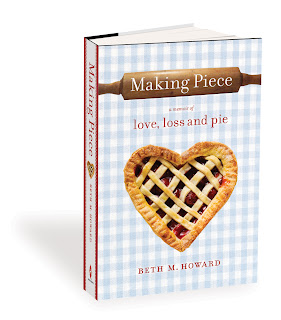
Reading her blog, I soon learned that she was also grieving. Her husband had died, very suddenly, of a heart ailment, just a couple of years ago. It was all very raw for her, and she was still processing it all. She was processing it through making and sharing pie, through caretaking the house in the background of one of the most famous paintings of the last 150 years, and, eventually, through writing a book: Making Piece: A Memoir of Love, Loss, and Pie. I’ve been lucky enough to get to know Beth Howard a little not just through blogging, but through Facebook and Twitter; I was able to follow her adventure of getting her book published, and it was truly exciting to see it finally come out. (I’m honored to have received a shout-out in her acknowledgments.) It took me a little while to get to reading it myself, but I do recall that I was rather nonplussed by the book’s review in the Buffalo News. The reviewer took the book to task for being too much about grief and not enough about pie. But the book’s very subtitle puts pie third, behind love and loss. What did that reviewer expect?
It’s really very proper that a book that deals with grief should be, to some extent, dominated by grief, because grief dominates. It just does. When grief comes, it comes hard, and it doesn’t just demand attention – it commands it. Grief is the only thing you feel, and even as it’s awful and unpleasant, there’s a strange guilt that sets in when you suddenly realize, for one second, that you’re feeling something else. It’s almost as if your mind says, “Oh my God, I’ve stopped grieving for a moment!”
Ultimately, the specific details of any one person’s grief are utterly different from any other person’s. It’s the quality of the experience of grief that is universal. It’s in the thousand little ways that grief seems, for a time, to take over one’s life. Beth’s book captures this very effectively.
The other half of the equation is, of course, dealing with grief. How does one ‘move on’? Well, you don’t, but that’s a story for another time. What you do is find a way to channel the grief into a positive use of energy. In Beth Howard’s life, that turns out to be pie: and not just the baking of pie at home, but making a life mission out of pie. She teaches people how to make it, how it brings people together, how many memories can be shared over the making and eating of it. Beth spent quite a lot of time trying to figure out how to best execute her new mission in life: a bakery? A TV show about pie? Her life eventually brings her to Iowa, where she finally comes to live in the American Gothic house. She bakes pie there, runs her little pie stand, and judges pies at county and state fairs, where her attempts to describe her reaction to a French Silk pie in erotic terms doesn’t quite make the other ladies on the judging panel happy.
Making Piece is not really a food book. It’s a personal narrative, much of which centers on food. It’s about injury and healing, and the way food plays a role. There’s a zen quality to Beth’s writing, and in her approach to her life, in following passions and ideas and interests, and in finding a way through pain by taking pleasure in doing a certain task, over and over again. It’s almost as if pie serves the role of a mantra in her life. Making Piece is her confessional: sometimes warm, sometimes raw, sometimes uncomfortable, and always honest and compelling.
True confession time: I have never made my own pie from scratch. This winter, I think it’s time to scratch that from my list.
Share This Post

A Random Wednesday Conversation Starter
(Before the question: I have not forgotten about the outstanding Ask Me Anything! queries! I swear I’ll get to them. I’m behind on posts I want to write, but I’m farther behind on other stuff. I’ll have that shield down, you’ve got to give me more time!)
OK, the question: What is your favorite ‘polite’ (i.e., you can say it in front of your mom without fear of getting your mouth washed out with soap) expletive? For SF readers, what’s your favorite fake expletive or curse?