A Random Wednesday Conversation Starter

Roger wrote an interesting post the other day about the process by which he and his wife arrived at their daughter’s name (“Lydia”, which is, by the way, a perfectly lovely name). A taste:

*No naming after any family member, living or dead. I want her to have her own identity. And I didn’t want, “Oh, you named her after Aunt Hortense!” We’ll call her Little Horty!” No, you won’t.

Actually, I would have considered Charlotte, after my great aunt Charlotte, who had died a couple years earlier, truth to tell. And my mother was living in Charlotte, NC; we referred to her, my late father, my baby sister and her daughter as the Charlotte Greens. But The Wife wanted to consider Ann, which is her middle name and her mother’s first name; so I nixed both names.

*No unisex names: Terry, Madison, Lynn, e.g.

This comes directly from the fact that my father AND my sister were both named Leslie. Confusion ensued, and often at my expense. Since my father had a child named Leslie, it was ASSUMED it was his ONLY son, i.e., me. “Hey, little Les,” one guy from church constantly called me. “That’s NOT my name,” I’d mutter under my breath (but never aloud, for that would have been considered rude.)

*It had to have two or more syllables, to balance off the shortness of Green.

That was my other objection to Ann.

This got me to thinking about our own process when The Daughter was born. Basically, we just kind of called out names until we arrived at a first name that we both liked (The Wife liked it more than I did, but I still liked it), and then I basically got to choose the middle name. When it got to be Little Quinn’s turn to be named, we decided to use one of the names we had rejected for The Daughter, plus a middle name that The Wife liked. And later on, we had a lovely name chosen (Fiona) for the girl who was, alas, born too early to live. About the only ‘rule’ we employed, and we didn’t even arrive at this until we were trying for Quinn, that we wanted a five-letter name, since we all have five-letter names. Silly, maybe, but hey — we look for connections, don’t we?

So, folks, what went into your naming processes, whether for kids or cats or goldfish?

Share This Post

“This never-ending road to Calvary….” (Thoughts on Les Miserables)

It all comes back to Star Wars, doesn’t it? Even Les Miserables.

What am I talking about? Well, back when The Phantom Menace came out, and initial reaction was somewhat mixed (before ossifying into outright hatred), I remember an article on some site – I think it was AICN – in which the writer said something I found fascinating. Paraphrasing, it went roughly like this:

I’ve made Episode I in my head many, many times since 1983. Now I’ve had to see the real thing twice, once just to get the one I’ve been making in my head for sixteen years out of the way so I can come to grips with the real one that George Lucas made.

I understood the sentiment, but I never made Episode I in my head – or any other Star Wars movie, for that matter. (What I did, in fanfic, was remake the original trilogy entirely, but that’s a tale for another time.) But the movie I have made in my head many, many times over the better part of two decades?

Les Miserables.

And I mean, I’ve made that movie in my head. All the way down to various visuals. Bear with me here a moment. I’ve seen the film tied together around a single location: a bridge over the Seine. We’d first see that bridge when Jean Valjean is conflicted over his release after he stole the silver. We’d see it again when Fantine sings “I Dreamed a Dream”. And again when Javert sings “Stars”, and again when Eponine sings “On My Own”. And at the end of the film, the entire cast would gather on that bridge, after Valjean’s passing. The bridge would be a visual motif tying the entire thing together.

(I know, this would require a bit of license, given that much of the first half of the story doesn’t take place in Paris. Like I said, bear with me.)

I don’t know why I’ve so vividly imagined Les Mis in my head over the years, because I very rarely do that with music. I’m never one to visualize certain scenes or mental images when listening to music, even if the composer intends me to do so, as is often the case with Berlioz. I generally belief, along with Leonard Bernstein, that music is inherently abstract, and that a composer can call his piece “The River” all he wants, but that doesn’t make the piece an actual depiction of a river. This was driven home once in grade school when a music teacher handed everyone a sheet of paper and some crayons and played a piece of music, telling us to draw what we heard in the music. Not one of us drew what the composer said was in the music.

So why did I have such strong visualizations of Les Mis? I have no idea, and I must answer blandly with something along the lines of “I am large; I contain multitudes.” But anyway, now along comes the real movie version of Les Mis. No, it doesn’t match up to my visualizations at all, and there were times when I thought, “No, that’s not the way it’s supposed to look!” But those moments were few and far between, and there were moments when it looked right to me, anyway.

Ultimately, Les Mis the movie seems to be fairly polarizing. I’ve heard basically two categories of responses to this film: “Oh my God thank the Lord that’s over and I never hafta watch it again”, and “Oh my God that movie was a religious experience I can’t wait to watch it again”. And the reactions, at least in my small and not-randomized sample, doesn’t seem to directly correlate in any real way with people who never saw the stage show and people who have.

So what did I think? Well…my reaction isn’t entirely positive, but it’s a lot closer to the latter reaction than the former. I did love the film, but not unreservedly. And my reservations aren’t entirely because the film doesn’t map out exactly with what I made in my head.

Story-wise, the Les Mis film is pretty much exactly the stage show that I saw last year. A few songs have been shortened or altered slightly, but in general, there’s nothing significant missing from the film that happened in the show. Thus, any difficulties in the story are inherent in the show itself, and in its nature: the show distills an immense novel down to a single night’s entertainment, and it does it mostly with music. (I’m reading the novel right now, as it happens. I’m taking my sweet time with it, doling it out to myself at a rate of about 10-15 pages a day. At that rate, I should be able to get through it in about three months. I’ve been at it for a few weeks already.)

From a story standpoint, then, the main problem is the same as the show’s: not enough backstory can be established, particularly in the second half, once our young revolutionaries show up. It’s hard to feel any particularly great emotional involvement in that particular storyline, because the film just can’t go into any great depth about what these students are fighting for and what the source of the revolutionary fervor happens to be. Now, I’m not even close to that point in the book yet, so I can’t be sure if Victor Hugo suffers the same problem, but on the basis of what I’ve read thus far, I rather doubt it. Hugo’s problem seems to be that he never met a chunk of backstory he didn’t love and go on about at length. Not the problem in the movie.

So, that being the case, what are we to make of that whole part of the film and the stage play? The idea seems to be to take Jean Valjean and Javert and put their respective moral centers in the middle of yet another set of moral choices, that of revolution. This can get a bit lost in the shuffle as the melodrama, wonderfully musical as it is, cranks on and on. But again, short of reworking the entire show, I’m not sure how the filmmakers could have really solved the structural problem of the story’s second half. I do think that the film makes two musical choices that don’t help matters, though.

First is a simple one: the wonderful song “Drink With Me” is greatly shortened in the movie. In the show, it’s a gorgeous song of men’s chorus, the young revolutionaries, singing sadly during the night after their first clash with the Paris military. The die is cast, and now they know that it’s for real: at this point real prices have been paid, and the song in its complete version plays as a serene acceptance that no matter what happens now, these young men will never again be simple lads wiling away the time with wine and women. There’s a fatalism to the complete song that’s sadly absent here as the movie only gives us one or two verses.

Second is more problematic. I think I know why Tom Hooper and the producers did it, but it still seems to me a pretty big error. In the film, we don’t hear the show’s singular anthem, “Do You Hear the People Sing”, until after what is the huge show-stopping number in the stage show, “One Day More”. And “One Day More” can be emotionally overwhelming – just listen to it (starting at 1:15) in the famed tenth anniversary concert performance of the show’s score. The problem? For one thing, “Do You Hear…” is what really establishes the revolutionaries in the story, even moreso than “Red and Black” (which immediately precedes “Do You Hear…” in the show). It’s the type of stirring melody that we haven’t heard to that point in the show, and when it comes, it really signifies that something’s coming, that as they say these days, shit’s about to go down. “Do You Hear…” conveys a sense of inevitability to what’s about to transpire, and the tune overhangs everything afterwards.

But in the movie, “Do You Hear…” is moved to after “One Day More”, which I found extremely jarring, because “One Day More” derives much of its astonishing effect from being a literal reprise of just about all the melodies of the entire first half of the show. “Who Am I?”, “I Dreamed a Dream”, “Master of the House”, and “Do You Hear…” – they’re all there, contained within “One Day More”. But in the film, you haven’t heard “Do You Hear…” yet. Instead, you hear it immediately afterwards, when the revolutionaries crash the funeral of the General. What the show does right after “One Day More” is more subtle, because in the show, the next thing we hear is Eponine and “On My Own”. Both acts feature, very early on, a woman singing of heartbreak and unrequited love – Fantine in Act I, and Eponine in Act II. The film messes with the structure a bit, and it doesn’t entirely work.

Neither, it pains me to say, do some of the film’s visual choices. Tom Hooper seems to have set out to make a movie of beautiful squalor, or squalorous beauty, or something like that. There’s a disjointed sense to the film’s visual approach that I found hard to put my finger on, until late in the film, when Valjean carries Marius through the sewers. When they emerge, they are covered literally head to toe with the filth of those sewers, and it was hard for me not to think, “My God, was that really necessary?” And there it was: there are times when it’s clear that Hooper is trying for beautiful effects, because he gets them when he wants to. But then there are other times when he feels the need to dial up the visual ugliness, with washed-out colors, with lingering shots on corpses, with Valjean and Marius completely encased in more shit than Andy Dufresne did, for basically doing the same thing.

I’m of similarly mixed mind on Anne Hathaway’s Fantine. Not because of anything she did, because I think she was basically amazing throughout. But even so, as gut-wrenching as her “I Dreamed a Dream” is, I can’t help wondering how necessary that was – the single take, the broken sobbing, the rest of it. Again, the concert performance of the show is key, because there, they can’t do a lot of stage trickery, so they just let the song speak for itself. For my money, Ruthie Henshall sells Fantine’s soul-crushing heartbreak every bit as well as Hathaway did. But here, I’m quibbling with a stylistic choice, and not so much with the song in question, but with an overall approach of ratcheting up the ugliness at times, which seemed rather unnecessary. Again, I’m not done with the book, but it seems to me that a theme of Les Miserables is the presence of beauty in the world that many can never touch or know.

All this sounds like I’m ripping the movie, but I don’t think I am. There’s much to love in it, because I really did enjoy it immensely, and I’ll be thankful to have it in my DVD collection for when I need a fix. For one thing, aside from the few musical alterations I mention (and the omission of Eponine from Valjean’s death scene, which struck me as quite wrong), the songs are for the most part given room to be the songs they are. That’s important, because in a movie like this, the music is what’s prime – nothing works if the music doesn’t work. And it does.

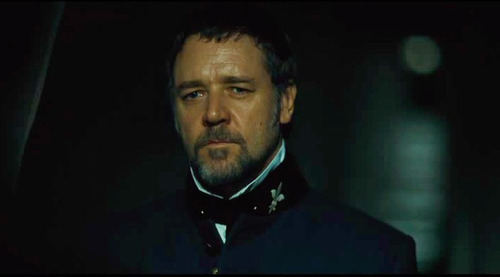
I had zero misgivings about the cast. Like many Les Mis lovers, the casting of Russell Crowe as Javert struck me as potentially problematic, not because of his appearance, but because he simply isn’t blessed with a great musical voice. And when your mental template for Javert is the great Philip Quast, well…yeah, good luck there, Russell. But Crowe did very well, I think, precisely because he doesn’t have a great voice. This makes sense to me because Javert is a man of virtually no happy touches in his life, no vices, no room to enjoy anything whatsoever. I have no trouble at all with the fact that his singing is distinctively unmusical, because Javert’s singing stands at odds with his role in the story, doesn’t it? Plus, Crowe’s singing voice plays in well with the way he plays Javert in the first place: his Javert is a man of weariness, a man who has seized on his obsession with upholding the law as the only way he can make sense of a world in which no matter how righteously he pursues his obsessions, he can never make the world into ‘paradise’. Humans have fallen too far, and Javert knows it – but he can’t ever say it. Crowe captures this internal strife of Javert’s perfectly: there is always a hint of tired confusion lurking in his eyes, and we know, almost immediately upon meeting him, that suicide is likely the only way he’ll ever reconcile the world with his place in it.
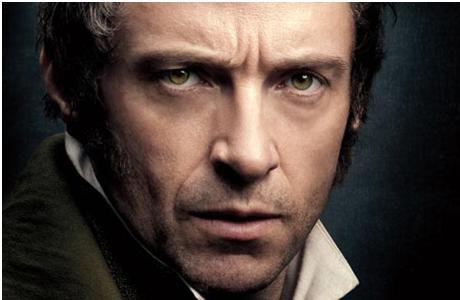
Hugh Jackman’s Valjean is likewise brilliant, and the film would fail utterly without him. I don’t think that the production decision to sing live on stage always served Jackman’s voice to the highest degree, but that is, again, a quibble. Jackman captures Valjean’s internal goodness as perfectly as Crowe captures Javert’s inability to live in the real world, and I loved Jackman’s voice. His Valjean is more of a tenor than usual, but that’s no matter. He completely convinces me of Valjean’s pain, of his moral certitude once he is set on the right course by a compassionate priest, and of the seriousness with which he holds the vow he made to Fantine on the night she died. Best of all, Jackman’s Valjean always seems to be thinking. He’s not just going through the motions of always doing what is moral; Jackman shows us that Valjean has to work at it, even if the music and script don’t always make that internal struggle entirely clear. (Victor Hugo spends entire chapters describing Valjean thinking about his moral choices.)
In all honesty, I can’t think of a wrong note in the cast. Amanda Seyfried’s Cosette is…well, she’s just kind of there, but I don’t think that Seyfried can possibly be blamed for that, as Cosette is just…well, there’s not much there there, with Cosette. She’s easily the weakest link in the stage show, dramatically speaking, and the film can’t really solve that difficulty, either. Cosette is just there to be loved, either protectively (Valjean), or unattainably (Fantine), or romantically (Marius). Eponine is far better drawn as a character in her short time on stage, but she’d better be, because her story is the tragic one.

Sacha Baron Cohen and Helena Bonham Carter as the Thenardiers? That was, for me, utterly perfect casting. Of all the numbers in the film, “Master of the House” is closest to that movie I’ve made in my mind over the years – my “Castle in the Clouds”, so to speak. The Thenardiers are disgusting individuals, the ones who steal the coins from the dead man’s eyes, so to speak. And the way they keep popping up is disconcerting, as if the very world is constantly trying to drag back down those who would rise above it. Which, when you think about it, is really true, isn’t it?

The best person in the cast is very likely Samantha Barks as Eponine, who makes the absolute most of the relatively short time she’s around. Her emotions are raw and we feel them with her, and Barks does something wonderful in the way she allows Eponine’s love for Marius to show only when he’s not looking (until the very end). It’s kind of a shame that Anne Hathaway’s “I Dreamed a Dream” seems to be shaping up as the film’s musical highlight, because Barks’s “On My Own” is amazing. But then, it’s Eponine’s constant fate, isn’t it, to stay in the shadows of someone else?

So no, Les Miserables is not a perfect movie. And it won’t win over anyone who didn’t like the stage show. Nor, I think, will anyone who sees this movie, wonders what the fuss is, and then goes to the stage show find that experience terribly more satisfying. This isn’t my Les Mis, but it is Les Mis. Warts and all, maybe more warts than I would have liked.

Put it this way: After writing this review, all I can think is…I want to go see it again. As soon as humanly possible. “One more day…another day, another destiny….”

Share This Post

Sentential Links

Let’s just keep saving the world, folks, one link at a time….

:: I can believe gullibility, I can believe catfishing, I can believe that some people are really good liars and willing to take advantage of people…but I have been in a long-distance relationship. I met my current wife over the Internet. And I can tell you with 100% certainty, if you care anything at all about your long-distance significant other, you are going to make an effort to see them. (This is where my ability to believe Te’o’s story falls apart as well. I just don’t buy this, nor do I buy, as some people have said, that he was just a college student who just couldn’t fly to LA at a moment’s notice. Maybe that’s true for a college student like I was, a run-of-the-mill philosophy major, but the star linebacker on one of the country’s most notable football teams? Come on.)

:: I almost never reread my own novels, once they are printed and on sale. The small exception is the period when I am choosing reading passages for a new one, and once or twice when I needed to help with a pitch for an older book for Hollywood purposes. (Guy Gavriel Kay only blogs when he is in the final stages of getting a new book published, so it’s nice to get a look in, once in a while. While it’s pretty meaningless coming from me, Mr. Still Unpublished, I have to admit that I, too, tend to not look at my earlier work all that much. I find that the short fiction stands up better than my aborted attempts at novels past, or even the screenplay that I wrote a few years ago, which will never see the light of day. (Don’t ask.) I suppose this is my way of finally, once and for all, declaring The Promised King dead. But even there, you never know…there’s no law that says you can’t go back to an earlier idea, once your skill improves. But it would have to be very different, given that there are aspects of that earlier book that manifest in Princesses In SPACE!!! (not the actual title).)

:: From those of us who are still living in Buck Rogers’ 25th Century, here’s wishing our very best to 70’s space hero – and intergalactic Romeo – Gil Gerard on his 70th birthday. (Just a one-sentence link, but holy crap — Gil Gerard is 70?! Quick, somebody freeze that guy for a while! Four hundred years oughta do it.)

(Hey, come to that, how come Buck Rogers hasn’t been rebooted yet? I’d be on board with a revisiting of that old property!)

:: There’s a somewhat startling 1978 Betty and Veronica story by Dan DeCarlo, the cartoonist who more than any other was responsible for defining the characters’ appearances and personalities, which attempted to make the point that there really is no choice at all: Betty and Veronica aren’t two different girls as much as they are two halves of the same girl.

:: Star Trek: Deep Space Nine is now twenty years old. The first episode aired on 3 January 1993, whilst The Next Generation was still on the air, and it was for 176 episodes over seven seasons, ending in May 1999. (I really need to start re-watching Trek in a big way. Twenty years since DS9 started! I always thought that was the best of the Trek series, in terms of overall quality; at its best, it was utterly great, and it never seemed to get as downright bad as TOS or TNG could be at times.)

:: If, like many fans, you have spent decades wondering what the Red Skull smelled like, this was your lucky week: (Hmmmm…yeah, no. Never wondered that a single time. Weird!)

:: AMAZING STORIES, the world’s first science fiction magazine, is now open to the public. (This is actually very cool news! Go to MD’s site for details. Note to self: set up an account this week!)

More next week!

Share This Post

Saturday Centus (Sunday edition)

I’m a day late with this week’s prompt, not because I was busy or because I forgot, but because this prompt is so evocative to me, on a personal level, that I had to think about it for quite a while. The phrase that Jenny assigned is one that seems to fall right into place in the universe of my novel-in-waiting*, so much so that this bit might end up in a future sequel that’s trundling about my brain.

Though you go to a place
where starlight fades,
I will find you.

Though you go to a place
where darkness reigns,
I will free you.

Though you go to a place
where all is old and all is cold,
I will save you.

Never, ever forget,
all the days you have,
the place you have in my heart,

No matter how long you journey,
no matter how far you go,
and that we will live the ages

Together:

Even if we are apart,
with me still here
and you gone far, far, far far beyond
the dark side of the stars.

* For Centusians who haven’t dropped by in a bit because I’ve been lax, I have submitted the manuscript of my space opera novel to a publisher, and I have also queried a couple of agents and plan to query more and more and more until one takes me on or until all the agents in the world rise up, with one unified voice, and say, “Verily your writing doth sucketh, so bother us no more!” Anyway, there’s a lot in my universe that I can with “the dark side of the stars”.

Share This Post

Sunday Burst of Weird and Awesome

Oddities and Awesome abound!

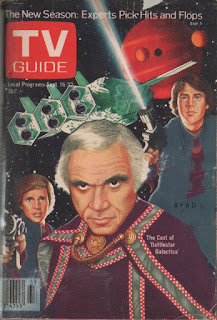
::  Jason Bennion posted this pic on Facebook. It’s the TV Guide cover from when Battlestar Galactica was set to premier, back in fall of 1978. Pretty cool stuff, although…well, I’ll give the geeks out there in the audience a chance to notice it.

Yup, look at that for a little bit. A hint: one of the details is really wrong.

See it yet?

The ship on the cover: that’s not the Galactica. That’s the back end of Discovery from 2001: A Space Odyssey. Oops!

What likely happened is that this issue had to go to press before ABC was willing to release certain details, like what the titular starship of the show looked like. (And also, judging by Richard Hatch’s and Dirk Benedict’s heads being placed atop weird gray blobs, certain details of costume design as well.) Understandable, but pretty amusing nonetheless! That’d be a funny mashup, anyway — just as the Cylons attack, they’d have to contend with Hal refusing to open the pod bay door….

::  A couple of folks go Scuba diving in Hawaii. Just a normal dive, down to the bottom…when one of the guys looks up, and Whoa! Admiral, there be whales here!


I tend to think that diving would be a bit too scary for me, but wow, what a moment that would be.

:: I’m not embedding this video here because it’s really kinda icky, but…sneezing in slow motion. There are things that should be seen in slow motion. This is not one of them.

More next week!

Share This Post

Film Quote Friday: “Sneakers”

COSMO: You could have shared this with me.

MARTIN: I know.

COSMO: You could have had the power.

MARTIN: I don’t want it.

COSMO: Don’t you know the places we can go with this?

MARTIN: Yeah, I do. There’s nobody there.

COSMO: Exactly! The world isn’t run by weapons anymore, or energy or money. It’s run by ones and zeroes, little bits of data. It’s all just electrons!

MARTIN: I don’t care.

COSMO: I don’t expect other people to understand this, but I do expect you to understand this! We started this journey together!

MARTIN: It wasn’t a ‘journey’, Cos. It was a prank.

COSMO: There’s a war out there, old friend, a world war. And it’s not about who’s got the most bullets. It’s about who controls the information: what we see and hear, how we work, what we think. It’s all about the information!

MARTIN: If I were you, I’d destroy that thing.

I saw Sneakers when it first came out, back in 1992 or thereabouts. It quickly became one of my favorite movies, and I saw it several more times theatrically before it became a fixture in my rotation of movies to rent on occasion, and later, when I had a sizeable collection of movies on VHS. But for one reason or another – mainly because I just never got around to it – Sneakers never got into my DVD collection, so I haven’t seen it in…holy crap. More than ten years. That seems rather wrong to me now, in retrospect, but never fear – I finally watched it recently, with some fear and trepidation that, like many a techno-thriller made more than a decade ago, it wouldn’t hold up very well.

Surprisingly – and satisfyingly – it does hold up, very well. And more than that: it’s striking to me now, twenty years later, just how eerily prescient this movie was.

Sneakers is one of the most entertaining cyberthriller-espionage movies I’ve ever seen. Robert Redford stars as Martin Bishop, the head of a security firm consisting of a group of men whose backgrounds mostly include shady dealings or outright brushes with the law. Their main job is simply to break into places that are supposedly highly secure, in order to demonstrate the lax areas in the security. They seem to be mostly just eking by: when they complete a job for a bank early in the film, a bank officer fills out the payment check, looks at it, and comments that it’s not a very good living. The team gets hired for another job, this time by two men claiming to be NSA agents, who happen to know who Martin Bishop really is (for which he could go to jail). They are to steal a device that decrypts codes which are supposedly unbreakable, which they do, and then give to the NSA guys – only to learn that they’re not NSA guys at all, and that they’ve murdered the mathematician who invented the device.

In a deeply eerie scene, Bishop’s hacker buddies start probing around with the little black box, just to see what it can do – and they discover that it can allow anyone to hack into extremely sensitive computer systems. The power grid of the entire Northeast…the Federal Reserve…air traffic control. They couldn’t have known it, writing this movie ten years before 9-11, but hearing one of the hackers jokingly say, “Anybody want to crash a few passenger jets?” is deeply chilling.

The entire movie is about security in an increasingly digital world, and at the end of the film, the exchange quoted above takes place, between Bishop and his onetime college buddy Cosmo, who has become a villain since doing time in prison for a crime that he committed with Martin at his side (but who eluded capture by the police simply by going out for pizza when they showed up with the guns). The idea of the world become increasingly governed by, and even defined by, the processing of data was a pretty bold one back in 1992. When I saw this movie, I had not yet even heard of the Internet, and the digital infrastructure that Sneakers portrays – with dial-up modems and not a cell phone in sight – seems utterly quaint. And yet, the movie is somehow fresh, despite all that, largely owing to the charm of the cast, the sparkling dialogue, the engaging direction, the brisk pacing, and – in terms of the technology – the nicely non-specific way the technology is depicted.

There are a lot of very clever touches in Sneakers: the reverse ‘race against time’, for example, in which Martin Bishop has to get a job done and yet literally can only do it at a very slow pace, lest the motion detectors notice his presence. Also the way they enlist Martin’s former (and yet still friendly) girlfriend to help with the problem of recording a particular scientist’s voice for use against the voice-print ID gizmo. (If the phrase “My name is Werner Brandes. My voice is my passport. Verify me.” is in your geek lexicon, then you are my kind of people.) I also like how vague the movie is about Cosmo’s villainy. We never learn who he works for, or if he is the main ringleader; we never learn what exactly it is that he wants to accomplish with the little black codebreaking box. In fact, it’s entirely possible that Cosmo doesn’t even have a specific plan in mind at all, and that he just wants the codebreaker because it will give him power that he as yet doesn’t really know how he intends to use it. He’s almost purely a theoretical villain, which is what makes him even scarier — as well as the sheer optimism of his villainy, which is what makes the quote above so memorable. It’s not about making threats or committing crimes or any of that dirty stuff. It’s about the possibilities inherent in controlling the world’s data.

And that is really makes this twenty-year-old film stay relevant.

Share This Post

Darth Abrams?

According to a number of media reports, JJ Abrams is directing the first Star Wars movie of the Disney era. I’m mostly fine with this — of all my myriad problems with Star Trek 2009, none of them were in the film’s execution or direction. I thought that Abrams made a fine explodey-spaceshippy-goodness movie, so if he’s directing Star Wars, yeah…I’m fine.

I don’t want him writing it, though. I’ve never cared for his work as a writer. Nor do I want Orci and Kurtzman to write it, either. Because they are, frankly, terrible writers.

If only there was a writer out there somewhere, well-steeped in Star Wars and space opera, waiting for his big break…if only…doo de doo de doo….

Long live Star Wars!

Share This Post

Something for Thursday

Sticking with a recent flare-up of a longtime obsession of mine, the music of the Russian Romantic and post-Romantic composers, here is the Capriccio Espagnol by Nikolai Rimsky-Korsakov. This piece is in five short movements, and constitutes something of a musical ‘travelogue’, intended by Rimsky-Korsakov to convey what he thought to be the musical flavors of Spain.


In the days of CDs, this work almost always showed up as the pairing on discs containing Rimsky-Korsakov’s longer, and possibly most famous, work Scheherazade. R-K was one of the great genius orchestrators, with an astonishing ability to use the instruments of the orchestra to create tableaus of enormous color and range. Enjoy!

Share This Post