OK, this is long…quite long. But necessary, because this is when we finally get to the meat of the whole thing.
At the end of last entry, Mace Windu had placed Anakin Skywalker under house arrest for the crime of MWJ (Marriage While Jedi). And now, Windu is on his way to force the Chancellor from power, not knowing – and having refuse to hear from Anakin – that Palpatine isn’t just the Chancellor, but also a Sith Lord. Anakin knows that Mace Windu is walking into disaster, and that he’ll need help if he is to take down a Sith Lord. What will Anakin do? Here we go!
I like the interplay of Anakin and Padme looking across the Coruscant cityscape to one another, but Anakin’s decision to defy Windu and go join the arrest of the Chancellor comes a bit out of the blue. We know why he’s feeling so tortured, but even so, there’s nothing that really establishes it; we have to tease it out from what we know of the story at that point. We have Anakin and Padme looking at each other across the skyline (well, looking toward one another, anyway), and then Mace and friends arrive to arrest the Chancellor (knowing that he is possibly a Sith Lord), and then Anakin takes off.
So I change all this to remove Mace Windu knowing of Palpatine’s Sith status, and to establish Anakin’s rage at Windu for basically having kicked him out of the Jedi. Anakin is starting to spiral out of control, now. In the film, the sequence of events feels incomplete, so my goal is to connect the dots a bit.
Again, I’m doing this without a lot of comment — I’ll just present my rendition of events. Enjoy — revisiting this terribly sad and emotional sequence was quite rewarding!
EXTERIOR: Planets – battle montage.
The various battles continue, with OBI WAN, YODA, PLO KOON, and other JEDI leading the fight against the battle droid armies.
INTERIOR: Coruscant – Jedi temple – Great Hall.
MACE WINDU stands with three other JEDI as he confers with a fifth, a young-looking JEDI WOMAN named GALINDA.
(“Galinda” is just a placeholder name, obviously. Go with it, folks!)
WINDU: We are going to confront the Chancellor and force him to stand down from his office.
GALINDA: Understood.
WINDU: If he refuses, we’ll be forced to act against him. Palpatine has many friends in the Senate. It will be your job to take a contingent of Jedi to the Senate and enforce our decision.
GALINDA: The people won’t like it, Master Windu.
WINDU: We are acting in their interest. Democracy must be restored, even if by force. You have your instructions.
GALINDA: I will await your signal.
WINDU: May the Force be with us all.
GALINDA bows as MACE WINDU and his other three JEDI turn to go confront the CHANCELLOR.
INTERIOR: Coruscant – Senate building – observation deck.
PADME sits with BAIL ORGANA, MON MOTHMA, and several others.
MON MOTHMA: All reports are that the war cannot go on much longer.
BAIL ORGANA: That may be true, but if so, we don’t yet have enough support in the Senate to stand against the Chancellor.
MON MOTHMA: I wonder what the Jedi think of all this….
The political talk goes on, but PADME is not listening quite attentively. Her hand absently massages her own belly, and she finds herself looking past her comrades, to the great glass windows overlooking the city.
INTERIOR: Coruscant – PADME’s apartment.
ANAKIN kneels on the floor, meditating. He is trying to achieve peace, but is having little success.
ANAKIN: Calm…at peace…passive….
His eyes are twitching, though, and he is beginning to sweat.
ANAKIN: Padme….
INTERIOR: Coruscant – Senate observation room.
PADME’s attention is increasingly focused on the great cityscape. We see that she is looking in the direction of her apartment building.
INTERIOR: Coruscant – Padme’s apartment.
ANAKIN’s meditation is growing more and more intense. He begins hearing VOICES:
PADME: Anakin! Please!
YODA: Death is a natural part of life…Mourn them, do not. Miss them, do not. Attachment leads to jealousy….
PALPATINE: He even learned to stop those he loved from dying….
MACE WINDU: You are no Jedi…The boy will not be trained.
PALPATINE: Your destiny does not lie with them.
PADME: Anakin! Please!
OBI WAN: Let her go, Anakin!
PALPATINE: Anakin!
MACE WINDU: Anakin!
QUI GON JINN: Anakin!
OBI WAN: Anakin!
PADME: Anakin!
ANAKIN snaps back to the present and blinks his eyes. He is very sweaty now. One last voice sounds in his mind:
PALPATINE: Only with my help, with my power, will you be able to save Padme.
ANAKIN rises to his feet and starts toward the door, but the JEDI move to intercede. He raises his hand to do something with the Force, and they ignite their lightsabers. ANAKIN gestures to a large sculpture and raises it with the Force, and the JEDI move into defensive position…but instead of hurling it at the JEDI, ANAKIN hurls it through the glass window, smashing it wide open. Then he runs and leaps into the open air, the sky of Coruscant.
C-3PO: Oh my!
EXTERIOR: Coruscant – twilight – sky above city.
ANAKIN plunges through the air and lands atop a speeder, whose DRIVER reacts with astonishment. ANAKIN jumps into the speeder alongside the driver.
ANAKIN: The Senate building. Jedi business.
The DRIVER jabbers something, but obeys.
INTERIOR: Senate building – Chancellor PALPATINE’s office
PALPATINE sits at his desk, calmly reviewing reports. We HEAR the outer door slide open, and PALPATINE looks up from his work and smiles.
PALPATINE: Master Windu! It is good to see you, my friend. I assume you bring news. Has Master Kenobi defeated General Grievous?
MACE WINDU enters, with the three other JEDI.
WINDU: He has, Chancellor. The Separatist forces are on the run and will be dealt with. For all intents and purposes, the war is over.
PALPATINE: Indeed? Many people may still die while the Separatists are on the run. Be mindful of assuming too much.
WINDU: Jedi are always mindful.
PALPATINE: And this news could not be trusted to your preferred messenger, Master Skywalker?
WINDU: Skywalker is…indisposed. An internal Jedi matter.
PALPATINE: Pray you handle it more delicately than your prior treatment of him, Master Windu. Now what brings you here?
The three other JEDI shift to form a defensive formation behind WINDU.
WINDU: It is time to restore proper governance to the Republic, Chancellor. You have promised to set aside your special powers and leave office when the war ended. That time is now.
PALPATINE: Is it?
WINDU: We are prepared to make a move to encourage the Senate to stand with us.
PALPATINE: I was not aware of any public mandate granted the Jedi.
WINDU: You will step down, Chancellor. You will step down now.
PALPATINE rises.
PALPATINE: Are you threatening me, Master Jedi?
WINDU: You will step down.
PALPATINE: You have no authority.
WINDU: The Senate will do our bidding.
PALPATINE: I am the Senate!
WINDU: Not yet!
WINDU ignites his lightsaber, as do the others. PALPATINE stares at WINDU.
PALPATINE: You would raise a weapon against the elected leader of the Republic?
WINDU raises his lightsaber.
WINDU: Step down, Chancellor.
PALPATINE: It’s treason, then.
A lightsaber snaps into PALPATINE’s hand, and he surges over his desk as his ignites it.
JEDI: He’s armed! He’s a Sith!
PALPATINE’s red-bladed lightsaber cuts down two of the JEDI almost immediately, and with shocking skill for a man his age, takes on a duel with the last JEDI and WINDU at the same time. In seconds he cuts down the third JEDI, and turns to face WINDU.
WINDU: Sidious.
PALPATINE: Only now do you understand.
EXTERIOR: Coruscant – night – Senate building.
The speeder that ANAKIN commandeered arrives, and Anakin barely waits for it to stop before leaping out and onto a speeder platform. He races inside, knocking over several DIGNITARIES in the process.
INTERIOR: Palpatine’s suite.
The fight between PALPATINE and MACE WINDU continues. PALPATINE is clearly the most lethal opponent WINDU has ever faced, but even so, WINDU is hardly an easy target for PALPATINE, and the two cause considerable damage to the suite in the course of their deadly battle.
Meanwhile, ANAKIN is racing through the corridors toward the Chancellor’s office.
The battle enters the Chancellor’s main office, where PALPATINE and MACE WINDU circle each other, blades clashing with tremendous speed and force. We see PALPATINE sense something in a tiny glance to one side, toward the door, which is followed by a tiny smile. And then WINDU begins to get the upper hand…or is PALPATINE letting him?
ANAKIN enters just as WINDU forces PALPATINE behind the great desk and forces him to drop his lightsaber. PALPATINE uses the Force to throw something at WINDU, but WINDU deflects it, sending it through the great window, smashing it open. Wind begins howling through the office as PALPATINE stumbles and backs against the edge of the precipice.
PALPATINE: Anakin!
WINDU: Skywalker! Help me!
WINDU tosses ANAKIN his lightsaber, which he still had clipped to his belt. ANAKIN catches it…but does not ignite it. Not yet.
PALPATINE: Anakin, I told you this would happen! The Jedi are taking over the Republic!
WINDU: Don’t listen to him, Skywalker! He’s a Sith Lord! He’s been a Sith Lord all along!
ANAKIN stands still.
WINDU: I will end this, Chancellor. Your plans are at an end, and you are under arrest.
PALPATINE: No. No, you will die!
PALPATINE blasts WINDU with Force lightning, which forces WINDU back.
PALPATINE: The Jedi are finished!
WINDU: Never!
WINDU manages to block the lightning with his lightsaber and force PALPATINE back until the Chancellor slumps back, breathing heavily.
WINDU: You are a traitor.
PALPATINE: No, you are the traitor! Anakin, you can see what is happening!
WINDU: Help me, Skywalker, and you will be a Jedi again.
PALPATINE: You will never be one of them, Anakin.
WINDU: Don’t listen to him, Anakin!
PALPATINE: They know about Padme, but they can’t help you save her! They will take her away from you!
WINDU: Enough of this!
WINDU steps forward for his final attack. PALPATINE tries to resist, but seems to be fading. WINDU moves in closer and closer…the flashes of the blue lightning reflect off ANAKIN’s face as he looks from PALPATINE to WINDU and back again…WINDU’s lightsaber blade gets closer and closer and closer to PALPATINE’s throat….
PALPATINE: I can’t hold out much longer….
WINDU: It…is…over!
WINDU raises his lightsaber for the final stroke, but then another lightsaber ignites and intersects his. ANAKIN has stepped in.
WINDU: Skywalker! What are you doing?!
ANAKIN’s eyes are wide and full of fear as he faces WINDU.
WINDU: You are a traitor as well!
WINDU’s words harden ANAKIN’s expression as he defends himself against WINDU’s attack. The duel is brief but furious, and WINDU almost wins when he strikes ANAKIN on the shoulder. The blow is only glancing, though, and ANAKIN becomes enraged and attacks with renewed and terrible vigor.
PALPATINE: Yes! Let the hate flow through you!
ANAKIN barely hears him as he pushes MACE WINDU back to the window. WINDU can barely keep up with ANAKIN’s onslaught, and then ANAKIN strikes, severing WINDU’s right hand. WINDU’s saber tumbles into the abyss and WINDU himself shrieks in agony.
And then PALPATINE springs to life, not quite so wounded as before:
PALPATINE: Power! Unlimted…POWER!!!
PALPATINE unleashes a torrent of Force lightning to dwarf everything he threw before, and in seconds it is over: MACE WINDU, one of the most powerful Jedi ever, is flung to his death.
PALPATINE: So die the first traitors.
A look of horror takes over ANAKIN’s face.
ANAKIN: What have I done?
ANAKIN turns to face PALPATINE, now looking more the frightened child than anything. He holds up his lightsaber, but his hand is trembling.
ANAKIN: Don’t…don’t move…you’re under arrest….
PALPATINE: Stop this foolishness, boy. Your choice is made. Your destiny awaits.
PALPATINE steps forward. His face has contorted into a grotesque and evil mask which he now conceals beneath the folds of the hood of a robe he pulls onto his shoulders.
PALPATINE: You can never be a Jedi now, even if you wanted to. My power awaits. Take it! She will die if you do not. Search your feelings, my young apprentice!
ANAKIN lowers his lightsaber…deactivates it…drops it to the floor.
PALPATINE: You know she will die. You are her only hope. And I am yours.
ANAKIN sinks to his knees.
ANAKIN: I pledge myself to you, Lord Sidious.
EXTERIOR: Kashyyyk – battle – command center.
YODA is listening to a report when he suddenly seems to sense something, looks away, and then returns to the moment.
INTERIOR: PALPATINE’s office.
PALPATINE: You swear to learn what I have to teach you?
ANAKIN: I swear.
EXTERIOR: Utapau – battle.
OBI WAN is climbing back onto his six-legged mount when he, too, senses something amiss. But he, too, dismisses the quick feeling….
INTERIOR: PALPATINE’s office.
PALPATINE: Do you swear that you will stand against enemies of the Republic, no matter who they may be?
ANAKIN: I will stand against them, Master.
PALPATINE: Good! Then rise, my new Sith apprentice. Rise…as Darth Vader.
ANAKIN rises. His face is grim. He has turned.
PALPATINE: And now, Lord Vader, it is time for your first duty…if your feelings are clear.
ANAKIN: They are clear, my master.
PALPATINE grins and laughs. His laughter echoes as we cut to:
INTERIOR: PADME’s apartment.
PADME’s speeder arrives and docks; PADME and R2-D2 emerge, and C-3PO approaches.
C-3PO: Miss Padme! I’m afraid we’ve had some excitement….
PADME: What happened here?
She runs into the apartment and sees that the window has been smashed open.
C-3PO: I believe Master Anakin may be in some trouble.
R2 beeps with concern.
INTERIOR: Jedi Temple – Great Hall.
Jedi Master GALINDA has organized all the JEDI of fighting ability, several hundred strong, in the Great Hall.
GALINDA: We have not heard from Master Windu. Soon we will move on the Senate anyway.
EXTERIOR: Jedi Temple – concourse.
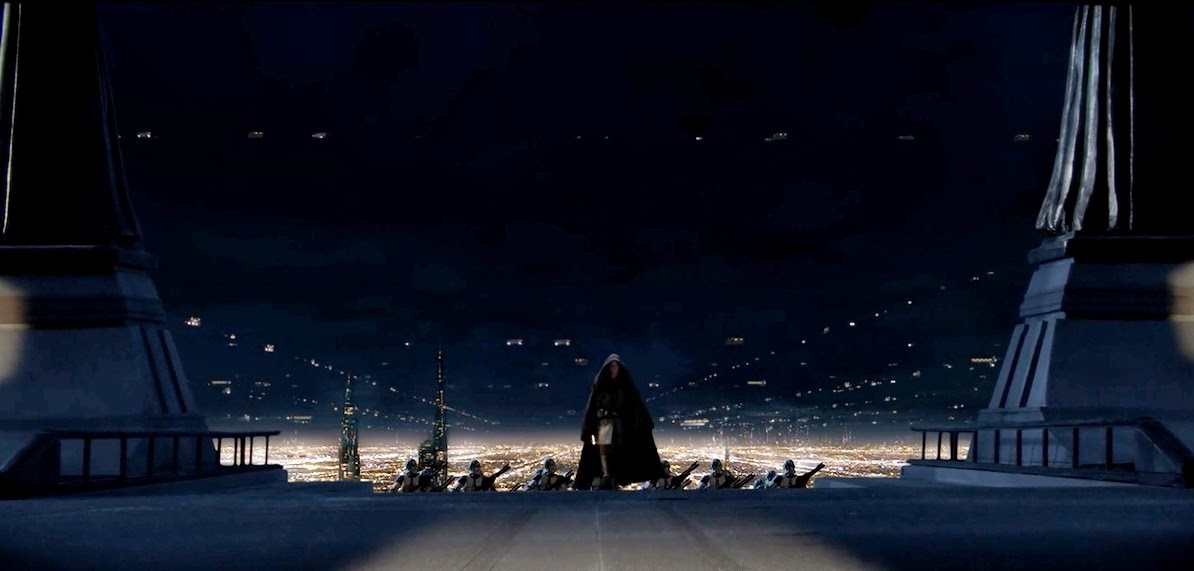
ANAKIN walks across the concourse toward the Temple entrance.
PALPATINE: (offscreen) The Jedi Order’s attempt to seize control must be stopped.
ANAKIN: (offscreen) I will stop it.
GALINDA and several other JEDI emerge from the temple and run toward ANAKIN.
GALINDA: Skywalker? But Master Windu said….
Her attention is caught by the marching contingent of CLONE TROOPERS, easily a thousand strong, marching onto the concourse behind ANAKIN.
PALPATINE: offscreen Traitors to the Republic cannot be tolerated. Do what must be done. Show no mercy, for they have earned none.
ANAKIN: offscreen I will show them no mercy. I will do what must be done.
GALINDA ignites her lightsaber, as do the other JEDI. ANAKIN’s expression does not change one bit as he ignites his…but now, he carries PALPATINE’s red lightsaber.
EXTERIOR: UTAPAU-TENTH LEVEL-LANDIXG PLATFORM-DAY
The battle between the CLONES and the DROIDS rages throughout the sinkhole. OBI-WAN rides up to CLONE COMMANDER CODY.
OBI-WAN: Commander, contact your troops. Tell them to move to the higher levels.
CLONE COMMANDER CODY: Very good, sir.
CLONE COMMANDER CODY starts to move away, then remembers something and returns to OBI-WAN.
CLONE COMMANDER CODY: (continuing) Oh, by the way, I think you’ll be needing this.
He hands OBI-WAN his lightsaber, and the LIZARD rears up.
OBI-WAN: Thank you, Cody, I’ve always had the most trouble with dropping this. Now let’s get a move on. We’ve got a battle to win here!
CLONE COMMANDER CODY: Yes, sir!
OBI-WAN and the LIZARD ride off down the wall of the giant sinkhole.
EXTERIOR: GALAXY – BATTLE MONTAGE.
Another MONTAGE of JEDI leading CLONE TROOPERS into battle.
On Kashyyyk, YODA looks increasingly disturbed.
INTERIOR: Coruscant – Jedi temple.
ANAKIN is methodically butchering his way through the JEDI, with the CLONE TROOPERS backing him up. The scene is hellish as JEDI after JEDI falls. They Force-throw large objects at him, but he flings each aside.
INTERIOR: Palpatine’s office.
PALPATINE presses a button, and COMMANDER CODY’s holographic image appears.
CODY: Chancellor?
PALPATINE: Commander Cody. Your time has come.
CODY’s posture changes, as PALPATINE’s voice and words trigger something in him.
CODY: I obey, sir.
PALPATINE: Execute Order sixty-six.
CODY: It will be done.
PALPATINE grins evilly as CODY’s image fades.
PALPATINE: Die, Jedi fools, die….
EXTERIOR: Utapau – tenth level.
CLONE COMMANDER CODY gestures to a nearby Clone Trooper.
CLONE COMMANDER CODY: Blast him!
The battle rages all around OBI-WAN. DROIDS and CLONES are everywhere. OBI-WAN is riding on a LIZARD, cutting down DROIDS as he races across the battlefield. Suddenly a volley of laser blasts from behind him knocks him and his LIZARD off the wall of the sinkhole. He looks around just in time to see his CLONE TROOPS are firing on him. OBI-WAN falls hundreds of feet to the bottom of the water-filled sinkhole.
EXTERIOR: MYGEETO-DAWN
The sky slowly awakens on the crystal world of Mygeeto. A battle rages. Clone troops battle the droid armies across a long bridge. KI-ADI-MUNDi uses his light saber to deflect enemy fire. CLONE COMMANDER BACARA (1138) exits a Gunship near the entrance to the city. He rallies his TROOPS to attack the city, then gets a message on his comlink. He stops and moves to one side as a HOLOGRAM OF DARTH SIDIOUS appears on the comlink in the palm of his hand. He moves further into the shadows.
DARTH SlDIOUS: Commander 1138 . . .
CLONE COMMANDER BACARA: Yes, sir.
DARTH SlDIOUS: Your time has come. Execute Order Sixty-Six.
CLONE COMMANDER BACARA: It will be done, My Lord.
DARTH SIDIOUS fades, and the CLONE COMMANDER snaps the comlink closed and looks to the main plaza of the city, where KI-ADI-MUNDI is leading the charge. The clones stop. KI-ADI-MUNDI turns around and is blasted by clone fire. He’s killed before he can defend himself.
EXTERIOR: FELUCIA-FOREST-DAY
A column of CLONE WALKERS marches across the forest floor. The STRANGE CALLS of the alien forest creatures of FELUCIA suddenly stop. The Jedi AAYLA SECURA and her CLONE TROOPS brace for an ambush.
AAYLA: Steady. . . . steady . . .
They all look around for signs of the enemy. CLONE COMMANDER BLY moves up behind the Jedi. BLY blasts AAYLA in the back. The OTHER CLONES fire on her as she hits the ground. Another Jedi, BARRISS OFFEE, is cutting down a patrol of DROIDS when a CLONE WALKING TANK and SEVEN CLONE TROOPERS round a corner and blast the Jedi away.
EXTERIOR: KASHYYYK-MEETING HALL-DAY
YODA drops his gimer stick, clutches his chest, and rests against a wall.
EXTERIOR: KASHYYYK-EDGE OF VILIAGE-DAY
The battle appears to be over. WOOKIEES stack destroyed Droids while CLONES assess the damage to their equipment. A Jedi, LUMINARA UNDULI, talks with EIGHT CLONE OFFICERS standing in a circle around her. Suddenly they reveal their hidden pistols and blast her before she can react.
The Jedi QUINLAN VOS is riding on top of a CLONE TURBO TANK. The main cannon of a second tank slowly swings to point right at him and a COUPLE OF CLONES. The cannon fires, and QUINLAN VOS and the CLONES disappear in a huge EXPLOSION.
INTERIOR: CATO NEIMOIDIA-COCKPIT CLONE FIGHTER-DAY
The CLONE PILOT watches a hologram of DARTH SIDIOUS.
DARTH SIDIOUS: Execute Order Sixty-Six.
CLONE PILOT: It will be done, My Lord.
INTERIOR: CATO NEIMOIDIA-JEDI STARFIGHTER-DAY
PLO KOON heads his ship toward a battle on a landing platform.
EXTERIOR: CATO XEIMOIDIA-JEDI STARFIGHTER-DAY
The FOUR CLONE PILOTS with PLO KOON drop back and blast him out of the sky.
EXTERIOR: SALEUCAMI-FOREST
Three Speeder Bikes race through the forest. A Jedi, STASS ALLIE is in the lead. The TWO CLONES following her drop back and blast her, causing her to crash in a huge EXPLOSION.
INTERIOR: CORUSCANT-CHANCELLOR’S OFFICE-NIGHT
DARTH SIDIOUS stands alone in his private office, illuminated only from a hologram projector beam from above. A small HOLOGRAM OF COMMANDER GREE stands in front of him.
CLONE COMMANDER GREE: Yes, My Lord.
DABTH SIDIOUS: The time has come. Execute Order Sixty-Six.
EXTERIOR: KASHYYYK-MEETING HALL BALCONY-DAY
A vista of waterways, high green mesas, and giant tree cities serves as a backdrop for the fierce battle, CLONES AND WOOKIEES against TRADE FEDERATION DROID ARMIES, with treaded tank-like vehicles. CLONE COMMANDER GREE holds his comlink.
CLONE COMMANDER GREE: It will be done, My Lord.
CLONE COMMANDER GREE snaps his comlink shut.
YODA watches from the balcony. The battle rages as CLONES and WOOKIEES attack DROIDS coming across the water on CORPORATE ALLIANCE TANK DROIDS. CHEWBACCA and TARFFUL stand on either side of the Jedi Master as he watches the battle below. CLONE COMMANDER GREE and ONE OFFICER walk onto the balcony toward YODA. YODA stands looking over the battlefield below. When they are close enough, the CLONES reveal their weapons and fire. But faster than the CLONES can reveal their weapons, YODA ignites his lightsaber, leaps in the air, and beheads both CLONES. CHEWBACCA and TARFFUL fire their weapons as more CLONES enter the hall. The Wookiees call out to YODA to follow them. CHEWBACCA picks YODA up and carries him away.
EXTERIOR: CORUSCANT-JEDI TEMPLE-NIGHT
A JEDI is surrounded and gunned down by CLONE TROOPERS. Many fires are burning in the Temple.
EXTERIOR: Coruscant – sky – night.
A speeder flies through the air.
INTERIOR: Coruscant – sky – night – speeder.
PADME sits in the speeder, reviewing some documents, when something outside catches her eye. They are flying by the Jedi Temple, where fires are visible and smoke is rising into the air.
PADME: What is happening at the Temple? Pilot!
CLONE PILOT: There is danger, Senator. I am now ordered to escort you home.
PADME: But the Temple–
CLONE PILOT: My orders are from the Chancellor, My Lady.
PADME starts to say something else, but sits back and says nothing.
INTERIOR: CORUSCANT-JEDI TEMPLE-NIGHT
ANAKIN walks through the Jedi Temple, where he finds and kills SHAAK TI without so much as breaking stride.
INTERIOR: CORUSCANT – JEDI TEMPLE – LIBRARY – NIGHT.
ANAKIN enters the library. He is immediately attacked by JOCASTA NU, the elderly but fierce librarian, who wields her lightsaber with dance-like grace that does not avail her at all as ANAKIN runs her through and Force-tosses her body aside. Then he deactivates his lightsaber and walks through the library, coming at last to stop before one of the busts of Jedi long-gone: the bust of QUI GON JINN. He stares up at the bust for a moment.
INTERIOR: Utapau – water cave.
The cave is filled by a lake whose surface is smooth until OBI WAN suddenly emerges from beneath the surface. He removes his breathing apparatus from his mouth and pulls himself up onto a rock, where the creature he’d been riding has just died. OBI WAN rubs its neck one last time.
OBI WAN: What is happening?
INTERIOR: CORUSCANT – JEDI TEMPLE – LIBRARY – NIGHT.
ANAKIN still stands before QUI GON JINN’s bust, his back to the camera.
YOUNGLING: (offscreen) Master Skywalker?
ANAKIN does not move. We now see that there are several dozen YOUNGLINGS here, where they have come to hide.
YOUNGLING: Master Skywalker, there are too many of them. What are we going to do?
ANAKIN stares up at the face of QUI GON JINN.
PALPATINE: (voiceover) You must destroy them all, even those too young to understand why their destiny is at hand.
A single tear runs down ANAKIN’s cheek as he finally looks down from QUI GON’s kind and unchanging expression.
ANAKIN: (voiceover) I will do what must be done. It will be a kindness, releasing them from the clutches of the Jedi.
ANAKIN turns to face the YOUNGLING and steps forward, out of the frame, leaving only the bust of QUI GON JINN, which reflects the red light of ANAKIN’s lightsaber as he reignites it.
YOUNGLING: Master?
We HEAR the characteristic sound of a lightsaber in motion, and then cut away….
And that’s where we’ll stop. From here on out, it’s all downhill. I love the way Lucas composed the entire scene once Anakin had fallen: the betrayal and destruction of the Jedi is masterfully done, with all those amazing battles on stunning planets that we’ve never seen before, accompanied by some of John Williams’s finest work. One thing that bothers me is that the music from Anakin’s first march on the Temple is tracked in from Episode II, which always strikes me as odd – it seems to me that moment screams out for the first big sounding of the Imperial March with Anakin as Vader.
I also always thought that Anakin should have made the switch to a red lightsaber here, which I rectify. Ultimately, though, this sequence has to show that while Anakin has made the choice to allow the dark path to dominate his destiny, he is still maintaining some semblance of who he was. He hasn’t completely gone yet…maybe.
Next time, the ramifications of Anakin’s betrayal become clear. Tune in, Star Warriors!