
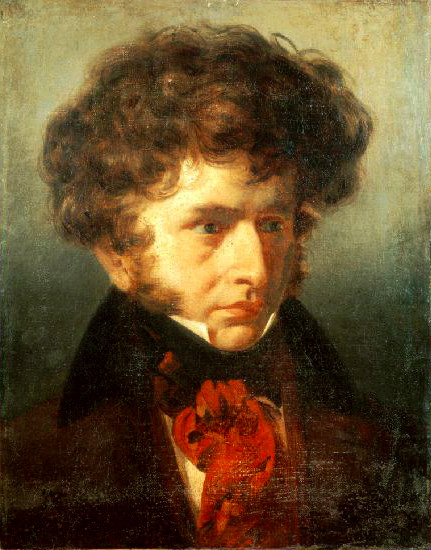
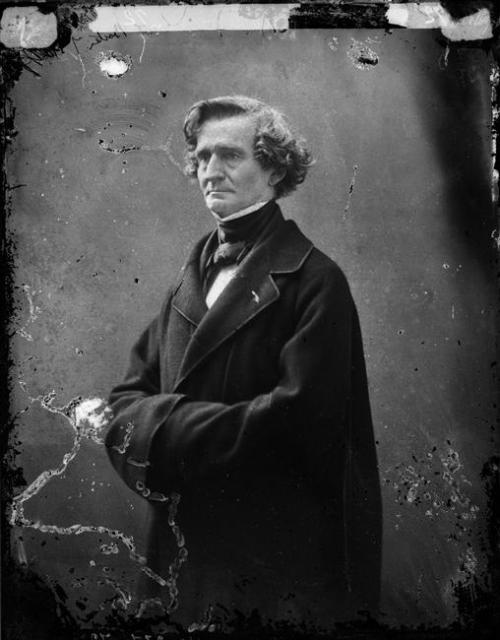
Hector and Me: My relationship with France’s greatest composer

This is a repost of a piece I wrote — oh my God! — over ten years ago, on the bicentennary of the birth of Hector Berlioz. I’m reposting it as prelude to today’s Symphony Saturday post.
In the movie Mr. Holland’s Opus, there is a wonderful scene – one of many – when Mr. Holland’s wife, Iris, is quite upset at her husband’s under-enthusiastic response to her news that she is pregnant with their first child. Mr. Holland, of course, realizes how he’s stepped in it, and he attempts to describe to his tearful wife his feelings about becoming a father. Like everything else in his life, he relates it back to music. What he says is this, in a rough paraphrase:

“When I was a kid I used to go to the record store every day, and the guy there would tell me what to listen to. One day he hands me a John Coltrane album and tells me to go home and listen to it. So I did, and I hated it. I mean, I just hated it. And I hated it so much that I had to listen to it, every day, over and over again, until I figured out why it was that I hated it so much. And while I tried to figure out why I hated it, I finally realized that I loved it. And to this day, I love John Coltrane. (beat) You telling me about our baby was like me coming to love John Coltrane all over again.”

That pretty much sums up my experience with the music of Hector Berlioz.

It was a pretty prosaic introduction, actually: high school band, when I was in ninth grade. We had just performed our fall concert the night before, and now it was time to start on some new pieces for our winter and spring activities. Two pieces of sheet music I’d never seen before turned up that day at rehearsal: something called Le Carnival Romain by a guy named Berlioz, and something called March to the Scaffold, also by this Berlioz fellow. We attempted sight-reading Carnival for most of the rehearsal, but since we were a high school band we had to take it incredibly slow at first, and as anyone who’s heard the piece will attest, most of it is a spirited vivace. Not the best way to make my acquaintance with Berlioz.

But then, the next day – that was when we started digging into March to the Scaffold.

So it’s a March, I can tell. That means a pretty brisk tempo, right? That’s what I expected, Mr. Young Band Student, after a steady diet of Sousa and K.L. King and “Entry of the Gladiators” and whatnot. But not this piece. It starts out with muffled drum sextuplets, which are answered by this weird syncopated figure in the low woodwinds. (No high school bandmember likes the sound of low woodwinds. Take it from a member of the trumpet section who used to join his brassplaying mates in inventing euphemisms for the low woodwinds that frequently involved metaphoric flatulent bovines. Luckily, I would later realize that those instruments do wonderful things. Like, say, the opening bars of March to the Scaffold.)

The piece went on, getting louder in places and having strange and sudden bursts of loudness from the brass – always fun – and then, at long last, a wonderful marching melody for the trumpets and the rest of the brass. (We trumpet players pretty much define the membership of any ensemble as “the trumpets and the rest of the instruments”.) Now I was a bit happier; after some weird and jocular opening stuff we get to the “meat” of the March, and everything would be fine.

Except after that melody ends (it’s stated twice, unless you observe the repeat which we did not), well, the March gets even weirder. The glorious brass melody is replaced with snarling, biting brass figures, the woodwinds scream, the rhythms become more insistent and driving, the guy behind me on the timpani starts pounding away, everything builds and builds and builds, and it gets crazier – until everything stops, and there’s this tiny wisp of melody on a solo clarinet. This is cut savagely short two bars later by a resounding whack by the whole group, some descending woodwind notes, and then a series of fortissimo chords ending the whole thing.

It was all very weird, and I didn’t understand any of it. The piece made no sense.

Well, we rehearsed that damned thing for a few days before the band director decided to reject it in favor of something else. At some point he let us in on the fact that the March to the Scaffold actually is a piece of program music. The story is simple: a guy is being “marched” to the scaffold where the guillotine awaits. He’s going to his execution; hence the dark beginnings and the frenetic stuff in the second half. And that bit of clarinet melody at the end? That’s the guy thinking of his lover one last time before the blade drops. Whack!

So, I thought, “OK, it’s interesting. Big whoop. At least I’ll never have to play that weird stuff again.”

A few months pass, and I’m in a record store thumbing through the budget-priced cassettes. Something strikes me: a cassette with this Berlioz fellow’s name on it. Picking it up, I see that it’s a recording of something called Symphonie fantastique; and perusing the back of the thing, I see that the fourth movement of this symphony is none other than the March to the Scaffold. Intrigued, and made adventurous by the $3.99 price tag (I’m a lot more likely to be musically adventurous when the recording is cheap), I bought the thing and took it home. I played the tape a few times, mainly just skipping right to that March just so I could hear the way the orchestra’s supposed to sound, and not a band arrangement (although it must be said that a lot of fine work gets done in band transcriptions). I had to admit, the March to the Scaffold was quite a bit more effective in its intended medium.

But I still didn’t like it.

Skip ahead a month or two when, on a lazy day, I happened to ask my band director a few questions about how to read a full score. He responds by handing me a book and telling me to figure it out on my own. The book is, I see, entitled The Symphony, 1800-1880, and opening it, I find that it is nothing more than eight or nine symphonies, each by a different composer, in the full orchestral score. Every part, from the flutes down to the double basses and including all the percussion, is laid out side-by-side. Here, I see, are the composers’ secrets: Beethoven’s Eroica, Mendelssohn’s Italian, Brahms’s Third (which, sad to say, is the only one of Brahms’s four symphonies that I’ve never liked), and…the Symphonie fantastique by Hector Berlioz.

I couldn’t wait to get home. In went the tape, onto my lap went the book, and I started following along. I kept up well through the first movement’s slow, dreamy opening, but I got lost a few times during the subsequent allegro. And then, about the third time I heard the main melody of that first movement, I realized that this was the melody that that single clarinet is quoting at the very end of the March to the Scaffold. And that same melody turns up in the second movement, a lilting waltz; and in the third movement, a ravishing pastoral slow movement; and in the last movement, which is titled “The Witches’ Sabbath”!

It wasn’t just the March to the Scaffold that was telling a story, I realized: the whole symphony is telling a story.

And as I taught myself how to read a score, by following along with the Symphonie fantastique, I became entranced and enchanted with the things this Berlioz does with the orchestra. Why use the flutes to double the melody in the violins? Well, it doesn’t sound the same, does it? Makes it more “dreamy”….and when he restates the waltz theme in the second movement, he uses a harp for the waltz rhythm and the woodwinds for the melody…and an part for solo cornet…and that opening of the third movement! Depicting the shepherds of the hills with an English horn and an offstage oboe answering it! Depicting a thunderstorm in a slow movement!…and a demonic dance of the witches, complete with the Dies Irae and that weird sound by having the violins turn their bows over and slap the wooden bow against the strings!

Over time, I realized that it didn’t really matter what the story of the Symphonie was; even then I had started being skeptical about music and its ability to “depict” anything concrete. What was more important is that I hated Berlioz, and then it was as if the Fates conspired to force me to re-evaluate him. And I did. Did I ever. I sought out other works by Berlioz, and then I read more about his life.

That was when I was hooked.

I have always thought that I would have been most comfortable in the Romantic era, and in the life of Berlioz I found proof. Here was a man of powerful appetites and desires: a man who fell in love with an actress when he saw her onstage in Hamlet, and he fell so completely that he ended up writing the Symphonie fantastique in her honor. (And could it be any surprise that, when he finally managed to marry her, it did not turn out well?) Here was a man who refused to adhere to the forms of his day: only one of his four Symphonies has the traditional four movements, and that one is heavily programatic with extensive use of a solo viola; he never wrote a concerto; he invented whole new groupings of instruments; for his Requiem he supplemented his full orchestra with four brass bands placed at the ordinal compass points in the Cathedral. Here was a man whose greatest literary loves were Shakespeare and Virgil, and here was a man whose music to this day has never been as appreciated within his homeland of France as outside it. Here was a man whose greatest work, Les Troyens, was never performed in his lifetime. Here was a man who viewed art in such stark terms that Schumann said of him: “Berlioz does not try to be pleasing and elegant. What he hates, he grasps fiercely by the hair; what he loves, he almost crushes in his fervor.” That sounds familiar to me. I have myself been accused of going overboard in praise for things I admire, and going equally overboard in my attacks on things I dislike. But in this I have had good company, n’est ce pas?

How keenly I remember my disappointment when I watched the remarkable film Impressions de France at Disney World’s Epcot, a thirty-minute travelogue of stunning French scenery scored with great French classical music – but not a single note of Berlioz! And how proud I was to have a scene in a Star Trek movie when Riker enters Picard’s quarters and finds the Captain listening to blazing, fiery operatic music. “Bizet?” Riker asks. “Berlioz,” answers Picard. In moments like these I realize that I take Berlioz personally. His music is my music, and if much of the world does not share that opinion, what of it? I, in admiring Berlioz, stand in the company of Wagner and Liszt. Pretty good company, that.

Ultimately, I think that every thoughtful person has that “tortured artist” whom they love dearly. For some it’s Jim Morrison, or maybe John Lennon. Some respond to Sylvia Plath; others are moved by the sufferings of Van Gogh or Mozart. I think that if we’re lucky enough to find someone who suffered for their art in much the same way that we see ourselves suffering (even if not nearly so dramatically), and we find them at the right time, the tumblers can somehow fall into place and something deep within our soul is unlocked. It’s ours forever — truly ours, in that sense that even when we find someone else who claims to love what we love, we’re skeptical. Nobody loves Berlioz the way I love Berlioz.

And so be it.
Share This Post

Something for Thursday

A short song today, but a favorite of mine.

Sheila O’Malley often sets her music player to “shuffle”, and then she will post the list of songs that it plays, with comment. I always look forward to these posts, even if I usually don’t have a lot of knowledge of the songs she mentions. This one, however, I know quite well: “Lodi” by Creedence Clearwater Revival.

CCR is one of my favorite bands of all time, and The Wife and I have an odd ritual where whenever CCR comes up in the background of our daily lives — car radio, music in a store, whatever — I have to say, “CCR!” Just one of those weird things…but this song isn’t usually one of the ones that comes up in general listening situations. I’m not sure why that is, but “Lodi” is a sad song about failed dreams, about what happens when life doesn’t meet our expectations. It’s along the same lines as the famous admonition (by John Lennon?) that “Life is what happens while you are busy making other plans.”

The lyrics to “Lodi” are simple, but the words are so perfectly chosen to the song’s message: “Rode into town on a Greyhound, I’ll be walking out if I go”; “You know I’d catch the next train back to where I live”…that last is a killer. “Where I live”. By this point, our singer’s been stuck in Lodi for a very long time, and yet, it’s not where he lives. He still believes this is temporary, a hitch in the plan. But we know: You live in Lodi now. Lodi’s home, Lodi’s the best you’re ever gonna have in this world.

Here’s “Lodi” by CCR.

Share This Post

Nose to the grindstone (A writing update)


Time for a brief update on the writing business!

At the Oscars the other night, Robert De Niro presented one of the screenwriting awards, and in his presentation speech, he said this:

“The mind of a writer can be a truly terrifying thing. Isolated, neurotic, caffeine-addled, crippled by procrastination and consumed by feelings of panic, self-loathing and soul-crushing inadequacy. And that’s on a good day.”

Isn’t that the truth, especially those last two! Most of the time I’m pretty confident in my abilities as a writer, but I have moments when I sit around in withering conviction that I’m not fooling anybody, that I totally suck, that I will never ever ever be any good at all.

But then I usually snap out of it. As John Cleese said in Monty Python and the Holy Grail, after revealing that he had been turned into a newt, “I got better!”

Anyway, I got the first round of edits done on Princesses II: Back in Blue (not the actual title) in early February, and since then, I’ve started hearing back from the beta readers, who are providing good and useful feedback. As for Princesses I: The Book That Started It All (not the actual title), I’m still waiting on that one until the summer months, at which point it’s time to start whipping that book into shape for publication late in the year. Plus, at that point I’ll probably start letting out drips and drabs of information about the story…including…the actual title!

And then there’s Lighthouse Boy, on which I managed to get myself stuck on a particular plot point for quite a while. I did the backtrack-and-attack-again thing three or four times, but I think I’ve finally managed to crack through that particular problem. All it took was a complete reimagining of the main character and what he wants to accomplish in life! Writing: it allows us to avoid rethinking our own life choices by rethinking those of fictional people!

I think I may be forgetting something…oh yeah, I have a complete manuscript of GhostCop (not the actual title) sitting here someplace. I should probably figure out what to do with that, too….

Share This Post

A Book Quiz!!!

SamuraiFrog did a quiz about books. So I will too. Because I’m all about…umm…hmmm, what the heck am I all about, anyway….

1. Your favorite book:

This is always the question, innit? The Lord of the Rings (JRRT), The Lions of Al-Rassan (Guy Gavriel Kay), Cosmos (Sagan), and…I’ll just stop there, or we’ll never get to the next question.

2. Your least favorite book: Back when I actually used to insist on finishing books that I thought sucked, I found some real stinkers. Nowadays, if a book isn’t doing it for me, I just stop reading it partway in. Life’s just too short. But, as noted, I did waste a chunk of my life on some crappy books. Representative titles? The Celestine Prophecy (I knew that my “New Age” phase was definitively over when I read this and couldn’t stop rolling my eyes), The Fountainhead and Atlas Shrugged (Ayn Rand was a morally stunted, facile non-thinker who couldn’t even take her own advice), and Twilight (and yes, I wanted to like this one, since I thought that a good teen romance combined with a good vampire story would kick lots of ass, so imagine my consternation when I realized that the book is neither one of those things).

3. A book that completely surprised you (bad or good):

I remain stunned at how bad the last two volumes of A Song of Ice and Fire were. And there was a graphic novel that I checked out of the library pretty much because the title sounded intriguing, called Alice in Sunderland (by Bryan Talbot), which absolutely floored me with how good it is.

Oh, and A Tale of Two Cities. When I read this, my plan was to read it one chapter a week, so as to simulate the original reading experience the novel’s readers had (because it was serialized in magazines of the day). This lasted until Chapter Five or so, when I just had to keep reading, the book was so good.

4. A book that reminds you of home:

Maybe the Prydain Chronicles by Lloyd Alexander or the Gothic YA novels of John Bellairs? Both entered my life via my mother’s standard punishment method of handing me a book when I’d screwed up with the admonition that I was not allowed to watch any teevee at all until I finished it.

5. A non-fiction book that you actually enjoyed:

Um, what’s with the wording of this question? It sounds like, “Holy crap, nonfiction doesn’t have to suck!” I wonder if this was originally one of those Tumblr quizzes that often read like they were written for fifteen-year-olds. Nothing wrong with that, but this question makes me think this quiz is aimed at high-school kids who likely haven’t read any nonfiction other than their textbooks.

Anyway, I read tons on nonfiction, so I could go on all day, here. Anything by Carl Sagan or Neil DeGrasse Tyson. Barbara Tuchman, for history. Bill Bryson.

6. A book that makes you cry: Lots of them have at various times.

There are a number of moments in Guy Gavriel Kay’s Fionavar Tapestry that reduce me to tears every time I re-read the trilogy.

7. A book that’s hard to read:

I increasingly view my life as a death-struggle between myself and The Brothers Karamazov What is it with me and that damned book?!

8. An unpopular book you believe should be a bestseller:

Mine, dammit! (Although it’s stretching the definition of “unpopular”, since it doesn’t really exist yet. Hmmmm.)

9. A book you’ve read more than once:

Here’s another question that makes me thing this quiz was aimed at younger readers, because the wording seems vaguely surprised at the idea of re-reading. I re-read a lot of books.

10. The first novel you remember reading:

Gosh, that’s going back quite a ways. Maybe The Mouse and the Motorcycle? I honestly don’t recall what the first proper “novel” I read might have been.

11. The book that made you fall in love with reading:

Ye Gods, I don’t know. I honestly have zero idea. Maybe one of the Curious George books. I always loved the Alphabet one.

12. A book so emotionally draining you couldn’t complete it or had to set it aside for a bit:

I don’t know that I’ve ever found a book that emotionally draining.

13. Favorite childhood book:

I mention some of them above, don’t I? I can’t name just one. So many of the books I read as a kid make up the person I am now.

14. Book that should be on a high school or college required reading list:

Gosh, I don’t know. I think the lists are probably pretty good already. Although I’ve always been really resentful that my own high school reading life didn’t include a word of Mark Twain, but I had to read Ordinary People. What the hell was that?!

15. Favorite book dealing with foreign culture:

Great travel writing is a favorite genre of mine, such as the books of Paul Theroux. Bill Bryson wrote an amazing book about Australia.

16. Favorite book turned movie:

The Lord of the Rings.

17. Book turned movie and completely desecrated:

I never go into movies adapted from books to be faithful adaptations of the book; as long as the movie gets the basic moral thrust of the novel’s story right, that’s pretty good. I could name some of the James Bond movies, many of which bear no similarity to their books other than the titles, but I really do approach movies and books as different things.

18. A book you can’t find on shelves anymore that you love:

Hmmmm. I generally know how to find what I want to read. No idea.

19. A book that changed your mind about a particular subject (non-fiction):

Macbeth changed my mind about Shakespeare being boring.

20. A book you would recommend to an ignorant/racist/close-minded person:

I wouldn’t bother. If a person whose views I find repugnant actually asked me for reading material that reflects my views, by definition, they aren’t closed-minded.

21. A guilty pleasure book:

I don’t feel guilty about pleasure. I own a book, it’s because I either like it or I haven’t read it yet. Neither of these things embarrasses me.

22. Favorite series:

Harry Potter. Or the John Bellairs Johnny Dixon-and-Professor Childermass series. Or James Bond! Or….

23. Favorite romance novel:

Hmmmmm…I don’t read romance as a genre, but I do like romance to figure in novels I read, for whatever reason. Pure love story? Richard Bach’s The Bridge Across Forever.

24. A book you later found out the author lied about:

Like that guy who went on Oprah and then made tons of money and later admitted making it all up? Never read anything like that, to my knowledge. I remember being somewhat disappointed to learn that relatively little of John D. Fitzgerald’s Great Brain books were really based on his youth…and then being disappointed again to learn that his Papa Married a Mormon was, likewise, not based all that closely on his family’s early years.

25. Favorite autobiographical/biographical book:

On Writing: A Memoir of the Craft by Stephen King.

26. A book you wish would be written:

Princesses In SPACE!!! III, which I haven’t written yet.

27. A book you would write if you had all the resources:

I have all the resources. I’m working on it.

28. A book you wish you never read:

I’d like to say that even by reading her I learned something about myself or became better able to discuss my own thought processes or some such rot, but ultimately, reading Ayn Rand was a giant frakking waste of time.

29. An author that you completely avoid/hate/won’t read:

Orson Scott Card, a moral midget whose books can live on all the shelves but mine.

30. An author that you will read whatever they put out:

Guy Gavriel Kay, Christopher Moore, Bill Bryson, and quite a few more!

Share This Post

Answers, the fourth!

Time for some more answers to questions!


These from an anonymous reader:

Have you read anything that you didn’t expect to like, but did? Any genres that you expected to not like, but did like at least some of them?

Oddly, I don’t think I ever have! I never read anything not expecting to like it. Which obviously doesn’t mean that I will like everything I read, but I always expect to like it.

Now, I do tend to lean toward some genres and away from others, but even that can change. It’s been a number of years since I found an epic fantasy that I really liked, and of late I’ve been kicking around dipping my toes into the mystery genre somewhat. We’ll see.

(By the way, any mystery recommendations? I’d like more contemporary, urban stuff. Or crime writing.)

Do you sing at all? In church? In the shower?

I tend to be moderately embarrassed to sing, and I’m not sure why…I like to think I have a decent voice and can carry a tune, but I have no idea, really. I do like to sing when I’m alone, and when I’m driving myself, I can belt showtunes with the best of ’em. I also tend to have a song somewhere under my breath as I go through my day at work. I’ve never sung publicly, for some reason. Probably some weird blend of cowardice and introversion!

Share This Post

Sentential Links

Linkage…or something….

:: Back in mid-February, our local newspaper social media guru wrote: “A good deed loses some of its purity when it’s broadcasted by the ‘doer’ on social media.” I thought this was self-evidently true.

:: In dining establishments all over America, there is a pattern that is hurting us. We, as Americans, are a nation of consumers, no doubt. We tend to like things big: big cars, big coffees, big houses, big buildings, big sodas, big macs, big deals, big flavors, and big entrée portions. These last two are the ones that concern me most as a chef.

:: There is no reason that this should be the only video of the Court. Proceedings held in secret are suspect proceedings, and proceedings that cannot be recorded, in 2014, are not public in any meaningful sense.

:: Other than that, I have no idea what I’m doing.

:: Meanwhile, in the “fun” Funkyverse strip, the actual, literal spectre of Death is strolling through Crankshaft’s suburban neighborhood, looking for souls to reap.

:: I started a bit of a minor nerd kerfuffle yesterday on Twitter when I said this, but I’m standing by it.

:: But it’s March now, and time to talk about cats. Specifically, it’s time to talk to all the people who hate cats. “Ewww!” they say. “I hate cats! They’re so aloof! They’re not affectionate and demonstrative like dogs are!”

More next week. Theoretically.

Share This Post