Something for Thursday

I don’t remember if I’ve featured this before, but it’s just such a perfect piece of music that it’s worth revisiting now and again. Alexander Borodin’s In the Steppes of Central Asia depicts the meeting of two trade caravans, on some road in the Asian wilderness. There is no war or conflict here, just two groups coming together — depicted by two melodies of differing character — greeting one another and parting. This wonderful piece is so full of warmth and human optimism that it simply glows.

Here is In the Steppes of Central Asia.

Share This Post

Nineteen years

On May 17, 1997, I married a beautiful young woman from Iowa. Nineteen years later, here we are!

19 years, married to this amazing woman! Huzzah!!

Here’s hoping for another nineteen years…and another nineteen after that…and, well…second star to the right, and straight on ’til morning!

Share This Post

Something From Thursday

Sorry, folks, yesterday was a bit preoccupying, what with a nice visit from my old friends, the Car Repair Gods*.

Here’s something fun.


Pro tip: Looking for light, fun classical music to brighten your day? Listen to the overtures of Franz von Suppe. My favorites are this one, “Light Cavalry”, “Poet and Peasant”, “Morning, Noon, and Night in Vienna”, and “The Beautiful Galatea”.

* They’re not friends. They’re jerks, and when they come by, well — as Ned Flanders noted, I’m obliged to offer them a beer, but it’s mostly head.

Share This Post

April Showers bring May…Apples?

So a few weeks ago I was hiking with The Dee-oh-gee (at Sprague Brook Park in Colden, NY) and I happened across this strange-looking plant:
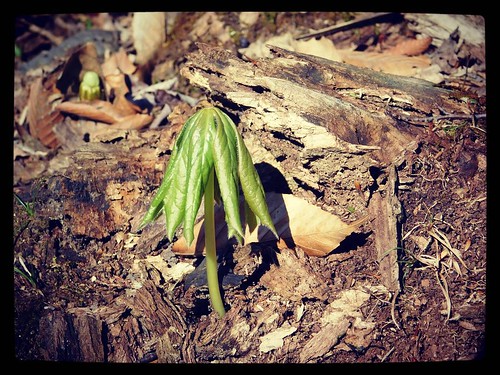
All right who knows what this is? It's only about 3-inches tall. #mysteryplant #SpragueBrookPark #wny

Odd little thing, innit? I’d never seen anything like it, to my recollection.

A week or so later, I’m hiking with the Dee-oh-gee (at Knox Farm State Park in East Aurora, NY), and I happened across an entire crop of those little plants:
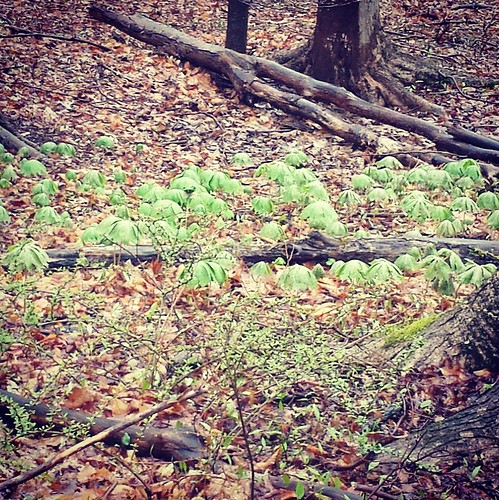
These odd little plants are all over Knox Farm. I wonder what they are. #knoxfarm #wny #EastAurora

And then yesterday, I’m hiking with the Dee-oh-gee (at Chestnut Ridge Park here in sunny Orchard Park), and I happened across another crop of those things, even bigger now.
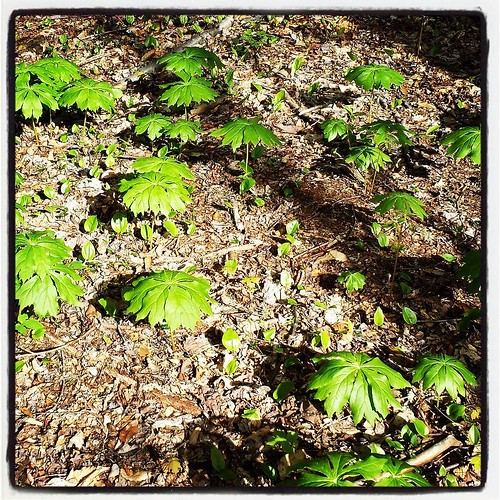
I'll probably spend all summer documenting whatever these plants are. #ChestnutRidge #wny #OrchardPark

Well, a helpful Instagram user has come to my rescue! They are “May apples”, or podophyllum, so named because the flower that generally blossoms from these plants in May that become fruits later on. May apples grow in large colonies, with the ‘plants’ actually sprouting from a single root that has spread beneath the ground. That’s why I’m seeing large patches of these things, when I spot them in the WNY woods.

Wikipedia indicates that they are poisonous, but this article indicates that the fruit can be eaten, albeit with preparation and quantity in mind. I’m not sure if I’m quite that curious, but still, a bit of learning is useful — especially when it’s something that I’ve been observing on my own!

Share This Post

Symphony Saturday

After three consecutive weeks of increasingly lengthy and heavy German symphonies, let’s step back and listen to something shorter and much less dense. What’s needed right now is a French composer, so this week we’ll encounter Vincent d’Indy.

I have heard almost nothing by d’Indy; in fact, it’s quite likely that the work featured in this post is the only work I’ve ever heard by d’Indy. My brief research confirms that his music is little heard today outside of the present piece, although in his Essential Canon of Classical Music, David Dubal does opine that d’Indy is a terribly underrated composer, so perhaps his work is deserving of greater exposure.

This work, the Symphony on a French Mountain Air, is unusual in a number of ways. First, it is in three movements instead of the traditional four; second, its melodic material is mostly derived from a single tune (the “mountain air” of the title, a song d’Indy heard while traveling in the mountains); and third, the work features a prominent (but not quite dominant) part for a solo piano, making it a sort of symphony-concerto hybrid, not unlike Harold in Italy, the symphony by d’Indy’s fellow Frenchman Hector Berlioz, which had featured a prominent part for solo viola.

The Symphony on a French Mountain Air is, to my ears, a delightful listen that always feels fresh and light, especially after a steady diet of heavy Germanic romanticism.


Next week: Well, I haven’t decided yet, but there is a big-name Russian composer knocking on the door….

Share This Post