No, John Williams did NOT rip off Dvorak.

UPDATE 2/18/2022: Broken link fixed.

REPOSTING 2/16/2022 because…see addendum to text.

UPDATE 2/7/19: This post, for some reason, must rank highly on some Google search index or something, because it’s been a relatively consistent driver of traffic to this blog ever since I posted it, nearly four years ago. I have closed off commenting for this post because the only discussion that has ever really occurred here has been people showing up to assure me that yes, John Williams really does rip off everybody under the sun, and in all honesty I’m not interested in entertaining those discussions anymore. That said, it does strike me as interesting how many different composers of wildly varying background and voice Williams is accused of “blatantly stealing”, and how many times a specific piece by Williams is said to be a clear rip from half a dozen specific earlier works. It’s a heck of a composer who can clearly steal four or five different pieces (or so I’m told) just to craft one theme for a Harry Potter movie, innit? Anyhow, here’s the post.

This is one of the trustiest of annoying old chestnuts. What happens is someone hears Dvorak’s Symphony No. 9 (titled “From the New World”) for the first time, encounters the opening bars of the fourth movement, and immediately races to the computer to post the revelation for the ages that “OMG! John Williams totally ripped off Dvorak’s “New World Symphony” for the theme from JAWS!” This is the most common example of a thing that John Williams has ripped off, but there are a lot of them. A partial list of composers from whom Williams is obviously a plagiarist includes Tchaikovsky, Mahler, Wagner, Korngold, Steiner, Prokofiev, and Penderecki — in addition to the afore-mentioned Dvorak.

By comparison, here’s the Dvorak, and here’s the Williams. The similarities between the two are, to put it kindly, extremely superficial. Both start with low strings intoning a note, and then the note a half-step above it, and then the motif is repeated a few times. But Dvorak repeats it loudly and uses all the lower strings and goes at a quick tempo, building quickly and bringing in the rest of the orchestra before getting to his main theme. He also stays quite clearly in the same time signature.

Williams, however, starts off with similar notes…but slower, and much softer, and lower — I’m not even sure if he uses the cellos at all. It might be just the double basses at first. And then his insistent rhythm starts with those punching chords at off moments, so you’re not even sure what the time signature of the piece is. Williams’s sound is insistent and mysterious and somehow both mechanical and not — pretty much the opposite of what Dvorak does. And yet, “Williams ripped off Dvorak!” is one of those zombie nonsense notions that always comes back, despite being complete nonsense to anyone who bothers to pay attention.

ADDENDUM: I just saw this on YouTube. Clearly Williams was actually stealing the JAWS theme from Beethoven!

In cases like this, for years I’ve been recommending a wonderful essay by Leonard Bernstein called “The Infinite Variety of Music”, which appears in the book of the same title. The essay is actually the script of one of the wonderful episodes he used to do for the educational teevee program Omnibus. In this particular episode, Bernstein described how composers are able to create an astonishing variety of musical works from just thirteen notes of the Western tuning system, by reducing things even further and showing how a number of great composers wrote amazing pieces, many of which are very familiar, by using as their main motif the exact same four-note melody. It’s a worthy reminder that there’s a lot more to music than just what the notes are, and I’ve always found that essay to be a good remedy against the over-used canard that this composer or that composer ripped someone else off.

Of course, the problem with recommending an essay like that is that it’s in a book that isn’t always readily available…but I’ve recently discovered that the audio of that very program is on YouTube, with the musical examples helpfully included so you can see what’s going on as Bernstein speaks. I can’t recommend this highly enough. It’s certainly worth the 48 minutes to listen through. No, Bernstein doesn’t specifically address Dvorak or Williams (in fact, this program was likely recorded while Williams was still a studio musician and Steven Spielberg was a kid), but it does suggest a good way of listening to music to evaluate such silly claims.

Here’s the video:


Really, give it a listen. It’ll make you better at listening to music!
Share This Post

From the Books: Mike Royko

A repost, because somehow the subject of Mike Royko came up on Twitter. For many years he was my father’s favorite columnist. I remember him handing me the Opinion section more than a few times, saying, “Royko’s got a good one today.” Sometimes I got to return the favor.

For quite a few years, one of my favorite things in the newspaper was the syndicated column by Mike Royko. I loved his writing, and his style has come to mean “Chicago” to me in a very real way. Royko was also a favorite of my father’s, and one year for either Christmas or his birthday I gave my father a collection of Royko’s columns. I spotted another collection – or maybe it’s the same one – on the shelf at the library the other day (One More Time: The Best of Mike Royko), and I’ve been dipping into it with great pleasure. It’s a voice I’d forgotten about.

Royko’s writing, more than anyone else’s, evokes a newspaper for me. Often when reading him I can almost see him there, at a desk in a corner of some big newsroom in a big building in downtown Chicago, his typewriter keys clicking away while he smokes. I actually don’t know if Royko was a smoker, but his columns evoke an era when smoking wasn’t quite the demon it is now. His writing is the writing of a guy who haunted local taverns, and reading him makes me think of the smell of newsprint.

Royko was also perceptive and, in some cases, prescient, as when he wrote of Rupert Murdoch in 1984: “No self-respecting fish would want to be wrapped in a Murdoch paper.” I really wish he was still around right now; in this world of FOX News, a voice like Royko’s would be invaluable. He’d only be 79 today, if a brain aneurysm hadn’t struck him down in 1997. I’d love to know what Mike Royko would make of the state of journalism today, and the fact that one of the most important political commentators of our day – two of them, actually – are hosts of shows on a comedy network.

Royko could write gorgeous, lyrical prose, though, and this column of his — from November 22, 1979, on the occasion of the sudden passing of his first wife – is a prime example. I love how delicately he chooses his visual descriptors, which details to include and which ones to omit. I love the lack of proper nouns, and that he didn’t write this in the first person. The short sentences and short paragraphs are a Royko trademark, but they add up to a larger, and deeply beautiful, portrait in words of a beloved person gone too soon. A more loving tribute would be hard to think of.

The two of them first started spending weekends at the small, quiet Wisconsin lake almost twenty-five years ago. Some of her relatives let them use a tiny cottage in a wooded hollow a mile or so from the water.

He worked odd hours, so sometimes they wouldn’t get there until after midnight on a Friday. But if the mosquitoes weren’t out, they’d go to the empty beach for a moonlight swim, then sit with their backs against a tree and drink wine and talk about their future.

They were young and had little money, and they came from working-class families. So to them the cottage was a luxury, although it wasn’t any bigger than the boat garages on Lake Geneva, where the rich people played.

The cottage had a screened porch where they sat at night, him playing a guitar and her singing folk songs in a sweet, clear voice. An old man who lived alone in a cottage beyond the next clump of woods would applaud and call out requests.

One summer the young man bought an old motorboat for a couple of hundred dollars. The motor didnt’ start easily. Some weekends it didn’t start at all, and she’d sit and laugh and row while he pulled the rope and swore.

But sometimes it started, and they’d ride slowly along the shoreline, looking at the houses and wondering what it would be like to have a place that was actually on the water. He’d just shake his head because even on a lake without social status, houses on the water cost a lot more than he’d ever be able to afford.

The years passed, they had kids, and after a while they didn’t go to the little cottage in the hollow as often. Something was always coming up. He worked on weekends, or they had someplace else to go. Finally the relatives sold the cottage.

Then he got lucky in his work. He made more money than he had ever dreamed they’d have. They remembered how good those weekends had been and they went looking at lakes in Wisconsin to see if they could afford something on the water.

They looked at one lake, then another. Then another. Cottages they could afford, they didn’t like. Those they liked were overpriced. Or the lake had too many taverns and not enough solitude.

So they went back to the little lake. They hadn’t been there for years. They were surprised to find that it was still quiet. That it still had no taverns and one grocery store.

And they saw a For Sale sign in front of a cedar house on the water. They parked and walked around. It was surrounded by big old trees. The land sloped gently down to the shore. On the other side of the road was nothing but woods. Beyond the woods were farms.

On the lake side, the house was all glass sliding doors. It had a large balcony. From the outside it was perfect.

A real estate salesman let them in. The interior was stunning – like something out of a homes magazine.

They knew it had to be out of their reach. But when the salesman told them the price, it was close enough to what they could afford that they had the checkbook out before they saw the second fireplace upstairs.

They hadn’t known that summers could be that good. In the mornings, he’d go fishing before it was light. She’d sleep until the birds woke her. Then he’d make breakfast and they’d eat omelets on the wooden deck in the shade of the trees.

They got to know the chipmunks, the squirrels, and a woodpecker who took over their biggest tree. They got to know the grocer, an old German butcher who smoked his own bacon, the little farmer who sold them vine-ripened tomatoes and sweet corn.

They were a little selfish about it. They seldom invited friends for weekends. But they didn’t feel guilty. It was their own, quiet place.

The best part of their day was dusk. They had a west view and she loved sunsets. Whatever they were doing, they’d always stop to sit on the pier or deck and silently watch the sun go down, changing the color of the lake from blue to purple to silver and black. One evening he made up a small poem:


The sun rolls down
like a golden tear
Another day,
Another day
gone.
She told him it was sad, but that she liked it.

What she didn’t like was October, even with the beautiful colors and the evenings in front of the fireplace. She was a summer person. The cold wind wasn’t her friend.

And she saw November as her enemy. Sometime in November would be the day they would take up the pier, store the boat, bring in the deck chairs, take down the hammock, pour antifreeze in the plumbing, turn down the heat, lock everything tight, and drive back to the city.

She’d always sigh as they pulled onto the road. He’d try to cheer her up by stopping at a German restaurant that had good food and a corny band, and he’d tell her how quickly the winter would pass, and how soon they’d be here again.

And the snow would finally melt. Spring would come, and one day, when they knew the ice on the lake was gone, they would be back. She’d throw open all the doors and windows and let the fresh air in. Then she’d go out and greet the chipmunks and woodpeckers. And she’d plant more flowers. Every summer, there were more and more flowers. And every summer seemed better than the last. The sunsets seemed to become even more spectacular. And more precious.

This past weekend, he closed the place down for the winter. He went alone.

He worked quickly, trying not to let himself think that this particular chair had been her favorite chair, that the hammock had been her Christmas gift to him, that the lovely house on the lake had been his gift to her.

He didn’t work quickly enough. He was still there at sunset. It was a great burst of orange, the kind of sunset she loved best.

He tried, but he couldn’t watch it alone. Not through tears. So he turned his back on it, went inside, drew the draperies, locked the door, and drove away without looking back.

It was the last time he would ever see that lovely place. Next spring there will be a For Sale sign in front and an impersonal real estate man will show people through.

Maybe a couple who love to quietly watch sunsets together will like it. He hopes so.

Yeah, I miss Mike Royko.

Share This Post

The Past harmonizes: 11/22/63, by Stephen King

(Re-upping this one after a discussion of Stephen King on Twitter, and specifically this book, made me remember this post!)


One odd bit of Star Trek lore that I didn’t know about until I read one of William Shatner’s Star Trek Memories books is that, during the 1980s when the Trek movie series was in “another sequel every two years” mode, Gene Roddenberry had a pet idea that he kept trying to get Paramount to adopt for whatever the next movie happened to be. This notion had the Klingons taking over the galaxy by going back in time to Earth in 1963, and preventing President Kennedy’s assassination. In order to fix things, Kirk and company have to go back as well and make sure that JFK dies like he’s supposed to; according to this site, Spock himself is the shooter behind the grassy knoll. I’m not sure how that would have gone over – frankly, it sounds a bit dour and depressing. That worked in the episode “The City on the Edge of Forever”, when Kirk had to stand by and allow a woman with whom he’d fallen in love to die in order to preserve history, but this story, if what Roddenberry truly had in mind, somehow crosses a line. Maybe it’s by having Spock actually kill JFK. I’m glad that movie never got made.

There’s always been something compelling about the JFK assassination to alternate history types and time-travel writers. I think there’s a definite sense to JFK’s murder as one of those singular events in history that neatly separates what came before it from what came after, and as with all such moments, there’s a definite feeling that if the event could be changed, what came after would change, too – mainly for the better, I think the argument goes. Certainly the general opinion seems to hold that had JFK not died in Dallas, but gone on to reelection and a second term, the 1960s might not have been as turbulent as they turned out, with Vietnam possibly not escalating as it did, with civil rights possibly having an easier road to passage, and so on. Obviously there is no way to evaluate such beliefs, but the closest we’re able to come to doing so lies in the power of fiction.

(I wonder if 9-11-01 is going to replace the JFK assassination in the public mind as the most recent ‘focal point in time’. After all, the events of 11-22-1963 happened almost 50 years ago, well before the lifetimes of most Americans living today. I wonder if there will be time travel stories involving time travelers showing up at Logan Airport to prevent the boarding of Mohammad Atta and friends….)

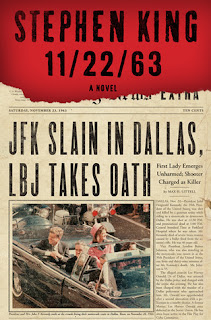
This brings me to Stephen King’s latest novel, 11-22-63. This is a time-travel story, in which a man from our time travels back with the intention of preventing the Kennedy assassination.

Jake Epping is a teacher whose marriage has just ended and who is apparently emotionally damaged in some way: he tells us up front that he simply does not cry, no matter what happens. Jake never cries, he tells us (the book is in first person, from Jake’s point-of-view), and he is haunted by the various injustices of history, such as the janitor who takes his adult education course and whose term essay smacks Jake between the eyes with a first sentence that refers to when the janitor’s dad ‘murdirt my mother and two brothers and hurt me bad’. This haunts Jake, and it’s all he can think of – even as his friend Al, who owns the local diner and who is going to die very soon of cancer, tells him of his own little secret.

In the basement of the diner is a gateway through time. Walk through it, and you emerge outside a factory in Lisbon Falls, Maine, on September 9, 1958. Walk back through, and you’re back in 2011 – exactly two minutes later than when you left. And if you go back in time again, no matter how long you’ve waited to do so, you go back to that exact same moment on September 9, 1958 – which means that any changes you have made to the past are now reset.

This limiting of the time travel possibilities is one of the masterstrokes of King’s novel. There’s no ‘setting a date and then hitting 88 mph’, no ‘slingshotting your starship around the sun’. You can only go back in time to a single place, to a single time, and you can only return to a single place, to a single time. And if you are ambitious enough – as Jake soon will be – to try and change history, if you want your changes to be permanent, you can never go back again. And if, like Jake, you decide that you’re going to try and keep JFK from being killed, that means that you can go back…and then you have to spend five years living there in the past until that fateful day. November 22, 1963.

King seems less interested in the various paradoxes of time travel stories, many of which have become clichees, than he seems to be in history as a force in itself. As he makes his life in the past, Jake – now going by the alias ‘George Amberson’ – frequently discovers ways that the past seems to be trying to right itself even as he messes with things. “The past harmonizes”, he tells us, again and again, and as the book goes on, the level of uncertainty involved in Jake’s self-appointed mission grows and grows and grows. Jake has to try and figure out if Lee Harvey Oswald was part of some kind of conspiracy, or if he acted alone; he has to try and decide if he should intercede earlier or later. He takes a ‘dry run’ early on, interceding on his janitor friend’s behalf when his father shows up to kill his family, and in such ways Jake discovers things about killing – even justified killing – that are troubling.

This is not a scary novel, but it is a haunting one. King masterfully keeps us aware of the onward march of time, so that the date of the title never really fades from memory, even as Jake is living out the five years he has to live out in the past, making a life for himself in a small town in Texas where he makes friends with local teachers and, in the ultimate complication, falls in love. Still, through all this there is a constant sense of growing doom, the constant ticking of King’s time bomb growing ever more and more insistent. Will he stop Oswald? If so, how? And will it matter in the end?

The time travel aspects of the story are, initially, pretty benign in nature, and we learn that Al is using the time portal to buy ground beef at 1958 prices, which enables him to sell his burgers in his diner for significantly cheaper than anyone else can manage. Jake discovers, though, that the past has ways of resisting change, and although King never really spells out much of the mechanism behind that sort of thing, it soon becomes clear that the bigger the change one is trying to make in history, the harsher the resistance one will meet.

11/22/63 is a thrilling King page-turner, loaded with emotional resonance, King’s keen eye for detail, and a bittersweet ending that is satisfying but not in an expected way. Parts of the book read as if Stephen King had written a mash-up of Back to the Future and Oliver Stone’s JFK. In other parts, though, the feel is pure King – especially in one section, taking place in Derry, Maine, where events bring Jake Epping into contact with two of the kids from IT. King is best at suggesting dark forces at work that we cannot understand – or perhaps I should say, forces that we cannot understand whose goals and priorities do not align with ours. Is history something we influence, or is it a force all to its own? 11/22/63 explores that question, even if it may not have a definitive answer.

(One final note: Throughout the book, Jake notes that ‘the past harmonizes’ – which means, history has a way of making things even out, of settling the books. A lot of times, what we call coincidence is this ‘harmonizing of the past’. Well, maybe fiction harmonizes, too; there’s a point in the book that actually features a pie fight. I read that just a day or two before my own pieing last week. How’s that for synchronicity!)

Share This Post

A possible technical change….

 So, as social media companies exercise more and more control over the content users post, and as those companies employ algorithms that are more and more quixotic in their moderation (I’ve seen people put into Facebook jail for using normal words that are homonyms of other words that may or may not be less normal, given the context), it’s more and more advisable that people with the intent of making at least some portion of their livings on content creation (like, writers!) own their own outpost online where there is no moderation save that which one applies themselves.

I already have such a space: my personal site, ForgottenStars.net, which I launched with the idea of using it as my base of operations for my “writing life”, while I’ve kept this blog going for all of my content that is not specifically writing-related.

The problem is that I don’t use the space I pay for enough, and that I’ve got what seems to me too many outposts online. Also, I don’t own this space: Google does, via their ownership of BlogSpot. So what I’m very strongly considering is migrating Byzantium’s Shores to Forgotten Stars. I’m not entirely sure what would look like, as I’m a wee bit nervous about pulling the trigger, but I’m told it’s not super hard to do. The problem is going to be that there is almost twenty years of content here, and I’m not sure how well the migrating will work.

The more I consider this move, the more likely I think it’s going to happen. I’m not sure when exactly I’ll pull the trigger, but it will likely be sooner rather than later, because I tend to be a “rip the bandaid off” kind of person. Ultimately I’d like to set up an automatic redirect here, but I’m not sure if that will work. We’ll see. It’s not as if I expect to lose a ton of traffic if I move, since this blog doesn’t get a ton of traffic these days; not many blogs do, in all honesty. But blogging does seem to be making a comeback, whether it’s on individual sites that people own themselves or on Substack or Medium or Patreon. So…be ready for things to randomly look very different here, pretty soon!

I have to admit to feeling a bit odd about such a move! As noted, I’ve got almost twenty years invested here at Byzantium’s Shores, but the arguments for consolidating and migrating elsewhere honestly do seem to outweigh staying on BlogSpot and keeping multiple content management systems going.

More to come!

Share This Post

Something for Thursday

The fifth episode of the great Carl Sagan show Cosmos is titled “Blues for a Red Planet”. The episode focuses on Mars: a history of the chase for life on Mars, the clash between the fictional Mars (and the one fervently wished for by men like Percival Lowell) and the real one, the discoveries made on Mars in the 1970s (particularly by the Viking lander), and the prospects for future Martian exploration. How I wish Carl Sagan had lived to see the astonishing advancements in Martian exploration since his terribly untimely death!

Cosmos was a series that paid careful attention to every detail, including its music. Obviously an episode called “Blues for a Red Planet” should include some blues in it, right? But not just any blues: the episode called for an ethereal, other-worldly kind of instrumental blues, and that’s exactly what it got in a track by blues guitarist Roy Buchanan. The track is called “Fly…Night Bird”, and it begins with just the kind of ethereal soundscape followed by equally ethereal blues guitar playing that sounds perfectly suited to the cold days of Mars.

I was going to present that track by itself, but then I found myself curious about the rest of the album on which “Fly…Night Bird” appears. Titled You’re Not Alone, the album is a 1978 release that was apparently a commercial failure for Buchanan, who worked and recorded for years but who never really turned the corner into actual stardom. Instead Buchanan produced highly respected and influential work that is deserving of reassessment and exploration. Sadly, Buchanan appeared to have finally achieved some degree of artistic freedom in the mid 1980s, but he also struggled with personal issues that led to his death in 1988. I certainly knew nothing about Buchanan until I did a bit of research for this piece.

You’re Not Alone is an amazing album, packing in some astonishing music making in its roughly 41 minutes. Only one track, the second side’s opening “Down By the River”, has vocals; the rest is pure instrumental, and the mood shifts across the entire album from blues to psychedelic to pure rock and back again to blues. Listening to this album made me feel like I was in the control of a master who knew what he was doing.

Here is the complete album You’re Not Alone by Roy Buchanan (and others), in two sides. (Come to that, anybody besides me occasionally miss the concept of “Side One” and “Side Two”?)

Share This Post

Vacation! (part the second)

 More photos from a two-day trip! Huzzah!

When last we checked in, The Wife and I had just finished up a visit to a Cayuga Lake winery. Next up was a stop that we make every single year, without fail: the great Taughannock Falls, which have the distinction of being the tallest waterfall in North America, east of the Mississippi River. Maybe next year we’ll try the longer walk on the Gorge Trail that goes up to the base of the Falls, but the higher overlook is always spectacular. This summer and fall have been pretty wet, so there was a good amount of water going over the brink. One year it had been so dry that the Falls were literally dry on the day we went.

I honestly do not remember a time in my life when I was not deeply thrilled by water, whether it be a placid lake, a running river, a surging sea, or a plunging fall.

As you drive up and out of Taughannock State Park, the road follows the stream before it starts its quick descent down its gorge before the fall. Up there it’s a beautifully picturesque Upstate New York stream, running quickly along its rocky slate bed. The temptation would be great to simply pull over and look for a swimming hole, if not for the signs all along the road pointing out the danger lurking a few bends downstream.
After Taughannock, into Ithaca we went. Unfortunately we had to miss this year’s Apple Harvest Festival, so we were just…in Ithaca. Which is fine! Ithaca is one of my favorite towns anywhere, and were I able to wave a wand and instantly move someplace, Ithaca would be the place. We went into bookstores and a few boutiques and gift shops and generally just soaked in the Ithaca vibe.

Ithaca is really a place that presses all my buttons. It’s big enough, with its population base and the two large colleges nearby, to have the cosmopolitan feel of a larger city while being very small. Its very geography keeps the degree of sprawl possible there to a minimum; the hills and the lake really keep Ithaca at a size where its only option is to expand upward, which it’s doing with a lot of high-rise construction of late. Still, the overall vibe is one of liberal weirdness. It’s the kind of place where I show up in a poofy Renfest shirt under a pair of vintage overalls, and I’m the one dressed kind of conservatively.
And the bookstores! Oh, my, so many bookstores. I only got into two this time (three if you include the comics store): Autumn Leaves, which is a wonderful used bookstore right in the middle of The Commons, and Odyssey, which is a beautiful new bookstore that just opened last year. Somehow Odyssey Bookstore has made a go of it despite having opened as COVID-19 hit. That says something. The only real downside to this year’s visit to Ithaca was that Waffle Frolic, our beloved joint for waffles and fried chicken, was closed! We arrived about 1:25pm, and Waffle Frolic had closed at 1:00. It never occurred to us to check their hours for abbreviated operation. Alas! But the day was lovely.
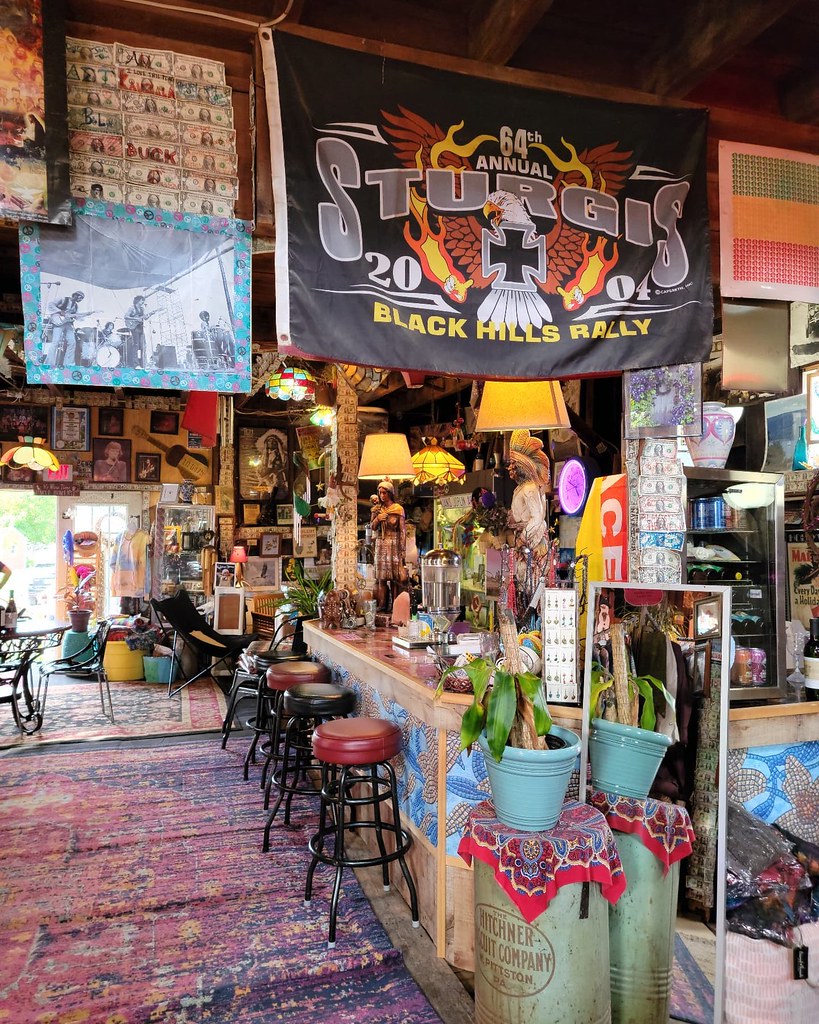
We passed a few hours in Ithaca and then had to strike out for home. We made one more stop, this time driving across the rise to the west of Cayuga Lake and into the valley of the next lake, the mighty Seneca Lake (largest and deepest of the Finger Lakes). Here we stopped at Rasta Ranch Vineyards, another favorite place of ours. This place is steeped in hippie vibes, with wines called things like “Uncle Homer’s Red” and “Terry’s Teaser”. Rasta Ranch is a joy, and here we pretty much wrapped up the “tourist” part of our day.

After this? Well, a sunset drive along the eastern shore of Seneca Lake, and then dinner at a fried chicken joint in Geneva (sadly they were out of bone-in chicken, so we had popcorn chicken), and then a stop at Trader Joe’s in Rochester for various items. And then…the trip home.
I’m always sad when we get home from a trip, any trip, to the Finger Lakes. The whole region always feels just slightly off-the-beaten-path, just slightly forgotten. It’s an entire region that still rolls along, probably with less money and fewer people than in days long gone by, but the bones are still there, and so is the wonder and the beauty. In fact, maybe some of that decay has even helped in some way: the old railroad tracks where the trains don’t run are a part of the landscape now. A long-abandoned army depot, which happens to house a herd of white deer because their population is protected by old fences. Occasional Amish folk in their buggies. The feeling of cresting a hill, leaving a lake behind you…but there’s still another one ahead.
Maybe it’s time for me to write that sequence of stories set in the Finger Lakes, after all….

Share This Post

Tone Poem Tuesday

 Some nifty stuff in the pipeline–I’m not going to keep ignoring Richard Strauss, now that I’ve opened him up on this series–but for now, a favorite potboiler by Tchaikovsky, a man who certainly knew how to compose the kinds of potboilers that kept audiences pleased while he worked on his more serious work.

There’s not a whole lot to say about this work, musically. It’s pretty much a collection of tunes, but orchestrated by a genius. There’s a lot to be said for works in which great composers collect some tunes.

This piece also happens to have be a favorite of my father’s. He particularly loves the dance-like central tune. And as a former trumpet player, I’m eternally sad that my trumpet-playing career never gave me the opportunity to play the part that happens around the 8:00 mark in this recording! Trumpet players LIVE for those brief moments to shine.

Here is Capriccio Italien, by Peter Ilyich Tchaikovsky. Daniel Barenboim conducts the Chicago Symphony Orchestra.

Share This Post

Vacation! (part the first)

 The Wife and I made our annual trek to Ithaca and the Finger Lakes this weekend. Our trip was timed a bit oddly and was truncated by a day, because of Reasons; usually we stay two nights in a hotel near Rochester, leaving Friday and spending Saturday trekking through the FLX region and Ithaca before returning to the hotel and coming home (at a leisurely pace) on Sunday. We usually attend the annual Apple Harvest Festival in Ithaca, but this year the folks in Ithaca took a rather long time in announcing the dates for the festival (or if they were even having it at all). We took a gamble, booking our trip for this weekend, since the Apple Fest is usually either the last weekend in September or the first in October, waiting as long as we could to nail down our price. And wouldn’t you know it: right after we booked, Ithaca announced next weekend as the Apple Festival.

Oh well. Win some, lose some, and all of that. It’s not really that big a deal! I know that the COVID pandemic has made it difficult for towns to plan things like annual festivals, and we had a good time nevertheless. It was a stunning weekend for weather: it had been annoyingly hot and humid until the beginning of last week, when it turned dreary and rainy for the better part of three days. By Friday, though, when we set out on US 20A heading east? Blue skies and cool breezes, and it’s been that way ever since.

And even though we missed out on lunch at our favorite joint in Ithaca on Saturday (apparently they’re closing at 1:00 and we got there at 1:20, having not even thought to check their hours for staffing-related changes), did we ever eat well.

It started at the Broadway Deli in Lancaster. Behold this cheesesteak sandwich!

And for dinner that night? A visit to PF Chang’s. Yes, it’s a chain joint, but not all chains are bad. PF’s puts thought into what they do and it’s always a delight to eat there.

The next morning we headed out, bright and early, looking for breakfast. We found it in someplace new: Macri’s Deli in Canandaigua, which has a nifty selection of breakfast sandwiches and they also make them gluten-free. The place is right on the city’s municipal pier, right on the water, which made eating there an absolute joy.

(This phone does panoramas!)

Our next destination was the Goose Watch Winery on Cayuga Lake. We discovered this winery last year and liked it so much we had to return.

(Note The Wife, eyeing my wine because she hasn’t been served hers yet!)

I’ll stop here for now, but the day wasn’t even close to being over at this point. Stay tuned!

Share This Post

A Pirate Looks at Fifty

 Normally I don’t post on Sundays much, but…well, today’s my birthday. I am now fifty.

Here’s what fifty (minus two days, since I took this two days ago) looks like:

Not a lot different, huh?

So, how does fifty feel? Well…so far, not a whole lot different from forty. A bit stiffer, a bit achier, a bit…longer. Mentally, it’s OK. I still have tons of interests and tons of things I want to do, places I want to see, stories I want to tell.

Introspectively, I suppose…geez, I don’t know. Is this the life I saw myself living twenty, thirty, forty years ago? Not even close. Is that bad? Not really, though in all honesty, as much as I generally avoid thinking about roads not traveled, I do find myself wanting my college decision to leave music behind back, more than any other decision. Everything else, I’m mainly fine with, at least as far as things that have happened over which I had any control. The worst things are the things I had no idea were coming, and I expect that’s true of most people.

So, anyway, that’s my introspection on turning fifty. Check back in ten years for sixty. Maybe then I’ll stop thinking mostly like a twelve-year-old sci-fi geek. More like…thirteen!

Onward and upward! Zap! Pow!!

Share This Post

Masks: an unpopular opinion

 Here’s the thing: I’m fine with wearing a mask. As in, I’m genuinely fine with it. Not only does wearing one not bother me, but…I honestly kind of like it.

The discourse on masks has mainly centered on their use being a mutual-protection kind of thing, which is absolutely true, and I have a whole lot of things to say about the degree to which this particular pandemic crisis has really exposed the degree to which a deeply depressing percentage of Americans simply have no investment in being parts of a larger, functioning society. Many see masks as just one more battlefield on which they can fly their “Don’t tread on me!” freak flags, but even as full of shit as that is, I have to note that I don’t much like the usual response:

“Hey, I hate wearing this thing, too! It sucks! I hate breathing through it and it makes me all sweaty and gross but I grit my teeth and do it because I’m a part of society!”
And hey, if you really really really hate wearing the mask, that’s your opinion. Like anything, it gets uncomfortable after a long enough time. The most comfortable underwear in the world reaches a point after the twelve-hour mark that…well, let’s just let that thought finish itself, shall we?
But for me, I can honestly report that from the vantage point of having been wearing a mask for close to a year and a half, it doesn’t bother me much at all to wear it for a length of time, even for most of my work day. I can breathe just fine. I don’t find that I’m getting any sweatier than usual, except for maybe when I had to do work outside on the really hot days of summer, and in that case, I have to be honest, it’s not as if the mask is the major factor in my general discomfort. In truth, I get to the point now where I forget the thing is even on my face to begin with. There have been moments when I lift my coffee mug to my mouth only to forget that I have to lower the mask to sip the stuff.
And we’re coming out a hot summer, but with cooler weather coming, let me say: masks rule when it’s cold out! I don’t have to wrap the scarf around my face when it’s cold, if I’m wearing a mask. This is huge. I remember being outside on windy days last winter with my mask on, and I never had the dry, chapped, wind-burned lip thing going on.

The other anti-mask thing I hear a lot is some variant of “Now I can’t see if you’re smiling!” or “I can’t tell what facial expression people are making!” And I’m, well, meh on that. As a longtime sufferer of “Resting Bitch Face” (that term sucks, by the way), the last 18 months of masking has been a deeply refreshing break from hearing “Smile!” or “Wow, you look really angry!” (when I’m almost certainly thinking along the lines of “Do I want a turkey sub or pizza for lunch today?”), on an almost daily basis. Our society’s insistence on performative perma-grins has bothered me for years, and the fact that so many of us find ourselves completely unsure of what to do with a person who isn’t SMILING CONSTANTLY is illustrative of a pretty superficial culture. The mask has been something of a leveler in that regard: you have to look people in the eye and listen to their words, their tone, and actually think about your interactions. I love that, and I also love that we’re not beating poor exhausted retail clerks and restaurant workers over the heads if they’re not smiling like we’re their long-lost cousin from Sheboygan.

Now, it did take me a bit to solve a few issues related to masks. My glasses did tend to fog up, but that problem went away when I insisted on getting masks with wire in the upper seams, so I could form the mask to the bridge of my nose; now, my glasses almost never fog up. One issue that I haven’t quite stomped out is related to my progressive lenses: a mask will, at times, push my glasses up slightly on my nose, which means that the lenses don’t quite line up anymore with my normal way of looking through them. This results in some occasional blurriness and now I’m reaching up to adjust my glasses pretty frequently as a habit. Not a bothersome thing, but it’s there.

I also decided very early on that masks with ear loops just irritate the hell out of me. This is a “Your mileage may vary” kind of thing, but the flesh behind my ears gets downright sore after a short while of this. There are some workarounds: some folks sell extender things that you can hook the loops to instead of your ears, but I’ve switched entirely to masks with loops that go around the head. In terms of comfort, this is far superior. The only issue there is a bit of finagling to get the mask cord to not interfere with my earbuds on the rare occasion that I’m wearing them with the mask.

So, in conclusion Your Honor: No, I don’t hate masks and I rather hope that they don’t become another “Hey, remember when” thing once COVID is in the rear-view mirror. (Of course, it won’t be in the rear-view mirror in the way that, say, smallpox is, because of reasons.) Hooray for masks!

Share This Post