Autumn is here! And almost like flipping a switch, we went from warm temperatures in the 80s for the last few days to high temps that are unlikely to rise above 70 for the better part of a week. This comes not a minute too soon, to be honest: I am long-since on record for preferring autumn over the other seasons, and that is unlikely to change any time soon.
There’s an old popular song called “Autumn Leaves” that has been covered and recorded a whole lot of times, including this setting for string quartet by the great Japanese composer Toru Takemitsu. Bring on the fall!
Mr. Tolkien was good enough to assign the birthday of two of my favorite fictional characters to the day when Autumn, my favorite season, generally starts. There’s poetry there, I think.
Has anyone noticed that in all the time I’ve been doing Tone Poem Tuesday, I have never once yet discussed any of the works of the composer who is not only best known for his tone poems, but who is actually best known for being the greatest composer of tone poems? I’ve been holding this composer back because aside from a handful of other works (which are also great, such as his operas, his songs, and his horn concertos), this composer is so synonymous with the tone poem that he actually overshadows just about everyone else in this rich, rich form of music.
But, I can’t keep him on the bench forever, so: at long last, let us grapple with Richard Strauss.
Strauss was the last of the line of German Romantics who reached their thundering apotheosis in Richard Wagner. Strauss’s life was long, spanning from 1864 to 1949; he saw the end of German nationalistic Romanticism, the rise of Modernism, and his own reputation falter as musical tastes changed and as he made his own regrettable political choices during his last two decades. Strauss did not actually join the Nazis, but neither did he exactly repudiate them. This might be seen as the sad choice of an old but beloved artist who was reluctant to turn away completely from his homeland, but still…the fact remains.
As an artist, Strauss’s work pushed Wagnerism about as far as it could go without crossing the line that the likes of Arnold Schoenberg would. Strauss’s music, at its best, is profound and evocatively lyrical. He wrote massive orchestral music that still shines with utter clarity in the orchestral writing; his textures are never muddy, never unclear, even when he is clearly indulging himself. Strauss is a great enough artist that his descents into self-indulgence are nevertheless captivating in their enthusiasm. Strauss’s skill at conveying scenes through orchestral tone-painting will be appreciated by anyone with a love of film music, where a lot of his influence can be felt, especially in the work of Korngold, Steiner, Waxman, and Rozsa.
Going back to my high school years, when I was doing my first major explorations of classical music, I entered the world of Richard Strauss not at the beginning of his career, but toward the end. (Some composers I entered through their early works, like Berlioz and the Symphonie fantastique, while others I entered through late works, like Mozart and his 40th Symphony or Beethoven with his 9th.) I knew that Strauss had written a series of works called “tone poems”: not symphonies, not concert overtures, but large scale symphonic works with form determined on an individual basis depending on the composer’s need. The first one of Strauss’s that I heard, via a cassette recording I bought pretty much on a whim (my allowance in those days mostly went to comic books and classical recordings), was a piece called Eine Alpensinfonie. This, I learned, was actually the very last of Strauss’s tone poems. Though he would live another thirty-four years after writing it, and though he would write a great deal of music in that time, never again did he write a tone poem.
Eine Alpensinfonie–“An Alpine Symphony”–is also not generally viewed as one of Strauss’s truly great tone poems, and there is reason for that. It’s almost entirely intended as pictorial music, and the focus is generally on orchestral pyrotechnics. Aside from a few introspective passages, Eine Alpensinfonie is almost entirely a showpiece. There’s a reason why, for a work not generally viewed highly by critics, a recording of Eine Alpensinfonie ended up being the work used on the very first test pressing of a compact disc. (That recording was by Herbert von Karajan conducting the Berlin Philharmonic, and by coincidence it ended up being one of the very first compact discs I ever owned. It only had one track, comprising the entire work. All later recordings separate the work into tracks, played without break, comprising the piece’s twenty-some sections.)
Eine Alpensinfonie is wildy Romantic, thrillingly dramatic, and massively orchestral. It also has moments of melodic grandeur that utterly soar, which is almost entirely why I love it: listening to it is an experience, and since despite the critics it has remained steadily performed and recorded for over a hundred years, I think it’s time to finally grant that it is, in any useful sense of the word, a classic.
“That’s great, but what is it about?” You might be asking…and you’re right to ask! Eine Alpensinfonie is simply a 50-minute musical depiction of a journey up an Alpine mountain peak, over the course of an entire day. The work opens with hushed tones and descending minor scales followed by soft churnings in the bass; a minute or so in we hear, in the low brass, the motif that will represent the mountain. As the orchestra slowly begins mustering its strength (in a passage that is spiritually connected with the opening of Wagner’s Das Rheingold, and its depiction of the Rhine’s deep dark waters), eventually everything culminates in a magnificent passage that is so gloriously resplendant that one almost doesn’t even realize that all Strauss has done is orchestrated, in grand fashion for full orchestra thundering fortissimo, a descending major scale.
What follows is a sequence of segments depicting various aspects of a climber’s ascent up the mountain: The ascent (note the offstage hunting horns), treks through forests and beside wandering brooks; scrambling over rocks beside a waterfall (the music actually glitters here); passages through flowering meadows and Alpine pastures (note the cowbells, inevitably making one wonder if the conductor asks the orchestra for more–well, you know); tense moments as the climb becomes more difficult; and then an introspective passage before we break through to the work’s grandest moments, depicting the acheivement of the summit. O, to be a brass player in the orchestra during this passage!
After the summit, the music takes on a darker tone as our climbers begin descending. The darkness is gathering, with good reason: the last big bit of musical theatricality that Strauss has in store is the “Thunder and Tempest” segment as a wild storm takes over. Here Strauss goes so far as to supplement the orchestra with a wind machine. After this, calm is restored and the sun returns, but the music grows quieter and quieter and quieter over as night settles. The entire work ends almost exactly as it began: descending soft scales, and the mountain’s motif plays once more before the final chords fade away.
Obviously Eine Alpensinfonie is not a symphony in any traditional sense. Strauss is not the least bit concerned with symphonic development or treatment of musical ideas here; the music is pure show from one of classical music’s great showmen. But really: what a show it is, and surely there’s room in our lives for pure theater, right?
Here are three recordings of Eine Alpensinfonie by Richard Strauss. The first is a magnificent classic performance, released in 1974, by the Staatekapelle Dresden, conducted by Rudolf Kempe (one of the finest Strauss conductors).
This recording, featuring Herbert Blomstedt conducting the San Francisco Symphony, may be the most technically perfect recording of the work I’ve ever heard. (Admittedly, Eine Alpensinfonie gets recorded a lot, because it’s so popular a showpiece; for all the recordings I’ve heard of it, there are many more I haven’t tried yet!)
Finally, here is the recording that got my attention in the first place, way back in, I don’t know, 1988 or so. This is Sir Georg Solti conducting the Bavarian Radio Symphony Orchestra. Many “Oh, wowwww” moments in this recording. (This is digitized from vinyl, but it’s a pretty high quality record, and it provides a neat demonstration of a particular problem that used to vex recording engineers back in the days of LPs and cassettes: how to accommodate long works on recording media that had two sides, neither of which could support the length of the work in question. The answer is simple: you have to split the recording in two, requiring the listener to flip the record or the cassette somewhere in the middle. Obviously this isn’t ideal, but it simply could not be avoided. In this case, those recording engineers managed to put the side-flip in a very logical place, musically. You can actually hear the brief gap in this recording, but it’s so well done that you have to know it’s there, almost.)
The most exciting development at Casa Jaquandor of late is this: I got a new phone! Yay!
There it is, on the right: my brand-spanking new Samsung Galaxy S21 Ultra, with 512gb internal storage and 5G capacity (which will go along well with the microchip I got from m COVID vaccine*). Yes, I went big. Yes, I went expensive. Yes, I’ve been saving shekels and quatloos** for quite a while to pay for this. Yes, I usually am more frugal than this, but yes, this one time I wanted the best shiniest thing that’s out there.
My previous phone was a Samsung Galaxy S8 that I had been using for three years. Its performance was still holding up, but I have noticed that the battery life has started suffering in the last six months or so. I used to be able to get through an entire day without having to charge, but more and more I’d been needing to plug it in mid-afternoon or risk dying at night. More pressing was that Samsung had announced earlier in the year that it would be ceasing support for this model phone later this year, which meant no more security updates. The S8 model had been out for a year when I got that phone, so four years of support really seems reasonable to me. My goal with each smartphone I get is at least three years of use, which I got with the S8; my phone before that was an S4, which lasted me four years until it got to the point where apps couldn’t even update anymore because it was out of date. The S21 is now my third smartphone in seven years. I’ll take that. (I know folks who upgrade their phones yearly, which seems frankly insane to me.)
So I knew earlier this year that I would be switching to a new phone, and I did some waffling between staying with Samsung, whose products I’ve used almost exclusively in the “mobile gizmo” area (my three tablets have also been Samsungs), Samsung isn’t perfect, by any means. Their devices do tend to get bundled with a lot of extra crap that you may not really want, which can be a bit frustrating–especially when the apps the thing comes with can’t always even be removed. I do not need a Netflix app on my phone, for example–I would never stream something I really want to watch on a screen this small, even if by phone standards the screen is actually pretty big. Also, Samsung’s digital assistant, “Bixby”, takes up space that I’d rather use for something else. As digital assistants go I’m fine with Google’s, which is pretty much on there anyway, since Android and Google go hand-in-hand. There tends to be a lot of duplication with Samsung devices: Samsung Pay and Google Pay, for example.
I can live with all of that, to be honest. I like the ease of transferring stuff from one phone to the next, and since I already have a Samsung account it’s easier to just keep using a Samsung account than port stuff from one platform to another completely different platform.
But the final factor that really got me to buy this phone was the cameras. Now, even that was not a slam-dunk, because Google’s Pixel phones are also possessed of fantastic photo-taking ability. Their cameras may not have the biggest or best sensors out there, but Google’s camera software somehow does magic stuff that takes up a lot of that slack. This S21 has a giant set of lenses: there’s a wide lens, an ultra-wide lens, and two telephoto lenses. I’m not going to get into the nuts and bolts of it all here, because I’m not that knowledgeable about it all and because I still have a lot of playing with this phone to do. Articles reviewing this phone’s camera performance abound online. I’ll just say that the 108 megapixel main lens is pretty amazing, and I love that the front-facing “selfie” camera is better, all by itself, than the main camera on my old S8.
Here are a couple of selfies I took using the front-facing camera:
And here are a couple of “general” photos, using the main camera:
Now here’s where it gets interesting: zooming. Phone cameras have historically not been able to do much in the way of optical zoom; there’s just not room in the phone’s casing for the mechanics needed to make a lens zoom. Phones have relied on digital zoom, which is OK at low-levels but at higher zoom multipliers results in photos that start to take on a Claude Monet kind of look.
This phone has a lens set at a 3x zoom, and one more at a 10x zoom, so I can stand in one place and take photos with multiple grades of zooming. Note the following trios of photos: in each case I was standing in the exact same place to take each shot!
Night photography is also fascinating with this phone. I’m not sure how this works, but I think it’s a combination of long exposure and overlaying of multiple images to composite one image. I might be wrong, though. These photos were taken at night, when things were considerably darker than they appear:
And all of this is just scratching the surface! I haven’t even attempted anything with video yet on this phone, after belatedly discovering that my old S8 was pretty damned good for video. I’ve also read that astrophotography is possible on this phone, by manipulating the Pro settings in the camera. That’s an exciting prospect.
Not everything is rosy: apparently the newest version of Android limits the use of the phone’s cameras to the native camera app, which is kind of a bummer because I’ve been using the CameraMX app as my default camera app all the way back to my S4. I was used to it and to its interface, and it had a pretty solid on-board editor. I suspect it’s hard to make a third-party app that takes proper advantage of all the various lenses that are available from one phone to the next, and I read that there are some other technical reasons for this as well, though I didn’t quite understand them. Also, this phone is my first of the post-headphone jack era. Now, I’m on board with Bluetooth earbuds, but I do still want that functionality, particularly for plugging in an outboard microphone for video making. I’ll need to get a USB-C adaptor for that, at some point.
All in all, though, I am quite happy with this phone and I look forward to getting several years out of it. I can’t imagine right now how the S24 or S25 will blow my mind, but hey, I’ve got time to get there.
In recent times we’ve made various classic rock and 1970s and 1980s hits stations our regular listening when we’re at home hanging out, or when we’re driving about. This is a song I don’t think I’d ever heard much growing up, for whatever reason; I remember hearing it once in a while but it doesn’t seem to have ever been a big enough hit to show up regularly on commercial classic rock stations (with their increasingly boring playlists).
Stevie Nicks is a singer that I’ve never disliked for any reason, but I was never all that big a fan, really…until now. It’s amazing how long it takes you to behold the beauty in what earlier seems, well, not that beautiful. Nicks’s voice is…I’m honestly not sure how to describe Stevie Nicks’s voice. It’s like it’s nasal and sultry at the same time.
Stevie Nicks apparently wrote this song as a duet vehicle for Waylon Jennings, but for some reason Jennings didn’t use the song on the album that has this title, so Nicks recorded it with Don Henley of The Eagles.
A strange and small subgenre popped up in the middle of the 20th century, called the “Tabloid Concerto”. These were entire classical works composed specifically for use in film. Not film music per se, with individual tracks written specifically to hew to the rhythm and length of specific scenes, but entire works to be used in the films themselves. The first, and probably best known example of this, is Richard Addinsell’s Warsaw Concerto, written for the 1941 film Dangerous Moonlight, which is about a concert pianist and composer who must fight in World War II. Needing a classical work to tie the film together musically, but wanting to avoid the specific associations of pre-existing (and well known) classical works, the producers decided to have composer Addinsell write a single movement, which has gone on to be known as the Warsaw Concerto (the composer in the film is a Pole) and has made the leap to the concert repertoire.
I’ll return to the Warsaw Concerto later on (maybe next week!), but this business of writing concert works for use in a film became a small genre in its own right, and a number of the great composers of the “Golden Age” of film music produced works like this, including Miklos Rozsa’s Spellbound Concerto, written for the Hitchcock film Spellbound. Unlike the Addinsell work, the Rozsa Concerto wasn’t written for specific use in Spellbound but was crafted from the film’s themes and cues later on, but it still falls into that same category: a single-movement work of throbbing romanticism in the great Hollywood style.
This performance is a dated one, but it is thrilling and vibrant, featuring the Hollywood Bowl Orchestra conducted by the composer, and with great pianist (and native Buffalonian!) Leonard Pennario as soloist. Enjoy!
I was slow to arrive at coffee, though I think I was always going to get there. I’ve loved the smell of coffee ever since I was very young; I remember making my mother let me take a nice, deep whiff from the Folger’s can every time she went to make a pot, even if I didn’t like the taste initially. It takes time to come around on a lot of flavors, especially the bitter ones, and I didn’t really start shifting toward drinking coffee until college, when the flavor of coffee finally enticed me by way of Coffee Haagen-Dasz ice cream.
And now, years later, I’m a nut about coffee, which means that I have no fewer than four methods of brewing in regular use at Casa Jaquandor, and I’m intrigued enough by several others that I might, just might, look into them someday. But for now, here are the means of coffee prep in my house!
Automatic Drip
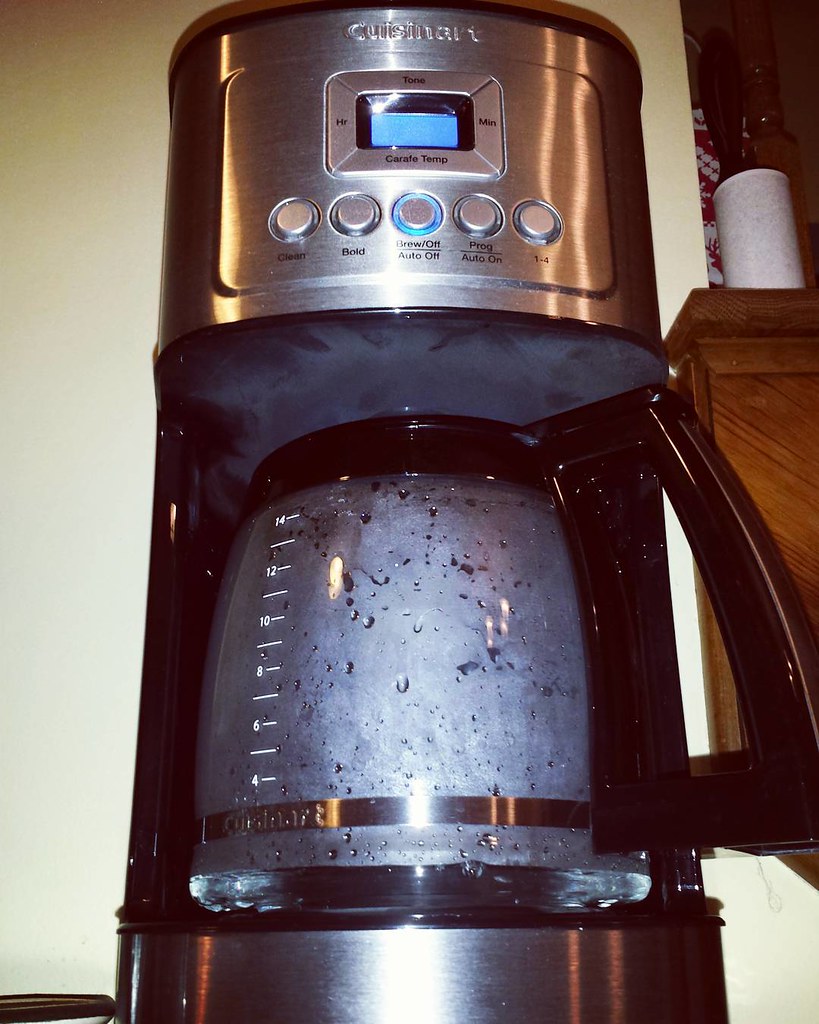
Now, I personally don’t drink a lot of coffee from this machine (it’s the source of The Wife’s daily coffee), but it does make a nice cup. Ours is a Cuisinart with reusable gold mesh filter, a programmable timer, and several temperature settings. Lots of coffee partisans look down on the drip machine, but I honestly think they do just fine for day-to-day coffee.
Pourover
This is the method I use most frequently for my own personal daily coffee. I have two devices for the pourover method: a small brew basket for single cup brewing, and a larger pot for if I need more than a single cup at once. I’ll brew the coffee into the big pot and then pour it into a thermal carafe for hotkeeping. (If ‘safekeeping’ is a word, why not ‘hotkeeping’? Anyway….) This is all very simple. You put a filter in place, measure in your ground coffee, and then you pour boiling water over the grounds. It’s basically the drip machine method, but executed manually. It also works better than most drip machines because you get to properly control the water temperature; many drip machines just don’t get the water hot enough.
If you’ve heard of a “Chemex pot”, my larger pot is pretty much that, only it’s not the Chemex brand. You don’t need to pay a lot for a specific brand name all the time!
French Press
I don’t use this as often, but it makes delicious coffee with quite a different mouthfeel than the pourover. French press coffee isn’t filtered, so a lot more of the oils from the bean end up in the final product, and all that direct contact between the water and the grounds makes for a stronger flavored brew. I own two French presses, one for whole pots and one for individual servings. Admittedly, I don’t use the smaller one very often at all, but I love the larger one. (And that reminds me: as I write this I need to clean my French press, since I used it yesterday morning and didn’t get around to cleaning it! The biggest drawback of the French press is likely that it’s harder to clean than the other methods here.)
Moka pot
And then there’s this gadget, which uses steam pressure to make very concentrated, strong coffee that’s quite similar to espresso in flavor. In fact, some folks refer to this pot as a “stovetop espresso maker”, which some other folks claim is inaccurate because of some stuff involving the proper levels of pressure under which the steam is forced through the coffee. I had to do a bit of research before I used this pot (how-to videos on YouTube are great!), and it’s not hard at all! The most counterintuitive thing about the Moka pot is that you don’t want to put cold water in the boiling chamber; the time it takes to heat the water to boiling ends up heating the grounds, which can make your brew taste burnt. You’re actually instructed to boil the water first in a kettle before adding it to the boiling chamber, and then you put the whole kaboodle on the burner! It’s neat the watch the coffee bubble up and out of the little tower in the pouring chamber, and I quite like the resulting coffee. (And I do get lazy on the whole ‘boiling the water first’ thing, sometimes using hot water from the tap.)
I only use the Moka pot for an afternoon cup of coffee during the cooler months. It doesn’t make a big enough cup for “morning coffee”, at least not for me. But it delivers a nice strong cup of espresso-style coffee!
So that’s all I have right now for hot coffee-brewing methods. I do have a countertop espresso brewer someplace, but it’s in the garage as it never really made it to my normal-use coffee rotation. I’m also intrigued by a gadget called the “Aero Press”, and there’s a thing called “Vietnamese coffee” that also intrigues (from what I understand, it’s basically a drip filter of a special make). I wouldn’t mind trying these, but space for kitchen gadgets is a concern, as is expense. (Not that these things are super expensive, but my desire to try each of these has not yet overridden my “Do I really wanna spend $20 or $30 on another coffee method just now?” thinking.)
I have, to my knowledge, never tried coffee brewed in a percolator. And honestly, from what I’ve read, I don’t particularly plan to. I’m told that you can make good coffee in one, but honestly–I have all these other ways of making good coffee.
“But wait! What about cold brew coffee?“
I’m glad you asked!
I do like cold-brew coffee, which I keep on hand during the warmer months so I can enjoy a cold coffee beverage on occasion. I used to make my cold-brew in a large glass carafe that I have and use for several applications, because it’s really easy. You don’t need a special contraption for making cold-brew coffee; you just need a vessel for ground coffee and enough water for brewing (recipes containing amounts abound online). The issue that I ran into was draining and filtering the coffee out: this can become a pain that takes a long time, as you run the coffee through a strainer or a coffee filter. I’m not sure if it’s a temperature thing or some other factor, but cold-brew coffee does not filter out nearly as quickly as hot coffee will.
So, I bought a cold-brew coffee pot. It’s a simple concept, really: it’s just a glass carafe with a lid, but there’s also a wire-mesh basket that goes inside. You fill the basket with your coffee, put that in the carafe, and then pour in enough water to cover. You do this slowly, giving the coffee basket a quick spin a few times to make sure the water saturates the grounds, and then you just let it sit on the counter for 18-24 hours. (I always go 24.) Then you just lift out the mesh strainer-basket and hold it up to drip out for a minute or two, and what’s left in the carafe is your cold-brew coffee concentrate.
I like to mix this stuff with milk and maybe a bit of chocolate syrup. Sometimes I also shake in one scoop of protein powder, but not always.
And finally, a shout-out to the unsung hero of all this: my electric kettle, which I use for boiling water quickly. Stove-top kettles used to be my jam, but not anymore. I am all about the speed and ease of the electric kettle, which makes my coffee and tea adventures an absolute breeze. I used to use a stove-top kettle for boiling water, but it takes way longer than an electric one to get the water to a boil.
So there it is: Coffee at Casa Jaquandor! Note that I do not own a Keurig machine, and nor do I have any intentions of owning one of those. They seem like a wasteful pain to me, a unitasker that just takes up a constant supply of counter space and involves waste in the form of all those little cups. Also, as brewing is cooking, I prefer to have as much control over things as I can.
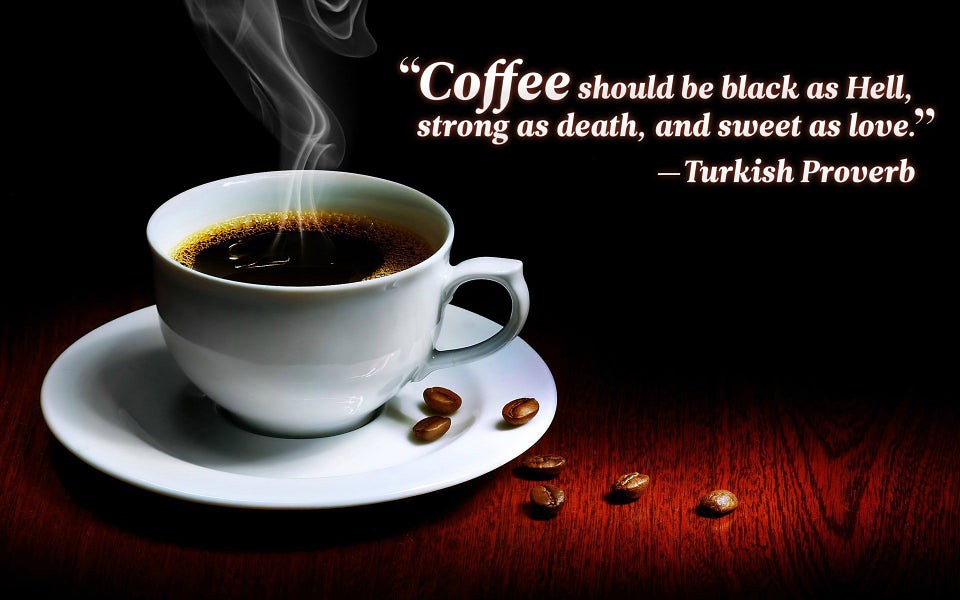
So that’s how I make my coffee. How do I take it? Most of the time, with cream (half-and-half, really) or black. While I used to put quite a bit of sugar into my coffee, I no longer use any sweetener at all. Coffee is one of the few areas of my culinary life where I’ve pretty much conquered my sweet tooth.
Now…what about mugs? And what about the other great hot beverage, tea?
I thought about writing a long remembrance of that horrible day, a walk-through of the weird mix of terror and business-as-usual that played out in the office where I was working at the time. I just…don’t want to do that.
I remember that for several days after I tried listening to music, and I just…couldn’t. It took, I think, until Friday when I was finally ready to listen to something. I chose one of the most emotional pieces of music I know, a work I played in my freshman year of college. It seemed, in terms of mood and title, appropriate: Elegy, by composer Mark Camphouse.
It was the saddest day I can remember as an American, and it’s even sadder now in retrospect as we went forth from that day and proceeded to learn all the wrong lessons and undertake all the wrong responses.
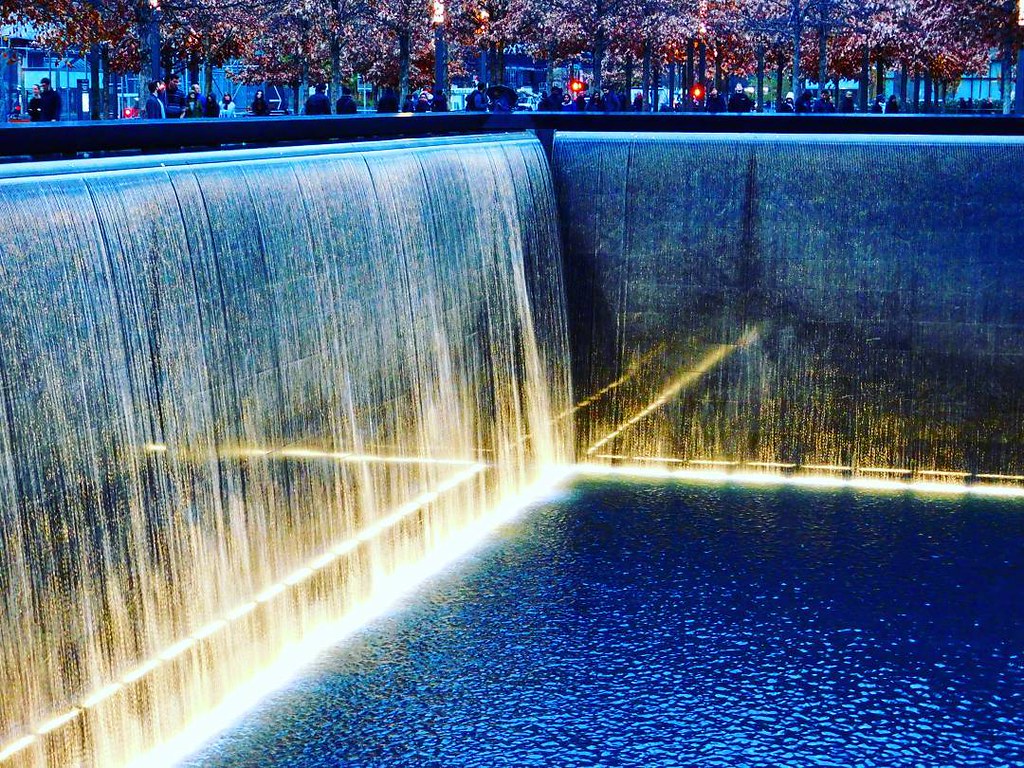
We went to New York City in 2015 for Thanksgiving, and we did go to “Ground Zero”. We weren’t there long, but we did want to see the place where this thing happened. It was a damp, cloudy, cold day…and for the location, somehow very beautiful.
There is always beauty to be found, eventually. I wish America would remember that more. Americans, myself included, are too quick to respond with anger and rage to the ugliness of the world.
Anyway, as part of my mood-listening for writing of late, I’ve been listening to music from Star Trek. Here’s a selection from James Horner’s score to Star Trek III: The Search For Spock.
In honor of Labor Day, and therefore of the labor movement and the fact that the single biggest contributor to the America that exists is the American worker, here’s a piece that pays tribute to one of the fruits of all that labor: the automobile.
Frederick Shepherd Converse was an American composer who lived from 1871 to 1940, spanning the shift from Romanticism to Modernism. As such, he is known for a handful of works, the best known is the tone poem The Mystic Trumpeter.
The piece before us today is Converse’s tone poem Flivver Ten Million. The word “flivver” was a slang term for Ford automobiles back in the days of the Model T and shortly afterward, and Converse gave his piece the subtitle A Joyous Epic Inspired by the Familiar Legend “The Ten Millionth Ford is Now Serving Its Owner. Quite a long title for such a short work (it’s only twelve minutes!), but there it is. The work does seem redolent of the enthusiasm of 1930s America for the coming of the automobile, and as we all know, the shift to being an automobile culture shifted America in ways that we are still grappling with to this day.
Even though the work is a single movement, Converse divided Flivver Ten Million into sections:
1. Dawn in Detroit (sunrise over the city)
2. The Call to Labor (the auto workers report to work)
3. The Din of the Builders (factory workers)
4. The Birth of the Hero – He Tries His Metal (the car wanders off into the great world in
search of an adventure)
5. May Night by the Roadside – America’s Romance (love music via solo violin)
6. The Joy Rider’s – America’s Frolic (happy have a great time music)
7. The Collision – America’s Tragedy (poignant, sad intonations)
8. Phoenix Americans – The hero, righted and shaken, proceeds on his way with
redoubled energy, typical of the indomitable spirit of America (great fun)
As an added bonus of civic pride, this performance is a recording of the Buffalo Philharmonic, conducted by JoAnn Falletta. Here is Flivver Ten Million by Frederick Shepherd Converse.