Erie County’s Chestnut Ridge park is one of my favorite places and has been for years. This park, larger than New York City’s Central Park, is set on the side of one of the higher hills to the south of Buffalo, and it is dominated by streams and gorges and beautiful meadows and one large hill that’s the regions preeminent spot for sledding when there’s snow…and there are even a few waterfalls.
One such waterfall is particularly beloved, not just because it’s beautiful in itself, but because there’s a hollow spot worn into the shale bed over which it drops, and from this hollow spot leaks a small flow of natural gas. This gas burns with beautiful golden light that prances and dances behind the flow of the water. (Sometimes it goes out, but it easily re-lit.)
The approach to the Eternal Flame Falls is not super-easy, but it’s not super-difficult either–and it’s better now that the deep descent into the gorge has been tempered by the addition of stairs. It used to be that you had to descend sharply down the wall of the gorge (I’m not sure of the height of the descent, but I think it’s at least a hundred feet at that point) by a root-covered trail, but now you descend the stairs. The walk along the gorge floor is still occasionally tricky, at times even requiring one to step in the stream (albeit in a spot where the depth is very manageable), but it’s absolutely worth it as one finally comes around the last bend and stands before the waterfall.
Along the way there is another waterfall in the side of the gorge, but this isn’t the one we’re here to see:
But finally, there it is:
As luck had it, when I arrived at the Eternal Flame Falls, I was alone there. For a full ten minutes, maybe fifteen, I was entirely alone: just me and the sound of the water tumbling down that shale wall, with the golden light magically flickering there. I don’t know if that’s because the weather was cold, or if it’s deep enough into fall that such outings aren’t as popular as in summer, or…well, who knows. I was alone.
The one other time I’ve gone to the Flame, I had Cane with me, and it was a warm summer day, so there were lots of people there. In fact, Cane and I arrived just as guy was proposing to his girlfriend. (She said yes.) There was a feeling that day of “Get up there and take your picture of the Flame because it’s someone else’s turn in a minute” that I managed to completely avoid yesterday. In fact, no one else came until I was already making my exit. I took my time with my camera, composing my shots and deciding what angles to take. I got some closeups of the grotto with the Flame in it, and I took some wider shots of the entire cataract, also using shutter-priority to get the soft-flow look that is so popular with water photography.
One area of photography I need to work on–well, I need to work on all of them, but especially this one–is low-light photography. I’ve done some experimenting here and there, and my results haven’t been super-encouraging yet, at least, not until the other night, when I got several shots that were workable. Not really good, but workable. We went to dinner at Lago 210, a restaurant that is right on the Lake Erie shore in Hamburg. The views there are pretty special, but when we got there it was after 7pm, and this time of year that’s well after sunset. Visibility was surprisingly clear, given how crappy the weather lately has been around here, and I could see clearly all the way to the city of Buffalo and I could even make out the lights of the Peace Bridge crossing the water. There were blinking lights of beacons out beyond the water, either on land in Canada or perhaps on buoys out there…I’m not really sure.
One of my main problems with low-light photography will be suppressing my point-and-shoot, get-it-quick instinct. This is something I’m working on anyway, the fact that I need to stop for a moment and compose my shots, but low-light makes it even harder because then I also need to adjust settings and study what I’m doing, and this is all while I’m still…well, I’m still not quite sure how the settings work and how to set up the Exposure Triangle to get a good night-time low-light shot. Also, I need to get more accustomed to using a tripod when doing low-light work, because the long shutter speeds make stability essential.
These first two are looking north-east toward Buffalo, which from Lago 210 is about 9 miles, give or take. Both of these I took right around the same time, so obviously my settings were very different!
I’m not in love with either of these, but I’ll figure it out. Another factor is my zoom lens, which is harder to manage in terms of settings during zooms. This may be a limitation of my particular camera, being a fixed-lens bridge camera, albeit a very good one. We’ll see, as I move forward. I’m determined, y’all!
Then there was this, which was the first photo I took when we got there, looking out into Lake Erie toward Cleveland, about 180 miles thataway. I’m quite happy with how this turned out, even if there’s still more noise than I would like.
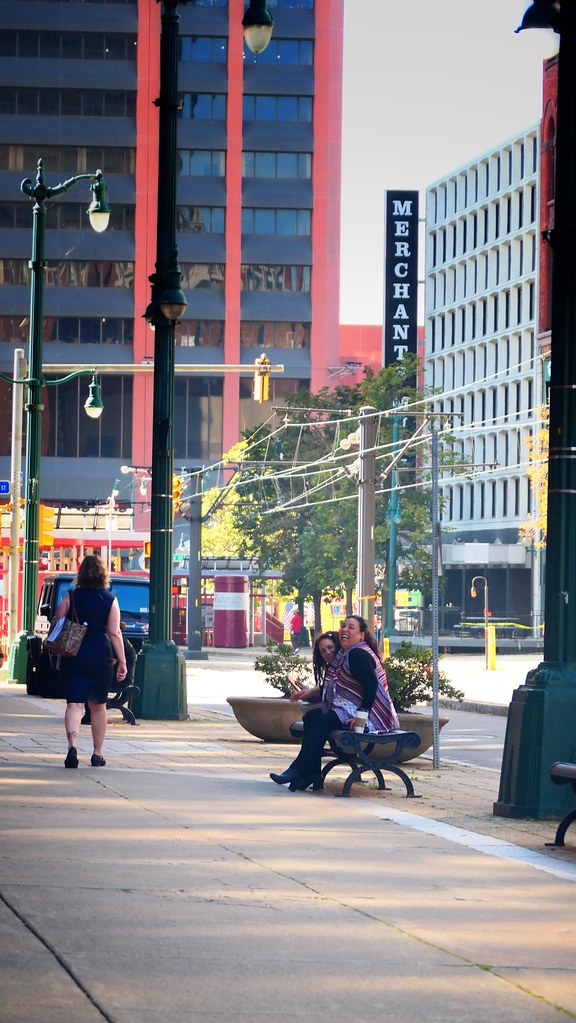
From a walk I took last week, going from Buffalo’s Old First Ward to downtown and back. My original plan was to accompany The Wife into downtown for one of her days working at the office; I was going to spend the entire day walking Buffalo, taking photos–doing street photography, basically–and then going to the Central Branch of the Erie County Public Library for an afternoon of reading and writing. Alas, Hobbes’s leg injury put that plan on ice for that day, but I still got downtown for half the day the next day. The day was hot and very bright–not the best lighting conditions, really–but I got some photos that I like a great deal. Buffalo is a fascinating place.
I’m finding myself more and more interested in street photography, or “streetscape”, as I prefer to call it. Here are a few examples from a walk I took last week around the village of East Aurora.
I do hope someone knows how that last one turned out. I have, ahem, a certain degree of sympathy to people who use the reader boards of public businesses for proposals.
On Labor Day, The Wife and I went down to Canalside in downtown Buffalo to hang out a bit, and afterwards we stopped at Wilkeson Pointe on the Outer Harbor. We hadn’t planned on the second stop, but we wanted to see more closely the big kites that were flying there. They were like giant airborne cephalopods, brightly colored and vibrant.
Yesterday’s photography location was Hunter’s Creek Park. Officially named “Sergeant Mark A. Rademacher Memorial Park”, the location is more generally referred to by its original, and now informal, name, which comes from the creek that runs through it. Hunter’s Creek Park is one of the most rugged parks in the Erie County Park System, with its most dominant feature being the gorge through which Hunter’s Creek runs. This being the case, the park is a “conservation” park, which means that aside from the two small gravel parking lots at either end (the park roughly runs north-south), there are no facilities at all. No shelters, no rest-rooms, nothing. Just trails, some of which are very popular with mountain bikers. The larger Conservation Trail, which is a part of the even larger Finger Lakes Trail System, partially runs through Hunter’s Creek Park.
Here are a few of the photos I took yesterday. More in this Flickr album.
As soon as you enter the trail you’re enclosed by vegetation that feels like a tunnel. It’s an amazing feeling: there’s no transition at all. One step down the trailhead and BAM, you’re in the wilderness.
The gorge’s walls are loaded with temporary waterfalls like this. I imagine this only runs in spring, with snowmelt, or for a few hours after a heavy summer rain. There are also many gullies for feeder-streams, just all of which are as dry as this, which run into Hunter’s Creek. You have to be careful when hiking here. Steep drops abound.
A study in shadows. I like this shot a lot. I thought about flicking that dead leaf aside, but I chose not to. I’m generally averse to modifying the scene that nature provides for me.This is new since I was last here, a few years ago! That’s a launch platform for mountain bikers. You can see the steep drop to the right, and at the bottom of that someone made a ramp to jump over a big log, and farther on a smaller ramp for another jump. I actually set up at the bottom, shifting my camera to Shutter Priority mode and dialing up the ISO so I could attempt a biker-in-midair shot if an opportunity presented itself, but no bikers came along in the few minutes I waited. Alas! Maybe next time.
I love how this turned out. Ditto the previous shot. It only took me a few months of owning this camera to learn that it has a Macro Focus setting for close-ups of small objects like this!
This is not a pose! I’m actually taking the preceding shot here. I just decided that, needing a self-portrait here, I should set up my phone to take my picture while I took the intended picture with the main camera. Two birds, one stone, you know the drill!
Even though it’s now September and everyone is mentally filing away Summer 2023 into the memory bank–and in a way they’re right, as “Meteorological Fall” has already begun–the summer isn’t showing signs of giving up just yet, as The 716 is in for a stiff dose of very hot weather this week, and yesterday was pretty warm for hiking purposes. If I wasn’t carrying along my good camera I might well have dipped myself in one of the creek’s deeper pools! I’m better at managing high heat than I used to be, but I’m unlikely to ever really love the heat, and I welcome the return of the cooler temps we enjoyed last week. Fall will come, after all, and I tend to file “Temps above 80 after Labor Day” along with “Snow after St. Patrick’s Day” in my head: even though they happen every year, I find them annoying.
But photography is about the light, after all, and the light is most definitely taking on a more autumnal feel now. It won’t be long before the trees do, as well.
My Sunday Photography Walk was at Buffalo’s Outer Harbor again, with a side-trek into the Tifft Nature Preserve. Photos here…but these are my favorites from the day’s work:
This next is my favorite photo from yesterday. This makes me think that maybe my time practicing photography is not actually time wasted!
I’m going to have to be more selective of which overalls I wear on these outings. I’ll be designating a few pairs specifically for photography, because I find myself going down on one knee a lot, and I don’t want to damage the knees of my favorite vintage pairs, like this pair of Dickies.
Heavens, I think I may be actually getting better at this photography thing! I know it’s only been a short while with this camera, but I’m getting to the point already where carrying this camera around feels natural. Looking around feels natural. Thinking in terms of, “How can I capture this? What’s a neat way of looking at it?” is becoming natural.
Or…at least more natural than it used to feel.
This past Sunday morning I ventured up to Chestnut Ridge for the second time in three weeks. (Titling this post “The Ridge, again” might be a bit confusing, since I didn’t post my thoughts on the photos I took that day yet!) What’s nice about Chestnut Ridge, which is by area larger than Central Park in Manhattan, is that you can go multiple times and not visit the same areas. This time I walked along a different stream, one that has a spot where it tumbles down probably twenty feet or so of incline over a few hundred feet laterally, making for a series of neat-looking miniature waterfalls. This is a spot that ends in a large pool about four-feet deep. Farther upstream the bed is lined by large moss-covered boulders. Here are some of the photos I took that day; more are in a Flickr album, here.
Meantime, here are some of the shots I took the other day. I like how many of these turned out.
Pump House, and Pump House Roof Detail.
I love how these old pump-houses are left to slowly crumble in the forests of Chestnut Ridge. The overgrowth around them and the moss on them really make them feel like something out of the backgrounds in a Hayao Miyazaki movie.
Stair-stepping Stream, the colors of the pool, and life in and atop.
Note to self: Visit this spot in late Spring or early Summer next year, when there is more water flowing. Still, this is a nice bit of flow; I’ve seen it in August with half as much water.The reflected colors of the sunlit forest on the surface, plus the colors of the bottom below, make this almost like an Impressionist painting.Note the fish! and the sunken leaf…and the bubble floating….I’m thrilled I got this as sharply as I did! You can’t really see the water-striders all that well, but they’re not actually my subject here: the shadows on the bottom of their footprints ON the water are.
One thing about deciding to take photography seriously at this point, after years of snapshotting, is that I already have a pretty good sense of what my usual subjects will be and what styles of photography I will gravitate toward. In this case: when I’m around water, I almost get twitchy if I can’t take a photo somehow. Lakes, rivers, streams, cataracts, pools, puddles, the sea: it’s all fascinating to me.
Rushing water: using shutter priority.
These next three photos involve ongoing experiments with Shutter-priority mode. Managing shutter speed is another way of regulating light that reaches the camera sensor, and shutter speed in particular affects how motion is captured. A very fast shutter speed freezes action, while a slower shutter speed allows for blurring of the action. In the case of flowing water, a slower shutter speed turns the same rush of water over some rocks into something gossamer-like, looking like a veil of water rather than a distinct flow. You can see the difference in the next two, taken of the same spot but with different shutter speeds:
This one, I did not get a comparison shot; I just really like how this turned out. Could it be sharper? Sure, as I was free-handing the shot at this point. When shooting with slower shutter speeds, vibrations of the camera itself actually show up in the image as blur, which is why tripods and timers and remotes are tools that help with this sort of photography.
I’m not sure what this rising steam was! Another hiker had passed through just a few seconds before I saw this mist, and I wondered if he had dropped a cigarette there, but I checked and no, he did not. So I suppose this is the mist of water rising from a dead and fallen tree trunk. Getting this was pure luck.
Mossy rocks and the stream. I think, if I were to do this one again, I’d shoot lower–maybe even set up a tripod in the water–so the framing of the shot would eliminate the fallen tree. Fallen trees are a major feature at Chestnut Ridge. They are always in evidence.
Buffalo-Niagara from the Chestnut Ridge Hill
This is one of this region’s best views. From the sledding hill facing north, you can see Buffalo (at right) and, at left in the distance, Niagara Falls, ON. In these two photos you can see two different approaches to editing: the first dials back the saturation while increasing the shadows and highlights, making the area of sunlight in the foreground pop a bit. The second photo is not zoomed at all, showing pretty much the entirety of the view from the Ridge. This one I brightened and dialed the saturation up, quite a bit more than I usually do, even.
By the way, that’s only 13 of the 30 shots that are in the Flickr album linked above…and the Flickr album only contains 30 of the more than 80 photos I took that day! I used to think it was all a matter of composing your perfect shot and then taking it, so you only end up with those perfect shots. It turns out that photographers take many, many more shots than they ever end up using…and that’s OK. It just means I didn’t understand that part of the process. Now, I’m on board.
Some shots from my photography session down at the Buffalo Outer Harbor this past Sunday:
I like how this one captures land and sea (lake, I should say) disappearing at the same vanishing point. The bird in flight was a happy unplanned element.Here we see the jetskiers three! I like how their knees and the green trim of their Jetski form arrows pointing in the direction they’re going. I also wanted the lighthouse and the towers for the wind turbines in here as well. Again, the bird–flying low, the opposite direction–is a happy unplanned element.Grain elevators. The dinosaurs, as it were, of the Great Lakes’ industrial past. I love these hulking old buildings.
More photos from that day, with full-size versions, in this Flickr album.
By the way, I think I am now going to start using HUE as an acronym: Happy Unplanned Element. I think Bob Ross (“There are no mistakes, just happy accidents”) would approve. “Accident” still sounds overly negative in my ears, though. So, a HUE is an element in my photo that I didn’t plan on capturing, either because I didn’t know it was there or because I couldn’t avoid capturing it.